
If you’re researching liquid facelift Turkey options, you’re likely looking for a credible, lower-downtime way to refresh your face—without committing to a full surgical facelift yet. A “liquid facelift” is not one single procedure; it’s a strategy that combines carefully selected injectables (most commonly dermal fillers and neurotoxins like Botox) to restore volume, soften lines, and improve facial proportions.
In this guide, we’ll explain what a liquid facelift in Turkey can realistically achieve, where it works best, and where its limits begin—using an evidence-based lens grounded in clinical literature and practical clinical decision-making. We’ll also touch on safety questions, “overfilled” risks, and how to evaluate results such as liquid facelift before after Turkey galleries with an expert eye.
Key takeaway: A Turkey liquid facelift can create a refreshed, rested look—especially in early-to-moderate aging—by restoring volume and rebalancing facial harmony. But it does not “lift” heavy jowls or significant neck laxity the way surgery can.
Table of Contents
What Is a Liquid Facelift?
A liquid facelift uses injectable treatments to mimic some of the benefits people want from a facelift—such as a smoother, more contoured, more youthful appearance—without surgical incisions. While the phrase is popular online, the best outcomes come from an individualized plan, not a one-size-fits-all injection map.
“Liquid Facelift” sits inside a broader spectrum of facial-rejuvenation options — not as a competitor to surgical facelifting, but as a parallel pathway with different mechanical capabilities, different durability profiles, and different patient candidacy. Understanding which pathway fits requires understanding what surgical facelifts actually accomplish first.
For the surgical-side context that liquid-facelift conversations should be calibrated against, the facelift surgery options overview covers the spectrum from mini and SMAS techniques through deep-plane lifting, the candidacy frameworks for each technique, the recovery and longevity profiles, and the decision architecture that determines whether a patient is in “volume restoration” territory or “tissue repositioning” territory.
The honest comparison isn’t “liquid vs. surgery” as competitors. It’s understanding which physical change each pathway actually produces, and which pathway your specific anatomy needs.

Strategic Use of Dermal Fillers and Neurotoxins
Dermal fillers and neurotoxins sit inside a broader category of “non-surgical facial rejuvenation” that has been expanding faster than most patient-facing summaries reflect. Regenerative approaches (stem cell, PRP, growth factor protocols) sit adjacent to filler-based volume restoration — and the distinction matters for patients trying to evaluate the full non-surgical landscape, not just one slice of it.
For one of the adjacent comparisons, the stem cell facelift comparison framework covers regenerative biology principles, the difference between stem cell-enriched fat grafting and conventional fat transfer, the longevity comparisons against both fillers and traditional surgical facelifts, and the candidacy criteria that distinguish patients well-suited to regenerative approaches from patients better served by volume-only or surgical pathways.
Liquid facelifts are one option in a category. The broader category includes regenerative approaches that some patients should evaluate alongside conventional filler protocols.
Most liquid facelift plans combine:
- Dermal fillers (often hyaluronic acid-based) to restore volume in areas like the temples, cheeks, and under-eyes.
- Neurotoxins (e.g., Botox-type treatments) to soften dynamic lines and reduce muscle pull that deepens wrinkles (forehead, glabella, crow’s feet) or contributes to downward tension in certain facial patterns.
From a “why this works” standpoint, the approach aligns with how facial aging typically happens: volume loss, changes in fat compartments, ligament laxity, and skin quality shifts. In other words, it’s not only about wrinkles—it’s about structure. That’s why a thoughtful injector will often treat the face as a whole rather than “chasing lines.” This principle is consistently supported across peer-reviewed evidence reports on facial anatomy, aging, and injectable technique.
| Treatment | Main Goal | Best For | Typical Timing |
|---|---|---|---|
| Dermal Filler | Restore volume / improve contours | Temples, midface, tear trough (selected cases), jawline (selected cases) | Immediate results; settles over days–weeks |
| Neurotoxin | Relax targeted muscles | Forehead lines, frown lines, crow’s feet; selected “lift-like” patterns | Results build in ~3–14 days |
What a Liquid Facelift Can and Cannot Do (Honest Results)
A liquid facelift can be excellent for:
- Early volume loss (flattening cheeks, hollow temples, mild under-eye shadowing)
- Softening expression lines and refreshing the upper face
- Subtle contour improvements when anatomy is favorable
However, it has clear limitations. It cannot reliably:
- Lift significant jowls or heavy lower-face descent
- Tighten a lax neck in a surgical sense
- Replace structural repositioning achieved by facelift techniques
This is the point where patients often start comparing liquid facelift surgery Turkey terms online. Strictly speaking, there is no “liquid facelift surgery”—it’s either non-surgical injections or a surgical facelift. Still, people use the phrase when they’re weighing injectable options against surgical lifting.
Safety Basics: Anatomy, Product Choice, and Injector Expertise
“Injector expertise” is the variable that produces the widest outcome variation in liquid facelift practice — wider than product choice, anatomical zone, or technique selection. The same syringe of HA filler produces meaningfully different results in different hands, and the difference traces back to anatomical training depth, complication-management experience, and the practitioner’s vascular-anatomy fluency.
For the credentials picture specifically relevant to filler and neurotoxin work, Dr. Akif’s dermatosurgeon injection profile covers the dermatosurgery training fellowship that shapes filler protocol design, the vascular-anatomy depth that informs cannula-versus-needle decisions, complication-management experience including hyaluronidase deployment protocols, and the surgeon-led injection model that distinguishes physician-conducted liquid facelifts from coordinator-led injection-room practice.
The product matters. The technique matters more. The injector’s training depth matters most.
Safety is the number-one priority, especially for the informed patient who wants to minimize complications. Key safety pillars include:
- Deep anatomical knowledge (critical in high-risk vascular zones such as the nose, glabella, and certain under-eye planes)
- Appropriate product selection (different rheology/firmness for different areas)
- Technique decisions (needle vs cannula, depth, volume per pass, aspiration practices where relevant)
- Emergency readiness (clear protocols and access to reversal tools like hyaluronidase for HA fillers)
If you’re considering facial fillers Turkey or non-surgical face rejuvenation Istanbul, you should also ask how complications are recognized and managed, not just how treatments are marketed. A safe clinic welcomes these questions and answers them transparently.
Target Areas: Temples, Cheeks, Jawline, and Under-Eyes
The effectiveness of a liquid facelift depends heavily on where treatment is placed and why. The goal is not to “fill everything,” but to restore youthful balance—often by addressing a few strategic zones that influence how light hits the face and how contours read at conversational distance.
Temples & Midface: Restoring Lost Volume Without Widening the Face
Temple and midface volume restoration via filler is one approach to lost volume; autologous fat transfer (lipofilling) is another. Both add volume to the same anatomical zones, but with different durability profiles, different recovery sequences, and different cost structures over time.
For the autologous alternative that liquid-facelift candidates should at least be aware of, the autologous fat transfer alternative covers harvesting and processing protocols, the longevity profile (typically permanent for the surviving fat fraction versus 9-18 months for HA filler), the candidacy criteria for fat transfer versus filler, the downtime difference (5-10 days versus same-day for filler), and the cost framework over 5 years that determines whether one-time fat transfer or serial filler treatment makes more sense for a specific patient profile.
Filler is the easier choice operationally. Fat transfer is sometimes the better choice economically across longer time horizons.
Temple hollowing and midface flattening can make the face look tired or “drawn.” Carefully placed filler can restore smoother transitions from forehead to cheek and improve midface support. The risk, however, is overcorrection—creating an unnaturally wide or heavy appearance. A conservative plan typically focuses on subtle structural support rather than surface puffiness.
Jawline & Chin: Subtle Contour vs True Neck/Jowl Lifting
Jawline and chin enhancements can sharpen the lower face, especially when there’s mild sagging or naturally soft definition. But it’s important to understand the boundary between “contouring” and “lifting.” Fillers can refine shape; they cannot reposition significantly descended tissue. This distinction matters when comparing filler vs facelift surgery Turkey searches—surgery changes position; fillers change contour and support.
Under-Eyes (Tear Trough): When Filler Helps—and When It Backfires
The under-eye area is one of the most requested—and most delicate—zones. In selected patients, tear trough filler can reduce shadowing and improve a fatigued look. In the wrong candidate (thin skin, prominent swelling tendency, certain anatomical patterns), it can backfire with persistent puffiness, Tyndall effect (bluish hue), or unnatural texture. This is why “before-after” assessment for liquid facelift before after Turkey should include lighting, angle, and time since treatment—not just the immediate post-injection photo.
“Full-Face” Planning: Why Isolated Injections Can Look Unbalanced
A common reason for unnatural outcomes is treating one feature without considering the entire facial framework. For example, adding volume to the cheeks without assessing temples, under-eyes, or chin projection can produce imbalance. A full-face approach aims for proportion, symmetry, and natural expression—especially important for patients who want to look refreshed, not “done.”
Liquid vs. Surgical Facelift: Managing Expectations
This is the decision point for many patients searching “Turkey liquid facelift” or even the confusing phrase “liquid facelift surgery Turkey.” A liquid facelift is not surgery—it’s a non-surgical plan using injectables. A surgical facelift is a true lifting procedure that repositions tissues. The right choice depends on what’s actually changing in your face: volume loss, skin quality, or tissue descent (sagging).
Volume vs. Lifting: Knowing the Limit
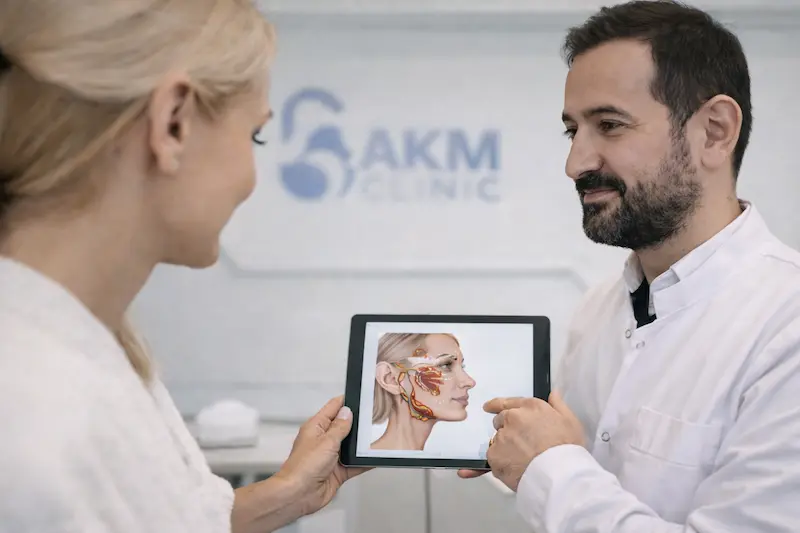
“Volume vs. Lifting” isn’t a marketing distinction — it’s an anatomical reality. Filler-based approaches add subcutaneous volume; surgical facelifts reposition deeper soft-tissue layers (SMAS, deep-plane) that fillers cannot mechanically reach. Patients who need lifting and try to substitute volume usually end up overfilled, not lifted.
For the surgical-lifting endpoint specifically, the deep plane facelift technique overview covers what surgical repositioning actually mobilizes, the longevity profile (8-12+ years versus 9-18 months for fillers), the candidacy criteria for deep-plane lifting versus less invasive techniques, and the patient profiles where deep-plane lifting is the right endpoint rather than serial filler treatments.
Liquid facelifts make sense for early-aging volume restoration. Deep-plane facelifts make sense for established structural ptosis. Confusing the two is the most expensive mistake non-surgical patients make.
In practical, anatomy-based terms:
- Fillers primarily address volume loss and can create the impression of lift in early aging by restoring support.
- Surgical facelifts address tissue descent—repositioning the deeper structures and removing/re-draping excess skin.
This is why “filler vs facelift surgery Turkey” is the most important comparison to get right. If your main issue is early hollowing and subtle contour changes, a liquid approach may be reasonable. If your main issue is heavier jowls, deep lower-face folds from descent, or neck laxity, surgery typically provides a more structural solution.
Reality check: If you need true lifting, adding more filler to “push” tissues upward can increase heaviness and risk an overfilled look—especially in the midface and lower face.
Best Candidate Profiles: Early Aging vs Advanced Sagging
Most satisfied results from a liquid facelift in Turkey come from patients who are:
- Experiencing mild-to-moderate volume loss (temples, cheeks, under-eye shadowing)
- Noticing early contour softening rather than significant “droop”
- Wanting subtle improvement and are comfortable with maintenance
Patients who may be better served by a surgical consult (even if they still choose non-surgical now) often have:
- Pronounced jowls or lower-face heaviness from tissue descent
- Neck laxity or banding that injectables cannot meaningfully correct
- Advanced skin laxity where volume replacement won’t address the main problem
For many, the most rational approach is a “bridge plan”: injections as a non-surgical face rejuvenation Istanbul strategy now, with a clear understanding of when surgery becomes the more efficient option.
Downtime, Risk, and Reversibility: Fillers vs Surgery
“Downtime fillers vs surgery” sometimes gets framed as binary — same-day filler return versus 2-3 week surgical recovery. The reality is more graded: certain surgical techniques performed under local anesthesia produce meaningfully shorter recovery profiles than the conventional “facelift recovery” framing suggests, and these sit between conventional facelifts and liquid facelifts on the intervention scale.
For one of the lower-downtime surgical pathways specifically, the awake facelift outcome documentation covers the local-anesthesia surgical approach, the recovery profile (typically 5-7 days versus 14-21 for general-anesthesia conventional facelifts), the candidacy criteria, and documented before-and-after outcomes that help calibrate what a “low-intervention surgical” result actually looks like — versus the “no-intervention filler” baseline most non-surgical patients compare against.
The “fillers vs surgery” binary obscures the middle ground. Awake facelift techniques sit in that middle ground and often deserve consideration alongside escalating filler protocols.
One reason patients consider facial fillers Turkey is the appeal of minimal downtime. But “less downtime” does not mean “no risk.” Both paths have different risk profiles.
| Factor | Liquid Facelift (Fillers/Toxins) | Surgical Facelift |
|---|---|---|
| Primary Effect | Volume restoration + line softening | Tissue repositioning (true lift) + skin redraping |
| Downtime | Often days (swelling/bruising varies) | Typically weeks (variable by technique and patient) |
| Reversibility | HA fillers can often be dissolved; toxins wear off | Not reversible in the same way |
| Key Risks | Vascular compromise (rare but serious), swelling, nodules, migration | Bleeding/hematoma, infection, nerve injury risk, scarring, anesthesia risks |
| Best For | Early aging, volume-driven changes, subtle refresh | Moderate-to-advanced sagging, jowls/neck laxity |
From an aesthetic medicine standpoint, safety in a liquid plan hinges on appropriate anatomy, conservative dosing, correct depth, and careful patient selection—especially in high-risk vascular territories. In surgery, safety hinges on surgeon expertise, patient health, operative planning, and aftercare protocols.
Natural Result Priorities: Avoiding “Done” or “Pulled” vs “Overfilled”
When people say they want a “natural” outcome, they usually mean:
- They still look like themselves
- They look rested and healthier, not dramatically different
- They don’t look tight, puffy, or distorted
A liquid facelift can look extremely natural when it respects facial architecture and uses conservative volumes. The most common “unnatural” injectable outcome is overfilling—especially when filler is used to compensate for laxity that really needs lifting. Conversely, the most common fear about surgery is looking “pulled.” Modern surgical techniques aim to avoid that, but the key is matching the technique to your anatomy and goals.
In short: the best “non-surgical alternative” is the one that matches your actual aging pattern—something careful clinical assessment (not marketing) should determine.
Liquid Facelift vs Thread Lift: Volume vs Lift
“Liquid facelift” and “thread lift” often get grouped together as “non-surgical alternatives” — but they accomplish meaningfully different physical changes, and the categorization obscures the choice more than it clarifies it.
The mechanistic difference: a liquid facelift adds volume in specific anatomical zones (temples, midface, jawline) via filler, with neurotoxins separately relaxing dynamic lines. A thread lift mechanically repositions sagging skin and subcutaneous tissue by passing barbed or smooth sutures under the skin and applying upward tension. Different mechanism, different candidacy, different durability, different complication profile.
For the complete mechanical-lift side, the thread lift mechanical lift framework covers PDO/PCL/PLLA thread types, candidacy criteria for mechanical lifting versus volume restoration, the durability profile (typically 12-18 months for thread-induced lift versus the longer collagen-stimulation effect), the complication patterns specific to thread procedures, and the decision framework for choosing between filler-based volume and thread-based mechanical lifting.
The right choice depends on whether the underlying problem is volume loss (filler) or mild ptosis (threads) — or sometimes both, in which case sequenced treatment makes more sense than either alone.
Longevity and Maintenance Costs
Cost is a major driver in searches like “liquid facelift cost Turkey” and “liquid facelift price Turkey.” But the most useful way to think about cost is not only the price of one session—it’s the total cost of maintenance over time, and what you’re trying to achieve (volume correction vs true lifting).
How Long Results Typically Last (Fillers vs Toxins, Area-by-Area)
“How long results last” is a question that the patient-facing summaries oversimplify. The published evidence on filler longevity has tightened in the past two years, especially for newer-generation HA formulations with amino-acid enrichment and modified cross-linking protocols.
For the quantitative-outcomes synthesis layer specifically, 2025 systematic review and meta-analysis of amino acid-enriched hyaluronic acid in facial rejuvenation across 11 studies with wrinkle severity reduction (Wiley / PRISMA-compliant analysis) — pooling outcomes across PubMed, EMBASE, Scopus, and Cochrane Library studies — reported a significant reduction in wrinkle severity following amino-acid-enriched HA treatment (Wrinkle Severity Rating Scale mean difference of 2.15, 95% confidence interval 2.00-2.30, p<0.0001), alongside documented improvements in skin thickness and epidermal growth factor-positive cell viability that conventional HA formulations did not produce.
The honest reading: not all HA fillers are equivalent. Product choice, formulation generation, and additive composition meaningfully affect both the magnitude and duration of the result — and the published evidence is now specific enough to inform that conversation rather than leaving it to marketing claims.
Longevity varies based on product type, injection depth, metabolism, and the area treated. In general:
- Neurotoxins often last a few months (variable by individual and dose).
- Dermal fillers can last longer, but duration depends heavily on the zone (high-movement areas often fade sooner).
Be cautious about overly precise promises. In real clinical practice, variability is normal—this is consistent with what you’ll see reported across aesthetic medicine on injectable longevity and patient-to-patient differences.
Total Cost Over 3–5 Years: Why “Non-Surgical” Can Add Up
Non-surgical does not automatically mean “cheaper long-term.” If you require multiple syringes per year plus ongoing toxin sessions, the cumulative spend can become significant. For some patients, a liquid plan is still the right choice because they value flexibility and minimal downtime. For others—especially those with true sagging—repeated filler sessions can become a costly way to chase a problem that fillers are not designed to solve.
5-Year Total Cost: Liquid Facelift vs One-Time Facelift Surgery
“Liquid facelift” sounds less expensive than “facelift surgery” — but the comparison usually deceives because patients compare a single liquid-facelift session ($3,000-$5,000 in major US markets) against a one-time surgical procedure ($15,000-$25,000). The honest comparison requires 5-year horizon math: how many liquid-facelift sessions, how much filler product, how many touch-ups, and what total cost emerges over the time-period a single deep-plane facelift would have lasted.
The 5-year math: serial liquid facelifts vs one-time deep plane surgery
A typical liquid facelift maintenance schedule looks like this: initial full session ($3,500-$5,000), 9-12 month follow-up touch-ups ($1,500-$2,500 each), annual neurotoxin maintenance ($600-$1,200 per year), and product upgrades as new formulations emerge. Across a 5-year horizon, a maintained liquid facelift program typically costs $14,000-$22,000 in major US markets — depending on areas treated, product selection, and maintenance discipline.
Deep plane facelift surgery has a different cost profile: one-time fee ($18,000-$28,000 in major US markets, $7,000-$12,000 at high-volume international centers like AKM Clinic in Istanbul), with no scheduled maintenance for 8-12+ years. Across the same 5-year horizon, the total cost is the procedure cost itself plus any optional skin-quality treatments — typically $0-$3,000 in additional spending.
| Cost Category | Liquid Facelift (5-Year) | Deep Plane Surgery (5-Year) |
|---|---|---|
| Initial cost | $3,500-$5,000 | $7,000-$28,000 (location-dependent) |
| Maintenance (Year 1-5) | $10,500-$17,000 | $0-$3,000 (optional) |
| 5-Year Total | $14,000-$22,000 | $7,000-$31,000 |
| Result longevity beyond Year 5 | Requires ongoing maintenance | 3-7+ more years before consideration of revision |
When 5-year math favors liquid facelift
Liquid facelift is cost-favorable when: (1) the patient is in early-aging territory (volume loss is the primary signal, lifting isn’t yet needed), (2) the maintenance commitment is 3 years or less before transitioning to surgery, (3) the patient genuinely values reversibility for medical or aesthetic reasons, and (4) major-market US pricing is the only available comparator.
When 5-year math favors one-time surgery
Deep plane surgery is cost-favorable when: (1) the patient has established structural ptosis (lifting is anatomically needed), (2) the long-term plan exceeds 5 years of expected aesthetic maintenance, (3) international surgical pricing is being considered (which significantly changes the comparison), and (4) the patient prefers a defined recovery window over indefinite maintenance scheduling.
The honest framing: liquid facelifts aren’t “cheap.” They’re “lower per-session cost with higher cumulative cost over time.” Whether that math favors liquid or surgical depends entirely on the patient’s anatomy, time horizon, and willingness to maintain.
Avoiding the “Overfilled” or “Pillow Face” Look
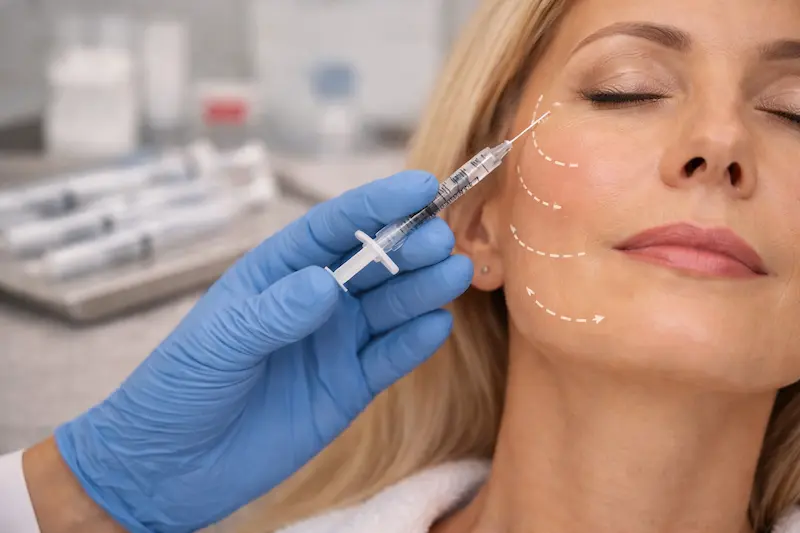
One of the biggest concerns for discerning patients considering a liquid facelift in Turkey is not pain or downtime—it’s the fear of looking puffy, unnatural, or “overdone.” The good news: “pillow face” is not an inevitable outcome. It’s usually the result of predictable planning errors: treating sagging with volume, using the wrong product in the wrong plane, or adding filler repeatedly without reassessing facial balance.
The Most Common Causes of “Pillow Face” (Dose, Placement, Product)
“Pillow face” typically happens when volume is used to compensate for laxity. Common triggers include:
- Too much total volume over time (especially in the midface)
- Superficial placement where filler becomes visible or distorts contours
- Wrong product choice (e.g., overly hydrophilic filler in areas prone to swelling)
- Chasing folds (like nasolabial lines) without correcting the upstream structural cause
- Ignoring facial proportions (e.g., cheeks enhanced while temples/chin support are not assessed)
Clinical principle: If a face looks heavier after a “lift,” the plan likely added volume where the patient needed repositioning (i.e., surgical lifting) rather than more filling.
Layering & Technique: Micro-placements, Cannula vs Needle, Conservative Plans
A natural-looking Turkey liquid facelift relies on technique as much as the product. In many cases, the safest and most aesthetic strategy is to start conservatively and build only if needed. Techniques that help reduce the risk of puffiness or distortion include:
- Micro-placements rather than large boluses
- Respecting anatomical planes (deep structural support vs superficial “puffing”)
- Cannula use in selected zones to reduce bruising and lower certain vascular risks (not a guarantee, but sometimes beneficial)
- Staged treatment: reassessing after swelling settles before adding more
This approach aligns with how many clinicians interpret outcomes in clinical evidence and real-world practice: subtle structural support tends to look more natural—and age better—than aggressive volumization.
Complication Awareness: Vascular Occlusion, Nodules, Migration—What Patients Should Ask
Even though serious complications are uncommon, informed patients should know what they are and how clinics handle them. If you’re exploring facial fillers Turkey options, ask how the team identifies and manages complications in real time.
| Potential Issue | What It Can Look/Feel Like | Why It Matters | What a Safe Clinic Should Have |
|---|---|---|---|
| Vascular compromise (rare but urgent) | Severe pain, blanching, mottled skin changes | Time-sensitive emergency | Clear emergency protocol; access to appropriate reversal/management tools |
| Nodules / lumps | Palpable bumps, uneven texture | May require follow-up management | Assessment plan; documented product choice; follow-up pathway |
| Migration | Fullness shifting beyond the treated area | Can distort facial proportions | Conservative dosing; correct placement; avoidance of unnecessary repeat filling |
| Persistent swelling (selected areas) | Long-lasting puffiness (often under-eye/midface) | May not settle as expected | Candidate screening; product selection tailored to swelling risk |
When reviewing liquid facelift before after Turkey photos, watch for the “too good, too fast” trap. Immediate post-treatment images can look impressive before swelling and lighting normalize. A credible result is typically evaluated after the settling period—especially for under-eyes and midface.
Reversal & Correction: Hyaluronidase, Dissolving Strategy, and When to Pause
One advantage of hyaluronic-acid fillers (commonly used in liquid facelift plans) is that they can often be dissolved if the result is not appropriate or if complications arise. But dissolving is not a casual “undo” button—it should be guided by proper assessment, with a plan for how correction affects facial balance afterward.
A cautious clinic will also know when to pause rather than keep adding. If your injector’s solution to every concern is “one more syringe,” that’s a warning sign—especially when the real issue is laxity that injectables cannot correct.
Combining Liquid Facelift with Microneedling/PRP: Synergy or Overkill?
Liquid-facelift-only protocols address volume and relaxation; they do not address skin-quality changes (texture, pore size, fine surface wrinkles, laxity at the dermal level). For patients with concurrent skin-quality concerns, layering microneedling/PRP or radiofrequency-microneedling treatments alongside a liquid facelift can deliver outcomes that filler alone cannot — when sequenced and dosed correctly.
The synergy logic: fillers restore volume in deep planes (subcutaneous and supraperiosteal); microneedling/PRP stimulates collagen at the dermal level; RF-microneedling tightens at deeper dermal-subcutaneous zones. Three different mechanisms, three different anatomical targets, three different problems — addressed in combination rather than serially.
The overkill risk: stacking too many treatments in too short a window produces inflammation that can mobilize fillers, distort early healing, and obscure which treatment is producing which result. The right sequencing typically separates filler placement and energy-based treatments by 2-4 weeks minimum.
For the skin-quality side of the equation specifically, the Morpheus8 RF microneedling framework covers what RF microneedling targets at the dermal and subdermal level, the candidacy criteria for combining RF microneedling with filler-based volume restoration, the sequencing protocols that prevent inflammation conflicts, and the realistic outcome expectations when energy-based skin tightening sits alongside (not as a substitute for) filler-based volume work.
Liquid facelift improves the volume conversation. Skin-quality treatments improve the surface conversation. The strongest non-surgical plans address both — sequenced, not stacked.
The multimodal sequencing question — when to combine fillers with energy-based skin-quality treatments — has been formally addressed in recent aesthetic-medicine literature. The synthesis evidence helps clarify which combinations are genuinely synergistic versus which produce diminishing returns or inflammation-related complications.
For one such synthesis layer, 2026 multimodal facial rejuvenation narrative review integrating HA fillers, collagen stimulators, botulinum toxin, and energy-based devices (Journal of Aesthetic Medicine, February 2026) — reviewing literature from 2000 through October 2024 across PubMed, Embase, and Web of Science — frames facial aging as a cascade across skeletal, ligamentous, muscular, dermal, and epidermal layers, and reports that monotherapy approaches are increasingly inadequate for contemporary patients seeking natural, harmonious, and durable outcomes; intelligently sequenced multimodal combinations (HA fillers for volumetric scaffolding, collagen stimulators for biostimulation, botulinum toxin for muscle relaxation, energy-based devices for skin quality) produce outcomes that single-modality protocols cannot replicate.
The takeaway for liquid-facelift patients: the strongest non-surgical results usually emerge from sequenced multimodal planning, not from filler-only protocols extended indefinitely.
Is a Liquid Facelift Right for You?
Choosing a liquid facelift Turkey plan should start with one question: What exactly is aging first in your face—volume, skin quality, or tissue position? The most successful non-surgical plans match the treatment to the underlying change. If your primary issue is volume loss and early contour softening, a liquid facelift in Turkey can be a smart, lower-downtime option. If your main issue is structural descent (jowls/neck laxity), it may be more efficient to discuss a surgical plan—even if you still choose injectables as a bridge.
Quick Self-Assessment: Signs You Need Lifting vs Volume
“Signs you need lifting vs volume” is a self-assessment with a specific failure mode: patients who actually need surgical lifting sometimes convince themselves they need volume because volume feels less daunting. The honest self-assessment requires a willingness to evaluate clinics in both categories — because patients who shortlist only filler clinics never reach the lifting conversation when lifting is the right answer.
For the surgical-side evaluation framework specifically, the deep plane facelift clinic evaluation covers the credentials and case-volume signals that distinguish surgical lifting expertise, the documentation patients should review before considering deep-plane surgery, the technique-versus-marketing distinction across clinics, and the verifiable criteria that separate clinics worth a consultation from clinics worth walking past — even (especially) when patients are leaning toward non-surgical pathways.
Evaluating only one side of the spectrum produces lopsided self-assessment. The strongest decisions come from patients who actually compared both sides honestly.
Here are practical, patient-friendly signs that help clarify whether you’re a stronger match for injectables or for a true lift:
| If You Mostly Notice… | You May Benefit More From… | What to Watch Out For |
|---|---|---|
| Hollow temples, flatter cheeks, under-eye shadowing | Fillers (volume restoration) | Overfilling the midface instead of balancing the whole face |
| Expression lines (forehead, frown lines, crow’s feet) | Neurotoxins (muscle relaxation) | Expecting toxin to “lift” heavy lower-face tissue |
| Heavier jowls, lower-face descent, neck laxity | Surgical lifting discussion | Using repeated filler to chase sagging (puffiness risk) |
| Combination of volume loss + mild sagging | Hybrid strategy (conservative fillers now, reassess) | Skipping reassessment and adding more each visit |
If your “before” looks mainly hollow or tired rather than droopy, you’re more likely to be satisfied with facial fillers Turkey as part of a strategic plan. If your main concern is jowls/neck, you may still enjoy short-term improvement from injectables—but expectations must remain realistic. This expectation management is central in clinical evidence-based aesthetic planning: matching the intervention to anatomy is what protects natural results.
Medical & Lifestyle Factors: Smoking, Blood Thinners, Skin Quality, Weight Changes
Not every patient is an ideal candidate on every day of the year. A good injector screens for factors that can increase bruising, swelling, or unpredictable outcomes. Consider discussing:
- Blood thinners and supplements (may increase bruising; never stop prescribed medication without medical advice)
- Smoking (can affect skin quality and healing; also impacts long-term aesthetic outcomes)
- Swelling tendencies (especially relevant for under-eyes and midface)
- Recent weight changes (volume changes from weight loss can affect how fillers settle)
- Skin quality (thin, lax, sun-damaged skin may need a broader rejuvenation plan beyond filler)
If you’re traveling for non-surgical face rejuvenation Istanbul, it’s especially important to plan timing: allow room for settling, potential follow-up, and conservative staging rather than “max dosing” in one visit.
If You’re Surgery-Avoidant: Best “Bridge” Plan Until You’re Ready
“Surgery-avoidant” sometimes means “not ready yet” and sometimes means “permanently opposed to surgical intervention.” The bridge-plan framework matters mostly for the first category — patients who will likely cross into surgical candidacy within 3-7 years and want to manage the interim well without overspending on serial liquid facelifts.
For one of the lower-intervention surgical endpoints that often comes after serial liquid facelifts, the mini facelift bridge option covers the candidacy criteria for less-invasive surgical lifting, the recovery profile (typically 7-10 days versus 14-21 days for deep-plane), the longevity expectations, and the decision framework that helps patients understand when “bridging” with fillers has reached its productive limit and when a mini facelift makes more financial and aesthetic sense than another year of serial injections.
The right bridge isn’t “fillers forever.” It’s “fillers until the math and the anatomy both point toward a less-invasive surgical step.”
Many patients searching “Turkey liquid facelift” are not anti-surgery forever—they’re simply not ready right now. A bridge plan can be a medically rational strategy when it is conservative and honest about limits. A smart bridge plan typically includes:
- Structural support in a few key zones (often temples/midface/chin—patient-specific)
- Toxin for upper-face expression lines and selected balancing effects
- Skin-quality strategy (because glow and texture changes often make the biggest “refreshed” difference)
- Scheduled reassessment instead of automatic refills
In real clinical practice (and reflected across scientific research discussions of injectable planning), the most natural outcomes come from staged, proportion-driven treatment—not from treating every fold directly.
Liquid Facelift Before Wedding/Event: Realistic 6-Month Strategy
Wedding, milestone birthday, professional milestone, or family event timelines compress the liquid-facelift planning window in ways patients consistently underestimate. The “I want to look my best for [event in 6 weeks]” timeline is the wrong timeline for first-time liquid-facelift patients — and it usually produces either underwhelming results or visible-on-camera complications.
The realistic 6-month strategy looks like this: Month 6 (event minus 6 months) — initial consultation and product discussion, planning of full-face approach. Month 5 — first round of injections (test how your tissue responds, identify any product sensitivities, allow vascular healing). Month 4 — assessment of initial result, planning of touch-ups or additional areas. Month 3 — second injection session for refinement, dosing adjustments based on Month 5 outcome. Month 2 — final touch-ups if needed; this is the last point at which significant changes are safe. Month 1 — neurotoxin maintenance only (relaxation of dynamic lines), no fillers. Event week — no injections, full settling of product, optimal photographic appearance.
The compressed alternative (6-8 weeks before event) is high-risk: insufficient time for vascular complications to fully resolve, no margin for revision or dissolving if the result is suboptimal, potential bruising still visible at event time, and the swollen/inflamed early phase coinciding with the event itself.
For brides, milestone events, or professional photo shoots: book first injection at least 6 months before the event date. Plan revisions and refinements into Month 4 and Month 3. Final dose-management call at Month 2. The result is meaningfully better than the rush version — and the complication risk is meaningfully lower.
Consultation Checklist: Questions an Expert Patient Should Bring
If you’re comparing liquid facelift cost Turkey or liquid facelift price Turkey across providers, use questions that reveal clinical quality—not just pricing:
- Who will inject? What is their clinical background and experience with full-face planning?
- Which products will be used? Are they traceable, authentic, and appropriate for each facial zone?
- How many syringes are estimated—and why? Ask for a face-map rationale, not a generic bundle.
- Needle vs cannula—what is the plan and why? (You’re looking for reasoning, not slogans.)
- What is the complication protocol? Especially for vascular events and persistent swelling.
- What does follow-up look like? Particularly if you are traveling.
- How should I evaluate results? When should “after” photos be taken for a fair comparison?
Finally, when reviewing liquid facelift before after Turkey images, look for consistency: similar lighting, neutral expression, and photos taken after settling—not immediately post-treatment. A credible clinic will educate you on this rather than relying on dramatic, same-day images.
Frequently Asked Questions (FAQ): Liquid Facelift Turkey
This FAQ is designed for the well-prepared patients comparing a liquid facelift Turkey approach with other options—especially if you’re searching for liquid facelift in Turkey, reviewing liquid facelift before after Turkey results, or weighing filler vs facelift surgery Turkey. While injectables can be an effective form of non-surgical face rejuvenation Istanbul, the safest outcomes come from realistic expectations, proper anatomy-based planning, and conservative dosing informed by medical science and clinical standards.
Is a liquid facelift painful, and is numbing used?
Most patients describe liquid facelift injections as uncomfortable rather than painful. Many dermal fillers contain lidocaine to reduce discomfort during placement. Topical numbing cream may be used for some areas, and ice/cooling can help both comfort and bruising risk. Sensitivity varies by zone (for example, lips and under-eye areas can feel more sensitive than cheeks).
How many syringes do I need for a natural result?
There is no universal number because the “right” amount depends on your anatomy, degree of volume loss, and which areas are treated (temples, midface, jawline, under-eyes). A natural-looking Turkey liquid facelift plan typically starts conservatively, then reassesses after swelling settles. Be cautious of rigid bundles that promise the same syringe count for everyone.
What is the downtime—can I fly back right away?
Downtime is usually mild and mainly related to swelling and bruising. Many patients can return to normal activities quickly, but travel planning should allow for:
- Potential bruising (often most visible in the first several days)
- Swelling (which can fluctuate, especially in under-eye areas)
- A short window for reassessment if you want a conservative, staged approach
If you are traveling specifically for non-surgical face rejuvenation Istanbul, it’s reasonable to avoid scheduling major events immediately after treatment.
How do I avoid looking puffy or overfilled?
Avoiding “pillow face” comes down to planning and restraint:
- Don’t use volume to “lift” true sagging (this is the most common cause of puffiness)
- Use the right product for the right plane (under-eye and midface require particular care)
- Stage treatments (allow settling before adding more)
- Choose an injector who does full-face assessment, not isolated “line chasing”
When reviewing liquid facelift before after Turkey images, look for results that preserve natural contours and expression—rather than dramatic, swollen, same-day t
What are the most serious risks, and how are they managed?
The most serious (and fortunately uncommon) risk with dermal fillers is vascular compromise, which is time-sensitive and requires immediate recognition and management. Other risks include nodules, prolonged swelling, asymmetry, and migration. A safety-focused clinic should be able to explain:
- How they screen candidates and high-risk zones
- Which products they use and how they ensure authenticity
- What their complication protocol is (including escalation pathways)
These safety standards are central to evidence-based practice and align with principles commonly discussed in clinical literature on injectable complications and prevention.
Can a liquid facelift replace a deep plane facelift?
No. A liquid facelift can improve volume loss and soften certain lines, but it cannot reposition descended tissues the way a deep plane (or other surgical) facelift can. This is the heart of the filler vs facelift surgery Turkey comparison: fillers primarily restore volume and contours; surgery provides true lifting and repositioning. If you have significant jowls or neck laxity, a surgical consultation may be more appropriate, even if you still choose injectables as a bridge.
What’s the difference between filler brands, and does it matter?
Yes, it can matter. Different fillers have different properties (such as firmness, cohesivity, and water affinity), which makes them better suited for certain areas. Under-eyes, for instance, typically require careful product selection to reduce persistent swelling risk. Regardless of brand, authenticity and proper storage/handling are essential—especially when comparing facial fillers Turkey providers.
Can fillers be dissolved if I don’t like the result?
If hyaluronic acid fillers are used (common in liquid facelift plans), they can often be dissolved with hyaluronidase. However, dissolving should be done thoughtfully: the goal is not just to remove filler, but to restore natural balance and address the reason the outcome wasn’t ideal (overcorrection, placement depth, product choice, or candidate mismatch).
How long do results last in the cheeks/jawline/under-eyes?
Longevity varies by area, product, and individual biology. In general, higher-movement zones may metabolize filler sooner, while deeper structural support can last longer. Under-eye outcomes can be less predictable due to swelling tendencies in that region. Be cautious about overly precise promises—variation is normal and consistent with real-world clinical data discussed in clinical practice contexts.
How do I choose a safe clinic and injector in Turkey?
If you’re searching for liquid facelift cost Turkey, don’t let price be the only filter. Use a safety-first checklist:
- Injector credentials and experience with full-face planning
- Transparent product selection (traceable, authentic, appropriate for each zone)
- Clear complication protocol and post-treatment support
- Honest guidance on whether you’re better suited for injections vs surgery
- Before-after standards (consistent lighting, timing after settling, neutral expression)
Clinics that prioritize education and realistic expectations tend to produce the most natural outcomes—especially for patients seeking a refined, credible liquid facelift in Turkey experience.