
If you’re researching English-speaking plastic surgeons in Turkey, you’re already doing the smart thing: prioritizing patient-surgeon communication before you commit to any procedure abroad. In medical tourism, outcomes aren’t shaped only by surgical skill—clear communication influences safety, satisfaction, and the ability to make truly informed decisions. Modern clinical safety literature and decades of clinical practice agree on a simple truth: when expectations, risks, and aftercare instructions are communicated clearly, patients tend to experience fewer preventable problems and higher satisfaction.
This guide is written for the “expert patient”—someone comparing options carefully, asking hard questions, and looking for English-speaking medical staff (not just marketing promises). You’ll learn what “English-speaking” should actually mean in a surgical context, how to verify it before you book, and how to avoid the most common communication pitfalls—especially language gaps in international medical travel.
“English-speaking surgeon” sits inside a broader question that’s harder to evaluate than language: who is actually operating, how is the team structured, and where does language fluency sit alongside credentials, technique training, and case-volume documentation? Patients who verify only language miss the rest of the audit.
For the team-level documentation that the language conversation belongs inside, the AKM Clinic surgical team directory covers the surgeons leading each procedure category, the team-structure model that supports international patients across communication layers, the credentialing-and-fellowship documentation behind each surgeon’s profile, and the operational model that determines whether language fluency translates into actually-clear consultations.
Language fluency is one verification step. Team-level transparency is the broader audit that fluency sits inside.
Key takeaway: The best results come from the best plan—and the best plan starts with communication you can trust.
Table of Contents
Why Communication Matters in Plastic Surgery Abroad
When you’re traveling for surgery, communication isn’t a “nice-to-have.” It’s a clinical safety layer. Every step—consultation, consent, anesthesia planning, surgical technique, and post-op monitoring—depends on shared understanding. If you’re comparing Turkey English-speaking plastic surgeons, prioritize clarity as much as credentials.
How “small misunderstandings” can lead to big dissatisfaction
“Small misunderstandings” sounds like soft language until you look at what the perioperative-outcomes literature reports. Communication failures in surgical care produce measurable process-of-care differences — not just patient experience differences — and the evidence base on this has tightened considerably in the past two years.
For one layer, 2024 JAMA Network Open study on professional interpreter use for surgical patients with limited English proficiency (Cevallos, Lee, Bongiovanni) — documenting professional interpreter utilization patterns across surgical care contexts and the gaps in current interpreter deployment — reported measurable shortfalls in how language services are integrated into surgical workflows even at major US academic centers, and underscored that “ad-hoc” interpretation (family members, untrained staff) carries documented risk for consent accuracy and discharge-instruction comprehension.
If language gaps produce measurable problems in surgical centers with built-in interpreter infrastructure, the gap matters even more in international medical-travel contexts where infrastructure varies clinic-by-clinic.
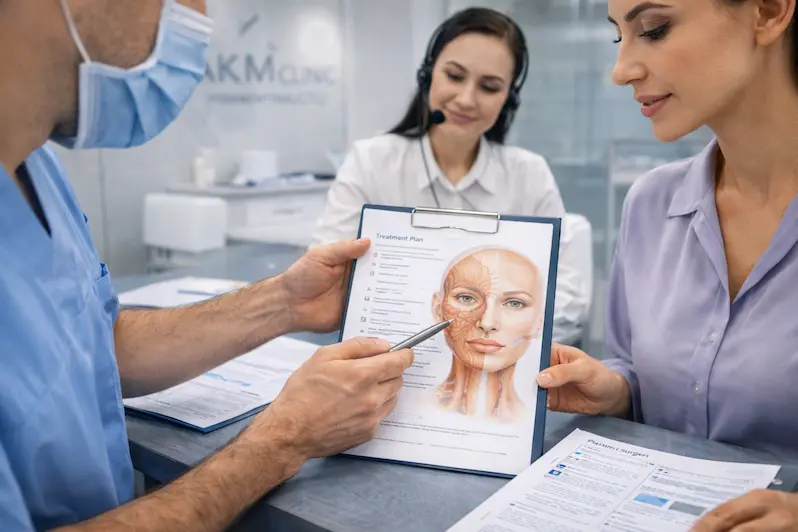
Many disappointing outcomes aren’t caused by dramatic surgical errors—they’re caused by misaligned expectations. For example, a patient might say “natural,” but mean “no one can tell,” while a clinic interprets it as “subtle but noticeable.” Another patient might request a “tight jawline,” while the surgeon is planning a conservative approach due to anatomy and safety. Clear, specific discussion—ideally with photos, measurements, and a written plan—reduces these gaps.
Informed consent: risks, expectations, and what must be crystal clear
Informed consent isn’t just a signature — it’s the clinical conversation that the signature documents. When that conversation is degraded by language barriers, consent quality degrades with it, and the perioperative outcomes data starts to reflect that gap.
For the synthesis layer, 2023 JAMA Network Open systematic review of language barriers and perioperative surgical outcomes across 29 studies and 281,266 patients (Joo, Fernández, Wick, Moreno Lepe, Manuel) — analyzing the relationship between limited English proficiency and surgical care across a broad patient population — reported that LEP was associated with reduced access, delays in care, longer surgical admissions, and higher rates of post-discharge transition to skilled facilities, while clinical outcomes related to mortality and major complications showed fewer significant associations.
The takeaway for international patients: the breakdown most often shows up in process-of-care details rather than catastrophic clinical events — but process-of-care details are where consent quality, discharge instruction comprehension, and post-op safety usually live.
Informed consent is not a signature; it’s a process. You should understand:
- What will be done (technique, incisions, areas addressed)
- What will not be done (limitations based on your anatomy and safety)
- What can happen (swelling, bruising, scarring, asymmetry, revision possibility)
- What “success” looks like (realistic outcome range and timeline)
If any of these feel vague, rushed, or translated poorly, that’s a communication risk—not a minor inconvenience.
Post-op safety depends on follow-up communication (not just the surgery)
Recovery instructions must be understood precisely—medications, wound care, sleeping position, activity limits, and warning signs. This becomes more important when you fly home. You need a clear channel to reach the team, plus written aftercare guidance in English. Without it, patients can delay care or mismanage a normal recovery phase and mistake it for a complication—or ignore a true complication.
What “English-Speaking Plastic Surgeon” Should Actually Mean
Search results for leading surgeons for international patients in Turkey or top plastic surgeons fluent in English in Turkey can be misleading because “English-speaking” is often loosely defined. For surgery, the standard should be higher: you need the ability to discuss risk, nuance, and trade-offs comfortably—especially if you’re considering surgeons among surgeons fluent in English in Istanbul.
Fluency vs. “basic English”: what’s acceptable in medical decision-making
Basic conversational English is not enough for surgical planning. You should be able to ask complex questions and receive precise answers without relying on “yes/no” reassurance. A strong indicator of true capability is whether the surgeon can explain:
- Why one technique is safer or more appropriate for you than another
- What complications are possible and how they’re handled
- How scarring and healing typically evolve over weeks and months
If the surgeon can only speak in generalities, you may be dealing with “marketing English,” not clinical communication.
Who speaks English—your surgeon, a coordinator, or a translator? Why it matters
Some clinics rely on coordinators or translators for communication. That can work—if the system is professional and medically competent. However, it changes the risk profile. The key question is: who is accountable for understanding your goals and translating them into a surgical plan?
- Best-case: The surgeon speaks English well enough to lead the consult and confirm details personally.
- Acceptable: A trained medical translator supports the consult, and the surgeon verifies critical decisions directly.
- Risky: You only interact with a coordinator, and the surgeon appears briefly—or not at all—until surgery day.
Translator vs Interpreter vs Bilingual Coordinator: The Key Differences
Three terms get used interchangeably in medical tourism marketing — and the distinction matters because the three roles have meaningfully different training, accountability, and risk profiles.
| Role | What They Do | Training Standard | Risk Profile |
|---|---|---|---|
| Medical Interpreter | Real-time spoken conversion between patient and surgeon during consultations and aftercare | Certified medical interpreter training (CCHI, NBCMI in the US equivalents); ethics + medical terminology + confidentiality | Lowest risk when properly credentialed — interpreter is bound by clinical accuracy and accountability standards |
| Medical Translator | Written conversion of documents (consent forms, surgical plans, discharge instructions, post-op summaries) | Written-translation certification (ATA in the US equivalents); medical-document specialty | Low risk when documents are translated by certified medical translators; high risk when documents are auto-translated or translated by non-medical staff |
| Bilingual Coordinator | Client-facing operational role — scheduling, hotel/transfer coordination, patient experience touchpoints | No standardized medical-language credential; usually multilingual office staff with international patient experience | Higher risk when used for clinical conversations — operational fluency does not equal clinical interpretation training |
The practical implication: a “bilingual patient coordinator” who books your hotel and answers email is excellent for logistics — and not appropriate as the primary interpreter during your consultation or pre-op consent conversation. Those conversations need either a fluent surgeon directly or a credentialed medical interpreter. A clinic that conflates these roles is one to verify carefully.
Ask the clinic directly: “For my consultation and consent conversation, will I speak with the surgeon in English, or through a medical interpreter, or through a coordinator?” A clinic that can answer this clearly is one that has thought about the distinction. A clinic that says “we have English-speaking staff” without specifying roles has not.
Medical English basics: terms you should hear explained clearly
Even if you don’t know surgical terminology, you should hear plain-English explanations of core concepts. If you’re not hearing these clearly, you’re not getting true “English-speaking” care:
- Technique details: where incisions go, what gets lifted/tightened, and what stays untouched
- Scarring strategy: expected placement and how scars mature
- Anesthesia plan: what type, who administers it, and what monitoring is used
- Revision reality: what could require a touch-up and under what conditions
How to Verify English Communication Before You Book
Anyone can claim they work with English-speaking clinical staff. Verification is different. If you’re comparing Turkey English-speaking plastic surgeons—especially among the surgeons in Istanbul—you want evidence that communication is structured, repeatable, and surgeon-led (or translator-supported with medical rigor). The goal is simple: reduce the language barrier in medical tourism before money changes hands.
Language verification is one of the earliest steps in a longer pre-travel planning sequence — it shapes which clinics make the shortlist, which consultations are worth scheduling, and where the audit funnel narrows. The verification step sits inside a broader planning architecture.
For the journey-level context, the international patient journey structure covers the pre-travel medical workup, the consultation-and-arrival days, the surgery-day staging, the in-Istanbul recovery period, the structured return-flight phase, and the months-long follow-up cadence — including the touchpoints where language quality directly affects each phase’s clarity and safety.
Verifying language at the start of the journey shapes what every subsequent step actually looks like.
The gold standard: a real-time video consultation with the surgeon
A short, real-time consult is the fastest way to confirm whether you and the surgeon can truly communicate. During the call, you should be able to:
- Describe your goals in your own words and feel accurately “reflected back” by the surgeon.
- Discuss trade-offs (e.g., tighter vs. more natural, scar length vs. lift strength) without confusion.
- Ask “what could go wrong?” and receive calm, specific answers—not vague reassurance.
If you can only speak to a coordinator and never see the surgeon until surgery day, that’s a communication risk—no matter how strong the marketing looks.
Language fluency verification is one verification step in a longer credential audit. The video-consultation criterion above tests communication; the broader credential audit tests whether the surgeon you’re talking to is actually the surgeon who will operate, with the training credentials the marketing page describes.
For the broader verification framework, the surgeon credential verification framework covers the Turkish Plastic Surgery Society (TPCD) lookup process, ISAPS and EBOPRAS membership verification, the documentation patients can independently confirm without relying on the clinic’s marketing pages, and the cross-checks that separate verifiable credentials from undocumented claims.
Language fluency without credential verification is a partial audit — and a partial audit is the audit pattern that fails patients most consistently.
Written treatment plan: what it should include (technique, anesthesia, recovery, inclusions)
The written treatment plan tells you one thing; the surgeon’s board certification documentation tells you another. Both belong in the verification stack — and neither replaces the other.
For the certification side specifically, the board certification reference covers what board certification means in plastic surgery, the differences between EBOPRAS (European), ABPS (American), and Turkish Plastic Surgery Society certifications, what fellowship subspecialty training adds, and how international patients can verify board certification independently without relying on the clinic to confirm what it claims.
Board certification is the credentialing baseline. Everything else — including language fluency — sits on top of it.
A credible clinic provides a written plan in clear English. This is not bureaucracy; it’s safety. At minimum, your plan should include:
- Procedure scope: what areas will be treated and what will not be treated
- Technique overview: incisions, lifting/tightening method (high-level), and scar strategy
- Anesthesia plan: type, who is responsible, and basic monitoring standards
- Recovery outline: typical swelling/bruising timeline and realistic return-to-activity expectations
- Inclusions/exclusions: hotel, transfers, garments, meds, lab tests, aftercare visits—clearly listed
This document also protects you from “scope creep” later (surprise add-ons or exclusions). It’s an essential tool for clear clinical communication.
“Proof signals”: clear answers, consistent messaging, and documentation quality
In clinical settings, consistency is a trust marker. Look for:
- Consistency across channels: the written plan matches what is said on calls and messages.
- Specificity over hype: you get measurable timelines and defined steps, not “guaranteed perfect” claims.
- Documentation quality: English is medically coherent (not auto-translated), and forms are understandable.
If messaging changes from one person to another, that’s often a sign of a weak system—especially risky when overcoming a cross-border surgical communication gaps.
Medical English Glossary: 25 Critical Terms You Should Hear Clearly
The clearest way to test a surgeon’s medical English isn’t to ask “Do you speak English?” — it’s to listen for how specific clinical concepts get explained. A fluent surgeon uses anatomical, anesthesia, and recovery terminology naturally in the right context. A surgeon working at the edge of their language skill avoids these terms or substitutes vague synonyms.
Listen for these 25 terms during your consultation. If most appear naturally in your conversation, with examples relevant to your case, that’s a meaningful fluency signal:
Anatomy & Surgical Planning (8 terms)
- Subcutaneous tissue — the fat and connective layer beneath the skin
- Fascia — the deeper connective tissue layer supporting muscles
- SMAS (Superficial Musculoaponeurotic System) — the structural facial layer addressed in facelifts
- Vascular pedicle — the blood supply that keeps tissue alive during repositioning
- Tension vector — the direction of pull during closure
- Undermining — surgical separation of skin from underlying tissue
- Plication — folding and stitching muscle together (common in abdominoplasty)
- Capsule — the scar tissue pocket that forms around implants
Anesthesia & Operating Room (6 terms)
- General anesthesia — fully unconscious with airway management
- Sedation / monitored anesthesia care (MAC) — semi-conscious, locally numbed
- Tumescent local — local anesthesia with diluted epinephrine for body procedures
- Intubation / extubation — placement and removal of the breathing tube
- Anesthesiologist — the physician managing your anesthesia (not a nurse or technician)
- NPO (nothing by mouth) — the fasting window before surgery
Recovery & Complications (11 terms)
- Hematoma — collection of blood under the skin requiring drainage
- Seroma — fluid collection under the skin (different from hematoma)
- Dehiscence — wound separation/opening
- Necrosis — tissue death due to compromised blood supply
- Edema — swelling from fluid accumulation
- Ecchymosis — bruising / blood discoloration
- Hypertrophic scar — raised scar within the original incision lines
- Keloid — raised scar extending beyond original incision (different from hypertrophic)
- DVT (deep vein thrombosis) — blood clot risk especially after flight
- Compression garment — post-op support garment with specific wear protocol
- Suture removal — timing varies by procedure (3-14 days typical)
The test isn’t whether your surgeon defines every term on the spot — it’s whether these terms appear naturally in the conversation when relevant. A surgeon who says “you might get a fluid pocket” instead of “you might develop a seroma, which we’d aspirate at week one if it doesn’t resolve” is operating at a lower fluency level — and that gap shows up later in consent comprehension and aftercare understanding.
If your surgeon avoids medical terminology entirely and only uses lay language, ask directly: “What’s the medical name for that?” The answer tells you whether they’re translating for clarity or translating because they can’t access the term.
Language-Specific Consultation Checklist for US Patients
The questions below test communication clarity — not procedural completeness. The broader procedural audit (technique, anesthesia plan details, complication policies) sits in the broader consultation question framework. Use both lists together.
Test 1: Can the surgeon explain your specific case in English without re-routing through a coordinator?
- “Walk me through what you’d change about my [face/abdomen/breast] specifically — based on the photos I sent.”
- “What’s the medical name for the technique you’re recommending?”
- “What are the three most common complications, and how do you describe each one to patients?”
If answers come back vague, generic, or get re-routed (“Let me check with the surgeon and get back to you” — when you’re already in the consultation), the language gap is real.
Test 2: Does your consent and aftercare documentation read like medical writing, or like marketing translation?
- Consent form in clear medical English with named risks, recovery timeline, and revision policy
- Surgical plan document with named technique, incision placement, and inclusion list
- Aftercare instructions with specific medication names, dosing, timing, and warning-sign descriptions
If the documents read like Google Translate output (sentence structure off, medical terms used incorrectly, terminology swapped between sentences), the post-op communication infrastructure is fragile in ways that matter at 2 a.m. when you have a question.
Test 3: Who answers your follow-up email, and in what language?
- Same-day response in English (or 24-hour for non-urgent)
- Response includes the question asked + a clinical answer (not a deflection to a phone call)
- Email is signed by a clinical team member, not an unnamed “Patient Coordination Team”
The pre-op email exchange usually predicts the post-op email exchange. Test it before you commit.
How Clinics in Turkey Should Build a Safe Communication System
When patients search for plastic surgeons in Turkey, they often focus on a single person. In reality, safe outcomes depend on a system: the surgeon, anesthesia team, nurses, coordinators, and English-speaking medical staff all need shared standards. A strong communication system reduces communication failures in international surgical travel and protects you from “lost in translation” decisions—especially for time-sensitive post-op concerns.
Clinic-level communication systems and individual surgeon language fluency are two separate audits. The surgeon may be fluent in English while the clinic infrastructure around them — translator availability, written-document quality, after-hours response chain — fails the international patient. Both layers need verification independently.
For the clinic-level side specifically, the clinic evaluation framework covers the practice-level features that predict outcomes versus the ones that predict regret, accreditation realities, surgeon-led versus coordinator-led practice models, and the verifiable signals that separate clinics with communication infrastructure from clinics with marketing language.
“English-speaking surgeon” and “English-speaking clinic” are different evaluations — and a patient who only audits one is unaware of where the actual breakdown might happen.
Professional medical translators vs. non-medical interpreters
The translator-versus-interpreter distinction matters because communication chains have failure points where patient identity, surgeon identity, and procedure scope can drift between consultation and operating room. Language complexity sometimes obscures more than it clarifies — and obscured communication is exactly where some of the worst medical tourism stories begin.
For the related risk category specifically, the ghost surgery risk framework covers the documented pattern where the surgeon a patient consulted with is not the surgeon who operated, the contractual protections that reduce this risk, the identity-verification protocols patients can request before agreeing to surgery, and the communication patterns that should raise concern during pre-op consultations.
Language unclear is bad. Surgeon-identity unclear is dangerous. The two failure modes sometimes share root causes.
Translation is a clinical skill when the topic is surgery. A non-medical interpreter might translate words correctly but miss meaning—like the difference between “expected swelling” and “concerning swelling,” or “temporary numbness” vs. “nerve injury.” If a translator is involved, ask:
- Are they trained in medical terminology?
- Do they translate during the surgeon consult, not just with coordinators?
- Do they translate written instructions and consent forms accurately?
For high-stakes decisions, the safest setup is either a surgeon who communicates comfortably in English or a medically trained translator who supports surgeon-led conversations—especially when evaluating English-speaking plastic surgeons in Istanbul.
Consent forms and medical records in English: what you should receive
You shouldn’t leave a clinic with only verbal instructions. A safe clinic should provide clear English documentation, including:
- Procedure summary (what was done, where incisions were placed, what technique was used at a high level)
- Medication list (names, doses, timing, and common side effects)
- Aftercare instructions (wound care, showering, sleeping position, garment use if applicable)
- Warning signs and what to do if they occur
- Follow-up schedule and contact channels
This isn’t just “paperwork.” It’s part of responsible patient-clinician dialogue and makes post-op care safer once you’re home.
“Medical records in English” sits inside a larger facility-documentation standards category — and accredited hospitals operate under documentation protocols that meaningfully shape what international patients can expect to receive in writing, in what language, on what timeline.
For the accreditation-standards layer specifically, the JCI accreditation safety standards covers what Joint Commission International accreditation actually means for documentation standards, the patient-record protocols accredited hospitals operate under, the language-accessibility requirements that apply to JCI facilities, and the verifiable list of JCI-accredited Istanbul hospitals where these documentation standards are formally enforced.
Documentation language quality usually traces back to facility-level accreditation discipline — not to individual willingness.
Post-op protocol: how to reach the team, response times, and emergency pathways
Before you book, you should know exactly how post-op communication works. Ask for details like:
- Primary contact (name/role) and backup contact
- Response expectations (e.g., how quickly messages are typically answered)
- Urgent pathways (what to do after-hours or if you’re back in the US)
Clinical best practice is to remove uncertainty from urgent moments. In medical settings, the most dangerous phrase is “I wasn’t sure who to contact.”
Practical rule: If a clinic can’t describe its follow-up and emergency pathway in clear English, you’re taking on avoidable risk.
Common Miscommunications (and How to Prevent Them)
Even when you find best plastic surgeon for English-speaking patients (or clinics marketing “top” rankings), the most common problems are surprisingly ordinary: unclear inclusions, unrealistic recovery expectations, and incomplete aftercare instructions. These are preventable—if you know what to watch for and you ask for clarity upfront.
“All-inclusive” pricing misunderstandings (what’s included vs. excluded)
The miscommunication patterns above sound abstract until they appear in actual patient stories. Pattern recognition across many testimonials teaches calibration about which language failures matter most and which are recoverable — in a way that reading any single review never does.
For the broader cross-section, documented patient communication experiences covers consultation-quality feedback across procedure types, the communication satisfaction patterns that recur across patient profiles, the clarity-of-plan reports that international patients consistently flag, and the long-term communication trajectory from first consultation through post-op follow-up.
Reading twenty reviews teaches communication calibration in a way that reading one or two showcase quotes never does.
“All-inclusive” can mean different things. To prevent confusion, request a written list of inclusions and exclusions. Here’s a simple structure you can ask any clinic to fill in:
| Item | Included? | Details (in English) |
|---|---|---|
| Pre-op tests / labs | Yes / No | Which tests and where performed? |
| Anesthesia fees | Yes / No | Type of anesthesia and who administers it |
| Hospital/OR facility fees | Yes / No | Length of stay, what’s covered |
| Medications | Yes / No | Which medications + how many days |
| Aftercare visits | Yes / No | How many visits and on which days |
| Compression garments / dressings | Yes / No | What’s provided and replacement costs |
This level of detail supports effective surgical communication and reduces last-minute surprises that can undermine trust.
Recovery timeline confusion (swelling, bruising, return-to-work realism)
Recovery is where expectations frequently drift. Social media can compress timelines, making results look “instant.” In reality, healing follows biology. A strong clinic communicates milestones in plain English and reinforces them in writing. Ask:
- “What should I expect at 1 week, 2 weeks, 6 weeks, and 3–6 months?”
- “When is it safe to fly? When is it safe to exercise?”
- “What signs are normal vs. concerning?”
Good clinics align this guidance with what clinical literature has long observed: swelling patterns vary by person, and final refinement can take months—especially for facial procedures.
Medication, aftercare, and wound care errors caused by unclear instructions
Post-op errors often happen because instructions are partial or misunderstood—especially if you’re navigating a language barrier in medical tourism. Make sure you receive:
- Written medication schedule (morning/evening, with food/without food)
- Wound care steps (what to clean with, how often, what to avoid)
- Do-not-do list (smoking, certain supplements, heavy lifting, sleeping positions)
If the instructions are only verbal, or if they’re translated in awkward, unclear English, ask for a corrected written version. Clear communication is not “high maintenance.” It’s risk management.
AKM Clinic Communication Model (Surgeon-Led Care for Clarity & Safety)
For patients looking at English-speaking plastic surgeons in Istanbul, the strongest reassurance usually comes from two things: (1) surgeon-led planning and (2) a structured team that supports the plan consistently. AKM Clinic’s model is built around surgeon leadership, clear patient education, and recovery support that is designed to reduce uncertainty during the most vulnerable period—right after surgery.
Surgeon-led planning: why direct surgeon communication reduces risk
When the surgeon leads the plan (instead of decisions being filtered only through coordinators), it becomes easier to confirm that your goals, anatomy, and safety considerations match the surgical strategy. This is especially important for informed international patient evaluating top English-speaking plastic surgeons in Turkey based on trust signals—not marketing language.
One AKM Clinic patient from the USA, Barbara (60), described “perfect English communication” and proactive instructions as part of her experience—details that matter because they reduce ambiguity and stress around surgery logistics and recovery.
Barbara (USA): “I actually look like nothing happened but probably 20 years younger.”
Dermatosurgeon + plastic surgery team advantage (skin quality + structure = more natural outcomes)
Communication is also about explaining why a plan is chosen. AKM Clinic’s facial approach highlights a key advantage: procedures are guided by a Dermatosurgeon (Dr. Akif Mehmetoğlu) working in synergy with a facial plastic surgeon team. This matters because natural results don’t come only from lifting—skin quality, healing behavior, and scar strategy also shape the final appearance.
- Structure: how deeper layers are repositioned for durable, natural contours
- Skin & scars: how skin biology, collagen behavior, and dermatologic expertise influence refinement
For “Skeptical Sam,” this is the kind of reasoning that builds trust: not “we’re the best,” but “here’s the clinical logic behind the plan.”
The dermatosurgeon role meaningfully shifts the communication dynamic — not just the technical capability. A surgeon who routinely walks patients through skin-quality, scar-maturation, and surface-recovery details usually has a more developed vocabulary for explaining outcomes to international patients than a surgeon whose practice volume sits exclusively in deeper structural work.
For the credentials picture relevant to surgeon-led language communication, Dr. Akif’s clinical communication profile covers training history, the dermatosurgical specialty fellowship that shapes how scar-aware closure design is explained to patients, society memberships, the consultation-language style that international patients consistently report, and the credentials behind the surgeon-led communication model the article above references.
“English-speaking surgeon” means something specific at the individual surgeon level — not just at the clinic level.
Post-op communication infrastructure: who you reach, when, and in what language
Recovery isn’t only about the surgery — it’s about the communication chain that supports the patient when something unexpected appears. The AKM model is built around documented English-language follow-up access at predictable intervals: structured check-ins on day 1, week 1, month 1, month 3, and month 6, with named clinical contacts and defined response-time expectations for non-urgent questions versus urgent concerns.
For international patients specifically, post-op communication infrastructure matters more than the average patient realizes — because when a question appears at month two from a different time zone, the patient needs to know exactly who to contact, in what language, and what the realistic response window is.
This is where “English-speaking surgeon” extends into “English-speaking aftercare team” — and where the verification framework above gets tested in practice, not just at consultation.
Frequently Asked Questions (FAQ): English-Speaking Plastic Surgeons in Turkey
If you’re comparing English-speaking plastic surgeons in Turkey and trying to avoid language gaps in international medical travel, these are the most practical questions to ask before you book. The goal is to protect your safety, your expectations, and your ability to get help quickly—especially once you return home.
Do I need my surgeon to speak fluent English, or is a translator enough?
Either can be safe—if the system is surgeon-led and medically rigorous. Ideally, your surgeon communicates comfortably in English. If a translator is involved, they should be a trained medical translator, present during surgeon consults, and able to translate consent and aftercare instructions clearly. “Coordinator-only” communication is riskier for true doctor-patient communication.
What should I receive in writing before I pay a deposit?
You should receive a clear English treatment plan: procedure scope, high-level technique description, anesthesia plan, recovery timeline, inclusions/exclusions, and cancellation/rescheduling terms. This is a key differentiator when evaluating your surgeon — serious clinics document care clearly.
How do I know I’m speaking to the real surgeon (not just a coordinator)?
Request a video consultation where the surgeon appears on camera, answers your questions directly, and summarizes the plan in their own words. You can also ask who will perform each part of the operation and who leads medical decisions. If you cannot access the surgeon before booking, that’s a red flag—even if a clinic claims to be among the top English-speaking plastic surgeons in Turkey.
What English documents should I take home after surgery?
Ask for: a procedure summary, medication schedule, aftercare instructions, warning signs list, and follow-up plan with contact details. If you’re traveling for surgery, these documents reduce errors and improve safety—especially when your local doctor needs accurate information quickly.
How is post-op communication handled once I’m back in the US?
There should be a defined channel (WhatsApp/email/portal) with named contacts, typical response expectations, and an urgent pathway for after-hours concerns. This is where English-speaking medical staff matters most. Ask how the clinic supports you across time zones and what happens if you need local evaluation.
What are red flags that communication won’t be safe?
Common red flags include: vague answers, “guaranteed” promises, inconsistent information from different staff members, refusal to provide a written plan, unclear anesthesia details, and no structured follow-up pathway. If the clinic can’t explain risks and aftercare in clear English, the communication foundation is weak—no matter how “best” the branding sounds.
How do time zones affect follow-up and emergency access?
Time zones shouldn’t leave you isolated. A safe clinic plans for it: defined response windows, backup contacts, and clear guidance on when to seek local urgent care. If you’re considering highest-rated surgeons in Turkey for international patients, ask exactly how they handle urgent messages when it’s nighttime in Turkey.