
Medical disclaimer: This guide is educational and reflects typical recovery patterns. Your surgeon’s instructions always come first, because your incision placement, muscle repair, drain use, and overall health can change the safest plan for you.
If you’re planning a combined tummy tuck and breast lift (a common “mommy makeover” combination), the first week can feel like a puzzle: you want to sleep, but you can’t lie flat; you want to move, but you feel tight; you want a timeline, but swelling seems to change hour by hour.
This article is designed as practical, planning-friendly guidance for recovery after tummy tuck and breast lift recovery—especially if you’re traveling for surgery and need to organize your hotel setup, mobility, and support. We’ll cover day by day tummy tuck recovery in the first 72 hours, then build into a clear tummy tuck recovery timeline and breast lift recovery week by week guidance in the next sections.
Surgeon-led recovery principle: In the early phase, “sleep position” isn’t just about comfort—it’s about protecting your incisions, reducing tension on repaired tissues, and preventing unnecessary swelling.
Table of Contents
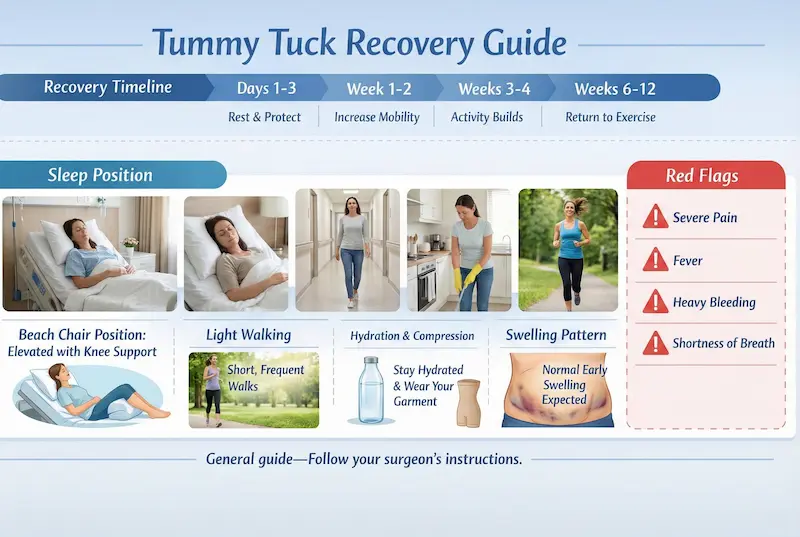
Why Sleep Matters in Recovery After Tummy Tuck and Breast Lift
Sleep is one of the most overlooked “recovery tools.” When you’re healing from a tummy tuck (especially if you had muscle repair) and a breast lift, your body is managing inflammation, fluid shifts, and tissue remodeling all at once. Quality sleep supports that process—while poor sleep can make pain feel louder, swelling more dramatic, and energy levels crash.
What “tightness” and pressure feel like (and why it impacts sleep)
During recovery from tummy tuck, many patients describe a tight, pulling sensation across the lower abdomen—often strongest when trying to stand straight or lie flat. After a breast lift, tightness can be felt across the chest, especially when changing positions or using your arms to push up. These sensations can interrupt sleep simply because your body is “guarding” the area.
- Abdomen: Tightness is common, especially with muscle repair; you may naturally stay slightly flexed at the hips.
- Breasts: A lifted, supported feeling with tenderness—often worse with arm movement.
- Combined procedures: You may find it harder to “get comfortable,” which is why setup matters (we’ll cover positioning next).
How good sleep supports swelling control and incision healing
Swelling is part of normal healing, but it can feel unpredictable. Getting consistent sleep helps your body regulate inflammation and supports the tissue repair processes happening underneath the skin. While sleep won’t erase swelling overnight, it can make your tummy tuck recovery time feel more manageable day to day—especially when paired with surgeon-approved walking and compression.
What makes combined recovery different vs. one procedure
When you combine procedures (for example, recovery after tummy tuck and breast lift), the “rules” don’t simply add up—they interact. Your abdomen may require a slightly flexed position, while your chest needs stable, gentle support. That’s why many patients find a recliner or wedge-pillow setup especially helpful in the first week.
Important planning note: If your surgery is part of a mommy makeover, your surgeon may tailor restrictions to match exactly what was done (full tummy tuck vs. mini tummy tuck recovery, breast lift alone vs. lift with implants). We’ll break down the week-by-week expectations later so you can plan realistically.
Day-by-Day Tummy Tuck Recovery: The First 72 Hours (What’s Normal)
The first three days set the tone for your entire recovery after a tummy tuck. This is the window where swelling ramps up, movement feels awkward, and sleep is often the hardest. The good news: many patients notice meaningful improvements by Day 3—especially once they have a reliable sleep setup and a simple routine.
| Timeframe | What you may feel | Sleep goal | What usually helps | Red flags (call your team) |
|---|---|---|---|---|
| Day 0–1 | Tightness, soreness, grogginess; drains (if used); difficulty standing fully upright | Short, frequent rest + protected positioning | Recliner/wedge, scheduled meds, small sips + light food, assisted bathroom trips | Severe one-sided swelling, shortness of breath, chest pain, uncontrolled bleeding |
| Day 2 | Swelling day by day often peaks; bruising becomes more visible | More continuous sleep blocks (still elevated) | Gentle walking, hydration, keeping compression positioned correctly | Fever, worsening redness/warmth, foul drainage, rapidly increasing pain |
| Day 3 | Less “shock,” slightly easier mobility; still tight and swollen | Consistent nighttime sleep routine | Same sleep setup + fewer position changes; simple daytime nap strategy | Sudden new swelling, calf pain, dizziness that doesn’t improve |
Day 0–1: The first night—pain, drains, and getting comfortable
The first night is often the toughest. You may feel sleepy but wake easily. If you have drains, they can make turning more complicated. Your priority is not “perfect sleep”—it’s safe rest in a protected position while staying on schedule with your surgeon-approved medications and walking plan.
- Keep your upper body elevated and your hips slightly flexed to reduce tension on the abdominal incision.
- Use support under the knees to prevent pulling across the lower abdomen.
- Avoid using your arms to push aggressively (important for breast lift incisions).
Day 2: Swelling and posture (“hunched” walking) expectations
Many patients worry they’re doing something wrong because they can’t stand up straight. A slightly flexed posture is common early in recovery time after tummy tuck—especially if muscle repair was performed. This is also the phase where people notice swelling day by day tummy tuck recovery changes that feel dramatic: morning can look different from evening.
What helps most is consistency: short walks, hydration, correct garment positioning, and avoiding long periods of sitting fully upright without support.
Day 3: Sleep improving—what changes, what shouldn’t
By Day 3, many patients report less overall “shock” and a bit more confidence moving around. You may still feel tight and swollen, but it can become easier to fall asleep once your body trusts your routine.
What should not happen: a sudden surge in pain, new severe asymmetry in swelling, or symptoms that feel systemic (fever, chills, shortness of breath). If anything feels “off,” treat that instinct as important and contact your surgical team.
How to Sleep After a Tummy Tuck and Breast Lift (Positions That Protect Your Results)
In the early phase of tummy tuck recovery and breast lift recovery, your sleep position is a medical strategy—not just a comfort preference. The goal is to reduce tension on the abdominal incision (and any muscle repair), minimize pulling across the breast lift incisions, and keep swelling from escalating unnecessarily overnight.
Simple rule for the first week: Sleep elevated, keep your hips slightly flexed, and avoid positions that stretch your abdomen or compress your chest.
The “beach chair” position explained (back + knees supported)
The most commonly recommended sleep posture early in recovery after tummy tuck is the “beach chair” position—upper body elevated with knees supported. This reduces tension on the abdominal incision and can make tightness feel dramatically more manageable.
- Upper body: elevated (think recliner angle or wedge pillow stack).
- Hips: gently flexed (you’re not trying to lie fully flat yet).
- Knees: supported with a pillow or wedge to prevent abdominal pulling.
- Breasts/chest: supported by a surgical bra; avoid rolling forward or collapsing the shoulders.
If you’re asking “how long is recovery after tummy tuck before I can sleep normally?”—sleeping flat and turning freely usually comes later than patients expect. Your surgeon will guide timing based on incision tension, swelling, and whether muscle repair was done. For many people, the first priority is simply achieving safe, consistent sleep during the toughest early days of the tummy tuck recovery time.
Pillow, wedge, recliner setup: what to use and why
The best setup is the one that keeps you stable all night with the fewest position changes. Here’s how to choose between the most common options during recovery time for tummy tuck and recovery time for breast lift:
| Setup Option | Why it works | Best for | Common downside | Pro tip |
|---|---|---|---|---|
| Recliner | Built-in elevation + hip flexion; easy to maintain “beach chair” | First 3–7 nights, especially with drains | Neck stiffness if unsupported | Add a small pillow behind the neck + a pillow under calves |
| Wedge pillow system | Creates stable angles in a bed without sliding | Hotel recovery or home bed setup | Can slide if stacked poorly | Use one wedge for torso + one under knees (not random pillows) |
| Adjustable bed | Most customizable elevation and knee support | Patients who want “set and forget” comfort | Not always available while traveling | Keep a small pillow at each side to prevent rolling |
Minimum “sleep kit” checklist (helpful for recovery after tummy tuck and breast lift, especially in a hotel):
- 1 firm wedge (or stable torso support)
- 1 knee pillow/wedge
- 2 side pillows (to prevent rolling)
- A lightweight blanket (heavy weight can feel uncomfortable on the chest)
- A bedside table setup: water, meds (as prescribed), lip balm, phone charger
Getting in/out of bed safely (log-roll technique basics)
This is one of the most important practical skills during recovery from tummy tuck. Many patients accidentally strain their abdomen by “sitting straight up” or twisting. A safer approach reduces tension and protects your incision—especially in the early tummy tuck recovery timeline.
Getting out of bed (simplified steps):
- Move to the edge while staying slightly flexed at the hips.
- Roll to your side as one unit (shoulders and hips together—no twisting).
- Let your legs drop off the bed as you use your arms gently to push up.
- Stand in a controlled way; don’t force yourself fully upright immediately.
Breast lift note: Because pushing up can stress the chest area, keep movements slow and “small.” If you have help, let a companion support your elbow/forearm rather than pulling your hands.
When side-sleeping becomes safer—and when it’s too early
One of the most searched questions in tummy tuck recovery week by week guides is when side-sleeping is allowed. The honest answer: it depends on your surgeon’s assessment of incision tension, swelling, and comfort—especially if your procedure is part of a mommy makeover.
- Too early: Side-sleeping can pull the abdominal skin and create pressure on the breasts, especially if you roll forward.
- Potentially safer later: Many patients can gradually tolerate partial side support once swelling is calmer and they can move without “sharp pulling.”
- How to transition: If cleared, try a “supported side-lean” with pillows behind your back and between knees—so you don’t fully collapse into the side.
Avoid stomach sleeping until you are explicitly cleared. It compresses healing tissues and can increase discomfort and swelling.
Nighttime swelling and comfort: why evenings can feel worse
If you feel more swollen at night, you’re not imagining it. During day by day tummy tuck recovery, fluid tends to shift and accumulate with daytime activity. That’s why many patients report “worse-looking” swelling in the evening during swelling day by day tummy tuck recovery. The goal is to reduce nighttime swelling triggers:
- Keep your recommended compression positioned correctly (not rolled or digging).
- Do short, gentle walks earlier in the evening (as cleared), then settle into rest.
- Limit salty foods and dehydration patterns that can worsen fluid retention.
- Use elevation consistently—switching setups nightly can make sleep harder.
Key takeaway: In the first week, the best sleep position is the one that keeps you stable and elevated with minimal effort—because fewer movements usually means less pain, less pulling, and an easier recovery night.
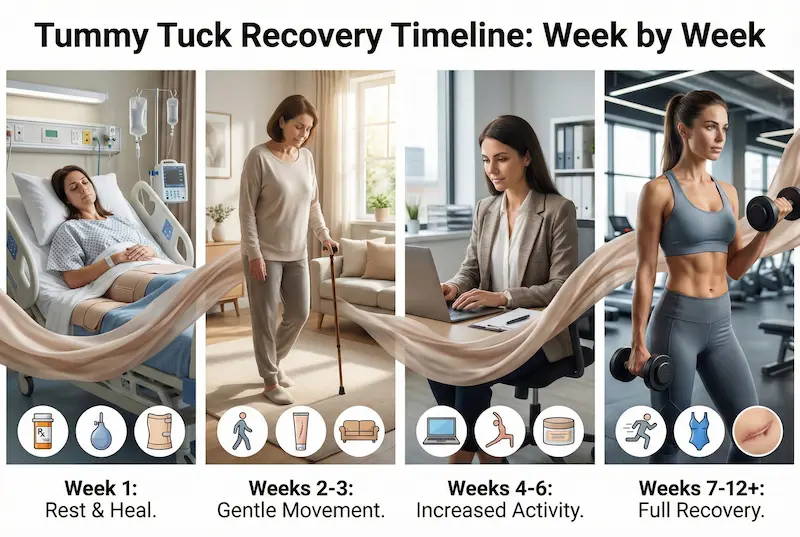
Tummy Tuck Recovery Timeline: Week by Week
Most patients want a clear answer to: how long is recovery after tummy tuck? The most accurate way to think about it is in phases. Your early phase is about protection and basic mobility, the middle phase is about steadily returning to normal routines, and the later phase is about tissue remodeling (where swelling and scar maturation continue quietly in the background).
This tummy tuck recovery timeline is intentionally practical. It applies to many patients, but your surgeon may adjust milestones based on whether you had muscle repair, drain use, the extent of tightening, and whether your procedure was part of a mommy makeover.
| Timeframe | What’s common | Your main goal | What to do | What to avoid |
|---|---|---|---|---|
| Week 1 | Tightness, fatigue, swelling fluctuations; posture is slightly flexed | Protect repairs + establish a routine | Short walks, consistent sleep positioning, hydration, garment compliance | Overreaching, lifting, twisting, “testing” core strength |
| Week 2 | Mobility improves; swelling still present; energy is uneven | Increase independence safely | More frequent walking, gentle daily activities, stable nutrition | Long outings, intense housework, bending for prolonged periods |
| Weeks 3–4 | Swelling often “comes and goes”; posture gradually improves | Return to light routines | Longer walks, desk work (if cleared), scar care habits | High-impact exercise, heavy lifting, stretching the abdomen aggressively |
| Weeks 6–12 | Most daily activities feel normal; swelling may persist subtly | Build back strength gradually | Progressive exercise (as cleared), consistent scar protection | Rushing core workouts or ignoring late swelling signals |
Week 1: Walking, compression, drains, and energy levels
Week 1 is the most “managed” part of recovery time after tummy tuck. You’re not aiming to feel normal—you’re aiming to stay safe and steady. Many patients are surprised by how tired they feel; that’s normal. Healing is work.
- Walking: Think short and frequent. A few minutes at a time (as cleared) is often better than one long walk.
- Compression: Wear it exactly as directed. Too loose won’t support you; too tight or rolled can worsen discomfort.
- Drains (if used): They can change how you sleep and move. Keep a simple tracking routine and avoid tugging.
- Energy: Expect “up and down” days. This is not the week to judge your progress emotionally.
During tummy tuck recovery week by week, Week 1 is also when sleep setup matters most. If your nights are unstable, your days will feel harder. Keep the elevated “beach chair” positioning consistent.
Week 2: Returning to light routines (and what to avoid)
By Week 2, most patients feel more confident walking around and managing basic self-care. This is also the phase where some people overestimate what they can do—because pain may be less intense, but internal healing is still active.
- What often improves: getting in/out of bed, walking more upright, appetite and hydration.
- What’s still normal: swelling that changes across the day, tightness, and “zingers” (brief nerve sensations).
- What to avoid: lifting, stretching, and long periods on your feet without breaks.
If you’re wondering after a tummy tuck how long is recovery before you can “do everything,” Week 2 is usually not that point—especially if you had muscle repair or a combined procedure.
Weeks 3–4: Swelling fluctuations + scar care basics
Weeks 3–4 can feel confusing because you may look better in the morning and more swollen at night. This is a classic pattern in recovery after tummy tuck. It’s also why “before and after” comparisons can be misleading when done too early.
At this stage of the tummy tuck recovery timeline, focus on:
- Consistency: stable movement patterns, hydration, and surgeon-approved activity.
- Scar protection: keep incisions protected from sun exposure and follow your team’s scar routine.
- Garments: continue as prescribed—don’t stop early just because you “feel okay.”
Tummy tuck before and after recovery tip: Take photos in the same lighting, same time of day, and same posture. Early swelling can create “false negatives” that add stress without adding useful information.
Weeks 6–12: Exercise, posture normalization, and long-term healing
This is the phase where many patients feel “back to life,” yet healing continues beneath the surface. For most people, this is when activity gradually increases (with surgeon clearance), posture feels more natural, and swelling becomes less dramatic—though it may still appear after travel, long days, or salty meals.
- Exercise: reintroduce activity progressively—especially core work.
- Swelling: may persist subtly. That doesn’t automatically mean something is wrong.
- Scars: mature over months, not weeks. Patience here pays off.
If your main question is how long is recovery after a tummy tuck, many patients feel meaningfully functional by 4–6 weeks, but “final-stage” tissue settling can continue for several months. Your individual recovery time for tummy tuck depends on your procedure details and your body’s healing response.
Mini tummy tuck recovery vs. full tummy tuck: what typically differs
Mini tummy tuck recovery is often described as “easier,” but it’s not “no recovery.” The main differences usually relate to the extent of dissection and whether muscle repair is limited. That can mean:
- Potentially quicker mobility and less tightness for some patients,
- Often fewer restrictions (depending on what was performed),
- But still real swelling and a need for protected movement and sleep positioning early on.
The safest approach is to treat recovery after mini tummy tuck with the same respect in Week 1: consistent sleep setup, gentle walking, and avoiding any movement that creates pulling or sharp discomfort.
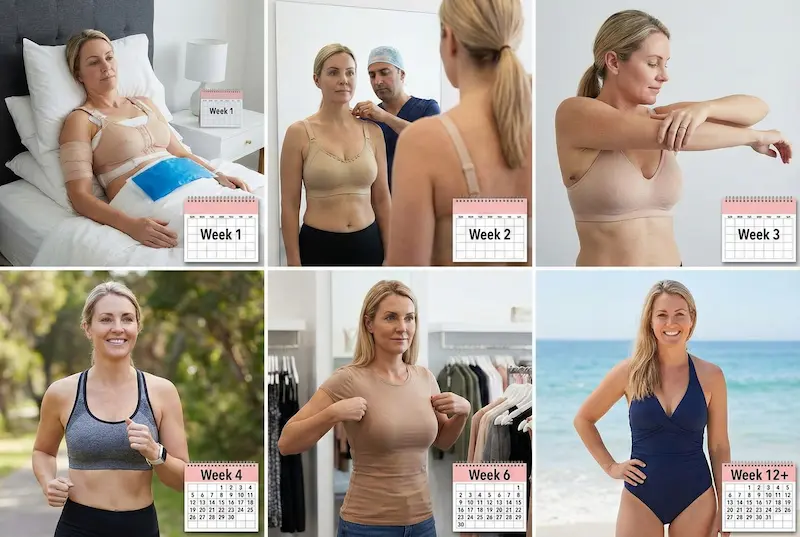
Breast Lift Recovery Week by Week (And If You Also Had Implants)
Breast lift recovery tends to feel different from abdominal healing. The abdomen often feels “tight and guarded,” while the chest can feel tender, heavy, and sensitive to arm movement—especially when you push up from a chair or reach overhead. When you combine procedures (common in a mommy makeover), the key is to choose movements and sleep positions that protect both areas at once.
Surgeon-led recovery principle: Early breast lift surgery recovery is about support and stability—minimizing bounce, pressure, and stretching so incisions can seal and swelling can settle predictably.
Breast lift recovery time: what most patients feel in Week 1–2
Patients often ask about breast lift recovery time as if there’s one “right” answer, but it’s best understood as a progression. In the first 1–2 weeks of recovery from breast lift, your main experiences are usually:
- Tenderness and tightness: especially when changing positions or standing up.
- Swelling and shape changes: breasts can look higher and firmer early on; this usually softens over time.
- Incision sensations: itching, light burning, or brief “zingers” as nerves wake up can be normal.
- Sleep challenges: back-sleeping is typically recommended early, which can be new for many people.
If you’re healing from a tummy tuck at the same time, Week 1–2 is when you’ll want your environment “built” around you: stable pillows/wedges, essentials within reach, and a plan for moving without using your core or pushing hard with your arms.
Support garments: surgical bra rules and comfort tips
A supportive surgical bra is one of the simplest ways to make breast lift recovery more comfortable. It reduces motion, helps swelling feel less dramatic, and keeps incision areas from being tugged by gravity.
- Follow your surgeon’s bra instructions exactly. The best garment is the one your team recommends for your technique and incision pattern.
- Avoid underwire early unless your surgeon specifically clears it—underwire can irritate incision zones.
- Fit matters: too tight can create pressure points; too loose doesn’t provide support.
- Keep it clean and dry: moisture around incisions can slow healing and irritate skin.
Travel-planning tip: If you’re staying in a hotel, pack or request an extra supportive, front-closure bra option so you’re not struggling with overhead movements.
Arm movement, lifting limits, and sleeping without pulling incisions
In early breast lift surgery recovery, arm movement is one of the biggest triggers for discomfort. Reaching overhead can pull on the chest and incision lines. Lifting can increase pressure and swelling. This is especially relevant if you’re simultaneously in recovery after tummy tuck, because you may be tempted to “use your arms more” to compensate for your core—yet overusing the arms can irritate breast incisions.
Practical rules many surgeons use (your plan may vary):
- Keep elbows closer to your sides during the first phase—avoid wide, forceful reaching.
- Lift limits: do not lift heavy bags, suitcases, or children until cleared.
- Sleep: back-sleeping with elevation is often recommended early; use side pillows to prevent rolling.
- Getting up: use slow, controlled movements and avoid “push-ups” from the bed with your arms.
When patients ask “recovery time for breast lift until I can move normally,” the answer is usually measured in weeks—not days. The first two weeks are the most protective, and then you gradually return to normal range of motion as cleared.
Breast lift recovery week by week: a realistic overview
This breast lift recovery week by week view gives you a practical structure for expectations. Always follow your surgeon’s specific milestones.
| Week | What’s common | What to focus on | What to avoid |
|---|---|---|---|
| Week 1 | Tenderness, swelling, incision sensitivity; sleeping on back | Support bra compliance, gentle walking, stable sleep setup | Overhead reaching, lifting, pressure on chest |
| Week 2 | Less acute soreness; swelling still fluctuates | Gradual independence, careful hygiene, consistent support | “Testing” workouts, carrying heavy items |
| Weeks 3–4 | Breasts begin to settle; discomfort becomes more situational | Incremental movement, scar routine (as advised) | High impact bouncing, underwire (unless cleared) |
| Weeks 6–12 | Most normal activities return; swelling reduces gradually | Progressive exercise (as cleared), long-term scar protection | Rushing heavy chest workouts without clearance |
Breast augmentation and lift recovery week by week: what changes (implant-related tightness)
If you had a lift and implants, the first phase can feel different. Patients often describe extra chest “pressure” or tightness because the tissues are adjusting to implant volume and the lift simultaneously. This doesn’t necessarily mean something is wrong—it’s a common part of breast augmentation and lift recovery week by week experiences.
- More tightness early: the chest can feel firmer in the first 1–2 weeks.
- Support becomes even more important: stable bra support helps comfort and reduces motion-related swelling.
- Movement needs to be controlled: sudden arm motions can feel sharper.
- Settling takes time: appearance changes as swelling resolves and tissues relax.
In combined cases, the best approach is to manage your recovery as an integrated plan: your tummy tuck recovery timeline may set your sleep position (elevated, hips flexed), while your breast procedure sets your “upper-body rules” (supportive bra, careful arm movement). Together, they guide a safer recovery after mommy makeover.
Key takeaway: If your recovery feels “uneven” (abdomen improving faster than chest, or vice versa), that can be normal. Focus on steady, surgeon-approved progress—especially in Weeks 1–2.
Swelling, Bruising, and “Normal vs Not Normal” During Recovery
Swelling and bruising are not “side effects”—they’re part of how your body heals after surgery. The tricky part is that swelling can change throughout the same day, which is why so many patients search for swelling day by day tummy tuck recovery and day by day tummy tuck recovery. When you also have a breast lift, swelling can feel “split” between two areas, each with its own rhythm.
The goal isn’t to chase a perfectly flat look in Week 1. The goal is to recognize what’s typical, follow your surgeon’s plan, and know when to speak up quickly.
Recovery mindset that prevents panic: Swelling often improves in a “two steps forward, one step back” pattern—especially in the evening or after increased activity.
Swelling day by day: why it can look worse before it looks better
During recovery after tummy tuck, swelling commonly ramps up in the first few days, then gradually becomes less intense—but it can still fluctuate for weeks. Many patients notice:
- More swelling at night than in the morning
- More swelling after long sitting/standing or increased walking
- Uneven swelling (one side may look “ahead” of the other temporarily)
Here’s a practical “pattern guide” for swelling day by day tummy tuck recovery in the first week (not a substitute for your surgeon’s instructions):
| Day | What swelling often feels/looks like | What helps most | What to watch closely |
|---|---|---|---|
| Day 0–1 | Early tightness; swelling begins; abdomen feels “full” and guarded | Elevation, protected sleep, short walks, hydration | Severe one-sided swelling with intense pain or new breathing symptoms |
| Day 2 | Swelling may increase; bruising becomes more visible | Consistent compression (as directed), gentle movement, routine | Rapidly increasing redness/warmth or foul drainage |
| Day 3 | Some patients notice slightly better comfort; swelling still prominent | Same setup nightly; avoid “testing” activity | Sudden new swelling spike + fever/chills |
| Days 4–7 | Swelling often “moves” and fluctuates; evening puffiness is common | Steady walking, consistent garments, salt awareness | Calf pain, dizziness that persists, incision changes that worsen |
When patients ask how long is recovery after a tummy tuck until swelling is “gone,” it helps to separate visible swelling from final settling. Many people look significantly better within weeks, but subtle swelling can come and go longer—especially after travel days, prolonged standing, or high-salt meals.
Drain and fluid management: what patients should track
If drains are used, they’re not a “bad sign”—they’re a tool to manage fluid during early recovery from tummy tuck. The key is simple tracking and gentle handling (no tugging). Your surgical team will tell you exactly what to record and when removal is appropriate.
Helpful tracking habits (if your team instructs):
- Record output amount and appearance at consistent times
- Keep tubing secured (clip/pin) to avoid accidental pulling
- Watch the skin around drain sites for increasing redness or irritation
Comfort tip for sleep: Many patients sleep better when drains are secured to a soft belt or pinned to a garment so they don’t swing or pull during position changes.
Warning signs that need a surgeon’s attention (red flags checklist)
Most recovery symptoms are uncomfortable but not dangerous. The problem is that serious issues can start subtly. If you’re in recovery time after tummy tuck or recovery time for breast lift, contact your team urgently if you notice:
- Shortness of breath, chest pain, or fainting
- Sudden, rapidly increasing swelling (especially one-sided) with escalating pain
- Fever or feeling systemically unwell (chills, severe weakness)
- Spreading redness, warmth, or worsening tenderness around incisions
- Foul-smelling drainage or pus-like discharge
- Calf pain, swelling, or new leg asymmetry
- Incision edges separating or sudden bleeding that doesn’t stop
If you’re unsure, ask. It’s always better to message or call your surgical team early than to “wait it out” with a symptom that’s escalating.
Scar protection habits that matter in the first 3 months
Scar quality isn’t determined in the first week—but your early habits influence the environment in which scars mature. During tummy tuck recovery and breast lift recovery, focus on protecting incisions from tension, irritation, and sun.
- Respect tension: Avoid sudden stretching, twisting, or lifting that pulls on incision lines.
- Keep incisions clean and dry as instructed (over-moisture can irritate healing skin).
- Sun protection: UV exposure can darken scars; keep them covered and protected.
- Scar products: Use only what your surgeon approves, and only when incisions are ready.
One more helpful thought for planning: scars typically look “worse before better” as they go through normal phases of redness and firmness. Your surgeon will guide timing and expectations as your body moves through the later stages of the tummy tuck recovery timeline and breast lift recovery week by week.
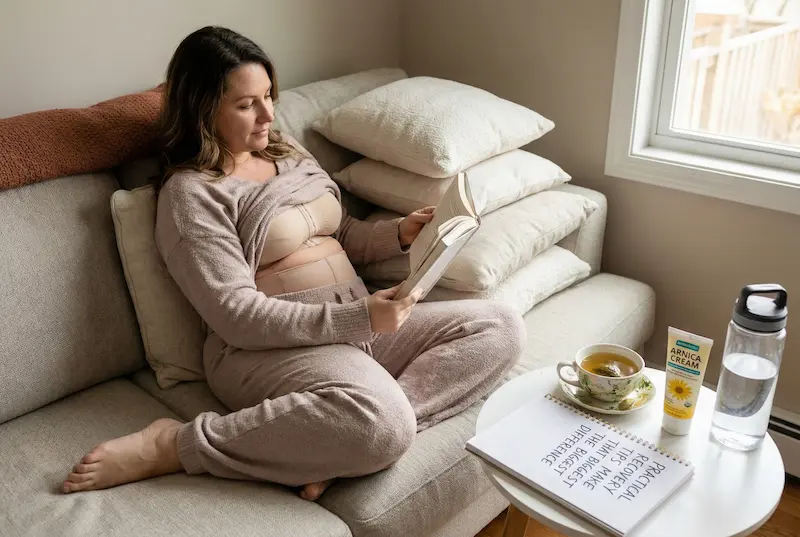
Practical Recovery Tips That Make the Biggest Difference (Hotel + Home Checklist)
When patients describe an “easier” tummy tuck recovery or smoother breast lift recovery, it’s rarely luck. It’s usually a simple system: consistent sleep positioning, a realistic walking routine, and fewer “friction points” (like reaching, twisting, or struggling with hydration and constipation). This section focuses on high-impact habits, supported by medical science, that support recovery after tummy tuck, recovery time after tummy tuck, and recovery time for breast lift—especially if you’re traveling and recovering in a hotel.
| Recovery Priority | What it prevents | What to do daily |
|---|---|---|
| Protected sleep setup | Incision tension, unnecessary swelling, poor sleep cycle | Elevated “beach chair” position + knee support + side pillows |
| Gentle walking routine | Stiffness, circulation problems, confidence loss | Short, frequent walks (as cleared) instead of one “big” walk |
| Hydration + nutrition | Constipation, fatigue, swelling worsened by poor intake | Small, protein-forward meals + steady fluids |
| Simple hygiene system | Skin irritation, avoidable stress around incisions/garments | Follow shower timing instructions + keep supplies organized |
Pain control + sleep support (safe habits, timing, routines)
Comfort matters because it directly affects your ability to sleep, walk, and stay calm during recovery after a tummy tuck and breast lift surgery recovery. The safest plan is always the one your surgeon prescribes, but these habits usually help:
- Stay consistent: Take prescribed medications exactly as directed—don’t “wait until it’s unbearable.”
- Protect your nights: Set your room so you don’t need to get up repeatedly (water, essentials, phone charger, tissues).
- Reduce “position fighting”: If you wake up uncomfortable, adjust pillows before you adjust your body.
- Keep movements slow: Sudden twisting can spike pain and swelling during early recovery from tummy tuck.
Most helpful mindset: Early recovery sleep is not about “8 perfect hours.” It’s about safe, repeated rest blocks that keep swelling and tension under control.
Walking schedule & circulation: reducing stiffness and risk
Gentle walking is one of the most powerful tools in tummy tuck recovery time and recovery from breast lift. It supports circulation, reduces stiffness, and improves confidence—without requiring strenuous effort.
- Short and frequent wins: A few minutes, several times per day (as cleared), is often better than one long walk.
- Posture patience: A slightly flexed posture can be normal early in your tummy tuck recovery timeline. Don’t force yourself upright aggressively.
- Use support: If you’re in a hotel, map the shortest “walking loop” in your room or hallway so you can move safely.
If your goal is to understand tummy tuck recovery week by week, walking is usually the activity that expands first—long before lifting, stretching, or workouts return.
Nutrition/hydration + constipation prevention (the “silent” recovery issue)
Constipation is one of the most common reasons patients feel miserable in the first week—especially after anesthesia, reduced activity, and pain medications. It can also increase abdominal pressure, which feels uncomfortable during recovery time after a tummy tuck.
Helpful strategies (align with your surgeon’s guidance):
- Hydration rhythm: Sip steadily throughout the day instead of “catching up” at night.
- Protein-first meals: Healing needs protein—choose easy-to-digest sources.
- Fiber carefully: Gentle fiber can help, but don’t overload suddenly if your appetite is low.
- Plan your bathroom comfort: A raised toilet seat (if available) or sturdy support can reduce strain.
For many people, fixing hydration + constipation is the moment day by day tummy tuck recovery starts to feel noticeably easier.
Showering, incision hygiene, and garment management (simple system)
Hygiene can feel stressful because you’re trying to protect incisions while also staying clean and comfortable. The key is a simple system and strict adherence to your surgeon’s shower timing and wound-care rules.
- Organize supplies: Clean towels, mild cleanser (if approved), gauze (if needed), and a fresh garment within reach.
- Avoid long, hot showers early: Heat can worsen swelling for some patients and may make you lightheaded.
- Garment routine: Put it back on as instructed—many patients feel more secure and less “pulling” with proper compression support.
- Dryness matters: Keep incision areas dry as directed; moisture trapped under garments can irritate skin.
This is especially important in combined cases like recovery after tummy tuck and breast lift, because you’re managing both abdominal compression and chest support.
When advanced recovery support may help (HBOT / LLLT—where it fits in a recovery plan)
Some clinics offer supportive recovery technologies such as HBOT (hyperbaric oxygen therapy) and LLLT (low-level laser therapy) as part of a broader aftercare plan. These are not “shortcuts” that replace surgical technique, safe movement, and proper wound care—but they may be used to support comfort and recovery quality in certain patients, depending on your surgeon’s recommendation and your specific case.
- Think of them as supportive tools: They may be considered to help manage early recovery stressors (like swelling or tissue recovery support) as part of a structured plan.
- Not for everyone: Your eligibility depends on medical history, surgical details, and your surgeon’s protocol.
- Still follow the basics: Even with advanced support, the foundation remains sleep positioning, walking, nutrition, and incision care.
High-conversion truth (without hype): The best results come from a surgeon-led plan plus disciplined aftercare—not from any single “miracle” add-on.
Hotel + home recovery checklist (what makes life easier)
Whether you’re recovering at home or managing recovery after mommy makeover while traveling, these items reduce stress and unnecessary movement:
- Sleep support: wedge or recliner plan, knee pillow, two side pillows
- Clothing: front-closure tops, loose pants, slip-on shoes
- Basics: water bottle, straws, light snacks, lip balm, phone charger
- Mobility helpers: small bag for drains (if used), easy-access medications (as prescribed)
- Comfort: small pillow for car rides, light blanket, extra surgical bra option (if approved)
Travel & Logistics (For International Patients Planning Istanbul Recovery)
If you’re traveling for a combined procedure, your recovery plan needs to work in real life—not just in theory. During recovery after tummy tuck and breast lift, small logistics (room layout, transportation, flight-day comfort) can make the difference between a stressful first week and a calm, predictable routine.
This section is written for patients who want a practical plan—especially those asking: how long is recovery after tummy tuck before travel feels comfortable, and what to do to make recovery after mommy makeover more manageable away from home.
Setting up your hotel room for sleep and mobility (what to request/pack)
Your hotel room becomes your recovery “clinic.” Your goal is to reduce bending, twisting, and repeated standing up and sitting down—especially during early tummy tuck recovery time and breast lift recovery.
What to request (if possible):
- A room with elevator access and minimal walking distance from the entrance
- Extra pillows (you’ll use them to maintain the elevated “beach chair” position)
- A stable chair with arms (helps you stand up without straining your core)
- Easy bathroom access (less risk, less fatigue)
What to pack for smoother recovery:
- Compression-friendly clothing: loose, front-opening tops; soft pants; slip-on shoes
- Practical supports: a small pillow for car rides; a knee pillow if you have one
- Drain management items (if used): a small belt/pouch to secure drains while walking
- Comfort basics: water bottle, straws, snacks that are easy to digest
Hotel recovery tip: Put everything you’ll need for 24 hours within arm’s reach—medications (as prescribed), water, charger, tissues—so you’re not repeatedly getting up and down during the most protective phase of recovery from tummy tuck.
Returning flight comfort: posture, compression, and swelling management
Flight days can be a swelling trigger, especially if you’re in the early-to-mid part of your tummy tuck recovery timeline. Sitting for long periods, dehydration patterns, and reduced movement can make your abdomen and breasts feel more “puffy” or tight.
Comfort strategies many patients use (only if cleared by your surgeon):
- Choose an aisle seat so short walks are easier
- Walk briefly and regularly during the flight (as allowed)
- Hydrate steadily and avoid dehydration patterns
- Keep garments supportive as instructed (don’t “take breaks” unless your surgeon advises it)
- Use a small pillow between your abdomen and the seatbelt for comfort
It’s normal to notice more swelling on travel days—this doesn’t automatically mean you’re “backtracking.” It’s a common part of day by day tummy tuck recovery and settles again with routine, elevation, and walking.
“How soon can I fly?” (what affects timing and safety)
There isn’t one universal answer, because “safe to fly” depends on your medical history, the extent of surgery, whether drains are still in place, how your swelling is behaving, and your surgeon’s protocols.
Instead of focusing only on the calendar, ask your surgeon these practical questions:
- Am I cleared to fly based on my current exam?
- Do I still have drains, and does that change the plan?
- What swelling patterns are expected at my stage of recovery?
- What movement plan should I follow during travel?
- Are there any risk factors that change my timeline?
If your main worry is how long is recovery after a tummy tuck before travel feels comfortable, many patients find that comfort improves as mobility improves and sleep stabilizes—but your surgeon’s clearance is the only reliable green light.
Traveling solo vs with a companion: what reduces stress the most
It’s possible to travel solo, but it’s usually easier—and emotionally calmer—if you have a companion for at least the first few days. In combined procedures like recovery after tummy tuck and breast lift, you’re managing two areas with movement limitations, which makes small tasks (lifting a suitcase, opening heavy doors, reaching overhead) harder than expected.
If you’re traveling solo, plan for support in these areas:
- Airport logistics: wheelchair assistance can reduce strain and fatigue
- Luggage handling: avoid lifting or carrying heavy bags during recovery time after tummy tuck
- First-night essentials: set up your room so you’re not repeatedly reaching or bending
- Check-ins and follow-ups: keep your clinic contact info accessible and respond early if anything feels “off” during recovery after a tummy tuck
Planning truth: The best travel recovery plan is the one that minimizes “unexpected effort.” If you remove friction from your day, your body can focus on healing.
Recovery After Tummy Tuck and Breast Lift Frequently Asked Questions (FAQ):
Below are concise answers to the most common planning questions we hear from patients researching recovery after tummy tuck, tummy tuck recovery week by week, and breast lift recovery time—especially when procedures are combined as part of a mommy makeover.
Real patient perspective (US “expert patient”): “I actually look like nothing happened but probably 20 years younger.”
How long is recovery after tummy tuck?
Most patients feel meaningfully more functional within a few weeks, but recovery time after tummy tuck is best viewed in phases: the first 1–2 weeks are protective and routine-based, Weeks 3–6 are gradual return-to-normal, and longer-term tissue settling and scar maturation can continue for months. Your exact recovery time for tummy tuck depends on muscle repair, incision tension, drain use, and your surgeon’s protocol.
What is the tummy tuck recovery timeline week by week?
A practical tummy tuck recovery timeline often looks like this: Week 1 focuses on protected sleep, short walks, and swelling management; Week 2 improves mobility and independence; Weeks 3–4 bring fluctuating swelling with improving stamina; and Weeks 6–12 is where exercise and fuller routines typically return with clearance. If you want a detailed guide, follow the tummy tuck recovery week by week structure in this article and match it to your surgeon’s individualized rules.
What does mini tummy tuck recovery usually look like?
Mini tummy tuck recovery can feel easier for some patients because the correction area is smaller, but it’s still real surgery. Early recovery after mini tummy tuck typically still requires elevated sleep positioning, gentle walking, and avoiding lifting/twisting. Your surgeon will tell you whether your recovery after mini tummy tuck has different restrictions than a full tummy tuck—especially if muscle repair was performed.
How long is breast lift recovery time?
Breast lift recovery time varies, but many patients find the first 1–2 weeks are the most protective (support bra, careful arm movement, back-sleeping), with steady improvement through Weeks 3–6. Longer-term settling continues beyond that. If you’re tracking recovery from breast lift, focus on comfort trends (less tenderness, easier mobility) rather than expecting a “perfect” look early, since swelling and shape changes are normal.
What is recovery like after tummy tuck and breast lift together?
Recovery after tummy tuck and breast lift is manageable when you treat it as one integrated plan: your abdomen typically determines your sleep posture (elevated, hips slightly flexed), while your breast procedure determines your upper-body rules (supportive bra, gentle arm use, no heavy lifting). Most patients do best with a consistent “beach chair” sleep setup, short frequent walks, and an environment that minimizes bending and reaching.
How long is recovery after a mommy makeover?
Recovery after mommy makeover depends on which procedures were combined. In general, the first two weeks are the most structured, and then activity gradually expands over the following weeks with clearance. Because multiple areas are healing at once, fatigue can be more noticeable and swelling patterns can feel “uneven.” The safest approach is to follow your surgeon’s most restrictive rule as your baseline until you’re cleared to progress.
When does swelling typically go down after a tummy tuck?
Swelling is expected and often changes across the day—many patients look more swollen at night in early day by day tummy tuck recovery. In the first week, swelling can ramp up and fluctuate (swelling day by day tummy tuck recovery often feels unpredictable). Over the following weeks it usually becomes less intense, but subtle swelling may still appear after long days, prolonged sitting/standing, or travel. Consistent sleep elevation, surgeon-directed compression, gentle walking, hydration, and patience are the most reliable tools.
Travel-planning note from a US patient testimonial: “Transportation, the hotel, the surgery, the nurses, the doctors, the medications, everything is included.”
Final planning tip: If you’re comparing “how long is recovery after a tummy tuck” across different sources, make sure you’re comparing the same procedure type (full vs. mini, with or without muscle repair) and the same “endpoint” (walking comfortably vs. returning to full workouts vs. final swelling/scar maturation).
If you’d like to expand beyond Sleeping and Recovery Tips After a Tummy Tuck and Breast Lift, you can also explore our related resources on Fly After Facelift, Flight Safety After Surgery, Solo Travel Surgery İstanbul, and What to Pack For Surgery. These guides complement your recovery knowledge by addressing common travel-related concerns, from when it’s medically appropriate to fly, to how to stay safe during long flights, and how to prepare if you’re traveling alone for surgery. Together, they provide practical, real-world support—helping you plan not only comfortable sleep and healing, but also a smoother, safer overall surgery and travel experience from start to finish.