If you’re researching how to minimize facelift scars laser options can help with, you’re already thinking like an “expert patient”: you want natural-looking results and a recovery plan that supports clean, quiet healing—especially around high-visibility areas like the hairline and ears.
Here’s the truth: facelift scars are real, expected, and (in most cases) strategically placed to be discreet. What separates “hard-to-notice” from “noticeable” is a combination of (1) surgical planning and technique, (2) your biology and daily habits, and (3) how intelligently recovery is supported—where laser treatment to minimize facelift scars (like LLLT) may play a role.
In this guide, we’ll break down why scars form, what “normal” healing looks like week by week, and how LLLT is used to reduce facelift scars with laser-based recovery support—without hype or unrealistic promises.
Table of Contents
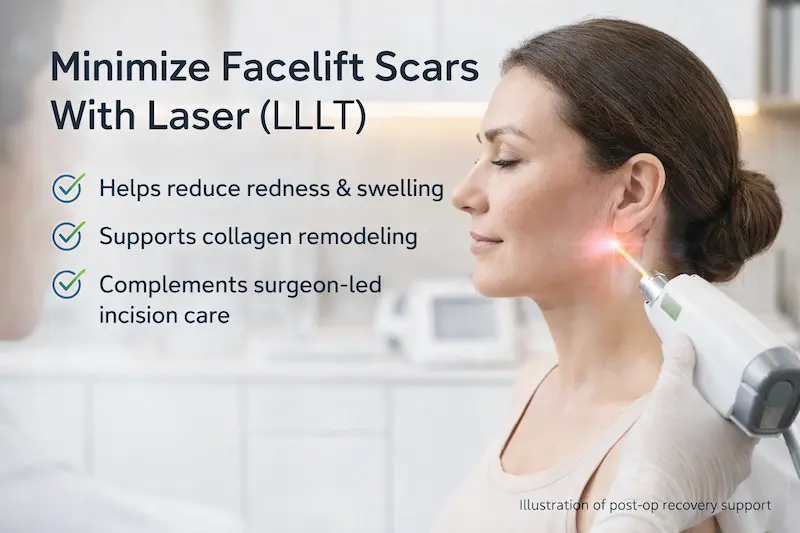
Why Scars Happen After Cosmetic Surgery (And What “Normal” Looks Like)
Every facelift—whether it’s a deep plane facelift, SMAS facelift, extended high SMAS facelift, mini facelift, a lower facelift, or an endoscopic facelift—involves controlled incisions. Your body responds the same way it always does: it repairs the wound by building new collagen. That collagen is what eventually becomes a scar.
Incision placement, tension, and why technique matters
The best scar is the one that’s planned to hide in plain sight. In facelift surgery, that usually means incisions designed around natural transitions:
- Facelift scars hairline: placed to blend into the hair-bearing scalp or hairline contours.
- Facelift scars in front of ears: typically positioned along natural creases so the line reads like anatomy, not surgery.
- Facelift scars behind ears: used to conceal portions of the incision and manage skin redraping.
Just as important as “where” is how the tissue is handled. Excess tension on the skin closure can widen scars, pull on the hairline, or make scars more visible. This is one reason advanced methods like deep plane facelift scars (when properly executed) can heal favorably: the lift is supported at deeper layers rather than relying on skin-tightening alone.
At AKM Clinic, facelift planning is surgeon-led and benefits from a dual-skill approach—combining facial plastic surgery expertise with a Dermatosurgeon who focuses on skin quality, incision design, and long-term scar aesthetics. The goal isn’t “scar-free.” The goal is scars that mature quietly and stay hard to detect.
Personal factors that change scar visibility (skin type, genetics, smoking, sun)
Even with excellent technique, your biology matters. Scar appearance is influenced by:
- Genetics (some people naturally form thicker or more pigmented scars)
- Skin tone and pigment response (post-inflammatory darkening can make scars more noticeable)
- Smoking / nicotine (reduces oxygen delivery and can slow healing)
- Sun exposure (UV can darken scars and prolong redness)
- Aftercare consistency (silicone, gentle cleansing, and timing matter)
This is why any plan to minimize scarring after facelift with laser should still start with fundamentals: clean wound care, sun protection, and surgeon-guided follow-up.
Scar timeline: inflammation → collagen remodeling → maturation
Patients often worry when scars look “worse” before they look better. That’s normal. Below is a practical reference for what many patients see—especially around the ear and hairline incision lines.
| Time Point | What You May Notice | What It Usually Means |
|---|---|---|
| 1 week (including 1 week post op deep plane facelift scars) | Swelling, bruising, tightness; incisions look “fresh” or slightly raised | Early healing + inflammation phase (normal) |
| 2 weeks (facelift scars after 2 weeks) | Red/pink lines, mild firmness; makeup may still be avoided near incisions | Collagen is being laid down; scar is “active” |
| 4 weeks (facelift scars after 4 weeks) | Less bruising, less swelling; scars may still look red or feel firm | Remodeling phase begins—this is when scar quality can be influenced |
| 3–6 months | Redness gradually fades; texture softens | Ongoing remodeling; consistency matters |
| 6–12+ months | Scars flatten and lighten (most noticeable improvements happen here) | Maturation phase (final scar “character” becomes clear) |
Key takeaway: If you want to speed up facelift recovery and improve how scars settle, the most important window is often weeks 2–8—when swelling is decreasing but scar remodeling is still very active.
This is also the period when many patients ask about minimize facelift scars with laser strategies—and specifically whether a gentle, non-ablative option like LLLT can support better scar quality.
“My surgery was fabulous, with no pain and minimal bruising.” — Barbara (USA)
What Is Low-Level Laser Therapy (LLLT)?
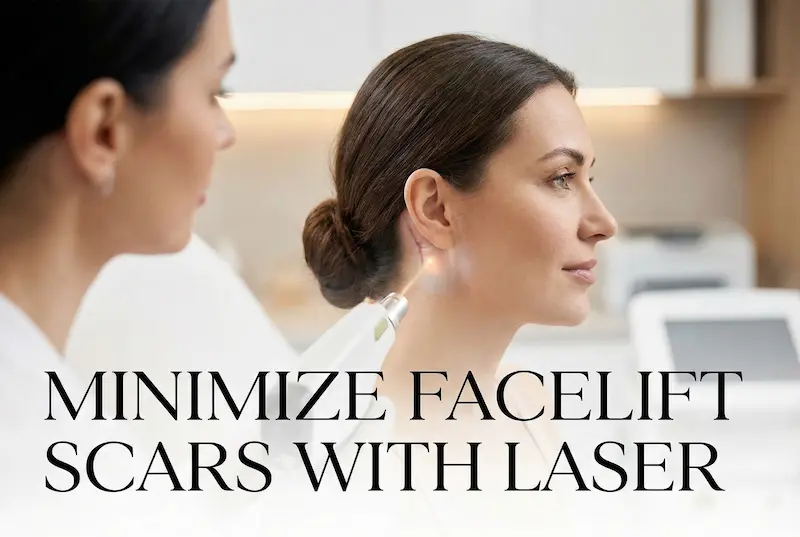
Low-Level Laser Therapy (LLLT)—often called photobiomodulation—is a non-ablative light-based treatment used to support healing. If you’re looking for ways to minimize facelift scars with laser, it’s important to know that LLLT is not the same thing as aggressive “skin resurfacing” lasers. It’s designed to be gentle: no burning, no peeling, no intentional wounding.
LLLT explained in plain English (light therapy, not “laser resurfacing”)
Think of LLLT as “cell-support light.” The goal is to deliver a specific wavelength of light energy to tissue so cells can function more efficiently during recovery. In AKM Clinic’s recovery protocols, the LLLT system used for post-surgical support is described as a low-level laser device (with 650 nm light) intended to stimulate cellular activity without heat damage.
Why does that matter for facelift scars?
- Scar quality is influenced by the inflammatory response (redness, swelling).
- Scar texture and firmness are influenced by how collagen is produced and organized.
- Incision zones (like facelift scars in front of ears, facelift scars behind ears, and facelift scars hairline) benefit from calm, steady healing because they’re easy to notice if irritated.
What a session feels like and how long it typically takes
Most patients describe LLLT as comfortable. You typically feel warmth at most—often nothing at all. Because it’s non-ablative, there is usually no “downtime” from the session itself. This is one reason many patients researching laser treatment to minimize facelift scars are drawn to LLLT early in facelift recovery.
Timing is medical. Your surgeon decides when it’s appropriate to start, based on incision closure, skin response, and your specific procedure (for example: deep plane facelift scars vs SMAS facelift scars vs endoscopic facelift scars vs mini facelift scars or lower facelift scars).
What LLLT can and cannot do for a surgical scar
LLLT can be a supportive tool to reduce facelift scars with laser-based care—but it’s not a magic eraser.
- Can help: support calmer healing, reduce prolonged redness, and encourage more favorable scar “maturation” (how the scar softens and fades over months).
- Cannot do: guarantee “scar-free” results, override poor incision placement, or replace proper wound care and sun protection.
| Treatment Type | What It Does | Typical Role in Scar Care |
|---|---|---|
| LLLT (Photobiomodulation) | Supports cellular activity without intentionally damaging skin | Often used to support early healing and scar quality during facelift recovery |
| Ablative / resurfacing lasers | Creates controlled micro-injury to remodel skin surface | Usually considered later (not “early incision” care) and only when appropriate |
| Silicone + scar care basics | Helps hydration/occlusion and supports scar flattening | Foundational, often paired with other modalities |
Clinical mindset: The best approach to “minimize facelift scars laser” patients worry about is layered: surgical planning first, then recovery support (like LLLT), then long-term scar maturation care.
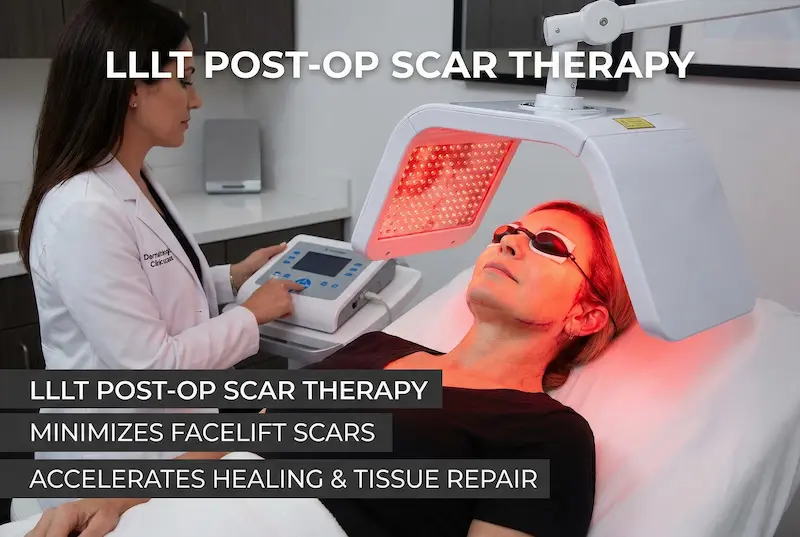
How to Minimize Facelift Scars with Laser Therapy (LLLT)
When people search minimize facelift scars laser, they’re usually asking a very specific question: “Can laser help my incision lines look less noticeable—especially around the ears and hairline—while I’m still early in recovery?”
LLLT is positioned as a recovery-support tool that aims to influence the biology behind scar formation. At AKM Clinic, its post-facelift use is described through three practical mechanisms: cellular repair support, collagen support, and inflammation control—often discussed alongside strategies to speed up facelift recovery responsibly.
Supporting collagen organization and scar “texture” over time
Scars don’t just “fade”—they remodel. During remodeling, collagen is reorganized and the scar typically becomes flatter and softer. In AKM Clinic’s description of LLLT, the therapy is used to stimulate fibroblast activity and support collagen synthesis—an element that can matter for patients worried about firmness or texture along extended high SMAS facelift scars or longer incision patterns.
Important nuance: “More collagen” isn’t always better—what you want is well-organized collagen and a calm healing environment. That’s why surgeon-guided timing and dosage matters more than simply doing “more sessions.”
Reducing inflammation and swelling to improve early healing
Early inflammation is normal. But prolonged redness, swelling, and irritation can make facelift scars look louder than they need to be—especially at high-visibility points like facelift scars in front of ears.
In AKM Clinic’s recovery positioning, LLLT is described as helping reduce inflammation, and it is noted to work “in tandem” with HBOT (Hyperbaric Oxygen Therapy) to further diminish post-operative swelling and redness. That combination is designed to support a smoother recovery experience—without claiming miracles.
Improving local circulation to support recovery
Healthy healing requires oxygen and nutrient delivery. LLLT is commonly discussed in terms of supporting microcirculation and cellular energy production. In AKM Clinic’s description, 650 nm light energy is absorbed at the cellular level and associated with increased ATP (cell energy), supporting repair processes during facelift recovery.
Practically, this is why some patients consider LLLT as part of a broader plan to minimize scarring after facelift with laser—particularly during the weeks when scars are active and easily irritated (for example, concerns like facelift scars after 2 weeks and facelift scars after 4 weeks).
Reality check: Even the best “reduce facelift scars with laser” strategy still depends on fundamentals—incision care, sun avoidance, and avoiding nicotine—because these can make or break how scars mature.
What the Evidence Says About LLLT for Scar Quality
Patients searching “minimize facelift scars laser” often want one thing: confidence that this is more than a trend. The evidence around Low-Level Laser Therapy (LLLT) / photobiomodulation is still evolving, but clinical research has explored how controlled light exposure may support wound healing and improve scar characteristics—especially when used as part of a structured, surgeon-supervised recovery plan.
Findings researchers commonly measure (redness, thickness, pliability)
When studies evaluate scar outcomes, they typically look at observable and measurable features such as:
- Redness (how “pink” or inflamed the scar appears)
- Thickness / elevation (whether the scar is raised)
- Pliability (how soft and flexible the tissue feels)
- Texture (smooth vs. uneven)
- Symptoms (itching, tightness, tenderness)
These are exactly the details patients ask about in real life—especially around high-visibility incision sites like facelift scars in front of ears, facelift scars behind ears, and facelift scars hairline.
What studies don’t always capture (individual variability, technique differences)
Two patients can have the same “type” of facelift and completely different scar journeys. That’s because scar behavior is influenced by variables research can’t standardize perfectly, including:
- Procedure differences (e.g., deep plane facelift scars vs SMAS facelift scars vs extended high SMAS facelift scars vs endoscopic facelift scars)
- Incision design and closure technique (tension control matters)
- Skin biology (genetics, pigment response, tendency toward thick scars)
- Aftercare behavior (sun exposure, nicotine, sleep, nutrition)
So while LLLT can be a meaningful part of a “minimize facelift scars with laser” strategy, it works best when it’s not treated as a standalone shortcut.
Setting realistic expectations: “less noticeable” vs “scar-free”
Here’s the standard you should hold any clinic to: a responsible team will talk about making scars less noticeable—not promising “no scars.” Even with excellent care, it’s normal to see visible healing stages:
- 1 week post-op (including 1 week post op deep plane facelift scars): incisions look fresh; swelling and bruising are common.
- 2 weeks (facelift scars after 2 weeks): lines are often red/pink; firmness may be noticeable.
- 4 weeks (facelift scars after 4 weeks): bruising usually improves, but scars may still look “active.”
| Goal | What It Looks Like in Real Life | What Helps Most |
|---|---|---|
| Less noticeable scars | Thin, flat lines that blend into natural creases/hairline | Surgeon-led planning + low-tension closure + consistent recovery support (LLLT/HBOT where appropriate) |
| “Scar-free” expectation | Unrealistic for surgical incisions | Not a credible promise—focus instead on scar maturation and concealment |
Bottom line: If your goal is to reduce facelift scars with laser, the best outcome comes from combining smart incision design, meticulous closure, and a recovery protocol that supports calm healing—then giving scars the time they need to mature.
AKM Clinic Approach to Scar Minimization During Recovery
At AKM Clinic, scar outcomes are approached as a continuum: surgical planning first, then recovery support designed to help you speed up facelift recovery safely—especially during the “active healing” window when scars are most responsive to careful management.
When LLLT is introduced in the recovery timeline
LLLT for scar support is not a one-size-fits-all timetable. The clinic’s approach emphasizes that timing depends on incision status, skin response, and the procedure performed (for example, a mini facelift vs a lower facelift vs a full deep plane facelift).
In practice, patients commonly ask about LLLT right around the time scars look “most obvious”—typically the phase that includes facelift scars after 2 weeks and facelift scars after 4 weeks. That’s also when structured follow-up matters most: starting too early or pushing too aggressively is never the goal.
How LLLT can be paired with other recovery-support technologies (e.g., HBOT)
AKM Clinic positions two post-operative technologies as key pillars of recovery support:
- LLLT: described as a low-level laser system (650 nm) used to support cellular repair, collagen processes, and inflammation control.
- HBOT (Hyperbaric Oxygen Therapy): framed as a major safety-focused recovery tool—supporting tissue oxygenation, swelling reduction, and wound healing.
This combination is particularly relevant for patients who want to minimize scarring after facelift with laser while also caring about overall recovery quality—because swelling, irritation, and prolonged redness, as supported by scientific research, can make incision lines look more conspicuous around the ears and hairline.
Surgeon-led philosophy: “People should notice a refreshed appearance, not an obvious surgical procedure.”
Surgeon-led follow-up: how scar progress is monitored and adjusted
Scar management is not “set it and forget it.” AKM Clinic’s approach is built around follow-up that evaluates scar behavior and adapts the plan—especially for patients concerned about:
- Facelift scars hairline visibility (hairline integrity and blending)
- Facelift scars in front of ears (creases, redness, and texture)
- Facelift scars behind ears (comfort, tightness, and maturation)
- Different technique footprints (e.g., SMAS facelift scars vs extended high SMAS facelift scars)
This is also where AKM Clinic’s team advantage matters: a Dermatosurgeon perspective focuses on skin quality and scar aesthetics (not only the lift mechanics), while the plastic surgery team focuses on deeper structural outcomes. For an “expert patient,” that dual focus is often what makes results look natural—and scars less detectable.
“I only took painkillers for probably one day.” — Sarah (UK)
Safety, Contraindications, and Who Is a Good Candidate
When patients ask about laser treatment to minimize facelift scars, the most important question isn’t “Does it work?”—it’s “Is it appropriate for me, at this point in my facelift recovery?” LLLT is generally positioned as a gentle, non-ablative support therapy, but timing and suitability still matter—especially if you’re healing from a more advanced technique (e.g., deep plane facelift scars or extended high SMAS facelift scars) or if your incision zones are sensitive (like facelift scars hairline and facelift scars in front of ears).
Who benefits most (scar-prone patients, thicker scars, redness concerns)
In practice, the patients most interested in ways to minimize facelift scars with laser are those who:
- Have a history of scars staying red/pink for longer than expected
- Notice early firmness or “ropey” texture along incision lines (common anxiety around week 2–4)
- Are concerned about visibility in high-attention zones (hairline, in front of the ear, behind the ear)
- Want a structured plan to speed up facelift recovery responsibly (not aggressively)
It can also be helpful when patients are comparing scar footprints across techniques—such as SMAS facelift scars vs mini facelift scars vs endoscopic facelift scars—because the “best” scar outcome is still a combination of incision design, closure mechanics, and calm biology during healing.
Surgeon-led perspective: The goal isn’t to chase “scar-free.” It’s to guide scars toward a mature, thin, flat line that blends into anatomy—especially around the ear and hairline.
Who should avoid or delay LLLT (photosensitivity, certain conditions/meds)
Even though LLLT is considered gentle, not everyone should start immediately—or at all—without surgeon review. You may need to delay or avoid LLLT if you have:
- Photosensitivity (light sensitivity) due to a medical condition
- Medications known to cause photosensitivity (your surgeon should review your full list)
- Active infection, wound separation, or concerning drainage at the incision
- Uncontrolled health issues that already compromise wound healing
This is also where AKM Clinic’s team structure matters: scar aesthetics aren’t only “plastic surgery mechanics.” A Dermatosurgeon lens helps evaluate skin quality, redness patterns, pigment behavior, and the safest timing for scar-focused interventions—while the plastic surgery team monitors deeper healing stability.
Side effects: what’s typical vs what’s a red flag
Many patients report that LLLT sessions feel neutral or mildly warm. But your incision sites are still healing, so it’s essential to separate normal post-op changes from warning signs—especially in the early weeks (including concerns like facelift scars after 2 weeks and facelift scars after 4 weeks).
| What You Notice | Usually Normal During Facelift Recovery | When to Contact Your Surgeon |
|---|---|---|
| Pink/red incision line | Common at 1–4+ weeks (scars are “active”) | If redness is rapidly spreading, hot, or worsening day-to-day |
| Mild firmness along the scar | Common as collagen is produced | If it becomes severely painful, increasingly swollen, or forms a hard lump suddenly |
| Itching or tightness | Often part of normal healing | If accompanied by rash, blistering, or intense burning |
| Small areas of dryness/scabbing | Can occur as the incision seals | If there is thick yellow/green drainage or foul odor |
| Asymmetry in swelling | Swelling can be uneven early on | If one side suddenly swells significantly or becomes very painful |
If your goal is to reduce facelift scars with laser, the safest approach is always: incision stability first, then supportive modalities like LLLT, and consistent follow-up—especially for areas patients commonly scrutinize such as facelift scars behind ears and facelift scars in front of ears.
Patient reality check: At week 1–2 (including “1 week post op deep plane facelift scars”), scars are not meant to look “finished.” They’re meant to be protected while the real scar-improvement work happens over months.
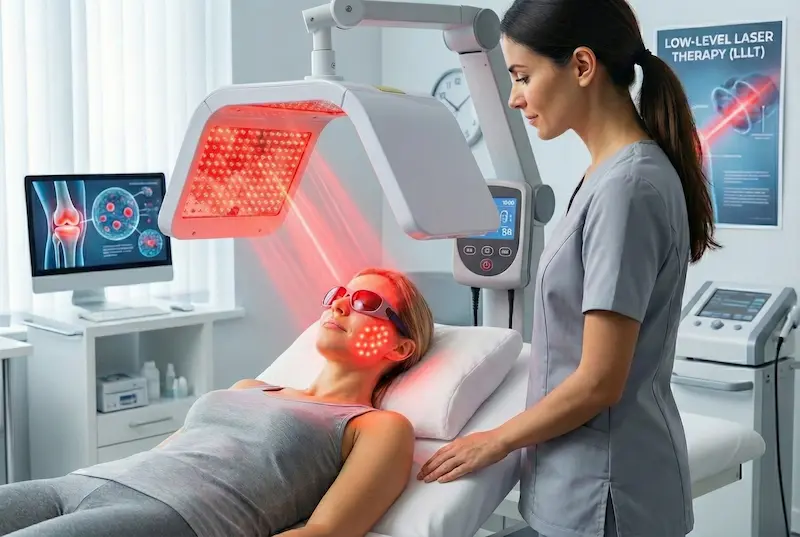
At-Home Habits That Make or Break Scar Healing
Even the best in-clinic plan to minimize facelift scars laser patients worry about can be undermined by daily habits—especially during the “active” scar window (often the same period when people Google facelift scars after 2 weeks or facelift scars after 4 weeks). Think of LLLT and HBOT as supportive tools; your at-home routine is the foundation that determines how quietly facelift scars mature.
Sun protection and why UV is the #1 scar “darkening” trigger
If there’s one non-negotiable for anyone trying to reduce facelift scars with laser (or any method), it’s UV protection. Fresh scars can darken more easily, and prolonged redness can last longer when scars are exposed to sun—particularly around facelift scars hairline and the ear area.
- Avoid direct sun on incision lines (especially in weeks 2–8).
- Use surgeon-approved sunscreen only when your team confirms incisions are ready.
- Physical barriers help: hats, staying in shade, and planning outdoor time carefully.
Practical reality: Many “laser treatment to minimize facelift scars” results look better because patients also commit to strict sun avoidance during facelift recovery.
Silicone, gentle massage, and when to start/stop
Silicone-based scar care (gel or sheets) is a common, evidence-supported baseline for surgical scar management—but timing matters. Starting too early or applying products to incisions that aren’t ready can irritate the skin and slow recovery. The same applies to scar massage: done too soon or too aggressively, it can increase inflammation.
What most surgeon-led plans emphasize:
- Silicone: helps support hydration/occlusion and can assist scar flattening once the incision is fully closed and cleared by your surgeon.
- Massage: gentle and targeted, introduced only when your surgeon confirms tissue stability—often after the earliest healing phase.
This becomes especially important for patients monitoring deep plane facelift scars (including the “1 week post op deep plane facelift scars” stage), where the tissues may feel tight early on. Early tightness is common—but it doesn’t mean you should “work the scar” immediately.
| At-Home Step | What It Helps With | Common Mistake to Avoid |
|---|---|---|
| Silicone (surgeon-approved) | Hydration + scar flattening support | Starting before incision is ready |
| Gentle scar massage (when cleared) | Softening firmness and improving pliability | Pressing too hard or starting too early |
| Consistent wound hygiene | Clean healing environment | Over-cleansing or using harsh products |
For patients with concerns about facelift scars in front of ears or facelift scars behind ears, the “behind-the-ear” region can be easy to irritate with glasses arms, masks, hair products, or sleeping pressure—small details that matter.
Nutrition, sleep, smoking, and recovery behaviors that affect collagen
If your goal is to minimize facelift scars with laser support, you’ll get better outcomes when your body has the resources to heal well. Scar quality is deeply linked to recovery basics:
- Nicotine avoidance: one of the most impactful steps for wound healing and scar quality.
- Sleep: supports recovery hormones and inflammation control.
- Protein and balanced nutrition: provides building blocks for tissue repair and collagen remodeling.
- Swelling management: following positioning instructions can help reduce tension and irritation on incision lines.
These habits matter across facelift techniques—whether you’re comparing SMAS facelift scars, extended high SMAS facelift scars, endoscopic facelift scars, mini facelift scars, or lower facelift scars. The “type” of facelift influences incision design and internal work; your daily recovery habits influence how the scar looks months later.
If you want to speed up facelift recovery: Focus on low-inflammation living (no nicotine, controlled sun exposure, good sleep, steady nutrition) and follow your surgeon’s timeline for any scar products or laser-based support.
Minimize Facelift Scars Laser Frequently Asked Questions (FAQ):
These are the questions patients most often ask when researching how to minimize facelift scars laser-supported recovery plans can help with—especially during the early “active scar” window of facelift recovery.
Does LLLT hurt?
LLLT is typically described as comfortable. It’s a non-ablative therapy (no intentional skin injury), so most patients feel little to nothing during the session—sometimes mild warmth. If you feel burning, worsening pain, or unusual irritation around incisions, contact your surgical team.
When will I start seeing scar improvement?
Scars often look most noticeable early on. It’s common to see pink/red lines at facelift scars after 2 weeks and even facelift scars after 4 weeks. Meaningful “quieting” (less redness, softer texture) usually happens gradually over months, with the most noticeable changes often occurring between 3–12+ months as scars mature.
How many LLLT sessions are typically needed?
There isn’t one universal number. The right schedule depends on your procedure (e.g., deep plane facelift scars vs SMAS facelift scars vs endoscopic facelift scars), your skin’s healing response, and how your incisions look at follow-ups. The safest approach is a surgeon-guided series that’s adjusted based on real-time healing—not a fixed “package” for everyone.
Can LLLT completely remove facelift scars?
No. Surgical incisions heal with scars. The realistic goal is to reduce facelift scars with laser-supported recovery so scars become thin, flat, and hard to detect—especially in strategic locations like facelift scars hairline, facelift scars in front of ears, and facelift scars behind ears.
Is LLLT the same as laser resurfacing?
No. LLLT (photobiomodulation) is designed to support healing at the cellular level without heat damage or peeling. Resurfacing lasers create controlled micro-injury to remodel the skin surface and are typically considered later (if needed) and only when incisions are fully stable. If your goal is to minimize facelift scars with laser early in recovery, LLLT is usually the gentler category being discussed.
Can LLLT help with “problem areas” like hairline or behind-the-ear scars?
Those areas are exactly why recovery support matters. Facelift scars hairline can be more noticeable if there’s irritation, tension, or pigment change. Facelift scars behind ears can be irritated by sleeping pressure, mask straps, glasses arms, or hair products. LLLT may support calmer healing, but protecting the area (and following surgeon instructions) is what truly makes or breaks the outcome.
Is LLLT included in the recovery plan, or is it an add-on?
That depends on your personalized surgical plan. At AKM Clinic, LLLT is positioned as part of an advanced recovery-support approach (alongside technologies like HBOT) when appropriate for the patient and procedure. Your team should explain what’s included, what’s optional, and—most importantly—why it’s recommended for your specific case (for example, extended high SMAS facelift scars vs mini facelift scars vs lower facelift scars).
Patient insight: Dilek (Germany) gave the clinic a “100 percent” recommendation and said she was “super, super, super satisfied.”
If you’d like to go beyond scar care, you can also explore related topics such as Minimize Facelift Scars Laser protocols, Hyperbaric Oxygen Therapy Benefits for post-op recovery support, and how Natural Hairline Design helps keep incisions discreet and results natural-looking. We also cover practical travel planning, including when you can Fly After Facelift and what to know about Flight Safety After Surgery, so you can make informed decisions before returning home.