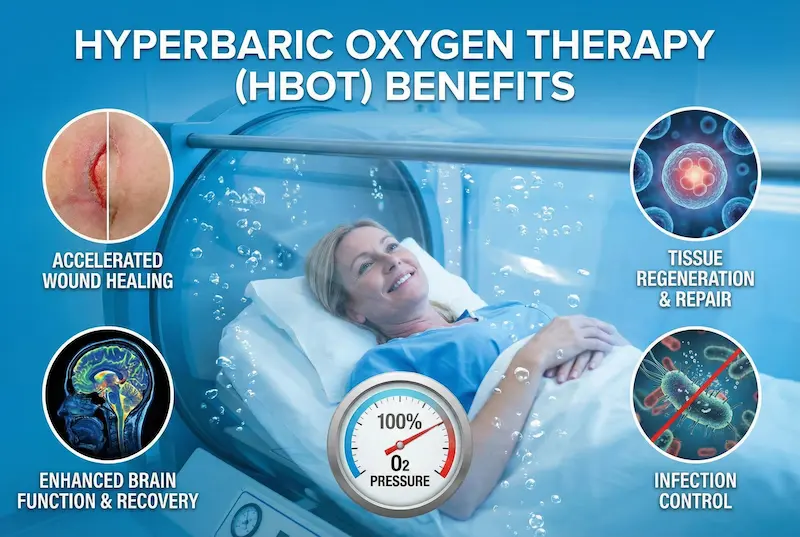
Hyperbaric Oxygen Therapy (HBOT) is a medically supervised therapy where you breathe 100% oxygen inside a hyperbaric oxygen therapy chamber (also called a hyperbaric oxygen chamber) while the air pressure is increased above normal atmospheric pressure. Patients often find us through questions like: “what is hyperbaric oxygen therapy?” and “what does a hyperbaric chamber do?”—especially when they’re planning hyperbaric oxygen therapy after plastic surgery or looking for hyperbaric oxygen therapy fast recovery support.
At AKM Clinic (Istanbul), we use HBOT hyperbaric oxygen therapy as part of an evidence-informed recovery strategy for eligible patients—particularly those who want a safer, more predictable healing phase after procedures where swelling, bruising, and tissue stress are expected. This article explains the science in plain English, sets realistic expectations, and clarifies what “hyperbaric chamber benefits” can (and cannot) mean in a post-op setting.
Key takeaway: HBOT doesn’t “replace healing.” It supports healing by increasing oxygen availability to tissues at a time when your body is working hard to repair itself.
Table of Contents
Hyperbaric Oxygen Therapy (HBOT), Explained in Plain English
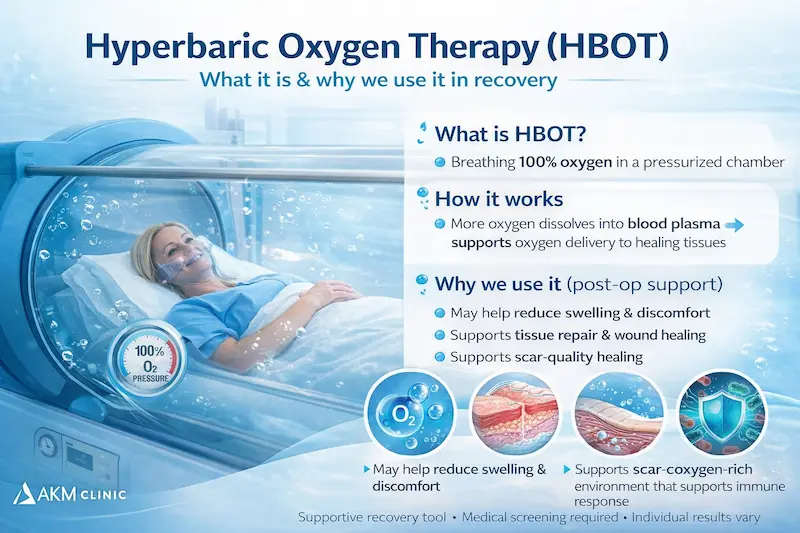
If you’ve searched “whats a hyperbaric chamber” or “what is a hyperbaric chamber used for,” here’s the simplest accurate explanation:
What happens inside a hyperbaric chamber?
During hyperbaric chamber therapy, you relax in a sealed chamber while the pressure is gradually increased. You breathe oxygen (typically through a mask or hood system, depending on the chamber design). The session is supervised and structured—this is not the same experience as trying to “biohack oxygen” at home.
Because the pressure is higher than normal, your lungs can take in more oxygen than usual, and your bloodstream can carry more oxygen to tissues. In a recovery context, that matters because tissues repairing after surgery can be temporarily “oxygen-hungry.”
| Quick HBOT Snapshot | What It Means for Patients |
|---|---|
| Where it happens | Inside a hyperbaric oxygen therapy chamber (a sealed, pressure-controlled environment) |
| What you breathe | 100% oxygen |
| What changes | Pressure rises above normal atmospheric pressure, increasing how much oxygen your body can carry and deliver |
| Common recovery goal | Support tissue oxygenation during the post-procedure period (when swelling and inflammation can temporarily reduce micro-circulation) |
| What it is NOT | Not a “miracle anti-aging hack,” not a substitute for surgeon technique, and not automatically right for everyone |
Why pressure + 100% oxygen changes oxygen delivery
Under higher pressure, oxygen dissolves more effectively into the plasma portion of blood. In practical terms, this can help oxygen reach areas where circulation is temporarily stressed—like post-op tissues affected by swelling. This is one reason people research wound healing hyperbaric oxygen therapy and hyperbaric oxygen therapy wound healing effectiveness when planning recovery timelines.
Patients often describe the perceived benefits of hyperbaric oxygen therapy in recovery as “less tightness,” “less puffiness,” or “feeling more comfortable sooner.” It’s important to note: comfort and appearance-based recovery are not identical to deeper healing, but they’re both meaningful to patients—especially those traveling internationally.
What HBOT is not (common misconceptions)
- HBOT is not the same as a personal hyperbaric chamber marketed for wellness. Many “personal hyperbaric chamber” devices operate at lower pressures and may not follow medical-grade protocols. If you’re comparing “oxygen health systems hyperbaric chamber” style consumer devices vs clinical HBOT, treat them as different categories and ask for specifications and oversight.
- HBOT is not automatically “anti-aging.” You may see claims like hyperbaric oxygen therapy anti aging or hyperbaric oxygen therapy benefits skin. Skin glow can be a short-term perception in some patients during recovery because swelling resolves and inflammation settles—but HBOT should be framed primarily as a recovery-support modality, not a promise of age reversal.
- HBOT is not a replacement for surgical expertise. For facial surgery outcomes to look natural, surgical planning and tissue handling matter first. At AKM Clinic, facial procedures are supported by a surgeon-led approach that includes dermatosurgical expertise alongside the plastic surgery team—because skin quality and underlying structure both influence the final result.
Safety-first mindset: If you’re specifically researching hyperbaric oxygen therapy post facelift or hyperbaric oxygen therapy after plastic surgery, the right question is not “Can I do HBOT?” but “Am I a good candidate for HBOT, and when does it make sense in my recovery plan?”
How HBOT Works: The “Oxygen-Rich Plasma” Mechanism
To understand hyperbaric oxygen therapy benefits, you don’t need a medical degree—but you do need one key idea: HBOT isn’t just “more oxygen.” It’s more oxygen delivered differently. In a hyperbaric oxygen therapy chamber, increased pressure helps oxygen dissolve into the liquid part of your blood (plasma) at higher levels than you can achieve at normal pressure. That’s why people researching what is hyperbaric oxygen therapy—and following the scientific research behind tissue oxygen delivery—often end up asking a more precise question: “How does HBOT actually change tissue oxygenation?”
Clinical logic: After surgery, tissues can be temporarily stressed by swelling and inflammation. HBOT aims to support oxygen availability during this demanding repair phase—without claiming to “speed-run” biology.
Breathing 100% oxygen in a pressurized chamber (the core setup)
During HBOT hyperbaric oxygen therapy, you breathe 100% oxygen while the chamber pressure is carefully increased. This combination is what makes therapy oxygen hyperbaric fundamentally different from breathing oxygen in a normal room (even if an oxygen concentrator is involved).
In plain terms, the pressure “packs” more oxygen into your bloodstream. This is also why you’ll see phrases like hyperbaric chamber benefits and hyperbaric oxygen chamber benefits—because the chamber environment is the mechanism, not a gimmick.
- Oxygen source: 100% medical-grade oxygen (not “oxygenated air” marketing)
- Environment: a sealed, monitored hyperbaric oxygen chamber with controlled pressure changes
- Goal: increase oxygen availability to tissues when your body is actively repairing
“Super-saturating” blood plasma and why that matters for healing
Most people know oxygen travels in blood—but the “how” is the important part. Under normal conditions, much of your oxygen is carried by hemoglobin (inside red blood cells). In HBOT, a larger amount of oxygen can also dissolve directly into plasma—the fluid portion of your blood.
Why does that matter? Because plasma can circulate through tiny vessels and tissue spaces where red-blood-cell flow may be temporarily reduced due to swelling. This is the core reason HBOT is associated with benefits of hyperbaric oxygen therapy in recovery discussions—especially in contexts like wound healing hyperbaric oxygen therapy and hyperbaric oxygen therapy wound healing effectiveness.
| What Changes in HBOT | What It Means in Recovery |
|---|---|
| More oxygen dissolved in plasma | Potentially improves oxygen availability to tissues that are temporarily “stressed” after surgery |
| Higher oxygen gradient to tissues | Supports the body’s natural repair processes that depend on oxygen (e.g., tissue regeneration and collagen-building pathways) |
| Better oxygen “reach” in microcirculation | Relevant when swelling or inflammation reduces optimal micro-blood-flow in the early post-op period |
How oxygen can diffuse into tissues where blood flow is temporarily compromised
After aesthetic surgery—especially facial procedures—swelling and inflammation can temporarily compress small blood vessels. This doesn’t automatically mean something is “wrong,” but it does mean oxygen delivery can be less efficient in certain zones while tissues are healing.
That’s where HBOT’s “diffusion advantage” is most relevant. By increasing oxygen content in plasma, HBOT can help oxygen move into tissues via concentration gradients, supporting areas that may be relatively under-supplied during early recovery. This is why some patients ask specifically about hyperbaric oxygen therapy post facelift or hyperbaric oxygen therapy after plastic surgery when they’re planning travel timelines and trying to reduce unpredictable downtime.
Important reality check: HBOT is a supportive tool—not a guarantee. It can’t override surgical technique, aftercare compliance, smoking status, uncontrolled medical conditions, or poor nutrition. When used appropriately and safely, it’s designed to assist the healing environment—not “force” healing.
Patient-centered way to think about it: If you’re asking “what is a hyperbaric chamber used for” after surgery, the most honest answer is: it’s used to support an oxygen-rich environment while your body does the real repair work.
Hyperbaric Oxygen Therapy Benefits: What Patients Actually Notice in Recovery
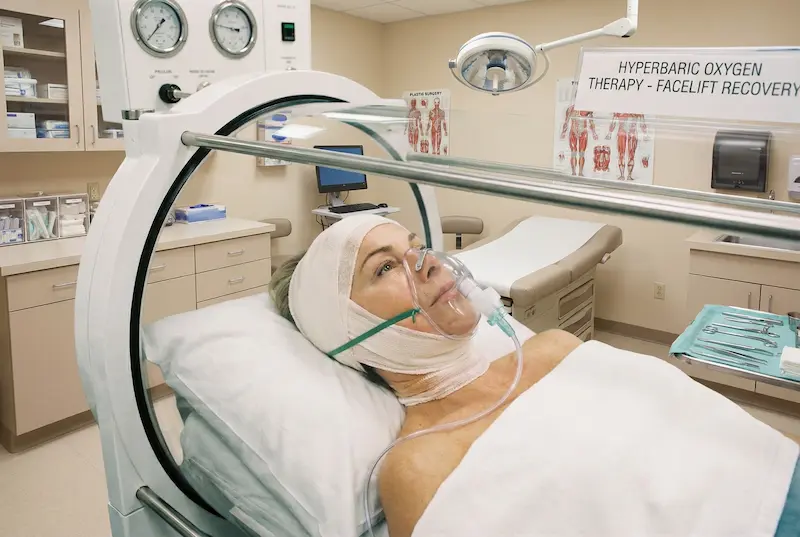
When people search hyperbaric oxygen therapy benefits (or the more specific “hyperbaric oxygen therapy after plastic surgery”), they’re usually trying to predict one thing: How will I look and feel in the first 1–3 weeks? In a medically supervised setting, the most realistic way to think about benefits of hyperbaric oxygen therapy is that it may support a healthier healing environment—especially during the early post-op period when swelling and inflammation can temporarily reduce optimal micro-circulation.
Below are the most common, patient-relevant “noticeable” effects people associate with hyperbaric chamber benefits during recovery—presented without hype and with clear boundaries.
Expectation-setting: HBOT is a recovery-support tool. It may help your body do what it’s already trying to do—heal—more comfortably and more predictably. It does not replace time, good surgical technique, or good aftercare.
Reduced swelling & shorter “social downtime”
One of the most frequently discussed hyperbaric oxygen therapy benefits after aesthetic procedures is the possibility of reduced swelling and a smoother early recovery experience. When tissues are better oxygen-supported, the body may manage inflammation more efficiently—potentially translating into less “puffiness” and faster return to a more social-ready appearance.
If you’re researching hyperbaric oxygen therapy fast recovery, this is the area where patients tend to be most interested—because “fast recovery” usually means looking presentable sooner, not skipping the biology of healing.
| Recovery Concern | What Patients Hope HBOT Helps With | What to Keep Realistic |
|---|---|---|
| Swelling | Potentially less swelling / less tightness over time | Swelling is normal; it fluctuates and may peak before it improves |
| Bruising | May feel like bruising resolves “cleaner” in some patients | Bruise color changes follow natural breakdown cycles (HBOT won’t erase bruises overnight) |
| “Social downtime” | Possibly earlier comfort with public-facing appearance | Your timeline depends on procedure type, skin quality, and your body’s response |
Tissue support: oxygen availability when tissues are under stress
Another set of benefits of hyperbaric oxygen therapy—especially relevant to surgical recovery—is tissue support during periods of increased demand. After procedures, the body is rebuilding micro-vessels, managing inflammation, and restoring tissue integrity. Oxygen is central to these repair processes.
This is why HBOT is often discussed in the context of wound healing hyperbaric oxygen therapy and hyperbaric oxygen therapy wound healing effectiveness: more oxygen availability can support repair pathways, particularly when tissues are temporarily stressed.
- What does a hyperbaric chamber do? It increases pressure so more oxygen can dissolve into blood plasma and reach tissues more effectively.
- What is a hyperbaric chamber used for in post-op care? To support oxygen delivery during a period when swelling may reduce optimal microcirculation.
Scar quality support: collagen-building processes (without promising “scar-free” healing)
Patients planning hyperbaric oxygen therapy post facelift or hyperbaric oxygen therapy after plastic surgery often ask about scars—especially if they’ve had poor scarring in the past. Oxygen plays a role in collagen-related pathways that support tissue repair, which is why HBOT is discussed as a supportive tool for scar healing quality.
That said, scar outcomes depend on many factors beyond oxygen: incision placement, surgical technique, tension management, infection prevention, genetics, smoking status, sun exposure, and adherence to aftercare. HBOT can be part of a thoughtful recovery plan, but it is not a “scar eraser.”
Best mental model: HBOT may support the conditions for better healing. It cannot override the fundamentals of scarring biology or replace proper incision care.
Infection-risk mitigation: supporting the body’s defense environment
When you look up hyperbaric oxygen therapy, you’ll see it discussed in broader medical contexts where oxygen-rich environments can support immune function. In post-op recovery, the goal isn’t to claim “zero infection risk”—that would be irresponsible. Instead, HBOT is sometimes considered as part of an overall strategy aimed at supporting healthy tissue conditions and recovery monitoring.
In plain language: better oxygen availability can support the body’s natural defense and repair response. But strict hygiene, proper wound care, and timely clinical follow-up remain the cornerstones.
Skin and “anti-aging” questions: what to believe, what to ignore
Search terms like hyperbaric oxygen therapy anti aging and hyperbaric oxygen therapy benefits skin are extremely common—especially among “expert patients” comparing multiple clinics and recovery protocols. Here’s the honest framing:
- During recovery, some patients feel their skin looks “better” as swelling settles and inflammation decreases. That can be perceived as a skin benefit.
- Long-term “anti-aging” claims are often oversimplified online. Skin aging is multi-factorial (sun exposure, genetics, collagen loss, lifestyle), and HBOT should not be marketed as a guarantee of reversal.
- Post-surgery context matters: If you’re doing HBOT, the primary goal is recovery support—not cosmetic “glow” promises.
| Claim You May See Online | What’s Reasonable to Expect |
|---|---|
| “HBOT makes you look 10 years younger.” | Not a responsible promise. Any perceived improvement may be related to reduced inflammation and recovery changes. |
| “Hyperbaric oxygen chamber benefits skin.” | Some patients perceive skin comfort/appearance improvements during recovery, but results vary. |
| “Benefits of hyperbaric chamber = instant results.” | HBOT supports healing conditions; it doesn’t instantly change your final surgical outcome. |
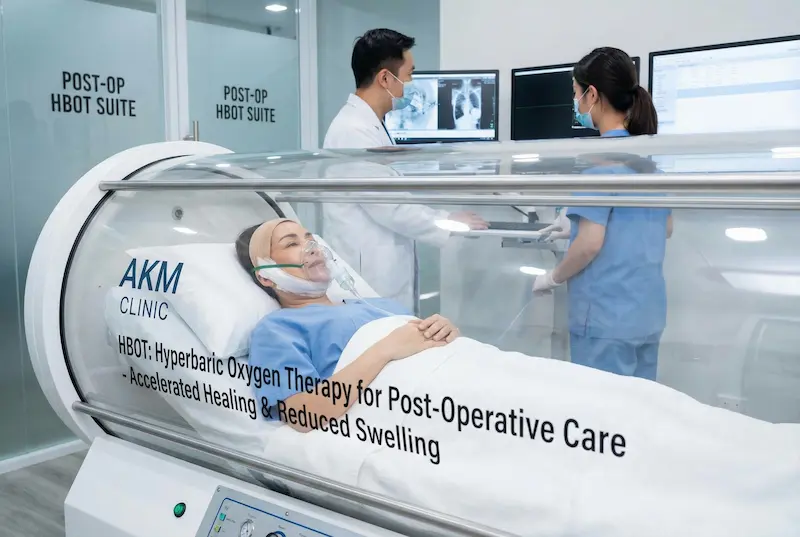
Why AKM Clinic Uses HBOT as Part of Post-Operative Care
When patients ask us about hyperbaric oxygen therapy—especially in searches like hyperbaric oxygen therapy post facelift or hyperbaric oxygen therapy after plastic surgery—the real question is usually about risk control and recovery predictability. Our approach is simple: if a therapy can support tissue oxygenation, comfort, and recovery quality for the right patient at the right time, we consider it as part of a structured, clinician-led protocol.
We do not position HBOT as a “luxury add-on.” We view it as a recovery-support technology that can be integrated into post-op care for eligible patients—particularly when swelling, inflammation, and tissue stress are expected during the early healing phase.
Clinic philosophy: Great outcomes are built on three pillars—surgeon-led planning, meticulous technique, and disciplined post-op recovery support. HBOT fits into the third pillar.
HBOT as an integrated recovery technology (not an “extra”)
Many patients arrive in Istanbul with a tight travel schedule and a clear goal: heal safely, minimize surprises, and get back to daily life with confidence. That’s why we think in systems. HBOT hyperbaric oxygen therapy is integrated where appropriate to support tissue oxygenation during the window when the body is working hardest to repair itself.
- Why a chamber? A hyperbaric oxygen therapy chamber (or hyperbaric oxygen chamber) creates a controlled environment where pressure and oxygen delivery can be standardized.
- Why medical oversight matters: HBOT should be clinically supervised, not treated like a consumer wellness trend.
- Why this matters post-op: swelling can temporarily reduce microcirculation; HBOT is designed to support oxygen availability while tissues stabilize.
A safety-focused recovery strategy (for the right candidate)
It’s normal for patients to worry about healing problems—especially if they’ve read stories about complications abroad. We address that fear by building recovery plans around safety fundamentals first: patient screening, clear aftercare instructions, close monitoring, and realistic timelines.
HBOT can support that strategy because oxygen availability is linked to multiple healing-related processes. In recovery discussions, you’ll see HBOT associated with:
- Swelling management support (potentially smoother “social downtime”)
- Tissue regeneration support during the early repair phase
- Scar-quality support through oxygen-dependent repair pathways (without promising scar-free healing)
- Defense environment support as part of a broader infection-risk mitigation approach (never a guarantee)
Important: not everyone is a candidate for HBOT. The decision should follow medical screening and a risk-benefit conversation—especially if a patient has underlying lung issues, ear/sinus concerns, or other contraindications.
How HBOT is paired with Low-Level Laser Therapy (LLLT) for layered recovery support
Some patients compare “benefits of hyperbaric chamber” with other modalities and ask which one is best. In practice, we don’t treat recovery tools as rivals. When appropriate, HBOT can be paired with Low-Level Laser Therapy (LLLT) as a layered approach:
| Recovery Tool | Main Purpose in Post-Op Care | How Patients Often Describe the Benefit |
|---|---|---|
| HBOT (Hyperbaric Oxygen Therapy) | Support tissue oxygen availability during early healing | “Less tight,” “more comfortable,” “recovery feels steadier” (varies by patient) |
| LLLT (Low-Level Laser Therapy) | Support inflammation and swelling management as part of recovery protocols | “Swelling settles faster,” “bruising looks calmer over time” (varies by patient) |
This “recovery stack” is especially relevant for patients asking about hyperbaric oxygen therapy post facelift, because the face is highly visible, swelling patterns can be unpredictable, and many patients want to shorten the time until they feel presentable on camera.
Clinical clarity: HBOT + LLLT can support the recovery environment, but the foundation is still surgeon-led technique and disciplined aftercare.
What a Typical HBOT Session Feels Like (What to Expect)
If you’ve been Googling “what does a hyperbaric chamber do” or “what is a hyperbaric chamber used for”, you’ve probably seen everything from spa-like descriptions to overly clinical explanations. In reality, a medically supervised hyperbaric oxygen therapy session is structured, calm, and predictable—especially when you know what sensations are normal (and what isn’t).
This section walks you through what a typical hyperbaric chamber therapy experience feels like, step-by-step, so you can plan your recovery days with fewer unknowns—particularly if you’re considering hyperbaric oxygen therapy after plastic surgery or hyperbaric oxygen therapy post facelift.
Quick reassurance: The most common “weird” sensation in a hyperbaric oxygen therapy chamber is ear pressure—similar to flying. It’s expected and manageable with the right guidance.
| Phase | What You Might Feel | What’s Normal |
|---|---|---|
| Pressurization (start) | Ear pressure, mild “fullness,” popping | Normal. Similar to airplane ascent. |
| At pressure (middle) | Relaxed, warm, sometimes sleepy | Normal. Many patients rest comfortably. |
| Depressurization (end) | Ear pressure again, gentle release | Normal. Similar to airplane descent. |
Step-by-step: before you enter the chamber (screening, comfort, safety)
Before any HBOT hyperbaric oxygen therapy session, a medical team should confirm you’re an appropriate candidate and that the session timing fits your recovery plan. This is especially important for patients asking about hyperbaric oxygen therapy after plastic surgery, because the goal is to support healing safely—not to “push” your body too aggressively.
- Medical screening: review of health history, medications, and any ear/sinus or lung-related issues that can affect pressure tolerance.
- Comfort prep: you’ll be positioned comfortably (many patients treat it like a structured rest period).
- Safety basics: you’ll receive clear instructions on what to do if you feel ear pressure, discomfort, or anxiety during pressurization.
If you’re comparing options like a personal hyperbaric chamber at home vs a clinical hyperbaric oxygen chamber, this screening and supervision is one of the biggest differences. Post-op recovery is not the time for guesswork.
During the session: pressure changes, ear equalization, and what’s normal
When the chamber begins to pressurize, most patients notice pressure changes in the ears. This is the same principle as flying, and it’s the number-one reason someone might say, “I’m nervous—whats a hyperbaric chamber going to feel like?”
What helps:
- Slow, coached equalization: swallowing, gentle jaw movements, or other approved techniques.
- Clear communication: you should be able to alert the team if you need a pause or slower pressure change.
- Relaxation: once stable pressure is reached, the sensation usually settles quickly.
Most patients describe the mid-session period as quiet and restful. In a post-op context—such as hyperbaric oxygen therapy post facelift—patients often appreciate that it’s a low-effort, supervised therapy session while they’re already prioritizing rest.
After the session: what patients commonly notice (and what they shouldn’t expect)
After leaving the hyperbaric oxygen therapy chamber, many patients simply feel normal—sometimes a bit relaxed or “clear-headed.” In a recovery context, the effects you’re watching for are typically gradual, not instant:
- Commonly reported: feeling more comfortable, less “tight,” or noticing swelling looks calmer over time (individual results vary).
- Not realistic: expecting bruising to disappear overnight or assuming HBOT guarantees a specific day-by-day cosmetic timeline.
If your goal is hyperbaric oxygen therapy fast recovery, the most honest way to define “fast” is: fewer bumps in the road, steadier comfort, and a potentially smoother early phase—paired with disciplined aftercare (sleep, hydration, nutrition, incision care, and follow-up).
Practical tip: If your main motivation is looking presentable sooner (work calls, travel, events), discuss your timeline openly. “Fast recovery” planning is about aligning expectations with your body’s biology—not forcing a deadline.
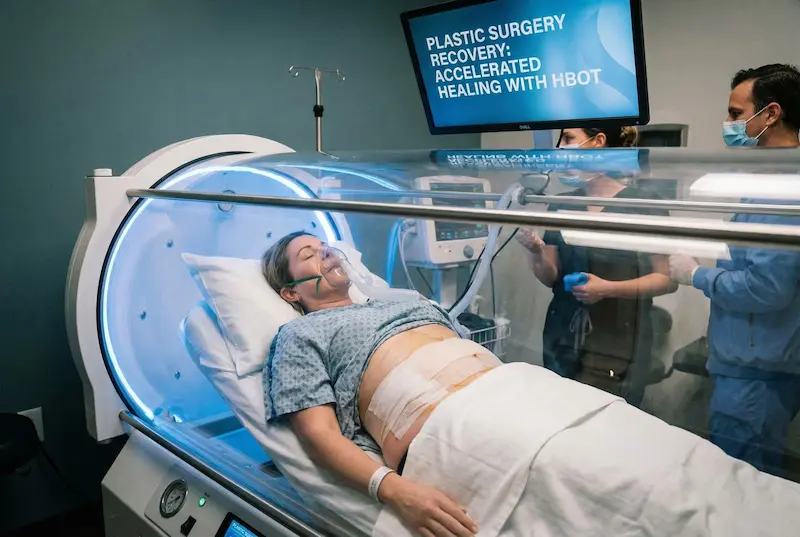
Evidence, Safety, and Who Should Consider HBOT
When someone types “what is hyperbaric oxygen therapy” or “benefits of hyperbaric oxygen therapy”, they usually want both: the upside and the safety details. That’s the right mindset—especially if you’re considering hyperbaric oxygen therapy after plastic surgery or hyperbaric oxygen therapy post facelift.
HBOT is a well-established medical therapy in several clinical indications, and in a post-operative context it’s best understood as a supportive recovery tool—used selectively, with screening, supervision, and realistic expectations.
Most important safety point: HBOT should be tailored to the patient. “More sessions” isn’t automatically “better,” and home-style solutions like a personal hyperbaric chamber are not equivalent to medically supervised care.
Common side effects and how they’re managed clinically
The most common issues in a hyperbaric oxygen therapy chamber are related to pressure changes—similar to what you feel during a flight. In a properly run setting, the team manages these risks by pressurizing gradually, coaching equalization, and stopping/adjusting if needed.
| Potential Side Effect | What It Feels Like | How It’s Typically Managed |
|---|---|---|
| Ear pressure (barotrauma risk) | Fullness, popping, discomfort during pressurization/depressurization | Slow pressure changes, coached equalization, pausing if needed |
| Sinus pressure | Pressure around cheeks/forehead, especially with congestion | Screening for active colds/sinus issues; scheduling adjustments |
| Claustrophobia/anxiety | Nervousness inside the chamber | Pre-session briefing, communication plan, comfort measures |
| Temporary fatigue/lightheadedness | Feeling sleepy or “off” briefly after | Rest, hydration, monitoring; typically self-limited |
In short: what does a hyperbaric chamber do physically? It changes pressure—so we respect pressure physiology and build safety around it.
Who may not be a candidate (contraindications & why disclosure matters)
Not everyone should do hyperbaric oxygen therapy. This is why medical screening matters more than marketing. If you’re evaluating hyperbaric oxygen chamber benefits, also evaluate whether you’re medically suitable for pressurized oxygen therapy.
- Untreated/unstable lung conditions that increase risk with pressure changes
- Significant ear problems or inability to equalize ear pressure
- Severe sinus congestion or active upper respiratory infections (timing may need adjustment)
- Uncontrolled medical issues where any additional therapy should be carefully coordinated
- Severe claustrophobia (not always a hard “no,” but it must be addressed honestly)
Why disclosure matters: the safest HBOT plan is the one built on accurate information—medications, smoking status, respiratory history, ear/sinus history, and any prior issues with pressure (flying/diving).
Setting realistic expectations (supportive recovery tool—not “magic”)
If you’re searching hyperbaric oxygen therapy fast recovery, it’s crucial to define “fast” correctly. For most patients, the value of HBOT is not a dramatic overnight transformation. It’s the possibility of:
- A steadier early recovery phase (comfort, swelling patterns, confidence in day-to-day progress)
- Support for oxygen-dependent healing processes while tissues are repairing
- Better recovery planning for travelers—when combined with clear aftercare and monitoring
At the same time, avoid exaggerated expectations such as “hyperbaric oxygen therapy anti aging” promises. You may see short-term “skin looks better” perceptions during recovery (less inflammation, swelling settling), which is why terms like hyperbaric oxygen therapy benefits skin appear online. But HBOT should be framed primarily as post-op support, not as guaranteed cosmetic anti-aging therapy.
Best decision framework: Ask two questions—(1) “Am I a good candidate for HBOT?” and (2) “Does HBOT meaningfully improve my recovery experience for this specific procedure and timeline?”
Hyperbaric Oxygen Therapy Benefits Frequently Asked Questions (FAQ):
Below are the most common questions we hear from “expert patients” researching hyperbaric oxygen therapy, especially in the context of hyperbaric oxygen therapy after plastic surgery and hyperbaric oxygen therapy post facelift. These answers are general education—not personal medical advice—because candidacy and timing should always be individualized.
Does HBOT hurt?
Most patients do not describe HBOT hyperbaric oxygen therapy as painful. The main sensation is ear pressure during pressurization (similar to flying). With proper coaching and gradual pressurization, it’s usually manageable. If you can’t equalize ear pressure comfortably, HBOT may not be appropriate until the issue is addressed.
Is hyperbaric oxygen therapy safe after facial surgery?
In medically supervised settings, hyperbaric oxygen therapy after plastic surgery can be safe for appropriately screened patients. The key is timing, medical history review, and monitoring. If you’re specifically asking about hyperbaric oxygen therapy post facelift, the goal is supportive oxygenation during recovery—not aggressive “speed healing.”
How soon can HBOT help with swelling and bruising?
Some patients feel recovery becomes “steadier” over time—less tightness or swelling patterns that settle more predictably. But HBOT is not an instant bruise remover. Bruising follows natural breakdown cycles; what HBOT may support is the healing environment while that process unfolds.
Can HBOT reduce infection risk?
HBOT may support tissue conditions that help your body’s defense and repair response, but it does not guarantee “no infection.” Safe surgery, sterile technique, proper wound care, and prompt clinical follow-up remain the most important factors.
Can hyperbaric oxygen therapy improve scars?
Wound healing hyperbaric oxygen therapy is often discussed because oxygen supports repair pathways involved in collagen and tissue rebuilding. That said, scar outcomes depend on many variables (incision technique, tension, genetics, smoking, sun exposure, aftercare). HBOT can be part of a scar-conscious recovery plan, but it cannot promise scar-free healing.
Do I need HBOT if I’m trying to be “camera-ready” fast?
“Fast recovery” should mean fewer surprises and a smoother early phase—not skipping biology. If your timeline is tight (work calls, travel, events), the right approach is a realistic recovery plan plus supportive therapies where appropriate.
These experiences don’t prove HBOT alone did the work—recovery is multi-factorial. But they reflect what patients value most: comfort, predictability, and careful post-op support.
Who decides if HBOT is right for me?
Your surgeon-led medical team should decide—based on your health history, procedure type, healing goals, ear/sinus and lung considerations, and overall risk profile. If you’re comparing a clinical hyperbaric oxygen therapy chamber to a personal hyperbaric chamber, treat them as different categories and prioritize safety, specifications, and medical oversight—especially post-op.
Real patient perspective (recovery comfort varies by person): One US patient described her surgery as “fabulous” and reported “no pain.” Another patient (Sarah) noted a “painless” recovery that required only one day of painkillers.
If you’d like, you can also explore related topics we cover for a safer, more predictable aesthetic journey—such as Hyperbaric Oxygen Therapy Benefits for recovery support, our approach to Natural Hairline Design for natural-looking hair restoration outcomes, and practical guidance on when you can Fly After Facelift. We also share travel-focused planning tips that address Flight Safety After Surgery, helping you understand timelines, comfort considerations, and what to discuss with your medical team before booking your return trip.