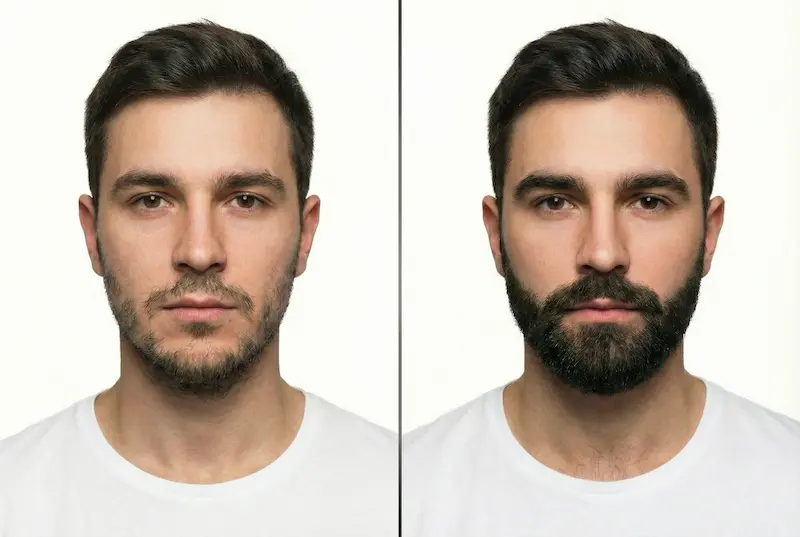

If you’re researching beard transplant Turkey, chances are you’re not just thinking about “more facial hair”—you’re thinking about structure. A well-designed beard can sharpen the jawline, balance facial proportions, and create a more masculine lower-third without looking artificial. The goal is not a “drawn-on” beard, but a natural pattern that matches your face, your skin, and your hair characteristics—guided by planning principles rooted in medical science and long-established hair restoration technique.
In this guide, we’ll explain how jawline definition actually works, what a beard transplant involves, and what “natural” results require—especially if you’re comparing options like Turkey beard transplant programs and evaluating which clinic standards matter most for safety and realism.
Key takeaway: Jawline definition is less about “maximum density” and more about strategic design—the right borders, angles, transitions, and graft distribution.
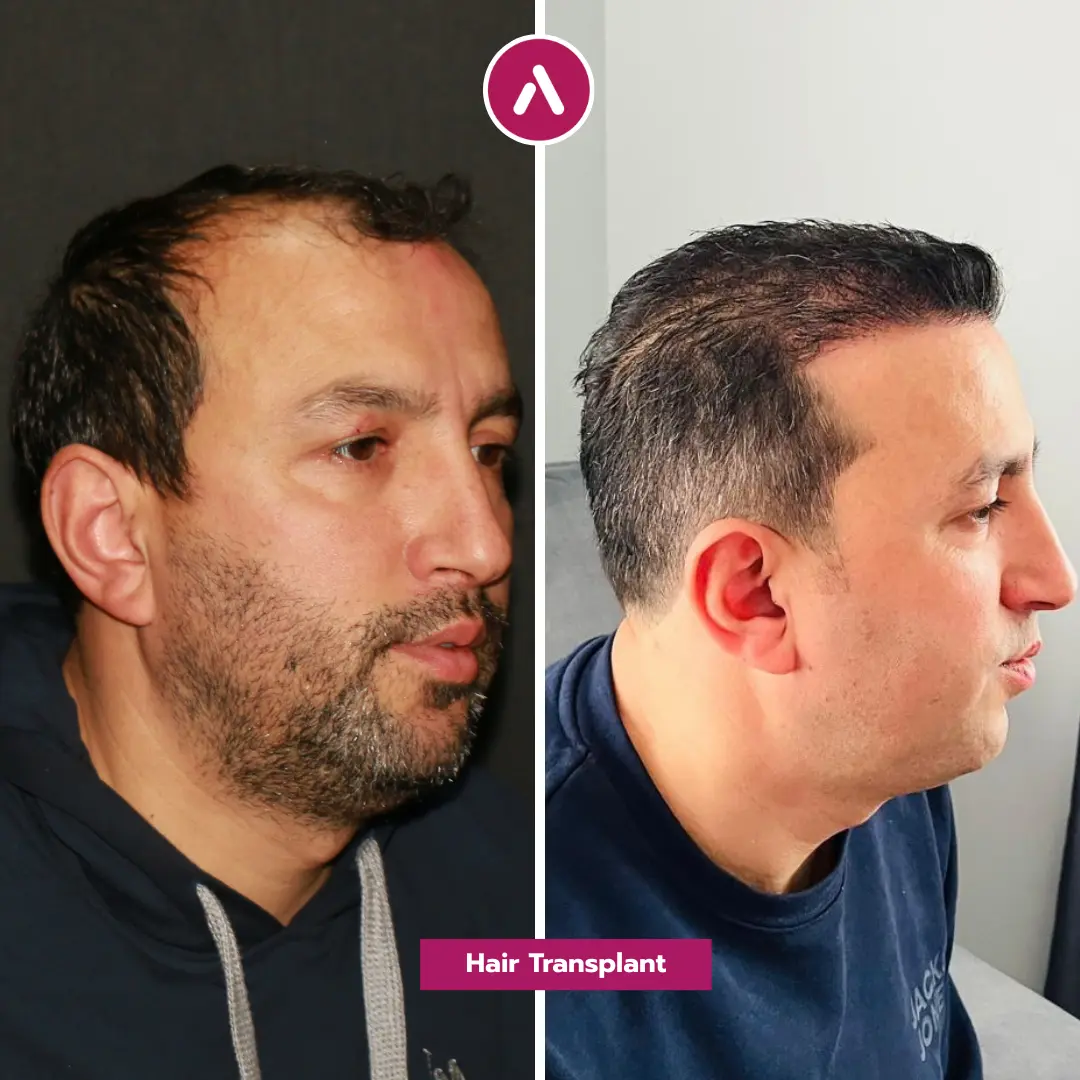
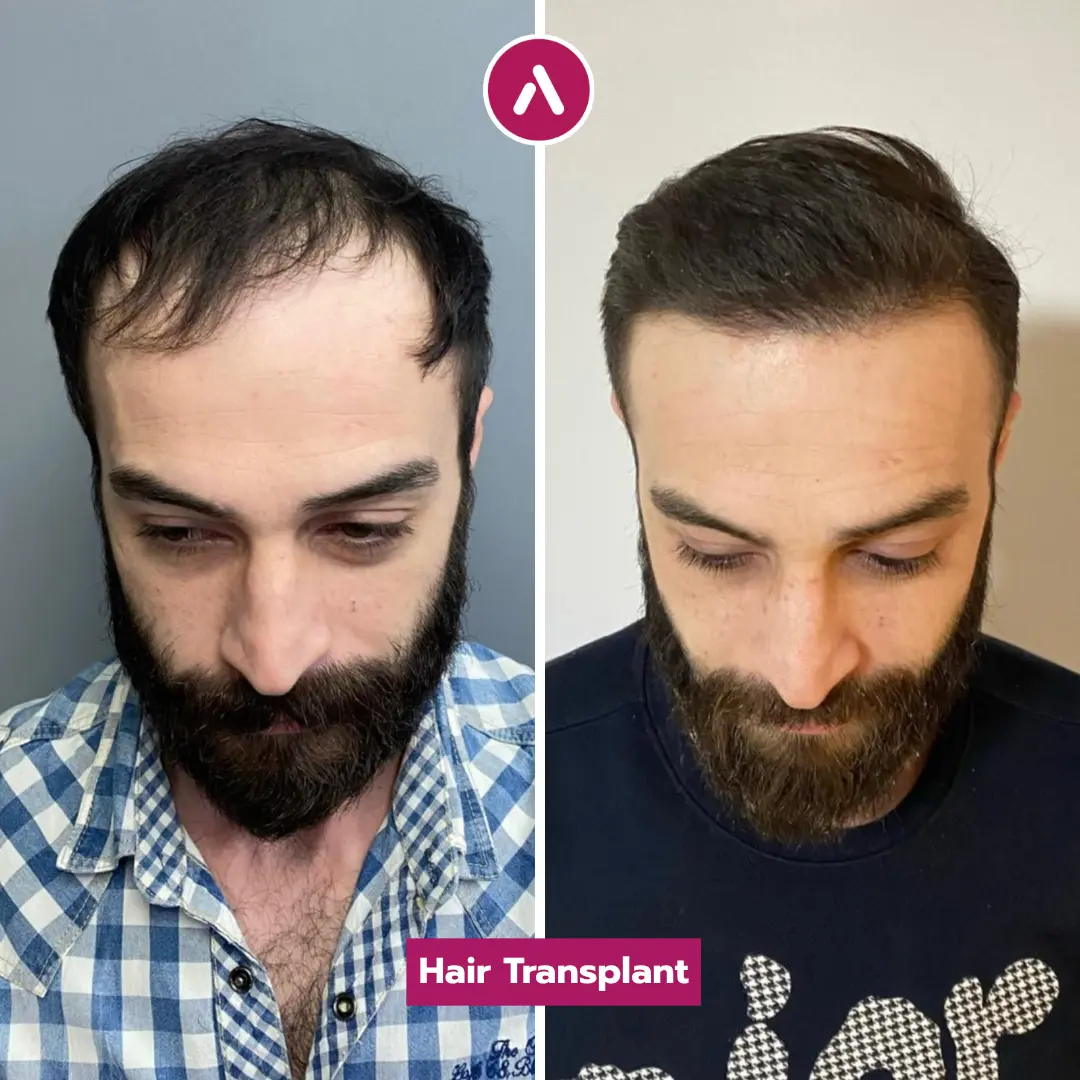
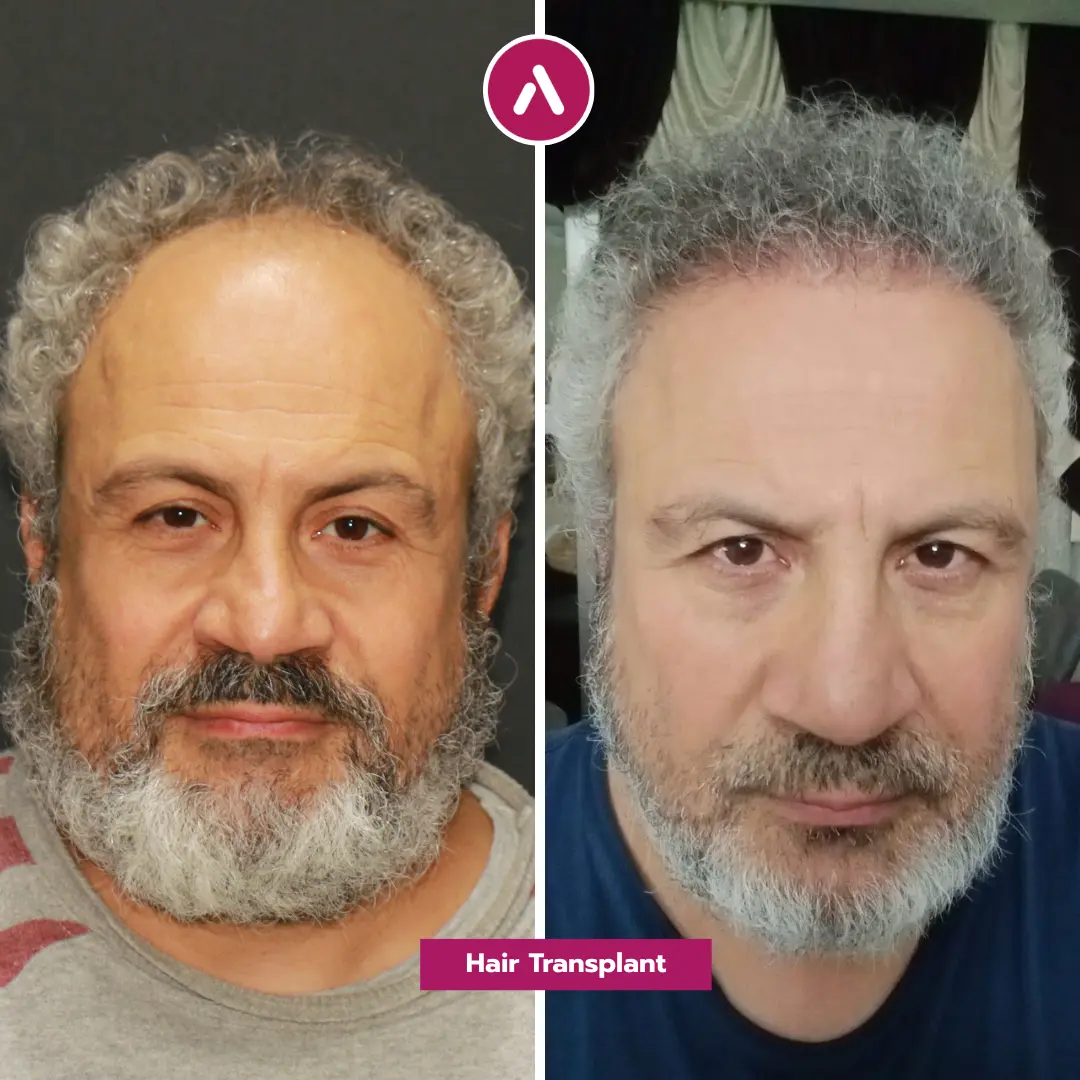
Table of Contents
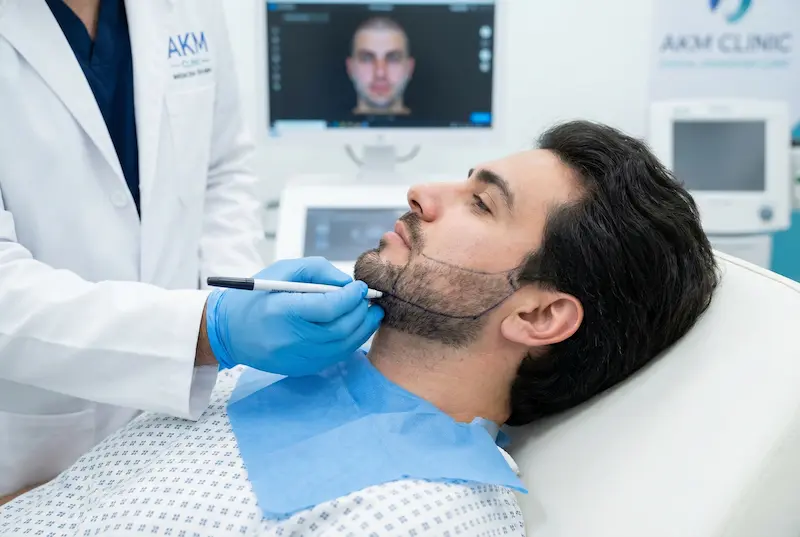
Why Beard Shape Changes the Jawline
Jawline “sharpness” is largely an optical effect created by contrast, borders, and shadow. A beard transplant can enhance that effect when the design respects anatomy (mandible angle, submental contour) and hair behavior (curl, caliber, growth direction). Done well, it creates a clean, masculine frame. Done poorly, it can look stamped-on or asymmetrical—so the design phase matters as much as the implantation phase.
The “shadow effect” and facial proportions
Facial hair adds controlled darkness along the mandibular border and under the chin, which can visually tighten the lower face. This “shadow effect” is why many patients focus specifically on the jawline, chin, and under-chin zones rather than pursuing a full, uniformly dense beard from day one. In practical planning, surgeons often prioritize “high-impact zones” that change the silhouette most with fewer grafts.
| Design Zone | What It Changes Visually | Common Planning Focus |
|---|---|---|
| Jawline border | Creates a sharper mandibular outline | Clean edge + natural transition |
| Chin / goatee area | Adds forward projection and balance | Density + direction control |
| Under-chin (submental) | Improves “defined” lower-third look | Shadowing without harsh borders |
| Cheek line | Frames the midface; affects “cleanliness” | Feathering to avoid a stamped look |
Natural vs. “painted-on” look: transitions and feathering
The most common aesthetic complaint after suboptimal work is a beard that looks “too perfect.” In real beards, density isn’t uniform: edges are softer, transitions are gradual, and follicles don’t sit in identical spacing. A natural result depends on controlled irregularity—micro-variation in spacing and careful “feathering” at borders (especially the cheek line) so the beard blends into bare skin convincingly.
Beard mapping 101: cheek line, neckline, chin emphasis
Beard mapping is the blueprint. It defines where hair should exist, how dense it should be, and how it should grow. For jawline definition, the neckline and jaw border are critical: too high can look unnatural; too low can blur definition. Chin emphasis (goatee zone) can also improve facial balance, but only when angles match native growth patterns. This is where surgeon-led planning becomes essential for patients seeking a best beard transplant Turkey outcome rather than a “generic template.”
Beard Transplant Basics (What It Is and How It Works)
A beard transplant is a form of follicular unit transplantation where hair follicles are typically harvested from the scalp donor area and implanted into the beard region. Although many people search “beard transplant in Turkey” thinking the procedure is simple, the beard area is technically demanding: facial skin characteristics, visibility, and angle sensitivity are different from the scalp. The fundamentals are consistent with hair restoration science, but execution details determine whether the outcome looks natural.
FUE for beard: how grafts are harvested
Most modern beard transplants use FUE (Follicular Unit Extraction). Individual follicular units are removed from the donor area—commonly the back/sides of the scalp—selected for suitability (hair caliber, curl, color match). The goal is to preserve donor appearance while obtaining grafts that will look believable in the beard. Donor management matters because overharvesting can thin the donor zone.
Placement methods (implanter vs. forceps): what matters for naturalness
Clinics may use different placement approaches (for example, implanter-assisted placement or forceps into pre-made sites). What matters most is not the marketing label, but the control of: (1) angle, (2) direction, (3) depth, and (4) site density. Beard hair needs extremely precise angulation—especially on the cheeks and jawline—because small errors are highly visible and can create a “wire brush” appearance or unnatural growth patterns.
Graft survival fundamentals: handling, hydration, and time
Graft survival depends on disciplined handling: minimizing time out of the body, keeping follicles properly hydrated, avoiding trauma, and placing at correct depth to reduce popping and tissue stress. These principles are backed by long-standing scientific research in transplantation and wound healing—regardless of geography. In clinics that invest in recovery protocols, supportive technologies may also be used after surgery to optimize healing conditions (for example, AKM Clinic describes the use of HBOT and LLLT as part of post-procedure recovery support in surgical care standards).
Designing a Masculine Beard (Surgeon-Led Planning)
The “best beard transplant in Turkey” is rarely about a single technique—it’s about design discipline. Masculine jawline definition depends on how the beard frames the lower face: the cheek line shouldn’t look overly crisp, the jaw border must follow your anatomy, and the chin zone often needs a different density strategy than the sideburn/cheek area. A surgeon-led plan uses principles that align with what we understand from reconstructive planning and aesthetics in medical science: harmony, proportion, and predictable healing.
Custom design by face shape and ethnicity
A beard that looks “natural” on one person can look out of place on another. Face shape (square, oval, round), chin projection, mandibular angle, and midface width all affect which beard patterns create a stronger jawline. Ethnicity and hair characteristics (curl, thickness, color) also influence how dense the transplant should be and how soft the borders must remain. This is why a serious beard transplant in Turkey consultation should not be a one-size-fits-all template—it should be a custom map with clear rationale.
Direction & angle control: mustache, goatee, jawline edge
Angle and direction are the “make-or-break” variables in beard work. Facial hair naturally exits the skin at shallow angles, and the direction changes by zone: cheeks differ from jawline, which differs again from the chin. Poor angulation can create a spiky appearance or hair that grows “up” instead of laying flat. High-quality planning uses zone-by-zone direction maps and staged placement strategy—especially around the jawline edge where definition is most visible.
Density strategy: “high-impact zones” vs full coverage
Many patients searching Turkey beard transplant options assume “more grafts = better.” In reality, a masculine look is often achieved with strategic density in high-impact areas: the jaw border, chin/goatee, and carefully blended transitions. Full coverage can be appropriate, but it’s not always the most efficient route to a stronger jawline—particularly if donor conservation is a priority. A reliable plan separates impact zones from fill zones and explains how the graft count is distributed.
| Goal | Primary Target Zones | Design Priority |
|---|---|---|
| Sharper jawline | Jaw border + under-chin shadowing | Angle control + clean but natural edge |
| Stronger chin | Goatee/chin prominence | Density + direction matching |
| Patch correction | Local gaps on cheeks/jaw | Blend + soft transitions |
| Full beard look | Cheeks + jaw + chin | Balanced distribution + donor protection |
Graft Numbers, Donor Area, and Realistic Limitations
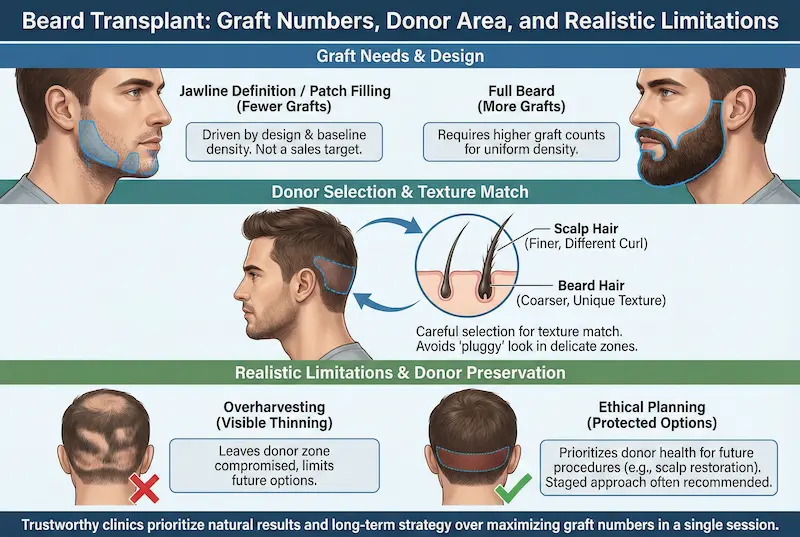
When people compare “beard transplant Turkey price” across clinics, graft counts are often used as the headline metric. But graft numbers should be a result of design and donor analysis—not a sales target. Beard transplantation is constrained by donor supply, hair characteristics, and the need to place grafts at safe densities that heal predictably. A trustworthy clinic will explain limitations clearly, because unrealistic planning is a common reason for disappointment.
Typical graft ranges: jawline definition vs full beard
Graft needs vary widely depending on your baseline beard growth and your objective. Jawline definition and targeted patch filling generally require fewer grafts than a full, uniform beard. The responsible way to estimate grafts is to start with: (1) your current density by zone, (2) your desired outline, and (3) the “blend requirement” at borders. If a quote promises dramatic transformation with minimal analysis, that’s a red flag—even if the Turkey beard transplant cost looks attractive.
Donor selection: texture match and caliber differences
Most beard grafts come from the scalp donor area, but scalp hair can behave differently than beard hair. Differences in caliber, curl, and growth cycle can matter—especially in highly visible regions like the cheek line. A careful plan selects donor areas that match as closely as possible and avoids pushing thick-caliber grafts into delicate transition zones where they can look “pluggy.” This is one of the reasons “best beard transplant Turkey” outcomes tend to correlate with meticulous graft selection and placement—not just extraction speed.
Avoiding overharvesting: protecting donor density long-term
Overharvesting can leave visible thinning or patchiness in the donor zone. Ethical planning prioritizes donor preservation, particularly for patients who may want future procedures (scalp hair restoration, eyebrow transplant, or revisions). A strong consultation should include a donor assessment and a conservative long-term strategy. In other words, a smart plan protects your “options” for later—even if it means recommending a staged approach rather than maximizing grafts in a single session.
Safety mindset: A responsible graft plan is built around donor preservation, realistic density, and zone-by-zone angulation—principles supported by long-standing scientific research on graft survival and wound healing.
Procedure Day in Turkey (What to Expect)
When patients search beard transplant Turkey or beard transplant in Turkey, they often picture an intense surgical day. In reality, most beard transplants are performed with local anesthesia and a structured workflow: donor extraction, beard-site creation (or site-making), and implantation. The experience should feel organized, calm, and predictable—because predictable processes are what reduce errors in angle, density, and graft handling.
Local anesthesia, comfort, and what you actually feel
You should expect brief discomfort during the anesthesia phase (a stinging or pressure sensation), followed by numbness in the treated areas. During extraction and implantation, most patients feel pressure and vibration rather than pain. If you’re anxious, a clinic may offer supportive comfort measures; the key is that you remain safe, stable, and able to follow instructions—especially for long procedures. Any clinic promising “zero sensation” or rushing anesthesia can be a red flag; comfort should be managed thoughtfully, not marketed aggressively.
Duration, breaks, and single-session vs staged approach
Procedure length depends on graft count and complexity. Jawline-definition cases may be shorter than full-beard builds, but both require meticulous work. Breaks matter for patient comfort and for team focus. In some cases, a staged plan is recommended—particularly when a patient wants maximum refinement, has limited donor supply, or needs conservative density for safer healing. Staging can also reduce the risk of over-packing and helps maintain a natural “progression” rather than forcing a dense look too early.
First 72 hours: washing rules, sleeping position, and hygiene
The first three days are about protecting grafts and preventing irritation. Typical principles include: avoiding friction on the beard area, sleeping with your head elevated, keeping the area clean per instructions, and avoiding gyms/saunas/sweating that can inflame follicles. Proper early hygiene reduces the risk of folliculitis and helps the transplanted follicles settle into the skin without trauma.
Practical mindset: Your “job” for 72 hours is simple—protect the grafts, minimize friction, and follow the cleaning protocol exactly.
Recovery Timeline and When It Looks “Normal”
Recovery is one of the most misunderstood parts of a beard transplant. Many patients assume the visible hair immediately after surgery equals the final look. It doesn’t. The transplanted hairs often shed, then regrow over months. This is normal biology—not a failure—and it aligns with what we understand from hair cycling in medical science and decades of clinical practice.
Shedding phase vs true loss: what’s expected
Within the first few weeks, many transplanted hairs shed (often called “shock loss” or shedding). The follicles remain in place; the hair shaft falls out and later regrows. This phase can look uneven, which is why reputable clinics set expectations upfront. True problems are usually signaled by persistent redness, escalating pain, or significant pustules—issues that require timely clinical guidance.
Regrowth milestones: 1, 3, 6, 12 months
Timelines vary, but most patients see early growth changes in the first few months and more meaningful cosmetic improvement by 6–12 months. Beard hair also needs “training” (gentle trimming and time) to blend naturally with native hair direction. If you’re evaluating the best beard transplant Turkey options, look for clinics that educate you on the timeline rather than overselling “instant” results.
| Time Point | What You’ll Commonly See | What Matters Most |
|---|---|---|
| Days 1–7 | Redness, small scabs, visible implanted hairs | Protection + careful cleansing |
| Weeks 2–6 | Shedding of transplanted hairs | Don’t panic; follow aftercare |
| Months 2–4 | Early regrowth, uneven density | Patience + inflammation control |
| Months 5–8 | More consistent growth and blending | Trimming strategy + skin health |
| Months 9–12 | Matured look, better direction and thickness | Assess final shape and refinement |
Recovery support: LLLT & HBOT and why clinics use them
Some clinics support recovery with adjunctive protocols aimed at optimizing healing conditions. Two examples often discussed in postoperative care are LLLT (Low-Level Laser Therapy) and HBOT (Hyperbaric Oxygen Therapy). In simplified terms, these approaches are used to support tissue recovery by promoting an environment favorable to healing—particularly helpful for patients who want a “quiet” recovery with less inflammation. While outcomes still depend primarily on surgical planning and graft handling, supportive recovery protocols can be a meaningful part of comprehensive care when applied appropriately.
Risks, Complications, and How to Prevent a Bad Outcome
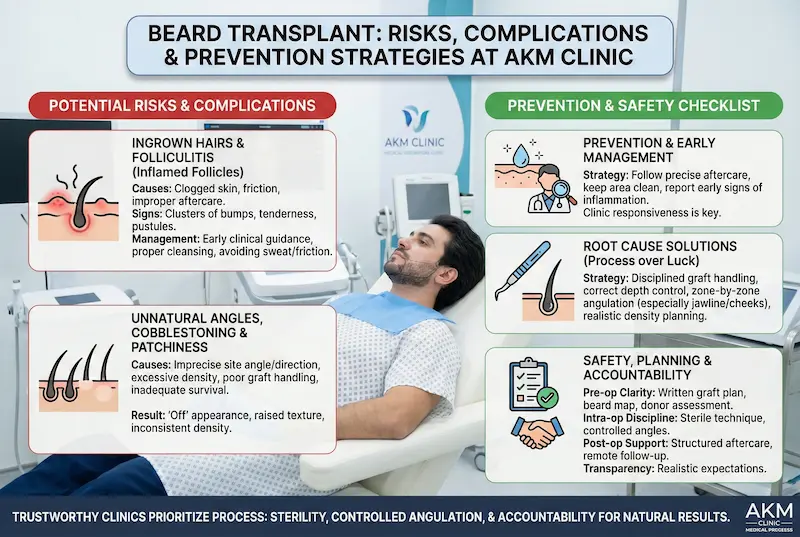
A beard transplant is generally safe when performed with proper medical standards, but the beard area is unforgiving aesthetically. Many “bad” outcomes aren’t dramatic surgical disasters—they’re subtle issues that look unnatural up close: wrong angles, harsh borders, patchy density, or persistent follicle inflammation. Preventing these problems is less about luck and more about process: planning, sterile technique, controlled angulation, and realistic density—principles consistent with scientific research on wound healing and graft survival.
Ingrown hairs & folliculitis: prevention and early management
Folliculitis (inflamed follicles) and ingrown hairs can happen during early healing or early regrowth, especially if the skin is irritated or clogged. Prevention typically includes proper cleansing, avoiding friction/sweat early on, and following aftercare instructions precisely. If you develop clusters of bumps, increasing tenderness, or pustules, it should be addressed early—often with simple clinical guidance rather than “waiting it out.” A clinic’s aftercare responsiveness matters as much as the procedure itself.
Unnatural angles, cobblestoning, and patchiness: root causes
Unnatural direction is one of the most common reasons transplanted beards look “off.” It’s usually caused by imprecise site angle and direction, or by pushing density too aggressively in delicate regions. Cobblestoning (raised texture) can be related to depth control and healing response. Patchiness may come from inconsistent placement, poor blending, or inadequate graft survival. The prevention strategy is straightforward: disciplined graft handling, correct depth, and zone-by-zone angulation—especially at the jawline edge and cheek transitions.
Safety checklist: sterility, planning, and accountability
If you’re researching best beard transplant Turkey options, focus on safety and accountability markers, not marketing claims. A serious clinic should be able to explain sterile protocol, who makes the design decisions, who performs each step, and what the follow-up plan looks like. You want a clearly documented plan (design map + graft distribution + donor strategy) and a defined escalation pathway if you have issues after returning home.
- Pre-op clarity: written graft plan, beard map, donor assessment.
- Intra-op discipline: controlled angulation by zone; careful graft handling.
- Post-op support: structured aftercare + responsive remote follow-up.
- Transparency: realistic expectations about density and timeline.
Cost & Value (Turkey vs High-Cost US Cities and Other Destinations)
Searches like beard transplant cost Turkey, Turkey beard transplant cost, and beard transplant Turkey price are common—and understandable. But the most useful cost analysis looks beyond a single number. Pricing is shaped by graft count, complexity (jawline design vs full beard), team expertise, quality controls, aftercare, and what is (or isn’t) included in the package. Comparing “cheap vs expensive” misses the point; compare what you’re actually buying: planning quality, safety standards, and follow-up.
What drives pricing in New York / Los Angeles / Miami vs Istanbul
In high-cost US cities (e.g., New York, Los Angeles, Miami), higher overhead, staffing costs, facility costs, and insurance structures tend to raise procedure pricing—often with itemized billing for consultation, procedure, medications, and follow-ups. In Istanbul, bundled programs may be more common, but the right comparison is not “cheaper is better”—it’s whether the package includes the essentials: surgeon-led design planning, safe clinical standards, and structured aftercare.
Package transparency: what should be included (and what’s a red flag)
A transparent Turkey beard transplant quote should clearly list what’s included and what’s optional. If pricing is vague, pressure-based, or changes after arrival, that’s a red flag. Likewise, be cautious with deals that emphasize extreme graft counts without showing a medically reasonable donor plan.
| Item | Should It Be Clearly Included? | Why It Matters |
|---|---|---|
| Surgeon-led beard design & mapping | Yes | Defines jawline realism, borders, transitions |
| Donor analysis + long-term donor plan | Yes | Prevents overharvesting and future limitations |
| Medications / aftercare kit | Yes (or itemized transparently) | Supports safe healing and inflammation control |
| Remote follow-up schedule | Yes | Key for managing bumps, shedding anxiety, timeline guidance |
| “Unlimited grafts” language | No (red flag) | Often ignores donor safety and realistic density |
Turkey vs Mexico vs Thailand: value, standards, and follow-up reality
Patients often compare Turkey to other medical tourism destinations such as Mexico or Thailand. The most meaningful differentiators are not slogans—they’re operational: clinic oversight, documentation, sterile standards, and follow-up reliability across time zones. Wherever you go, you want a clinic that can show consistent results for your specific goal (jawline definition vs full beard), and a structured plan for managing early inflammation or folliculitis if it occurs after you return home.
Bottom line: The “best value” isn’t the lowest beard transplant Turkey price; it’s the option that combines predictable design quality, safe execution, and real aftercare support.
How to Choose the Right Clinic in Turkey
If you’re comparing options for a Turkey beard transplant, the safest way to choose is to evaluate process—not promises. A beard transplant is visually unforgiving, and “jawline definition” success depends on design accuracy, angulation control, and dependable aftercare. Below is a practical checklist to help you identify quality—and avoid the most common red flags—when searching for the best beard transplant Turkey experience.
Reading before/after results correctly (angles, lighting, timelines)
Before/after photos can be useful, but only when they’re honest and comparable. Look for consistent lighting, similar head position, and clear close-ups of the cheek line, jawline border, and chin. Also check the timeline: immediate post-op photos are not results—they’re placement photos. Real results should show mature growth (often many months later) and should include “normal” cases, not only extreme transformations.
- Good sign: multiple angles (front, both profiles, down-tilt), consistent lighting, clear timeline labels.
- Red flag: only one angle, heavy shadowing, no timeline, or “day-1” photos presented as outcomes.
What a real consultation should include: design + graft plan + donor analysis
A high-quality beard transplant in Turkey consultation should feel like a plan—not a pitch. You should leave with a written or clearly explained map: your cheek line, neckline, jaw border, and density targets by zone. You should also get a donor evaluation that explains how many grafts are safe to take and why. This is where cost quotes become meaningful: a quote without design logic and donor logic is not decision-grade information.
| Consultation Element | Why It Matters | What You Should Hear |
|---|---|---|
| Beard mapping (borders + transitions) | Determines how “natural” the jawline looks | A zone-by-zone plan, not a generic template |
| Angulation strategy | Prevents unnatural direction/spiky growth | How angles differ on cheek, jaw, chin |
| Graft distribution plan | Prevents overpacking and patchiness | High-impact zones vs fill zones rationale |
| Donor assessment | Protects your long-term options | Safe limits + future planning |
Aftercare and remote follow-up: what “good support” looks like
Aftercare is where many medical tourism experiences succeed—or fail. You want a clinic that provides a structured schedule for check-ins, clear instructions for washing and trimming, and a responsive channel for concerns like bumps, redness, or suspected folliculitis. Strong follow-up matters regardless of the beard transplant cost Turkey you’re quoted; it’s part of safety. The best clinics treat aftercare as clinical responsibility, not an afterthought.
Decision filter: If a clinic can’t explain design logic, donor logic, and follow-up logistics clearly, it’s not a “best beard transplant in Turkey” option—no matter how attractive the pricing sounds.
Frequently Asked Questions (FAQ): Beard Transplant Turkey
Below are concise answers to common questions patients ask when researching beard transplant Turkey, including cost-related searches like Turkey beard transplant cost and beard transplant Turkey price.
Does a beard transplant work for genetic patchiness?
Yes—genetic patchiness is one of the most common reasons people pursue a beard transplant. The key is realistic design and blending so the transplanted areas match your natural pattern and don’t create harsh borders.
How many grafts do I need to define my jawline?
It depends on your current beard density and how strong a jawline effect you want. Many patients achieve noticeable definition by focusing on high-impact zones (jaw border, chin, under-chin shadowing) rather than trying to build uniform density everywhere.
Will transplanted beard hair look like scalp hair?
The follicles often come from the scalp donor area, so characteristics can differ slightly. A natural look depends on smart donor selection, careful placement, and blending—especially near the cheek line and borders.
When can I shave or trim after a beard transplant?
Follow your clinic’s instructions, but generally you avoid shaving/trimming very early to protect grafts and reduce irritation. When trimming is allowed, starting gently helps the new hair blend while the skin fully settles.
Are results permanent?
Transplanted follicles are typically considered permanent once they’ve successfully established and matured. However, the cosmetic quality depends on design, angulation, and how well the grafts survive the early healing period.
Can I combine a beard transplant with a hair transplant on the same trip?
Sometimes, yes—but it depends on donor supply, procedure length, and healing considerations. A responsible clinic will only combine procedures when it’s medically sensible and won’t compromise graft handling or donor safety.
What if I get ingrown hairs or folliculitis afterward?
Mild bumps can happen during regrowth. Proper cleansing and early guidance usually resolve it. If you develop worsening redness, pain, or pustules, contact your clinic promptly—responsive follow-up is part of what you’re paying for, regardless of beard transplant Turkey price.
If you’d like to go beyond beard restoration, you can also explore related safety and planning topics such as Ghost Surgery in Turkey, Questions to Ask Plastic Surgeon, and what’s typically included in Plastic Surgery Packages Turkey. For remote planning, our guide to Online Plastic Surgery Consultation explains what can (and can’t) be accurately assessed before travel, while English Speaking Plastic Surgeons in Turkey covers how to ensure clear communication throughout your journey. You may also be interested in combined or male-focused procedures like Hair Transplant And Facelift, Male Facelift Techniques, and body contouring options such as Male Liposuction Turkey.
Medical Disclaimer: This page is provided for general educational purposes only and does not replace a face-to-face medical consultation, diagnosis, or personalised treatment plan. All surgery carries risks and outcomes vary between individuals. Suitability for a beard transplant, procedure selection, and anaesthesia choice can only be determined after a full clinical assessment by a qualified surgeon. Always follow your clinician’s instructions and seek urgent medical attention if you develop concerning symptoms during recovery.