In the last few years, a growing number of Americans getting facelifts in Turkey—not because they’re chasing a “cheap deal,” but because they’re chasing a specific outcome: a natural-looking refresh, delivered by a surgeon-led team, with a recovery plan that feels supported from day one.
If you’re the kind of person who reads facelift in Turkey reviews, compares techniques (Deep Plane vs SMAS), and worries about safety, anesthesia, and “looking done,” you’re not alone. Many U.S. patients who fly for facelift surgery describe the same mindset: they’re not bargain-hunting—they’re risk-managing.
Barbara (USA), an “expert patient,” described her result as: “I actually look like nothing happened but probably 20 years younger.”
This article breaks down why Americans decide to get a facelift in Turkey, what they’re really comparing (it’s not just facelift Turkey price), and what real patients noticed most about their journey—especially the parts you can’t see in a before-and-after photo.
Table of Contents
Why Americans Are Getting Facelifts in Turkey (Beyond Price)
Yes—cost matters. Searches like cost of facelift in Turkey, deep plane facelift Turkey cost, and facelift cost in Turkey are common. But when you read real patient stories, the decision usually comes down to a mix of access, technique, trust, and total experience.
The U.S. “cost barrier” in New York, Los Angeles, and Miami
For many Americans, the first shock is how expensive facelift surgery can be in high-cost markets like New York City, Los Angeles, and Miami—especially when you’re comparing a true surgical facelift (like a deep plane facelift) with the level of aftercare you’d want.
But here’s what often gets missed: patients aren’t only comparing a surgeon’s fee. They’re comparing the entire journey—pre-op planning, anesthesia strategy, follow-up schedule, and what happens if they need support after they’re home.
That’s why many “expert patients” don’t search only for facelift Turkey price—they search for:
- deep plane facelift Turkey price (technique-specific comparisons)
- best facelift surgeon in Turkey / best facelift surgeon Turkey (credibility validation)
- cost of facelift Turkey package 2024 (all-in packages and what’s included)
The demand for natural-looking, advanced techniques (Deep Plane, SMAS, mini, lower facelift)
Most U.S. patients aren’t trying to look like a different person. They’re trying to look like themselves—just less tired. That’s why technique matters. In consultations, patients often ask about:
- Deep plane facelift in Turkey (often associated with natural midface/neck improvement when indicated)
- SMAS facelift in Turkey (a well-known structural approach many patients compare)
- mini facelift Turkey / mini facelift in Turkey (for select candidates with earlier laxity)
- lower facelift in Turkey (jawline/neck-focused concerns)
In other words: people aren’t only asking “How much does it cost?” They’re asking, “Which technique fits my anatomy and gives the most natural result?”
| What U.S. Patients Want | What They Should Compare (Not Just Price) |
|---|---|
| Natural results (“not done”) | Technique selection (Deep Plane vs SMAS vs mini) + surgeon’s aesthetic consistency |
| Lower risk / higher safety | Anesthesia plan, facility standards, and clear protocols for aftercare & follow-up |
| Predictable downtime | Recovery plan (swelling/bruising expectations, monitoring, supportive therapies) |
| A smooth travel experience | Coordination, translation support, logistics, and “what’s included” clarity |
The appeal of a turnkey, supported medical travel journey
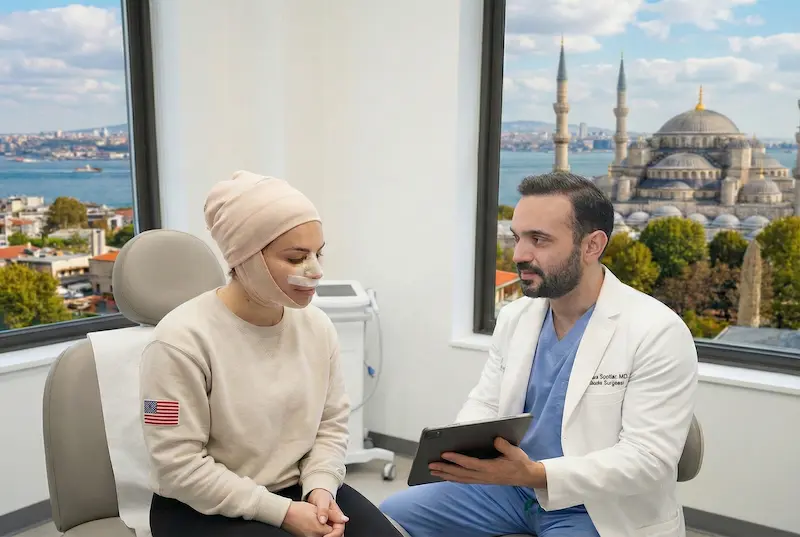
One reason patients choose to fly for facelift surgery is that the logistics can feel overwhelming—especially if they’re traveling alone. Real-world stories repeatedly highlight the value of feeling supported before, during, and after surgery.
Laura (USA), who traveled solo for multiple procedures, emphasized how much the “unknowns” shrink when the journey is structured. In her words, what stood out was that “the nurses, the doctors, the medications, everything is included.”
That line matters because it’s not really about luxury—it’s about reducing uncertainty. For many Americans reading facelift in Turkey reviews, the biggest fear isn’t the flight. It’s the question: “What happens after surgery—who is actually watching over me?”

Is It Safe? The Non-Negotiables U.S. Patients Must Verify
If you’re in the “expert patient” mindset—reading facelift in Turkey reviews, comparing smas facelift in Turkey vs deep plane facelift in Turkey, and searching “best facelift surgeon in Turkey”—your real question isn’t just “Is Turkey safe?”
Your real question is: “How do I verify safety and quality in a way that would satisfy me if this were happening in the USA?”
Below is a practical checklist you can use whether you’re evaluating AKM Clinic or any other clinic in Istanbul.
Surgeon credentials: what to verify (and how to validate)
When Americans decide to get facelift in Turkey, the safest pathway is choosing a surgeon-led practice with clear training history, a consistent aesthetic style, and a well-defined scope of expertise (especially for structural techniques like Deep Plane).
At AKM Clinic, facelift planning is led by Dr. Akif Mehmetoğlu (MD), a Dermatosurgeon & Face Expert with a career beginning in 2013 and advanced training exposure through international congresses (including U.S.-based meetings). This “skin + structure” lens is one reason many patients seeking natural results feel more confident—because facial rejuvenation isn’t only about lifting; it’s also about skin quality, healing, and long-term refinement.
- Ask: “What is your specialty training, and how long have you been performing facelift surgery?”
- Ask: “Which technique do you recommend for me—and why?” (Deep Plane vs SMAS vs mini vs lower facelift)
- Ask: “Can I see before/after results that match my age, facial structure, and goals?”
- Ask: “If I’m researching best deep plane facelift surgeon in Turkey, what makes you the right match for my anatomy?”
Expert-patient takeaway: A surgeon who can clearly explain why you’re (or aren’t) a Deep Plane candidate is often safer than a clinic that sells everyone the same procedure.
Facility standards + sterilization protocols: don’t skip the basics
Most “botched surgery” fears are really fears about systems: sterile technique, infection prevention, emergency readiness, and consistent clinical routines.
AKM Clinic’s stated care model emphasizes a “zero-compromise” approach to hygiene and sterilization and references alignment with internationally recognized standards (including CDC and WHO-aligned principles), alongside official authorization under Turkey’s health regulations.
Here’s what you should verify—regardless of where you’re considering facelift surgery Turkey:
| Non-Negotiable | What to Ask / Verify | Why It Matters |
|---|---|---|
| Licensed facility | “Is the clinic/hospital officially licensed? Who oversees standards?” | Licensing is the minimum baseline for safety processes. |
| Sterilization protocols | “What are your sterilization and infection-prevention protocols?” | Reduces infection risk and protects incision healing. |
| Emergency readiness | “What happens if I have a complication—who manages it and where?” | Prepared systems matter more than promises. |
| Structured follow-up | “How many post-op checks happen before I fly home?” | Facelift outcomes depend heavily on early monitoring. |
Anesthesia safety: general vs twilight vs “awake” facelift (what patients should know)
Many U.S. patients who fly for facelift are specifically worried about anesthesia. Some search for “awake facelift” or “twilight facelift” because they want to avoid general anesthesia—or they want a faster, clearer early recovery experience.
AKM Clinic is known for offering Twilight & Awake facelifts as a differentiator in suitable candidates. However, the key phrase is: “in suitable candidates.” Not everyone is a fit, and safety should always outweigh preference.
- Ask: “Am I a candidate for twilight/awake, and what medical factors could make it unsafe?”
- Ask: “Who administers anesthesia/sedation, and how am I monitored during surgery?”
- Ask: “What is your plan for nausea control, pain control, and anxiety control?”
- Ask: “If we start with twilight/awake, under what conditions would you convert to a deeper level of anesthesia?”
If you’re comparing deep plane facelift Turkey cost or deep plane facelift cost Turkey, remember: anesthesia staffing, monitoring, and facility resources can affect value—and they should never be the place you “save money.”
Red flags that show up in “too-good-to-be-true” offers
When people search facelift Turkey price, facelift cost Turkey, or mini facelift Turkey price, they’ll inevitably see deals that look unbelievably low. In real patient journeys, the “cheapest quote” often comes with missing details—especially around follow-up and safety.
- Red flag: No clear technique rationale (everyone is sold the same “one facelift”).
- Red flag: Vague answers about who manages complications after surgery.
- Red flag: Pressure tactics (“book today,” “limited discount,” “guaranteed results”).
- Red flag: No structured follow-up plan before you fly home to the USA.
Laura (USA) described what reduced her anxiety most: “the nurses, the doctors, the medications, everything is included.”
That sentence is a clue: for many Americans getting facelifts in Turkey, “value” means clarity + coverage + continuity—not just a lower number on a quote.
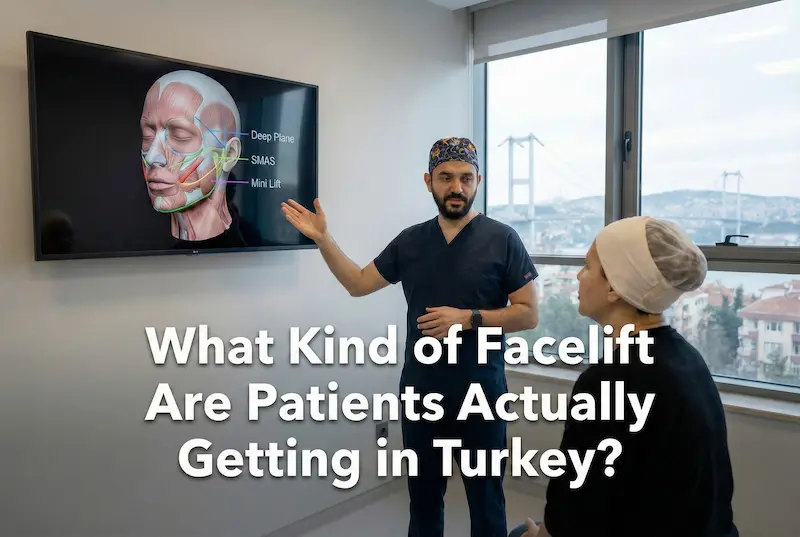
What Kind of Facelift Are Patients Actually Getting in Turkey?
When Americans decide to get facelift in Turkey, they quickly discover that “a facelift” isn’t one procedure. The technique matters, the anatomy matters, and the surgeon’s plan matters.
In real consultations, U.S. patients commonly compare:
- Deep plane facelift in Turkey (often searched as deeplane facelift in Turkey or deep plane facelift in Turkey)
- SMAS facelift in Turkey
- mini facelift in Turkey (and mini facelift Turkey price)
- lower facelift in Turkey (jawline + neck focused)
Below is a clear, expert-patient-friendly breakdown—so you can understand what you’re comparing before you start comparing deep plane facelift Turkey cost or facelift Turkey price, using an approach grounded in medical science.
Deep Plane Facelift: who it’s for—and why many Americans want it
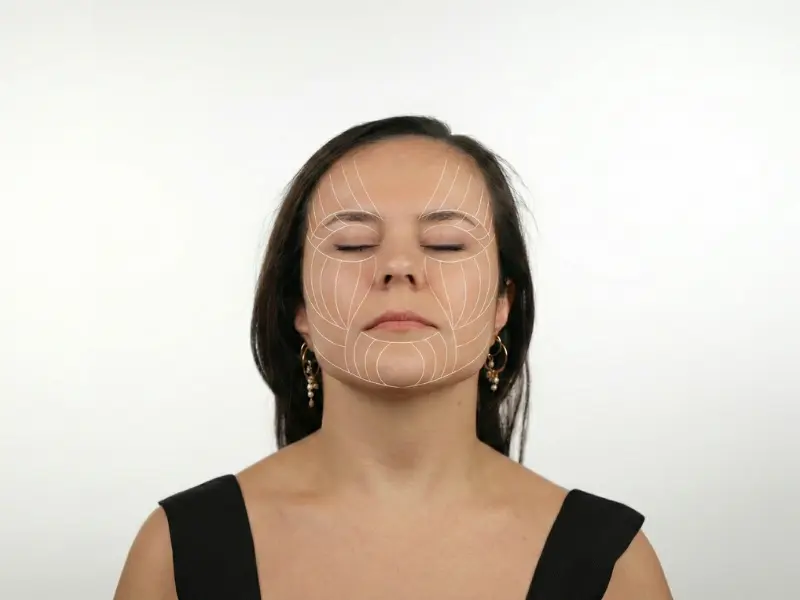
A deep plane facelift is often chosen by patients who want meaningful rejuvenation in the midface, jawline, and neck—without a tight, pulled appearance. Instead of relying mainly on skin tension, the goal is to reposition deeper facial layers so the skin can “redrape” more naturally.
Barbara (USA) is a classic example of why technique selection matters. After years of global research, her goal was not “more lift,” but a result that looked untouched. Her conclusion after surgery was simple: “I actually look like nothing happened but probably 20 years younger.”
It’s also why searches like best deep plane facelift surgeon in Turkey are so common: this technique is highly skill-dependent, and outcomes are closely tied to surgical judgment and experience.
Expert-patient note: “Deep Plane” should never be a one-size-fits-all label. A responsible surgeon explains why it fits your facial structure, not just why it’s popular.
SMAS vs Deep Plane: practical differences patients care about
Patients often ask, “Is a SMAS facelift in Turkey less effective than a Deep Plane?” The honest answer is: it depends on your anatomy, your age-related changes, and your goals.
| What You’re Comparing | Deep Plane Facelift | SMAS Facelift |
|---|---|---|
| Main concept | Repositions deeper facial layers for a natural redrape | Lifts/tightens the SMAS layer with technique variations |
| Why patients choose it | Natural-looking midface + jawline/neck rejuvenation when indicated | Strong, established approach with reliable structural support |
| What matters most | Surgeon experience + precise anatomy-based planning | Surgeon technique selection + alignment with your needs |
| What it is NOT | Automatically “better” for everyone | Automatically “less advanced” |
If you’re comparing deep plane facelift Turkey price or deep plane facelift cost Turkey to a SMAS quote, remember: you’re not only comparing line items. You’re comparing a plan.
Mini facelift vs lower facelift: when “less” is actually smarter
Many Americans search mini facelift Turkey because they want a shorter downtime or a smaller intervention. A mini facelift can be a great option for the right candidate—typically someone with earlier-stage laxity who needs subtle tightening rather than major structural repositioning.
A lower facelift in Turkey usually targets the jawline and neck area more specifically. For patients whose primary complaint is jowling or a soft jawline (with relatively stable midface volume), a lower-focused approach can make the result look balanced and age-appropriate.
Lisa (USA) adds another layer to the conversation: she pursued an awake deep plane facelift because her biggest barrier was anxiety about general anesthesia. Her story matters because it highlights a key truth: the “best” approach is the one that matches your anatomy + your medical profile + your comfort with anesthesia.
- Mini facelift: best for select patients with mild-to-moderate laxity who want a subtle refresh.
- Lower facelift: best when the jawline/neck is the priority and the midface doesn’t need major repositioning.
- Deep Plane / SMAS: best when structural rejuvenation is needed for a natural overall reset.
The AKM Clinic Philosophy: Surgeon-Led Planning + Dermatosurgeon Advantage
When Americans are getting facelifts in Turkey, the safest decisions tend to follow a pattern: they look for surgeon-led planning, technique clarity (Deep Plane vs SMAS vs mini vs lower facelift), and a recovery system that doesn’t “end” when they leave the operating room.
At AKM Clinic, the facelift approach is built around one central idea: rejuvenation without looking “done.” That means the plan isn’t only about lift—it’s about structure, skin behavior, incision strategy, and how the body heals.
Why dermatosurgeon involvement matters for natural results
Many patients searching for the best facelift surgeon in Turkey (or the best deep plane facelift surgeon in Turkey) are actually searching for something deeper than a title: they want a surgeon who understands how skin quality and healing influence the final look.
Dr. Akif Mehmetoğlu’s background in dermatology and advanced facial rejuvenation supports that “skin + structure” mindset. In practice, this can matter for:
- Natural surface finish: how the skin redrapes after deeper layers are repositioned
- Scar strategy: incision planning, tension control, and supportive post-op care
- Long-term refinement: facial rejuvenation as a balance of structure, skin quality, and healing
A dual-specialty surgical team: structure + function + aesthetics
Facial surgery is high-stakes because tiny details change the entire “read” of the face. AKM Clinic’s surgical leadership is positioned as a dual-specialty model—combining dermatosurgery-focused rejuvenation with facial plastic/ENT expertise. For patients, the advantage is a more holistic assessment that protects both harmony and (when relevant) function.
In other words, patients aren’t only choosing a country or a package—they’re choosing a team that can plan for the full picture, especially when procedures are combined (for example: facelift + neck lift, or facelift + eyelids).
What “surgeon-led” should feel like: your plan is personalized to your anatomy and goals—not a pre-set menu item.
Awake / Twilight facelift capability: a real differentiator for the anesthesia-anxious
One reason some Americans fly for facelift surgery is very specific: anxiety about general anesthesia. AKM Clinic highlights the ability to perform complex facial procedures—particularly a Deep Plane technique—under local anesthesia in appropriate candidates (often referred to as twilight or awake).
This matters because it directly addresses a common “procedural barrier” for U.S. patients: they want a high-level technique, but they also want an anesthesia plan that matches their medical profile and comfort level.
Recovery is treated like a protocol: HBOT + LLLT as part of aftercare
Expert patients don’t just compare deep plane facelift Turkey cost or facelift Turkey price—they compare downtime. AKM Clinic’s aftercare messaging emphasizes advanced recovery technologies as part of the post-op framework:
- Hyperbaric Oxygen Therapy (HBOT): delivered in a pressurized chamber with 100% oxygen, positioned to support fragile post-surgical tissues, reduce swelling/downtime, improve scar healing, and mitigate infection risk.
- Low-Level Laser Therapy (LLLT): a “soft laser” approach (650nm) used to support cellular repair, collagen synthesis, and inflammation reduction as the tissue heals.
The practical goal isn’t a miracle shortcut—it’s a more supported recovery with clearer milestones and fewer “unknowns,” especially for patients traveling back to the USA.
Transparency + continuity: what “all-inclusive” should actually include
A major reason patients choose Istanbul is that the experience can be structured end-to-end. AKM Clinic describes an all-inclusive model designed to remove hidden fees and logistical stress, with long-term virtual follow-ups scheduled after the patient returns home.
For the expert patient, this is less about comfort and more about risk reduction: a plan for monitoring, answering questions, and supporting healing beyond the flight home.
Real Patient Story #1 — Barbara (USA): A 4-Year Global Search for the Right Result
If you’ve been reading facelift in Turkey reviews and comparing every detail—from technique to surgeon to recovery—Barbara’s story will feel familiar. She wasn’t a first-time patient. She was an “expert patient” who described herself as being on her 10th or 11th procedure, and she spent four years researching globally before committing.
Her procedures included a Deep Plane Facelift, Neck Lift, and Upper Eyelid Surgery. Her goal wasn’t to look “pulled” or dramatically different. It was to look undetectably refreshed.
What she feared most: the “overdone” look (and being a long-distance patient)
Many Americans getting facelifts in Turkey share the same core fear: a facelift that looks obvious. Barbara’s story highlights that fear from an unusually informed perspective—she had enough experience to recognize inconsistent results and avoid clinics that felt like a gamble.
That’s why her research wasn’t only about facelift Turkey price or facelift cost in Turkey. Like many expert patients, she was validating:
- Whether the clinic’s results looked consistently natural across different faces
- Whether the team could communicate clearly in English (and answer high-detail questions)
- Whether the experience felt surgeon-led—not “package-led”
What convinced her: “very impressive” results and a VIP-level patient experience
Barbara said AKM Clinic’s online results were “very impressive”—the detail that made her pause after years of research. But what reinforced her confidence was how structured the journey felt once she engaged: clear instructions, strong communication, and proactive reassurance for her family.
One detail that stands out for many families in the USA: she described the clinic calling her husband to reassure him during the process. For long-distance patients, that kind of communication can reduce the “fear of the unknown” in a very real way.
What she noticed after surgery: “no pain,” minimal bruising, and a natural-looking outcome
Barbara described her surgery as “fabulous,” reporting no pain and minimal bruising—and she even mentioned personal touches like homemade lentil soup during recovery. But the most important part wasn’t comfort. It was the outcome.
Barbara (USA): “I actually look like nothing happened but probably 20 years younger.”
That sentence captures what many people search for when they type best facelift surgeon in Turkey or best facelift in Turkey: not the biggest change, but the most believable one.
Important: Every facelift journey is individual. Your best approach—whether it’s deep plane facelift in Turkey, SMAS facelift in Turkey, a mini facelift in Turkey, or a lower facelift in Turkey—should be decided by anatomy, medical history, and a surgeon-led plan (not a trend or a timeline).
Real Patient Story #2 — Laura (USA): Conquering Solo Travel Anxiety
If you’ve ever caught yourself thinking, “I want to get facelift in Turkey… but can I really do this alone?”—Laura’s story is the one many Americans relate to most.
Laura is a 55-year-old woman from the USA who traveled to Istanbul for a combination of procedures: facelift, neck lift, rhinoplasty, lip lift, and upper blepharoplasty. Her biggest challenge wasn’t finding a flight. It was managing the emotional load of traveling solo for major surgery—exactly the fear behind so many facelift in Turkey reviews.
The real fear: “What if I’m alone and something goes wrong?”
When Americans fly for facelift surgery, the anxiety is rarely about Istanbul itself. It’s about the “in-between moments”:
- Who is checking on me the first night?
- Who explains meds and aftercare clearly?
- What happens if swelling, bruising, or discomfort feels scary?
- If I’m used to U.S.-style follow-up, will I feel abandoned?
That’s why the safest decision isn’t just choosing a country—it’s choosing a system.
What helped her commit: an informative, specific remote consultation
Laura described the remote consultation as “informative” and “specific”—and that specificity matters. For the expert patient, details reduce risk.
If you’re evaluating facelift surgery Turkey options (including mini facelift in Turkey or lower facelift in Turkey), your consultation should cover:
- Technique fit: what’s recommended (Deep Plane vs SMAS vs mini) and why
- Combination logic: why add (or not add) neck lift, eyelids, etc.
- Recovery milestones: what “normal” looks like day-by-day
- Follow-up plan: how often you’re checked before you fly home to the USA
What she emphasized most: what “all-inclusive” felt like in real life
Laura’s story highlights something that people miss when they compare facelift Turkey price or search facelift cost Turkey: “all-inclusive” is only meaningful if it reduces uncertainty when you’re most vulnerable.
Laura (USA): “The nurses, the doctors, the medications, everything is included.”
Here’s a practical framework you can use before you book—whether you’re looking for the best facelift surgeon Turkey or simply trying to avoid hidden gaps.
| What “All-Inclusive” Should Cover | Why It Matters When You Fly for Facelift |
|---|---|
| Clear medication plan + instructions you can follow | Reduces avoidable complications and anxiety during recovery. |
| Scheduled post-op checks before you travel home | Early monitoring protects outcomes more than anything else. |
| Direct access for questions (not just a generic hotline) | Solo travelers need fast reassurance and guidance. |
| Transparent inclusions/exclusions (no surprises) | Prevents “cheap quote → expensive reality.” |
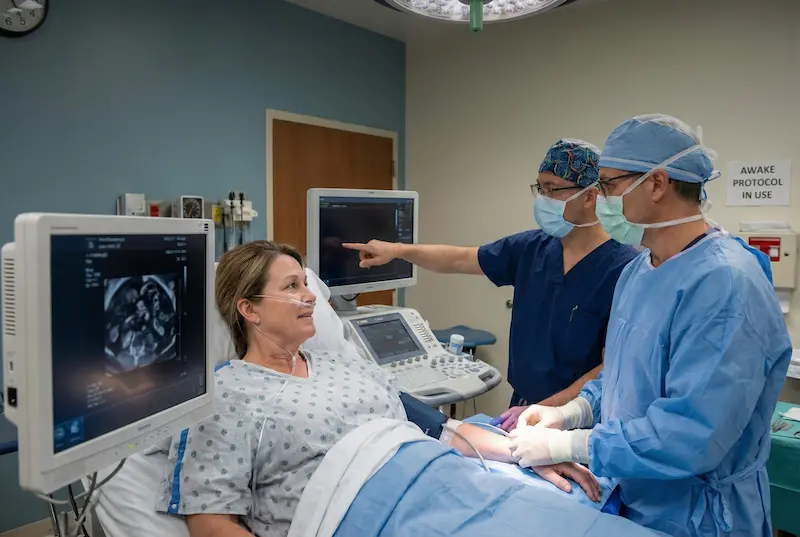
Real Patient Story #3 — Lisa (USA): Choosing an Awake Approach to Avoid General Anesthesia
If you’ve been Googling awake deep plane facelift Turkey or comparing deep plane facelift in Turkey options because general anesthesia scares you, Lisa’s story is the clearest example of why some Americans fly for facelift surgery in Istanbul.
Lisa is a 65-year-old woman from the USA who came to AKM Clinic for a major combination plan: an Awake Deep Plane Facelift, Neck Lift, Upper Blepharoplasty, plus an Arm Lift and CO2 Fractional Laser. Her motivation was deeply personal—she described this transformation as a “lifelong dream”. The problem was that she felt “paralyzed” by anxiety about general anesthesia.
Why “awake / twilight facelift” becomes the deciding factor
For many expert patients, safety questions aren’t abstract—they’re specific. Lisa’s fear was not about Turkey; it was about anesthesia. And this is exactly why searches like facelift under local anesthesia, twilight facelift, and deeplane facelift in Turkey are rising: patients want an option that fits their medical comfort zone without giving up a high-level technique.
In Lisa’s case, she reported that the medical team’s guidance—especially the reassurance that her combination of procedures could be done under local anesthesia with sedation—was the definitive reason she was able to move forward.
Lisa (USA): She described the “awake” approach as the key that helped her finally pursue her “lifelong dream.”
What “awake” actually means (and what it does NOT mean)
One reason people hesitate is the mental image of being fully alert during surgery. In AKM Clinic’s explanation, “awake” doesn’t mean you’re watching surgery or feeling pain. It means the area is thoroughly numbed with a tumescent local anesthetic technique, and a light sedative is used so the patient is typically relaxed, sleepy, and calm.
- Pain control: the surgical area is numbed, so pain is not expected during the procedure.
- Memory/anxiety: sedation is intended to keep the experience low-anxiety, and patients generally do not see or remember technical details.
- Breathing/reflexes: “awake” means basic reflexes and breathing are preserved while you remain comfortably sedated.
Important: an awake/twilight approach is still surgery. It’s not “risk-free,” and it’s not appropriate for everyone. The safest plan is always the one that matches your health profile, anatomy, and surgeon’s recommendation—not just a preference you bring from online research.
Her recovery experience: “treated like royalty” and feeling “fantastic” in days
Lisa’s post-op experience highlights why many Americans are getting facelifts in Turkey for more than a lower facelift Turkey price. She said she felt “treated like royalty,” and she described her recovery as “easy” and “smooth.” Most striking: she reported feeling “fantastic” just four days after a major combination surgery.
Lisa (USA): “Treated like royalty”… and “fantastic” within days.
Her outcome is also a trust signal: she stated she planned to return for future procedures and intended to “always recommend” the clinic—exactly the kind of long-term confidence that many people hope to find when they search for the best facelift surgeon in Turkey or compare facelift in Turkey reviews.
What the First 14 Days in Istanbul Can Look Like (A Realistic Timeline)
One reason Americans fly for facelift surgery is the ability to plan recovery in a structured, supported way—especially if you’re traveling from the USA and you want your early healing monitored before you fly home. Whether you choose a deep plane facelift in Turkey, SMAS facelift in Turkey, a mini facelift in Turkey, or a lower facelift in Turkey, the first two weeks are where swelling, bruising, and incision care matter most.
Day-by-day: swelling, bruising, energy, and what feels “normal”
| Timeframe | What Many Patients Experience | What to Prioritize |
|---|---|---|
| Day 1–2 | Tightness, swelling starting, fatigue; you’ll likely want quiet rest. | Hydration, gentle walking, medication schedule, incision protection. |
| Day 3–5 | Swelling/bruising can peak; emotional ups/downs are common. | Follow-up checks, photos for monitoring, reassurance on “normal vs not.” |
| Day 6–7 | Bruising often starts shifting/fading; you may feel more like yourself. | Low-salt nutrition, sleep position, gentle activity only. |
| Week 2 (Days 8–14) | Steadier improvement; swelling becomes more “localized.” | Incision care, scar strategy, clear travel-readiness assessment. |
Follow-ups and monitoring: what good aftercare includes
If you’re comparing facelift in Turkey reviews, notice what patients mention about follow-up—because a lower facelift Turkey price means very little if post-op monitoring is weak. A strong aftercare plan typically includes:
- Scheduled in-person checkups during the first week
- Clear wound/incision care instructions (easy to follow even when tired)
- Medication guidance and what symptoms require immediate contact
- Planned communication after you return to the USA (virtual follow-ups)
Why this matters for expert patients: early monitoring protects outcomes more than “perfect” packing lists or hotel choices.
When can you fly home after a facelift in Turkey?
Patients often ask this when researching cost of facelift in Turkey or cost of facelift Turkey package 2024—because the timeline affects time off work, privacy, and comfort on the return flight.
- Many patients plan to stay roughly 4–5 days in Istanbul after a facelift, depending on the procedure scope (e.g., deep plane facelift in Turkey vs mini facelift Turkey) and how healing progresses.
- Your surgeon should make the final call based on swelling, incision status, and your overall readiness.
Flying too early can increase stress, discomfort, and anxiety. A good plan prioritizes safety over speed—even if you’re eager to return to the USA.
“Faster Recovery” Proof Points: HBOT & LLLT in Aftercare
Many Americans getting facelifts in Turkey aren’t just comparing the facelift Turkey price—they’re comparing downtime. That’s why supportive recovery options like HBOT and LLLT come up in consultations, especially for patients who want a smoother early healing period.
HBOT after facelift surgery: what it’s used for
Hyperbaric Oxygen Therapy (HBOT) is delivered in a pressurized chamber with oxygen support. In a post-surgical context, it’s commonly positioned to support vulnerable tissues, help swelling settle, and support incision healing—especially when a patient wants a structured recovery plan before they fly home.
LLLT after facelift surgery: what patients should expect
Low-Level Laser Therapy (LLLT) (often described as a “soft laser”) is used as a supportive recovery tool. The goal is not a “miracle overnight change,” but a calmer healing environment that can support comfort, inflammation reduction, and skin recovery during early downtime.
A realistic mindset: helpful support, not magic
Whether you’re researching deep plane facelift Turkey cost, deep plane facelift cost Turkey, or facelift cost in Turkey, treat recovery tech as part of the overall plan—not the main reason to choose a clinic. The fundamentals still win:
- Technique matched to anatomy (Deep Plane vs SMAS vs mini vs lower facelift)
- Surgeon-led planning
- Strong monitoring and clear aftercare

Cost & Value Reality Check (Comparing Apples to Apples)
Let’s talk about the question behind almost every search phrase on this topic—facelift Turkey price, facelift turkey price, cost of facelift in Turkey, facelift cost Turkey, deep plane facelift Turkey cost, and even older search patterns like cost of facelift Turkey package 2024.
The most important thing to understand is this: the “best value” isn’t the lowest quote. For Americans getting facelifts in Turkey, value usually means clarity, safety coverage, and continuity of care—especially when you’re flying home to the USA while still healing.
What must be included in a safe facelift package (and what’s often missing)
If you’re comparing facelift in Turkey packages, ask for a written breakdown. The safest packages are transparent—because transparency is a safety feature.
| Item | Should Be Clearly Included | Why It Matters |
|---|---|---|
| Surgeon-led evaluation + plan | Technique rationale (Deep Plane vs SMAS vs mini vs lower facelift) | Prevents one-size-fits-all surgery and reduces regret. |
| Facility + anesthesia monitoring | Who administers/monitors sedation/anesthesia and where surgery is performed | Safety is a system, not a promise. |
| Medications + written aftercare | Clear schedule + what’s normal vs urgent | Reduces avoidable complications and anxiety. |
| Post-op checks before departure | Planned follow-ups during the first 7–14 days | Early monitoring protects results more than anything else. |
| Virtual follow-up after you return | Structured check-ins when you’re back in the USA | Continuity matters when swelling/scars evolve over weeks. |
| Revision/complication pathway | Clear plan if you need additional care | Reduces “what if?” fear—especially for international patients. |
Why the “cheapest quote” can become expensive later
Low pricing can be real—but sometimes it’s low because key components are missing. For the expert patient, the risk isn’t only financial. The bigger cost can be:
- Gaps in follow-up: flying home without adequate monitoring
- Unclear technique selection: “everyone gets the same facelift”
- Hidden add-ons: medications, imaging, or additional facility costs
- Revision risk: paying more later (in time, money, and emotional stress)
Expert-patient mindset: If a quote is dramatically lower, ask: “What’s not included?”
A practical comparison framework: NYC/LA/Miami vs Istanbul (and why Mexico/Thailand also come up)
When Americans compare cost of facelift in Turkey to the USA, the most meaningful comparisons usually involve high-cost markets like New York City, Los Angeles, and Miami—because that’s where many advanced facial procedures (including Deep Plane approaches) are frequently quoted at a premium.
But U.S. patients also often compare Turkey to other medical tourism destinations like Mexico and Thailand. The smartest way to compare isn’t “country vs country.” It’s this:
| Comparison Category | Questions to Ask (Any Destination) | What “Good” Looks Like |
|---|---|---|
| Technique fit | Am I best suited for Deep Plane, SMAS, mini facelift, or lower facelift? | A personalized explanation based on your anatomy. |
| Surgeon credibility | Who is actually operating—and what results are consistent in patients like me? | Surgeon-led plan + consistent aesthetic outcomes. |
| Aftercare structure | How many follow-ups happen before I fly home? What happens after I return to the USA? | Planned monitoring + continuity of care. |
| Total journey support | What logistics are handled, and what is my responsibility? | Clear, written itinerary and support pathway. |
| True total cost | What is included vs excluded (meds, follow-ups, therapies, revisions)? | No surprises; transparent scope. |
If you’re searching for deep plane facelift cost Turkey or deep plane facelift Turkey price, apply that same framework. A Deep Plane facelift is not a commodity—and a quote is only meaningful when you know exactly what it covers.
How to Decide If Turkey Is Right for You
By the time most people in the USA reach this point, they’ve already compared technique options (deep plane facelift in Turkey vs SMAS facelift in Turkey), skimmed dozens of facelift in Turkey reviews, and started price-searching (facelift Turkey price, facelift cost Turkey, cost of facelift in Turkey).
The better question is: Is international surgery a fit for your timeline, risk tolerance, and support system? Use the decision framework below to make the choice like an expert patient—not like an impulsive shopper.
A self-assessment checklist (time off, privacy, support, and expectations)
- Time off: Can you realistically take 10–14 days for early recovery plus a few extra weeks of “social downtime” back in the USA?
- Support system: Are you traveling alone? If yes, do you feel confident you’ll have consistent post-op support?
- Risk tolerance: Are you comfortable recovering away from your home physician network (with virtual follow-up)?
- Expectations: Are you aiming for “rejuvenation, not alteration”—or chasing a dramatically different look?
- Medical readiness: Do you have any conditions (or medications) that affect bleeding, healing, or anesthesia risk?
Reality check: The best facelift in Turkey (or anywhere) is the one that fits your anatomy, health profile, and goals—not the fastest timeline or the lowest facelift Turkey price.
Consultation questions that reveal quality (and protect you)
Whether you’re searching for the best facelift surgeon in Turkey, the best facelift surgeon Turkey, or the best deep plane facelift surgeon in Turkey, these questions tend to separate surgeon-led planning from “package selling”:
| Question to Ask | What a Strong Answer Includes |
|---|---|
| “Which technique is right for me—Deep Plane, SMAS, mini facelift, or lower facelift?” | A clear anatomy-based explanation (not a one-size-fits-all pitch). |
| “What results can you show for patients like me?” | Consistent, natural outcomes in your age range and facial structure. |
| “What is your anesthesia plan—and am I a candidate for twilight/awake?” | Safety-first guidance, with clear criteria (not promises). |
| “How many post-op checks happen before I fly home?” | A structured follow-up schedule (especially for international patients). |
| “If I have a concern after I return to the USA, what happens?” | A defined continuity plan (virtual follow-ups + escalation pathway). |
When to postpone surgery (the most underrated safety move)
If you feel rushed, pressured, or uncertain, postponing is often the safest decision. Consider delaying if:
- You can’t take adequate recovery time (or you’re trying to “hide” a major facelift in a week)
- You’re being sold a procedure without a clear rationale (especially for deeplane facelift in Turkey)
- You’re comparing quotes without understanding what’s included (e.g., cost of facelift Turkey package 2024 without a written breakdown)
- You have unmanaged medical issues that raise anesthesia or healing risk
If you do decide to move forward with facelift surgery Turkey, choose the path that prioritizes safety, technique-fit, and aftercare—not just facelift turkey pricing.
Americans Getting Facelifts In Turkey Frequently Asked Questions (FAQ):
These are the most common questions Americans ask when they’re deciding whether to get facelift in Turkey, comparing deep plane facelift Turkey cost, or searching for the best facelift in Turkey.
Is it safe for Americans to get facelifts in Turkey?
It can be safe when you verify surgeon credentials, facility standards, anesthesia monitoring, and a structured follow-up plan. Treat it like a due-diligence project—not a vacation purchase.
How do I verify a surgeon’s credentials in Turkey?
Ask for full name, medical registration details, specialty background, and case experience in your chosen technique (Deep Plane/SMAS/mini/lower facelift). A credible clinic answers transparently.
What’s the difference between Deep Plane and SMAS facelifts?
They’re different structural approaches. Deep Plane focuses on repositioning deeper layers for a natural redrape when indicated; SMAS techniques lift/tighten the SMAS layer with many variations. The “best” choice depends on your anatomy.
Can a facelift be done under local anesthesia (awake/twilight)?
Sometimes, for suitable candidates. “Awake” typically means strong local numbing plus sedation (twilight), not feeling pain or watching surgery. Eligibility depends on health profile, procedure scope, and surgeon recommendation.
How long should I stay in Istanbul after a facelift in Turkey?
Many patients plan about 10–14 days, depending on the procedure (e.g., mini facelift in Turkey vs a deeper structural facelift) and how healing progresses. Your surgeon should decide travel readiness.
When can I fly back to the USA after surgery?
It varies, but flying too early can increase stress and discomfort. Your clinic should assess swelling, incision status, and overall stability before clearing travel.
How do I avoid an “overdone” facelift look?
Choose a surgeon whose results consistently look natural, and ensure the plan is anatomy-based (not trend-based). Natural outcomes are designed—through technique, tension control, and skin handling.
What complications should I understand before booking?
Ask about bleeding/hematoma risk, infection prevention, nerve-related concerns, scarring, and asymmetry—plus the clinic’s plan if you need extra care. A quality clinic discusses risks without minimizing them.
What is typically included in a Turkey facelift package?
Inclusions vary—so get it in writing. At minimum, compare what’s included in: surgeon fees, anesthesia/facility, meds, post-op checks, and aftercare/virtual follow-ups (especially important for Americans).
How should I compare prices like “deep plane facelift Turkey price” or “facelift cost in Turkey”?
Compare apples to apples: technique, surgeon experience, anesthesia monitoring, facility standards, follow-up schedule, and what happens after you return home. Price alone can hide risk.