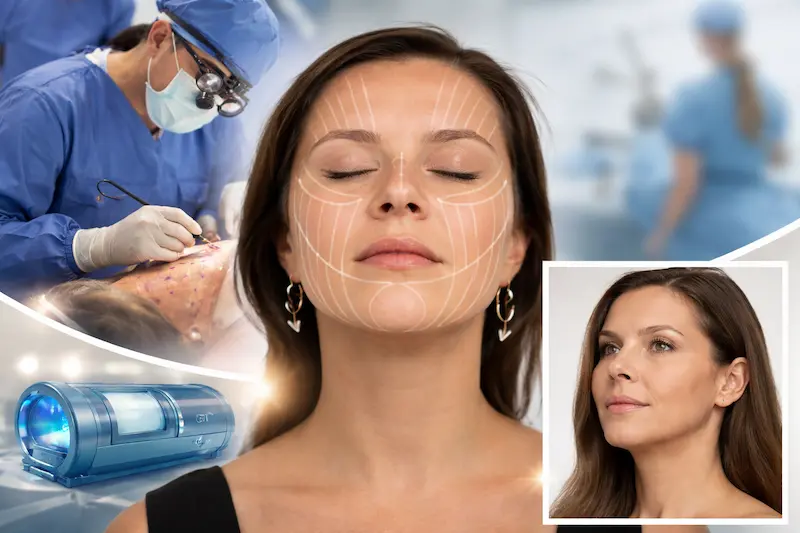

If you’re comparing stem cell facelift vs traditional facelift, you’re likely trying to answer one practical question: Which option will look natural, heal safely, and be worth the investment? The challenge is that “stem cell facelift” is often used as a marketing label—sometimes describing regenerative techniques grounded in medical science, and sometimes describing something much less specific.
In this guide, we’ll separate terminology from reality, summarize what scientific research supports, and give you a decision framework you can actually use. To anchor that framework, our complete Istanbul-based facelift surgery program at AKM Clinic outlines the structural-lift baseline that any “regenerative add-on” decision should be measured against — including technique selection (deep plane, SMAS, mini), anesthesia options, and the surgeon-led planning protocol.
If you are still exploring all your options and want to understand the complete journey, surgical standards, and what it entails to have this procedure abroad, you can read our comprehensive guide on getting a facelift in Turkey before diving into this specific comparison.
Important note: This article is educational and not a substitute for an in-person evaluation by a qualified surgeon.
Table of Contents
Quick Definitions: What Each Term Actually Means
Before you compare outcomes, you need clean definitions. Many “stem cell facelift reviews” online mix together very different procedures—so patients end up comparing apples to oranges. Below is a precise, patient-friendly breakdown.
“Traditional Facelift” = What is being lifted (SMAS vs Deep Plane basics)
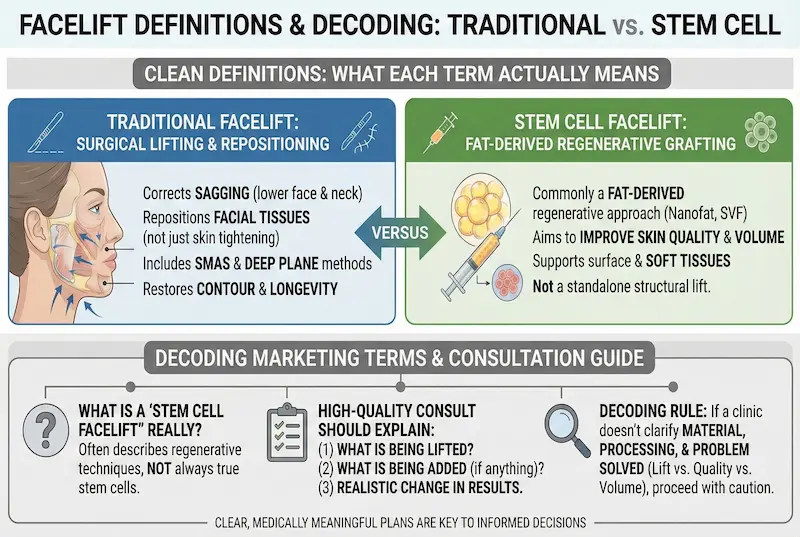
A traditional facelift is a surgical procedure designed to correct sagging in the lower face and neck by repositioning facial tissues—not just tightening skin. Depending on the technique, the surgeon may work with deeper layers (often discussed as SMAS-based approaches or deeper-plane methods) to restore contour at the jawline, cheeks, and neck with better longevity than skin-only tightening. The most structurally aggressive modern variant — the deep plane facelift technique with composite flap dissection — is documented separately on our procedure page, including the midface ligament release sequence and SMAS-skin unit repositioning that defines this approach.
For patients whose anatomy fits a less aggressive but still structurally durable correction, our SMAS facelift procedure for moderate sagging details the superficial musculoaponeurotic system tightening protocol, candidacy thresholds, and the recovery profile that often appeals to patients seeking a balance between traditional facelift surgery and minimally invasive options.
“Stem Cell Facelift” = Is it really stem cells, or fat-derived regenerative grafting?
When patients search what is stem cell facelift, they often find a wide range of claims. In many clinics, a “stem cell facelift” is not a standalone “stem cell facelift surgery” in the way people imagine. Instead, it commonly refers to a fat-derived regenerative approach—for example, using your own processed fat (sometimes described with terms like “regenerative,” “nanofat,” or “SVF” in some contexts) to improve skin quality and volume. The “nanofat” terminology specifically refers to mechanically emulsified fat with high progenitor-cell concentration; for the technique-level breakdown, our explainer on nanofat grafting technique and skin-quality applications separates this approach from whole-fat transfer and clarifies which “stem cell facelift” marketing claims actually map onto nanofat protocols.
Why marketing terms confuse patients (and how to decode them)
Here’s the decoding rule: if a clinic promises a “stem cell facelift” without clearly explaining where the material comes from, how it’s processed, and what problem it solves (lift vs. quality vs. volume), you may not be getting a clear, medically meaningful plan. A high-quality consult should explain (1) what is being lifted, (2) what is being added (if anything), and (3) what can realistically change in “stem cell facelift results” versus a surgical lift.
Want to know exactly how it works? We have kept this guide focused on comparing the two methods. For a full mechanism-level explainer — including the SVF (stromal vascular fraction) processing pipeline, the difference between adipose-derived stem cells and whole fat grafting, and the candidacy markers a surgeon evaluates — read our companion guide on what stem cell assisted facelift surgery actually involves.
Mechanism of Change: Lift vs Regeneration (What Improves, and Why)
This is the heart of the comparison. A facelift is primarily about repositioning. A regenerative add-on is primarily about tissue quality (and sometimes volume). Understanding the mechanism helps you predict results, downtime, and risks.
Traditional facelift: repositioning tissues for structural lift
Gravity and time affect deeper facial support. A traditional facelift targets that descent by repositioning supportive structures to restore a more youthful facial geometry—especially around the jowls and neck. This is why, for patients with meaningful sagging, a lift is usually the most predictable path to strong contour change.
Regenerative approach: improving skin quality, texture, and glow
Regenerative techniques are often discussed as improving skin texture, hydration appearance, and overall “brightness.” That doesn’t mean a dramatic “lift.” Instead, many patients pursue it for skin quality—fine creasing, dullness, or a tired look. The best clinics will connect claims to plausible biology (and to the limits of scientific research), rather than implying guaranteed transformation.
Volume restoration: where fat transfer fits into the equation
Some patients don’t just sag—they also deflate. Strategic volume restoration (often via fat transfer) may be used to soften hollowness and support harmony. But volume work is not the same as lifting, and it can be less predictable over time due to variable retention. This is why many surgeons use it thoughtfully—as a complement, not a substitute—depending on anatomy and goals. The full protocol — including donor-site selection, processing technique, and the volume-vs-survival trade-off curve — is detailed on our facial fat transfer procedure page, which also covers candidacy for combined fat-grafting plus surgical-lift plans.
Results You Can Expect: Naturalness, Skin Quality, and “Aging Back”
Patients usually care about two outcomes: (1) looking like themselves—just rested—and (2) not looking “done.” Comparing “stem cell facelift before and after” galleries can help, but only if you’re comparing similar starting points and techniques.
What looks most natural—and what can look “overdone”
“Overdone” results are usually not caused by the word “facelift”—they’re caused by poor planning, excessive tension on skin, or a mismatch between technique and anatomy. A well-executed surgical lift can be extremely natural, while any approach (surgical or regenerative) can look unnatural if it’s used to chase the wrong goal. Our case study on subtle facelift results that prioritize rejuvenation over alteration walks through a real “expert patient” goal set — including how surgeons read before/after photos in motion (not just stills), the structural markers that prevent a “wind-swept” outcome, and the 6–12 month benchmark for evaluating whether a result reads as truly natural.
Skin quality outcomes: fine lines, crepey skin, dullness
If your main complaint is skin quality—fine lines, crepey texture, dullness—regenerative add-ons may be relevant to discuss. That said, patients should treat dramatic promises cautiously and ask for evidence, consistency in before/after lighting, and realistic timelines for “stem cell facelift results.”
Durability: Which Option Wins the Test of Time?
A major deciding factor between these two approaches is how long the results will hold up against natural aging. Traditional structural lifting inherently offers more predictable, long-term contour correction. Regenerative fat add-ons, on the other hand, follow a different timeline when it comes to tissue retention and skin quality maintenance.
Because this is such a critical topic for our patients, we have dedicated an entire guide to it. Our deep-dive on stem cell facelift longevity at 5, 10, and 15 years covers the collagen remodeling timeline, the variables that affect fat retention rates, and the maintenance protocols that protect your investment over time.
Comparing Recovery: Structural Healing vs. Regenerative Swelling
Healing from a traditional lift is primarily about structural recovery. You are dealing with repositioned tissues, which means tightness, specific incision care, and predictable swelling that gradually subsides.
When you add a regenerative fat-transfer component, the recovery profile shifts. While you might still feel the structural tightness, you are also managing the biological response of fat grafting. This can mean different bruising patterns and a slightly longer period of “puffiness” as the newly introduced cells integrate and establish a blood supply.
For a day-by-day breakdown — including which milestones differ between traditional and regenerative-augmented healing — see our complete facelift recovery timeline with stem-cell augmentation, which maps out swelling pattern, incision-care variations, and the social-readiness checkpoints from Day 1 through Month 12.
Safety & Predictability: Risks, Trade-Offs, and Who Should Avoid What
Patients researching “stem cell facelift reviews” often focus on excitement and overlook the most important decision variable: predictability. A traditional facelift is a mechanical solution for sagging; a regenerative approach relies more on biologic response and healing variability. A 2024 peer-reviewed analysis published in the National Library of Medicine examining the role of mesenchymal cells in autologous fat transfers for facial rejuvenation reported that ADSC-enriched grafts show measurable benefit primarily in larger-volume cases, while smaller-volume outcomes remain debated across studies — confirming that “stem cell” branding alone does not predict superiority over traditional fat grafting techniques. Outcomes still depend heavily on technique, patient selection, and follow-up care.
Surgical risks (bleeding, nerve injury, hematoma) and how risk is minimized
All surgery carries risk. For a traditional facelift, the most discussed concerns include bleeding/hematoma, infection, wound healing issues, and nerve-related complications (usually temporary, rarely persistent). Risk reduction comes from surgeon expertise, meticulous hemostasis, appropriate patient screening (especially for blood thinners and smoking), and structured post-op monitoring.
One reason “expert patients” consistently emphasize surgeon selection is that the best outcomes come from technique precision and conservative planning—especially when your priority is a natural look.
Fat grafting / regenerative risks (resorption, unevenness, nodules)
When “stem cell facelift” refers to a fat-derived regenerative technique, the risk profile shifts. Commonly discussed stem cell facelift risks include:
- Variable retention/resorption: not all transferred volume “takes,” so results can change over time.
- Irregularities: unevenness, lumpiness, or firmness can occur depending on placement and healing.
- Nodules or cyst-like changes: uncommon but important to discuss upfront.
- Bruising/swelling: especially when combined with harvesting.
This is why a credible consultation explains exactly what the clinic means by “stem cells,” how the material is obtained/processed, and what the intended benefit is (skin quality vs volume vs adjunct to lifting). If the explanation stays vague, that’s a signal to slow down and ask harder questions.
Predictability: why some patients prefer “mechanical lift” vs “biologic response”
Predictability is the reason many patients with moderate-to-severe sagging choose a traditional facelift. If your primary issue is jowls/neck laxity, a lift often gives the most consistent contour correction. Regenerative approaches may be most logical when the goal is improving skin quality, mild volume correction, or enhancing overall “glow,” but they are less reliable as a substitute for structural lifting.
How to interpret online reviews: With stem cell facelift reviews, check whether the reviewer had true sagging (a lifting problem) or primarily skin/volume concerns (a regenerative/volume problem). Many mismatched expectations come from choosing a biologic approach for a structural issue.
Who Is a Better Candidate for Each Option? A Decision Framework
Most confusion around stem cell facelift results comes from choosing a procedure that doesn’t match the underlying problem. A traditional facelift is primarily for structural descent (sagging). A “stem cell facelift” (as commonly marketed) is usually a regenerative / fat-derived approach aimed at skin quality and soft-tissue support—sometimes with volume restoration. Below is a practical framework you can use before you get influenced by glossy stem cell facelift before and after photos or overly enthusiastic stem cell facelift reviews.
If your main issue is sagging/jowls/neck laxity
If your “before” is defined by jowls, a heavy lower face, or neck laxity, a traditional facelift surgery is often the most predictable way to restore contour. This is where a true lift provides “mechanical” correction—repositioning tissues rather than relying on a biologic response.
- Best fit: moderate-to-significant sagging of the lower face/neck
- Most predictable change: jawline definition, neck contour, jowls
- Common mismatch: expecting a regenerative-only approach to “lift” significant sagging
If your main issue is volume loss + skin quality
If your primary concern is hollowing (temples, midface), tired texture, or a “deflated” look—without major sagging—then a regenerative / fat-derived approach may be relevant to discuss as a stem cell facelift procedure (as many clinics use the term). In real-world practice, this is often about supporting skin quality and adding subtle volume—rather than delivering a dramatic lift.
- Best fit: mild laxity + visible volume loss + skin quality concerns
- Most common benefits: softness, skin “freshness,” gentle volumization
- Key reality: retention can vary; shape evolves as swelling resolves and tissues stabilize
When the best answer is a combined approach (lift + regenerative support)
For many “expert patients,” the best plan is not either/or. A combined strategy can use a traditional facelift for structure and a regenerative component to support skin quality—especially when the goal is a natural, rested look rather than a dramatic “change.” This is also where surgeon planning matters most: adding volume in the wrong place can make the face look heavy, while a well-designed plan can look exceptionally natural.
| Your Main Concern | Most Predictable Core Solution | Possible Add-On |
|---|---|---|
| Jowls / neck laxity | Traditional facelift surgery (structural lift) | Targeted regenerative support for skin quality (case-dependent) |
| Hollowing / deflation | Strategic volume restoration | Regenerative/fat-derived approach (if appropriate) |
| Crepey texture / dullness | Skin-quality focused plan | Regenerative adjuncts + evidence-based skincare |
| Both sagging + skin quality issues | Combined approach | Lift + regenerative support, designed to stay natural |
Cost reality check: Searches like stem cell facelift cost and comparisons such as stem cell facelift Beverly Hills often mix pricing for very different things (injectable regenerative add-ons vs a full stem cell facelift surgery package vs a true surgical lift). Always ask for an itemized plan: What is included (surgery, anesthesia, facility, aftercare, follow-ups, recovery therapies)? For a transparent baseline you can compare against — including what’s bundled in AKM Clinic’s all-inclusive surgical-lift packages versus what’s add-on — see our facelift cost breakdown by technique, which separates deep plane, SMAS, and combined-procedure pricing so you can do the apples-to-apples math properly.
Practical rule: If the goal is a visible lift of jowls/neck, don’t let a “stem cell” label replace structural logic.
What Matters Most for Outcomes: Surgeon Skill, Team Approach, and Aftercare
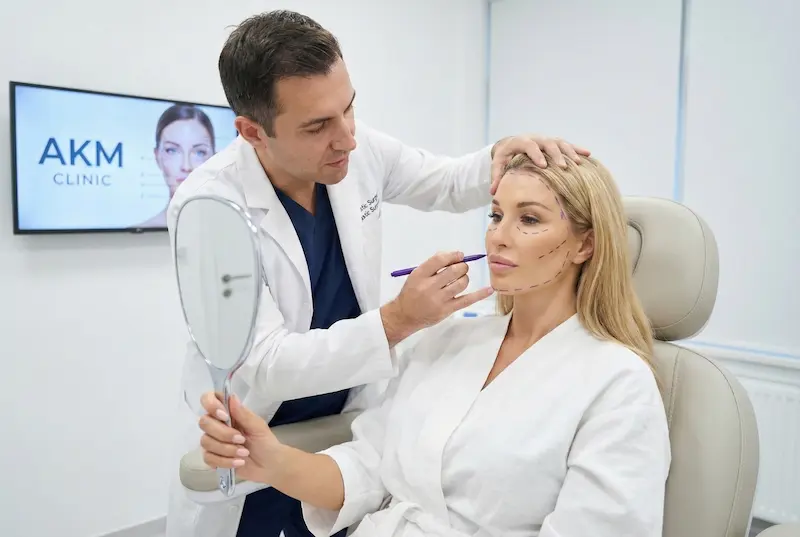
When patients compare stem cell facelift vs traditional facelift, they often focus on the label. In practice, the biggest predictors of a natural, safe result are: (1) correct diagnosis of your aging pattern (sagging vs volume vs skin quality), (2) the surgeon’s technique and restraint, and (3) structured aftercare that supports healing. This is also why “amazing” stem cell facelift before and after photos can be misleading if the patient’s starting point—and the exact procedure—aren’t comparable.
Why technique expertise matters (and how to evaluate it as a patient)
If you’re an “expert patient,” you don’t just ask what the procedure is—you ask how it will be performed. A credible consultation should clearly answer:
- What is the primary problem? (structural descent, volume loss, skin quality)
- What is the primary correction? (lift, volume restoration, regenerative support—or a combined plan)
- What are the main trade-offs? (predictability, downtime, scarring, revision risk)
- How will risks be managed? (bleeding/hematoma protocols, infection prevention, monitoring)
How to read reviews intelligently: Many stem cell facelift reviews are positive because the patient had mild laxity and mainly wanted skin “freshness.” That doesn’t mean the same approach will correct jowls and neck laxity. Look for reviews that match your starting anatomy and that describe the timeline honestly (2 weeks vs 6 months makes a huge difference). For an anatomy-matched review pool you can filter by procedure type and patient profile, our verified third-party patient review platform aggregates Trustpilot, Google, and structured testimonials with timeline-stamped feedback — so you can find reviewers whose starting point resembles yours, not just the highlight cases.
Cost context you should demand: Searches like stem cell facelift cost can be misleading because “stem cell facelift” may describe anything from an injectable regenerative add-on to a full combined surgical plan. If you’re comparing pricing to stem cell facelift Beverly Hills packages, insist on itemization: surgeon fees, anesthesia, facility, aftercare, follow-ups, and whether it’s truly stem cell facelift surgery or a regenerative adjunct. Without that breakdown, cost comparisons aren’t scientifically meaningful.
Dermatosurgeon advantage: skin quality + structure addressed together
Facial rejuvenation is not only about lifting—it’s also about how the skin behaves after lifting. At AKM Clinic, the lead doctor is Dr. Akif Mehmetoğlu, MD, a Dermatosurgeon & Face Expert known for advanced facial rejuvenation planning (including deep-plane facelift strategy and awake/twilight approaches). This matters for patients who want natural results because the plan can address:
- Structure: restoring facial contour without creating a “pulled” look
- Skin quality: supporting texture, tone, and scar quality considerations with dermatosurgical expertise
- Balance: avoiding overfilling or over-tightening—two common reasons results look “done”
AKM Clinic’s team model also includes facial plastic surgery expertise supporting a multi-disciplinary approach when anatomy and goals require it.
Patient reality check: Barbara (USA) described her surgery as “fabulous,” with “no pain” and minimal bruising—and said she looked like “nothing happened but probably 20 years younger.” The key point is not the quote itself; it’s that naturalness is a planning outcome, not a marketing label.
Recovery optimization: AKM Clinic’s HBOT & LLLT support and why it matters
Two patients can have the same procedure and very different recoveries. That’s why aftercare is part of the clinical strategy—not an afterthought. AKM Clinic supports recovery with two advanced modalities often used to help reduce inflammation and support tissue repair:
- HBOT (Hyperbaric Oxygen Therapy): uses a pressurized environment where the patient breathes high-concentration oxygen. The goal is to support oxygen delivery to healing tissues—often discussed in medical science as beneficial for tissue recovery support. In practical terms, it’s used to support swelling reduction, scar quality, and infection-risk mitigation strategies.
- LLLT (Low-Level Laser Therapy): a non-invasive light-based therapy used to support cellular repair and inflammation control. In post-surgical protocols, it’s commonly positioned to support collagen-related recovery and reduce redness/swelling—an approach consistent with how scientific research frames photobiomodulation mechanisms.
Why this matters for you: if you’re comparing options (or countries), don’t only compare procedure names—compare the recovery system. Many “I healed fast” testimonials come down to structured monitoring, rapid access to the team, and recovery support that reduces social downtime.
Support matters: One patient described AKM’s aftercare as a “lifeline of support,” saying “again and again, they answered me”—a direct antidote to the fear of post-op abandonment that medical tourists often have.
Frequently Asked Questions (FAQ): Stem Cell Facelift vs Traditional Facelift
Below are the most common questions patients ask when comparing stem cell facelift vs traditional facelift. These answers are intentionally practical: they focus on terminology clarity, realistic expectations, and how to verify claims using a science-first mindset (rather than marketing).
Is a “stem cell facelift” FDA-approved / scientifically proven?
It depends on what the clinic means by stem cell facelift. In many cases, “stem cell facelift” is a marketing umbrella for fat-derived regenerative techniques (often paired with volume restoration). The broader field has ongoing scientific research, but outcomes and claims vary widely by protocol. The safest approach is to ask for a clear explanation of: (1) source material, (2) processing method, (3) intended benefit (skin quality vs volume vs adjunct to lifting), and (4) realistic limitations based on medical science—not hype.
Will I look “pulled” with a traditional facelift?
“Pulled” results usually come from excessive skin tension or poorly matched technique—not from the fact that a facelift is surgical. A well-planned traditional facelift surgery repositions deeper structures to restore contour naturally. The best safeguard is surgeon selection: look for consistent, time-stamped results and a plan that prioritizes harmony over maximum tightening.
How long do results last for each option?
Because this involves two different timelines—the durable structural support of a traditional lift versus the evolving skin surface improvements of a regenerative approach—we have covered this comprehensively in a separate guide. Find out exactly how long a stem cell facelift lasts compared to traditional methods here.
Can regenerative fat-based treatment replace a facelift if I have significant sagging?
Usually not. If your main issue is structural descent (jowls/neck laxity), a “regenerative-only” plan is often the wrong tool for the job. A stem cell facelift procedure (as commonly marketed) may support skin quality and mild volume issues, but it typically cannot substitute for the mechanical correction of a true lift when sagging is significant.
What’s the biggest risk with each approach?
For a traditional facelift surgery, key concerns include bleeding/hematoma, infection, wound healing issues, and (rarely) nerve-related complications—risk is reduced by meticulous surgical technique, screening, and close monitoring. For regenerative/fat-derived approaches, common concerns include variable retention/resorption, unevenness, nodules, and evolving shape during healing—these are often summarized by patients as stem cell facelift risks. In both cases, predictability improves with correct candidacy and experienced hands.
When is the best age (or “best time”) to do each procedure?
There’s no universal age. “Best time” is when your anatomy and goals match the method. If sagging is your dominant issue, a lift-based approach may be appropriate regardless of whether you’re in your 40s, 50s, or 60s—if you’re medically fit. If your primary concern is skin quality and early volume changes without major sagging, a regenerative plan may be discussed earlier. A proper consult should prioritize anatomy over trends.
How do I verify a clinic’s claims about “stem cells,” safety, and outcomes?
Define the procedure: Ask exactly what “stem cell facelift” means in their protocol. Is it truly stem cell facelift surgery, a fat-derived regenerative add-on, or a combined plan?
Demand time-stamped proof: Review stem cell facelift before and after galleries with consistent lighting/angles and clear timelines (2 weeks vs 6 months).
Read reviews with anatomy-matching logic: Many stem cell facelift reviews reflect mild laxity patients; don’t assume the same outcome applies to significant sagging.
Ask about risk protocols: Monitoring schedule, red-flag pathway, infection prevention, and revision strategy.
Price transparency: Compare stem cell facelift cost only with itemized plans. “All-in” pricing in places like stem cell facelift Beverly Hills may reflect different inclusions than elsewhere (anesthesia, facility, aftercare, recovery therapies, follow-ups).