If you’re thinking about a deep plane facelift, you’re probably not just asking if it will make you look younger — you’re asking how long does deep plane facelift last and whether it’s truly worth the investment, the travel and the recovery time.
The deep plane facelift is often chosen by patients who want more natural, longer-lasting results than a traditional facelift, especially in the midface (cheeks), jawline and neck. Many patients are told they can expect their results to last 10 years or longer — but what does that really mean in day-to-day aging, and what does “after 10 years” actually look like?
At AKM Clinic in Istanbul, we regularly see international patients — especially from the US — who fly to Turkey because they want a high-end deep plane facelift with 10+ year longevity but at a more accessible price point than in cities like New York, Los Angeles, San Francisco or Chicago. This article will walk you through how this technique works, what affects its duration and what you can realistically expect in 1, 5 and 10+ years after surgery.
Let’s start with the basics: what a deep plane facelift actually is, and why it tends to age better than more superficial techniques.
Table of Contents
What Is a Deep Plane Facelift and Why Does It Last Longer?
A deep plane facelift is an advanced facelift technique that targets the deeper support layers of the face, not just the skin. Instead of pulling skin tight on the surface, the surgeon repositions the deeper muscle–fat structures that have sagged with age. The full surgical methodology — incision design, ligament release sequence, and what the surgical team specifically does at the deep plane level to set up 10+ year results — is documented on our deep plane facelift technique overview.
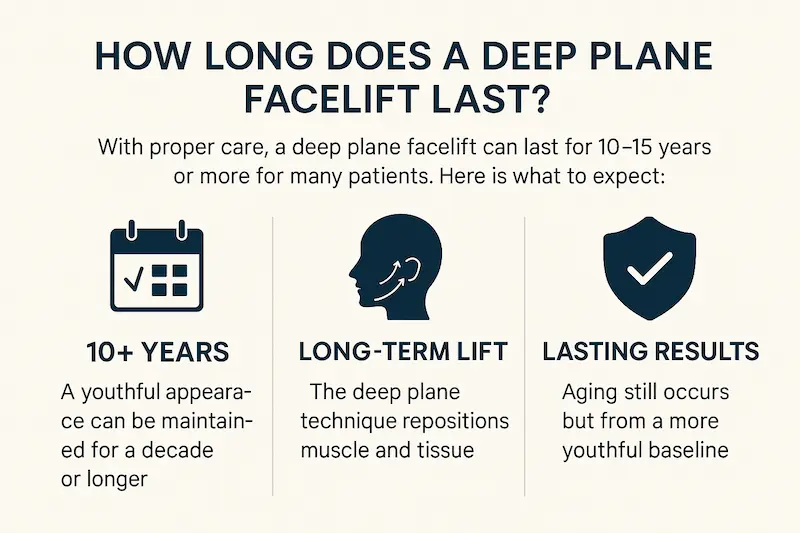
How a deep plane facelift works beneath the SMAS layer
To understand why a deep plane facelift can give such long-lasting results, it helps to know a key term: SMAS (Superficial Musculoaponeurotic System). This is the fibrous layer that connects your facial muscles to your skin.
In a deep plane facelift:
- The surgeon carefully works beneath the SMAS layer instead of just tightening it.
- They release and reposition the deeper facial ligaments and fat pads that have descended over time.
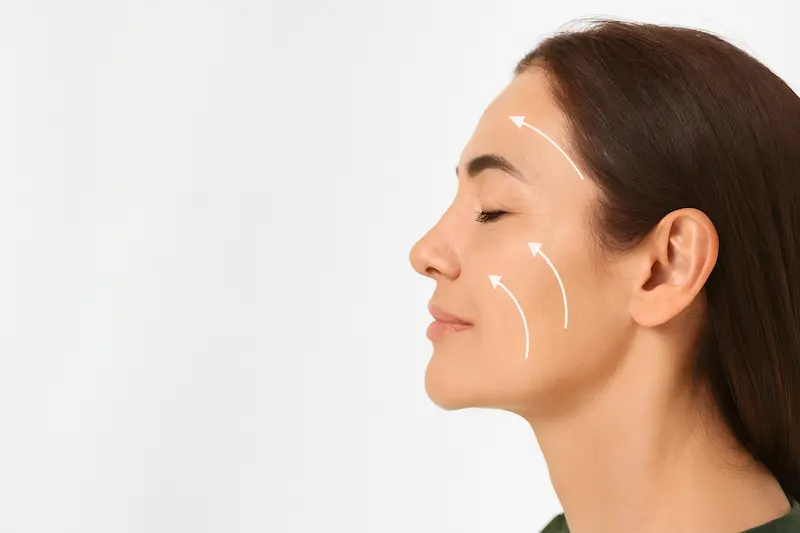
- This allows the cheeks, jawline and nasolabial folds (smile lines) to be lifted in a more anatomical, upward direction.
Because the deeper tissues responsible for facial shape are moved back to where they used to be, the face doesn’t just look “pulled” — it looks restored. This deeper repositioning is one of the reasons patients often ask, “How long does a deep plane facelift last compared with standard facelifts?” and hear answers in the 10–15 year range.
Deep Plane Facelift vs Traditional Facelift: What’s Actually Different?
In a more traditional facelift, the focus is often on tightening the skin and sometimes the SMAS layer with stitches or plication (folding and suturing). While this can improve jowls and loose skin, skin by nature stretches again over time, so SMAS-based lifts often soften more quickly. The full SMAS technique mechanism, candidacy criteria, and where it remains the right choice are detailed on our SMAS facelift treatment.
By contrast, in a deep plane facelift:
- The lift is carried by the deeper structural layers, not the skin alone.
- The skin is then gently redraped over the new foundation with much less tension.
- This usually leads to a more natural expression and smoother, more graceful aging over time.
Because of these differences, deep plane techniques are often recommended for patients who want a major refresh and are specifically asking, “How long does facelift last if I want this to be my ‘big’ facial surgery?”
Why deeper tissue lifting leads to longer-lasting facelift results
The structures that truly determine facial sagging are not superficial wrinkles; they are the deeper fat pads, ligaments and muscle-support layers that slowly descend with gravity and collagen loss. When these are lifted and anchored properly:
- The midface (cheeks) regains youthful fullness and height.
- The jawline appears sharper and more defined.
- The marionette lines and nasolabial folds soften because the tissue above them is elevated.
Because the main “weight” of the face has been repositioned higher, the results typically remain attractive for many years, even as normal aging continues. This is why, for many patients, the answer to “how long does deep plane facelift last” is significantly longer than with more superficial approaches.
How Long Does Deep Plane Facelift Last on Average?
Now to the core question: How long does a deep plane facelift last in real life, not just on paper? While every face is unique, many surgeons quote an average of 10–15 years of noticeable rejuvenation. An October 2025 study published in Facial Plastic Surgery presenting a long-term evaluation of deep plane versus high SMAS facelift analyzed how each technique holds up beyond the early postoperative window — providing the kind of multi-year, technique-specific evidence that informs realistic 10–15 year expectations rather than marketing claims. That doesn’t mean you won’t age during this time; it means you’ll generally look younger than you would have without the surgery.
A good way to think about it is this: instead of “freezing time,” a deep plane facelift tends to turn the clock back about 10–15 years. After that, you continue aging from this new, younger baseline. So even 10 years later, you often still appear younger than your peers who never had surgery.
How long does a deep plane facelift last in real life? (10–15 year expectations)
For most healthy, non-smoking patients who choose an experienced facial plastic surgeon:
- The first year shows the biggest transformation: tighter jawline, elevated cheeks, smoother folds.
- Between years 2–7, the result usually looks stable and natural — you simply age more slowly.
- Between years 8–15, some sagging may gradually return, but you still appear noticeably more refreshed than if you had never had surgery.
Many patients feel that even a decade later, their deep plane facelift has “held up” far better than friends who had earlier-generation facelift techniques. This is why you’ll frequently hear the phrase deep plane facelift longevity in consultations and online research.
Deep Plane Facelift Longevity: What Changes at 1, 5 and 10+ Years?
Here’s a simplified timeline of what to expect over the long term:
- At 1 year: Swelling is fully resolved, scars have softened and your results look natural. This is usually when you see your “final” outcome.
- At 5 years: You’re still enjoying a defined jawline and improved midface. Some subtle aging may be visible, but most people still feel they look significantly younger than their actual age.
- At 10+ years: Gravity and collagen loss continue, so mild jowling or laxity may reappear. However, many patients still look younger than they would have without surgery and may only need minor tweaks or non-surgical maintenance.
Beyond lifestyle, biologic adjuncts can extend longevity. Autologous stem cell augmentation layered on top of deep plane lifting may improve skin quality and tissue resilience over the years following surgery — supporting the deeper structural lift with cellular-level support. The mechanism, candidacy criteria, and realistic outcome data on how stem cell augmentation affects 5- and 10-year longevity markers are explained in our stem cell longevity outcomes.
Factors like skin quality, genetics, weight changes and lifestyle (sun, smoking, stress) play a big role here — we’ll cover those in detail in the next section of the article.
Deep Plane Facelift After 10 Years: what most patients can realistically expect
When people search for “deep plane facelift after 10 years”, they’re usually worried about two extremes: either “Will everything drop again?” or “Will I look strange or overdone?” The truth for most well-performed surgeries is somewhere between those fears:
- You will have aged, but usually in a more elegant and balanced way.
- Your jawline and midface typically still look better than they did before surgery.
- If a touch-up is desired, it is often more conservative than the first operation.
Many patients find that instead of needing another full facelift at the 10-year mark, they can extend their results with maintenance treatments like skin tightening, laser, injectables or a small neck or midface refinement — especially when their original surgeon used a thoughtful, deep plane technique.
What Affects How Long Your Deep Plane Facelift Results Last?
Even though a deep plane facelift is designed for long-term rejuvenation, no two faces age in exactly the same way. That’s why one person may still look incredible 15 years later, while another might feel they need a small revision after 8–10 years. When you ask, “how long does deep plane facelift last for someone like me?”, the honest answer always depends on a few key factors.
Age, Skin Quality and Genetics: Who Keeps Results the Longest?
Your starting point before surgery plays a huge role in deep plane facelift longevity. Some of the most important biological factors are:
- Age at the time of surgery: Patients in their late 40s to early 60s often see the most balanced, long-lasting results. You’re old enough to notice sagging, but your tissues still have good healing and elasticity.
Patients in their late 60s or 70s can still be great candidates, but their tissues may not hold tension quite as long, which can slightly shorten the deep plane facelift duration. - Skin quality and thickness: Naturally thicker, well-hydrated, collagen-rich skin tends to drape better over the repositioned deep structures. Very thin, sun-damaged or crepey skin may show fine lines and laxity sooner, even when the deeper lift is still intact.
- Genetics and facial structure: If you come from a family where people keep strong bone structure and decent skin quality as they age, your facelift will likely age better too. Strong cheekbones and jawline support the new lifted position more effectively.
So, when discussing how long does a deep plane facelift last, your surgeon isn’t just thinking about the technique; they’re also evaluating your unique anatomy, skin and family aging patterns to predict realistic long-term outcomes.
Lifestyle Habits: Smoking, Sun Exposure, Weight Changes and Sleep
Your lifestyle after surgery is like a “multiplier” of your result. The exact same surgical technique can last very differently in two patients depending on how they live. Some key lifestyle habits that influence how long a deep plane facelift lasts include:
- Smoking or vaping: Nicotine constricts blood vessels, reduces oxygen delivery and damages collagen. It can:
- Slow your healing in the first weeks and months, andAccelerate the breakdown of skin and connective tissue over years.
- UV exposure and sun habits: Chronic, unprotected sun exposure is one of the fastest ways to age the skin. UV rays:
- Break down collagen and elastin
- Cause pigmentation, rough texture and fine lines
- Lead to “crepey” skin even if the deeper lift is still strong
- Weight fluctuations: Major weight gain and loss after surgery can stretch and relax the tissues again. Rapid weight loss can also make the face look more hollow. For the best deep plane facelift longevity, it’s ideal to be at a stable, healthy weight before surgery and maintain it afterward.
- Sleep, stress and overall health: Chronic stress, poor sleep and inflammatory diets can all accelerate visible aging. On the flip side, prioritizing sleep, stress management, hydration and a nutrient-rich diet supports skin quality and healing, so your results tend to last longer.
In other words, when patients ask, “deep plane facelift, how long does it last?”, part of the answer is in their own hands. A healthy lifestyle doesn’t just protect your heart and brain; it also helps protect your surgical investment.
Surgeon Skill, Technique and Follow-up Care: Why They Matter for Longevity
The experience and technique of your surgeon are absolutely central to the question of how long your deep plane facelift will last. This is not a beginner-level procedure; it’s a technically demanding operation requiring deep knowledge of facial anatomy and careful, precise execution. The credential verification framework — including TPCD/EBOPRAS/ISAPS public registries, fellowship pedigree, and the specific markers that distinguish a deep-plane-experienced surgeon from a generalist — is documented in our surgeon evaluation guide.
Longevity is influenced by:
- Anatomical expertise: The surgeon must know exactly where to work beneath the SMAS, how to release retaining ligaments safely and how to reposition tissues without damaging critical nerves or blood supply. Proper release and repositioning are key to long-term lift.
- Vector and degree of lift: The direction and amount of lift must respect your natural facial structure. Over-pulling in the wrong direction might look tight at first but can age poorly and may not last as long.
- Handling of the skin: When skin is draped back with minimal tension and carefully closed, scars heal better and the result remains more natural as you age.
- Post-operative care and follow-up: A structured follow-up plan with your clinic — including scar care, swelling management, and clear guidelines for activity, sleep position and skincare — helps optimize healing and protect the result.
At a well-organized center, you’re not just getting an operation; you’re entering a long-term relationship with a team that guides you from consultation to recovery and beyond. That ongoing care significantly affects how your deep plane facelift looks not just at 6 months, but at 6, 10 and 15 years.
In the next section, we’ll compare how long a deep plane facelift lasts with other popular facelift techniques like SMAS and mini facelifts — so you can clearly see why deep plane is often chosen for its 10+ year expectations.
Deep Plane Facelift Longevity vs Other Types of Facelifts
When you’re deciding on surgery, it’s natural to compare how long does deep plane facelift last with other options such as SMAS, mini or mid-facelifts. All of these procedures aim to rejuvenate the face, but they don’t age in the same way. Understanding their typical lifespan helps you see why so many patients choose the deep plane technique when they want a “do it once, do it right” solution.

How Long Does a Facelift Last with SMAS, Mini and Mid-Facelifts?
Most surgeons will give rough time frames, but remember these are averages, not guarantees. Here’s how longevity typically compares:
- A mini facelift usually targets early jowling and mild laxity in the lower face, with smaller incisions and a shorter recovery — typically suited for patients in their 40s or early 50s with mild sagging, where noticeable improvement is expected for around 3–5 years. The candidacy framework, incision pattern, and exact use cases where a mini lift outperforms a full deep plane approach are covered on our mini facelift procedure.
- Standard SMAS facelift: The SMAS layer is tightened, folded or sutured, and excess skin is removed. Many patients enjoy a more defined jawline and reduced jowls for about 7–10 years with a SMAS facelift — better longevity than a mini lift, but often less midface improvement than deep plane work. Results can sometimes look more “pulled” if too much tension is placed on skin. The full technique-by-technique decision tree — including which anatomies favor SMAS over deep plane and vice versa — is detailed in our SMAS versus deep plane breakdown.
- A mid-facelift focuses mainly on lifting the cheek and under-eye area — refreshing the central face for around 5–7 years in suitable candidates, though it does not always address the neck or jawline as fully. The candidacy criteria, incision strategy, and how mid-facelift differs in longevity from comprehensive deep plane work are explained on our mid-facelift procedure page.
By comparison, a deep plane facelift works on the deeper “suspension system” of the face. This is why, when patients ask, “deep plane facelift, how long does it last compared to these?” many surgeons talk about 10–15-year expectations in suitable candidates.
Deep Plane Facelift vs Mini Facelift: 5-year vs 10+ year expectations
Patients often come to consultation torn between a mini lift and deep plane facelift. The mini lift sounds simpler, but they also want results that look good in 10 years, not just 2 or 3.
A helpful way to think about it:
- Mini facelift:
- Good option if you are younger, with mild jowling and little neck laxity
- Less invasive, but a more modest and shorter-lived change
- You may be asking again in a few years, “how long does facelift last?” as aging catches up
- Deep plane facelift:
- Designed for patients who want a major, structural rejuvenation
- Lifts the midface, jawline and often neck together for a harmonious result
- Many patients still enjoy clear benefits 10+ years later
If your main question is “how long does deep plane facelift last, and is it worth doing instead of a mini lift?”, the answer often comes down to your age, degree of sagging and long-term goals. If you’re already noticing significant jowls, deep nasolabial folds and neck laxity, a mini lift may simply not give you the kind of 10+ year improvement you’re hoping for.
When a second facelift is needed: realistic long-term planning
No facelift, not even a deep plane one, stops the aging process. What it does is reset your baseline. A common question is whether you’ll “need another facelift” and, if so, when.
In practice:
- Many deep plane patients feel no need for another major surgery for 10–15 years.
- Some never choose a second facelift at all, especially if they maintain healthy habits and use non-surgical treatments to support their result.
- Others may opt for a smaller touch-up or neck refinement later in life.
When surgeons plan your first surgery with long-term thinking in mind, they consider how your tissues will age, where support is needed most and how to preserve options for the future. That’s why it’s important to see the deep plane facelift as part of your lifetime aging strategy rather than a one-off fix.
Deep Plane Facelift in Turkey: Longevity, Cost and Patient Journey
Many patients researching how long does deep plane facelift last soon discover that Turkey — especially Istanbul — has become a major destination for advanced facial surgery. The key question then becomes: “If I travel to Turkey for a deep plane facelift, will the quality and longevity of my result match (or exceed) what I’d get in New York, LA or Chicago?”
At AKM Clinic in Istanbul, the answer is built around three pillars:
- High-level, facial-focused surgical expertise
- Advanced recovery technology designed to protect and extend your result
- A tightly organized VIP patient journey for international guests
This combination is what attracts patients from the USA, many of whom specifically choose AKM Clinic for deep plane facelift surgery and share that they look 10–20 years younger while still feeling like themselves years later.
How Long Does Deep Plane Facelift Last in Turkey vs US?
The biology of aging is the same whether you have surgery in Istanbul, New York or London. What changes is the quality of the technique and the post-operative care wrapped around it.
At AKM Clinic, deep plane facelift is not a side procedure; it’s one of the clinic’s core facial surgeries. International patients often come after months of research and multiple online consultations. They are typically looking for:
- Advanced deep plane work on the midface, jawline and neck
- Natural, “not operated” appearance
- Results that can hold for 10+ years with proper lifestyle and maintenance
In that sense, the answer to how long does a deep plane facelift last in Turkey is the same as in the US when the surgeon and care standards are equivalent: many patients enjoy a clearly rejuvenated look for a decade or more, aging more slowly from a younger baseline.
The difference is that in Istanbul, you often receive this at a more accessible price point, with a structured medical tourism pathway that includes hotel, transfers and aftercare — all of which can make the overall journey smoother.
Why Many US Patients Choose Istanbul for Deep Plane Facelift
Patients from major cities like New York, Los Angeles, Miami or London often compare quotes at home with what they’re offered at AKM Clinic. While quality is their first priority, deep plane facelift cost is usually the final push that makes a decision.
Common reasons they ultimately choose Istanbul and AKM Clinic include:
- Comparable or higher expertise at a lower overall cost: Deep plane facelift in top-tier US centers is often priced as a premium, “elite” procedure. In Turkey, patients can access similarly advanced techniques at a significantly lower total cost, even after including flights and accommodation. When you divide the total investment by 10–15 years of result longevity, the cost-per-year framing changes the value calculation entirely. The full Turkey pricing breakdown — including what “all-inclusive” actually covers and how Istanbul totals compare to NYC, LA, and Chicago benchmarks — is detailed on our deep plane facelift cost breakdown.
- Comprehensive packages for international patients: Instead of organizing everything themselves, patients often receive:
- Airport pickup in a private vehicle
- Hotel arrangements close to the clinic
- In-person translation and 24/7 English-speaking support
- Planned follow-up visits before they fly back home
- Strong focus on natural results: The clinic positions itself explicitly against the “overdone” look. Many case studies highlight patients who report looking “10–20 years younger” yet still very natural — a key expectation for those choosing deep plane facelift over fillers and threads.
- Structured, high-touch communication: From the first WhatsApp or video consultation, patients are guided step-by-step. Clear explanations of how long deep plane facelift lasts, what recovery involves and how long they should stay in Istanbul reduce anxiety and build trust.
For many, the decision isn’t just “Turkey vs home country”. It becomes “this specific Istanbul clinic that can offer deep plane expertise, safety, and a VIP journey vs a more fragmented, more expensive experience at home.”
AKM Clinic’s Approach: Surgical Technique, Healing Support and Long-Term Follow-Up
Beyond the operation itself, AKM Clinic emphasizes a comprehensive care model designed to protect your investment and support long-term longevity of results.
Key elements of this model include:
- Facial plastic surgery focus: Deep plane facelift is performed within a broader facial portfolio that includes neck lift, brow lift, eyelid surgery and fat transfer to the face. This allows tailored combinations (for example, deep plane facelift + neck lift + upper eyelids) that create a more complete and longer-lasting rejuvenation.
- Advanced recovery technologies: The clinic supports healing with tools such as:
- Hyperbaric Oxygen Therapy (HBOT): Used to improve oxygen delivery to healing tissues, reduce swelling, support scar quality and lower infection risk — all of which help the result stabilize cleanly and predictably.Low-Level Laser Therapy (LLLT): Applied to stimulate cellular repair, collagen production and reduce inflammation in the skin after surgery.
- Strict safety and hygiene standards: AKM Clinic operates under full licensing and oversight from the Turkish Ministry of Health, with a self-described “zero-compromise” approach to sterilization and operating room standards. This medical backbone is crucial when you’re traveling abroad for surgery.
- VIP patient journey for medical tourists: International patients are guided from:
- Initial online consultation and photo evaluation
- Personalized treatment plan and quotation
- Airport pickup and hotel check-in in Istanbul
- Pre-operative assessment and imaging
- Surgery day with full English support
- Daily or frequent post-op check-ins during the stay
- Structured follow-up plan once back home (online video calls, messaging, photo reviews)
All of this forms the context for the question “how long does a deep plane facelift last?” at AKM Clinic. It isn’t just about what happens in the operating room. It’s also about how your tissues are cared for during healing, and how supported you feel as an international patient flying in for a major, life-changing procedure.
Frequently Asked Questions (FAQ):
Is a deep plane facelift permanent, or will I eventually “lose” the result?
No facelift is truly permanent, including a deep plane facelift. You will continue to age, and gravity, sun exposure and lifestyle will all still affect your face over time.
What a deep plane facelift does is reset the clock by about 10–15 years for many patients. From that new baseline, you keep aging — but you usually look younger than you would have without surgery. Even 10+ years later, most patients still feel they look fresher and more lifted than their peers.
So you don’t suddenly “lose” the result one day; instead, you age gradually on top of a more youthful foundation.
Will I need another facelift after 10 years if I choose a deep plane facelift?
The good news is that when the first surgery is well planned and well executed, any future procedure is usually less aggressive, focusing on refinement rather than starting from zero again. The technical considerations specific to operating on previously-lifted tissue planes, scar planning around existing incisions, and what makes revision deep plane work different from primary surgery are detailed on our revision facelift page.
How long does facelift last if I combine it with neck lift or fat transfer?
Combining procedures can often make your overall result look more complete and more harmonious over time. For example:
Deep plane facelift + neck lift: Treating the face and neck together often creates a more balanced, "top-to-bottom" rejuvenation. When the neck is tight and the jawline is sharp, the whole result tends to look younger for longer — often in the 10–15+ year range for suitable patients. The platysmaplasty technique, submental incision, and how neck lift is sequenced alongside deep plane work are documented on our neck lift surgery page.
Deep plane facelift + facial fat transfer: Fat transfer restores lost volume in areas like the cheeks, temples or under-eyes. The lift handles sagging; the fat addresses hollowing. The lift itself can last 10+ years, while some portion of the fat usually becomes permanent living tissue, although natural fat loss can still occur over time. The donor site planning, fat survival rates, and how nanofat versus structural fat are layered with deep plane lifting are explained on our facial fat grafting page.
Does a deep plane facelift make me age slower than my peers?
Technically, your biological aging speed doesn’t change. But in daily life, many patients do feel like they are aging more slowly than people around them.
Here’s why:
The deep plane facelift puts your facial tissues back where they used to be, often 10–15 years earlier.
As you age from there, your face has a better “starting structure” — lifted cheeks, cleaner jawline, smoother neck.
If you also protect your skin, avoid smoking and maintain a healthy lifestyle, your outward appearance can stay in that “younger than your age” zone for many years.
So while time doesn’t slow down, your visible aging can look slower and more graceful compared to friends of the same age who haven’t had a facelift.
How long does deep plane facelift swelling last and when do results stabilize?
Swelling is a normal and expected part of the healing process. For most deep plane facelift patients, the general timeline is:
First 1–2 weeks: Swelling and bruising are most noticeable. You’ll look puffy and may not recognize your “final” face yet.
Weeks 3–6: Swelling steadily improves. Many patients feel comfortable going back to work and social activities with light makeup.
3–6 months: The majority of swelling is gone; the face looks much more refined and natural.
6–12 months: Final definition appears, especially along the jawline and neck. Scars continue to soften and fade.
So when you ask, “how long does deep plane facelift last and when will I see the true result?”, it’s important to remember that the result lasts years, but it takes at least several months to fully reveal itself.
How can I make my deep plane facelift last as long as possible?
You can’t control your genetics, but you have a lot of influence over how your skin and facial tissues age after surgery. To support the longest possible deep plane facelift duration:
Don’t smoke or vape: Nicotine is extremely damaging to collagen, blood flow and healing.
Protect yourself from the sun: Daily SPF, hats, shade and avoiding intense sun will slow photoaging.
Maintain a stable, healthy weight: Avoid big fluctuations that stretch or deflate facial tissues.
Prioritize sleep, hydration and nutrition: Your skin is an organ that responds to how you treat your body.
Follow your surgeon’s skincare and maintenance plan: This may include medical-grade skincare, occasional laser or energy-based treatments and carefully planned injectables to enhance, not distort, your result.
Think of your deep plane facelift as a high-end investment. The surgery itself is the “principal”; your daily habits are the “interest” that keeps it growing.
Is a deep plane facelift worth it compared to non-surgical treatments over 10+ years?
This is one of the most important questions patients ask. Over 10+ years, many people spend large amounts of money on:
Fillers for cheeks, jawline and under-eyes
Threads to temporarily lift sagging tissues
Repeated skin-tightening devices with modest results
These treatments have their place, but they cannot reposition the deep tissues the way a deep plane facelift does. Over time, some patients feel they are “chasing” youth with injections and threads but not getting the structural change they really want.
A deep plane facelift involves a higher upfront commitment, but when you look at how long a deep plane facelift lasts — often 10–15 years of clearer jawline, elevated midface and smoother neck — it can actually be more cost-effective and more satisfying over the long term than serial non-surgical procedures.
For many AKM Clinic patients, especially those traveling from the Los Angeles, Chicago, New York or Seattle, the decision comes down to this: One major, well-done surgery with long-lasting results vs. constant smaller procedures with limited impact.
Medical Disclaimer: This content is for educational purposes only and does not replace medical advice. Deep Plane Facelift outcomes, risks, and recovery vary by individual. Always consult a qualified, board-certified surgeon for diagnosis and treatment decisions. If you have a medical emergency, seek immediate local care.