




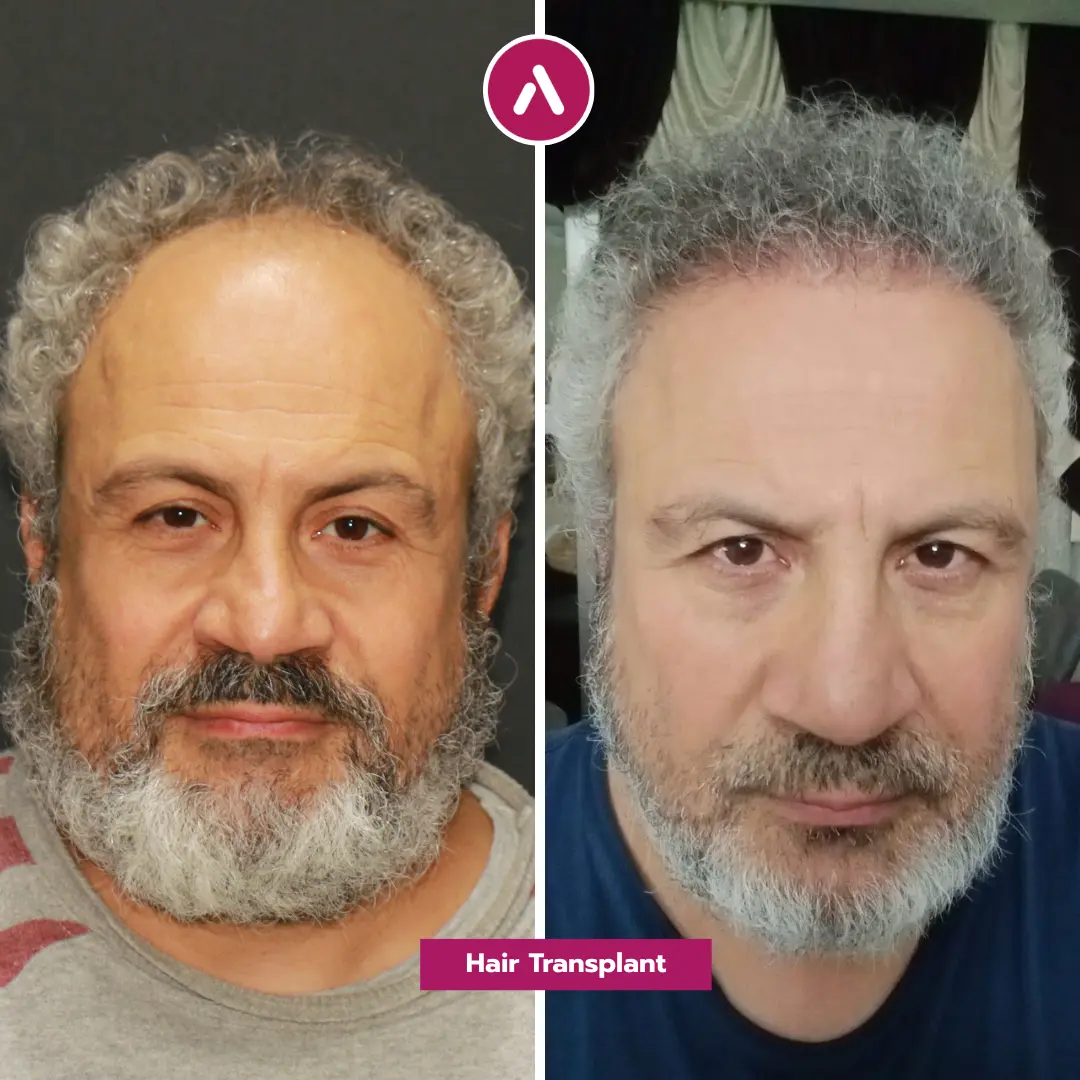
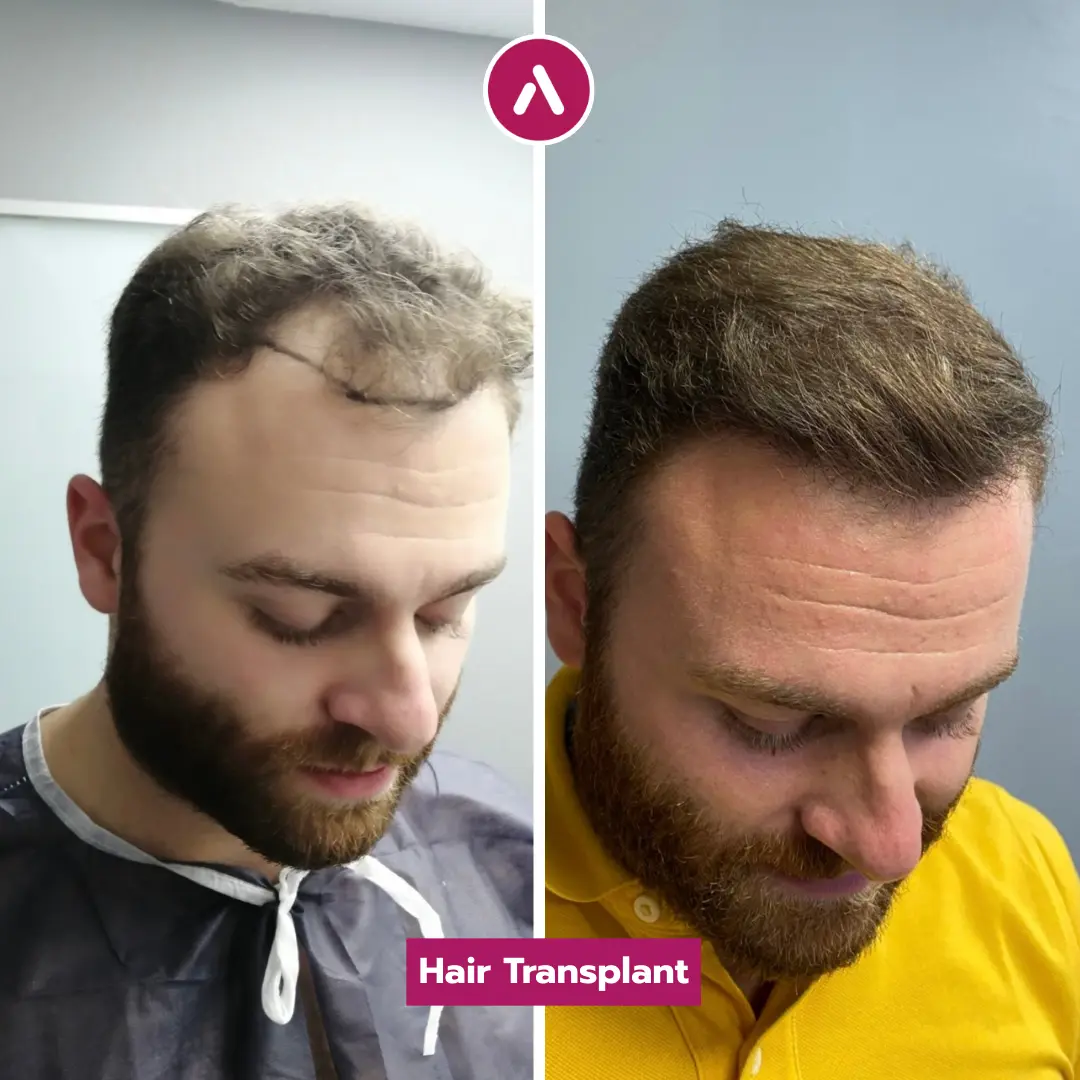
If you’re researching Hair Transplant For Women, you’re already doing what “expert patients” do best: separating marketing from medicine. This guide is built to answer the real questions first—how the procedure works, who it helps, and what results are realistic. Then we’ll connect the dots on safety, recovery, and how to choose the right plan. No hype. Just clarity.
A hair transplant is a surgical method that relocates healthy hair follicles from a stable “donor” area to a thinning or balding area. The goal is not to create new hair. The goal is to redistribute the hair you have in a way that looks natural and holds up over time. For women, planning matters even more because hair loss patterns can be diffuse and the hairline must remain soft and feminine.
Table of Contents
What is a Hair Transplant For Women?
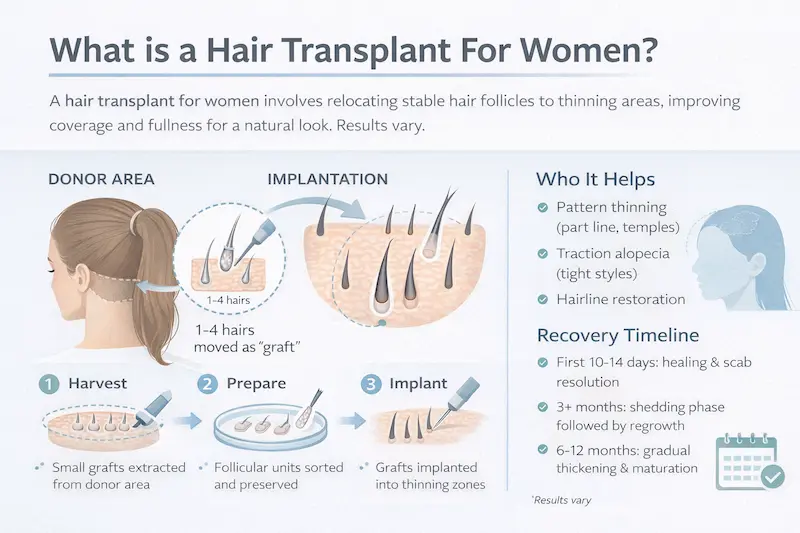
A hair transplant procedure for women moves individual follicular units (grafts) from a donor zone—usually the back or sides of the scalp—into areas where density has dropped. Each graft contains one to a few hairs, and each one is placed to match the direction, angle, and spacing of native hair. That design is what makes results look “undone,” even up close. In women, the plan often focuses on density along the part line, hairline refinement, or traction-related thinning rather than a classic male-pattern recession.
What a female hair transplant actually does (and what it can’t)
The surgery restores the appearance of fullness by adding permanent hairs to the zones that bother you most. It can rebuild a thinning hairline, reinforce temples, and increase density where the scalp shows through. It does not stop ongoing shedding from hormonal or medical causes. That’s why diagnosis and stabilization come first when active loss is suspected.
- Does hair transplant work for women? Yes—when donor hair is stable and the cause of loss is compatible with transplantation.
- It works best when we can “anchor” the result to an area with predictable long-term blood supply and stable donor quality.
- It’s not a quick fix for uncontrolled diffuse shedding or untreated scalp disease.
Donor area basics: the supply that limits the plan
Your donor area is the “bank.” It’s finite. A strong plan preserves it. Women often wear longer styles and part their hair in consistent patterns, so the donor strategy must also protect how the back of the scalp will look when hair is up, wet, or under bright light.
- Donor density and hair caliber affect how much visible fullness we can create.
- Over-harvesting can thin the donor zone and create see-through areas.
- Good planning prioritizes natural coverage, not maximum graft numbers.
How grafts are moved: the core steps
The procedure has three essential phases: harvesting, graft handling, and implantation. Harvesting can be done with modern follicle-by-follicle methods such as FUE hair transplant for women. After harvesting, grafts must be protected from dehydration and trauma. Finally, implantation is performed with controlled angles and spacing to avoid a harsh, pluggy look.
- Harvesting: follicles are extracted from the donor zone with micro-instruments.
- Preparation: grafts are sorted and protected to preserve viability.
- Placement: grafts are implanted to mimic native growth patterns.
Benefits—What Changes When Hair Returns (And Stays Natural)
The best outcome is subtle. People notice you look healthier, not “treated.” When density is restored in the right places, styling becomes easier and you stop fighting your hairline every morning. The practical benefit is simple: less camouflage. The emotional benefit is bigger: you get to feel like yourself again without constant mental math about lighting, photos, or wind.
Natural density and “undetectable” design
Women’s transplants live or die by design. A feminine hairline is not a straight line, and it should not look “drawn on.” Micro-irregularity, soft transitions, and conservative placement keep the result believable. Density is built strategically, concentrating where it creates the biggest visual change.
- Soft, irregular hairline edges look more natural than perfectly symmetrical borders.
- Angle and direction matter—especially in the temples and part line.
- Realistic density targets prevent disappointment and protect the donor supply.
Confidence and styling freedom
Many women don’t want “more hair.” They want normal life back. A stronger hairline can make ponytails feel comfortable again and reduces the urge to hide behind fibers, powders, or strategic bangs. You also gain consistency—your hair looks better across different lighting and in photos. That reliability is the quiet win.
Who benefits most
Women who benefit most typically have a stable donor zone and a clear, localized area that needs density. Hairline recession, temple thinning, and traction-related loss can respond well when the underlying cause is controlled. Diffuse thinning can still be treatable, but it requires more careful candidacy screening and realistic density planning. The right question is not “Can I do it?” It’s “Will my pattern deliver a predictable result?”
Am I a Good Candidate For a Hair Transplant For Women?
Great results start before surgery day. Candidacy is the difference between a transplant that looks natural for years and a transplant that looks “fine” for a few months, then disappoints. In women, we pay special attention to the pattern of thinning, the stability of the donor area, and whether active shedding is still happening. If we see signs that the foundation isn’t stable, we slow down and address the why before we talk about graft counts.
The candidacy checklist (medical + aesthetic)
Most women who do well have a stable donor zone and a clear target area where added density will make a visible difference. We also look for realistic expectations about coverage and timelines. A transplant can improve how your hair looks and styles. It won’t turn fine hair into thick hair overnight.
- Donor stability: adequate density and quality in the back/sides of the scalp.
- Pattern clarity: a defined area of thinning (hairline, temples, part line, traction zones).
- Health screening: safe to proceed with a surgical procedure and a predictable healing response.
- Expectation fit: the goal is believable fullness, not “perfect” density everywhere.
Surgeon’s Insight (Natural-First): We don’t chase a “new” hairline. We restore the one that still looks like you—soft, age-appropriate, and impossible to spot as surgical.
Who should avoid or postpone a female hair transplant
Sometimes the smartest plan is not surgery—at least not yet. If hair loss is driven by an active medical trigger or rapid shedding, grafts can survive but the surrounding native hair may continue to thin. That creates a patchy, “floating island” effect over time. In those cases, our job is to protect your long-term outcome by recommending stabilization first.
- Active diffuse shedding: sudden, widespread shedding that hasn’t stabilized.
- Untreated scalp conditions: inflammation, scarring processes, or infections that can compromise growth.
- Unstable donor area: donor thinning that limits safe harvesting.
- Unrealistic goals: expecting full density across the entire scalp in one session.
What we evaluate in a virtual consultation
Many patients start with a remote consult, especially if they’re planning travel. We review high-quality photos in natural light, your hair history, and your top priorities (hairline vs part line vs temples). We also ask about timing—pregnancy/postpartum changes, stress events, new medications, and family history can all affect planning. From there, our European Board Certified team outlines whether surgery makes sense, which technique fits, and what a realistic outcome looks like for you.
- Top-down and side photos, including the donor area.
- Your hair loss timeline and any recent acceleration in shedding.
- Daily styling goals (center part, side part, ponytail, bangs).
- A conservative graft estimate and a staged plan if needed.
Why Women Lose Hair—And Why Diagnosis Comes Before Surgery
Women don’t lose hair in just one way. Some see widening at the part line, others notice temple thinning, and some experience traction-related loss from years of tight styles. The cause matters because it changes the plan. When we understand the driver, we can set the right expectations, protect the donor area, and choose the safest path to a stable result.
Female pattern thinning vs traction-related loss
Female pattern thinning often looks like overall miniaturization—hair becomes finer and coverage drops, especially along the part line and crown. Traction-related loss is different. It tends to show up at the hairline and temples where repeated tension weakens follicles over time. Both can be treatable with transplantation, but the design approach is not the same.
- Diffuse thinning: density strategy focuses on the part line and “see-through” zones.
- Hairline recession: requires soft, irregular borders and conservative temple work.
- Traction alopecia: often benefits from restoring a natural frame while preventing future tension.
Stabilizing ongoing shedding (protecting your long-term result)
A transplant doesn’t stop hair loss. It relocates stable follicles to areas that need coverage. If the underlying trigger is still active, the surrounding native hair can keep thinning and make results look uneven later. That’s why we prioritize strict pre-operative screening and honest planning, so you don’t invest in surgery before your pattern is ready for it.
- We look for signs of active shedding and discuss timing if loss seems unstable.
- We plan density in a way that blends with your native hair as it changes over time.
- When stabilization is needed, we’ll guide you toward the right next step before surgery.
Alternatives to a hair transplant for women
Not every patient needs surgery to feel better about her hair. If your thinning is early, widespread, or still changing, non-surgical options can be the most effective first move. These approaches can slow shedding, support thicker-looking hair, and help you avoid harvesting donor follicles too soon. If you later decide on surgery, your foundation is stronger and outcomes are more predictable.
- Medical management: guided treatment plans to support stability and reduce shedding.
- Regenerative support: targeted therapies that aim to improve scalp environment and hair quality.
- Styling strategies: part-line changes, color techniques, and cut planning that boost coverage.
Hair Transplant For Women Surgical Techniques Explained
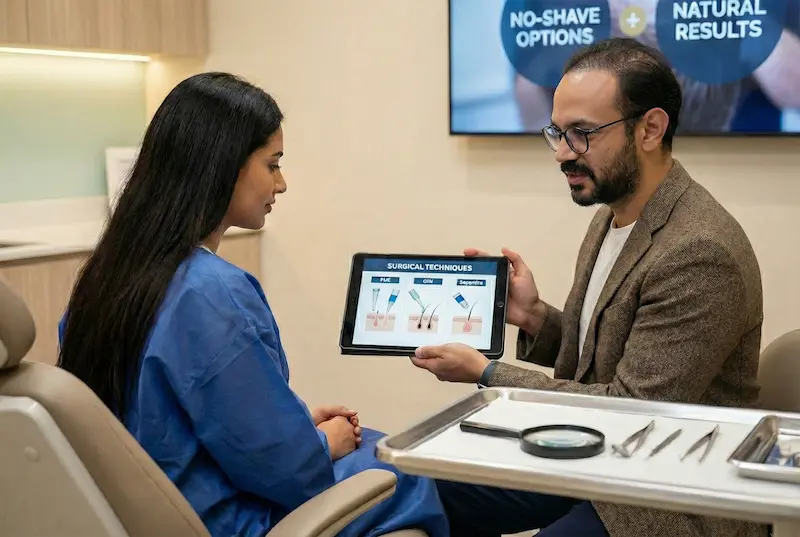
When patients search FUE hair transplant for women or “no-shave” options, they’re usually trying to solve two problems at once: getting a natural result and protecting privacy during recovery. Technique matters—but not because one method is “the best” for everyone. The right choice depends on your hair loss pattern, donor stability, styling habits, and how visible you need the early healing phase to be.
FUE hair transplant for women: the modern standard
FUE (Follicular Unit Extraction) harvests follicles one-by-one from the donor area using micro-instruments. It’s widely used because it avoids a long linear scar and allows precise donor management when planned conservatively. For many women, FUE is the go-to option—especially when the target is the hairline, temples, or localized density.
- Why women choose it: no long incision, flexible styling once healed, precise graft selection.
- What matters most: donor preservation and even harvesting to prevent see-through donor areas.
- Ideal use cases: hairline refinement, temple work, traction-related thinning, selective part-line density.
DHI: implantation control for strategic density
DHI focuses on the implantation phase using an implanter tool to place grafts with controlled depth and direction. It can be a strong option when we want a highly controlled placement plan, especially in visible zones where angle and spacing determine “undetectability.” DHI isn’t a shortcut; it’s a placement method that can be useful when design precision is the priority.
- Best for: detailed work in the hairline and part line where direction and spacing are critical.
- Key advantage: controlled implantation that supports natural growth patterns.
- Planning note: the method still depends on graft quality and donor strategy.
Sapphire: refined channel creation for natural-looking placement
Sapphire refers to the channel-opening step using sapphire blades for precise micro-incisions. The goal is controlled recipient-site creation that supports clean placement and consistent angles. It’s often chosen when we want a meticulous approach to site-making in areas where softness and realism matter—like the front hairline and temples.
- Where it helps: hairline refinement, dense-packing zones, and angle-sensitive areas.
- What it supports: clean channel creation and intentional direction control.
- Important: a “sharp tool” doesn’t replace artistry—design still drives naturalness.
FUT for women: what it is—and why it’s less common today
FUT (Follicular Unit Transplantation) harvests donor follicles via a thin strip from the back of the scalp, then dissects grafts under magnification. Some patients research FUT hair transplant women because it can maximize graft yield in certain situations. However, it typically leaves a linear scar and can be less compatible with women who wear their hair up, swim often, or want maximal flexibility with short hairstyles.
- Potential benefit: can be considered when donor characteristics and goals align.
- Trade-off: linear scar and longer donor healing considerations.
- Practical reality: many women prefer FUE-style harvesting for privacy and styling freedom.
No-shave options: hair transplant for women without shaving
Privacy is a real concern—especially for patients who want to return to work quickly or keep the procedure discreet. A no shave hair transplant women approach can reduce visible changes in the early phase by keeping surrounding hair longer. This is not “better” than standard shaving; it’s a privacy-driven strategy that can require extra time and careful planning.
- Who it fits: patients prioritizing discretion and a less noticeable early recovery phase.
- What to know: it can be more time-intensive and depends on your hair density and length.
- Planning tip: the design should protect donor coverage when hair is worn up or parted.
| Technique | Best For | Shaving Requirement | Scarring Pattern | What to prioritize |
|---|---|---|---|---|
| FUE | Hairline, temples, localized density | Often partial or full (plan-dependent) | Micro-dot pattern | Donor preservation + natural angles |
| DHI | Precision placement in visible zones | Plan-dependent | Micro-dot pattern (harvesting method dependent) | Controlled direction + spacing |
| Sapphire | Refined channel creation for realism | Plan-dependent | Micro-dot pattern (harvesting method dependent) | Clean site-making + design accuracy |
| FUT | Selected cases where strip harvesting is appropriate | No shaving usually required in the same way | Linear scar | Scar acceptability + hairstyle preferences |
| No-Shave | Discretion and fast social return | Minimal (often none in visible zones) | Micro-dot pattern (limited visibility) | Privacy strategy + time planning |
Surgeon’s Insight (Natural-First): Technique is a tool. The result is created by planning—donor protection, hairline design, and placing each graft as if it were always meant to grow there.
Hairline Design For Women—Where Artistry Matters
The hairline is the “tell.” It’s also the area women notice first in the mirror. A feminine hairline should look soft, irregular, and age-appropriate—not sharp or perfectly symmetrical. That’s why the design phase is not a formality. It’s the blueprint that determines whether the outcome looks natural in daylight, in photos, and when your hair is pulled back.
Hair transplant women hairline: the rules of natural framing
Women’s hairlines typically have subtle micro-irregularity, softer transitions, and a gradual density build. We avoid harsh borders because they can look artificial, especially when makeup, lighting, or wet hair exposes the scalp. The goal is to restore a believable frame that matches your face and styling habits.
- Soft transitions: gradual density prevents a “wall” of hair at the front.
- Micro-irregularity: tiny natural variations keep the hairline from looking drawn on.
- Age-appropriate positioning: youthful is not the same as natural—balance matters.
Receding hairline & temple refinement
Temple work is high-impact but high-responsibility. Done well, it makes the face look naturally framed. Done aggressively, it can look unnatural or limit future options. When treating recession or temple thinning, we prioritize conservative placement and consistent direction so growth blends seamlessly with existing hair.
- Conservative temple strategy helps maintain long-term naturalness.
- Angle control is critical because temple hair has a distinct direction.
- Blend planning prevents a “separate zone” look as hair changes over time.
Part-line density strategy for diffuse thinning
Diffuse thinning often needs a different mindset: the objective is improved coverage where the scalp shows most—usually the part line and top. Because the thinning is widespread, grafts must be allocated strategically to create the biggest visual improvement without overusing the donor supply. That’s also where expectation-setting matters: we aim for natural-looking fullness, not maximum density everywhere.
- Focus zones: reinforce the part line and “see-through” areas that bother you most.
- Blend with native hair: spacing and direction are planned to look natural as hair grows.
- Long-term thinking: donor preservation keeps future options open.
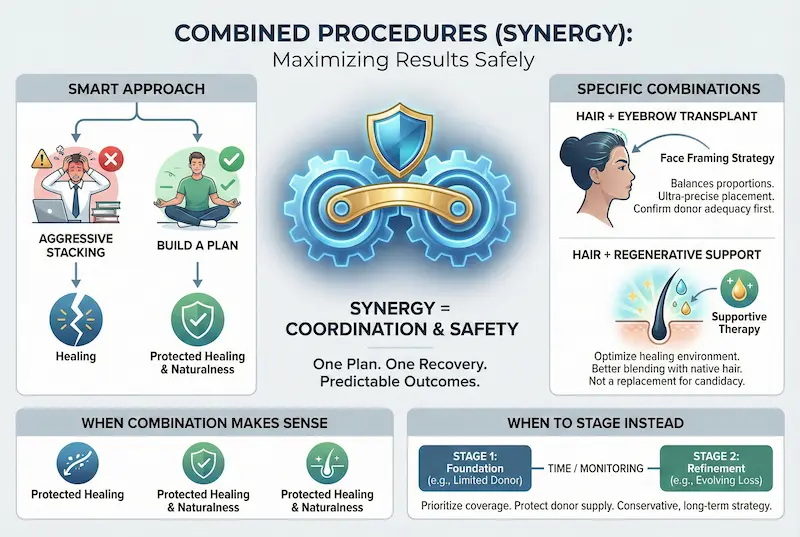
Combined Procedures (synergy)—Maximizing Results Safely
Many women ask if they can “bundle” treatments to get a bigger transformation with fewer disruptions. The smart approach is not to stack procedures aggressively. It’s to build a plan that protects healing, minimizes stress on the body, and keeps outcomes predictable. When combination treatment makes sense, the advantage is coordination: one medical plan, one recovery window, and one follow-up pathway—without compromising safety or naturalness.
Hair transplant + eyebrow transplant (face framing strategy)
For some patients, the most visible change is not only scalp density. It’s how the face is framed. An eyebrow transplant can complement a female hairline restoration by balancing proportions and softening the overall look—especially when brows have thinned from over-plucking, genetics, or hormonal changes.
- Why it can pair well: both procedures rely on meticulous angle and direction control for natural results.
- Design priority: brows require ultra-precise placement to match natural hair growth patterns.
- Planning note: we confirm donor adequacy first so scalp goals aren’t compromised.
Hair transplant + facial refinement procedures (coordinated planning, often staged)
Some women explore facial balancing procedures during the same overall treatment journey—especially if the goal is a comprehensive, natural refresh. Options may include fat transfer to face for soft volume restoration, chin augmentation for profile balance, rhinoplasty for nasal refinement, or a facelift for lower-face and neck rejuvenation. Because these procedures vary in invasiveness and recovery demands, the priority is always safety-first coordination.
- Why patients consider it: a balanced “face frame” can amplify the natural impact of improved hair density.
- Planning priority: each procedure requires its own candidacy screening, anesthesia plan, and recovery logic.
- Safety note: combining is not automatically better—many patients do best with a staged schedule.
When to stage procedures instead of combining
Sometimes the safest path is a staged plan. If you have diffuse thinning, an unstable shedding pattern, or a large target area, spacing treatments can protect your donor supply and keep results looking seamless. The goal is always the same: natural coverage that holds up over time.
- Stage when: donor supply is limited and coverage must be prioritized.
- Stage when: hair loss is still evolving and needs monitoring.
- Stage when: you want the most conservative, predictable long-term strategy.
- Stage when (especially relevant): you’re also considering higher-recovery procedures like rhinoplasty or a facelift, where separating healing phases can improve comfort and predictability.
Anesthesia—Why We Prefer Awake/Twilight Comfort
If anesthesia is your biggest concern, you’re not alone. Most women don’t fear the transplant itself. They fear discomfort, loss of control, or a difficult day. Our approach prioritizes safety and comfort with an awake/twilight style plan when appropriate, so you can get through the procedure calmly and recover smoothly.
What “awake / twilight” means in practice
Awake/twilight approaches generally focus on keeping you relaxed and comfortable while allowing you to breathe on your own and communicate if needed. You are not “fully asleep” in the way many people imagine. Instead, the goal is a controlled, calm state paired with effective local anesthesia where the work is performed.
- Local anesthesia: numbs the donor and recipient zones.
- Comfort-focused sedation (as appropriate): helps reduce anxiety and tension.
- Practical benefit: many patients feel the day is easier than expected.
Who benefits most from this approach
This style of anesthesia can be helpful if you’re anxious about medical environments, sensitive to discomfort, or simply want a more relaxed experience. It can also be a good fit for patients traveling internationally who want a clear-headed recovery routine. The final plan depends on your medical history and safety screening.
- Patients with high procedure anxiety who want a calmer experience.
- Patients who value a smoother day-of recovery rhythm.
- Patients who prefer an approach that supports communication and comfort.
What you feel during the procedure (honest expectations)
The key moment is the local anesthetic. After that, most patients report pressure or mild pulling sensations rather than pain. We also plan comfort breaks because long procedures are about pacing as much as technique. Your experience should feel managed and predictable, not overwhelming.
- You may feel: brief stinging during numbing, then pressure.
- You should not feel: sharp pain during harvesting or implantation.
- Comfort pacing: breaks and position changes are part of a well-run day.
Surgeon’s Insight (Natural-First): Comfort is not a luxury. When you’re calm and well-supported, we can work with precision—especially in hairline zones where millimeters matter.
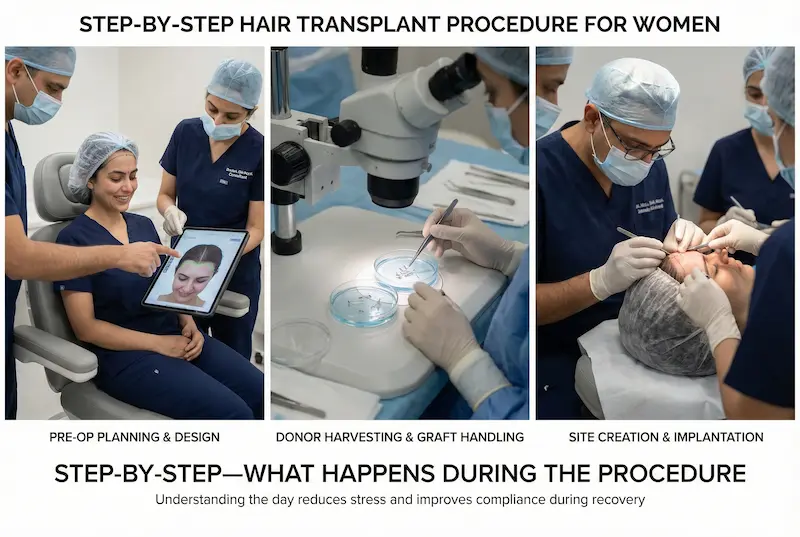
Female Hair Transplant Step-By-Step—What Happens During The Procedure
Understanding the day reduces stress and improves compliance during recovery. A hair transplant procedure for women is carefully structured: planning first, then harvesting, then implantation. The details vary by technique (FUE, DHI, Sapphire, or no-shave strategy), but the principles stay the same: protect donor supply, handle grafts gently, and place each graft with natural direction and spacing.
Pre-op planning: design, graft estimate, and safety checks
Before anything starts, we confirm the plan in real time. This includes the hairline or density map, an estimated graft range, and a safety review. For women, we also confirm styling preferences because the best design is the one that matches how you actually wear your hair.
- Hairline and/or density mapping with a conservative, natural target.
- Donor assessment to protect long-term appearance and options.
- Medical screening and documentation so the plan is safe and consistent.
Donor harvesting and graft handling (quality control)
Harvesting is not just “taking grafts.” It’s choosing the right follicles and distributing extraction so the donor area stays visually even. After harvesting, grafts must be protected from dehydration and handled gently. This phase is a major driver of survival and growth.
- Donor strategy: even distribution to avoid see-through areas.
- Graft protection: careful sorting and hydration to preserve viability.
- Quality mindset: fewer, healthier grafts can outperform aggressive harvesting.
Site creation + implantation (where naturalness is built)
Next comes the recipient area. This is where the “look” is created: angle, direction, spacing, and transition zones. Women’s hairlines require softness and micro-irregularity, and part-line work requires a blending strategy that looks natural as native hair changes over time.
- Angle and direction: matched to your native growth pattern.
- Density planning: concentrated where it creates the biggest visible improvement.
- Soft transitions: no harsh borders at the hairline.
Immediate aftercare instructions (the first 24 hours)
Aftercare begins the same day. We explain sleeping position, hydration, how to protect the grafts, and what “normal” looks like so you don’t panic at every small change. The first night is mostly about avoiding friction, keeping swelling controlled, and following a simple routine.
- How to sleep to protect grafts and reduce swelling.
- What to avoid: touching, rubbing, and high-risk activities.
- When to contact us: pain that escalates, unusual redness, or unexpected symptoms.
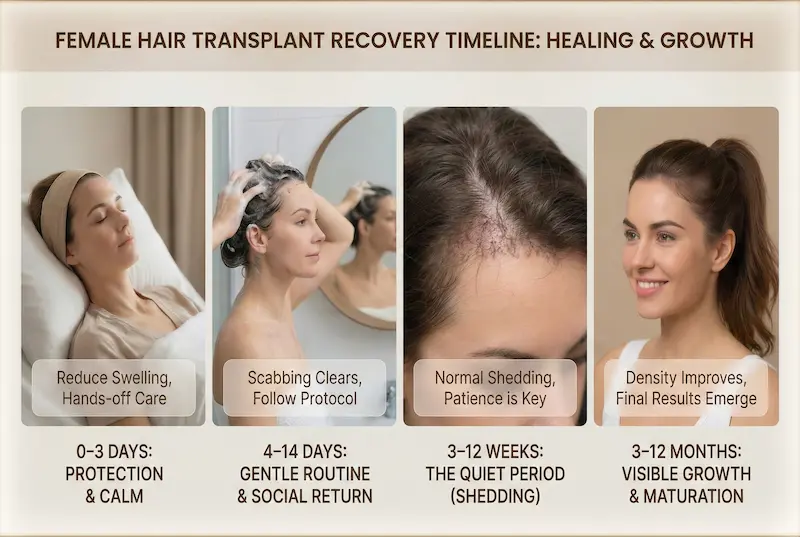
Female Hair Transplant Recovery Timeline—How Long Does Healing Take?
Hair transplant recovery women timelines are predictable when the plan is conservative and aftercare is consistent. Most of the “visible” recovery happens in the first 10–14 days, while the “patience phase” happens over months as the transplanted hairs cycle and regrow. The goal is to help you feel prepared, not surprised—because normal healing can look dramatic if you don’t know what to expect.
First 72 hours: protecting grafts and controlling swelling
The first three days are about protection and calm. You’ll want to avoid friction, keep your head elevated, and follow a structured routine. Mild swelling, tightness, and sensitivity are common, and they usually peak early and then settle.
- What’s normal: mild swelling, tenderness, and a “tight” scalp feeling.
- Your focus: sleep position, hydration, and hands-off graft protection.
- Avoid: rubbing, hats that press, heavy sweating, and alcohol unless cleared.
Days 4–14: washing routine, scabbing, and social return
This is the phase where most women want a clear plan, because the scalp looks “busy.” Scabbing/crusting is expected as the recipient area heals. With correct washing and gentle handling, those crusts typically loosen and clear within about two weeks.
- What’s normal: scabbing, mild itchiness, and a pink tone in the recipient area.
- Social return: many patients feel comfortable being out and about during this window.
- What matters: following the washing protocol exactly—gentle, consistent, and patient.
Weeks 3–12: shedding and the “quiet period”
Many patients worry something went wrong when they see shedding. In most cases, it’s part of the cycle: the transplanted hairs often shed before the follicles produce new growth. During this phase, your scalp may look similar to baseline again—this is normal and temporary.
- What’s normal: shedding of transplanted hairs and a slower-looking period.
- What to avoid: judging results too early or over-checking daily in harsh light.
- What helps: structured follow-up and realistic milestone tracking.
Months 3–12: visible growth and density maturation
New hairs typically begin to appear in the months after surgery, then thicken and mature. The timeline varies by individual factors like hair caliber, scalp healing, and the area treated. Hairline work often looks refined gradually as the texture becomes softer and more natural.
- Month 3–6: early growth becomes noticeable.
- Month 6–9: density improves and styling gets easier.
- Month 9–12: maturation phase—hair shafts thicken and results look more “settled.”
Our Rapid Recovery & Safety Protocol: HBOT + LLLT
For patients who want a more structured recovery pathway, we may include supportive protocols designed to optimize comfort and healing conditions. Two examples are HBOT (Hyperbaric Oxygen Therapy) and LLLT (Low-Level Laser Therapy). These are used as adjuncts—meaning they support the post-op environment and recovery experience, but they do not replace proper surgical planning, safe technique, or correct aftercare.
- HBOT: used in many medical settings to support tissue oxygenation and recovery conditions.
- LLLT: a non-invasive light-based support option often used to promote scalp comfort and recovery routines.
- Our philosophy: structured support can improve the patient experience, especially in the early phase.
Surgeon’s Insight (Natural-First): A great result is built twice—once in the operating plan, and once in recovery. Consistency in the first two weeks protects everything we placed.
Safety & Risks—Is a Hair Transplant Safe For Women?
When performed by a qualified, medically led team, a female hair transplant is generally considered a low-risk procedure. The key is not perfection—it’s control: controlled donor harvesting, controlled implantation angles, and controlled aftercare. Safety is also about selection: the right candidate at the right time gets the most predictable outcome.
The real risks (and how they show up)
Most risks are preventable with good planning and proper protocols. The most important risks to understand are those that affect naturalness, healing, and long-term appearance—not just short-term discomfort.
- Infection: uncommon, but possible if hygiene and aftercare are poor.
- Poor growth: can occur if graft handling is compromised or candidacy is wrong.
- Shock loss: temporary shedding of native hairs near the treated zone can happen.
- Over-harvesting: the donor area can look thin if extraction is aggressive.
How we reduce risk (planning + protocols)
Our approach prioritizes conservative planning and medical oversight. We focus on donor preservation, gentle graft handling, and a recovery plan that makes compliance easy—especially for patients traveling internationally.
- Conservative donor strategy: protects the back of the scalp from see-through thinning.
- Natural-direction placement: reduces the risk of “noticeable” results.
- Structured aftercare: clear instructions, check-ins, and long-term guidance.
Red flags to avoid anywhere (clinic selection checklist)
If you’re comparing clinics, look for signals that the process is medically led and quality-controlled. Overpromises and speed-focused assembly-line workflows are not compatible with high-end, natural outcomes—especially for women where design precision matters.
- Guarantees of “perfect density” or unrealistic timelines.
- Pressure tactics, discounts that feel rushed, or unclear medical oversight.
- No clear plan for donor preservation, follow-up, or long-term support.
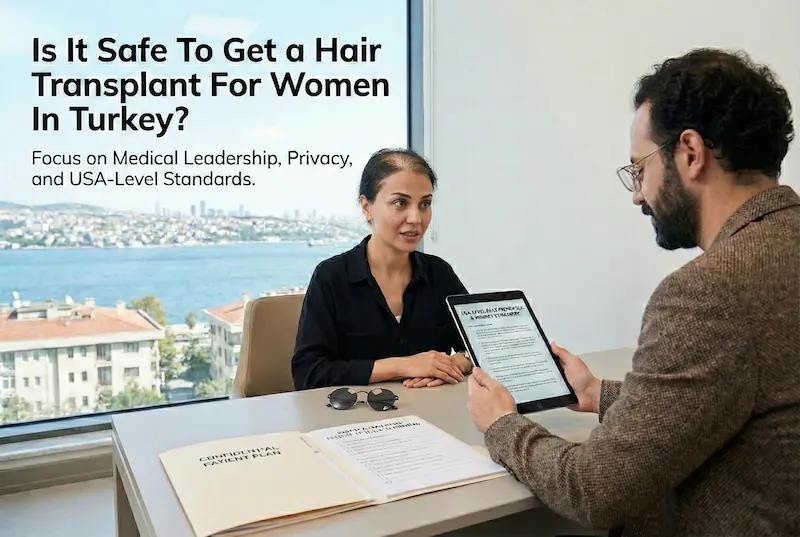
Is It Safe To Get a Hair Transplant For Women In Turkey?
Turkey is a global destination for hair restoration, but safety depends on the clinic—not the country. The right question is: “Is the care medically led, quality-controlled, and built for international follow-up?” For US-based patients, we also consider privacy, communication, and a recovery plan that fits travel logistics.
Standards and regulation—what “licensed & accredited” should mean
Strong clinics operate with clear medical leadership, documented protocols, and transparent patient communication. Ask who designs the plan, who performs the critical steps, and how quality is verified. A safe environment is not a sales promise—it’s a process.
- Medical leadership: a qualified team directing diagnosis, planning, and execution.
- Documented protocols: sterile standards, aftercare pathways, and complication response.
- Transparency: clear explanation of technique choice and realistic outcomes.
Privacy expectations for US patients
Discretion is often a deciding factor for women. Privacy should be treated as part of care: confidential communication, respectful clinic flow, and a plan that supports a discreet recovery—especially if you’re considering a no-shave approach or want to return to work quickly.
- Confidential consult process: organized communication and clear documentation.
- Discreet care pathway: designed to reduce stress and unnecessary exposure.
- Follow-up clarity: structured check-ins that don’t end when you fly home.
What makes a clinic “USA-level” in practice
For expert patients, the difference is consistency. “USA-level” care means conservative planning, medical oversight, predictable protocols, and a recovery plan built for real life. It’s not about chasing numbers. It’s about delivering natural outcomes with safety-first decision-making.
- Planning depth: donor preservation, hairline artistry, and realistic density targets.
- Patient experience: calm, organized care with predictable day-of flow.
- Long-term mindset: guidance at 1, 3, 6, and 12 months—not just day 1 photos.
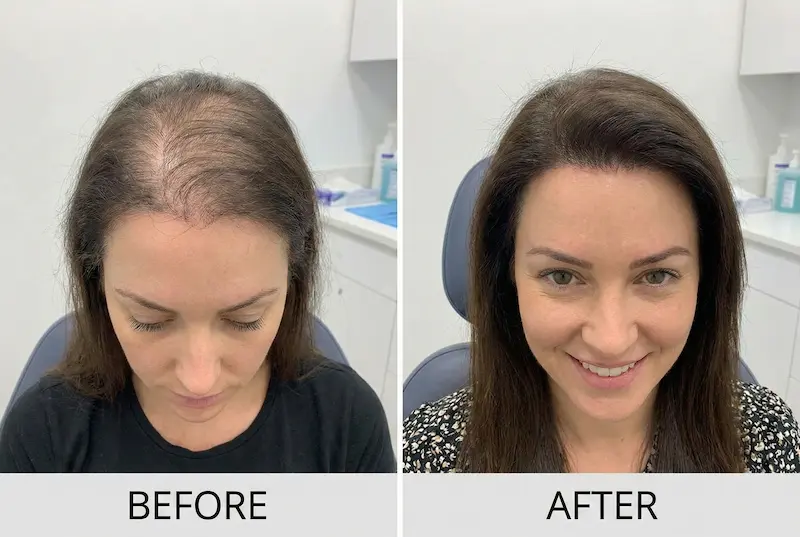
Female Hair Transplant Before And After: Realistic Expectations & Results
The best results look effortless—not “surgical.” That’s why expectation-setting is part of medical planning, not an afterthought. A Hair Transplant For Women can restore fullness and reshape the frame of your face, but it works within real limits: donor supply, hair caliber, and the stability of your hair loss pattern. When those variables are respected, outcomes can be both natural and durable.
Does hair transplant work for women?
Yes—when the donor area is stable and the pattern of loss is compatible with transplantation. Many women see meaningful improvement in a thinning hairline, temples, traction-related loss zones, and targeted density along the part line. Diffuse thinning can still be treatable, but it requires a more conservative density strategy and honest planning to avoid disappointment.
- Most predictable: localized thinning (hairline/temples/traction areas) with stable donor supply.
- More complex: diffuse thinning where the “target” area is broad and native hair may continue changing.
- Key concept: surgery relocates stable follicles; it does not stop an active shedding trigger.
Women hair transplant results: what “natural” actually means
“Natural” is not only about density. It’s about how hair behaves at the front of the face and how it blends with your styling habits. A natural result has soft transitions, believable spacing, and direction that matches your existing growth patterns—especially in the temples and hairline where millimeters matter.
- Soft hairline edge: no harsh border, no perfectly straight line.
- Correct angles: direction control prevents a “standing up” look as hair grows.
- Strategic density: we build fullness where it changes what you see most (often the part line or frontal frame).
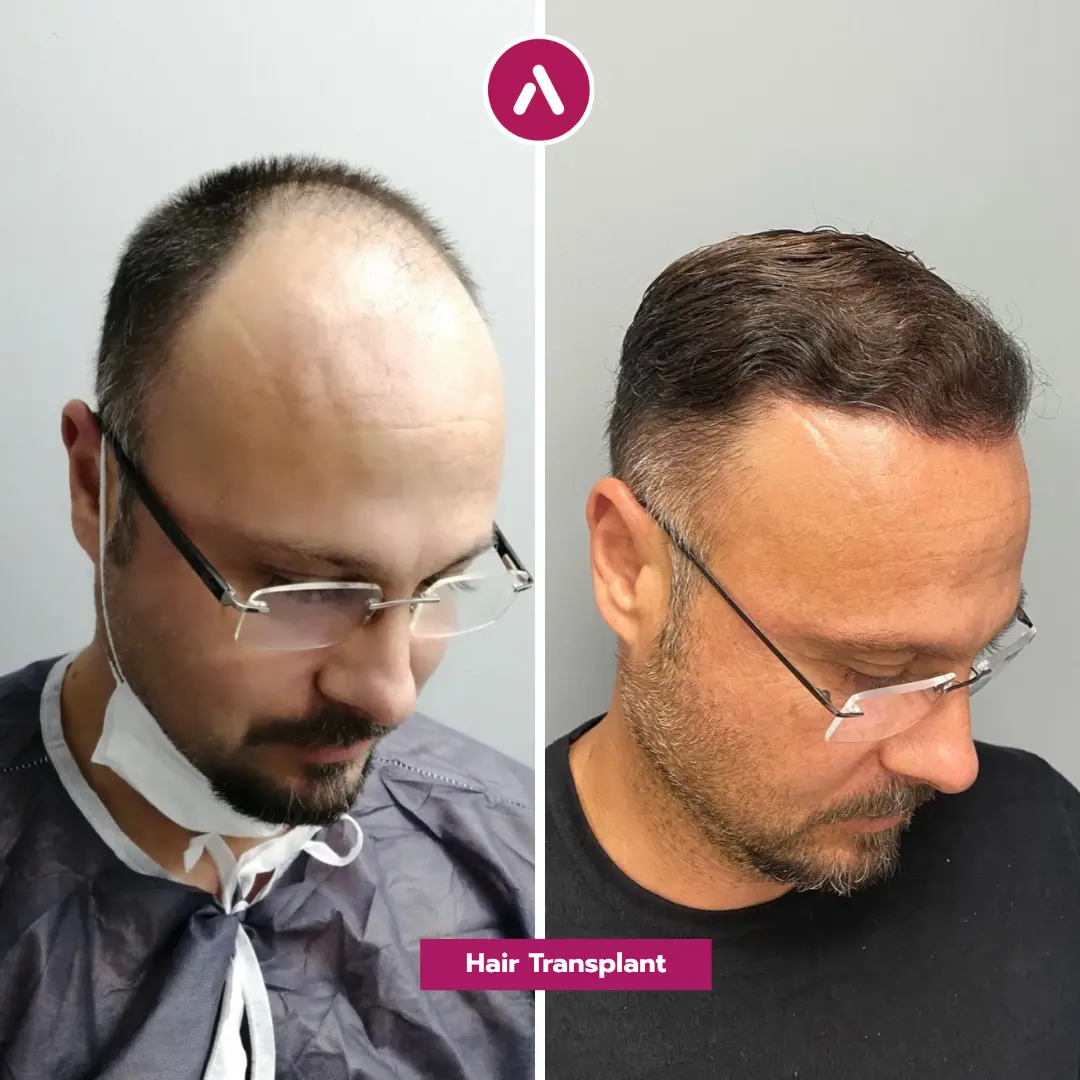
Hair transplant women before and after: how to evaluate photos the right way
Before-and-after photos are useful only if you read them correctly. Lighting, wet hair, hair length, camera distance, and styling can dramatically change what you perceive. The most reliable comparisons are consistent: similar angle, similar lighting, and similar hair length—plus a time stamp that reflects true maturation (not “early growth”).
- Compare like with like: same lighting and angle, not “studio vs bathroom mirror.”
- Look for time markers: early growth is not the final result; maturation takes months.
- Ask what was treated: hairline refinement and part-line density are different goals with different visual signatures.
Success rate and what influences growth
Patients often search for a “female hair transplant success rate,” but the more useful question is: “What makes growth predictable in my specific case?” Growth depends on candidacy, donor management, graft handling, and disciplined aftercare. When the plan is conservative and the process is medically led, the outcome is typically far more predictable than online forums make it seem.
- Predictability improves with: stable donor, clear target zone, and realistic density goals.
- Growth can suffer with: poor graft handling, aggressive harvesting, or unstable ongoing hair loss.
- Your role matters: the first two weeks of aftercare protect everything that was placed.
Surgeon’s Insight (Natural-First): The goal is not to “win the first month.” The goal is to build a hairline and density pattern that still looks believable years from now.
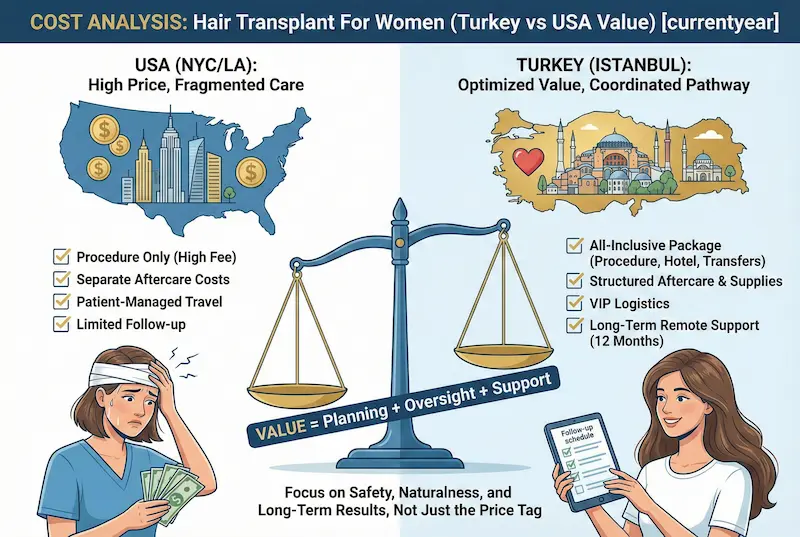
Cost Analysis—Hair Transplant For Women Cost 2026 (Turkey vs USA value)
If you’re researching hair transplant for women cost, you’re likely comparing more than a price tag. You’re comparing risk, predictability, privacy, and the overall experience. A high-quality hair transplant is a medical-and-aesthetic investment: the real value is consistent planning, medical oversight, and a recovery pathway that supports your result long after you return home.
What drives the cost of a hair transplant for women?
Women’s cases are often design-intensive. The hairline must be soft, the donor must be preserved, and implantation angles need meticulous control. Cost is typically influenced by the size of the treatment area, the complexity of design, the technique used (FUE/DHI/Sapphire/no-shave), and the level of medical oversight and aftercare.
- Graft range and complexity: localized hairline work vs diffuse density planning.
- Technique selection: privacy-focused no-shave planning can be more time-intensive.
- Clinical standards: medical oversight, quality control, and structured follow-up.
Turkey vs NYC/Los Angeles: shifting the conversation from price to value
Many US patients compare Istanbul with major US cities like NYC and Los Angeles. The most useful comparison is not “lowest number.” It’s what’s included, how care is organized, and how predictable the plan is. In high-end care, value means you know exactly who leads the process, what the protocol is, and how support continues after you fly home.
- USA city pricing context: costs often reflect overhead and limited bundled logistics.
- Turkey value model: international patients may receive a more coordinated medical-travel pathway.
- Decision filter: choose the plan that prioritizes safety, naturalness, and long-term support.
What “all-inclusive” can mean (and what to verify)
Some clinics offer coordinated packages that simplify travel. If you’re comparing offers, verify what’s included in writing: airport transfers, hotel coordination, aftercare supplies, and follow-up checkpoints. The goal is not convenience alone—it’s reducing friction so you can focus on healing and compliance.
- Logistics: VIP transfers and accommodation coordination (confirm details in your plan).
- Aftercare: written care pathway, washing protocol, and check-in schedule.
- Follow-up: structured milestones (for example, 1/3/6/12 months) with clear photo guidance.
| Cost Category | Typical USA (NYC/LA) Structure | Turkey (Istanbul) Value Structure | What to Verify |
|---|---|---|---|
| Procedure & Medical Oversight | Often billed as procedure-only | Often packaged with coordinated medical pathway | Who leads planning and critical steps; documentation of protocols |
| Technique Complexity | May add separate fees by method | Often offered as technique-based plan | Which technique is recommended for your pattern and privacy needs |
| Aftercare & Supplies | Commonly separate or minimal | Often structured and included | Written washing protocol, medications/supplies list, check-in schedule |
| Travel Logistics | Patient-managed | May include VIP transfers + hotel coordination | Exact inclusions, hotel category, and what you book yourself |
| Long-term Follow-up | Variable; may be limited | Often structured for international patients | Milestones and response time; what happens if you have a concern back home |
How To Choose The Best Female Hair Transplant Surgeon
If you searched hair transplant for women near me, you’ve probably seen dozens of clinics that sound identical. They aren’t. Women’s cases are design-heavy, and the margin for error is smaller—especially at the hairline and temples. The right team protects your donor supply, sets realistic density targets, and builds a plan that still looks natural as your native hair changes over time. That’s the difference between a result that simply “fills in” and a result that stays believable for years.
Credentials that matter (and the ones that don’t tell the full story)
Board credentials and training matter, but they are only the start. What you really want is a team that can explain why a technique fits your pattern and how they’ll preserve the donor zone. Our European Board Certified Surgeons and US-trained specialists approach planning conservatively, focusing on long-term naturalness over short-term wow factors. Ask for the reasoning, not just the label.
- Who designs your hairline and density strategy?
- Who performs the critical steps (harvesting and placement planning)?
- How does the team prevent over-harvesting in the donor area?
What to verify when you’re comparing “best” options
Patients often type best hair transplant for women and expect a simple answer. There isn’t one. What you can do is verify process quality. A high-end clinic will have clear medical leadership, written protocols, and a structured follow-up pathway—especially important if you’re traveling.
- Planning depth: conservative graft estimate, donor mapping, and a clear design rationale.
- Safety systems: pre-op screening, sterile standards, and vitals monitoring during the procedure.
- Privacy: a discreet patient flow and strict confidentiality/data security practices.
Questions to ask in your consultation (use this list)
A good consultation feels specific. It should address your pattern, not just your age or gender. You should leave knowing which technique is recommended, what you can realistically expect at 6 and 12 months, and how your donor area will look when your hair is up or wet.
- Am I a candidate for a no-shave approach, and what trade-offs does it involve?
- Where will density be prioritized (hairline, temples, part line), and why?
- What is the plan if my native hair continues thinning in the future?
“Near me” vs. “right for me”: how expert patients decide
Searching hair transplant clinic for women near me is logical. Convenience matters. But expert patients also evaluate predictability: the team’s medical oversight, the quality of communication, and the long-term support after surgery. If you’re considering international care, the real question becomes whether the clinic operates at the standard you’d expect at home—then backs it up with a documented process.
Your VIP Medical Journey—From First Message To Long-Term Follow-Up
Travel can feel like the biggest barrier, especially for women who want privacy and a predictable recovery plan. We built our process so you don’t have to “figure it out.” You get a structured medical pathway, a calm day-of experience, and follow-up that continues after you’re back in the US. The goal is simple: reduce friction so you can focus on healing and results.
Step 1: Free virtual consultation (clear plan, no pressure)
Your journey starts at home. You share photos, your hair history, and your goals. We review candidacy, discuss technique options, and outline a plan with realistic expectations. If your pattern looks unstable, we say so—and we’ll guide you toward the safest next step before surgery.
- Photo guidance (angles and lighting) so evaluation is accurate.
- A conservative graft range and a design-first plan.
- A transparent quote and a clear timeline for travel and recovery.
Step 2: Secure your date & VIP planning (you book the flight, we handle the rest)
Once you decide to proceed, your dedicated Patient Host coordinates the logistics. We schedule your procedure date, organize VIP transfers, and coordinate 5-star hotel accommodation from our partner network. You remain in control of the one piece only you can choose: your international flight.
- Procedure date coordination and a written pre-op checklist.
- VIP airport and clinic transfers scheduled around your arrival time.
- Hotel coordination designed for comfort, privacy, and easy access.
Step 3: Arrival in Istanbul (a predictable, low-stress flow)
When you land, a private driver welcomes you and takes you to your hotel. Your pre-op testing and final plan review are organized so you’re not bouncing between appointments. Our clinic environment is curated to feel private and calm, because comfort matters—especially when you’re away from home.
- VIP airport pickup and coordinated transport.
- Pre-operative tests and final plan confirmation.
- A discreet experience built for international patients.
Step 4: What’s included (and what isn’t)
Expert patients want clarity. We keep it simple. Our VIP model is designed to eliminate hidden surprises and make your recovery routine easy to follow.
- Typically included: your procedure, anesthesia/OR fees, pre-op tests, 5-star hotel stay, VIP transfers, post-op medications, and long-term virtual follow-up.
- Typically not included: international flights, personal travel insurance, and personal expenses (like meals beyond what’s provided).
- What you should confirm: number of hotel nights, what aftercare supplies are provided, and your follow-up schedule.
If you’ve been searching hair transplant doctor for women near me, consider expanding the filter: not just distance, but process quality, privacy, and long-term support. That’s how expert patients choose confidently.
Long-Term Follow-Up—What Happens After You Fly Back To The USA?
A female hair transplant is not a one-day event. It’s a 12-month process with predictable milestones. What expert patients value most is not “a quick photo.” It’s knowing what’s normal at each phase and having a medical team that stays reachable when questions come up—especially during shedding and early regrowth.
Your follow-up checkpoints (1, 3, 6, and 12 months)
We use structured checkpoints because they match how follicles behave after transplantation. Each milestone has a purpose: early healing verification, shedding reassurance, early growth tracking, and final maturation assessment. This keeps your expectations aligned with biology, not internet timelines.
- 1 month: healing review, scabbing resolution, redness expectations, early comfort check.
- 3 months: shedding phase review, early sprouting awareness, routine optimization.
- 6 months: visible growth assessment, density trend check, styling guidance.
- 12 months: maturation review, long-term plan discussion, future-proofing if needed.
How to take progress photos that actually help
Progress tracking is only useful if it’s consistent. We recommend the same lighting, the same distance, and the same angles each time. This prevents false anxiety caused by harsh overhead light or different part placement.
- Use natural light near a window (avoid strong overhead bathroom lighting).
- Capture the hairline, temples, top/part line, and donor zone from the same angles.
- Keep hair dry and similarly styled for each checkpoint.
When to contact us (instead of guessing)
Most changes are normal, but you should never feel like you’re “bothering” the clinic with safety questions. If something feels off, clarity matters. We prefer early communication because small issues are easiest to solve early.
- Increasing pain that doesn’t improve with the expected recovery rhythm.
- Unusual warmth, swelling, discharge, or fever-like symptoms.
- Any concern that makes you change aftercare behavior out of fear.
Ready To Explore Your Options?
If you’re considering a Hair Transplant For Women, the next best step is a structured virtual consultation. You’ll get a candidacy review, a technique recommendation (FUE/DHI/Sapphire/no-shave), and a realistic expectation plan. If surgery is not the right move right now, we’ll tell you—and guide you toward the safest next step instead.
What to send for your virtual consultation
- Photos: front hairline, temples, top/part line, crown, and donor area (back and sides).
- Your timeline: when thinning started, whether it’s stable, and any recent shedding changes.
- Your priorities: hairline framing, part-line density, discretion/no-shave, or a combination.
What you’ll receive
- A clear candidacy decision and recommended technique.
- A conservative graft estimate range and treatment map.
- A structured travel-and-recovery plan designed for US patients.
Surgeon’s Insight (Natural-First): The best plan is the one you’ll still feel proud of in five years—because it was built conservatively, with donor protection and natural design from day one.
Hair Transplant For Women Frequently Asked Questions (FAQ):
What is a hair transplant for women?
A hair transplant relocates stable follicles from a donor area (usually the back/sides of the scalp) to thinning areas. It restores the appearance of fullness by redistributing hair you already have, using natural direction and spacing.
Does hair transplant work for women with diffuse thinning?
It can, but it requires careful screening. Diffuse thinning often needs a conservative density strategy and realistic goals, because the native hair may continue changing over time.
How long is hair transplant recovery for women?
Most visible recovery (scabbing/crusting) typically improves within about 10–14 days. The full result develops over months, with growth and maturation continuing up to 12 months.
What is the difference between FUE and DHI for women?
FUE refers to the harvesting method (follicles extracted one-by-one). DHI refers to an implantation approach focused on controlled placement. The right choice depends on your pattern, design needs, and privacy goals—not a one-size-fits-all rule.
Can I get a no-shave hair transplant?
In many cases, yes. No-shave approaches prioritize discretion by keeping surrounding hair longer, but they can be more time-intensive and require careful planning based on hair length and density.
Is hair transplant safe for women?
When performed by a medically led, qualified team with proper screening and sterile protocols, it is generally considered a low-risk procedure. The key is correct candidacy, conservative donor management, and structured aftercare.
What are the biggest risks for women?
The most important risks to avoid are donor over-harvesting, poor growth from compromised graft handling, and uneven appearance if native hair continues thinning. Choosing the right plan at the right time reduces these risks significantly.
How much does a hair transplant for women cost?
Cost depends on graft needs, design complexity, technique choice (including no-shave strategies), and the level of medical oversight and aftercare. The most useful comparison is value: predictability, safety, privacy, and long-term support.
Is it safe to get a women’s hair transplant in Turkey?
Safety depends on the clinic’s standards, medical oversight, and follow-up process. Ask who leads planning, how protocols are documented, and how support continues after you return to the US.
When will I see results?
Many patients see early growth after the first few months, with noticeable improvement by 6 months and ongoing maturation up to 12 months. Hairline refinement often looks more natural as the texture settles over time.
Will the transplanted hair fall out?
Shedding of transplanted hairs in the first weeks to months can be normal as follicles cycle. The follicles remain, and new growth typically follows as part of the process.
What are alternatives to hair transplant for women?
If hair loss is early or unstable, non-surgical approaches may be the best first step. Medical management and supportive scalp therapies can help stabilize shedding and improve predictability if you later choose surgery.
Medical Disclaimer (Educational Use Only): This page provides general information and does not replace personalized medical advice, diagnosis, or treatment. Candidacy and outcomes vary by individual. Always consult a qualified medical professional for advice tailored to your health history. Reviewed by AKM Medical Board.