



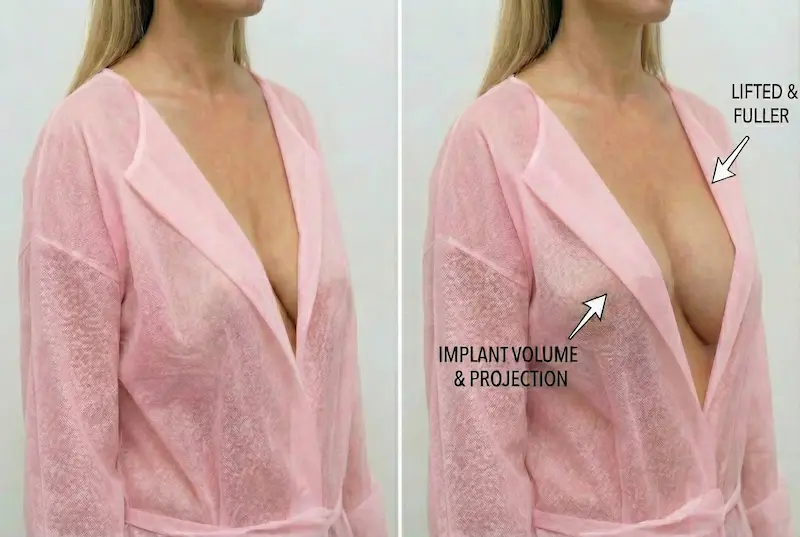
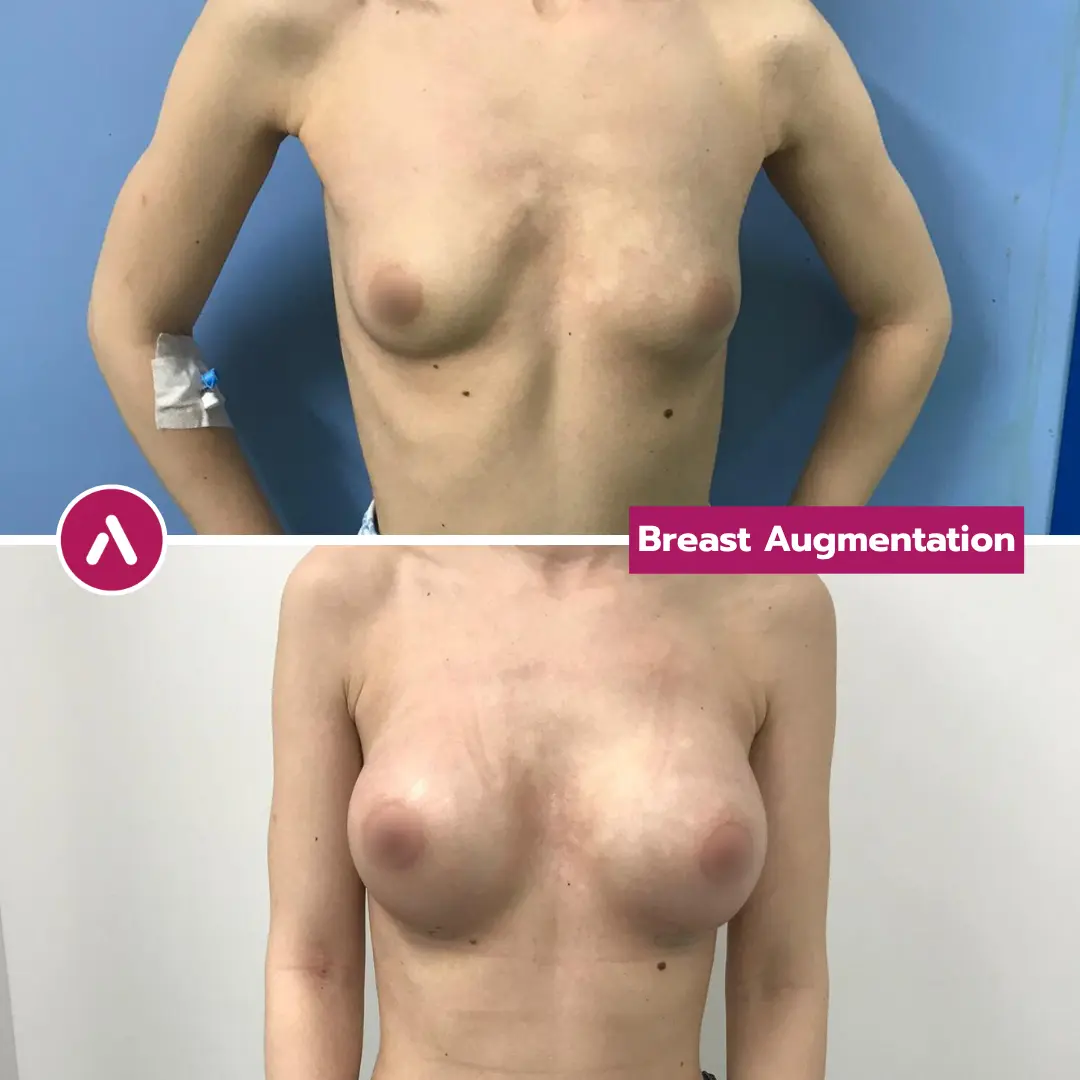
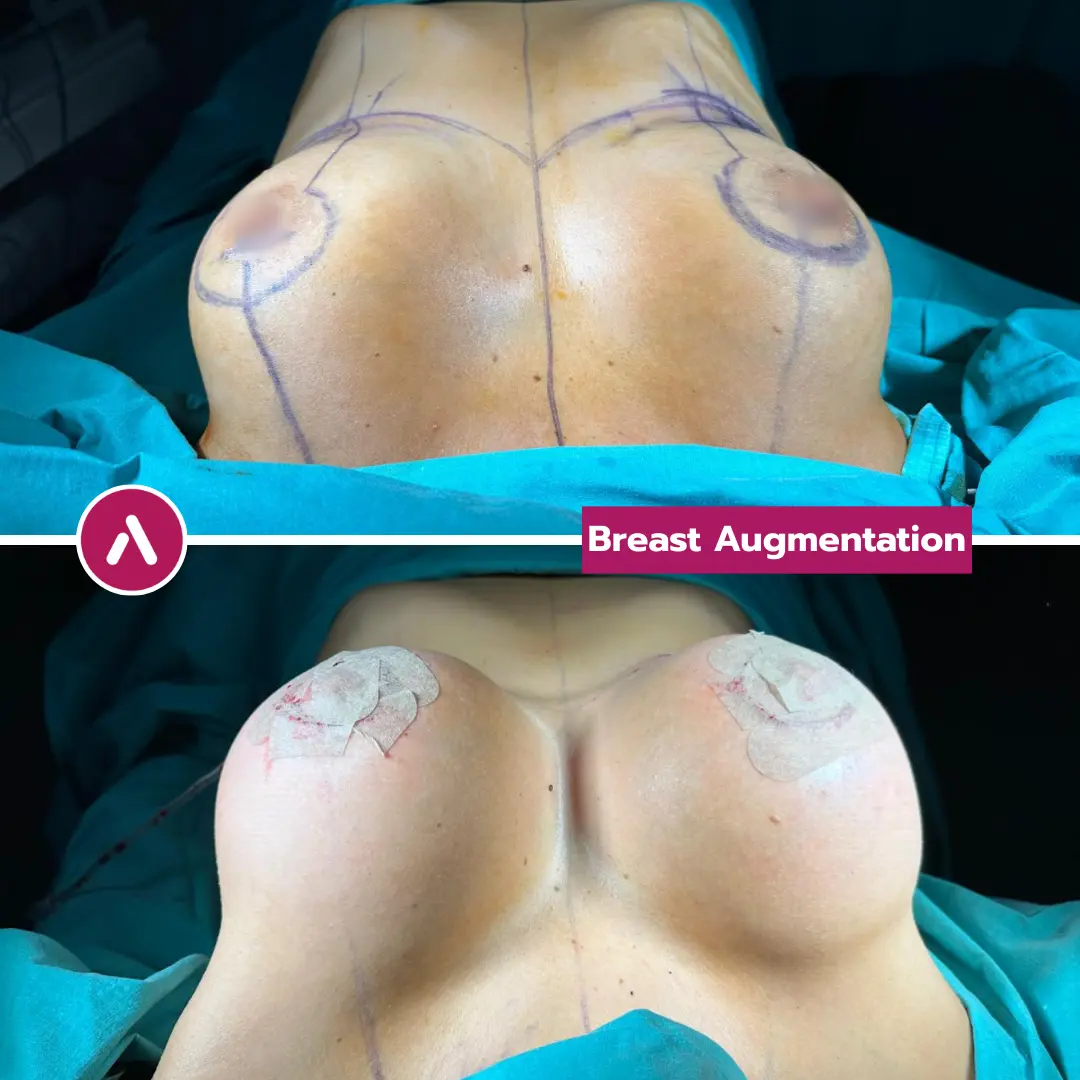
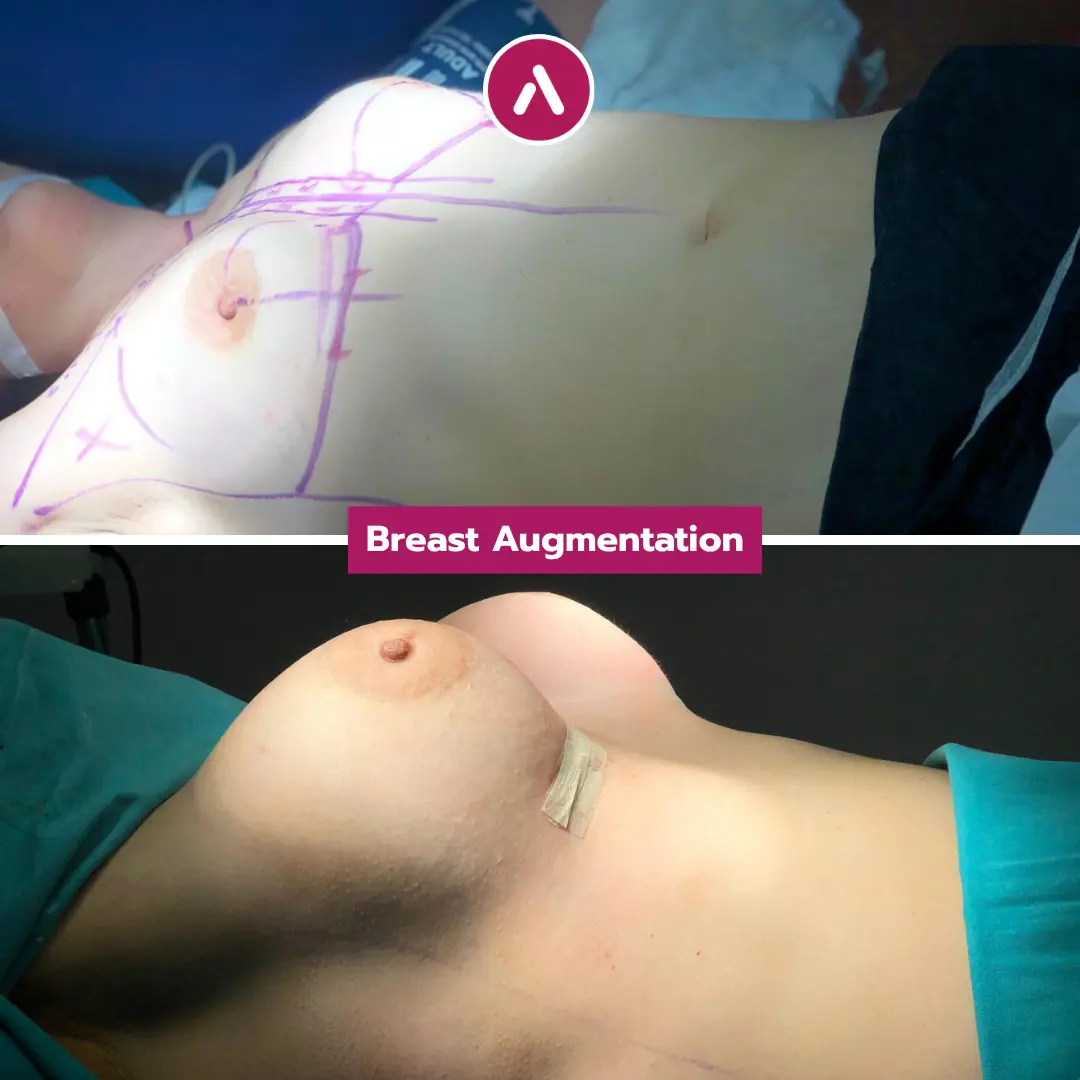
A Breast Lift With Implants is designed for one clear goal: restore a youthful breast position and shape while also adding volume where you actually want it. It is not about creating a “different body.” It is about rebuilding proportion, projection, and balance when skin and tissue no longer hold their shape the way they used to.
For US patients comparing NYC, LA, or Miami costs, Istanbul can offer a different value equation when safety systems are verifiable. We outline candidacy, anesthesia options including twilight sedation, and our Rapid Recovery & Safety Protocol (HBOT + LLLT), plus what to verify in surgeons, facilities, and follow-up planning today.
Table of Contents
What Is a Breast Lift With Implants?
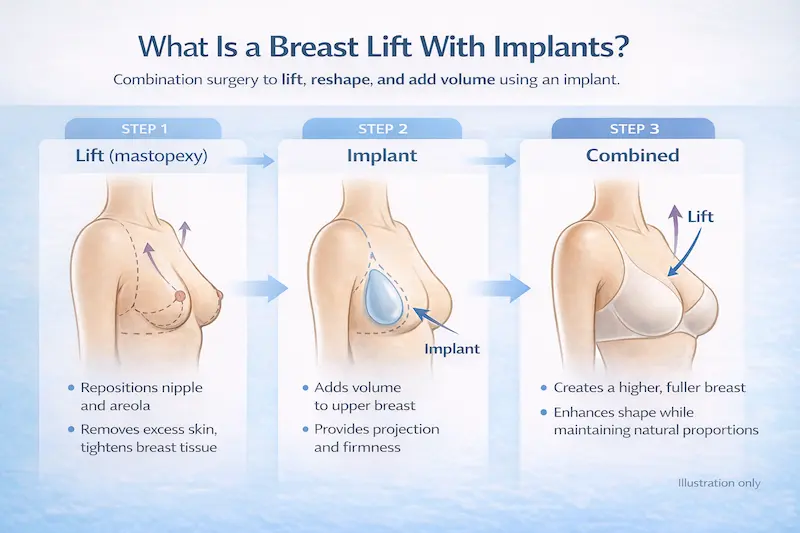
A breast lift with implants (often called augmentation-mastopexy) combines two procedures in one surgery: a lift to raise and reshape the breast and reposition the nipple-areola complex, plus an implant to restore or enhance volume. It’s designed for patients who have both drooping (ptosis) and loss of upper fullness, creating a more youthful contour while maintaining natural proportions.
What is a breast lift with implants called?
You may hear this procedure called an “augmentation-mastopexy.” It combines two operations in one: a lift (mastopexy) to reposition the breast and nipple-areola complex, and an implant (augmentation) to restore or enhance volume.
People search this term when they want a single solution for two problems at once: droop (ptosis) and loss of fullness.
How is a lift different from implants alone?
Implants can add volume, but they do not reliably “lift” a breast that has dropped. When the skin envelope is stretched and the nipple sits low, volume alone often creates a heavier look.
- Implants alone add size and projection, especially in the upper breast.
- A lift alone reshapes and elevates the breast, but does not replace lost volume.
- Lift + implant aims to rebuild shape and fullness together, so the result looks intentional and stable.
Anatomy: why breasts droop (and what “ptosis” means)
Breast ptosis is a position problem. The breast tissue descends on the chest, the nipple sits lower, and the lower breast can look longer while the upper breast looks flatter.
This happens for predictable reasons:
- Skin laxity: the skin stretches and loses recoil after pregnancy, weight changes, or aging.
- Loss of tissue support: the internal structure is no longer firm enough to hold shape.
- Volume changes: many patients lose upper fullness, even if overall breast size stays similar.
A lift addresses the position and shape by removing excess skin and reshaping the tissue. The implant is chosen to restore volume and projection without overpowering your frame.
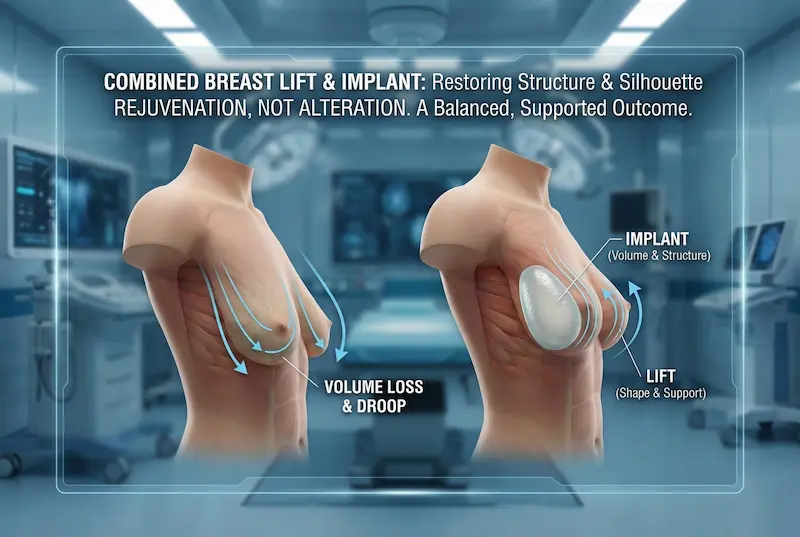
Benefits of Breast Lift with Implants
A breast lift with implants is designed for patients who want more than added volume. It addresses two common concerns at once: breast droop (ptosis) and loss of upper fullness. The lift reshapes and elevates the breast, helping reposition the nipple-areola complex and tighten excess skin for a more supported contour. The implant then restores controlled volume and projection—especially in the upper breast—so the result looks balanced rather than “heavy.”
One plan, one recovery window
When the combined approach is appropriate, patients can benefit from a single surgical timeline and one recovery period instead of staging procedures months apart. This may reduce overall disruption to work, travel, and daily routines while still prioritizing safe planning, natural proportions, and long-term stability.
Why Combine a Breast Lift With Implants?
Combining a breast lift with implants makes sense when you need more than volume alone. Implants can add fullness, but they don’t reliably correct droop or stretched skin. A lift restores position and shape, while the implant rebuilds upper-breast structure and projection—especially after pregnancy, weight loss, or aging. Together, they create a balanced, supported silhouette with a single surgical plan and one recovery timeline.
Restoring shape and upper-breast fullness
Many patients don’t want “bigger.” They want their breast shape back—especially a smoother upper contour and a rounder, more supported profile in clothing.
A combined approach can help when you have both:
- noticeable droop or a low nipple position, and
- deflation or a hollow upper breast (often described as “empty”).
Our philosophy is “Rejuvenation, Not Alteration.” That means we plan for a result that looks like you—just reset.
Correcting asymmetry and “empty” upper breast after life changes
Asymmetry is common, especially after breastfeeding or major weight changes. One breast may drop more, or one side may have less volume and a different nipple position.
Combining a lift with an implant allows us to address multiple variables in the same plan:
- reshape each breast for a more matched contour,
- adjust nipple position to sit naturally on the breast mound,
- replace volume where it was lost instead of overfilling everything.
During your evaluation, our European Board Certified Surgeons focus on proportion, tissue quality, and long-term support—not just a cup size.
When a lift alone is enough (and when it isn’t)
A lift alone can be the right choice if you like your current volume, but the position and shape have changed. It is also a good option when your tissue is naturally full, yet the breast sits low.
An implant becomes more valuable when:
- you want more upper fullness and cleavage structure,
- your breast feels “deflated” and you want projection back,
- a lift would leave you smaller than you want after reshaping.
There is no universal “best” plan. The best plan is the one that respects your anatomy and produces a result that still looks natural years from now.
Am I a Good Candidate for a Lift + Implants?
This surgery works best when the goal is clear: lift what has dropped and restore volume that has deflated. It’s a highly personalized operation because skin quality, breast tissue density, and nipple position can vary dramatically from person to person. Your safest plan starts with an honest evaluation of your anatomy and your medical history. We also look at your lifestyle and timing—because the “right” surgery at the “wrong” moment can create avoidable stress during recovery.
Common reasons patients choose a combined approach
You may be a strong candidate if you recognize more than one of these patterns:
- Your nipples sit lower than before, or point downward.
- Your upper breast looks flatter, especially in a bra or swimsuit.
- You feel you have “extra skin,” not just “not enough volume.”
- You want a stable, balanced breast shape rather than simply “bigger.”
Surgeon’s Insight: The best outcomes happen when we treat the breast as a shape problem and a support problem—not a size problem.
Breast lift with implants after weight loss
After significant weight loss, the breast often loses internal volume and the skin envelope becomes looser. That combination can create a longer lower pole, a lower nipple position, and a “deflated” look up top. A lift reshapes the tissue and removes excess skin; the implant replaces missing structure and projection.
One key point: tissue can be thinner after weight loss. Implant size and placement must respect that reality. Conservative planning usually wins long-term.
Who should avoid surgery (or delay it)
Some situations call for postponing surgery or choosing a different plan:
- Active smoking or nicotine use: nicotine reduces micro-circulation and can raise wound-healing risk.
- Uncontrolled medical conditions: issues like uncontrolled diabetes or untreated clotting risks need clearance first.
- Unstable weight: major weight changes after surgery can stretch the skin again.
- Near-term pregnancy plans: pregnancy and breastfeeding can change breast shape and volume.
Safety is never a slogan for us. We use strict pre-operative health screening and continuous vitals monitoring protocols because candidacy is the foundation of predictable results.
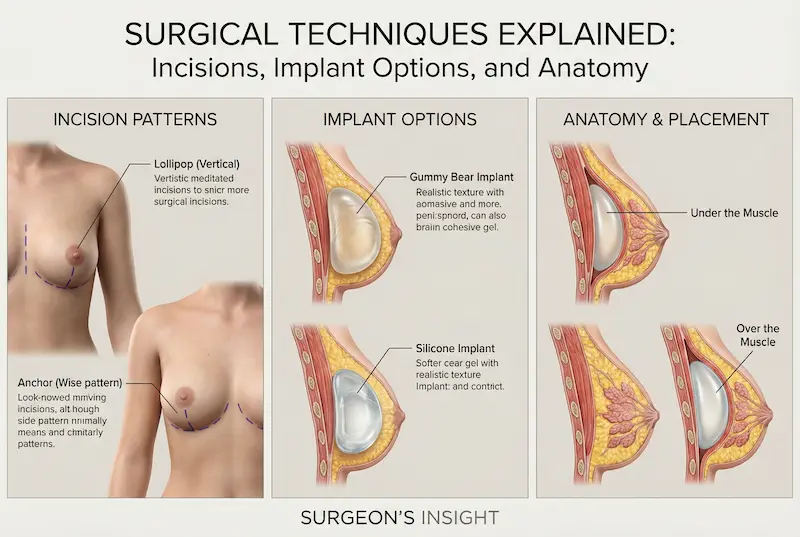
Surgical Techniques Explained: Incisions, Implant Options, and Anatomy
Technique is not just “how the scar looks.” It’s how we build lasting support and symmetry. The incision pattern is chosen based on how much lifting is needed and where the nipple sits today. Implant selection is then tailored to your chest width, tissue quality, and your desired upper fullness. This is the “expert patient” level detail that matters—because technique drives both shape and recovery.
Lollipop breast lift with implants vs anchor breast lift with implants (and where “vertical” fits)
These terms describe incision patterns. Each pattern matches a different degree of skin laxity and nipple elevation needed.
| Technique | Typical Incision Pattern | Best For | Trade-Off |
|---|---|---|---|
| Lollipop (Vertical) | Around the areola + vertical line down | Moderate lift, reshaping, improved projection | Less ability to remove large skin excess |
| Anchor (Wise pattern) | Around the areola + vertical line + crease line | More significant droop, more skin excess | More scar surface area, longer scar pathway |
In real planning, the question is simple: how much skin needs to be removed to restore a natural breast footprint? The “right” scar is the one that creates the most stable shape.
Gummy bear implants with breast lift vs silicone: what matters clinically
Implants differ by material, feel, and how they hold shape. Many patients ask about “gummy bear” implants because they’re associated with form stability. Others prefer a silicone implant for a softer feel.
What matters most is not the marketing name. It’s fit. We choose an implant style and size that your tissue can support and that matches your proportion goals.
Surgeon’s Insight: When tissue support is limited, “bigger” is not “better.” A well-matched implant often looks more natural and ages more gracefully.
Breast lift with implants under the muscle vs breast lift with implants over muscle
This is one of the most important anatomy decisions in the entire plan. There isn’t a universal winner. There is a best match for your tissues.
- Under the muscle (submuscular / dual-plane): can add extra coverage in thinner patients and may soften implant edges.
- Over the muscle (subglandular): can be appropriate when tissue coverage is strong and you want a specific look and movement pattern.
During consultation, we assess tissue thickness, chest anatomy, and how much upper fullness you want. We also simulate planning with advanced imaging when appropriate, so expectations are visual and specific—not vague.
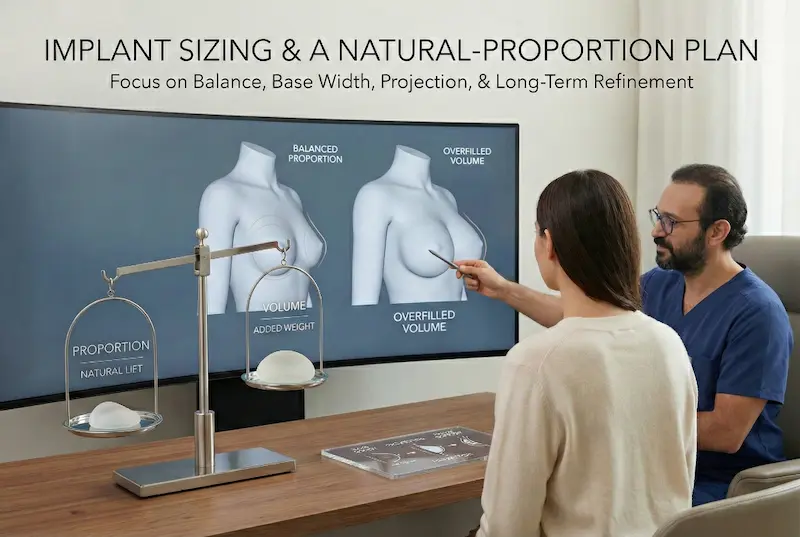
Implant Sizing & A Natural-Proportion Plan
Implant selection is where many results are won or lost. Size is only one variable. Base width, projection, tissue thickness, and skin elasticity matter just as much. Your goal should be proportion, not a number on a bra label. When we plan implants, we prioritize what will look balanced on your frame now and still feel “you” years from now.
Breast lift with small implants: why “less” can look more refined
Many patients assume a bigger implant automatically creates a better lift effect. It doesn’t. Larger implants add weight, and weight can challenge long-term support—especially when the skin envelope has already stretched. For patients who want an elegant, athletic, or “quiet luxury” look, a smaller implant often delivers the most natural outcome.
- Better tissue match: smaller implants can sit more harmoniously within thinner tissue.
- More controlled cleavage: you get structure without an exaggerated, “overfilled” upper pole.
- Long-term logic: less weight can mean less downward pull over time.
Surgeon’s Insight: Proportion beats volume. A well-matched implant can look more “lifted” than a larger one, because the breast sits in balance instead of fighting gravity.
Profile, base width, and tissue support: the three decisions that matter
Think of an implant as a shape tool. The “right” shape depends on your chest dimensions and how much native tissue you have. That’s why implant conversations should always include more than “CCs.”
- Base width: determines how naturally the implant fills the breast footprint on your chest.
- Projection: affects forward fullness and upper contour; too much projection can look artificial on a narrow frame.
- Tissue support: guides how aggressive we can be with volume while still protecting the lift.
This is also where implant placement matters. If you have thinner tissue, additional coverage may be beneficial. If you have stronger coverage, other placement plans may be appropriate. Your anatomy drives the strategy.
How we plan: 3D simulation for clearer expectations
Online photos can be misleading because bodies, tissue quality, and incision patterns are different for every patient. Planning is more precise when we can map your anatomy and talk in real dimensions. That’s why we use advanced pre-operative imaging to support surgical simulation and detailed planning. It helps align expectations before surgery, not after.
- We focus on symmetry goals and realistic upper fullness.
- We plan for a natural breast footprint, not a “round on top” template.
- We keep the lift strategy and the implant strategy connected as one plan.
Combined Procedures (Synergy): Maximizing Your Results
Combining procedures is not about doing “more.” It’s about doing what makes sense in one controlled plan. When the right procedures are paired, patients often benefit from a single recovery window and a single surgical timeline. That can mean fewer disruptions to work and family life. The key is selection: the combination must match your health profile, your safety priorities, and the amount of change you want—whether that plan includes a breast lift alone, implant exchange, or a coordinated breast augmentation strategy.
Breast lift with existing implants: when the implant is fine, but the breast has changed
Some patients already have implants, but the breast tissue has shifted over time. Pregnancy, weight changes, and natural aging can cause the breast to descend even when the implant remains intact. In these cases, the main problem is position and skin envelope—not necessarily implant volume or the original augmentation result.
- A lift can re-center the nipple and tighten the skin envelope.
- In select cases, keeping the existing implant is possible if size and condition are appropriate.
- If the implant no longer fits your goals, an implant exchange can be planned as part of the same surgery (a lift + revision augmentation approach).
Removal of breast implants with lift: restoring shape after explant
Explant patients often worry that removing implants will leave them flat or shapeless. A lift can play a major role in rebuilding contour after removal by reshaping tissue and addressing excess skin. The goal is a stable, natural breast shape—not a “deflated” look—whether you choose to remain implant-free or plan a smaller, more conservative augmentation later.
Every explant plan is different. Some patients need a conservative lift. Others need a more structural reshaping approach. The deciding factors are skin quality, how long the implants have been present, and how much tissue remains.
Breast lift and reduction with implants: is it ever logical?
It sounds contradictory—reduce and add volume. In reality, certain patients want less overall breast weight, but still want upper fullness and a more youthful contour. That can make a combined plan logical in carefully selected cases, especially when a small implant is used to fine-tune shape rather than to “size up” like traditional augmentation.
- Breast Reduction decreases heaviness and improves comfort and proportions.
- A lift restores a higher, more supported breast position.
- An implant (sometimes small) rebuilds controlled upper structure when native tissue is insufficient.
This combination requires careful surgical judgment. The safest and most aesthetic plan is the one that respects tissue blood supply and avoids overcorrection.
Mommy makeover synergy: pairing breast surgery with tummy tuck and liposuction
For some patients—especially after pregnancy—breast changes and abdominal changes happen together. In a carefully selected mommy makeover, we may coordinate a breast lift with implants (or other augmentation plan) alongside a tummy tuck to restore abdominal contour, and targeted liposuction to refine the waistline. The goal is one cohesive plan, one recovery window, and results that look balanced head-to-toe.
- Tummy tuck addresses abdominal skin laxity and muscle separation (when present).
- Liposuction can refine localized fat pockets for smoother proportions.
- Breast lift with implants (augmentation-mastopexy) restores position plus controlled upper fullness.
Not every patient is a candidate for combined body and breast procedures. We prioritize safety, operative time, and recovery capacity—supported by peer-reviewed clinical studies.
Anesthesia Options: Awake/Twilight Sedation vs General Anesthesia
For many “expert patients,” anesthesia is not a footnote—it’s a core safety decision. A Breast Lift With Implants can be performed under different anesthesia approaches depending on your health profile, surgical complexity, and the exact lift and implant plan. Our priority is to match the anesthesia method to the safest pathway for your case, not to force a one-size-fits-all protocol.
Awake sedation breast lift with implants safety: what “twilight” actually means
“Awake” or “twilight” sedation generally refers to a carefully controlled, monitored sedation state where you are relaxed and comfortable, while maintaining protective reflexes more reliably than with full general anesthesia. The exact medication plan varies by patient and by anesthesia team protocols.
- Comfort-focused: patients are typically calm and pain-controlled.
- Monitoring-heavy: continuous vitals monitoring remains essential.
- Case-dependent: candidacy depends on medical history, anxiety level, and procedure scope.
For the right candidate, sedation-based approaches can be a modern, patient-centered option. The key is careful selection and meticulous monitoring.
Awake twilight sedation vs general anesthesia breast lift: how to think about the trade-offs
General anesthesia (GA) is a widely used, appropriate option for many surgical cases—especially when procedure duration is longer or surgical complexity is higher. Twilight sedation may be appropriate in selected cases when the plan is suitable and the patient is a good medical candidate.
When we discuss anesthesia, we focus on practical decision points:
- Procedure complexity: larger lifts, more extensive reshaping, or revisions may favor GA.
- Medical risk profile: certain conditions may influence what is safest.
- Comfort and cooperation: patient comfort matters—especially for anxiety-prone patients.
- Recovery priorities: some patients prefer the idea of a lighter anesthesia approach when appropriate.
Surgeon’s Insight: The “best” anesthesia is the one that matches your procedure plan and your health profile with the widest safety margin—then we optimize comfort inside that choice.
Who may qualify for sedation-based approaches (and who may not)
Not every patient is a candidate for awake/twilight sedation. In our consultation process, we evaluate whether your plan fits a sedation-based pathway or whether GA is more appropriate. You may be less suitable for sedation-based approaches if you:
- have complex revision needs or expect a longer operative time,
- have significant anxiety that would make the experience uncomfortable,
- have medical factors that require a more controlled airway plan,
- need a larger, more extensive lift pattern that increases procedural scope.
If GA is recommended, that is not a “worse” option—it is often simply the safest and most predictable approach for that specific surgical plan.
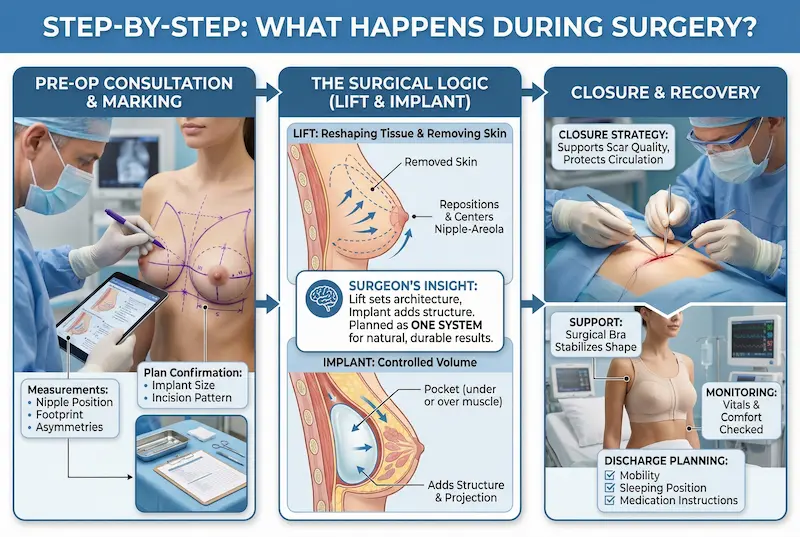
Step-by-Step: What Happens During Surgery?
Expert patients tend to feel calmer when they understand the sequence. While details vary by technique, the structure of surgery is consistent: confirm the plan, execute the lift safely, place the implant strategically, and close in a way that protects blood supply and supports clean healing.
Pre-op consultation, measurements, and surgical markings
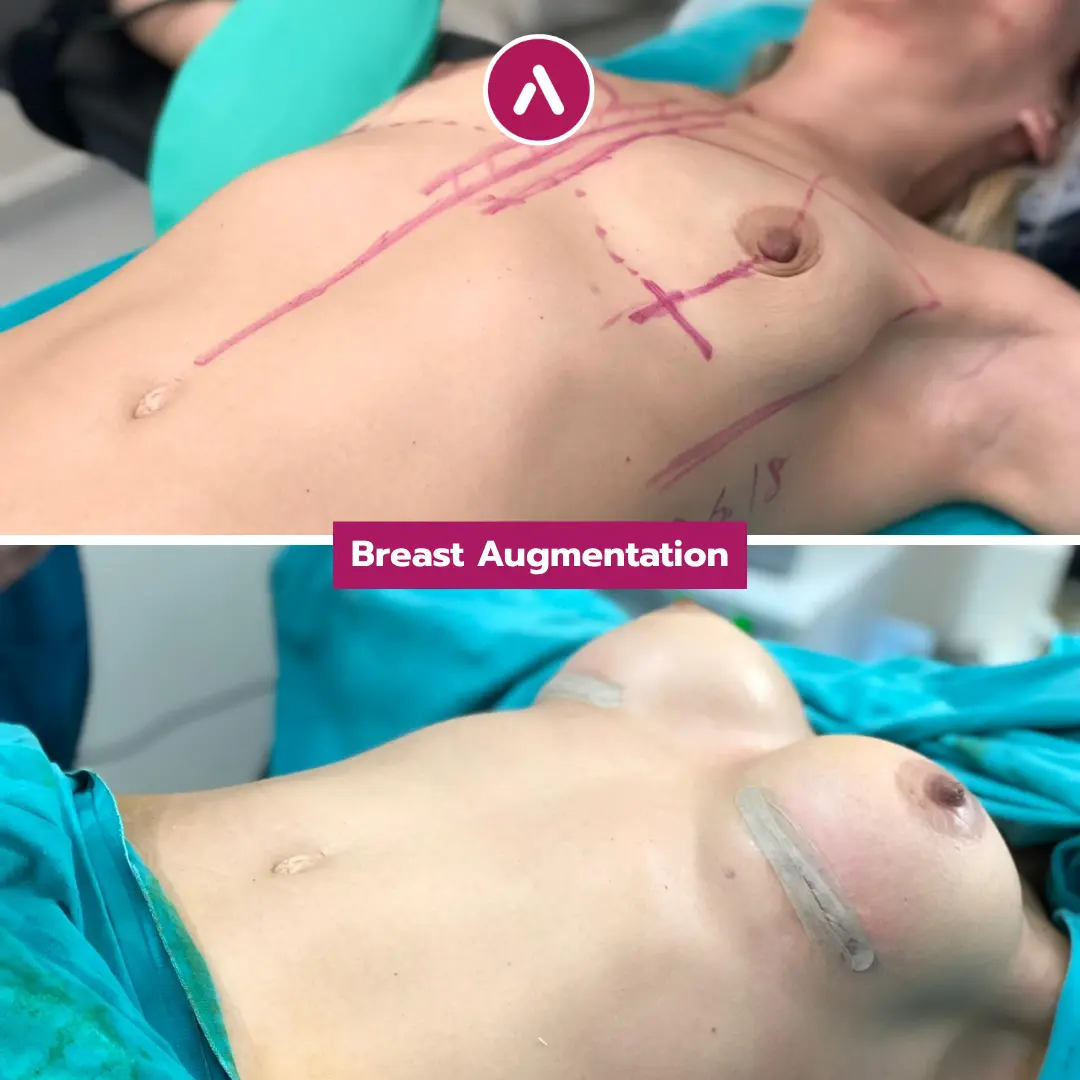
Before surgery, we confirm the operative plan with a final review of your goals, your implant selection, and your incision strategy. Surgical markings are not cosmetic doodles—they are a map that guides symmetry, nipple position, and the reshaping plan.
- Measurements: nipple position, breast footprint, and asymmetries are documented.
- Plan confirmation: implant size/profile and incision pattern are re-checked.
- Safety checks: we verify your pre-op screening and monitoring plan.
How is a breast lift done with implants? (the surgical logic)
The lift portion reshapes the breast tissue and removes excess skin so the breast sits higher and looks more supported. The implant portion restores controlled volume—most importantly in the upper breast—when your natural tissue cannot provide that fullness on its own.
In simplified terms, the surgery aims to:
- reposition and center the nipple-areola complex for a natural look,
- reshape the breast mound for better projection and contour,
- create a stable “skin envelope” that matches the new shape,
- place the implant in the chosen plane (under vs over muscle) to match tissue needs.
Because a lift and an implant affect each other, we plan them as one system. That integrated approach is what helps avoid common problems like “bottoming out,” an overly tight upper look, or a result that feels unstable over time.
Surgeon’s Insight: The lift sets the architecture. The implant adds structure and projection. When they’re planned as one system—not two separate ideas—the result is more natural and more durable.
Closure, dressings, and immediate post-op monitoring
Closing is not just “stitching.” Closure strategy supports scar quality, reduces tension on the skin, and protects circulation. After closure, dressings and supportive garments are applied according to your surgical plan.
- Support: a surgical bra helps stabilize the new shape early on.
- Monitoring: vitals and comfort are monitored closely during the initial recovery period.
- Discharge planning: you receive clear instructions for mobility, sleeping position, and medication timing.
This first phase sets the tone for the rest of recovery: controlled swelling, protected incisions, and predictable early healing.
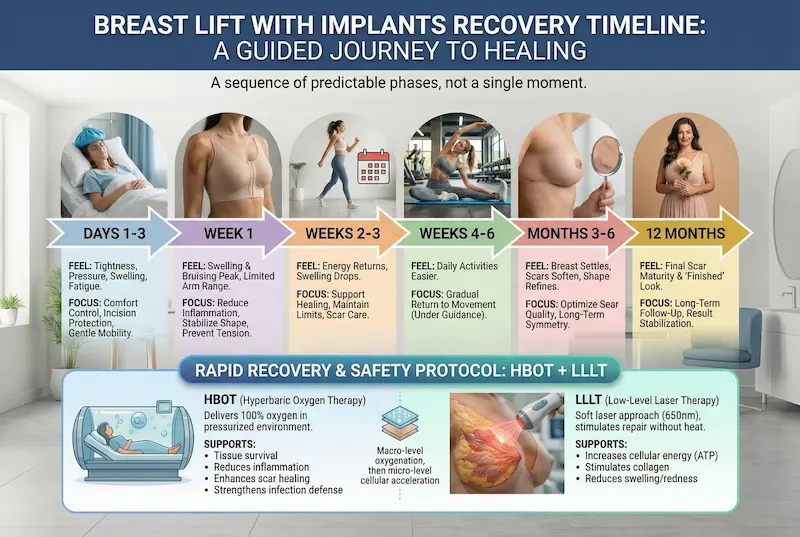
Breast Lift With Implants Recovery Timeline: How Long Does Healing Take?
Recovery is not one single moment. It’s a sequence of predictable phases: early swelling control, incision protection, gradual return to movement, and then scar maturation. Most patients feel “better” long before tissues are fully healed. That gap can lead to doing too much too early. Our job is to guide you through each phase with a plan that protects your result.
We also build recovery into the surgical strategy from day one. That includes strict screening for candidacy and continuous vitals monitoring during your procedure. It’s the safest way to keep recovery smooth and predictable.
Breast lift with implants recovery time and the breast lift with implants healing process
Healing speed varies by incision pattern, implant placement, and your baseline tissue quality. Still, most patients experience the same broad timeline. Think in “weeks,” not “days.”
| Timeframe | What You’ll Typically Feel | Our Focus |
|---|---|---|
| Days 1–3 | Tightness, pressure, swelling, fatigue | Comfort control, incision protection, gentle mobility |
| Week 1 | Swelling and bruising peak, limited arm range | Reduce inflammation, stabilize shape, prevent tension |
| Weeks 2–3 | Energy returns, swelling begins to drop | Support healing, maintain activity limits, scar care begins |
| Weeks 4–6 | Most daily activities feel easier | Gradual return to movement under guidance |
| Months 3–6 | Breast settles, scars soften, shape refines | Optimize scar quality and long-term symmetry |
| 12 months | Final scar maturity and “finished” look | Long-term follow-up and result stabilization |
How painful is breast lift with implants?
Most patients describe the early phase as tightness and pressure more than sharp pain. The implant can add a “heavy” feeling, while the lift can feel like skin tightness across the lower breast. Pain is usually most noticeable in the first few days, then gradually improves.
- First 72 hours: tightness, swelling, fatigue are common.
- Week 1: discomfort decreases, but you still need support and rest.
- Weeks 2–3: many patients feel “normal” in daily life, but healing is still active.
Simple habits matter. Sleep on your back, keep your upper body slightly elevated, and avoid sudden arm movements. Your body will tell you when you’ve pushed too far.
Our “Rapid Recovery & Safety Protocol”: hbot for breast lift recovery + lllt therapy after breast surgery
We frame recovery as a medical protocol, not luck. That’s why we integrate a two-layer system designed for faster healing and risk reduction: Hyperbaric Oxygen Therapy (HBOT) and Low-Level Laser Therapy (LLLT). HBOT delivers 100% oxygen in a pressurized environment to support tissue survival, reduce inflammation, enhance scar healing, and strengthen infection defense. LLLT then adds targeted cellular support by increasing ATP (cellular energy) and stimulating collagen activity, helping reduce swelling and redness while supporting repair.
- HBOT: supports oxygen delivery to healing tissues and promotes smoother scar outcomes.
- LLLT: a “soft laser” approach (650nm) designed to stimulate repair without heat damage.
- System effect: macro-level oxygenation first, then micro-level cellular acceleration.
Recovery is also logistics and follow-through. We provide structured post op care for breast lift with implants, including close immediate monitoring after surgery, clear medication and garment guidance, and long-term virtual follow-up milestones. The goal is simple: keep your healing predictable and your outcome stable.
Scars & Scar Management
Scars are part of breast lifting. The real question is not “Will I scar?” It’s “How will my scar mature?” Scar quality depends on incision choice, closure strategy, tissue blood supply, and your post-op behavior. Genetics also plays a role. Our role is to choose the right technique, minimize tension, and then guide scar care so healing stays clean and controlled.
A good scar plan is realistic. It doesn’t promise “scar-free.” It aims for “scar-fine.”
Breast lift with implants scars: what to expect
Your scar pattern depends on how much lift your anatomy requires:
- Around the areola: blends into the natural color transition.
- Vertical line: helps reshape and shorten the lower breast.
- Crease line (anchor pattern): used when more skin removal is needed.
Early scars usually look red or pink. That’s normal. They typically soften and lighten over months as collagen reorganizes.
Reducing scars after breast lift with implants: what actually helps
Scar care is not one magic cream. It’s a consistent routine and a few non-negotiables. The first goal is to prevent irritation and tension while the incision seals.
- Protect the incision: avoid stretching, friction, and aggressive arm movement early on.
- Follow garment guidance: stable support helps reduce pull on the scar line.
- Respect sun exposure: UV can darken scars during the active healing phase.
- Use recovery technology strategically: our HBOT + LLLT protocol is designed to support tissue quality, collagen behavior, and smoother healing.
Surgeon’s Insight: The best scar is usually the one that had the calmest healing environment—low tension, low inflammation, and consistent protection.
Scar timeline and “when to worry” signals
Scars mature slowly. Many patients judge scars too early at week 2 or week 6. True maturation continues up to a year.
- Weeks 2–6: scars may look darker or raised before they improve.
- Months 3–6: softening and lightening usually becomes noticeable.
- Up to 12 months: final refinement continues.
Contact your care team if you notice spreading redness, worsening warmth, sudden swelling on one side, or drainage that changes in color or smell. Early action is the best protection for both safety and aesthetics.
Safety & Risks: Is a Breast Lift With Implants Dangerous?
No surgery is “zero-risk.” A lift with implants is a controlled, planned procedure, but it combines two powerful tools: reshaping tissue and adding volume. That increases the need for careful patient selection, precise technique, and structured aftercare.
We don’t minimize risk. We manage it with strict pre-operative screening, rigorous sterilization standards, and advanced vitals monitoring throughout your procedure.
Risks of breast lift with implants: the honest list
Most risks are uncommon, but you deserve clarity. Potential complications can include:
- Bleeding (hematoma): may require urgent evaluation and, rarely, a return to the operating room.
- Infection: usually treatable, but an implant infection can be more complex.
- Delayed wound healing: more likely with nicotine exposure, poor circulation, or high tension on incisions.
- Scarring concerns: widened, raised, or darker scars can occur based on genetics and healing behavior.
- Changes in sensation: temporary numbness is common; permanent changes are possible.
- Asymmetry: breasts are naturally different; surgery improves symmetry, but perfection is not guaranteed.
- Revision surgery: sometimes needed for shape refinement, scar concerns, or implant-related changes over time.
Implant-specific risks (and what they mean in real life)
Implants are medical devices. They can be safe and predictable, but they’re not “lifetime products.”
- Capsular contracture: the body forms a capsule around every implant; in some cases it tightens and changes feel or shape.
- Malposition: an implant can shift, especially if tissue support is limited or sizing is too aggressive.
- Rippling or edge visibility: more likely in thin tissue; planning and implant placement choices matter.
- Rupture or device aging: rare in the short term, possible over the long term.
This is why our approach is proportion-first. When the implant fits your tissue and frame, the result usually looks more natural and behaves more predictably.
Lift-specific risks: circulation and scar quality
A breast lift repositions tissue and the nipple-areola complex. That means blood supply and tension control are essential.
- Areola shape changes: can occur as swelling resolves and tissue settles.
- Tension-related scars: high tension can widen scars; technique and post-op behavior both matter.
- Delayed healing at incision junctions: some areas work harder during healing and may need extra attention.
Surgeon’s Insight: Risk management starts before surgery. Candidacy, planning, and a disciplined recovery protocol matter as much as the operation itself.
When to contact your team urgently
During recovery, call your care team right away if you experience:
- rapid, one-sided swelling or sudden tightness
- worsening redness, warmth, or fever
- drainage that changes in color or odor
- shortness of breath, chest pain, or calf swelling
Early intervention protects both safety and results.
Is It Safe to Get a Breast Lift With Implants in Turkey?
“Turkey” is not a safety standard. The real question is which hospital system, which protocols, which materials, and what aftercare structure you’re choosing. For expert patients comparing NYC, Los Angeles, or Miami to Istanbul, safety is the non-negotiable baseline.
Our approach is built around internationally benchmarked standards: FDA-approved materials, JCI-accredited hospitals, and strict sterilization and monitoring protocols designed for international patient expectations.
Standards that matter (and what we actually do)
- JCI-accredited hospital environment: surgery is carried out in facilities built to meet international accreditation expectations.
- Rigorous sterilization standards (ISO/TÜV): infection control is a system, not a promise.
- Advanced vitals monitoring: we monitor patients throughout every procedure.
- Strict pre-op health screening: we screen candidacy carefully to reduce avoidable complications.
Surgeon credentials: what “European Board” signals
Expert patients want verifiable training markers. Our surgical authority is grounded in a rigorous credential culture, including European Board Certifications (such as EBOPRAS equivalency referenced in our standards documentation), which are positioned as the direct counterpart to high-expectation Western board systems.
In your consultation, we focus on what matters: technique fit, safety margin, and long-term stability—not a quick “one size fits all” plan.
Continuity of care: the part most clinics don’t engineer
International patients often fear being “on their own” after flying home. We solve that with a structured support model.
- 24/7 dedicated Patient Host: support stays accessible during your Istanbul recovery window.
- Long-term virtual follow-up: we schedule structured check-ins at 1, 3, 6, and 12 months.
- All-inclusive clarity: pre-op tests, post-op medications, and garments are organized as part of the plan.
This is how medical travel becomes a controlled medical journey, not a logistical gamble.
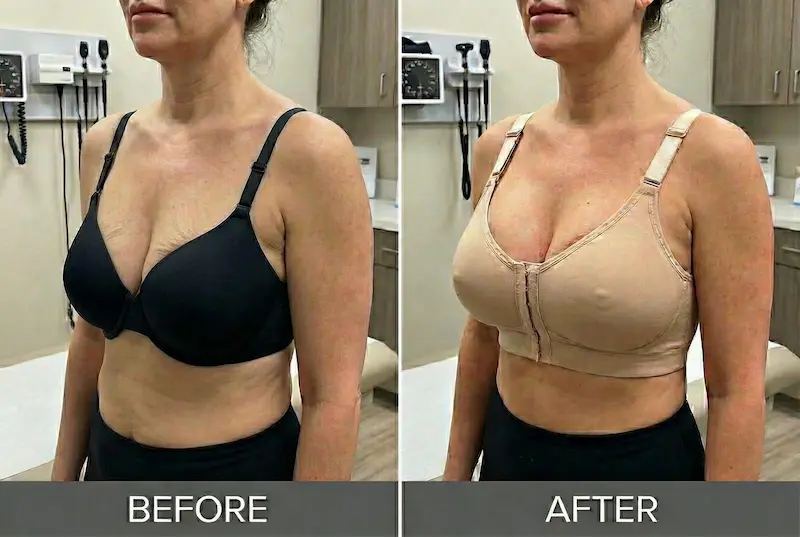
Realistic Expectations & Results (Natural-First Philosophy)
A Breast Lift With Implants can create a dramatic improvement in shape, but the most satisfying results are the ones built on realistic expectations. A lift improves position and contour. An implant restores controlled volume and projection. Together, they can create a more youthful silhouette—while still looking like you.
What “natural” really means in lift + implant planning
“Natural” is not a single look. For most expert patients, it means:
- Balanced proportions: the breast fits your chest width and frame, not an arbitrary cup goal.
- Stable nipple position: centered on the breast mound, not pulled or overstretched.
- Controlled upper fullness: refreshed, not overfilled.
Our planning is proportion-first. We choose an incision strategy that provides the lift you actually need, then select an implant that your tissue can support without fighting long-term gravity.
Surgeon’s Insight: A natural-looking result is rarely “the biggest implant you can fit.” It’s the implant that matches your footprint, your tissue, and the lift architecture.
How long do results last (and what can change over time)?
Longevity depends on biology and behavior. Your breasts will still respond to aging, gravity, weight changes, pregnancy, and hormonal shifts. The lift improves structure, but it cannot freeze time.
- Skin quality matters: thinner, stretchier skin may relax sooner.
- Implant size matters: heavier implants can increase downward pull over time.
- Life changes matter: major weight changes or pregnancy can alter results.
Many patients enjoy long-lasting improvements, but it’s normal for the breast to “settle” as swelling resolves and tissues soften. That refinement phase is part of healing—not a sign that something went wrong.
What is “settling” and when do you see the final result?
Early results can look higher, tighter, and more swollen. Over the next weeks and months, tissues relax, swelling reduces, and the breast shape becomes more natural. Scars also mature gradually.
- First 6 weeks: swelling and tightness are common; shape is still evolving.
- 3–6 months: breasts look more “finished” as settling continues.
- Up to 12 months: scar maturity and final refinement continue.
Cost Analysis: Breast Lift With Implants Prices 2026 (Turkey vs USA/UK)
Cost questions are valid—but “price” only makes sense when you know what’s included. In the U.S., fees are often itemized (surgeon fee, facility, anesthesia, implants, garments, medications). In Istanbul, international patients often prefer an all-inclusive pathway that bundles medical and travel logistics into one clear plan.
Cost drivers: why Turkey can offer a different value equation
The core difference is overhead structure—not “lower standards.” In high-cost U.S. cities, operating facility expenses, staffing, insurance, and real-estate overhead can heavily influence pricing. In Istanbul, patients can access internationally benchmarked care without the same cost structure.
Value is not “cheap.” Value is the combination of surgeon credentials, hospital standards, safety protocols, and structured aftercare—delivered at a rational cost.
Breast lift with implants cost NYC vs Istanbul
NYC is one of the highest-cost markets in the U.S. Even for breast lift alone, metro-level pricing is elevated. A combined lift + implants procedure is typically higher because it combines reshaping with an implant device, added operating time, and anesthesia/facility costs.
In Istanbul, patients often compare not only the surgical fee, but also what is included: coordinated hotel stay, transfers, pre-op testing, post-op medications, and long-term follow-up planning.
Average cost of breast lift with implants Los Angeles vs Turkey
Los Angeles is another premium-cost market. For expert patients, the decision often comes down to whether the cost premium is driven by medical superiority—or by city overhead. When comparing LA to Turkey, evaluate the full care pathway: hospital environment, anesthesia safety, technology-supported recovery, and follow-up structure.
Breast lift with implants cost Miami (and why prices can look “lower” there)
Miami can show wide pricing variability because the market ranges from boutique premium care to high-volume models. That variability makes it even more important to compare like-for-like: board credentials, facility standards, what’s included, and who manages follow-up if you travel.
| Cost / Value Variable | Typical U.S. Major Metro (NYC / LA / Miami) | Istanbul with Our All-Inclusive Pathway |
|---|---|---|
| Pricing structure | Often itemized (surgeon, facility, anesthesia, implants billed separately) | Often bundled for clarity (medical + logistics organized as one plan) |
| Facility & anesthesia | Separate line items; varies by center and anesthesia team | Coordinated within a hospital-based environment and pre-planned monitoring |
| Implant choices | Device cost varies by type and brand | Chosen based on anatomy and goals; included/outlined transparently in the plan |
| Recovery optimization | Often optional add-ons, varies by practice | Technology-supported recovery protocols (when appropriate) integrated into care |
| Travel logistics | Patient-managed (hotel, local transport, time off work) | Coordinated (airport transfers, hotel planning, on-ground support) |
| Follow-up continuity | In-person local follow-up standard | Structured follow-up milestones + remote support for international patients |
Important note: Any “average cost” you see online may reflect a partial fee, a full bundled price, or a patient-reported estimate. Always confirm what’s included (facility, anesthesia, implants, garments, medications, and revision policy) before you compare across countries.

Finding the Right Surgeon for a Lift + Implants
When you combine a lift and implants, you’re asking for two outcomes at once: a higher, reshaped breast and a stable volume result that still looks natural. That’s why best surgeon selection matters more here than with a single procedure. You’re not just choosing a “style.” You’re choosing planning discipline, safety standards, and long-term judgment.
If you’re comparing options in the U.S. (NYC, Los Angeles, Miami) versus Istanbul, focus on verifiable credentials and systems—not marketing language. The best surgeon for you is the one who can explain trade-offs clearly, set realistic expectations, and show consistent results in anatomy similar to yours.
Best European board certified surgeons for breast lift turkey: what to verify
“Board certified” should mean something specific, not something vague. Look for credential clarity and a safety-first operating environment.
- Credential transparency: we position our team as European Board Certified Surgeons because expert patients want objective training markers.
- Hospital standards: ask where the surgery takes place and what monitoring protocols are used.
- Clear anesthesia planning: the safest plan is the one matched to your health profile and procedure complexity.
How to evaluate results (beyond “before and after” photos)
Photos are helpful, but expert patients look deeper. You want consistency, not a single impressive outlier.
- Find anatomy matches: ask to see cases with similar skin laxity, breast width, and degree of droop.
- Check scar placement logic: ask which lift pattern was used and why.
- Look for long-term stability: ask what the results look like after settling, not only at 2–6 weeks.
Surgeon’s Insight: A beautiful result is planned, not “hoped for.” The right surgeon explains the trade-offs before surgery—then designs the plan to protect your blood supply, scars, and long-term support.
Questions to ask in your consultation (the expert patient checklist)
Use questions that reveal planning depth. If the answers feel rushed, keep looking.
- Which lift pattern fits my anatomy: lollipop/vertical or anchor, and why?
- Will my implant be under or over the muscle, and what does my tissue thickness suggest?
- How do you prevent “bottoming out” or implant malposition over time?
- What implant size range is realistic for my chest width and skin quality?
- What is your plan for scars and tension control at closure?
- What does follow-up look like if I’m traveling internationally?
Red flags that should make you pause
Some signals are subtle. Others are obvious.
- One-size-fits-all sizing: “Everyone gets X cc” is not serious planning.
- Guarantees: medicine doesn’t come with “perfect symmetry” promises.
- Vague safety answers: if the clinic can’t explain monitoring and screening clearly, that’s a risk.
- Pressure tactics: you should feel guided, not pushed.
If you’re considering breast lift with implants Turkey, we start with a free virtual consultation to confirm candidacy, goals, and the most logical technique. Then we build a plan that prioritizes natural proportions and safety.
Your Medical Journey: What to Expect (From Arrival to Follow-Up)
Medical travel should feel structured, not uncertain. The right process removes guesswork: you know what happens first, what happens next, and who is responsible for each step. That matters because stress increases fatigue—and fatigue makes recovery harder.
We designed our pathway for international patients who want privacy, clarity, and continuity of care. You get a step-by-step plan before you fly, on-ground support in Istanbul, and long-term follow-up after you return home.
Step 1: Free virtual consultation and personalized plan
Your journey begins at home. We review your goals, assess your anatomy from submitted photos (and any available medical history), and build a personalized surgical plan.
- Technique recommendation (incision pattern + implant strategy)
- Recovery expectations and timeline
- Transparent, all-inclusive package quote structure
Step 2: Arrival in Istanbul and VIP coordination
When you arrive, logistics should disappear. Our team coordinates airport welcome, private transfer, and hotel planning so you can rest and prepare.
- VIP airport pickup and private transfer
- 5-star partner hotel coordination
- 24/7 access to a dedicated Patient Host
Step 3: In-person consultation, tests, and procedure day
Before surgery, we confirm the plan in person. This is where expert patients feel the difference: measurements, symmetry goals, incision strategy, and implant selection are reviewed as one integrated system.
- Pre-op tests and final safety checks
- Final plan confirmation with our surgical team
- Procedure performed in a fully accredited environment
Step 4: Recovery in Istanbul and clearance to fly home
Early recovery is about control: swelling management, incision protection, and calm, supported rest. Before you leave, we reassess healing and confirm that travel is safe.
- Close post-op monitoring by our medical team
- Clear instructions for garments, sleep position, and mobility
- Final in-person check-up and flight clearance
Step 5: Long-term follow-up after you return home
Support shouldn’t end when your plane lands. We schedule structured check-ins to monitor scar maturity, settling, and overall satisfaction.
- Virtual follow-ups at 1, 3, 6, and 12 months
- Fast access to guidance if you have questions
- Continuity that protects both safety and aesthetics
Ready for next steps? If your goal is to book breast lift with implants Istanbul, we can begin with a no-obligation virtual consultation and map your ideal timeline from planning to recovery.
Breast Lift With Implants Frequently Asked Questions (FAQ):
These are the questions we hear most from expert patients researching a lift-and-implant plan. Some answers depend on technique, implant placement, and your medical profile. That’s why we treat FAQs as guidance, not a substitute for a consultation. The safest plan is always personalized. Clear expectations make recovery easier.
Breast lift with implants under vs over muscle: which is safer?
“Safer” depends on your anatomy and goals. Under-the-muscle (often dual-plane) can provide more upper-pole coverage for thinner patients, but may feel tighter early and can create visible movement with flexing in some athletic individuals. Over-the-muscle may feel less tight early and can suit certain body types and activity patterns, but may show edges more in thin tissue. The best plan is individualized and should be explained clearly in your consult.
Anchor vs lollipop breast lift with implants: which is better?
Neither is “better” universally. Vertical/lollipop is often ideal for moderate sagging and balanced reshaping with fewer scar lines than an anchor. Anchor is often chosen for more advanced sagging or significant skin excess where maximum control is needed to achieve a stable, well-shaped result. The right choice is the one that meets your lift needs without forcing high-tension closure.
What is a breast lift with implants called?
You may see it called augmentation mastopexy or mastopexy with augmentation. In everyday language, it’s often shortened to “breast lift with implants.” The key idea is that the lift corrects position and shape, while implants restore or add controlled volume.
What do breast lift with implants scars look like?
Scar placement depends on the lift pattern:
Donut (periareolar): around the areola border
Vertical / lollipop: around the areola + a vertical line to the fold
Anchor: around the areola + vertical line + along the breast crease
Scars typically look more noticeable early (pink/red, firmer), then fade and soften over months. Scar behavior is influenced by genetics, tension, sun exposure, and aftercare consistency.
What should I expect after breast lift with implants in the first month?
Expect swelling fluctuations, firmness, and a “higher/tighter” look early on. Temporary asymmetry is common as one side can settle faster. Most patients feel increasingly normal week by week, but true aesthetic refinement continues for months as implants settle and scars mature.
Breast lift with implants cost Turkey: what determines the final quote?
Cost depends on your lift complexity (vertical vs anchor), implant choice, anesthesia plan, and what’s included in your pathway. Many international patients prefer a bundled plan that covers surgery, hospital fees, tests, medications, garments, and logistics. If you’re comparing breast implants with breast lift in Turkey to U.S. metro pricing, confirm you’re comparing the same scope of care. Clarity matters more than a headline number.
When can I return to work, driving, and exercise?
Light daily activity starts early, but training waits. Many patients can return to desk work within a couple of weeks, depending on comfort and swelling. Driving usually depends on mobility and whether you still need strong pain control. Exercise returns in phases, with upper-body strain introduced last.
Is HBOT necessary for breast lift recovery?
Recovery isn’t “one-size-fits-all,” but we don’t treat healing like an afterthought. We integrate HBOT as part of our Rapid Recovery & Safety Protocol because oxygen-rich healing can support tissue survival, reduce inflammation, and improve scar quality. We often pair it with LLLT to support cellular repair and reduce redness and swelling. Your exact protocol is tailored during planning.
When can I fly after breast lift with implants?
Flight timing depends on your healing progress, clot-risk profile, and your surgeon’s clearance. Many international patients plan enough time in Istanbul to complete early follow-ups and ensure they’re stable for travel. The safest approach is to follow a plan designed specifically around your surgery date, your mobility, and your medical screening.
Can I breastfeed after a lift with implants?
Some patients can breastfeed after surgery, but it’s never guaranteed. Incision pattern, glandular tissue, and individual anatomy matter. If future breastfeeding is a priority, we plan as conservatively as your anatomy allows. Your consultation is the right place to discuss trade-offs clearly.
Will I need drains?
Drain use depends on technique and surgeon preference. Some cases require drains for a short period. Others do not. We explain your expected pathway before surgery so you’re not surprised in recovery.
Medical Disclaimer: This page is for educational purposes only and does not replace personalized medical advice, diagnosis, or treatment. Every surgical plan must be individualized after an in-person evaluation and review of your medical history. Results and recovery timelines vary by patient. This content has been reviewed by the AKM Medical Board.