



If you’re researching rhinoplasty with an “expert patient” mindset, you want clarity before opinions. This guide breaks down the anatomy, the core techniques, and what surgeons are actually trying to achieve. You’ll also see common nose-shape categories so you can describe your goals more precisely in consultation.
Table of Contents
What is Rhinoplasty Surgery?
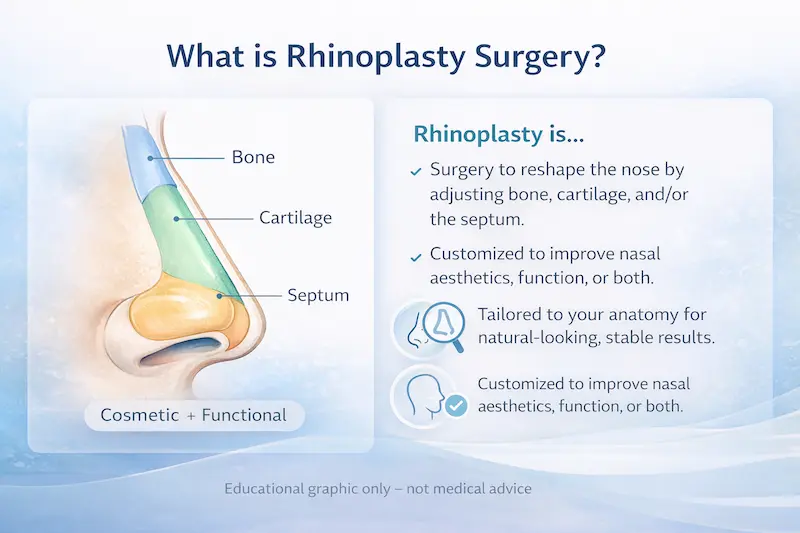
Rhinoplasty is a surgical procedure that reshapes the nose by adjusting bone, cartilage, or both. It can be done to change appearance, improve breathing, or achieve both goals at the same time. The best plans respect your natural facial proportions and the structural job the nose has to do every day.
People often search “what is rhinoplasty surgery” because the term covers a wide range of surgical decisions. Your nose has support structures, airflow pathways, and skin thickness that all influence what’s possible. That’s why two patients can request the same “look” and still need different surgical strategies.
Nasal anatomy 101 (bone, cartilage, septum, tip support)
Think of the nose as a framework covered by skin. The framework has fixed parts and flexible parts, and both affect how the nose looks and functions.
- Nasal bones: The upper third that shapes the bridge.
- Upper and lower lateral cartilages: The middle and lower support for the sidewalls and the tip.
- Septum: The central wall that supports shape and guides airflow.
- Tip support: A combination of cartilage shape, ligaments, and how the tip is stabilized.
- Skin thickness: Influences definition and how “sharp” tip detail can appear.
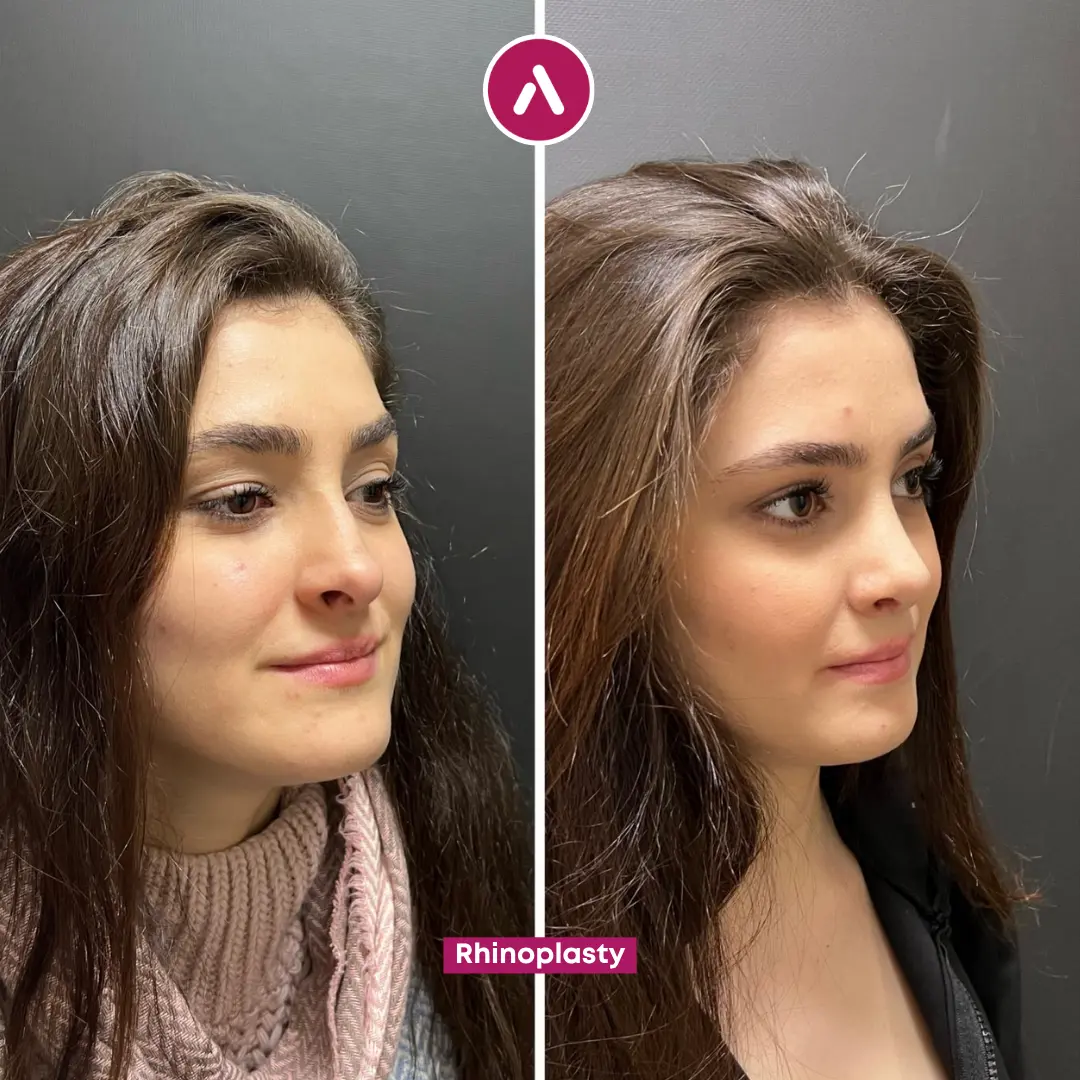
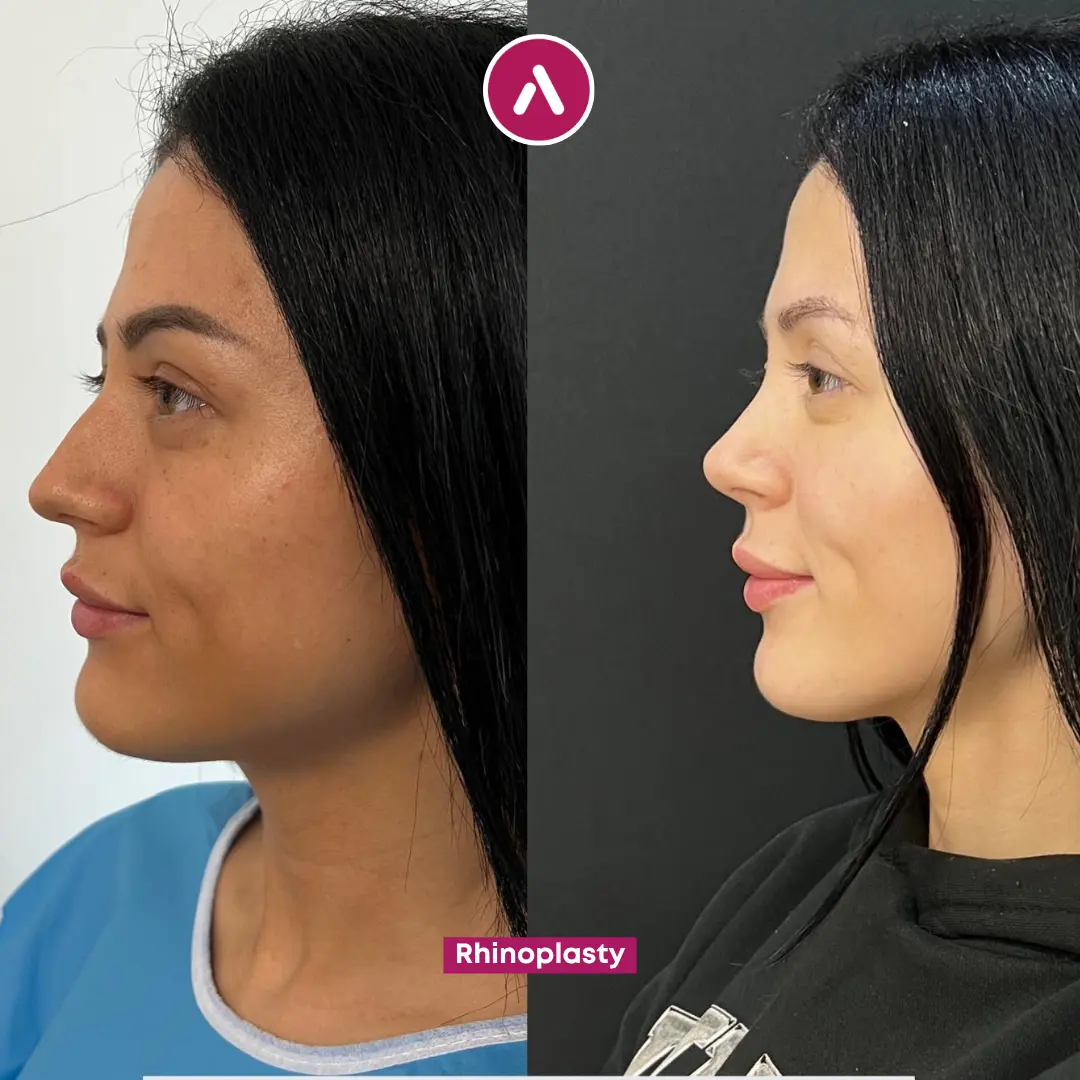
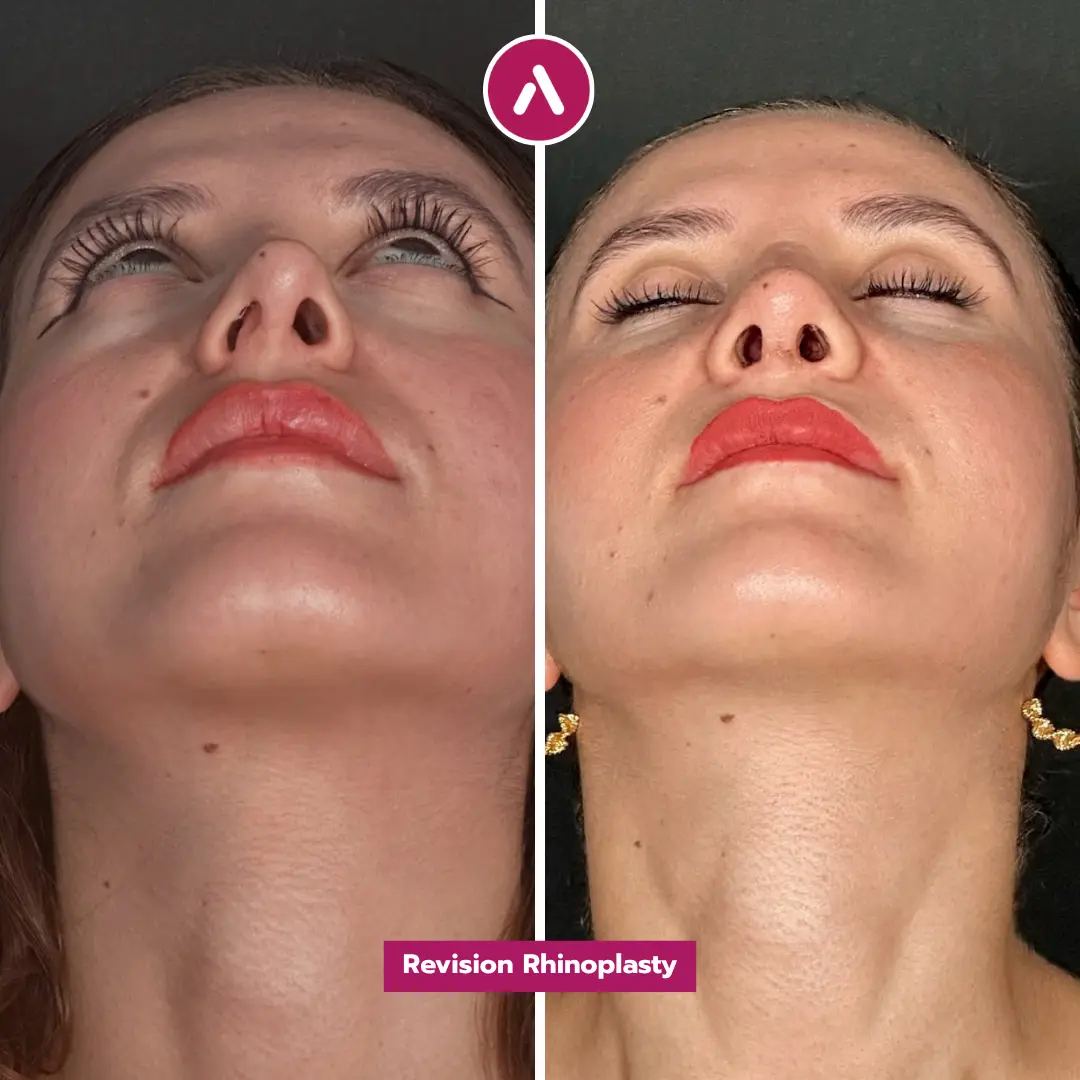
Cosmetic vs functional goals (form + breathing together)
Cosmetic goals focus on shape, symmetry, and facial balance. Functional goals focus on airflow, stability, and comfort when breathing through the nose.
- Cosmetic examples: refining a bulbous tip, smoothing a hump, improving symmetry.
- Functional examples: supporting weak sidewalls, addressing a deviated septum, improving internal valve stability.
- Combined planning: a smaller-looking nose that still breathes well requires structural support, not just reduction.
Septoplasty vs rhinoplasty: what’s the difference?
Septoplasty vs rhinoplasty is a common comparison because the names sound similar, but the goals are different. Septoplasty is primarily a functional operation to straighten or reposition the septum to improve airflow. Rhinoplasty focuses on reshaping the external nose, though it can also include functional corrections.
- Septoplasty: targets internal alignment to improve breathing.
- Rhinoplasty: targets shape, proportion, and structural aesthetics.
- Septorhinoplasty: combines both when appearance and breathing need a single integrated plan.
Open vs closed overview (high-level differences)
Patients frequently ask about open vs closed rhinoplasty because the choice affects access and precision, not “how good” the result will be. Both approaches use incisions placed to minimize visibility, and both can deliver natural outcomes when the plan matches the anatomy.
Open rhinoplasty uses a small external incision between the nostrils to lift the skin and expose the framework directly. Closed rhinoplasty (endonasal approach) keeps incisions inside the nostrils, which can reduce external scarring and swelling in select cases. The right choice depends on the complexity of tip work, asymmetry, revision status, and how much structural change is needed.
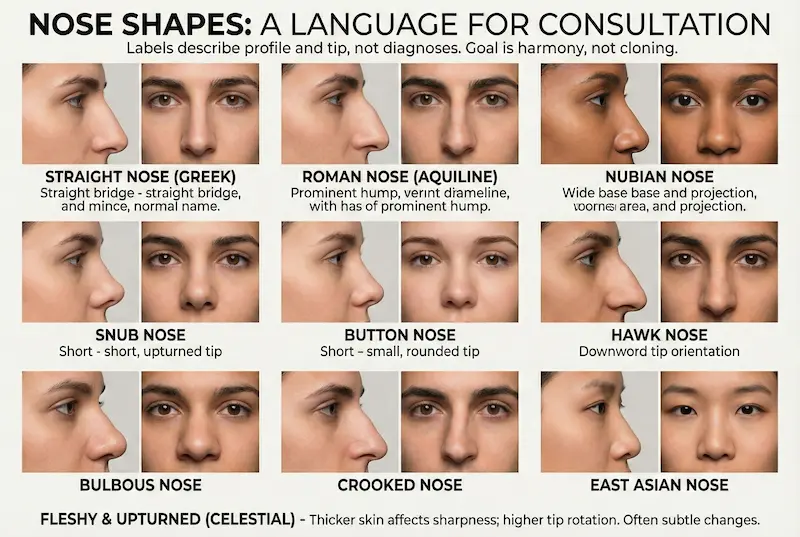
Nose Shapes
Nose-shape labels help you describe the overall profile and tip characteristics in simple terms. They are not a diagnosis, and many noses don’t fit neatly into one category. In consultation, shape is only the starting point; surgeons also evaluate breathing, structural support, skin thickness, and facial proportions.
Use these categories as a language tool. They help you communicate what you like, what you want to keep, and what you want to refine. The goal is harmony, not cloning someone else’s nose.
Straight Nose (Greek Nose)
Often described as a straight bridge from the radix to the tip with minimal hump. Requests commonly focus on subtle refinement rather than major structural change.
Roman Nose (Aquiline Nose)
Typically features a prominent dorsal bridge with a visible hump or convexity. Surgical planning often prioritizes balanced hump reduction while preserving strong, natural lines.
Nubian Nose
Commonly associated with a longer bridge and a wider base with more projection. Plans may involve proportion changes while respecting ethnic identity and maintaining stable airflow.
Snub Nose
Often shorter with an upturned tip and a smaller bridge. Goals can include gentle lengthening, improved definition, or better tip support to avoid an overly “turned” look.
Button Nose
Usually small with a rounded, slightly upturned tip. Refinement requests often focus on tip definition and subtle contouring rather than reduction alone.
Hawk Nose
Often features a prominent bridge with a more downward tip orientation. Planning commonly balances dorsal refinement with tip rotation and structural stability.
Bulbous Nose
Defined by a wider, rounder nasal tip, often influenced by cartilage shape and skin thickness. Tip refinement is typically about structure and support, not aggressive removal.
Fleshy Nose
Often refers to thicker skin and softer tip definition. Results may refine shape, but expectations should match how thick skin affects final sharpness and timeline.
Crooked Nose
Characterized by a visible deviation of the bridge and/or tip. Successful correction usually involves both cosmetic straightening and structural support, sometimes with functional work.
Upturned Nose (Celestial Nose)
Often has higher tip rotation with more nostril show. Requests may involve subtle de-rotation or better tip support for a more balanced profile.
East Asian Nose
Common traits can include a lower bridge and softer projection, with wide variability between individuals. Plans often prioritize natural-looking projection and stable structural support, not a one-size-fits-all template.
Benefits of Nasal Reshaping (Aesthetics + Function)
Good rhinoplasty is not about turning a nose into a trend. It is about balance. When the nose fits the face, people notice the person, not the surgery.
There is also a practical side. A beautiful result means less if breathing gets worse. The highest-quality plans treat aesthetics and function as one system.
“Rejuvenation, Not Alteration” approach (natural results)
Our guiding philosophy is simple: Rejuvenation, Not Alteration. The goal is a refreshed version of your features, not a different identity.
- Preserve what works: strong support, stable airflow, natural angles.
- Refine what distracts: asymmetry, disproportion, harsh dorsal lines, under-supported tips.
- Avoid the “operated” look: over-reduction is hard to fix and often weakens structure.
Most expert patients want the same thing in different words: a nose that looks like it has always belonged to their face.
Functional gains (airflow, structural support, balance)
Some patients come in for appearance and discover their breathing could be improved. Others start with breathing issues and realize the external shape is also part of the problem.
- Airflow stability: supporting the internal and external nasal valves can reduce collapse and obstruction.
- Structural integrity: the nose must resist daily forces from breathing, sleeping position, and facial movement.
- Long-term comfort: “looks good today” is not the same as “functions well for years.”
Function is not an add-on. It is part of the design.
Facial harmony: profile, tip refinement, symmetry
Your nose is a central feature, so small changes can create big improvements in facial harmony. This is why detailed pre-op planning matters.
- Profile balance: smoothing a hump or refining the bridge can soften harsh lines.
- Tip definition: creating support and shape can reduce a round or heavy tip without forcing sharp angles.
- Front-view symmetry: correcting deviation can improve alignment and overall facial balance.
Harmony means proportion. Not perfection.
Confidence and “not obvious” results
Most people are not chasing compliments about their nose. They want fewer questions. They want to look “well” without looking “done.”
That outcome comes from restraint, structure, and a plan that matches your anatomy. It also comes from respecting your personal and ethnic features instead of erasing them.
Am I a Good Candidate for a Nose Job?
Candidate selection is where great outcomes begin. The best surgery in the world cannot override poor timing, unstable health, or unrealistic expectations.
This section helps you self-screen before you book a consultation. If you recognize yourself in the “delay” or “avoid” categories, it does not mean “never.” It often means “not yet.”
Medical candidacy checklist (health screening, nasal maturity)
Strong candidates are healthy, have stable goals, and have noses that are fully developed. For most patients, that also means a clear understanding of what they want to change and what they want to keep.
- Overall health: well-controlled medical conditions and a stable baseline.
- Nasal maturity: facial growth complete (your surgeon will confirm).
- Breathing assessment: any blockage, valve collapse, or septal deviation should be evaluated.
- Skin thickness awareness: thick skin can still get beautiful results, but definition and timeline differ.
We run strict pre-operative health screenings to confirm candidacy and reduce avoidable risks. Clear data lowers anxiety. It also lowers complication rates.
Who should delay or avoid surgery (risk factors, smoking, uncontrolled illness)
Some factors increase risk or compromise healing. When that happens, the smartest move is to pause, stabilize, and come back with better conditions.
- Nicotine use: smoking and vaping can slow healing and raise complication risk.
- Uncontrolled medical issues: poorly managed blood pressure, diabetes, bleeding disorders, or active infections.
- Recent nasal trauma: swelling and instability can distort surgical planning.
- Unstable expectations: chasing a “perfect” nose or frequent goal changes week to week.
Delaying can feel frustrating. It is still a win. Better healing conditions produce better results.
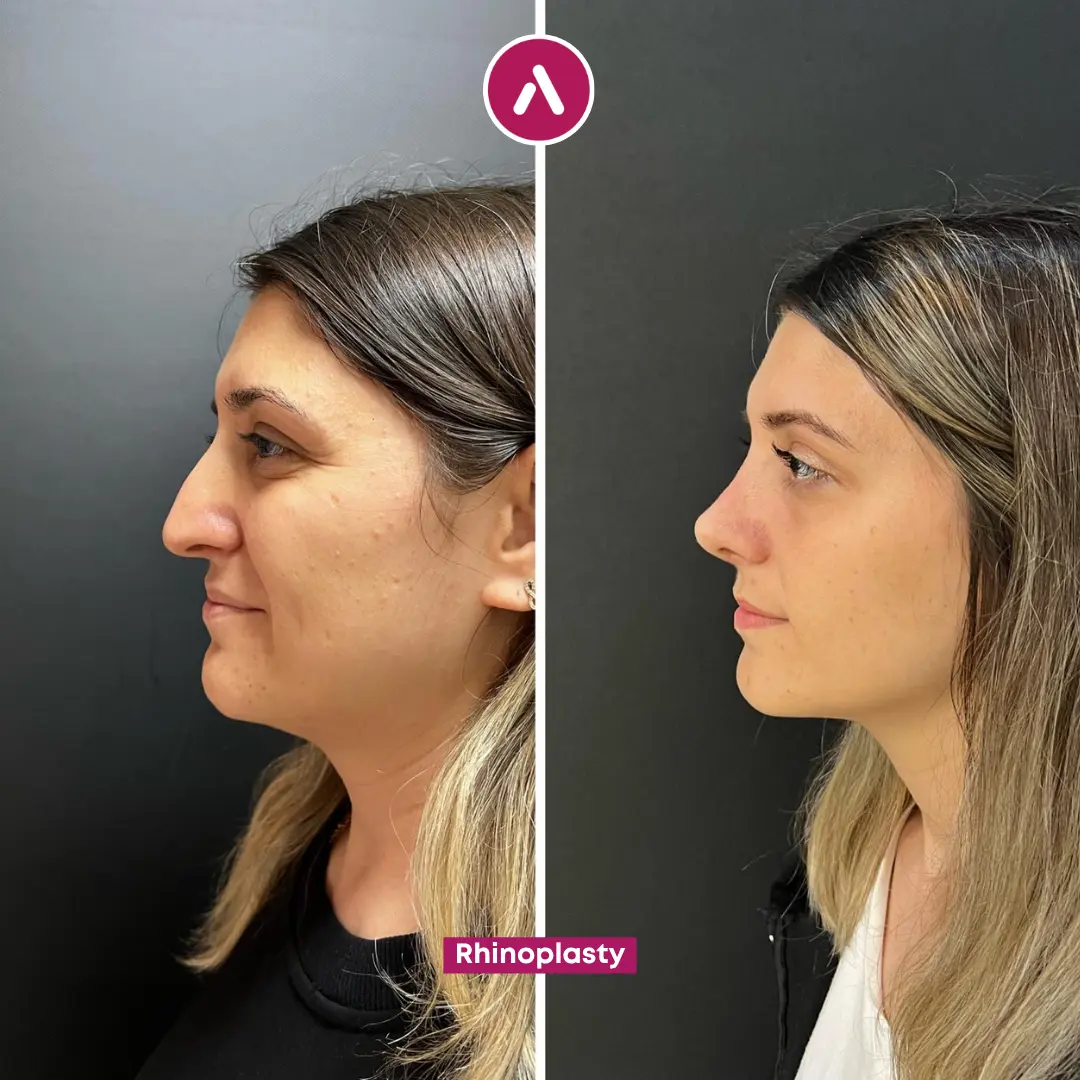
Realistic goals: what you can and can’t “design”
Rhinoplasty is not a filter. It is structural surgery. The safest, most natural-looking outcomes are built on what your anatomy can support.
- You can usually change: dorsal hump, tip refinement, mild-to-moderate asymmetry, bridge width, projection, rotation.
- You cannot promise: identical results to a celebrity nose, perfect symmetry, or “instant final definition.”
- Timeline reality: early swelling can hide detail, especially in the tip.
In consultation, we focus on measurable goals and a plan that protects both aesthetics and breathing.
Revision cases: when “second surgery” is truly needed
Revision rhinoplasty is not rare, but it should never be rushed. Most surgeons prefer waiting until tissues settle and swelling resolves, unless there is a clear functional emergency.
- Common revision reasons: persistent asymmetry, breathing issues, under-supported tip, over-reduction, scar tissue effects.
- What makes revision harder: altered anatomy, reduced cartilage, and unpredictable scar patterns.
- What helps: an honest analysis, realistic endpoints, and a structural plan that prioritizes stability.
If you are researching a revision, look for surgeons experienced in complex cases and functional planning. Precision matters more the second time.
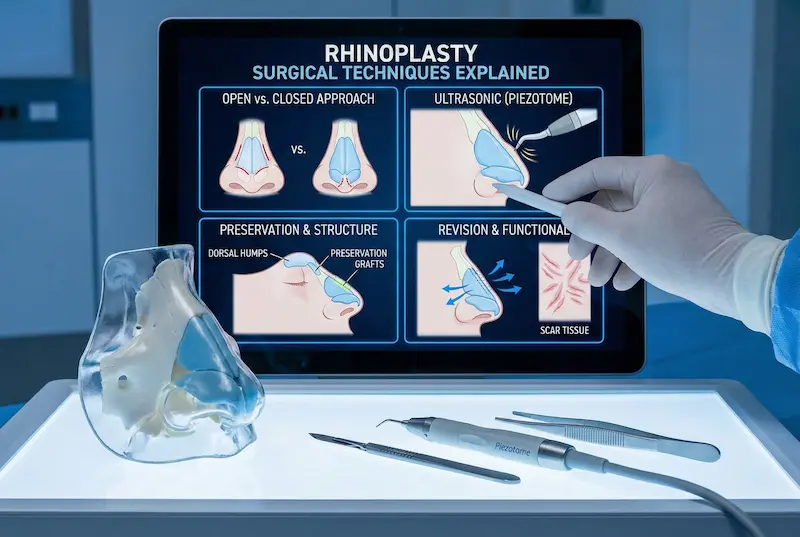
Surgical Techniques Explained (Open vs Closed, Ultrasonic & More)
The term Rhinoplasty covers a set of techniques, not a single “one-size-fits-all” operation. What matters is matching the technique to your anatomy, goals, and functional needs. Two patients can both request “a natural nose,” yet one may need structural support for breathing while the other needs a subtle contour refinement.
Below is an evidence-informed, patient-friendly breakdown of the most common techniques you’ll see during research, including open vs closed rhinoplasty, preservation strategies, ultrasonic tools, and approaches used for complex revision and functional cases.
Open rhinoplasty: when visibility matters
Open rhinoplasty uses a small incision on the columella (the tissue between the nostrils) plus internal incisions. This allows the surgeon to lift the skin and see the nasal framework more directly.
- Common reasons to choose open: complex tip refinement, significant asymmetry, major structural changes, many revision cases.
- Strength: visibility and precision when building or reshaping support.
- Consideration: more soft-tissue handling can mean swelling lasts longer, especially at the tip.
Closed rhinoplasty: internal approach and limits
Closed rhinoplasty (endonasal approach) keeps incisions inside the nostrils. There is no external columella incision. For the right patient, this can be an elegant option.
- Common reasons to choose closed: select hump reduction, limited tip work, mild-to-moderate changes with stable structure.
- Strength: less external scarring and often less disruption of some soft tissues.
- Consideration: not ideal for every nose—complex tip architecture and major asymmetry may need open access.
Ultrasonic rhinoplasty (Piezotome): precision bone shaping
Ultrasonic rhinoplasty uses piezoelectric energy to shape nasal bones with a specialized instrument. Instead of traditional bone-cutting tools, ultrasonic devices can allow more controlled work around delicate structures.
- Where it helps most: controlled bone contouring, precise narrowing, detailed work on bony irregularities.
- Why expert patients like it: the goal is accuracy and smoother contour transitions.
- Consideration: tool choice is not a guarantee—planning and technique still determine the outcome.
Preservation rhinoplasty: structure-first philosophy
Preservation rhinoplasty refers to techniques that aim to preserve key dorsal (bridge) structures rather than removing and rebuilding them. The idea is to maintain natural dorsal lines and structural continuity when anatomy allows.
- Where it can fit: select hump cases where dorsal aesthetics can be improved while maintaining natural contours.
- Strength: can support a “natural-first” look by preserving original lines.
- Consideration: not every anatomy is suitable; some noses require more direct reconstruction.
Revision rhinoplasty: scar tissue + strategy
Revision rhinoplasty is performed after a prior nose surgery. It is typically more complex because anatomy may be altered, cartilage can be reduced, and scar tissue can limit predictability.
- Common revision problems: pinched or unstable tip, over-reduction, persistent deviation, breathing issues, contour irregularities.
- Why it’s harder: less native cartilage, less reliable tissue planes, and healing patterns that vary widely.
- What revision often requires: structural rebuilding and support (frequently with grafts).
Functional rhinoplasty: breathing as a surgical endpoint
Functional rhinoplasty focuses on airflow while also respecting appearance. This may involve strengthening the internal or external nasal valves, correcting septal deviation, and stabilizing sidewalls that collapse during breathing.
- Functional focus areas: septum alignment, valve support, sidewall stability.
- Common tools: structural grafting (tailored to the specific problem).
- Key idea: reducing the nose without preserving support can compromise airflow—function must be designed into the plan.
Ethnic rhinoplasty & tip rhinoplasty: personalization principles
Ethnic rhinoplasty is not a single technique. It is a planning philosophy: refine proportions while preserving identity and respecting anatomical differences such as skin thickness, cartilage strength, and typical bridge/tip profiles.
- Ethnic rhinoplasty: aims to enhance harmony without erasing defining features.
- Tip rhinoplasty: focuses on tip definition, projection, rotation, and support when the bridge does not need major change.
- Consideration: thick skin often means the plan must prioritize structure and support to achieve stable definition.
| Technique | Best For | Advantages | Trade-offs | Typical Complexity |
|---|---|---|---|---|
| Open Rhinoplasty | Complex tip work, significant asymmetry, many revisions | Direct visualization, precise structural work | Often longer swelling timeline (especially tip) | Moderate to High |
| Closed Rhinoplasty (Endonasal) | Selected primary cases with limited structural changes | No external columella incision, efficient access in suitable cases | Less ideal for complex tip architecture or major asymmetry | Low to Moderate |
| Ultrasonic Rhinoplasty | Precise bony contouring, controlled narrowing | Fine control over bone shaping | Tool choice alone doesn’t guarantee outcomes | Moderate |
| Preservation Rhinoplasty | Select dorsal cases suited to structure-preserving strategies | Can maintain natural dorsal lines when appropriate | Not compatible with all anatomies; may still require reconstruction | Moderate |
| Revision Rhinoplasty | Post-surgical irregularities, structural weakness, functional issues | Addresses complex problems with tailored rebuilding | More variable healing; limited native cartilage | High |
| Functional Rhinoplasty | Valve collapse, sidewall weakness, breathing-centered goals | Breathing-first structural stability | May require grafts and careful balance with aesthetics | Moderate to High |
| Ethnic / Tip-Focused Rhinoplasty | Identity-preserving refinement, targeted tip goals | Personalized planning for anatomy and aesthetics | Thick skin can lengthen refinement timeline | Moderate |
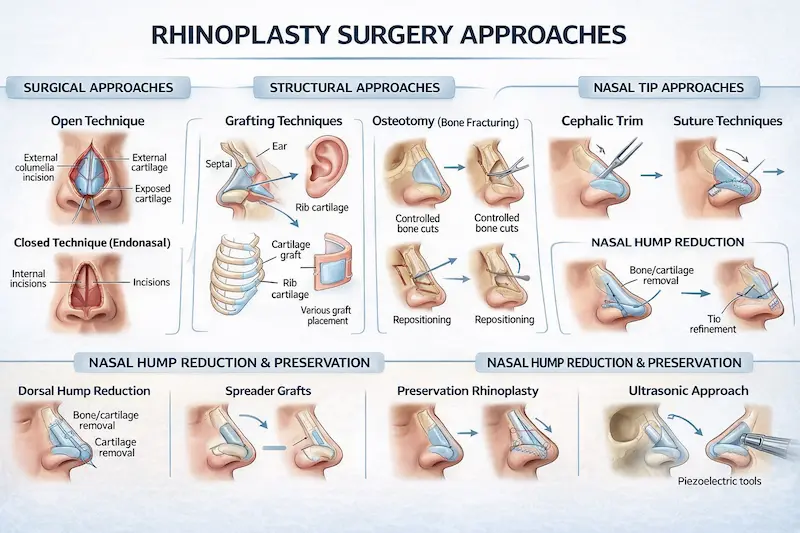
Rhinoplasty Surgery Approaches
This section organizes rhinoplasty into “approach families.” Think of it as a map of what a surgeon can do: how they access the nose (open/closed), how they support structure (grafting/osteotomy), and how they refine key zones like the tip and dorsal hump.
In real surgical planning, these approaches are combined. For example, a patient may need a closed approach plus ultrasonic bone contouring plus tip suture work. The “best” approach is the one that matches your anatomy and protects long-term stability.
Surgical Approach Techniques
Open Technique
- Creates direct visibility of cartilage framework and tip structures.
- Often chosen for complex tip shaping, asymmetry correction, and many revision cases.
- Typically involves a small external incision that usually heals as a fine line.
Closed Technique (Endonasal Approach)
- Incisions remain inside the nostrils with no external columella incision.
- Can be ideal for selected primary cases with stable anatomy and more limited changes.
- May be less suitable for certain complex tip and revision requirements.
Structural Approach Techniques
Grafting Techniques
Grafts are used when the nose needs support, definition, or breathing stability. The goal is structural reinforcement, not simply “adding volume.”
- Common graft purposes: tip support, valve support, straightening, dorsal contour refinement.
- Potential graft sources: septal cartilage (often preferred when available), ear cartilage, or rib cartilage (in select complex cases).
- Key principle: stable support reduces long-term issues like collapse, pinching, or shifting.
Osteotomy (Bone Fracturing)
Osteotomy refers to controlled bone cuts or mobilization used to reposition nasal bones—commonly after hump reduction or when narrowing/straightening is needed.
- Why it’s done: to narrow a wide bridge, close an “open roof,” or correct deviation.
- Modern refinements: careful planning and precision tools can reduce unwanted irregularities.
- What to expect: bruising and swelling vary; bone healing follows a predictable timeline but is individual.
Nasal Tip Approach Techniques
Cephalic Trim
Cephalic trim is a technique that reshapes part of the lower lateral cartilage to refine a wide or boxy tip. The key is conservatism—over-resection can weaken support and create pinching.
- Best use: selected cases where cartilage shape contributes to tip bulk.
- Safety principle: preserve support to avoid long-term collapse.
Suture Techniques
Suture techniques shape and stabilize the tip by repositioning cartilage with carefully placed stitches. This can improve definition and symmetry while maintaining natural movement.
- What it can do: refine tip shape, adjust rotation, improve symmetry.
- Why it matters: refined structure often looks more natural than aggressive removal.
Nasal Hump Reduction Approach Techniques
Dorsal Hump Reduction
Dorsal hump reduction smooths a convex profile. It can be performed through different strategies depending on whether preservation or reconstruction is more appropriate for your anatomy.
- Goal: a balanced profile line that matches your facial proportions.
- Key consideration: removal without support can widen the bridge or destabilize the vault.
Spreader Grafts
Spreader grafts are placed along the dorsal septum to support the middle vault. They can help maintain both shape and internal valve function—especially important after hump reduction or in noses with narrow middle vaults.
- When used: to prevent or treat narrowing, support dorsal aesthetics, improve airflow stability.
- Why expert patients care: they protect long-term structure and breathing outcomes.
Preservation Rhinoplasty Approach Techniques
Preservation approaches aim to maintain important dorsal structures when anatomy allows. Rather than “taking down and rebuilding,” the plan focuses on controlled adjustments that keep the natural dorsal continuity.
- Potential benefit: natural dorsal lines with structural continuity.
- Not universal: some noses require more direct reconstruction to achieve stable, safe goals.
Advanced Ultrasonic Approach Technique
Advanced ultrasonic approaches use piezoelectric tools for refined bone work—often for contouring, narrowing, or correcting bony irregularities with a high level of control.
- What it supports: precision shaping in the bony vault.
- How it fits in planning: typically combined with other approaches (open/closed, structural support, tip refinement) based on the case.
- Important note: technology supports technique, but the surgical plan and execution drive the outcome.
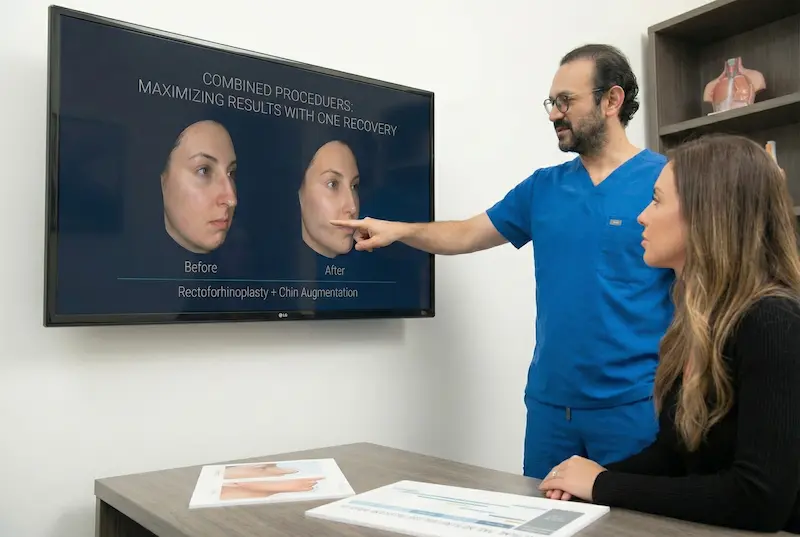
Combined Procedures: Maximizing Results with One Recovery
Many patients benefit from combining procedures when the surgical goals are connected. One plan. One anesthesia event. One recovery timeline. The key is restraint and logic—combining only what improves outcomes without stacking unnecessary risk.
We plan combined procedures as an integrated facial system, not a checklist of add-ons. The goal stays the same: natural harmony and stable function.
Rhinoplasty + septoplasty (form + function together)
When the septum is deviated, the nose can look off-center and breathe poorly. Addressing shape without correcting the internal issue can leave you dissatisfied.
- Best fit: patients with a visible deviation, chronic obstruction, or a history of nasal trauma.
- Why combine: one surgical plan can align the structure and optimize airflow together.
- Common term you’ll see: septorhinoplasty (a combined functional + aesthetic approach).
Your surgeon should evaluate airflow mechanics, not just the profile photo. Breathing is a measurable endpoint.
Rhinoplasty + chin aesthetics (profile balance)
Some “nose size” concerns are really about profile balance. A mildly under-projected chin can make the nose look larger than it is. Small changes can shift the whole profile.
- When it helps: weaker chin projection, steep nasolabial angle concerns, or a desire for smoother profile lines using chin aesthetics.
- What changes: facial proportions, not identity.
- Planning rule: we aim for harmony from multiple angles—front view matters as much as side view.
Expert patients often prefer this logic because it avoids aggressive nasal reduction. It keeps structure stronger.
Rhinoplasty + lip lift / eyelid surgery (face harmony approach)
Combination planning can make sense when multiple facial zones compete for attention. This is especially true if the goal is to look more rested, not “different.”
- Common pairing logic: subtle nasal refinement + a conservative lip lift or eyelid surgery can improve overall facial balance.
- Benefit: one recovery period instead of repeating downtime later.
- Constraint: we keep combined plans conservative to protect safety and healing quality.
Rhinoplasty + Deep Plane Facelift
In select patients, combining rhinoplasty with a deep plane facelift can address both nasal refinement and midface/lower-face laxity in a single, coordinated plan. The goal is cohesive facial harmony—without over-correcting any one feature.
- When it helps: patients seeking nasal refinement alongside meaningful facial rejuvenation of the cheeks and jawline.
- Planning priority: balanced proportions, stable function, and a recovery plan matched to your lifestyle and healing capacity.
- Often discussed with: a conservative neck lift when neck definition is part of the goal.
Not everyone is a candidate for combining these procedures. Safety, surgical time, and recovery bandwidth guide the decision.
Safety logic: one plan, one recovery timeline
Combining procedures should simplify your life, not complicate your healing. Safety comes from selection, planning, and monitoring.
- Pre-op screening: strict health checks confirm candidacy and reduce avoidable risk.
- Time under anesthesia: we plan efficient surgical flow and avoid unnecessary steps.
- Follow-up structure: your post-op schedule should be clear before you travel.
Not everyone should combine procedures. If your recovery bandwidth is limited, staged surgery can be the smarter move. If your recovery bandwidth is limited, staged surgery can be the smarter move.
A well-designed combined plan feels organized. No surprises. No hidden steps.
Anesthesia Options: Why We Prefer Awake/Twilight Sedation (When Appropriate)
Anesthesia is not just a technical detail. It’s a major emotional decision for many patients—especially those who fear general anesthesia. We take that fear seriously and address it directly with clear options and strict monitoring.
Not every case is suitable for an awake approach. When it is appropriate, it can be a powerful advantage for comfort and confidence.
Local, twilight sedation, general anesthesia: what each means
- Local anesthesia: numbs the surgical area. You stay awake.
- Twilight sedation: you are deeply relaxed and often drowsy, while breathing on your own. Many patients remember little.
- General anesthesia: you are fully asleep with advanced airway management and full anesthetic control.
All three can be safe when indicated. The right choice depends on surgical complexity, patient comfort, and medical history.
Why “awake/twilight” can reduce fear and improve comfort
Our clinic is known for offering Awake Surgery options, often under twilight sedation when the case is suitable. For many expert patients, this removes the biggest psychological barrier to moving forward.
- Fear reduction: patients who feel stuck because of anesthesia anxiety often regain control with an awake plan.
- Smoother early recovery: many patients report feeling more “clear” sooner after the procedure.
- Comfort-first approach: we keep pain control and calmness as a primary goal, not an afterthought.
Some patients want to be asleep, and that’s valid. We choose the method that fits the case—not a one-rule system.
Who is a candidate for awake/twilight approaches
Awake or twilight approaches work best when the procedure scope and patient profile align. Selection is strict. That’s intentional.
- Often a fit for: patients with high anxiety about general anesthesia, and cases where the surgical plan allows it.
- May not be ideal for: complex revisions, highly extensive structural work, or patients with specific medical considerations.
- Decision point: your surgeon and anesthesia team confirm suitability after reviewing your health screening and goals.
If you are a “Skeptical Sam,” this is where transparency matters most. You should be told what’s possible and what’s not.
Monitoring & safety standards during anesthesia
Safety is built into the system, not promised in marketing language. We use advanced vitals monitoring throughout every procedure and follow strict pre-operative screening protocols.
- Continuous monitoring: heart rate, blood pressure, oxygenation, and respiratory status.
- Clear escalation plan: if your comfort or safety requires a change in anesthetic depth, the team adjusts immediately.
- Post-op observation: we monitor you closely before discharge and provide structured instructions for recovery.
The goal is calm, controlled surgery. Then a predictable recovery.
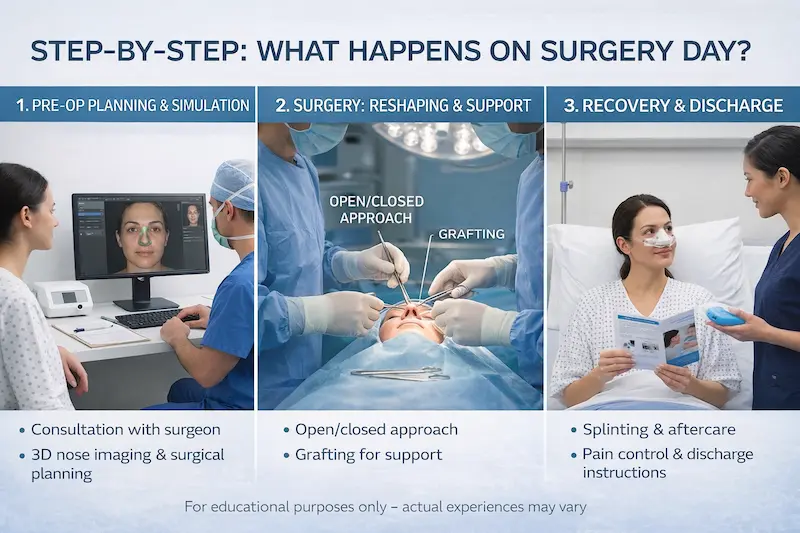
Step-by-Step: What Happens During Surgery Day?
Surgery day should feel structured, not mysterious. A well-run rhinoplasty pathway has clear checkpoints: final planning, safety screening, anesthesia, the procedure itself, and monitored recovery.
We keep communication simple. You should know what happens first, what happens next, and what the “normal” sensations are afterward. Clarity lowers stress. It also helps you recover better.
Pre-op planning (consultation + measurements + simulation logic)
We start with a surgeon-led review of your goals, nasal anatomy, and breathing concerns. Then we confirm the surgical plan with structured measurements and facial proportion analysis.
For detailed planning, we utilize 3D Vectra imaging to support meticulous pre-operative planning and surgical simulation. This helps align expectations with anatomy. It also prevents “surprises” after surgery.
- What we confirm: bridge height, tip projection, symmetry, rotation, and functional stability.
- What we clarify: what can be improved safely, and what should be preserved.
- What you decide: the final plan before the procedure begins.
Incisions, reshaping, grafting/support (education-focused)
Once anesthesia is set, your surgeon proceeds using the approach that matches your plan (open or closed). The core work may include reshaping bone, refining cartilage, and building support where it’s needed.
Support is the difference between “looks good” and “lasts well.” When structure is weak, grafting can stabilize the tip, reinforce the middle vault, or support breathing mechanics.
- Bone work: contouring or narrowing when the bony vault needs refinement.
- Cartilage work: tip shaping, symmetry correction, and structural stabilization.
- Functional planning: protecting airflow pathways while refining aesthetics.
Splinting, packing, discharge plan
After reshaping, we place a protective splint to support early healing. Not every patient needs internal packing. When it is used, it’s for a specific reason and for a limited period.
Before you leave, we review your medication plan, cleaning routine, and your follow-up schedule. You should also know what is normal and what is not.
- Splint: protects the new shape during the most delicate early phase.
- Instructions: sleep position, hydration, gentle nasal care, and activity limits.
- Contact access: a clear pathway to reach your team if questions show up.
What you’ll feel (pain control, congestion, swelling expectations)
Most patients describe pressure and congestion more than sharp pain. The first week often feels like a “stuffy nose” phase. That’s normal.
Swelling is also normal. So is uneven swelling from side to side. Your job is not to judge the final shape early. Your job is to heal.
- Common sensations: congestion, tightness, mild headache, watery eyes.
- What helps: rest, hydration, consistent medication timing, and gentle care.
- What to avoid: nose blowing, heavy lifting, and bump risk during early healing.
Recovery Timeline: How Long Does Rhinoplasty Recovery Take?
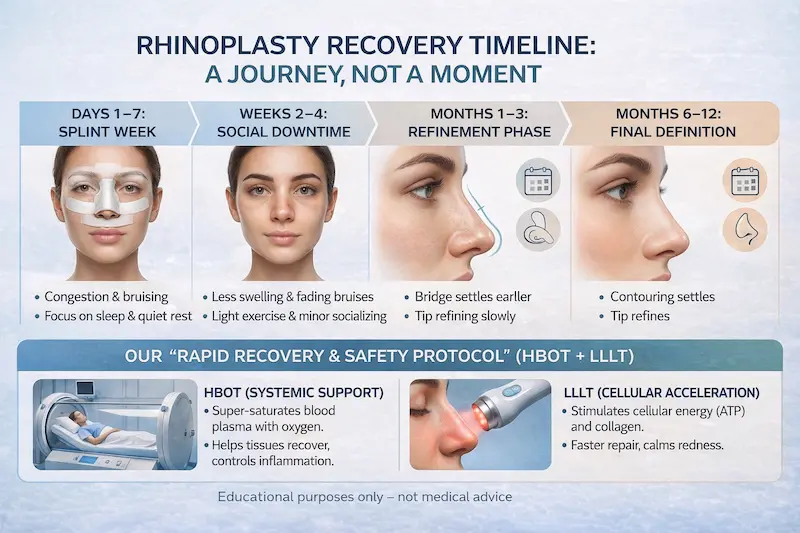
Patients search “how long does rhinoplasty recovery take” because recovery is not one moment. It’s a timeline. You’ll feel better quickly, but refinement takes longer.
The first goal is comfort and safety. The second goal is reducing visible downtime. The final goal is stable definition as tissues settle.
Swelling does not disappear in a straight line. It comes in waves. That doesn’t mean something is wrong.
Days 1–7: splint week, congestion, early bruising
Week one is the “protected healing” phase. You may feel congested and tired. Bruising and swelling peak early, then begin to calm.
- What’s typical: congestion, pressure, swelling, bruising around the eyes.
- Your focus: sleep elevated, avoid salt overload, follow cleaning instructions.
- What you’ll want: quiet days, short walks, and low-stress routines.
Weeks 2–4: social downtime, swelling patterns
This is when many patients feel “human” again. Bruising usually fades. Swelling becomes more subtle, but it’s still present—especially at the tip.
- Social readiness: many patients return to normal social activity with minor residual swelling.
- What still surprises people: morning puffiness and uneven swelling from side to side.
- Activity: light exercise may be allowed based on your surgeon’s guidance.
Months 1–3: refinement phase (tip vs bridge)
At this stage, the bridge often looks more “settled” than the tip. Tip swelling can be stubborn. This is especially true with thicker skin.
Your nose is still evolving. Photos can look different week to week. That’s expected.
- Bridge: tends to refine earlier in many patients.
- Tip: refines more slowly and may feel firm during healing.
- Best mindset: track progress monthly, not daily.
Months 6–12: final definition and tissue settling
Most patients see meaningful refinement by month six. Final definition can keep improving up to a year, especially in the tip.
- What improves: subtle contour smoothing, tip definition, softening of firmness.
- What can still fluctuate: mild swelling after salty meals, travel, or high stress.
- Best habit: compare month-to-month photos, not week-to-week selfies.
This is the stage where “natural” becomes obvious. The nose looks less like a post-op nose and more like your nose.
Swelling after rhinoplasty timeline: how long does swelling last?
Patients ask “how long does swelling last after rhinoplasty” because swelling is the main reason early results can look different than the final outcome. The timeline depends on skin thickness, how much structural work was done, and how your body heals.
- Most visible swelling: typically improves substantially in the first few weeks.
- Tip swelling: often lasts longer than bridge swelling.
- Uneven swelling: common. It does not automatically mean asymmetry is permanent.
If you want a reliable rule: expect quick improvement, then slow refinement.
Our “Rapid Recovery & Safety Protocol” (HBOT + LLLT) – logic & goals
We use a mandatory Rapid Recovery & Safety Protocol built around Hyperbaric Oxygen Therapy (HBOT) and Low-Level Laser Therapy (LLLT). This is not a “spa add-on.” It is a clinical strategy designed to support safer healing and reduce social downtime.
- HBOT (systemic support): super-saturates blood plasma with oxygen to help tissues recover, supports inflammation control, and strengthens the body’s defense against infection.
- LLLT (cellular acceleration): stimulates cellular energy (ATP) and collagen activity, supporting faster repair and helping calm redness and swelling.
- Why we combine them: HBOT creates the foundation. LLLT accelerates targeted recovery on top of that foundation.
The goal is simple: help you heal efficiently, safely, and predictably.
Safety & Risks: Is Rhinoplasty Dangerous?
Rhinoplasty is a major surgery. It can be done safely, but only when risk is treated as a real topic—not a taboo topic. Expert patients don’t want perfect marketing. They want an honest risk map and a strategy to reduce those risks.
Below are the most common side effects, the less common complications, and the systems we use to keep outcomes predictable.
Common short-term effects (swelling, bruising, numbness)
Most “side effects” are normal healing responses. They can look dramatic early, then improve steadily.
- Swelling: expected, with the tip often holding swelling longer.
- Bruising: varies by patient and by the extent of bone work.
- Congestion: common in the first weeks.
- Numbness or stiffness: especially around the tip; typically improves over time.
Discomfort is usually manageable with a structured medication plan and rest.
Rhinoplasty complications (bleeding, infection, asymmetry, scarring)
Complications are uncommon in well-selected patients, but they are possible. Your surgeon should discuss them clearly before surgery.
- Bleeding: usually mild, rarely significant.
- Infection: uncommon, but a real risk in any surgery.
- Asymmetry or contour irregularities: swelling can mimic these early; true issues are assessed over time.
- Scarring: open approach scars usually heal as a fine line; internal scarring can affect breathing in rare cases.
- Breathing changes: can occur if support is reduced or if valve stability is not protected.
We don’t hide these topics. We plan for them. Prevention starts before surgery, not after.
Long-term side effects: what’s rare but possible
Long-term problems are not the norm, but they can happen—especially after aggressive reduction or unstable structural support.
- Persistent obstruction: often tied to valve weakness or structural collapse.
- Tip irregularities: can be influenced by scar tissue and skin thickness.
- Structural weakness over time: more likely when support is sacrificed for “smaller at any cost.”
This is why we prioritize structure. A natural look is built on a stable framework.
Risk reduction strategy: screening + technique choice + follow-up
Safety is a system. We reduce risk with strict screening, precise planning, and structured follow-up.
- Strict pre-operative health screenings: to confirm candidacy and identify avoidable risk factors early.
- Precision planning: 3D Vectra imaging supports meticulous pre-op analysis and surgical simulation.
- Advanced monitoring: continuous vitals monitoring throughout the procedure.
- Technique discipline: we choose the approach that protects structure and airflow, not the trendiest label.
- Recovery protocol: HBOT + LLLT to support healing and reduce downtime.
When patients ask, “Is rhinoplasty dangerous?” our answer is: it can be high-stakes if done casually. We don’t do casual.
Is It Safe to Get a Nose Job in Turkey?
“Is it safe to get a nose job in Turkey?” is one of the most important questions you can ask—because it forces you to define what “safe” really means. Safety is not a country label. It is a system: surgeon expertise, facility standards, anesthesia protocols, infection prevention, and structured follow-up.
Turkey (and especially Istanbul) has become a major destination for rhinoplasty because experienced surgical teams can deliver high-quality outcomes with strong value. But the decision should be made with a clear checklist—not optimism.
What “safe” actually means (standards, facility, protocols)
In rhinoplasty, safety is practical and measurable. You should be able to verify the basics, not just trust a claim.
- Facility standards: a regulated surgical environment with sterile protocols and qualified staff.
- Anesthesia safety: a dedicated anesthesia team, continuous monitoring, and clear emergency readiness.
- Infection prevention: strict perioperative protocols, patient screening, and post-op wound care education.
- Risk management: honest discussion of complications and a plan for follow-up care.
If a clinic can’t explain its safety system clearly, that’s a signal to pause.
Surgeon credentials that matter (board certification, ENT/facial plastics)
When you’re comparing surgeons, look beyond social media aesthetics. The most important indicators are training, case experience, and decision-making discipline.
- Specialization: surgeons with deep rhinoplasty focus and experience with both aesthetic and functional planning.
- Functional awareness: a surgeon who evaluates breathing mechanics (not only profile shape).
- Complex-case capability: experience with revisions, asymmetry, thick skin, and structural rebuilding.
- Transparency: realistic limits, realistic timelines, and no overpromising.
Expert patients usually get the best results when the surgeon talks more about structure, support, and airflow than about “perfect” photos.
Continuum of care: follow-ups after you return home
For international patients, the biggest fear is not the surgery day—it’s “What happens when I’m back in the US?” Safe planning includes a real follow-up system.
- Early follow-ups in Istanbul: scheduled checks before you fly home to confirm healing is on track.
- Clear home-care plan: what to do daily, what to avoid, what’s normal, and what’s not.
- Virtual follow-ups: structured check-ins (commonly at 1, 3, 6, and 12 months) so progress is monitored over time.
- Escalation pathway: a direct way to reach your team if you have concerns.
We build the follow-up plan into the journey from the start, so you’re not left improvising once you’re home.
Why Istanbul can be a rational choice for the Expert Patient
If you’re an expert patient, you’re not looking for “cheap.” You’re looking for smart value: strong surgical expertise, modern techniques, and a system that supports predictable healing.
Our approach in Istanbul is designed around that mindset: strict pre-op screenings, meticulous planning supported by 3D Vectra imaging, advanced recovery support (HBOT + LLLT), and structured follow-ups. When appropriate, we also offer awake/twilight approaches for patients who are anxious about general anesthesia.
In other words: the decision is rational when the clinic can demonstrate a complete safety pathway—before, during, and after surgery.
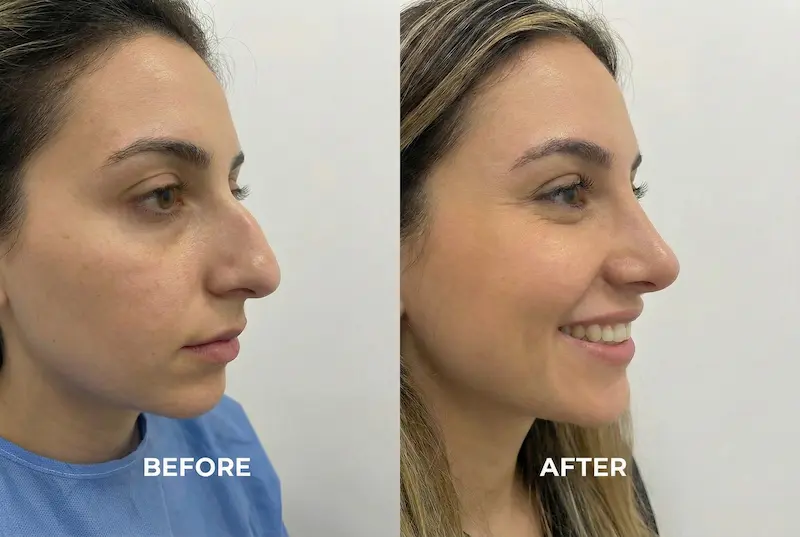
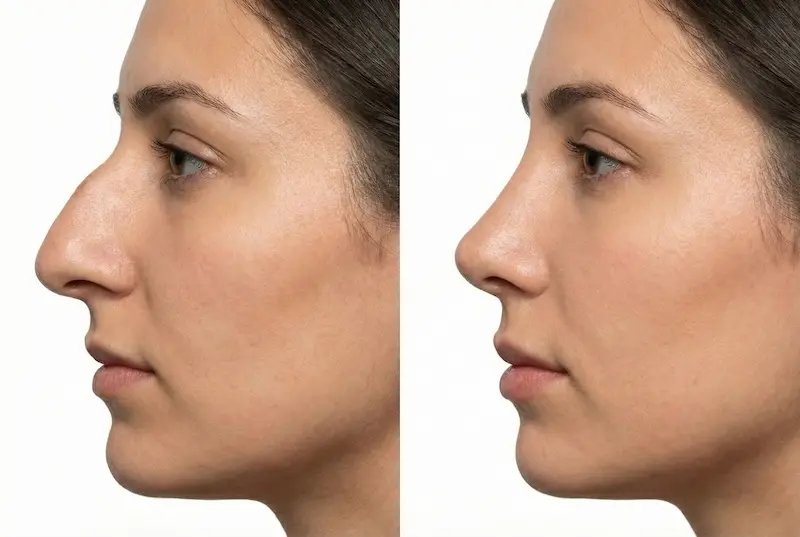
Rhinoplasty Before and After: Realistic Expectations & Results
A natural rhinoplasty outcome is not an accident. It is the result of a plan that respects anatomy, preserves structural support, and sets realistic expectations from day one.
Most disappointment comes from one of two problems: unrealistic “design” expectations, or underestimating how long refinement takes. Expert patients do best when they understand the timeline and judge results at the right milestones.
What results look like at 1 month vs 6 months vs 12 months
Rhinoplasty healing is gradual. The nose can look “done” early in some areas, while other areas (especially the tip) continue evolving.
- At 1 month: you can usually see the new direction, but swelling still hides detail. Tip definition is not final.
- At 6 months: many patients see a more stable profile and better refinement. Subtle swelling may remain.
- At 12 months: the nose typically looks softer, more natural, and more “settled” into your face.
The most accurate way to judge progress is to compare consistent photos at monthly or milestone intervals.
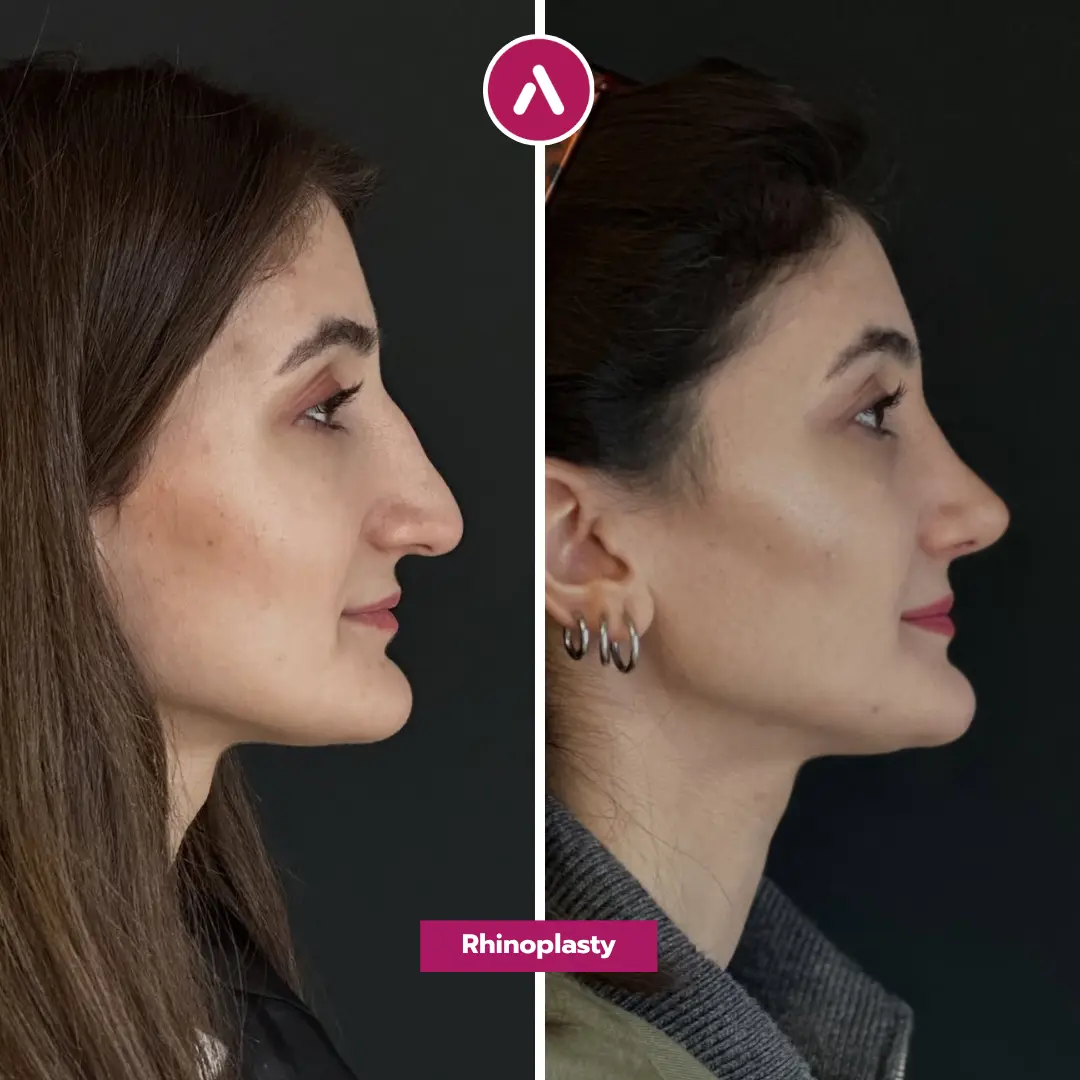
“Natural, not operated” goals: proportional changes
“Natural” doesn’t mean “no change.” It means the change looks believable for your face, your skin thickness, and your bone/cartilage structure.
- Proportion-first planning: we prioritize balance with your chin, lips, and overall facial width.
- Structure-first technique: preserving or rebuilding support helps avoid the pinched, over-reduced look.
- Identity-respecting outcomes: the goal is refinement, not replacement.
Our “Rejuvenation, Not Alteration” philosophy exists to protect you from the most common long-term regret: doing too much.
When revision is discussed (timing + criteria)
Revision conversations should be calm and evidence-based. In most cases, it’s too early to judge permanent asymmetry in the first months because swelling is still active and uneven.
- Timing principle: meaningful assessment typically happens after tissues have had time to settle.
- Functional priority: breathing concerns deserve earlier evaluation than purely aesthetic refinement.
- Clear criteria: a defined structural issue, persistent functional obstruction, or a stable contour problem after adequate healing time.
We guide patients to evaluate results at the right milestones, not during the “emotional swelling phase.”
Patient experience themes (evidence-led tone)
Across rhinoplasty patients, the same themes show up again and again:
- Week 1 feels intense, then improves quickly: congestion and swelling are the main challenges early.
- Tip patience is everything: the tip often refines last, especially with thicker skin.
- Natural outcomes feel quiet: people notice you look refreshed, not “surgically changed.”
- Confidence rises as swelling falls: many patients feel better month by month, not day by day.
We structure follow-ups around those realities so you don’t feel alone in the timeline.
Cost Analysis: Rhinoplasty Prices 2026 (Turkey vs. USA)
Cost questions are rational. They’re also hard to compare because many US quotes are “a la carte,” while international clinics often present a bundled model. The right comparison is not “price vs price.” It’s “what’s included, what’s verified, and what happens if you need support after you fly home.”
If you’re researching the average cost of rhinoplasty in the US, you’ll notice big spreads by city, surgeon demand, and facility fees. In Istanbul, the lower overall pricing is commonly driven by macroeconomic and operational cost differences, not a shortcut in medical intent. The smart move is to evaluate value through transparency and safety checkpoints.
What drives cost in the US (city, surgeon expertise, facility fees)
In the US, pricing typically rises with location and surgeon demand. Major cities often have higher facility and staffing costs. Surgeon reputation and case complexity also move pricing fast.
- Geography: major metro pricing can be significantly higher than smaller markets.
- Complexity: revision, functional cases, and major asymmetry are typically more expensive.
- Facility structure: operating room fees and anesthesia fees may be itemized separately.
- Follow-up intensity: some practices include more structured follow-ups than others.
Turkey value equation: macro factors + operational costs
When patients compare the cost of rhinoplasty in Turkey to US pricing, the gap can feel surprising. The simplest explanation is macroeconomics and local operational costs. Exchange-rate dynamics and lower national overhead (rent, salaries, operating costs) can shift the baseline without changing the clinical objective.
We position Istanbul as a high-value option. We do not frame it as “budget surgery.” You should still verify the same safety standards you would demand at home.
All-inclusive model: what’s included vs not included
One reason international quotes feel “cleaner” is the all-inclusive model. Our VIP package is designed to reduce logistical stress and eliminate hidden line items. It’s also built to support a structured recovery experience in Istanbul and after you return home.
- Included: your complete surgical procedure, anesthesia & operating room fees, all pre-operative tests, 5-star hotel accommodation, VIP airport & clinic transfers, all post-operative medications & garments, your first post-op meal, long-term virtual follow-up care, and a 24/7 dedicated patient host.
- Not included: international flight tickets, personal travel insurance, personal expenses (such as meals outside the first post-op meal), visa fees (if applicable), and additional hotel nights if you extend your stay.
If you’re searching rhinoplasty turkey all inclusive, confirm that “all-inclusive” actually includes the medical essentials, not only hotel and transfers. Real value is clinical transparency, not marketing language.
How to compare offers safely (apples-to-apples checklist)
Use a checklist. It prevents regret. It also protects you from comparing a full pathway to a partial quote.
- Scope clarity: open vs closed approach, bone work, structural support, and functional assessment.
- Facility verification: where the surgery is performed and what standards the facility meets.
- Materials quality: confirm that internationally recognized, approved materials are used when needed.
- Follow-up plan: your scheduled checks before flying and your virtual follow-ups after returning home.
- Revision policy: what happens if healing reveals a true structural issue.
When you compare this way, the decision becomes calmer. It’s no longer about fear or hype. It’s about a complete system of care.
Finding the Best Rhinoplasty Surgeon
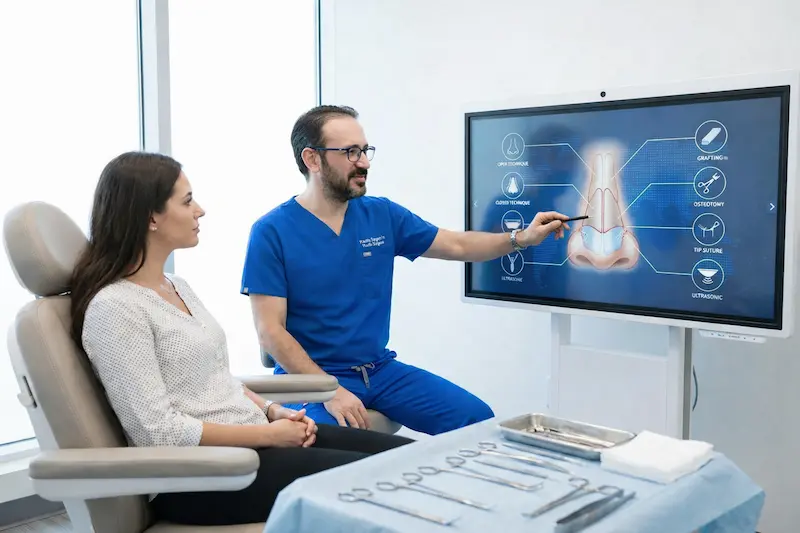
Choosing the best rhinoplasty surgeon is the highest-leverage decision you’ll make. Technique labels matter, but judgment matters more. A great surgeon is disciplined: they preserve structure, respect breathing, and set limits when your request conflicts with anatomy.
Expert patients also want proof of training and ongoing education. Credentials are not a “nice to have.” They are a baseline. The best consultation feels like a clinical planning session, not a sales call.
Board certification & specialization (ENT + facial plastics)
Rhinoplasty sits at the intersection of aesthetics and function. Surgeons with deep ENT and facial plastic experience often bring stronger breathing awareness to aesthetic planning. That matters if you want a nose that looks refined and stays comfortable long-term.
- Look for: board certification, facial plastic focus, and a track record in complex primary and revision cases.
- Ask directly: “How do you assess my airflow and valve stability?”
- Expect: a plan that protects structure, not only a plan that reduces size.
Questions to ask in consultation (plan, risks, revision policy)
The right questions expose the quality of planning fast. If a surgeon can’t answer clearly, that’s information.
- Technique fit: “Why open vs closed for my anatomy?”
- Breathing strategy: “What are the risks to airflow, and how do you protect it?”
- Swelling reality: “How long will tip swelling last for my skin type?”
- Revision logic: “What is your revision evaluation timeline if I’m unhappy early?”
Red flags (overpromising, no functional assessment, vague planning)
Rhinoplasty requires humility. Overconfidence is not a strength here.
- Overpromising: guarantees of perfection or instant final definition.
- No function talk: no breathing evaluation, no mention of valve support.
- Vague plan: “We’ll decide during surgery” without a structured explanation.
- Trend chasing: pushing a single “signature nose” for every face.
Why experience with complex cases matters (revision, preservation, functional)
Complex cases test decision-making. Revision anatomy, thick skin, significant deviation, and functional collapse all require structural thinking. That experience also protects natural results because the surgeon knows when to build support instead of removing more.
We build rhinoplasty plans around the intersection of function and aesthetics. Our European Board Certified surgeons focus on stable, natural outcomes, not shortcuts. When you evaluate experience through this lens, the right choice becomes clearer.
Your Medical Journey in Istanbul: What to Expect
International surgery should feel organized. Calm. Predictable. We built our process to remove the usual friction that comes with distance: unclear steps, hidden costs, and vague follow-up.
If you’re searching rhinoplasty in istanbul turkey, you’re probably comparing systems of care, not just outcomes. That’s the right mindset. Our job is to make the process simple while keeping medical standards non-negotiable.
Below is what the journey looks like from first contact to long-term follow-up.
Free virtual consultation (photo review + plan)
Your medical journey starts from home. We review your photos, listen to your goals, and map out a plan with the surgical team. You’ll also receive a transparent all-inclusive quote so you can compare offers fairly.
- What we assess: facial proportions, nasal structure, skin thickness, symmetry, and any breathing concerns.
- What you get: a clear surgical plan outline and a realistic recovery timeline.
- Why this matters: it reduces uncertainty before you ever book a flight.
Search terms like best rhinoplasty doctors in turkey exist for a reason. The consultation is where you confirm expertise through clarity, not marketing.
VIP planning: hotel + transfers + coordinator support
Once you choose a date, we plan the logistics around you. Our VIP model is designed to remove travel stress and protect your privacy. You focus on preparation. We handle the operational details.
- Hotel: 5-star partner accommodation arranged in advance.
- Transfers: VIP airport and clinic transfers coordinated end-to-end.
- Support: a dedicated patient host available 24/7.
We’re based in Levent, one of Istanbul’s most modern and accessible districts, with proximity to our partner hotels. The clinic environment is intentionally designed to feel private and comfortable, and we maintain USA-standard patient confidentiality and data security protocols.
Arrival, in-person exam, procedure, post-op checks
On arrival day, you’re not left to figure things out. A private driver meets you at the airport and brings you to your hotel. Then we schedule your in-person consultation and pre-operative tests.
- Arrival: airport welcome and private transfer (IST or SAW).
- In-person consultation: final confirmation of the plan with your surgeon.
- Pre-op testing: safety screening and medical clearance.
- After surgery: close monitoring and planned post-op checks before you fly home.
When patients search top rhinoplasty clinics turkey or best rhinoplasty surgeon istanbul, they’re often trying to find the clinic that treats the journey as part of the medical product. That’s how we built it.
Long-term virtual follow-ups (1, 3, 6, 12 months)
International care fails when follow-up disappears. We do the opposite. Our commitment continues after you return home, with scheduled virtual check-ins to track healing milestones and answer questions as swelling evolves.
- Milestones: 1, 3, 6, and 12 months.
- What we monitor: swelling patterns, symmetry progression, scar maturation, and functional comfort.
- What you get: continuity and fast answers when you need them.
Rhinoplasty (Nose Job) Frequently Asked Questions (FAQ):
These are the questions patients ask when they’re doing serious research. The answers are meant to be clear and practical, not vague. Use them to compare consultations and to set realistic expectations.
If your question isn’t listed, that’s normal. Rhinoplasty planning is personal. Anatomy changes the details.
What matters most is that your surgeon can explain the “why” behind the plan and the “how” behind the safety strategy.
What is rhinoplasty surgery?
Rhinoplasty is surgery that reshapes the nose by adjusting bone, cartilage, or both. It can be cosmetic, functional (breathing-focused), or combined. A strong plan protects structure while refining proportions.
Open vs closed rhinoplasty: which is better?
Neither is universally “better.” Open offers direct visibility for complex tip and structural work. Closed keeps incisions inside the nostrils and can be ideal for selected primary cases with more limited changes.
What is a closed rhinoplasty?
Closed rhinoplasty (endonasal approach) uses internal incisions only. It can reduce external scarring and soft-tissue disruption in suitable cases. It’s not the right choice for every anatomy or every goal.
How long does rhinoplasty recovery take?
Most patients feel noticeably better within a few weeks, but refinement continues for months. The bridge often settles earlier than the tip. Final definition can take up to 12 months, especially in thicker skin.
Rhinoplasty healing timeline: what happens each week?
Week 1 is the splint and congestion phase. Weeks 2–4 usually bring visible improvement and social readiness for many patients. Months 1–3 are refinement, then slower changes continue through months 6–12.
How long does swelling last after rhinoplasty?
Most visible swelling improves significantly in the first few weeks, then tapers slowly. Tip swelling lasts longer than bridge swelling. Swelling can also fluctuate with sleep position, diet, and stress.
Septoplasty vs rhinoplasty: what is the difference?
Septoplasty focuses on straightening or repositioning the septum to improve airflow. Rhinoplasty focuses on changing the external shape, though it can also address breathing. Septorhinoplasty combines both when needed.
What are rhinoplasty complications?
Possible complications include bleeding, infection, contour irregularities, scarring, asymmetry, and breathing changes. Good candidate screening, structural planning, and clear follow-up reduce these risks.
Is it safe to get a nose job in Turkey?
Safety depends on systems, not geography. Verify surgeon expertise, facility standards, anesthesia monitoring, infection prevention, and a real follow-up pathway after you return home. Avoid clinics that can’t explain these clearly.
What affects the cost of rhinoplasty?
Cost depends on case complexity, surgeon experience, facility and anesthesia fees, location, and whether functional work is included. Comparing offers safely means checking what is included, what is verified, and what follow-up looks like.
Can a nose job be done with twilight sedation instead of general anesthesia?
In selected cases, yes. We often use twilight sedation to keep you comfortable while you breathe on your own. Complex revisions or extensive structural work may still require general anesthesia.
When can I wear glasses after rhinoplasty?
Early pressure can disrupt healing on the bridge. Many patients avoid resting glasses on the nasal bones for the first weeks, then return gradually with surgeon guidance. If you must wear them, we can show you protective taping or alternative support options.
How do I know if swelling is normal or if I may need revision rhinoplasty?
Swelling is rarely even and often lingers longest at the tip. We only discuss revision rhinoplasty after tissues have had time to settle, unless urgent functional concerns appear. Worsening pain, fever, drainage, or persistent breathing difficulty should be evaluated promptly.
Medical Disclaimer: This page is provided for general educational purposes only and does not replace a face-to-face medical consultation, diagnosis, or personalised treatment plan. All surgery carries risks and outcomes vary between individuals. Suitability for a rhinoplasty, procedure selection, and anaesthesia choice can only be determined after a full clinical assessment by a qualified surgeon. Always follow your clinician’s instructions and seek urgent medical attention if you develop concerning symptoms during recovery.