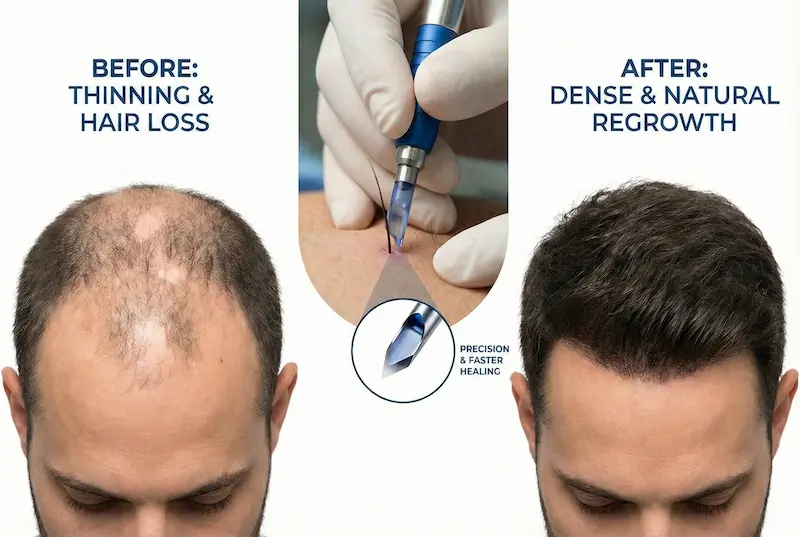

If you’re comparing clinics in Istanbul and across Turkey, the first thing you’ll notice is how wide the hair transplant Turkey price range can be. That spread isn’t random—and it isn’t only about “branding.” In medical science, pricing often reflects differences in surgical planning time, team structure, graft handling protocols, sterility standards, and the level of post-op monitoring. This guide breaks down what typically separates economy from premium options, so you can assess value without guessing.
Throughout the article, I’ll also use the common variations you’ll see in searches—such as price range for hair transplant Turkey, price range for hair transplant in Turkey, hair transplant in Turkey price range, and hair transplant Istanbul price range—but the goal stays the same: help you identify what you’re actually paying for.
Table of Contents
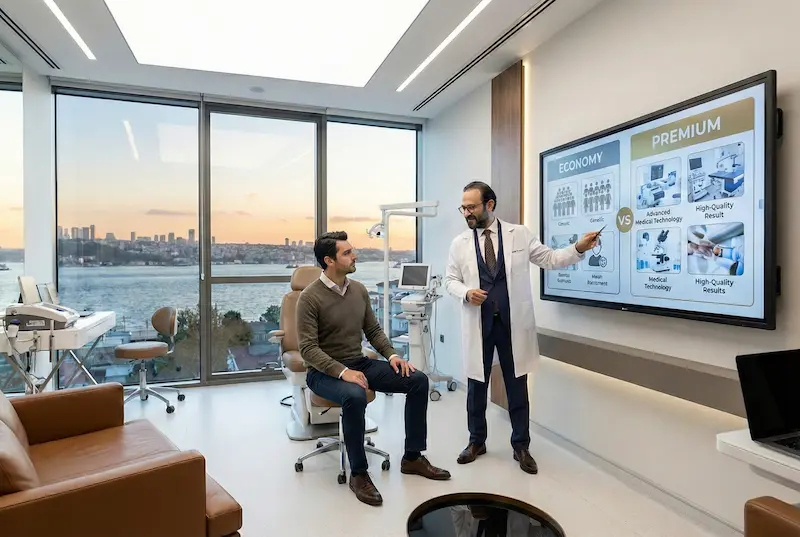
The Real Price Range in Turkey (And Why It Varies So Much)
The hair transplant in Turkey price range can vary because “a hair transplant” isn’t a single standardized product. Quotes change based on how many grafts you truly need, which technique is appropriate, who performs each step, and how the clinic designs a plan that protects your donor area for the long term. The more transparent the clinic is about these variables, the easier it becomes to compare an economy package with a premium package on equal terms.
Typical pricing models: per graft vs. package vs. “unlimited grafts”
Most clinics use one of three models:
- Per-graft pricing: You pay based on the final graft count (e.g., 2,500 grafts). This can be the most transparent if the clinic documents graft numbers carefully.
- Package pricing: A fixed price includes a “typical” graft range, accommodation, transfers, and basics. The catch: what’s included clinically can vary widely.
- “Unlimited grafts” marketing: Often presented as a bargain, but in scientific research and clinical practice, donor supply is always limited. Ethical planning sets a realistic graft target rather than chasing a marketing number.
The 5 biggest variables that change the quote (grafts, technique, team, facility, aftercare)
When patients ask for the price range for hair transplant in Turkey, these are the five drivers behind the final number:
- Graft count & complexity: Coverage goals, hair caliber, curl pattern, and existing miniaturization affect how many grafts are needed for a natural-looking result.
- Technique selection: Options like Sapphire FUE or DHI may differ in time, instrumentation, and staffing demands—impacting cost.
- Who does what: Surgeon-led planning and execution vs. technician-heavy workflows change both pricing and risk profile.
- Facility & safety standards: Sterility processes, monitoring, and clinical governance add real operational costs.
- Aftercare depth: A premium pathway may include structured follow-ups, clearer complication protocols, and documentation that supports long-term outcomes.
A quick “economy vs. premium” snapshot table (what’s included and what’s not)
Below is a practical snapshot to help you compare clinics without getting lost in sales language. Think of it as a starting checklist—especially useful if you’re searching specifically for the hair transplant Istanbul price range.
| Category | Economy Clinics (Typical) | Premium Clinics (Typical) |
|---|---|---|
| Consultation & planning | Short planning window; templated hairline options | More time on hairline design, donor strategy, and long-term planning |
| Who performs key steps | Often technician-driven for extraction/placement (varies by clinic) | More surgeon oversight and defined roles for each step |
| Technique & instrumentation | Basic toolsets; speed-focused workflow | Technique matched to case; emphasis on graft handling and consistency |
| Daily patient volume | Higher volume, faster turnover | Lower volume, higher staff-to-patient ratio |
| Aftercare & follow-up | Basic instructions; limited structured follow-up | More structured follow-ups and clearer management plan if issues occur |
| Transparency | Sometimes vague graft counts or “unlimited” claims | More explicit documentation of graft targets and limitations |
Economy Clinics: What You Usually Get (and What You Often Don’t)
When people search for the hair transplant Turkey price range or the price range for hair transplant in Turkey, economy clinics often appear first—because their offers look simple and “all-inclusive.” In reality, economy pricing usually reflects a high-volume operating model: more patients per day, standardized planning, and a workflow that leans heavily on technicians for time-intensive steps. That doesn’t automatically mean “bad,” but it does mean your outcome may depend more on consistency, staff skill, and process discipline than on individualized surgical strategy—something the medical science literature repeatedly emphasizes as a driver of variability in surgical outcomes.
High-volume workflows: speed vs. personalization trade-offs
Economy clinics typically optimize for throughput. You may see:
- Shorter consultation windows: Hairline and density decisions are made quickly, sometimes using templates rather than personalized facial proportions.
- Multiple patients per day per team: Teams rotate between cases, which can reduce the time spent on micro-decisions that affect naturalness.
- Standardized implantation patterns: Faster placement may come at the expense of nuanced angulation and direction—key to a natural result.
If your case is straightforward (e.g., mild recession, good donor, realistic density goals), an economy pathway can sometimes be acceptable—provided the clinic is transparent about who does what, documents graft targets, and follows a consistent protocol.
Common cost-cutting areas (technician dependence, limited aftercare, basic instruments)
This is where the hair transplant in Turkey price range becomes clinically meaningful: the lower the price, the more likely certain cost centers are minimized. Watch for:
- Technician-heavy execution: In many economy settings, technicians may do most of the extraction and/or placement. The risk isn’t “technicians” in general—it’s unclear training standards, high fatigue, and inconsistent oversight.
- Less robust graft-handling controls: Grafts are delicate. Time out of the body, hydration, temperature, and handling technique influence survival—details that matter in scientific research on graft viability.
- Basic instrument choices: Clinics may use general-purpose tools rather than case-specific punch strategy or optimized blades/implanters.
- Minimal aftercare structure: Post-op instructions may be generic, follow-ups may be limited, and there may be less proactive monitoring for swelling, folliculitis, shock loss, or suboptimal early healing.
These factors don’t always show up in marketing—but they can show up in results: uneven density, visible scarring patterns, or a hairline that looks “too straight” or placed too low.
Risk profile: where poor planning shows up (hairline design, density, donor management)
In economy care, the most common problems often start with planning rather than the day of surgery. Here are the key areas where risk can increase:
- Hairline design: A low, flat, or overly sharp hairline can look unnatural—especially as you age. Premium planning usually prioritizes a mature, irregular, age-appropriate design.
- Density promise vs. biological reality: Aggressive “maximum density” claims may ignore scalp vascular limits and graft survival constraints.
- Donor overharvesting: Taking too many grafts too quickly or without long-term strategy can permanently thin the donor area—reducing options for future procedures.
- Poor candidate matching: If diffuse thinning or miniaturization is not assessed carefully, transplanting into unstable zones can lead to patchy outcomes later.
Practical warning: If a quote is far below the typical price range for hair transplant Turkey and the clinic can’t clearly explain the graft plan, who performs extraction/placement, and the aftercare schedule, you’re not comparing “price”—you’re comparing process risk.
Premium Clinics: What You’re Actually Paying For
Premium pricing within the hair transplant Turkey price range is usually not about luxury—it’s about process control. In medical science, better outcomes tend to correlate with tighter protocols: clearer surgical planning, more consistent graft handling, better-defined team roles, and structured follow-up. If you’re researching the price range for hair transplant Turkey and wondering what “premium” truly buys, it generally comes down to who plans the case, how the team is organized, how grafts are protected, and how your clinic manages recovery.
Surgeon-led planning: hairline artistry + long-term donor strategy
A premium clinic typically invests more time in pre-op planning. That planning is not cosmetic “marketing”—it’s the blueprint that determines whether your result looks natural now and still makes sense years later.
- Hairline design tailored to your face: Premium planning often includes age-appropriate placement, micro-irregularity, and careful temple/transition zone strategy (instead of a straight “edge” hairline).
- Donor preservation strategy: A long-term plan considers future hair loss progression so you don’t “spend” your donor area too aggressively early on.
- Realistic graft targets: Rather than chasing “unlimited grafts,” premium planning typically focuses on the graft number that best balances density goals, survival, and donor safety—an approach aligned with scientific research on donor limitations.
This is especially relevant if you’re comparing the hair transplant Istanbul price range, where the market includes both extremely high-volume centers and more selective, planning-intensive clinics.
Smaller daily patient load and higher staff-to-patient ratio
One of the clearest operational differences is volume. Premium clinics generally run fewer cases per day, which can translate into more time and attention per patient.
- Less rushing during extraction and placement: Time pressure can increase variability. Lower volume helps protect consistency across the most delicate steps.
- More controlled workflow: Defined team roles reduce “handoff” errors and help maintain a stable pace and protocol adherence.
- Lower fatigue risk: Transplants can be long procedures. A higher staff-to-patient ratio helps avoid fatigue-driven inconsistency—an often overlooked factor in surgical quality.
When patients ask why the price range for hair transplant in Turkey differs by so much, volume is often the hidden answer: high throughput can lower cost, but it can also raise the importance of strict oversight and repeatable process quality.
Stronger aftercare system: follow-ups, documentation, and complication management plan
Premium care should not end when you leave the clinic. A higher-end pathway typically includes:
- Structured aftercare timeline: Clear guidance for hair washing, sleeping position, swelling control, and return-to-work planning—plus what symptoms are normal vs. concerning.
- Planned follow-ups: Scheduled check-ins (often remote for international patients) to monitor healing and early issues like folliculitis, excessive shedding, or delayed scab release.
- Documentation culture: Pre-op photos, donor mapping, graft targets, and post-op photo tracking help you understand what was done and support accountability.
- A real “if something goes wrong” plan: Premium clinics typically explain how they manage complications, who you contact, and what the escalation pathway is.
From a value perspective, this is where premium can be rational—even if the initial quote is higher within the hair transplant in Turkey price range. Better follow-up doesn’t just feel reassuring; it can reduce the chance that small healing problems become big cosmetic problems.
Bottom line: Premium clinics justify higher costs when they can show, concretely, that you’re paying for surgeon-led planning, tighter execution controls, and a more robust aftercare system—not vague promises.

What “All-Inclusive” Should Mean (Hidden Costs Checklist)
When comparing the hair transplant Turkey price range, “all-inclusive” packages can be genuinely convenient—but only if you know what’s actually included clinically (not just travel logistics). Many patients searching for the price range for hair transplant Turkey focus on the headline number and miss the details that affect both safety and final cost. This section gives you a practical checklist so you can compare economy vs. premium offers on the same baseline.
What should be included: pre-op assessment, meds, post-op kit, aftercare schedule
A truly complete package should cover more than the procedure day. At minimum, look for clarity on:
- Pre-op evaluation: A proper scalp/donor assessment, realistic graft estimate, and a plan that accounts for ongoing hair loss (not just “fill everything”).
- Medication plan: Clear guidance on pain control, antibiotics (if used), swelling management, and what to avoid.
- Post-op care kit: Saline spray, gentle shampoo/foam (as advised), and written washing instructions with a timeline.
- Aftercare schedule: Day-by-day guidance for sleep position, exercise, sun exposure, hats/helmets, and return to work.
- Follow-up access: A named contact (medical coordinator/nurse) and a defined follow-up schedule for international patients.
From a medical science perspective, early aftercare compliance affects healing quality—so the clinic’s ability to educate and monitor you matters as much as the procedure itself.
Travel-related costs that change your real budget (hotel nights, transfers, companion needs)
If you’re looking specifically at the hair transplant Istanbul price range, travel is often bundled—but not always fully. Make sure you understand:
- Hotel nights: Some offers include 2 nights; others require 3–4 depending on washing schedule and check-up timing.
- Airport and clinic transfers: Confirm whether transfers are private, shared, or limited to specific time windows.
- Companion costs: If you’re traveling with someone, ask whether the hotel room type includes them and whether transfers cover both.
- Extra days “just in case”: Some patients prefer buffer days for swelling or comfort—plan for this in your total budget.
This is why two clinics can appear similar in the hair transplant in Turkey price range, yet the “real” total cost differs once travel details are fully counted.
Red-flag fees: “extra graft charges,” unclear anesthesia/sedation fees, vague aftercare pricing
Hidden costs often appear as vague line items or changing terms. Be cautious if you see:
- Unclear graft limits: If a package has a “range,” ask what happens if the surgeon recommends more grafts—do you pay extra per graft?
- “Unlimited grafts” without donor logic: This can be a marketing hook rather than a medically sound plan. Ethical clinics discuss donor limits and long-term strategy.
- Ambiguous anesthesia/sedation language: If sedation is mentioned, ask exactly what’s used, who monitors you, and whether it’s included in the quote.
- Aftercare as an add-on: Be wary if essentials like follow-ups, post-op products, or complication support are priced separately without transparency.
- Pressure to upgrade once you arrive: If pricing changes significantly after in-person assessment with no clear medical rationale, that’s a major trust concern.
Practical rule: A reliable quote within the price range for hair transplant in Turkey should be stable, itemized, and clinically explained—so you can compare economy vs. premium based on real inputs, not surprises.
Quality & Safety Signals That Separate Clinics (A Practical Audit)
When you’re navigating the hair transplant Turkey price range, the safest way to compare clinics is to audit their process—not their promises. Whether you’re searching the price range for hair transplant Turkey or narrowing down the hair transplant Istanbul price range, the same principle applies: the best clinics can clearly explain roles, standards, and decision-making. This section is a practical checklist you can use on calls, video consults, and pre-booking messages to identify quality signals (and avoid red flags) regardless of budget tier.
Who does what in the OR: surgeon vs. technicians (and why it matters)
One of the most important “value” questions behind the price range for hair transplant in Turkey is: Who performs the critical steps? Hair transplant outcomes depend on thousands of small, repeated actions—so consistency and oversight matter.
- Ask for role clarity: Who designs the hairline? Who administers anesthesia? Who performs extraction? Who does the incisions/recipient site creation? Who places grafts?
- Surgeon-led planning is non-negotiable for naturalness: Hairline design, density distribution, and donor strategy are not “simple tasks.” They determine whether the result looks age-appropriate and sustainable.
- Technicians may participate, but oversight matters: If technicians are involved, ask about training, supervision, and how the clinic ensures consistency across long procedures.
Red flag: If a clinic refuses to specify who performs each step, or says “everyone does everything,” it’s difficult to evaluate risk—especially when comparing the hair transplant in Turkey price range.
Sterility, licensing, and facility standards: what to ask for and how to verify
Safety is not a marketing bullet—it’s a system. Premium clinics often invest more in governance and facility standards, but economy clinics can be safe too if they follow strict protocols. Ask direct questions:
- Facility type: Is the procedure performed in a licensed medical facility (not a non-clinical setting)?
- Sterility workflow: How are instruments sterilized? Are single-use items used where appropriate? How is cross-contamination risk managed?
- Monitoring: If sedation is used, who monitors vital signs and what equipment is available?
- Emergency readiness: What is the escalation pathway if a medical issue occurs?
Even without reading scientific research papers, you can still test “seriousness” by the specificity of the answers. Vague replies like “don’t worry, we’re very clean” should not be acceptable.
Medical transparency: realistic graft numbers, donor limits, and complication disclosure
The most trustworthy clinics are transparent about limitations. When the hair transplant Turkey price range seems confusing, transparency is often what separates safe value from risky “cheap.” Look for:
- Realistic graft planning: A clinic should explain why a certain graft number is recommended and what coverage you can expect from it—rather than promising maximum density for everyone.
- Donor limits explained clearly: Your donor area is finite. Any claim that ignores donor biology (e.g., “unlimited grafts” without assessment logic) should be treated as a warning sign.
- Complication honesty: Ask what the clinic sees most often (swelling, folliculitis, shock loss, delayed healing) and how they manage it. In medical science, no procedure is “zero risk,” and honest clinics don’t pretend otherwise.
- Photo documentation and case consistency: Reliable clinics can show consistent before-after patterns across different hair types and loss levels, not just a few standout cases.
Actionable audit tip: Before you book—especially if you’re comparing the price range for hair transplant Turkey—request a written plan that includes a graft target range, technique recommendation, who performs each step, and a follow-up schedule. If the clinic can’t provide that, the quote alone isn’t enough to make a safe decision.
Technique & Technology Differences That Affect Value (Not Just Marketing)
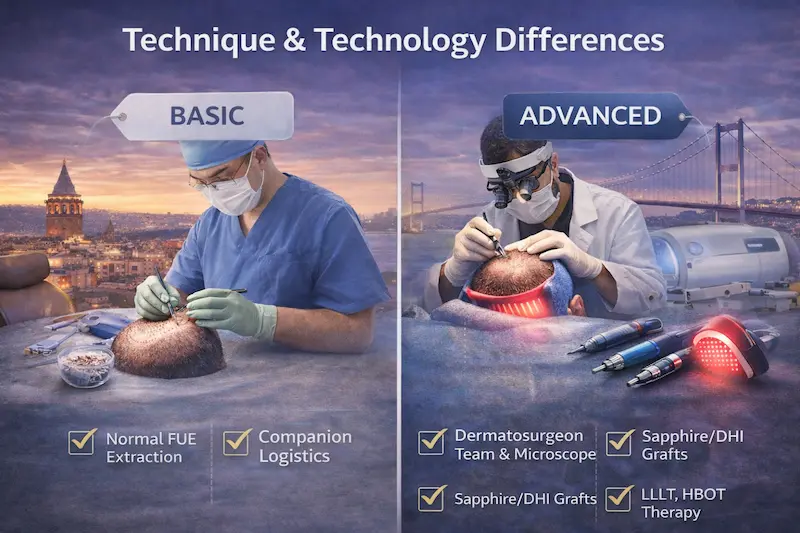
When patients compare the hair transplant Turkey price range, technique names can make premium quotes look “mysteriously higher.” The truth is that some technique differences can meaningfully affect graft survival, consistency, and naturalness—while other “tech” claims are mostly branding. The goal is to understand what changes the clinical process (time, staffing, graft handling) so you can decide whether a higher tier makes sense for your case within the hair transplant in Turkey price range.
Sapphire FUE vs. DHI: when each is worth the premium
Two of the most common options you’ll see in Istanbul are Sapphire FUE and DHI. Both can deliver excellent outcomes, but their workflows differ.
- Sapphire FUE (recipient sites + placement): After extraction, the clinic creates recipient sites (micro-channels) using sapphire blades, then places grafts. This approach can be highly effective when planning is meticulous, especially for controlling direction and distribution.
- DHI (implanter pen placement): Grafts are implanted using an implanter tool, which can allow precise control and may be helpful in certain scenarios (e.g., minimizing time grafts spend outside the body in some workflows, or working between existing hairs).
When “worth it” is case-dependent: In scientific research and clinical practice, the technique alone doesn’t guarantee a better result—execution quality does. If the clinic can explain why a technique fits your hair type, loss pattern, and density target, the premium may be rational. If they can’t explain beyond “it’s newer,” be cautious.
Micromotor/punch strategy and graft handling: how damage rates impact density
A major driver behind the price range for hair transplant Turkey is how carefully a clinic protects grafts. This isn’t glamorous marketing, but it’s where outcomes are won or lost.
- Punch selection and extraction strategy: The clinic should adapt punch size and approach to your hair caliber and skin characteristics. Poor extraction technique can increase transection (cutting follicles), reducing effective density.
- Out-of-body time and hydration: Clinics that control timing, hydration, and gentle handling tend to protect graft viability more reliably—principles aligned with medical science.
- Sorting and placement discipline: Naturalness depends on placing single-hair grafts at the hairline and distributing multi-hair grafts behind it. When teams rush, this detail can slip.
If you’re assessing the hair transplant Istanbul price range, ask the clinic to describe their graft handling protocol in plain terms. A premium clinic should be able to explain this clearly without evasion.
Recovery & growth support: why post-procedure protocols (e.g., LLLT) can matter
Some premium pathways include recovery-support technologies and structured patient-care standards. While no device replaces a well-executed procedure, supportive protocols can improve comfort, reduce downtime, and help patients stay compliant—especially during the early healing window.
- LLLT (Low-Level Laser Therapy): Often used as a supportive modality in post-procedure care plans. In clinical settings, it’s positioned as a non-invasive adjunct that may support scalp health and recovery routines.
- Structured follow-up and photo tracking: A protocol-driven aftercare plan reduces uncertainty and helps address early issues quickly.
- Clear “do and don’t” guidance: Practical recovery coaching (washing, swelling management, sleep positioning) can protect the grafts during the most vulnerable period.
When you see a higher quote within the price range for hair transplant in Turkey, ask what the clinic’s post-op pathway includes beyond a basic shampoo and a generic instruction sheet. If the premium tier provides a defined, clinician-supervised follow-up structure, that can be meaningful value—especially for international patients.
How to Choose the Right Tier for Your Case
Once you understand what drives the hair transplant Turkey price range, the decision becomes less emotional and more practical: you’re choosing the level of planning depth, process control, and follow-up support that matches your risk tolerance and goals. If you’re comparing the price range for hair transplant Turkey or narrowing down the hair transplant Istanbul price range, use the framework below to avoid two common mistakes: (1) paying premium prices for upgrades you don’t need, or (2) choosing an economy offer that cuts corners exactly where your case needs precision.
If you’re early-stage hair loss vs. advanced loss: different priorities
The “right” tier depends heavily on your stage of hair loss.
- Early-stage (mild recession, small crown thinning): Your top priority is usually a natural hairline and conservative donor use. Many patients in this category do well with a mid-tier or economy clinic if the clinic is transparent, surgeon-led in planning, and disciplined about hairline design and graft placement strategy.
- Moderate loss (noticeable hairline + mid-scalp changes): Planning matters more. You need a density map that looks natural from multiple angles and preserves donor capacity for future changes.
- Advanced loss (large area coverage): This is where premium planning can be most valuable. The challenge isn’t just “more grafts”—it’s balancing coverage vs. density expectations, donor limitations, and long-term progression. Clinics that treat this like a simple volume job may increase the risk of overharvesting or a thin-looking final result.
In short: the more complex your case, the more the premium end of the hair transplant in Turkey price range tends to make sense—because complexity demands planning and consistency.
“Natural look” decision factors: hairline design, temple points, density planning
If “natural” is your non-negotiable, focus on these three items—not just technique labels:
- Hairline design: Look for mature placement, micro-irregularity, and a plan that suits your facial proportions. Straight, low, overly sharp hairlines are the classic “transplant look.”
- Temple points and transition zones: Many clinics avoid nuanced work here because it requires time and precision. But this detail often separates average results from excellent ones.
- Density distribution: Natural results depend on where density is concentrated (front framing vs. crown spread) and how graft types are placed (single-hair grafts at the hairline, multi-hair behind). This is a process-quality issue—well supported by scientific research on aesthetic planning rather than a “device” upgrade.
A decision matrix: economy vs. premium—who each option fits best
Use this matrix when comparing the price range for hair transplant Turkey. It’s designed for “expert patients” who want a rational decision, not a sales pitch.
| Your Priority / Situation | Economy Tier May Fit If… | Premium Tier Is Usually Better If… |
|---|---|---|
| Case complexity | Mild recession, good donor, simple goals | Moderate–advanced loss, diffuse thinning, crown complexity |
| Risk tolerance | You accept higher variability and will audit the clinic carefully | You want maximum consistency and lower “process risk” |
| Naturalness standards | You’re satisfied with a solid improvement if planning is decent | You want highly refined hairline/temples and consistent angulation |
| Aftercare needs | You’re confident managing aftercare independently | You prefer structured follow-ups and clear escalation pathways |
| Budget reality | Your priority is affordability within the hair transplant Turkey price range | You’re optimizing for value + reduced revision risk over time |
Decision tip: If two clinics sit in different parts of the hair transplant Turkey price range, ask both to provide the same details in writing: graft target range, technique rationale, who performs each step, and follow-up schedule. The clinic that can answer clearly is usually the safer bet—regardless of price.
Frequently Asked Questions (FAQ): Hair Transplant Turkey Price Range
Below are the most common questions patients ask while researching the hair transplant Turkey price range—especially those trying to understand the difference between economy and premium clinics in Istanbul and across Turkey.
What is a realistic hair transplant price range in Turkey?
The realistic hair transplant in Turkey price range depends on graft count, technique, team structure, facility standards, and aftercare depth. Instead of trusting a single headline number, compare itemized inclusions and the clinical workflow behind the quote.
Are “unlimited graft” packages safe or just marketing?
They’re often marketing-driven. Donor supply is finite, and ethical planning sets a medically realistic graft target based on donor capacity, scalp needs, and long-term hair loss progression.
How can I tell if a clinic is surgeon-led or technician-led?
Ask who designs the hairline, who creates recipient sites, and who performs extraction and placement. A trustworthy clinic will answer specifically and consistently—ideally in writing—rather than using vague phrases like “our team handles it.”
Does DHI always cost more than Sapphire FUE—and is it worth it?
DHI often costs more because it can require specific tools and workflow structure, but it isn’t automatically “better.” In medical science, technique name matters less than execution quality and case-appropriate planning.
What hidden costs should US patients plan for?
Common hidden costs include extra hotel nights, companion logistics, unclear graft limit charges, add-on aftercare, and ambiguous sedation/anesthesia fees. Ask for an itemized quote and a written aftercare plan.
What questions should I ask on a video consultation before booking?
Ask for a graft target range, technique rationale, donor assessment logic, who performs each step, daily patient volume, sterility standards, and how follow-ups work for international patients.
How do I reduce the risk of unnatural results (“pluggy” hairline, low density)?
Prioritize surgeon-led hairline design, proper use of single-hair grafts at the hairline, disciplined angulation/direction planning, conservative donor strategy, and a clinic that documents and explains its graft handling protocol.
If you’d like to go beyond the topic covered here, you can also explore related guides such as Total Cost of a Turkey Trip for Hair Transplant for a realistic end-to-end budget, Best Plastic Surgery Clinic Turkey for a step-by-step clinic vetting framework, and AKM Clinic Reviews to see real patient experiences and decision factors. For additional reassurance, our safety-focused resource Is It Safe to Have Plastic Surgery in Turkey explains the key standards, questions to ask, and red flags to avoid—so you can make a confident, evidence-based choice.