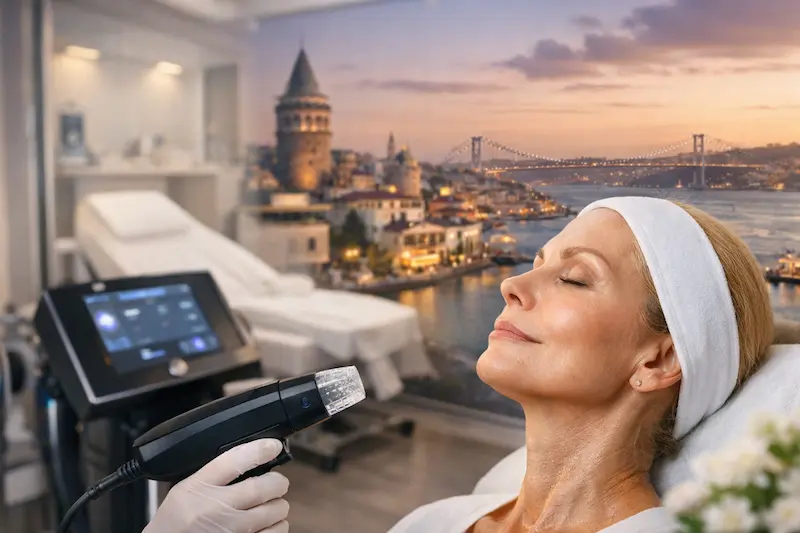
You had the surgery. The contour is better, the swelling is settling—but the skin still feels a little loose or looks slightly crepey, and you’re wondering whether Morpheus8 can finish the job. It often can, but timing is everything, and “too early” can quietly compromise your surgical result.
This guide answers the two questions post-op patients actually have: when is it safe to do Morpheus8 after each procedure, and how does it compare to the other skin-tightening options you’ll be pitched. We’ll cover the procedure-by-procedure timing logic, the honest difference between Morpheus8 and J-Plasma, Ultherapy, and Sofwave, and the realistic results RF microneedling can—and can’t—deliver.
Table of Contents
What Morpheus8 Actually Does (And Why It’s Popular After Surgery)
Morpheus8 is a form of RF microneedling designed to deliver controlled energy beneath the skin surface. In practical terms, it’s used to improve skin firmness, refine texture, and support collagen and elastin remodeling. After surgery—once your surgeon confirms you’re healed enough—patients often look to Morpheus8 to help “polish” results: smoothing, subtle tightening, and improving skin quality in areas that can lag behind the new contour.
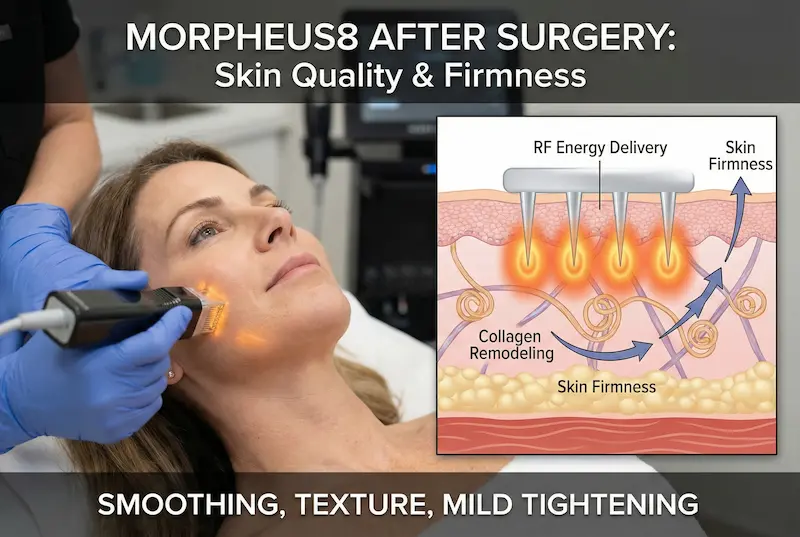
RF Microneedling 101: How collagen remodeling creates tightening
Morpheus8 combines microneedles with radiofrequency energy. The needles create precise micro-channels, and RF energy is delivered at controlled depths. This triggers a wound-healing response—an area where clinical studies consistently focus on collagen remodeling over time. The result is typically gradual improvement in:
- Firmness (mild-to-moderate tightening depending on baseline laxity)
- Texture (smoother surface, improved “crepey” appearance in some cases)
- Skin quality (a more resilient, refined look as collagen reorganizes)
Because collagen remodeling is a biological process, results are not “instant.” They build over weeks to months.
Morpheus8 is one device inside a broader category of energy-based skin technologies, and where a clinic sits on technology standards tells you a lot about whether the device is run correctly. Settings, depth control, and tip selection matter as much as the device name on the brochure.
For the standards context, the clinic technology standards overview covers the equipment, calibration, and safety-protocol framework that determines whether energy-based treatments are delivered to specification or improvised.
RF microneedling’s tightening mechanism has been formally reviewed in recent literature. a 2026 systematic review of radiofrequency microneedling effectiveness across 41 studies including 15 randomized controlled trials (Aesthetic Plastic Surgery, PROSPERO-registered, spanning January 2015 through July 2025) reported that RF microneedling delivers measurable improvements in skin texture, laxity, and dyschromia across diverse Fitzpatrick skin types, while noting that the absence of standardized temperature and cooling protocols across studies still limits direct reproducibility comparisons.
Skin quality vs. structural laxity: what Morpheus8 can/can’t fix
A helpful way to set expectations is to separate two issues:
- Skin quality: texture, pores, fine lines, mild crepiness, and mild laxity
- Structural laxity: deeper sagging caused by tissue descent (often requiring surgical lift)
| Concern | Is Morpheus8 a good fit? | What usually works better if not? |
|---|---|---|
| Mild looseness / crepey texture after swelling goes down | Often yes (good “refinement” tool) | Sometimes combo with other energy-based tightening or skin protocols |
| Moderate-to-severe sagging (true “droop”) | Usually no (limited for deeper laxity) | Surgical lift or surgeon-led structural plan |
| Irregular texture, enlarged pores, fine lines | Often yes | Laser resurfacing or hybrid protocols (case-dependent) |
| Scar maturation / post-op skin unevenness | Sometimes (timing + technique matter) | Scar-specific protocols; surgeon clearance first |
This distinction matters especially for post-op concerns like neck laxity. Many patients searching “morpheus8 for Turkey neck” are actually describing different problems—some are skin-quality issues that Morpheus8 can improve, while others involve deeper banding or descent that may need a different plan.
The “after surgery” goals: smoothing, firmness, texture, mild laxity
After surgery, patients typically consider Morpheus8 for one (or more) of these goals:
- Refining skin texture once swelling is settling
- Improving mild skin looseness that remains after contouring
- Helping the skin “snap back” in areas prone to laxity (case-dependent)
However, the most important rule is that Morpheus8 should be scheduled based on healing status, not travel dates. In the next section, we’ll cover when it’s typically safe, what milestones matter, and why surgeon clearance is non-negotiable—especially if you’re coordinating treatment while traveling for care.
When Is It Safe to Do Morpheus8 After Surgery?
Timing is the single biggest factor that separates a smooth, predictable Morpheus8 experience from unnecessary complications. If you’re considering morpheus8 in Turkey as a post-op refinement step, the priority is not “how fast can I do it,” but “when is the tissue biologically ready.” In post-surgical skin, blood supply, swelling dynamics, and scar formation are actively changing—so the safest path is always surgeon-led clearance and individualized timing.
The single most important rule is that your operating surgeon clears you before any energy-based treatment near healing tissue. Beyond that clearance, the timing logic follows the healing biology of each procedure—earlier isn’t better, and treating inflamed or unsettled tissue risks distorting the surgical result.
| Procedure | Earliest Morpheus8 (typical) | Why |
|---|---|---|
| Facelift / neck lift | ~6 months | SMAS and deep-tissue healing must stabilize |
| Liposuction | ~3–6 months | Final contour and swelling need to settle |
| Tummy tuck | ~6+ months | Scar maturation and tissue remodeling |
| Breast surgery | ~6 months | Tissue stabilization and scar settling |
These are typical floors, not green lights—individual healing varies, and the surgeon’s assessment overrides any general timeline. The reassuring part is that RF microneedling has been studied specifically in the surgical-adjacent setting.
On that safety question, a review of transcutaneous radiofrequency microneedling in facial plastic surgery practice examining the Morpheus8 device and its tissue effects (Facial Plastic Surgery & Aesthetic Medicine) reported that Morpheus8 treatment was studied for its effect on skin perfusion and lymphatic function and was not found to negatively affect either—supporting its consideration alongside surgical procedures once healing has progressed appropriately.
The non-negotiable rule: your surgeon clears you first
Even though Morpheus8 is not “surgery,” it is still a device-based treatment that creates controlled micro-injuries and delivers thermal energy. After an operation, your body is already in repair mode—this is basic healing biology. Adding another stimulus too soon can increase risk of prolonged swelling, pigment changes, delayed healing, or irritation of sensitive tissues.
Your surgeon should confirm:
- Incisions are fully closed (no scabbing, drainage, or tenderness at incision lines)
- Swelling has stabilized (you’re past the highly reactive, early swelling phase)
- No infection or inflammation is present
- Scar biology is appropriate for energy-based treatment planning
If you’ve had a facelift/neck lift, neck liposuction, or any procedure around the lower face, this clearance is especially important—because vascularity and nerve sensitivity are key considerations in treatment planning.
Typical healing milestones and why timing matters
Patients often ask for a “universal schedule,” but the truth is: healing is procedure-specific and patient-specific. Still, there are practical milestones most surgeons use when thinking about post-op devices. From a clinical standpoint, collagen remodeling occurs over months—not days—so rushing rarely improves final outcomes.
| Healing Phase | What’s happening biologically | Why Morpheus8 timing matters |
|---|---|---|
| Early recovery (first weeks) | Active inflammation, fluid shifts, fragile tissues | Higher risk of prolonged swelling and irritation |
| Mid recovery (weeks to a few months) | Swelling gradually settles; scars begin maturing | Often when device planning becomes realistic (with surgeon approval) |
| Later recovery (months) | Scar maturation and collagen organization continue | Typically the “safer window” for refinement treatments in many cases |
Important: This table is a general framework, not a medical instruction. Your surgeon’s plan overrides general timelines—especially if you had complex surgery, revision work, slower healing, or are prone to pigmentation changes.
Procedure-based timing logic: face/neck vs. lipo vs. body surgery
Post-op Morpheus8 planning depends heavily on what was done and where. Below is the decision logic well-prepared patients use when discussing timing with their surgeon and provider.
- After facelift / neck lift: The neck and lower face can remain reactive longer than patients expect. If you’re considering morpheus8 Turkey neck refinement after a neck lift, the goal is usually skin quality and subtle tightening—not structural lifting. Providers typically need a stable, non-inflamed tissue environment before treating.
- After neck liposuction or face liposuction: Many patients search “morpheus8 for Turkey neck” because skin feels looser once swelling resolves. This can be an appropriate indication in some cases, but timing should account for residual swelling and sensitivity.
- After body contouring (abdomen/arms/thighs): Body skin often behaves differently from facial skin, and swelling can linger. If Morpheus8 is being considered to support skin tightening after contouring, providers usually plan around the point when swelling is clearly trending down and the skin is no longer tender.
If you’re traveling for care, be cautious about forcing treatment into a short trip window. A well-designed plan may involve:
- Initial surgical recovery first
- Then a surgeon-approved window for Morpheus8
- Then follow-up protocols (including remote check-ins if you’re an international patient)
Best Post-Op Use Cases (Where Morpheus8 Makes the Most Visible Difference)
Not every post-surgical concern is a “Morpheus8 problem.” The best candidates are usually patients who love their new contour—but want improved skin quality, a firmer feel, and refinement in areas where the skin lags behind the underlying result. If you’ve been searching for morpheus8 Turkey before and after photos, what you’re really trying to verify is whether your specific concern (texture, mild laxity, crepey skin) is the type that reliably responds to RF microneedling based on established principles like collagen remodeling.
Best-fit pattern: “My surgery improved shape/structure, but my skin still looks a bit loose/crepey or uneven.”
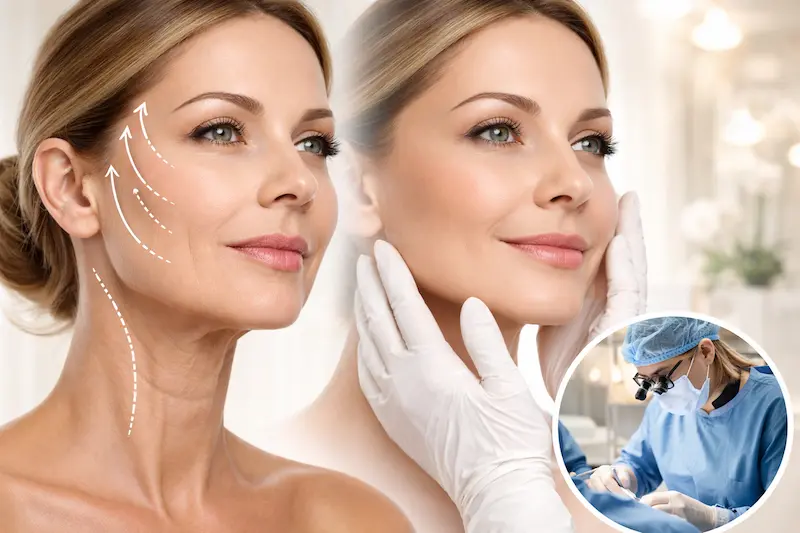
Face & neck refinement: the “polish phase” after facelift/neck procedures
After facial surgery, many patients experience a phase where the structural improvement is clear, but the skin still appears slightly textured or not as “snug” as expected—especially as swelling resolves. In carefully selected cases, Morpheus8 can support:
- Texture refinement (smoother look, improved surface quality)
- Subtle tightening (mild laxity, not deeper sagging)
- Overall skin quality (a more cohesive, finished appearance)
However, if your concern is mainly deep descent or significant neck banding, Morpheus8 is not a replacement for surgical correction. This is why “post-op Morpheus8” should be framed as refinement—not re-lifting.
The “polish phase” after a facelift or neck procedure is where Morpheus8 fits best—refining surface quality and mild residual laxity once the structural work has fully healed. It refines; it does not lift.
For the structural procedure that Morpheus8 polishes rather than replaces, the facelift procedure overview covers what surgical lifting accomplishes, the healing timeline that must complete before skin-quality treatment begins, and the realistic division of labor between surgery (lift) and Morpheus8 (surface refinement).
Jawline/neck skin after liposuction: when “Turkey neck” searches are actually about skin recoil
A common search pattern is morpheus8 Turkey neck or morpheus8 for Turkey neck—especially from patients who had neck liposuction or weight loss and then notice residual looseness once swelling fades. This can be a reasonable use case if the issue is:
- Mild-to-moderate skin laxity
- Crepey texture under the chin or along the upper neck
- Skin quality changes that make the neck look less firm than the jawline contour
Here’s the key: the term “Turkey neck” is used for multiple problems. Morpheus8 is best for the skin-quality version of Turkey neck (looser, thinner-looking skin), and less effective for the structural version (significant platysmal banding or deeper tissue descent).
| What you mean by “Turkey neck” | Is Morpheus8 typically helpful? | What to discuss with your surgeon |
|---|---|---|
| Crepey neck skin / mild looseness | Often yes | Timing + realistic tightening range |
| Noticeable vertical banding (platysmal bands) | Usually limited | Whether bands need surgical correction |
| Deeper sagging under chin / heavy laxity | Often no | Structural treatment options (lift-based plan) |
If you’re reading morpheus8 Turkey neck reviews, look for reviews that match your “type” of concern (skin crepiness vs. deeper sagging). Reviews are most useful when the patient’s baseline is similar to yours.
Morpheus8 is also raised for surgical scar improvement—softening texture and color of maturing scars once they’re past the acute healing phase. It’s an adjunct, not a primary scar treatment.
For the broader surgical context, the plastic surgery procedures hub covers where energy-based scar refinement fits among the full range of procedures and when scar concerns warrant surgical revision instead.
Body areas after contouring: arms, abdomen, thighs—what’s realistic (and what isn’t)
On the body, Morpheus8 can be considered as a supportive tightening tool after contouring in carefully chosen cases—particularly when the remaining issue is skin quality rather than large excess skin. Patients often hope it can replace excisional surgery; that expectation usually fails because the biology of skin contraction has limits.
More realistic post-op goals on the body include:
- Improving mild looseness after liposuction or contouring
- Smoothing texture (especially if the skin looks thin or crepey)
- Refining unevenness once swelling is stable
Less realistic goals include “removing” significant excess skin that would normally require an arm lift, thigh lift, or tummy tuck. In those situations, Morpheus8 may still improve skin quality—but it won’t replicate surgical removal or lifting of a large skin surplus.
After body contouring, Morpheus8 is most often discussed for the abdomen and arms—areas where mild skin crepiness can remain after fat removal even when the contour is good.
For the abdominal context, the tummy tuck procedure guide covers when loose abdominal skin needs surgical excision rather than energy tightening—an important distinction, because Morpheus8 cannot remove true skin excess.
For the arms specifically, the arm lift procedure guide covers the same threshold: mild crepiness may respond to RF microneedling, but significant upper-arm skin laxity is a surgical problem, not an energy-device one.
What Results Look Like (Timeline + How Long They Last)
When patients look up morpheus8 Turkey before and after, they’re often hoping for a fast, dramatic “lift.” In reality, Morpheus8 results are typically gradual—because collagen remodeling is a biological process. This is one of those areas where the biology helps you set correct expectations: you’re not just “tightening” skin on the day of treatment; you’re stimulating a healing cascade that develops over time.
Expectation reset: Morpheus8 outcomes tend to look like “progressive refinement” rather than an overnight transformation.
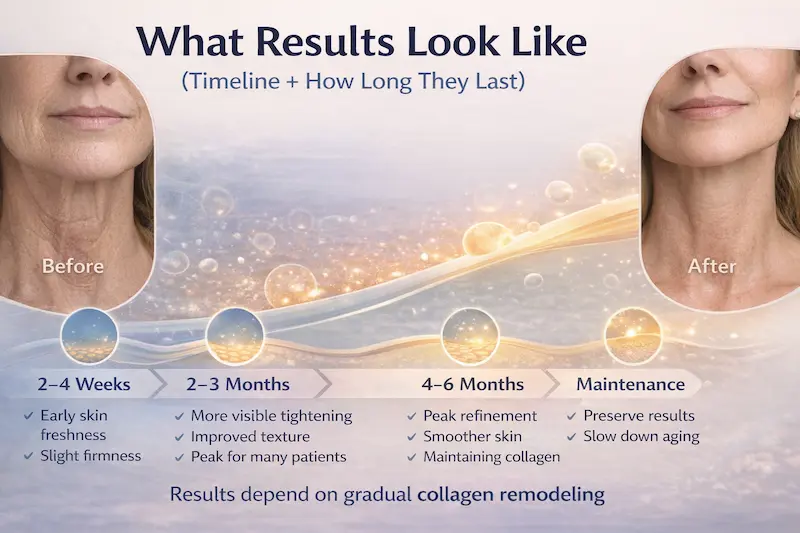
What you may notice at 2–4 weeks vs. 2–3 months vs. 6 months
Most patients experience results in phases. While timelines vary by area treated, baseline laxity, settings, and number of sessions, this general pattern is common:
| Time Point | What you may notice | What it means |
|---|---|---|
| Days 1–7 | Redness, mild swelling, “sandpapery” texture in some cases | Normal post-treatment response; not final outcome |
| Weeks 2–4 | Early skin “freshness,” slight firmness, smoother feel | Early remodeling begins; subtle changes may appear |
| Months 2–3 | More visible tightening + improved texture | Collagen remodeling is more established |
| Months 4–6 | Peak refinement for many patients | Skin structure continues reorganizing over time |
If your main focus is the neck—especially searches like morpheus8 Turkey neck or morpheus8 for Turkey neck—the “peak improvement” often feels slower than the face because neck skin can be thinner and more sensitive, and outcomes depend heavily on baseline laxity.
Why tightening is gradual (collagen takes time)
Morpheus8 works by triggering controlled dermal remodeling. The body’s response follows a predictable wound-healing logic: inflammation settles, fibroblasts produce new collagen, and fibers reorganize. This is well aligned with general published research on collagen maturation: it’s not immediate and it doesn’t behave like an instant “shrink wrap.”
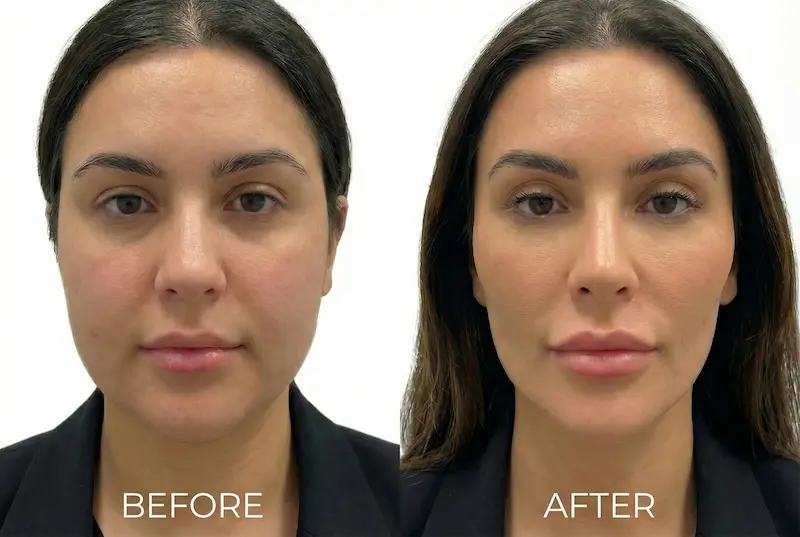
This is also why evaluating morpheus8 Turkey before and after images requires context:
- How long after treatment was the “after” photo taken?
- Was it after 1 session or a series?
- Was Morpheus8 combined with other treatments?
- Was the patient also still changing due to post-op healing?
For post-surgical patients, one more layer is added: you may still be evolving from surgery while Morpheus8 results begin. Good providers document timing carefully so improvements are interpreted accurately.
Maintenance strategy: who needs repeat sessions and why
Many clinics recommend a series (often multiple sessions) because collagen remodeling can be cumulative. Whether you need repeat sessions depends on:
- Baseline laxity (mild vs. moderate)
- Area treated (neck often needs more patience than cheeks)
- Skin thickness and quality (thin/crepey skin may require a more staged approach)
- Aging pace and lifestyle factors (sun exposure, smoking, weight fluctuation)
Maintenance is usually about keeping skin quality stable rather than continually “lifting” more. If you see very strong claims in morpheus8 Turkey neck reviews about dramatic lifting, compare them to your baseline: were those cases mild laxity with strong skin recoil? Or were they describing improvements in texture and firmness (which is more typical)?
Morpheus8 vs Other Skin-Tightening Options in Turkey (How to Choose)
If you’re comparing options in Turkey, the smartest approach is to choose the treatment that matches the type of problem you have—skin quality vs. deeper laxity—then match the treatment to your recovery stage. Morpheus8 is typically chosen when the goal is texture + mild-to-moderate tightening with manageable downtime. For post-op patients, choice should be guided by healing biology and safety, not just marketing claims or aggressive timelines.
Decision rule: If your issue is “skin texture/crepiness/mild looseness,” Morpheus8 can be a strong fit. If your issue is “true sagging,” you may need a structural (often surgical) solution.
Morpheus8 vs J-Plasma/Renuvion (especially after liposuction)
Patients often compare Morpheus8 with J-Plasma/Renuvion because both are discussed in the context of tightening—especially after liposuction. The key differences usually come down to depth of effect, the nature of energy delivery, and how they’re typically used in clinical practice (some are used in a surgical context).
| Option | Best for | Typical role after surgery | What to be cautious about |
|---|---|---|---|
| Morpheus8 (RF microneedling) | Skin quality, crepiness, mild laxity | Refinement / “polish phase” after healing is stable | Overtreating early post-op tissue; expectations of surgical-level lift |
| J-Plasma/Renuvion (energy-based tightening, often discussed in lipo contexts) | Selected laxity patterns, often paired with contouring | More often positioned as a surgical-adjacent tightening approach | Must be performed by appropriately qualified teams; strict safety protocols |
If you’re post-lipo and searching “morpheus8 in Turkey vs other tightening,” ask your provider a very direct question: “Is my remaining issue primarily skin quality or excess skin?” That answer usually clarifies whether Morpheus8 is the right tool—or simply an add-on with limited impact.
This comparison matters more than any other on the page, because J-Plasma and Morpheus8 are genuinely different procedures that get marketed under the same “skin tightening” umbrella—and confusing them leads patients to the wrong treatment.
J-Plasma (Renuvion) is invasive: it delivers helium plasma energy beneath the skin through a cannula, typically during or immediately after liposuction, and produces stronger one-time contraction—but with a surgical recovery and a narrower indication. Morpheus8 is minimally invasive: RF energy through microneedles at adjustable depths, no cannula, broader indications (texture, mild laxity, scars, body and face), and a gradual collagen-driven result over months rather than a single dramatic contraction.
The practical split: J-Plasma suits the lipo patient who wants maximum one-time tightening and accepts a more invasive recovery; Morpheus8 suits the patient wanting graduated skin-quality improvement without a surgical recovery, across more areas.
For the invasive-tightening side in full, the J-Plasma skin tightening guide covers the helium-plasma mechanism, the lipo-combined candidacy, the recovery profile, and the specific cases where J-Plasma’s stronger contraction outperforms RF microneedling.
Morpheus8 vs Sofwave vs Ultherapy: Energy Device Comparison
Beyond J-Plasma, patients comparing energy devices usually run into Ultherapy and Sofwave—both ultrasound-based, both non-needle. The core distinction: Ultherapy and Sofwave deliver focused ultrasound to specific depths without breaking the skin surface, suiting patients who want zero-needle tightening; Morpheus8 uses microneedles plus RF, reaching adjustable depths and adding a texture/scar benefit that ultrasound devices don’t provide.
Ultrasound devices tend to win on “no downtime, no needles.” Morpheus8 tends to win on depth customization, texture improvement, and body applications. The right choice depends on whether surface texture and scar concerns are part of the goal, or whether it’s pure laxity in a needle-averse patient.
Morpheus8 Body vs Face: Why Tip Sizes and Settings Differ
“Morpheus8” isn’t a single setting—the device uses different tips for different regions. Facial work typically uses finer-pin tips at shallower, precisely controlled depths to protect delicate facial structures; body work uses larger-pin tips reaching deeper to address thicker tissue and larger surface areas.
This is why “I had Morpheus8” can mean very different treatments. A patient asking about body tightening and a patient asking about facial refinement are describing different tip configurations, depths, and energy settings—and a provider who can’t explain which they’ll use for your area is a red flag.
Morpheus8 vs laser resurfacing (texture, pigment, downtime differences)
Laser resurfacing is often considered when the dominant problem is surface-level texture, fine lines, and photodamage. Morpheus8 can overlap with some of those benefits, but they are not interchangeable. Where Morpheus8 can be advantageous is in addressing dermal remodeling with controlled depth delivery; where lasers can be advantageous is in targeting surface-level texture and tone (depending on laser type).
- Choose Morpheus8 when: laxity + texture are both concerns and you want a collagen-driven tightening effect.
- Consider laser when: texture, pigmentation, and surface renewal are dominant concerns, and your skin type and post-op timeline are appropriate.
For patients prone to hyperpigmentation, provider skill and protocol matter greatly. This is why “device choice” should never be separated from “operator experience,” especially if you’re reading morpheus8 Turkey neck reviews and seeing mixed outcomes that may reflect technique differences rather than the technology itself.
Combination planning: when stacking treatments helps—and when it’s too much
Many “best” outcomes come from a staged plan rather than one aggressive session. However, post-op tissue is not the time to stack treatments casually. In real-world practice, a safe combination strategy typically follows the logic of controlled healing—minimize overlapping inflammation, respect recovery windows, and avoid treating unstable tissue.
Combination planning may help when:
- You have both mild laxity and texture concerns (e.g., Morpheus8 + a conservative skin protocol later)
- Your surgeon confirms stable healing and provides a staged timeline
Combination planning can be “too much” when:
- You are still in active post-op swelling/inflammation
- You’re trying to compress multiple energy-based treatments into a short trip
- You have a history of prolonged swelling, pigment issues, or slow healing
Stacking treatments helps when each addresses a different problem, and overwhelms healing when they overlap. Morpheus8 (skin quality) pairs logically with volume restoration or mechanical lift—each solving something RF microneedling doesn’t.
For the volume side, the liquid facelift volume guide covers filler-based volume restoration that addresses deflation while Morpheus8 addresses surface quality—different problems, sometimes sequenced together.
For the mechanical-lift side, the thread lift mechanical option covers suture-based lifting for mild ptosis, which Morpheus8 cannot provide—and the sequencing logic when a patient needs both lift and skin-quality work.
Safety, Pain, and “Expert Patient” Red Flags
Safety questions are not “overthinking”—they’re the right questions. If you’re an informed patient comparing morpheus8 in Turkey options, your goal is to avoid preventable complications like burns, pigment changes, infection, or prolonged swelling. Morpheus8 can be safe when performed by experienced providers using appropriate settings and protocols—especially for delicate areas like the neck.
Pain control and comfort: what patients typically feel during/after
Morpheus8 is typically performed with topical numbing, and some clinics may use additional comfort measures depending on the area and intensity. Sensation varies, but patients often describe:
- Pressure and heat during the procedure
- Post-treatment tightness, warmth, and mild swelling
- Short-term redness (commonly a few days)
The neck can feel more sensitive than the cheeks. For patients seeking morpheus8 Turkey neck treatments, comfort strategies and conservative settings often improve the overall experience without compromising safety.
Risk management: infection, burns, hyperpigmentation, prolonged swelling
Key risks and how high-standard clinics reduce them:
- Infection: sterile technique, correct pre/post care, avoiding treatment over compromised skin
- Thermal injury (burn risk): correct settings, experienced hand, careful energy delivery
- Hyperpigmentation: skin-type specific protocols, sun avoidance guidance, appropriate timing
- Prolonged swelling: avoiding early post-op treatment and over-aggressive passes
In expert hands, the goal is to create the minimum effective stimulus that supports collagen remodeling without triggering excessive inflammation—an approach grounded in clinical evidence on controlled tissue response.
Provider selection checklist: experience, protocols, and why dermatosurgery expertise matters for skin quality
If your primary objective is post-op skin quality, provider expertise matters as much as the device. In a surgeon-led environment, planning often becomes more conservative, more precise, and more outcome-driven. A dermatosurgeon’s approach to skin biology—combined with a surgical team’s structural understanding—can be particularly valuable when refining delicate areas like the lower face and neck.
- Ask who performs the treatment and their Morpheus8 experience volume
- Ask how they adjust settings for the neck vs. face vs. body
- Ask what they do if swelling is prolonged or if pigment risk is high
- Ask for realistic outcomes based on your baseline (not generic promises)
Skin-quality work rewards a specific kind of expertise: a practitioner who understands the dermis and subdermis as a surgeon does, not just as a device operator. Depth selection, energy titration, and complication management all trace back to anatomical training.
For the credentials picture relevant to energy-based skin work, Dr. Akif’s dermatosurgery profile covers the dermatosurgery training that informs depth and settings decisions, the surgical-team coordination that matters when Morpheus8 follows a procedure, and the complication-management experience that separates physician-led treatment from device-operator practice.
The AKM Clinic Approach to Post-Op Skin Quality (Recovery-First Mindset)
For expert patients, the real differentiator isn’t just whether a clinic offers Morpheus8—it’s whether the plan is built around healing biology, surgeon oversight, and realistic goals. At AKM Clinic, post-op refinement is approached as a staged process: first, protect tissue recovery; then, improve skin quality with the right timing, settings, and follow-up. This is especially important for delicate indications like morpheus8 Turkey neck, where outcomes depend heavily on technique and patient selection.
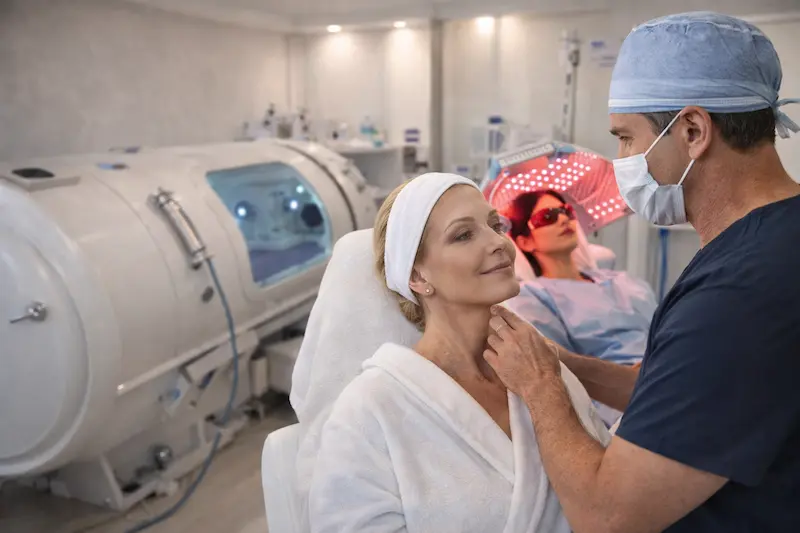
Skin-first planning with a Dermatosurgeon + surgical team coordination for natural outcomes
Post-surgical tightening and “finish work” is fundamentally about skin behavior—thickness, elasticity, collagen response, pigment risk, and inflammation control. That’s why dermatosurgery-level skin expertise matters when planning refinement treatments. In a surgeon-led model, Morpheus8 is positioned as a precision tool for skin quality and mild laxity—never as a substitute for structural lifting.
- Right candidate selection: distinguishing skin-quality laxity vs. deeper structural sagging
- Right settings for the area: especially the neck, which is typically more sensitive
- Right timing: based on healing milestones, not travel convenience
Follow-up structure for international patients (what “aftercare” should include)
If you’re traveling for morpheus8 in Turkey, aftercare matters as much as the procedure day. A serious post-op refinement plan should include:
- Clear timing guidance (what is safe now vs. what must wait)
- Written pre/post instructions for skincare, sun avoidance, and activity
- Remote check-ins after you return home (especially if your skin is reactive)
- Photo tracking so “before and after” is evaluated at meaningful time points
This also addresses a common fear in medical tourism: being “done and dismissed” after you fly home. The best outcomes come from continuity.
Cost & Trip Planning Basics
Patients often search morpheus8 Turkey price or morpheus8 cost Turkey expecting a single number. In practice, Morpheus8 pricing is variable because treatment is customized: depth, intensity, number of passes, area size, and number of sessions all matter. For post-op patients, the timeline and safety planning can also influence cost (for example, staged sessions vs. one aggressive session).
What drives cost: areas, sessions, settings, expertise
Morpheus8 pricing tracks four drivers: the areas treated, the number of sessions (most patients need one to three), the device settings and tip type, and provider expertise. Rather than duplicate full pricing here, the dedicated resource handles cross-procedure and combined-plan pricing on consistent terms.
For the complete pricing framework, the procedure cost reference covers session-based pricing, package inclusions, and the Istanbul-versus-other-markets comparison on like-for-like terms.
Frequently Asked Questions (FAQ): Morpheus8 Turkey
The questions below come up most often from international patients planning Morpheus8 around a surgical recovery. If your situation isn’t covered here, treat it as a prompt for your surgeon rather than a substitute for their clearance.
How soon after surgery can I get Morpheus8?
There isn’t one universal timeline. The safe answer is: only after your surgeon confirms you’re healed enough. Timing depends on your procedure type, incision healing, swelling stability, and scar maturation.
Can Morpheus8 tighten loose skin after liposuction?
It can help when the remaining issue is mild-to-moderate looseness and skin-quality changes (texture/crepiness). It typically cannot replace surgery when there is significant excess skin.
How many sessions do most patients need?
Many patients benefit from more than one session, especially for the neck. The exact number depends on baseline laxity, area treated, and how your skin responds over time.
Does Morpheus8 hurt, and what is the downtime?
Discomfort varies, but topical numbing is commonly used. Downtime often includes redness and mild swelling. The neck can be more sensitive than the cheeks, so conservative planning matters for morpheus8 for Turkey neck concerns.
Can Morpheus8 replace a facelift or tummy tuck?
Usually no. Morpheus8 is best for skin quality and mild tightening. Surgical procedures address structural laxity and/or remove significant excess skin—results Morpheus8 cannot fully replicate.
Is Morpheus8 safe for darker skin tones / hyperpigmentation-prone skin?
It can be safe when performed by experienced providers using appropriate settings and protocols. Your risk profile depends on skin type, timing (especially post-op), and post-care discipline (sun avoidance is critical).
What are the signs I should delay treatment and see my surgeon first?
Delay and contact your surgeon if you have: persistent increasing swelling, unusual pain, warmth/redness suggestive of infection, incision issues, drainage, or any new concerning symptoms. Post-op tissues must be stable before energy-based treatments.