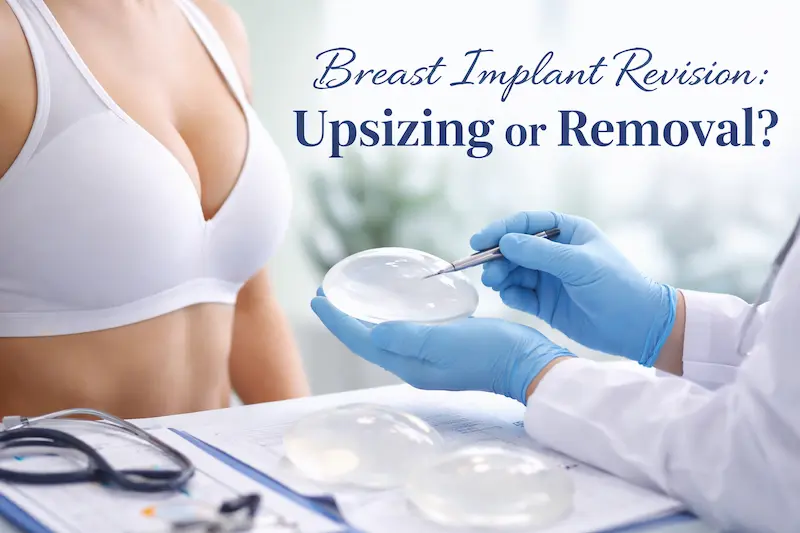
If you’re researching breast implant revision, you’re probably not looking for vague reassurance—you want a clear framework for making the safest, most predictable decision: upsizing (going larger) vs. removal (explant), sometimes with additional support procedures. This guide is written for the “expert patient” mindset: evidence-aware, detail-oriented, and focused on avoiding preventable complications.
In modern medical science, revision planning is less about trends and more about anatomy, tissue behavior, and risk control. That means your best next step is not “bigger” or “smaller”—it’s the option that matches your skin quality, implant pocket, scar tissue, and long-term goals.
Clinic philosophy matters in revisions: “Enhancing your natural beauty, not changing it.” A revision should look intentional, stable, and natural—not like a quick fix.
Quick note on keywords you may be comparing: patients often search breast implant exchange, upsizing breast implants, explant surgery Turkey, and pricing terms like breast implant revision cost or breast implant revision cost Turkey. We’ll address each of these directly as we move through the decision framework.
| Decision Point | Upsizing (Implant Exchange) | Removal (Explant) |
|---|---|---|
| Primary goal | More volume / fuller upper pole | Natural look, lighter feel, fewer implant-related concerns |
| Common “must-consider” factor | Tissue support & pocket control | Skin elasticity & whether a lift is needed |
| Often paired procedure | Lift or internal support (case-dependent) | Lift (if laxity/ptosis is present) |
Medical disclaimer: This article is educational and not a substitute for an in-person surgical evaluation.
Table of Contents
Understanding Breast Implant Revision: The Most Common Reasons Patients Change Course
Breast implant revision is any surgery performed to change, correct, or remove existing implants. Revisions are common—and they’re not automatically a “failure.” Many revisions happen because a patient’s goals evolve, the body changes over time, or the first plan wasn’t structurally ideal for their anatomy.
A revision conversation only becomes useful once the primary procedure is properly framed — what’s typically done, how it heals, what the realistic boundaries are. Patients comparing revision plans without that baseline often evaluate the wrong variables.
For the procedural foundation underneath the revision-specific decisions in this article, the primary breast augmentation overview covers implant selection logic, pocket placement options, candidacy criteria, recovery profiles, and the structural decisions during primary surgery that determine which revision pathways are even relevant later.
Most “Why do I need a revision?” questions trace back to primary-procedure decisions that need to be understood before the revision plan makes sense.
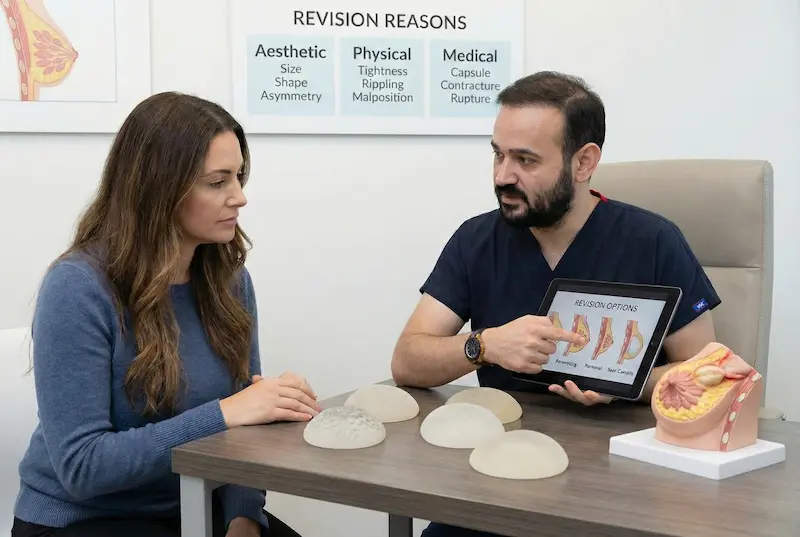
Aesthetic reasons: size dissatisfaction, shape, cleavage, asymmetry
These are the most frequent “I want something different” drivers. Typical concerns include:
- Size mismatch: feeling too small/too large for your frame, lifestyle, or proportions.
- Shape issues: lack of upper-pole fullness, a “ball” look, or implants sitting too high/low.
- Asymmetry: one breast settling differently or differences in implant position/pocket.
- Cleavage expectations: wanting closer cleavage or a softer, more natural slope.
Important: Not every aesthetic goal is solved by “bigger.” In revision work, tissue support and pocket stability often determine whether upsizing creates improvement—or makes problems more obvious.
Physical reasons: discomfort, tightness, rippling, implant malposition
Some revisions start with a sensation problem, not a mirror problem:
- Tightness or distortion: can be linked to scar tissue behavior and implant pocket mechanics.
- Rippling: more common with thin tissue coverage; may be visible at the sides or lower pole.
- Malposition: “bottoming out,” lateral drift (implant sliding outward), or implants sitting unevenly.
- Movement issues: visible shifting with chest muscle activation (case-dependent).
These concerns often require a structural solution (pocket repair or support), not just an implant swap. That’s why a thorough revision plan matters more than a quick “exchange.”
Medical/capsular reasons: capsular contracture concerns, rupture concerns, chronic inflammation questions
Some revision decisions are risk-driven. Patients may explore revision because of:
- Capsular contracture concerns: hardening, distortion, or persistent tightness that may be associated with scar capsule behavior.
- Rupture concerns: suspected implant compromise, changes in shape, or imaging findings.
- Chronic inflammation questions: patients may want clarity on symptoms and whether implants could be contributing.
BIA-ALCL (breast implant–associated anaplastic large cell lymphoma) is a rare but well-documented condition that has reshaped the implant-safety conversation since its initial reporting nearly three decades ago. For patients researching revision specifically because of implant-related concerns, the multidisciplinary consensus literature is the appropriate evidence layer to start from.
In these cases, a surgeon will typically discuss what should happen to the implant and to the capsule (the scar tissue pocket), because different clinical contexts call for different approaches. The detailed medical evidence framework — including BIA-ALCL surveillance and breast implant illness assessment — is covered in Section 3 below.
Patients evaluating implant-related concerns deserve to hear what the consensus literature actually says — not just marketing-page reassurances that gloss over a rare but real clinical entity.
In these cases, a surgeon will typically discuss what should happen to the implant and to the capsule (the scar tissue pocket), because different clinical contexts call for different approaches.
Capsular Contracture Grades (Baker I–IV): When Each Grade Needs Revision
Not every capsule causes problems. The Baker classification system — developed in the 1970s and refined since — sorts capsular contracture into four grades that shape whether revision is even on the table, and what kind of revision is appropriate.
- Baker Grade I: The breast feels naturally soft and looks normal. The capsule is present (it always is) but isn’t tight enough to be noticeable. No revision indicated.
- Baker Grade II: The breast feels slightly firm but still looks normal. Patients may notice a difference on palpation but not visually. Conservative management (massage protocols, observation) is usually appropriate; revision is rarely the first step.
- Baker Grade III: The breast feels firm and looks abnormal — visible distortion, displacement, or rippling visible to the eye. Revision is often appropriate at this grade, typically involving capsulectomy or capsulotomy combined with implant strategy decisions (exchange, plane change, or explant).
- Baker Grade IV: The breast is firm, painful to touch, and visibly distorted. Revision is generally recommended at this grade for symptom relief and aesthetic restoration. Capsulectomy is more commonly indicated, and implant decisions become more individualized.
The grade matters because it changes the conversation. Grade I-II patients exploring revision should usually pause and verify whether the underlying issue is contracture-driven or something else (rippling, positioning, sizing dissatisfaction). Grade III-IV patients have a clinical indication beyond aesthetics, which shapes both the surgical plan and what the recovery is honestly likely to look like.
For the synthesis layer underneath these grading conversations, 2025 Aesthetic Surgery Journal Open Forum meta-analysis of capsular contracture across 16 studies and 17,407 breast augmentation cases (Haas, Christodoulou, Kaoutzanis et al., Oxford University Press) — comparing smooth versus textured implants, subpectoral versus prepectoral placement, and saline versus silicone fill — reported that surface texture, plane, and fill type each interact differently with contracture incidence, with no single variable acting as a universal protector. The right revision plan addresses the specific variable most relevant to the patient’s case rather than swapping implants by default.
Option 1 — Upsizing: When a Larger Implant Is (and Isn’t) the Right Fix
Upsizing can be the right move when your main issue is insufficient volume relative to your frame—or when a slightly larger implant helps fill loose skin after weight loss, pregnancy, or natural tissue changes. In most cases, upsizing is done as a breast implant exchange (removing the old implants and placing new ones), but a safe revision plan looks beyond “bigger” and focuses on pocket control, tissue support, and long-term stability.
What “upsizing” can realistically improve (volume vs. lift vs. skin quality)
Upsizing breast implants can enhance:
- Overall volume (fullness in clothing and in profile)
- Upper pole fullness (to a degree, depending on tissue and implant type/profile)
- Balance (sometimes helpful for mild asymmetry when planned precisely)
What upsizing usually does not reliably fix on its own:
- True sagging (ptosis): implants do not replace the mechanics of a lift
- Poor skin quality: stretch, thin coverage, or laxity may worsen rippling or instability
- Malposition (bottoming out, lateral drift): a bigger implant can increase the force that created the issue
Practical takeaway: Upsizing should be chosen because it matches your anatomy and goals—not because it seems like the fastest way to “correct” a shape problem.
Pocket and support considerations (why bigger isn’t always better)
In revision cases, the implant pocket may already be stretched or altered. A larger implant can increase downward or lateral pressure, which can contribute to:
- Bottoming out (implant sitting too low)
- Lateral drift (implant moving outward, widening cleavage)
- Visible rippling (especially with thin tissue coverage)
This is where evidence-informed planning matters. In clinical practice and outcome research, predictable results come from matching implant dimensions (base width, projection/profile) to the chest and soft-tissue envelope—rather than selecting a size based only on cc volume.
| What the Surgeon Evaluates | Why It Matters for Upsizing | What Can Happen If Ignored |
|---|---|---|
| Breast base width / chest dimensions | Determines implant footprint and edge position | Unnatural lateral “overflow” or wide cleavage |
| Skin stretch / tissue thickness | Predicts support and rippling risk | Rippling, early descent, dissatisfaction |
| Existing pocket integrity | Impacts stability and symmetry | Malposition recurrence (bottoming out/drift) |
When upsizing should be combined with a breast lift for a stable result
“Mastopexy” is the technical name for breast lift surgery — a procedure that repositions the nipple-areola complex and tightens the skin envelope so the breast sits higher on the chest wall. It’s a separate operation from implant exchange, but the two are frequently planned together when ptosis (sagging) is part of the patient’s concern.
For the structural details of how a lift is planned, what scar patterns are involved (Wise, vertical, or peri-areolar), and how the lift decision interacts with implant selection, the breast lift mastopexy procedure overview covers candidacy by ptosis grade, the trade-offs between scar length and lift strength, and the recovery profile specifically for the mastopexy component of a combined plan.
Understanding mastopexy as a standalone operation makes it easier to evaluate whether your revision plan needs it — or whether implant exchange alone is enough.
If the nipple position is low relative to the breast crease, or if the breast tissue “hangs” over the implant, upsizing alone can create a heavier, lower-looking result over time. In those situations, surgeons may recommend:
- Breast lift (mastopexy) + implant exchange to reposition the nipple-areola complex and tighten skin
- Pocket repair/support when the old pocket has stretched (to reduce repeat malposition)
Combined lift-and-implant surgery is the operational answer to a common revision question: “Can my volume goal and my shape goal be solved in one procedure?” When the anatomy and tissue biology support it, the answer is often yes — but the planning is different from a simple exchange.
For the combined-procedure framework specifically, the combined lift-and-implant procedure framework covers when the combination is appropriate versus when it should be staged, the implant-selection logic when a lift is included, scar planning that accounts for both elements, and the recovery profile that’s typically longer than either procedure alone.
The combined plan can be the more stable “reset” — but only when the anatomy genuinely supports both components in the same surgical event.
Option 2 — Removal (Explant): Natural Shape Goals With or Without a Lift
Removal is chosen for many reasons—comfort, lifestyle changes, or a desire to reduce implant-related maintenance and uncertainty. Patients searching implant removal Turkey often want two things at once: a more natural look and reassurance that they won’t be left with an unpredictable shape. The key is understanding what removal can achieve on its own—and when adding a lift (or other support) makes the outcome more aesthetically predictable.
Explant-only vs. explant + lift: how to choose based on skin elasticity
Explant outcomes depend heavily on skin elasticity and the degree of stretching that occurred with implants. As a general concept:
- Removal-only may be reasonable when skin quality is strong, ptosis is minimal, and the patient is comfortable with a softer, smaller breast.
- Removal + lift is often considered when there is noticeable sagging, stretched skin, or when the patient wants a tighter, more “shaped” natural breast after removal.
Many “I want to go natural” patients still want a refined shape. A lift can reposition and reshape tissue so the final look feels intentional rather than deflated.
What patients mean by “going natural” (shape, upper pole, and firmness)
“Going natural” doesn’t always mean accepting whatever shape the breast lands at after explant. For patients who want to soften the post-explant transition or restore some upper-pole fullness without re-introducing implants, autologous fat transfer is sometimes considered as a complementary or staged approach.
For the implant-free volume option, the fat transfer breast augmentation alternative covers donor-site planning, the volume range realistically achievable in one or two sessions, fat survival rate expectations, and how the technique combines (when appropriate) with explant surgery to refine the final shape without the long-term maintenance considerations that come with implants.
Fat transfer isn’t a one-to-one replacement for implant volume — but it can meaningfully shift the post-explant outcome for patients whose goal is “softer, not flat.”
“Natural” can mean different things:
- Natural size: returning closer to pre-implant proportions
- Natural slope: less upper-pole roundness and a softer contour
- Natural feel: lighter weight, less tightness, more comfort in activity
One important expectation-setting point: after explant, the breast may not look like it did before implants. Tissue changes over time—age, pregnancy, weight shifts—so a surgeon’s job is to map what’s realistic and what techniques can help you land closer to your ideal.
What happens to the capsule (simple removal vs. capsulectomy discussions)
“Should I do fat transfer at the same time as my explant or stage it later?” is one of the more common decision points after a patient has decided to remove implants. The timing question matters because tissue conditions change after explant — and fat survival depends on healthy, settled recipient tissue.
For the technique-specific deep-dive, the lipofilling breast technique deep-dive covers the donor area harvesting logic, processing methodology (washing, centrifugation), the multi-session approach when more volume is needed, and the staged-versus-simultaneous decision logic that affects fat survival rates after explant specifically.
The right answer depends on tissue thickness, vascular bed quality, and how settled the breast is after explant — not on convenience alone.
When implants are placed, the body forms a capsule (scar tissue) around them. During explant planning, surgeons discuss how to manage that capsule. Patients frequently see terms like “capsulectomy” online; however, the right approach depends on the clinical situation, anatomy, and intraoperative findings.
- Implant removal with capsule management may involve leaving some capsule tissue if it’s thin and not problematic.
- Capsulectomy may be discussed when there are specific indications (e.g., significant contracture, abnormal capsule appearance, or other clinical reasons based on evaluation).
Because this is individualized, the safest path is a consultation that clarifies: (1) what’s recommended for your capsule and why, and (2) what that choice means for recovery and scarring.
BIA-ALCL and Breast Implant Illness: When Removal Is Medically Recommended
Most explant decisions are aesthetic or comfort-driven. A smaller subset is medically driven — and for those patients, the medical context shapes what “explant” actually means in surgical terms.
BIA-ALCL (Breast Implant–Associated Anaplastic Large Cell Lymphoma) is a rare type of T-cell non-Hodgkin lymphoma that develops in the scar capsule around breast implants — predominantly with macro-textured implants rather than smooth ones. When BIA-ALCL is suspected or confirmed, removal isn’t a choice — it’s a treatment. The surgical plan typically involves en bloc capsulectomy (removing the implant and capsule together as a single unit when feasible), and the case is co-managed with oncology rather than handled as a routine aesthetic revision.
Patients with textured implants placed in earlier decades should ask their surgeon explicitly whether their implant brand/surface is associated with documented risk — and what the appropriate surveillance pathway looks like. For one such evidence layer, 2025 Journal of Plastic Reconstructive Aesthetic Surgery EURAPS expert consensus on breast implant–associated anaplastic large cell lymphoma (Santanelli di Pompeo, Sorotos, Clemens, Firmani et al., European Association of Plastic Surgeons / Elsevier) provides the multidisciplinary recommendations clinicians use when counseling revision and removal patients.
Breast Implant Illness (BII) is a different — and more contested — clinical entity. Patients report systemic symptoms (fatigue, joint pain, brain fog, autoimmune-like patterns) that they attribute to their implants. BII isn’t a single recognized diagnosis with a definitive diagnostic test; it’s a symptom cluster that patients describe and that surgeons increasingly take seriously despite the unsettled science. For BII-driven explant requests, the appropriate planning includes:
- A clear symptom history and timeline (what changed, when, and what other causes have been ruled out medically)
- A discussion of realistic outcome expectations — recent literature reports that approximately 43% of BII patients experience symptom improvement after explantation, with about 10% reporting complete resolution. Improvement isn’t guaranteed.
- An honest discussion of what the breast may look like after implant removal (with or without lift) so the cosmetic outcome isn’t a surprise on top of the medical motivation
Medically driven removal is structurally different from aesthetically driven removal. The recovery is similar, but the surgical planning, the consent conversation, and the post-op follow-up structure should reflect the medical context — not be retrofitted from a standard cosmetic explant pathway.
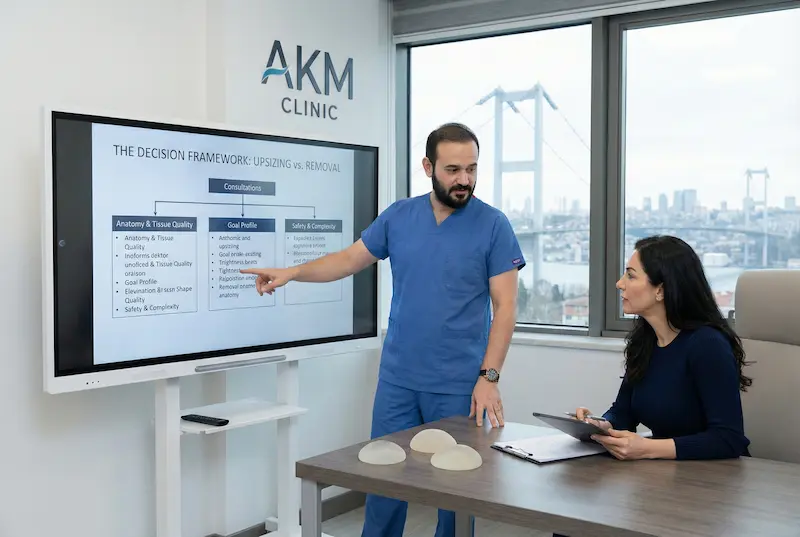
The Decision Framework: How Surgeons Choose Between Upsizing and Removal
For a discerning patient, the decision isn’t framed as “Which option is more popular?”—it’s “Which option fits my anatomy, tissue behavior, and risk tolerance?” A high-quality consultation will walk you through objective decision points and translate them into a plan that reduces repeat revision risk.
Your anatomy and tissue quality (skin stretch, breast width, ptosis grade)
The most important variables are structural:
- Breast base width: helps determine implant footprint and whether upsizing can be done without pushing the implant too wide.
- Skin stretch and tissue thickness: impacts rippling risk and how well the breast can support a larger implant.
- Ptosis (sagging) level: determines whether a lift is needed to achieve a stable, “finished” shape—especially after explant.
If your tissue envelope is thin or overstretched, upsizing may create more visible rippling and instability. If sagging is the main issue, a lift may be the stabilizing move—whether you keep implants or not.
Your goal profile (bolder transformation vs. lighter, more natural silhouette)
This is where patient priorities must be translated into an actual plan:
- If you want a bolder, fuller look: a carefully selected implant exchange may help, but only if pocket support and dimensions are right.
- If you want lighter weight and a more natural contour: removal (explant), often with a lift, can deliver a result that feels more “you.”
In practical terms, many patients exploring revision options in Turkey are balancing two things: predictable aesthetics and a more structured, medically supervised aftercare experience while traveling. Your plan should reflect both.
Safety priorities and revision complexity (scar tissue, prior techniques, healing risk)
Revision complexity rises when there’s:
- Significant scar tissue/capsule issues
- Prior malposition (bottoming out, lateral drift, asymmetry)
- Multiple previous surgeries
- Thin tissue coverage or poor healing history
This is where a surgeon’s process matters: detailed measurement, a clear written plan, and conservative risk control. In other words, revision decisions should feel like applied surgical science — structured, testable, and based on anatomy — not like guesswork.
Decision clarity is a safety tool: If a consultation can’t clearly explain “why upsizing” vs. “why removal,” it’s hard to trust the plan under real surgical conditions.
What Revision Surgery Can Involve: Key Techniques Patients Should Understand
A revision is often more than swapping implants. A stable result usually comes from correcting the “environment” around the implant (the pocket, support structures, and skin envelope). Understanding the basics helps you evaluate your surgical plan with confidence—especially if you’re comparing breast implant exchange options and reviewing revision before and after photos.
Correcting implant position (bottoming out, lateral drift, symmastia)
Common position problems and what the plan may include:
- Bottoming out: the implant sits too low; correction typically focuses on restoring support and redefining the fold.
- Lateral drift: implant shifts outward; correction often aims to re-center the implant and protect cleavage aesthetics.
- Symmastia (“uniboob” look): requires meticulous pocket correction to re-establish midline boundaries.
These are not “size” problems—they’re pocket mechanics problems. Upsizing without stabilizing the pocket can increase the chance of recurrence.
Managing scar tissue and the implant pocket (capsule management basics)
Scar tissue (capsule) is normal, but when it becomes thick or contractile, it can distort shape and cause discomfort. Revision planning usually clarifies:
- How the capsule looks on exam/imaging (when applicable)
- Whether the pocket needs reshaping for symmetry and stability
- What capsule approach is planned (individualized based on clinical need)
Ask your surgeon to explain the capsule plan in plain language and how it affects recovery and long-term results.
Implant choices and tradeoffs (profile, projection, feel, and long-term maintenance)
When the plan includes implant exchange, high-quality revision planning discusses implant selection beyond “cc”:
- Base width match: the implant must suit your chest dimensions.
- Profile/projection: influences how “forward” the breast looks and how much upper pole fullness is created.
- Soft tissue coverage: helps determine rippling risk and “feel.”
- Long-term maintenance: implants aren’t lifetime devices; plan with future aging and body changes in mind.
| Technique / Decision | Primary Benefit | Best For |
|---|---|---|
| Implant exchange (upsizing or resizing) | Adjusts volume/shape goals | Size dissatisfaction with stable tissue/pocket |
| Pocket correction/support | Improves position stability | Bottoming out, lateral drift, asymmetry |
| Explant with/without lift | More natural silhouette, lighter feel | Patients prioritizing natural goals or implant reduction |
Recovery Timeline: What Changes in a Revision (Compared to First-Time Augmentation)
Recovery after a breast implant revision varies more than first-time augmentation because revision surgery can involve additional steps—such as pocket correction, scar tissue (capsule) management, or a lift. If you’re traveling for breast implant revision Turkey, recovery planning also includes flight timing, follow-up scheduling, and contingency planning (what happens if swelling or a wound issue needs quick attention).
The first 72 hours: swelling, support bra, movement limits
Most patients experience the peak of swelling and tightness in the first 2–3 days. Your surgeon’s instructions will be specific, but commonly include:
- Support garment / surgical bra: worn consistently to protect the surgical plan and reduce swelling.
- Activity limits: short walks are encouraged, but lifting and overhead arm movement may be restricted.
- Sleep position: often on your back with upper body slightly elevated.
- Pain control plan: many patients describe pressure/tightness more than sharp pain, but revision complexity changes this.
If your case involved pocket repair or significant capsule work, you may feel tighter and “more protected” by the bra than you remember from your primary surgery—and that’s often by design.
Weeks 1–2: travel planning, follow-ups, “social downtime” expectations
Travel planning for a revision is a different choreography from primary surgery — the recovery window is more variable, the follow-up cadence is denser, and the return-flight timing depends on what was actually done in the operating room (exchange vs. lift vs. pocket repair vs. combined).
For the end-to-end view of how the journey integrates with the surgical plan, the structured international patient journey covers the pre-travel medical workup, arrival and consultation days, surgery day staging, the in-Istanbul recovery period, the structured return-flight phase, and the months-long follow-up cadence — including the touchpoints where revision-specific aftercare differs from primary-surgery aftercare.
Patients who treat travel logistics as a separate task from the surgical plan usually find seams that the journey-level plan would have prevented.
In week 1, your focus is protecting the result while swelling starts to come down. If you’re considering explant surgery Turkey or an implant exchange in Istanbul, ask your clinic exactly how follow-ups are handled during your stay and after you return home.
- Bruising and swelling: typically improve gradually; symmetry can look “off” early because each side heals at a different pace.
- Incision care: you should have clear written guidance—what’s normal vs. what needs urgent attention.
- Social downtime: many patients feel comfortable going out in loose clothing within 7–14 days, but this is case-dependent.
Patient experience insight: One U.S. “expert patient” (Barbara) described her AKM Clinic recovery as having “no pain” and minimal bruising, with results that looked natural and undetectable to others. Individual experiences vary, but structured aftercare and clear communication are often what patients remember most.
Weeks 6–12 and beyond: settling, scar maturation, and when results look “final”
Revision results don’t “lock in” immediately. Implants settle, tissues relax, and scars mature over months. Typical milestones include:
- 6 weeks: many normal activities resume if healing is smooth and your surgeon clears you.
- 3 months: the shape often looks significantly more stable; swelling is markedly reduced.
- 6–12 months: scars soften and fade; the breast contour looks more “finished.”
If your plan included a lift, scar maturation is a longer-term process. The trade-off is that a lift can make the post-explant or post-exchange shape more predictable and “intentional.”
Advanced recovery support: where technology and standards can matter
Some clinics integrate supportive recovery modalities (HBOT, LLLT) into post-op care pathways. The honest framing: these are adjuncts that may support inflammation control and tissue recovery, not replacements for the surgical care plan. Whether they’re appropriate for your specific revision case depends on your surgeon’s clinical evaluation and care pathway.
For traveling patients, the more important value is structured aftercare, clear written instructions, and international follow-up support — those organizational layers shape recovery experience more than any single adjunct.
Risks, Red Flags, and How to Reduce the Chance of Needing “Another Revision”
Revision surgery can be highly rewarding—but it’s also more complex than first-time augmentation because the surgeon is working with pre-existing scar tissue, altered anatomy, and sometimes a stretched implant pocket. If your biggest fear is a “botched” look, the best protection is a plan that is structural, measurable, and conservative—not purely aesthetic.
The biggest risk drivers (technique mismatch, tissue limits, implant sizing errors)
The most common reasons patients end up needing multiple revisions are usually not “bad luck.” They often trace back to one of these drivers:
- Implant-to-anatomy mismatch: choosing an implant width/profile that doesn’t suit the chest and tissue envelope.
- Underestimating tissue limits: thin tissue coverage can increase rippling and visible edges—especially with upsizing breast implants.
- Pocket instability: if the implant pocket is stretched, a simple breast implant exchange may not hold position long-term without support/pocket correction.
- Ignoring sagging mechanics: if ptosis is present, a lift may be necessary for a stable shape—whether you upsize or remove implants.
- Expectation gaps: “I want natural AND very full AND zero scar AND no downtime” is rarely realistic in a revision setting.
Risk-control mindset: A good revision plan looks like applied medical science: measured, anatomy-driven, and designed to prevent predictable failure points.
Red flags in consultations (overpromising, rushed planning, vague safety protocols)
If you’re comparing surgeons—especially for breast implant revision Turkey—watch for red flags that informed patients consistently flag as “avoid”:
- Overpromising: “We can fix everything with a bigger implant” (without discussing pocket integrity, tissue thickness, or lift need).
- No objective measurements: decisions based only on a quick look, not chest/breast width measurements and tissue assessment.
- Vague capsule strategy: no clear explanation of what will be done with scar tissue and why.
- No plan for malposition prevention: if you had bottoming out/drift before, ask how recurrence is prevented.
- Unclear aftercare structure: especially critical if you’re traveling—who follows you, when, and what happens if you need urgent advice?
Surgeon evaluation is the audit step that separates research from due diligence. For revision specifically, the question isn’t only “Is this surgeon experienced?” — it’s “Does this surgeon’s documented case mix include the specific revision pathway my case needs?” Generic plastic surgery experience doesn’t guarantee revision competence.
For the full credentials picture relevant to revision work, Dr. Akif’s surgical experience profile covers training history, the dermatosurgical specialty fellowship that informs scar-aware closure design, society memberships, and the specialty background that the consultation framework in this article references.
Revision work is one of the procedure categories where surgeon-specific credentials and documented case volume actually change the outcome equation — not just the consultation experience.
What to ask for: surgical plan clarity, photo evaluation standards, aftercare structure
Use these questions to turn a consultation into a decision-quality discussion:
- “What is the diagnosis?” (e.g., malposition type, tissue coverage issue, ptosis grade)
- “What is the surgical plan step-by-step?” (implant exchange vs explant, pocket repair, lift, capsule plan)
- “What are the top 3 risks in my case—and how are you reducing each one?”
- “What’s the revision policy if something doesn’t heal as expected?”
- “How is follow-up handled if I’m flying home?”
The five questions above are the minimum framework. For revision cases specifically, additional questions matter — about scar tissue management, capsule planning, malposition prevention, and revision-policy specifics that primary-surgery checklists don’t typically address.
For the expanded version with rationale behind each question (why it matters, what a strong answer sounds like, and what the answer reveals about the surgeon’s planning depth), the expanded consultation question framework walks through the credential layer, the technique layer, the safety layer, and the aftercare layer — separating the questions that test honesty from the questions that test specialty experience.
Reading the question rationale before the consultation is what turns the conversation from a sales pitch into a structured interview.
How to evaluate breast implant revision before and after photos like an expert:
- Look for cases like yours: similar starting anatomy, similar complication type (malposition, rippling, contracture, etc.).
- Check consistency: do results look stable across many patients, not just one “perfect” example?
- Study the side view: it reveals pocket stability and lower-pole support better than front-only photos.
- Ask about timelines: early photos can be misleading—true settling often takes months.
Photo evaluation for revision cases is harder than photo evaluation for primary cases — because the “before” image is already a surgical result, not a baseline, and the “after” needs to be read against the difference between two surgical outcomes rather than between unaltered anatomy and surgery.
For the procedure-specific photo archive that helps calibrate expectations consistently across angles and timing, the documented breast augmentation gallery covers primary breast augmentation case sets with documented timing labels, multi-angle documentation across recovery phases, and the consistency standards (lighting, distance, posture) that the photo-evaluation checklist above describes — applied across the practice’s archive rather than curated for marketing.
Reading an archive teaches calibration in a way that reading one or two showcase photos never does.
Cost Drivers in Breast Implant Revision: Why Prices Vary So Much
Revision pricing is more variable than primary surgery pricing because “revision” can mean anything from a straightforward implant exchange to a complex structural repair with capsule work and a lift. The most useful framing: complexity = operating time + materials + risk management + aftercare.
What makes a case more complex
These factors commonly increase cost:
- Capsule/scar tissue work: more time, more precision, sometimes higher bleeding/swelling management needs
- Pocket correction/support: fixing bottoming out or lateral drift can be more technical than primary surgery
- Adding a lift: increases surgical steps and scar management, but can improve predictability — especially after explant
- Implant choice/brand and size change: and whether additional balancing steps are needed for symmetry
For the line-item structure, packaged inclusions, comparison methodology across geographies, and the question of how to evaluate revision quotes against primary baselines, the breast augmentation cost framework covers the practice-wide pricing architecture that revision pricing sits on top of.
The fastest way to be misled on revision cost is to compare a clean revision quote against a stripped-down primary quote — different procedures, different baselines, different inclusions.
Frequently Asked Questions (FAQ): Breast Implant Revision
These are the most common questions patients ask when deciding between upsizing and removal—and when comparing revision cost, before-and-after outcomes, and travel options.
How do I know if I need upsizing or a breast lift instead?
If your main issue is volume and your tissue support is good, upsizing via breast implant exchange may help. If the main issue is sagging (nipple/breast position), a lift is often the structural solution—sometimes with implants, sometimes without.
Will explant surgery leave my breasts saggy?
It can, depending on skin elasticity and how stretched the tissue is. Many patients choose removal + lift to shape the breast so the result looks intentional and proportionate rather than deflated.
Is capsulectomy always necessary during implant removal?
No. Capsule management is individualized. Your surgeon should explain what they recommend for your capsule and why, based on clinical findings and risk factors.
How long should I wait after my first surgery before doing a revision?
Many revisions are safest after tissues have stabilized, because swelling and settling can mimic “problems” early on. The right timing depends on the issue (aesthetic dissatisfaction vs malposition vs other concerns) and must be decided with your surgeon.
What does recovery feel like compared to my original augmentation?
It depends on complexity. Simple implant exchange may feel similar or even easier for some patients, while pocket repair, capsule work, or a lift can increase tightness and recovery demands. A detailed plan should include what restrictions apply and for how long.
Can revision fix rippling, asymmetry, or “bottoming out”?
Often, yes—but only when the plan addresses the cause. Rippling may require improved soft-tissue strategy; asymmetry may require pocket and implant dimension planning; bottoming out typically requires pocket correction/support, not just a size change.
How do I evaluate breast implant revision before and after results fairly?
Compare cases with similar starting anatomy and similar problems. Ask when photos were taken (early vs settled), and pay attention to side views and symmetry consistency across many patients—not just one highlight case.