




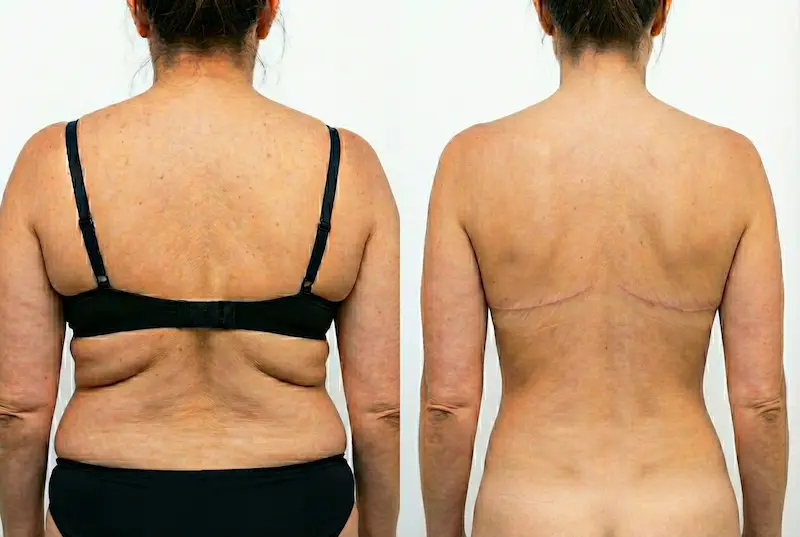
An Upper Back Lift is a body contouring surgery designed to remove excess skin and refine the shape of the upper back—especially the area where a bra band typically sits. In patient-friendly language, you may also see it called a Bra Line Back Lift. Both terms refer to the same core goal: smoothing the upper back contour when diet, exercise, and stable weight are no longer enough to address loose skin or persistent folds.
This concern is common after significant weight loss, with natural aging, or when skin elasticity has been stretched over time. While the “problem” often shows up in clothing—visible bra-line rolls, a bulge above the band, or a back that looks less defined—the underlying issue is usually structural: the skin has become lax and no longer drapes smoothly over the upper back.
Importantly, an Upper Back Lift is not about creating an artificial look. A natural result is built on a precise plan that respects your anatomy and aims for rejuvenation, not alteration—restoring a cleaner silhouette without making your body look “pulled” or over-tightened.
Table of Contents
What Is an Upper Back Lift?
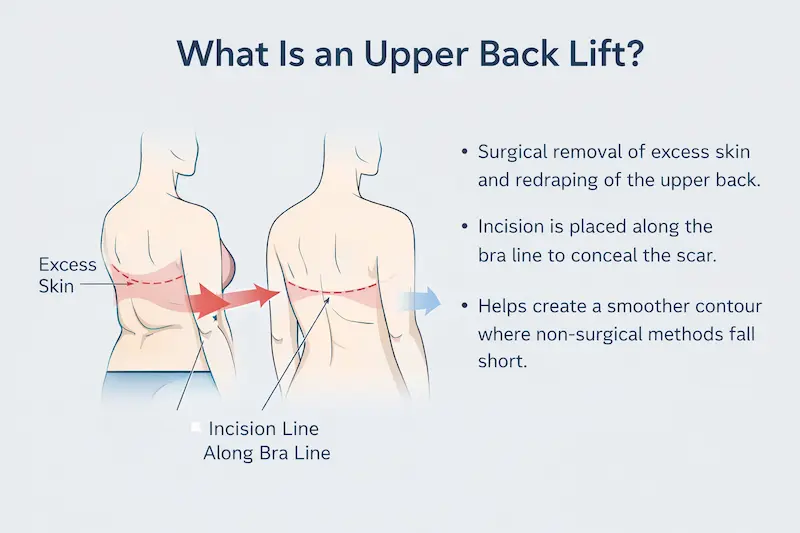
An Upper Back Lift is a surgical tightening procedure for the upper back skin envelope. It focuses on removing excess tissue and repositioning the remaining skin so it lies flatter and more smoothly. For the “expert patient,” the key is understanding the trade-off: meaningful contour improvement typically requires an incision, and the surgeon’s job is to place and manage that incision strategically while maintaining a natural shape.
Upper Back Lift vs. Bra Line Back Lift (Terminology)
Upper Back Lift is often used as the clinical term. Bra Line Back Lift is the patient-facing term that describes the most common incision concept: the scar can often be positioned along the bra line so it is naturally covered by standard undergarments. Because patient language is not standardized, you may see both terms used interchangeably. When you evaluate surgeons and clinics, look for a provider who clearly explains what they mean by the term, where the incision typically sits, and what outcome is realistically achievable for your body type.
What the Surgery Targets (Upper Back “Bra Bulge” Anatomy)
The upper back contour is shaped by a combination of skin quality, underlying fat distribution, and how tissue drapes across the shoulder blades and upper flank. When skin laxity develops, it can create:
- Horizontal folds that become more pronounced with arm movement or certain postures
- A visible ridge above or below the bra band (often described as “back bra bulge”)
- Uneven draping that makes the upper back look less defined even at a healthy weight
An Upper Back Lift addresses the part of the problem that non-surgical approaches cannot reliably correct: excess skin. Liposuction alone may reduce fullness in select patients, but it does not remove redundant skin—and in some cases can make laxity more obvious if skin quality is already compromised.
Common Goals (Smoother Upper Back Contour, Clothing Fit)
Most patients pursue an Upper Back Lift for highly practical, outcome-based reasons. The most common goals include:
- A smoother upper back silhouette when wearing fitted clothing
- Reduced bunching along the bra band area
- More defined lines across the upper torso that better match overall weight and fitness
In consultation, a high-quality surgical plan translates those goals into specifics: how much laxity is present, what degree of tightening is realistic, whether liposuction is helpful as an adjunct, and where the incision can be placed to balance visibility with optimal contour.
Benefits of an Upper Back Lift
The benefits of an Upper Back Lift go beyond a “flatter back.” The procedure can refine how tissue sits across the upper torso and can improve daily comfort and clothing options. For the patient who has done extensive research, it helps to separate benefits into three categories: aesthetic change, functional comfort, and psychological ease—because the value of the procedure often lives at the intersection of all three.
Aesthetic Benefits (Smoother Bra-Line Silhouette)
Aesthetic improvement typically shows up as a cleaner, more continuous contour from the mid-back up toward the shoulder blades. Rather than looking “compressed” by a bra band, the upper back can appear more streamlined. The goal is not to create a dramatically different body shape, but to restore proportion—so the upper back matches the rest of the torso and the body looks consistent from multiple angles.
Functional & Comfort Benefits (Clothing Fit and Skin Friction)
When lax tissue creates folds, it can affect how clothing sits and how comfortable you feel throughout the day. By reducing redundant skin and improving drape, many patients report a more predictable fit in bras, athletic wear, and structured garments. In some cases, reducing persistent skin folds can also lessen irritation from friction and moisture in the crease area—especially in warm climates or during workouts.
Psychological Benefits (Confidence Without an “Operated” Look)
Upper back concerns often feel disproportionately frustrating: you may be healthy and active, yet the upper back looks older or less defined than the rest of you. The psychological benefit is often the removal of a persistent distraction—no longer thinking about back rolls, bra adjustments, or avoiding certain clothing cuts. For many expert patients, the highest value is a result that feels quietly right: noticeable to you, but not obvious to others.
Surgeon’s Insight: The best upper back lift results are built on “natural-first” planning—tightening enough to restore a smooth contour, while avoiding over-tension that can make the back look unnaturally pulled or compromise scar quality.
Ideal Candidates (And Who Should Wait)
Candidate selection is where an Upper Back Lift becomes either a high-satisfaction procedure or a frustrating compromise. In general, the best candidates have a clear mismatch between their overall weight/fitness and the way their upper back skin drapes. Your consultation should focus on tissue quality, the pattern of laxity, and whether your goals can be achieved with a scar placement you can accept.
Best Candidates (Stable Weight, Localized Upper Back Laxity)
You may be a strong candidate if you:
- Have stable weight and are not actively losing large amounts of weight
- Notice excess upper back skin or bra-line folds that persist despite lifestyle efforts
- Have a clear goal: smoother contour and improved fit in clothing
- Understand the core trade-off: better contour requires an incision
From a planning standpoint, stable weight matters because ongoing weight changes can alter skin tension and contour, potentially impacting long-term satisfaction.
After Weight Loss Candidates (Body Contouring Context)
After significant weight loss, skin laxity can remain even when body fat is low. Upper back folds may become more visible because the skin envelope is larger than the reduced underlying volume. In these patients, an Upper Back Lift is often considered as part of a broader body contouring strategy, where each procedure is chosen to address a specific zone of laxity. The key is sequencing: choosing the right timing once weight has stabilized and your nutrition and healing capacity support a predictable recovery.
Who Is NOT a Candidate (Or Should Wait)
You may be advised to delay or avoid surgery if you have factors that raise risk or reduce predictability, such as:
- Active smoking or nicotine use (which can impair healing)
- Uncontrolled medical conditions that increase surgical risk
- Unrealistic expectations (for example, expecting a scar-free result)
- Ongoing major weight loss or plans for significant weight change
A responsible evaluation prioritizes safety and long-term outcome quality. The right plan may be surgery now, surgery later, or a different approach entirely—depending on your anatomy, goals, and risk profile.
Procedure Options for Back Contouring (Where an Upper Back Lift Fits)
An Upper Back Lift is one piece of a larger body contouring toolbox. For the expert patient, the goal is to match the procedure to the pattern of laxity—because different regions of the back age (or change after weight loss) in different ways. Your consult should feel less like “one procedure fits all” and more like a structured decision: Which area is the true problem zone, and what approach gives the cleanest contour with the most acceptable scar trade-off?
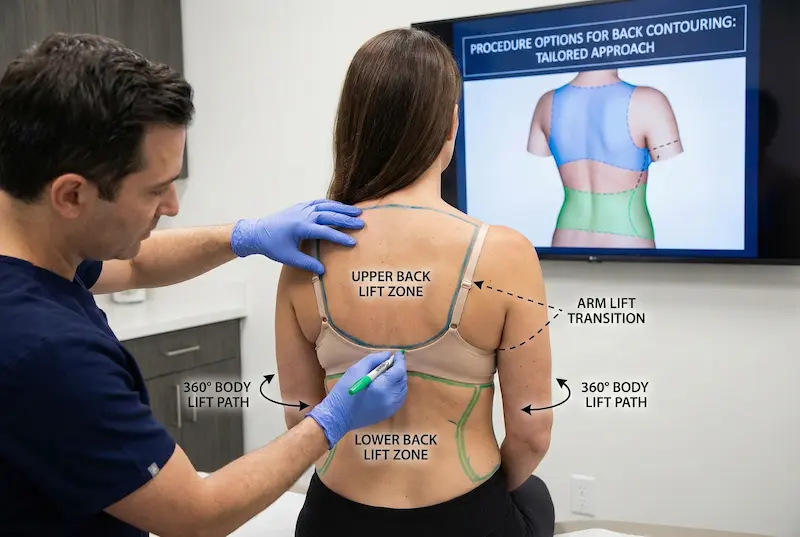
Upper Back Lift vs. Lower Back Lift vs. 360 Body Lift
These terms are often mixed online, but they describe different targets:
- Upper Back Lift: Focuses on laxity and folds higher on the back—commonly around the bra band region and the upper flank.
- Lower Back Lift: Targets laxity closer to the waistline and lower torso transition. It’s typically discussed in the context of reshaping the lower trunk and hip region.
- 360 Body Lift: A circumferential approach designed for patients whose laxity wraps around the body (front and back). It’s often relevant after major weight loss when the skin envelope is loose across multiple zones.
A practical way to think about it: if your main concern is what you see above the bra band, you’re usually discussing an Upper Back Lift; if laxity is more concentrated at the waistline, it shifts toward a lower-back approach; if the laxity is global and circumferential, a 360 Body Lift can become the more coherent plan.
When an Arm Lift Is Added (Arm + Back Lift Logic)
Upper back laxity often overlaps with changes near the posterior axillary fold (the back of the underarm area). That’s why some surgical plans consider an Arm Lift in the same operative setting. The advantage of a combined strategy is not simply “doing more,” but creating a smoother transition between adjacent areas so the result looks consistent from multiple angles.
That said, combination planning is not automatic. It depends on:
- Where the skin is truly loose: upper back only vs. arm + upper flank
- Scar tolerance: an arm lift has its own incision logic that must be acceptable to you
- Recovery strategy: how much downtime you can realistically allocate
In a high-quality consult, your surgeon should clearly explain whether combining procedures improves the overall result—or whether it adds scar burden without meaningful aesthetic gain.
When Skin Tightening Adjuncts Are Considered (And Their Limits)
In mild cases—especially when the issue is more about localized fullness than true skin redundancy—non-excisional adjuncts may be discussed as part of a staged plan. Options can include liposuction-focused contouring and J-plasma based skin tightening platforms. However, it’s critical to understand the boundary: adjuncts can improve skin quality and contraction, but they do not reliably replace excisional surgery when there is significant excess skin.
For the expert patient, the most useful way to frame adjuncts is as “support,” not “substitute.” They may be helpful when:
- skin laxity is mild-to-moderate and elasticity remains relatively good
- the main concern is a small contour irregularity rather than a true fold
- you are trying to minimize scar burden and accept a more conservative improvement
Surgeon’s Insight: The most “natural” body contouring plans are the ones that treat the body as a connected map—tightening one zone only makes sense if the transition into the neighboring zones still looks smooth and proportional.
Upper Back Lift Surgical Techniques (Incisions, Vectors, and Trade-Offs)
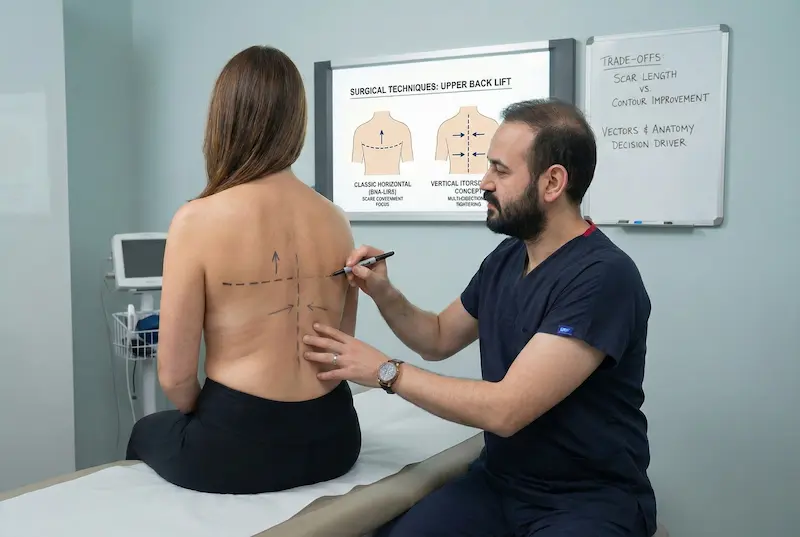
Technique is where an Upper Back Lift becomes a high-satisfaction procedure—or a result that looks “operated.” The best surgeons don’t simply remove skin; they plan incision placement, redraping direction, and closure tension so the contour improves while the scar is positioned as intelligently as possible. For most patients, the “right” technique is the one that matches the distribution of laxity and your scar tolerance.
Classic Bra-Line (Horizontal) Upper Back Lift Technique
The most commonly discussed approach is a horizontal excision designed to tighten the upper back by removing a measured segment of excess skin. The incision is typically planned to align with where a bra band sits—because that location can naturally conceal the scar in everyday life.
This technique is often appropriate when laxity is primarily horizontal (folding or rolling) and concentrated around the upper back and upper flank. The fundamental trade-off remains consistent: the more laxity you want to correct, the more skin must be removed, and the more important scar planning becomes.
Vertical Back Lift / Torsoplasty Concepts (When They Enter the Conversation)
A vertical back lift (sometimes discussed under the broader concept of torsoplasty) may be considered when laxity is not primarily “bra-line horizontal,” but instead extends in a pattern that benefits from a different vector of tightening. This is more commonly discussed in advanced body contouring cases, including some post–massive weight loss patients where the skin envelope has changed in multiple directions.
The expert-level question here is not “which scar is better,” but “which scar gives the best contour for my anatomy.” In some bodies, a purely horizontal approach may not address the true direction of skin redundancy. A surgeon’s role is to explain that logic clearly, using your specific laxity pattern as the decision driver.
Liposuction-Assisted Approaches (When They Help, When They Don’t)
Liposuction can be a valuable adjunct when there is a meaningful component of excess fat contributing to upper back fullness. In selected patients, reducing volume can help the back look smoother and more defined. But liposuction is not a skin-removal procedure. If skin quality is poor or laxity is significant, liposuction alone may leave redundant skin behind—or make it more visible.
A precise plan often answers two questions:
- Is fullness the main issue? If yes, liposuction may play a larger role.
- Is lax skin the main issue? If yes, excision-based lifting becomes the core solution.
| Technique | Best for | Incision / scar logic | Key advantages | Limitations | Common combinations |
|---|---|---|---|---|---|
| Classic bra-line (horizontal) Upper Back Lift | Upper back folds concentrated around the bra band; primarily horizontal laxity | Placed to align with typical bra-line coverage when possible | Direct removal of excess skin; strong contour improvement in the target zone | Requires an incision; scar management is part of the aesthetic plan | Arm Lift, liposuction (adjunct), broader body contouring plans |
| Vertical back lift / torsoplasty concepts | Complex laxity patterns, often in advanced body contouring cases | Vector and scar orientation are selected based on the direction of redundancy | Addresses laxity that may not respond well to a purely horizontal excision | Different scar placement trade-offs; not needed for most standard cases | Multi-zone lifts, staged body contouring strategies |
| Liposuction-assisted contouring | Patients with localized fullness and relatively good skin elasticity | Small access incisions; no long excision scar | Refines volume and definition; can complement lifting in selected cases | Does not remove excess skin; may worsen visible laxity in poor-skin-quality patients | Energy-based tightening adjuncts, targeted contouring plans |
| Energy-based skin tightening (adjunct) | Mild-to-moderate laxity where scar minimization is a high priority | No long excision scar; used as supportive technology rather than a lift replacement | May improve skin contraction and quality in selected patients | Not a substitute for excision when excess skin is significant | Liposuction & skin tightening plans, staged approaches |
Surgeon’s Insight: A refined back contour is not achieved by “pulling harder.” It’s achieved by choosing the right direction of redraping and closing without excessive tension—because tension is what tends to make results look unnatural and scars heal poorly.
Anesthesia Options (Awake/Twilight vs. General)
An Upper Back Lift is commonly performed under general anesthesia, especially when it’s combined with other procedures or when a more extensive tightening plan is required. In select cases, clinics may discuss twilight sedation (deep sedation) with advanced local anesthesia strategies. The right choice depends on your surgical plan, overall health profile, comfort expectations, and the estimated operative time.
General Anesthesia (When It’s Preferred)
General anesthesia is often preferred when:
- the excision is more extensive or requires complex repositioning
- multiple procedures are planned (for example, Arm Lift + Upper Back Lift)
- you want maximal comfort and a fully controlled operative environment
- your surgeon anticipates that positioning and operative time make it the safest option
For many expert patients, the priority is predictability—consistent comfort during surgery, stable monitoring, and a smooth early recovery plan managed by an experienced anesthesia team.
Twilight Sedation / Advanced Local Concepts (Who May Be Eligible)
Twilight sedation may be discussed in more limited scenarios where the surgical plan is conservative and the patient is an appropriate candidate. If this option is offered, your consultation should include a clear explanation of:
- what level of sedation is intended (and what you will feel or remember)
- how pain control is maintained during tissue work and closure
- who monitors you and what safety protocols are in place
In high-quality practices, anesthesia selection is never a marketing feature—it’s a clinical decision based on safety, comfort, and the requirements of your specific plan.
How a High-Standard Clinic Frames Comfort + Recovery
Regardless of anesthesia type, the key is a structured system: careful pre-op screening, intra-op monitoring, and post-op pain control that supports early mobility and predictable healing. A good plan aims to keep you comfortable without relying on excessive sedation after surgery, while still protecting the integrity of the result (for example, minimizing strain on incisions during early recovery).
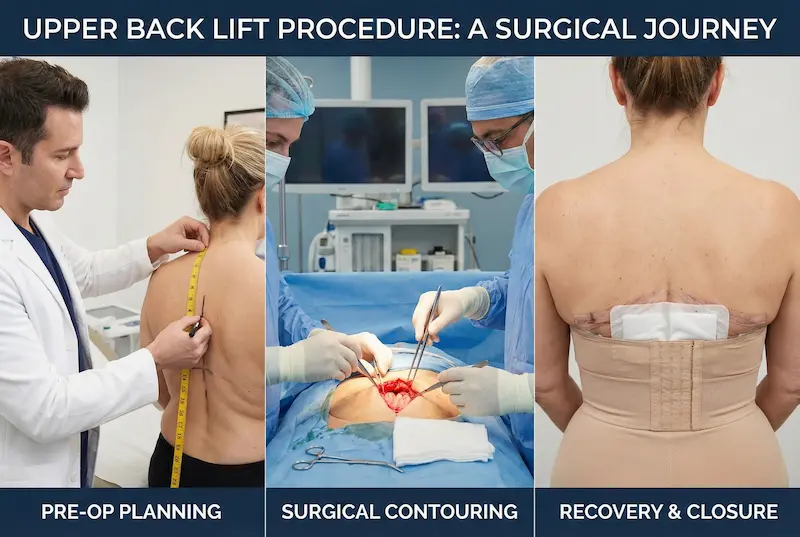
Step-by-Step: How an Upper Back Lift Is Performed
Exact details vary by technique, but the fundamental workflow is consistent. A well-executed Upper Back Lift is not just “skin removal.” It is a controlled reshaping procedure designed around measurements, vector planning, and a closure strategy that prioritizes both contour and scar quality.
Pre-Op Planning (Assessment + Markings)
Pre-operative planning typically includes:
- a focused physical exam of your laxity pattern (where the fold starts, how far it extends, and how the skin behaves with movement)
- photo documentation and discussion of realistic outcomes
- markings placed with you standing, so the surgeon can map how tissue naturally drapes
This is where the most important decisions are made: incision placement logic, how much tightening is possible without distortion, and whether adjunct contouring (such as selective liposuction) improves the final silhouette.
Incision, Tissue Redraping, Excess Skin Removal
During surgery, the surgeon typically:
- creates the planned incision (often oriented to align with the bra-line concept when appropriate)
- carefully mobilizes the tissue to allow repositioning without excessive tension
- redrapes the skin in the correct direction to smooth the contour
- removes the precise amount of redundant skin needed for a refined result
In expert hands, the goal is not maximum tightness—it is balanced shaping. Over-resection can increase tension and compromise scar quality, while under-resection can leave residual folds. The best outcome sits in the middle: enough improvement to be clearly meaningful, but still natural in posture and movement.
Closure Strategy (Tension Management) + Dressings/Garments
Closure is where “surgical quality” becomes visible months later. A meticulous closure strategy focuses on:
- layered closure to distribute tension below the skin surface
- alignment so the scar sits predictably along the planned line
- skin-edge precision to support smooth healing and scar maturation
After closure, dressings and (in many cases) a compression garment may be used to reduce swelling and support early contour stability. Your surgeon will also advise you on movement patterns during the initial healing phase to avoid unnecessary strain.
Scars & Scar Management (A Primary Patient Concern)
The question “What will the scar look like?” is not a sign of vanity—it’s a rational evaluation of the trade-off. An Upper Back Lift usually delivers meaningful contour improvement because it removes excess skin, and removing skin creates an incision. The goal is not to pretend scars don’t exist; the goal is to plan them intelligently and manage them strategically so they mature as favorably as possible.
Where the Scar Typically Sits (Bra-Line Logic)
In many upper back lift plans, the incision is positioned with concealment in mind—often near the natural bra band line. That does not mean every scar is invisible in every outfit, but it does mean the location is chosen deliberately to reduce day-to-day visibility. During consultation, you should ask your surgeon to explain:
- the planned scar position on your body (not a generic diagram)
- how that position relates to your usual bra styles
- what range of motion and posture can reveal the scar temporarily in early healing
Scar Maturation Timeline (What to Expect Over Months)
Scars change gradually. While every patient heals differently, a typical maturation pattern looks like this:
- Weeks 1–6: the scar is new, often pink/red, and the area may feel firm or tight
- Months 2–4: texture and color begin to evolve; itching and sensitivity can be normal
- Months 6–12+: the scar generally softens and fades, with the final appearance continuing to improve over time
If you have a history of thick or raised scars, that is critical information to share. A good surgical team will incorporate that into your plan and follow-up strategy.
Evidence-Based Scar Care (Silicone, Sun Protection, Follow-Up)
High-quality scar care is proactive, not reactive. Common evidence-based principles include:
- silicone therapy (gel or sheets) once your incision is appropriately healed and cleared by your surgeon
- sun protection (UV exposure can darken scars and prolong redness)
- structured follow-ups so early thickening, irritation, or delayed healing can be addressed promptly
- scar massage guidance when appropriate, to improve pliability
In some cases, your surgeon may discuss additional options if a scar starts to thicken, such as targeted treatments based on how your scar is behaving over time.
Surgeon’s Insight: The scar is part of the surgical design. The most aesthetic upper back lift plans don’t “ignore” scarring—they place the incision where it makes sense, close it with low tension, and support the scar through a structured aftercare plan so it matures as cleanly as possible.

Recovery & Aftercare (Timeline + Rapid Recovery & Safety Protocols)
Recovery after an Upper Back Lift is usually straightforward when your plan is well-designed and you follow the aftercare instructions closely. Most patients describe the first week as the most “noticeable” phase—mainly because of swelling, tightness, and the need to limit certain movements. After that, daily function typically improves steadily, and your comfort becomes more predictable as the incisions settle.
Your personal timeline will depend on: (1) how much skin was removed, (2) whether you combined procedures (such as an Arm Lift), (3) your baseline health and healing capacity, and (4) how closely your routine supports low-tension healing.
The First 72 Hours (Swelling, Mobility, Support Needs)
The first three days are mostly about protection and calm healing. Common experiences include:
- Tightness across the upper back (especially with arm movement)
- Swelling and mild bruising
- Fatigue from anesthesia, sleep disruption, and early recovery stress
What helps most in this phase is a structured plan: scheduled rest, short assisted walks, hydration, and careful positioning that avoids stretching the incision line. Many patients benefit from having someone help with basic tasks for the first 24–48 hours (especially if a combined procedure is performed).
Week-by-Week Recovery Timeline (Work, Exercise, Driving)
While healing is individual, a realistic upper back lift timeline often looks like this:
- Week 1: Focus on comfort, incision care, and gentle mobility. Avoid overhead reaching and sudden shoulder movements.
- Weeks 2–3: Many patients feel noticeably better and can return to light daily routines. Swelling continues to improve. Activity is still restricted to protect the closure line.
- Weeks 4–6: You typically regain more normal movement and stamina. Depending on your surgeon’s guidance, you may gradually return to structured exercise.
- After 6 weeks: Most patients can return to a fuller activity level, with ongoing scar maturation and contour “settling” continuing for months.
Work: If your job is desk-based and you can avoid lifting and repetitive shoulder motion, some patients return within 1–2 weeks. If your work is physical or involves frequent upper-body movement, you may need more time.
Driving: Driving is usually considered when you’re off strong pain medication and can comfortably rotate and control the steering wheel without tension.
Exercise: Walking is encouraged early, while weight training and high-impact workouts typically return later—based on healing progress and your surgeon’s protocol.
Aftercare Essentials (What Most Plans Have in Common)
Small details have a big impact on scar quality and overall satisfaction. Most structured aftercare plans include:
- Compression support when recommended (to help swelling control and early contour stability)
- Incision care guidance with clear “do” and “don’t” instructions
- Movement strategy that avoids over-stretching the incision during early healing
- Follow-up checkpoints to monitor healing, swelling, and scar evolution
If you are traveling for surgery, aftercare planning should also include a practical travel strategy: when it’s safe to fly, how to manage swelling on the return trip, and what your follow-up structure looks like once you are home.
Rapid Recovery & Safety Protocols (HBOT + Low-Level Laser Therapy)
Some clinics integrate supportive technologies into recovery planning, such as Hyperbaric Oxygen Therapy (HBOT) and Low-Level Laser Therapy (LLLT). These modalities are best understood as supportive tools—not magic shortcuts. They may be used to help optimize tissue conditions during healing, support comfort, and complement a broader safety-oriented recovery protocol.
- HBOT: In a controlled setting, HBOT increases the amount of oxygen delivered to tissues. In surgical recovery contexts, this can be used to support the healing environment and may be incorporated when a clinic’s protocol aims to reduce recovery friction and promote reliable healing.
- LLLT: Low-level laser therapy is often used in post-procedure settings to support comfort and tissue recovery. Some protocols include it to help manage swelling and to encourage a smoother early healing phase.
What matters most is that these technologies are not used as a substitute for excellent surgery and safe fundamentals. The core of a great recovery remains: good candidate selection, precise technique, low-tension closure, and consistent follow-up.
Surgeon’s Insight: Fast recovery is rarely about “doing more.” It’s about reducing stress on healing tissue: low-tension closure, smart movement restrictions, and a structured follow-up plan. Supportive therapies can help—but the foundation is always surgical planning and disciplined aftercare.
Risks, Safety, and the “Is It Safe in Turkey?” Question
Every surgery carries risk, and a credible clinic will discuss them clearly—without minimizing or exaggerating. For an Upper Back Lift, most risks are manageable when planning is precise, protocols are structured, and you follow aftercare instructions. The expert patient mindset is the right one: evaluate safety through standards, systems, and transparency, not marketing.
Honest Surgical Risks (What to Understand Upfront)
Potential risks can include:
- Bleeding or hematoma
- Infection
- Seroma (fluid collection)
- Delayed wound healing (risk increases with nicotine use and certain medical conditions)
- Unfavorable scarring (thickening, widening, or prolonged redness)
- Contour irregularities (rare, and typically minimized through careful planning)
Discuss your full medical history and all medications/supplements openly. Risk is not just about the operation—it’s also about your baseline healing capacity and how the plan fits your body.
Risk Mitigation (How High-Standard Teams Reduce Risk)
Risk reduction is a system, not a single step. Strong safety frameworks commonly include:
- Pre-op screening and medical clearance when indicated
- Clear infection-prevention protocols and sterile technique standards
- Consistent monitoring during and after anesthesia
- Structured follow-up so small issues are addressed early
- Clear travel planning if you are flying home—timed to reduce stress on healing tissue
Is It Safe in Turkey? What Actually Matters
Patients often compare US-based options (NYC, Miami, Beverly Hills) with Turkey because the value proposition can be meaningful. Safety, however, is not defined by geography—it is defined by surgeon credentials, facility standards, anesthesia quality, and post-op systems.
When evaluating destination surgery, ask practical, expert-level questions:
- What are the surgeon’s credentials and case volume for body contouring procedures?
- Is the operating facility accredited and equipped for safe monitoring and emergency readiness?
- Who provides anesthesia, and what are the monitoring standards?
- What does follow-up look like after you return home?
A high-quality provider will answer these questions directly and consistently. If answers are vague, overly defensive, or overly sales-oriented, treat that as a red flag—no matter what country you’re considering.
Safety Checklist for the Expert Patient (What to Verify)
If you’re comparing surgeons and locations, a simple way to stay objective is to evaluate the “system,” not the sales pitch. Here is a practical checklist you can use in any consultation:
- Credentials: Board certification equivalence, focused training, and consistent case experience in body contouring.
- Facility standards: Accredited operating environment, appropriate monitoring, and clear emergency readiness protocols.
- Anesthesia: Who administers it, how you’re monitored, and what the clinic’s safety workflow looks like.
- Follow-up structure: Clear day-by-day plan early on, and a defined long-term follow-up pathway after you return home.
- Transparency: Clear discussion of realistic outcomes, scar placement, and recovery timeline—not vague promises.
Surgeon’s Insight: Safety isn’t a claim—it’s a process. The most reliable outcomes come from careful patient selection, a disciplined surgical plan, and a follow-up system that identifies small issues early, before they become big ones.
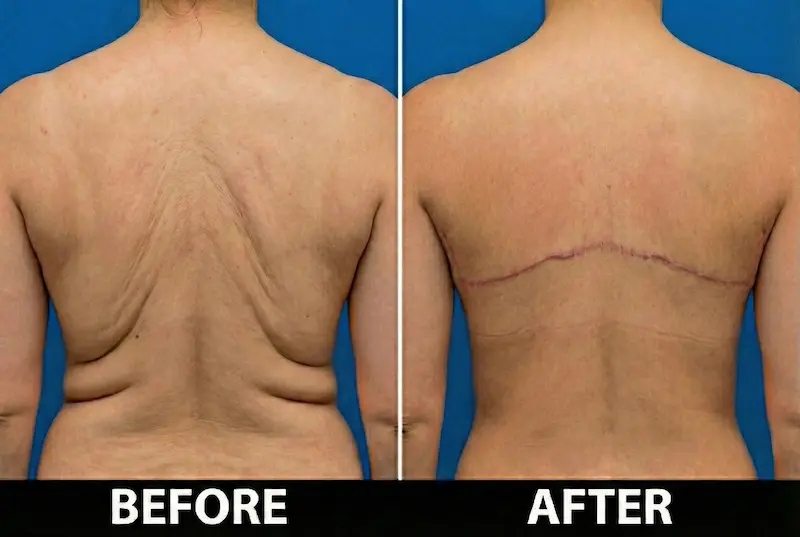
Realistic Results & Longevity (Natural-First Outcomes)
Upper Back Lift results can be highly rewarding because the “before” problem is usually clear: folds, bunching, or visible rolls near the bra band that don’t match your overall fitness. The “after” improvement is often equally clear: smoother drape, better clothing fit, and a cleaner upper-back silhouette. The most important part is setting expectations that are both ambitious and realistic—especially if you are an expert patient comparing multiple providers.
What Changes First (Swelling vs. Early Shape)
In the early weeks, you’ll see two things happening at the same time:
- Immediate contour improvement: Excess skin has been removed, so the “bulk” of folds is reduced right away.
- Temporary swelling and tightness: Early healing can mask the final finesse of the contour.
This is why early photos can look “different” from month-3 photos. The structure is improved early, but the refinement emerges as swelling resolves and the tissues settle into their new position.
When Results Look “Settled” (6 Weeks to 3+ Months)
Many patients feel socially comfortable within the first few weeks, but the result often looks more “finished” later. A realistic progression is:
- Weeks 4–6: swelling decreases, mobility improves, clothing fit feels more predictable
- Months 2–3: contour continues to smooth; scar begins transitioning from “new” to “maturing”
- Months 6–12+: the scar typically softens and fades; final refinement continues gradually
If you are evaluating outcomes, ask to see photos at multiple time points—not only early “after” images—so you can understand what the result looks like once it has fully matured.
How to Keep Results (Weight Stability, Skin Quality, Lifestyle)
Upper Back Lift results can be long-lasting, especially when the factors that caused laxity are stable. The most important longevity drivers are:
- Weight stability: large weight fluctuations can change skin tension and contour over time
- Skin health: sun protection, good nutrition, and avoiding nicotine support better tissue quality
- Strength and posture habits: while exercise can’t remove excess skin, it can support a balanced upper-torso look
It’s also worth noting that aging continues. A good Upper Back Lift does not “freeze time,” but it can meaningfully reset the contour and reduce the visual impact of laxity for years—especially when lifestyle and weight remain consistent.
Cost Analysis (US Cities vs. Turkey) — Value, Not “Cheap”
Cost is a major part of the decision for many patients researching “Upper Back Lift” or “Bra Line Back Lift,” and it’s also where online information can become confusing. Prices vary based on surgeon expertise, facility standards, anesthesia plan, whether you’re combining procedures, and the overall complexity of your anatomy. The smartest way to evaluate cost is to treat it as total investment, not just a number—because what’s included (and what isn’t) can change the true cost dramatically.
What Drives Price in the US (Why Major Cities Cost More)
In major US markets like NYC, Miami, and Beverly Hills, pricing is often shaped by:
- Operating room and staffing costs (which can be significantly higher in premium urban centers)
- Surgeon demand and specialization (high-volume aesthetic surgeons often command premium fees)
- Facility structure and overhead (accreditation, staffing, equipment, and support systems)
- Combination procedures (Arm Lift + Upper Back Lift, or broader body contouring plans)
Why Turkey Can Be Lower Cost (And Why That Doesn’t Automatically Mean Lower Quality)
Patients often compare US pricing with Turkey because the overall cost can be lower due to macro factors such as operational costs and currency dynamics. For an expert patient, the correct framing is: the price difference should be justified by transparent standards. A credible destination provider positions the decision as high-value care—built on surgeon expertise, modern facilities, and an organized patient journey—rather than “cheap surgery.”
What “All-Inclusive Packages” Typically Covers (Transparency + Hidden Cost Checklist)
If you’re comparing offers, verify what is included. A transparent plan often clarifies:
- surgeon and facility fees
- anesthesia and intraoperative monitoring
- standard pre-op evaluation requirements (when applicable)
- post-op medications and compression garments (if recommended)
- local logistics (such as transfers) and accommodation structure (if packaged)
- post-op follow-up schedule and remote support after travel
Also ask about common “hidden cost” scenarios:
- additional nights for extended monitoring (if needed)
- extra garments or specialized wound care supplies
- revision policies and what is considered medically necessary vs. cosmetic refinement
- how post-op support works once you are back in the US
| Location | Typical total investment level (general) | What often influences the total | Common “extra cost” watch-outs | What to verify |
|---|---|---|---|---|
| NYC | High five-figures (often premium) | Facility overhead, surgeon demand, staffing | Separate anesthesia/facility billing, limited bundled aftercare | What is included in the quote and how revisions are handled |
| Miami | Mid-to-high five-figures (variable) | Surgeon tier, facility type, combination procedures | Compression/meds, additional follow-ups, add-on procedure costs | Accreditation, anesthesia team, clarity on total fee structure |
| Beverly Hills | High five-figures (often premium) | Brand premium, surgeon demand, facility standards | Separate line items, higher revision/aftercare add-ons | Detailed surgical plan, scar strategy, and true total cost |
| Istanbul | Often lower total investment (high-value positioning) | Operational costs, bundled logistics, structured patient journey | Travel timing, extended stay needs, remote follow-up structure | Credentials, facility standards, follow-up plan after returning home |
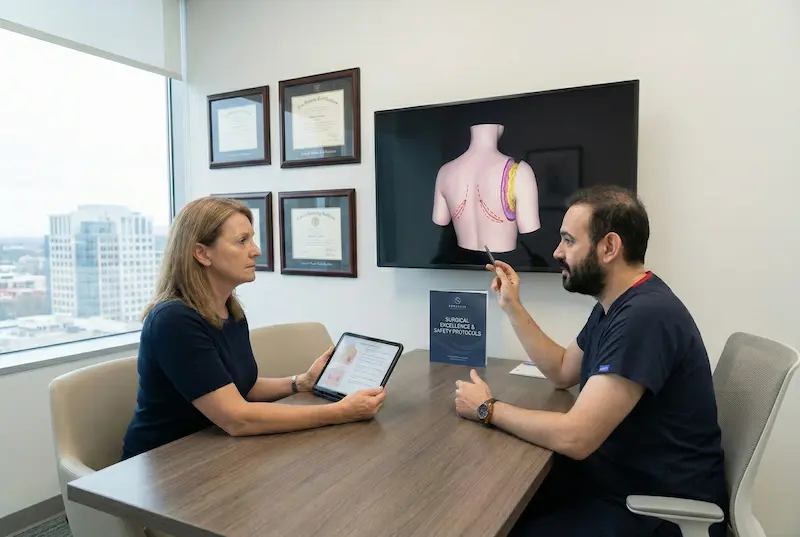
Choosing the Right Surgeon for an Upper Back Lift
For an “expert patient,” choosing the right surgeon is less about marketing and more about process clarity. An Upper Back Lift is a precision procedure: incision placement, tissue redraping direction, and tension management determine whether your result looks smooth and natural—or tight, uneven, or scar-dominant. The most reliable way to choose well is to evaluate how the surgeon thinks, not just what the gallery shows.
Credentials That Matter (Training, Board Standards, Case Experience)
When you compare providers, look for credential signals that indicate consistent surgical standards and meaningful experience with body contouring. During consultation, you should be able to confirm:
- Board-level qualification and formal training: Ask what boards/certifications the surgeon holds and how their training aligns with recognized standards.
- Focused case experience: Upper back lifting is not the most common procedure, so experience matters. Ask how often they perform bra-line/upper back tightening and in what patient types (post-weight loss vs. aging-related laxity).
- Portfolio relevance: Request to see results in patients with a similar laxity pattern, skin quality, and body type—not only the most dramatic transformations.
In high-standard environments, you’ll also see emphasis on systems: pre-op screening, anesthesia quality, postoperative monitoring, and structured follow-up. Those components are part of “surgical quality,” even though they are not visible in a before-and-after photo.
Questions to Ask in a Consultation (Scar Plan, Safety, and Strategy)
If you want to quickly identify whether a surgeon has a sophisticated approach, ask questions that force specificity. For example:
- “Where will my scar sit on my body, and why?” (You want individualized planning, not generic diagrams.)
- “What is your closure strategy to reduce tension?” (Low-tension closure is a major driver of scar quality.)
- “Would liposuction help me—or make skin laxity worse?” (A nuanced answer shows experience.)
- “If I combine procedures, what improves—and what trade-offs increase?” (This tests whether the plan is patient-centered or upsell-driven.)
- “How do you manage seroma risk and early swelling?” (You want a clear protocol, not vague reassurance.)
A high-quality consultation should also include a reality check. If your goals are not achievable without a certain scar placement or without combining procedures, the best surgeons will explain that directly—because honest planning prevents regret.
Facility Standards (Accreditation, Monitoring, and Protocol Discipline)
Even the best surgeon needs the right environment. When evaluating a clinic, your “expert patient” lens should include:
- Operating environment standards: Ask whether the facility is accredited and how patient monitoring is managed.
- Anesthesia team structure: Who provides anesthesia and how intraoperative safety is supervised.
- Post-op support: What monitoring and medical access looks like in the first 24–72 hours.
If the clinic is offering destination surgery, ask how complications (rare, but possible) are handled and what the escalation pathway is. The best answer is structured, calm, and specific—not defensive.
Surgeon’s Insight: A great result is rarely the product of one “secret technique.” It’s the product of disciplined planning: accurate markings, correct tightening direction, low-tension closure, and a follow-up system that protects healing in the real world—not just on the operating table.
The Medical Journey (Planning, Travel, and Follow-Up)
If you’re traveling for an Upper Back Lift—especially if you’re comparing the US with Istanbul—the journey matters. Expert patients tend to value a clear, step-by-step system: how the plan is created, how logistics are managed, and how follow-up is structured once they return home. The best experience feels organized, medically grounded, and transparent.
Virtual Consultation (Photo Review + Personalized Plan)
Many patients begin with a virtual consultation. A structured virtual process typically includes:
- Photo review from multiple angles (standing posture matters for back laxity assessment)
- Goal alignment (what “success” means for you—clothing fit, smoothness, definition)
- Procedure strategy (Upper Back Lift alone vs. combined Arm Lift vs. adjunct contouring)
- Scar placement planning (how concealment is approached based on your bra styles and anatomy)
- Recovery planning (time off, movement limits, compression guidance, travel timing)
A strong sign of quality is specificity. You should finish the consultation with a plan that sounds tailored to you, not a generic sales script.
VIP Logistics (Transfers, Hotel Structure, Meds, Garments)
For destination surgery patients, well-run clinics typically organize a predictable logistics pathway so you can focus on recovery. Depending on the provider, a structured experience may include:
- Airport and clinic transfers to reduce stress immediately post-op
- Accommodation planning aligned with post-op comfort needs
- Medication and garment coordination so essentials are ready without last-minute searching
- Clear day-by-day itinerary for check-ups and dressing changes
As an expert patient, the key question is not “Is it included?” but “Is it clinically sensible?” The best packages are designed to support healing, not just convenience.
Long-Term Follow-Up (1–12 Month Check-Ins)
Follow-up is where destination surgery either feels reassuring—or risky. A high-standard plan should clearly explain:
- Early check-ups: how you’re monitored during the initial healing window
- Remote follow-up: what happens once you’re back in the US (photo check-ins, scheduled calls, escalation path)
- Scar support timeline: when silicone therapy begins, how scar maturation is monitored, and when intervention is considered
- Revision policy clarity: what is considered normal healing variation vs. a correctable issue
FAQ: Upper Back Lift (Bra Line Back Lift)
What is an Upper Back Lift (Bra Line Back Lift)?
An Upper Back Lift—often called a Bra Line Back Lift—is a surgical procedure that removes excess upper back skin and re-drapes tissue to create a smoother contour, especially around the bra-band area. It’s typically chosen when the main issue is skin laxity (not just fullness) that doesn’t respond to exercise or non-surgical tightening options.
How long does Upper Back Lift recovery take?
Recovery timelines vary, but many patients feel significantly better after the first 1–2 weeks, with steady improvement over weeks 4–6. Scar maturation and final contour refinement continue for months. Your exact recovery depends on the extent of tightening, whether you combine procedures (like an arm lift), and how your body heals.
Where is the scar placed for a bra-line back lift?
In many cases, the incision is planned to align with the bra-band region so the scar can be naturally concealed by typical undergarments. However, scar placement is individualized—your surgeon should explain where your scar will sit, why that position improves contour, and how it aligns with your usual bra styles.
Is an Upper Back Lift painful?
Most patients describe early recovery as tightness and soreness rather than sharp pain, especially during arm movement or certain postures. Discomfort is typically most noticeable in the first week and improves gradually. A structured pain-control plan and smart movement restrictions usually make recovery manageable.
When can I return to work after an Upper Back Lift?
For desk-based work with minimal lifting and limited shoulder motion, some patients return within 1–2 weeks. Physically demanding jobs often require more time. Your surgeon should tailor guidance to your incision placement, your movement needs at work, and whether your procedure was combined with other surgeries.
Can an Upper Back Lift be combined with an arm lift?
Yes—combining procedures can make sense when laxity extends into the posterior underarm region and the arm/back transition needs smoothing. The decision should be based on your anatomy and goals, not routine bundling. A good plan explains what combining improves, what it adds (scar and recovery), and whether staging is safer or more predictable.
How long do Upper Back Lift results last?
Results can be long-lasting, especially with stable weight and healthy tissue habits. Aging continues, but a well-planned lift can meaningfully “reset” the contour. Weight fluctuations and nicotine use can negatively impact long-term skin behavior and scar quality.
What are the risks of a bra-line back lift?
Risks can include bleeding, infection, seroma (fluid collection), delayed wound healing, unfavorable scarring, and contour irregularities. The best way to reduce risk is careful patient selection, disciplined surgical technique, and structured follow-up—especially in the first few weeks.
How much does an Upper Back Lift cost in the US vs Turkey?
Costs vary widely based on surgeon expertise, facility standards, anesthesia, procedure complexity, and whether you combine surgeries. In the US, major markets like NYC and Beverly Hills are often priced at a premium due to overhead and demand. Turkey can be a lower total investment due to operational and currency dynamics, but the correct evaluation is always value + standards: credentials, facility quality, anesthesia safety, and follow-up structure.
How do I choose the right Upper Back Lift surgeon near me?
Start with surgeons who can clearly explain your laxity pattern, scar placement logic, closure strategy (tension management), and recovery plan. Ask to see results in patients similar to you, and verify facility/anesthesia standards. If you’re comparing “near me” options with destination surgery, prioritize transparency and systems over marketing claims.