



If you’re researching otoplasty (ear surgery), you’re likely looking for natural balance, not an obvious change. Our approach starts with anatomy: we identify whether prominence comes from the antihelical fold, concha, or both, then choose the least aggressive technique that stays stable and discreet.
From consultation to follow-up, safety drives every step—including awake or twilight sedation when appropriate and a structured recovery plan. Many US patients consider Istanbul for smarter value; we make that decision easier with transparent cost logic, VIP logistics, and Rapid Recovery support using HBOT and LLLT to reduce swelling and downtime without compromising quality or comfort.
Table of Contents
What Is Otoplasty (Ear Surgery)?
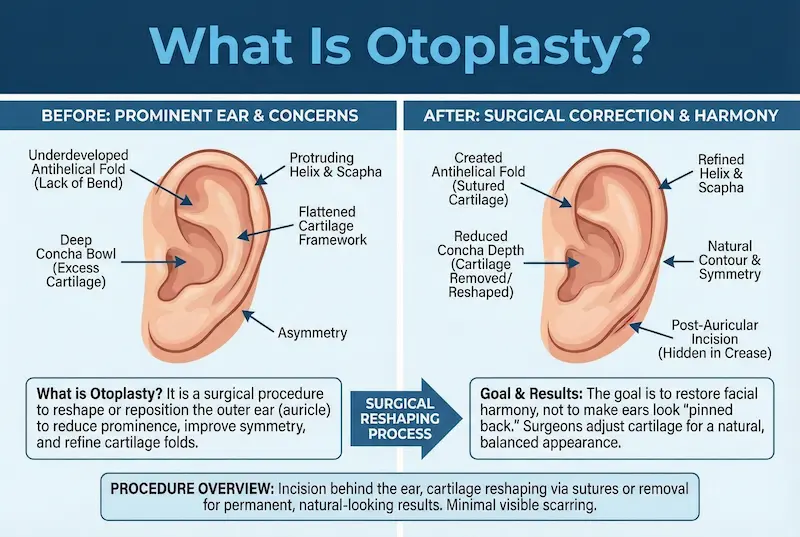
Otoplasty is a surgical procedure that reshapes or repositions the outer ear (the auricle) to reduce prominence, improve symmetry, or refine specific cartilage folds. If your main question is what is otoplasty, the simplest answer is this: it changes ear shape and projection in a controlled, natural-looking way.
Most “prominent ear” concerns come from how the ear cartilage is folded, not from the size of the ear alone. The goal is not to make your ears look “pinned back.” The goal is to restore harmony with your facial features. In practice, surgeons adjust the cartilage and its position so the ears sit closer to the head while keeping a soft, anatomical contour.
Ear anatomy 101: the structures we work with
The visible ear is a complex cartilage framework covered by thin skin. Small changes in cartilage shape can create a big visual difference from the front. A good surgical plan starts by understanding which part of the ear is driving the projection.
- Helix: The outer rim of the ear.
- Antihelix: The inner fold that often appears underdeveloped in prominent ears.
- Concha: The bowl-shaped cartilage near the ear canal; a deep concha can push the ear outward.
- Lobule: The earlobe; it may need subtle repositioning for balanced results.
- Mastoid area: The bony region behind the ear that influences perceived “setback.”
What does otoplasty correct?
Otoplasty can address several aesthetic concerns. Some are obvious in photos. Others show up in real life when you wear your hair up or see your side profile.
- Prominent ears: Excessive outward projection, often from an underdefined antihelical fold or an enlarged concha.
- Asymmetry: One ear sits farther out, sits higher, or has a different fold pattern.
- Cartilage shape irregularities: Overly sharp edges, flat contours, or disharmonious folds.
- Lobule position issues: An earlobe that “kicks out” even after cartilage correction.
How does ear pinning surgery work?
Patients often ask how does otoplasty work in practical terms. In classic techniques, the incision is typically placed behind the ear in the natural crease. That location helps keep visible scarring minimal. From there, the surgeon reshapes cartilage and uses precise sutures and/or cartilage modification to create a more natural fold and reduce projection.
The plan is individualized. Some ears need primarily antihelix refinement, while others need conchal setback. The best results come from an anatomy-first approach: correct the true driver of projection, then fine-tune symmetry. A well-executed otoplasty should look “unnoticed” in everyday life.
What Are The Benefits Of Otoplasty?
The biggest benefit is proportional balance. When the ears sit in a more harmonious relationship to the head, the entire face can look calmer and more symmetrical. The change is focused and structural, not dramatic or artificial. Our guiding philosophy is “Rejuvenation, Not Alteration.”
Facial balance and natural harmony
Prominent ears can visually widen the upper face and pull attention away from your eyes and smile. Otoplasty corrects this by refining projection and contour, so your ears support your facial features instead of competing with them. The goal is an anatomically believable ear shape with smooth transitions between folds.
Natural outcomes come from restraint. We prioritize correct vectors and stable cartilage support over an overly tight “pinned” appearance. That’s what makes results look timeless, not trendy.
Confidence impact in daily life
Many patients describe subtle but meaningful changes in daily behavior after ear surgery. They stop thinking about their ears in photos. They feel more comfortable with hair pulled back. They spend less mental energy on angles, lighting, and hiding.
- More freedom with hairstyles (ponytails, short cuts, updos)
- Less self-consciousness in social settings
- Improved comfort with profile photos and video calls
Realistic “before-and-after” goals
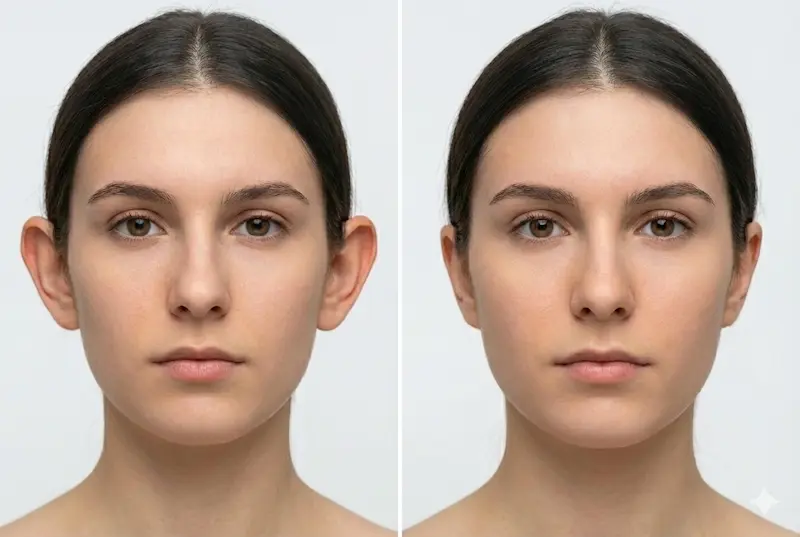
If you’re researching otoplasty before and after images, focus on shape, shadow, and ear-to-head distance from multiple angles. The best comparison sets include front, oblique, and side views in consistent lighting. A realistic goal is improved symmetry and softer prominence, not “mirror perfect” ears. Cartilage has natural variation, and subtle asymmetry exists in every face.
Surgeon’s Insight: The most convincing otoplasty results are the ones you don’t notice at first glance. When the ear shape looks naturally “yours,” the brain stops scanning for a change—and that’s the point.
Am I A Good Candidate For Ear Pinning Surgery?
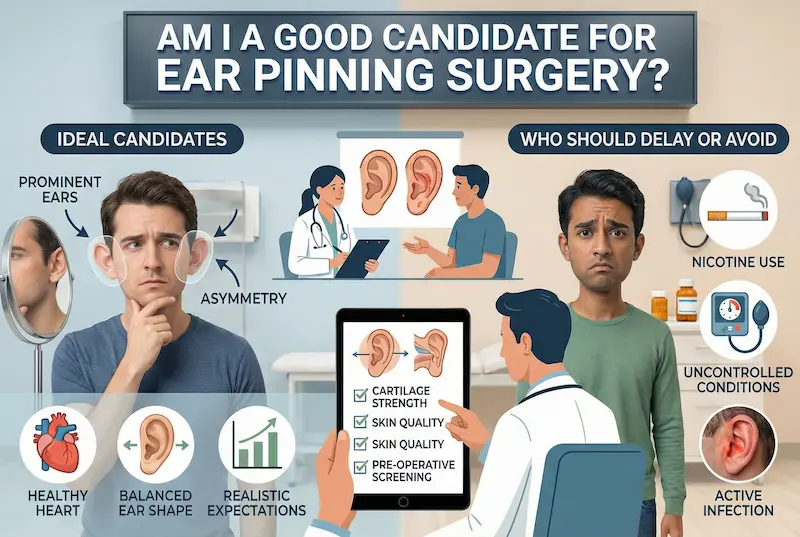
Most people who consider ear surgery are healthy, detail-oriented, and looking for a change that feels natural. Candidacy depends on your ear anatomy, skin quality, cartilage strength, and how your ears sit relative to your head. It also depends on expectations—symmetry improves, but “mirror-perfect” ears are not a realistic goal. We start with strict pre-operative screening and a clear surgical plan so you know what we can achieve before you commit.
Ideal candidates: who benefits most
You may be a strong candidate if your ears project more than you want, or if one ear sits differently than the other. Many patients also have a specific cartilage fold issue that becomes obvious in photos or when they wear their hair up. The best candidates want refinement, not a dramatic change.
- Prominent ears: Often linked to an underdefined antihelical fold and/or an enlarged concha.
- Asymmetry: One ear projects more, sits higher, or has a different fold pattern.
- Stable health: No uncontrolled medical conditions that would increase surgical risk.
- Realistic expectations: A natural contour with improved balance, not an “over-corrected” look.
Who should delay or avoid surgery
Some situations call for waiting. Others require a different medical plan before surgery is safe. This is where an evidence-based consultation matters more than marketing.
- Active skin or ear infection: Surgery should wait until the infection is fully treated.
- Uncontrolled chronic conditions: Blood pressure, diabetes, bleeding disorders, or immune issues must be optimized first.
- Nicotine use: Nicotine can impair healing and raise complication risk; we guide you on a safer timeline.
- Unrealistic goals: If the goal is “perfect symmetry” or an unnaturally tight setback, the plan needs a reset.
Consultation checklist: what we evaluate
A high-quality consult looks at anatomy first, then technique selection. We assess which cartilage structure is driving projection and how stable the correction can be. We also map out your recovery constraints—work, travel, and social downtime—so the plan fits real life.
- Front, oblique, and side evaluation for projection and fold definition
- Cartilage strength and skin thickness (important for technique selection)
- Ear-to-head distance pattern (upper, middle, and lower third)
- Any history of keloids or problematic scarring
- Your timeline for return to work and fitness
Ear Reshaping Techniques: Incisionless vs Traditional Approaches
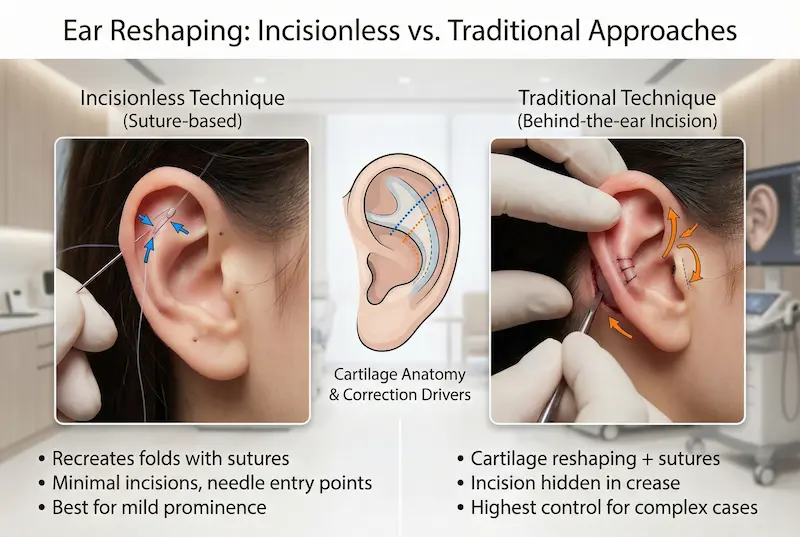
There isn’t one “best” method for every ear. The best plan matches the technique to your cartilage anatomy and the specific driver of prominence. Some ears need fold creation, others need conchal setback, and some need a combination for stable symmetry. When patients compare otoplasty techniques, the smartest question is: “Which method gives me the most natural contour with the lowest chance of relapse for my ear type?”
Suture-based correction: refining folds with controlled support
Suture techniques are designed to recreate or strengthen the antihelical fold without aggressive cartilage cutting. A classic example is the Mustardé technique otoplasty, which uses carefully placed sutures to shape the fold so the ear sits closer to the head. This approach can produce soft, anatomical contours when the cartilage is flexible enough to hold the new shape.
- Best for: Underdefined antihelix, mild-to-moderate prominence
- Key idea: Create a natural fold, not a sharp “crease”
- Often paired with: Conchal correction when the ear bowl is pushing outward
Setback techniques: addressing the concha and overall projection
If the concha is deep or over-projecting, fold work alone may not be enough. In these cases, setback otoplasty focuses on repositioning the conchal cartilage closer to the head. The goal is balanced projection across the upper, middle, and lower third of the ear—so the result looks even from every angle.
- Best for: Prominence driven by a strong conchal push
- Key idea: Reduce “sail-like” projection while keeping a natural rim
- Stability: Often very stable when the true anatomic cause is corrected
Cartilage scoring/cutting: when the cartilage is thick or resistant
Some ears have cartilage that resists bending, especially in adults with firmer cartilage. In these cases, selective scoring or controlled cartilage modification can help the ear hold a refined shape. This is not about being aggressive. It’s about using the lightest effective touch to prevent the ear from “springing back.”
Incisionless ear surgery: who it fits, and where it falls short
Incisionless otoplasty can be appealing because it minimizes external incisions. It typically relies on sutures placed through small needle entry points. The tradeoff is that it isn’t suitable for every anatomy, especially when conchal prominence or thick cartilage drives the projection.
- Best for: Selected cases with mild prominence and favorable cartilage
- Limitations: Less control for complex asymmetry or strong conchal push
- Key question: Is the correction stable for your cartilage type?
Size and shape reduction: when “smaller” is part of the goal
Most prominent ears do not need size reduction. When the ear is genuinely oversized or specific areas need refinement, reduction otoplasty can reshape sections of cartilage and/or address lobule position for better proportion. This is always customized, because over-reduction can look unnatural.
| Approach | Best For | How It Works | Incisions / Scars | Control & Stability |
|---|---|---|---|---|
| Traditional (Behind-the-ear) | Most ear anatomies; moderate-to-complex cases | Cartilage reshaping + sutures; can include conchal setback | Incision hidden in the crease behind the ear | Highest control; typically the most predictable stability |
| Incisionless | Selected mild prominence with favorable cartilage | Suture-based reshaping via small needle entry points | No classic incision; tiny entry points | Lower control in complex anatomy; stability depends on cartilage type |
| Reduction / Reshaping | Oversized ears or specific contour/lobule concerns | Targeted cartilage/skin refinement for proportion | Often combined with hidden behind-the-ear access | High control when carefully planned; avoids “overdone” reduction |
Surgeon’s Insight: The technique is never the headline. The anatomy is. When we correct the true driver of projection—fold, concha, or both—the result looks natural and stays stable.
Can Otoplasty Be Combined With Other Procedures?
Yes, ear surgery can be combined with other aesthetic procedures in the right patient. The key is surgical logic, not “bundling.” We look at your goals, your anatomy, and your recovery capacity, then decide whether combining improves the final harmony without raising risk unnecessarily. When it’s planned well, combining procedures can simplify your calendar and reduce total downtime.
Facial harmony combinations: when it makes sense
Most patients seek otoplasty as a standalone refinement. Still, some choose to combine it with procedures that improve overall balance. The goal is a cohesive result, not multiple “separate” changes.
- Rhinoplasty + ear surgery: A common pairing when profile balance is the main concern.
- Chin refinement (non-surgical or surgical) + ear surgery: Helpful when jawline projection affects overall facial proportion.
- Upper facelift procedures: Selected cases where multiple small refinements create a single, natural-looking improvement.
One anesthesia, one recovery: the practical advantage
Combining procedures can mean one pre-op screening process, one anesthesia plan, and one recovery timeline. That matters if you have limited time away from work, family, or travel. It can also reduce the mental load—one set of instructions, one follow-up schedule, one healing phase to manage. The plan must stay conservative, though. We don’t combine procedures if it compromises safety or predictability.
When combining is NOT recommended
Sometimes, the smartest plan is staging. If your procedure list becomes too long, swelling and fatigue can make recovery harder. If your medical history adds risk, keeping the surgery focused is usually safer. We also avoid combining when it would blur decision-making—if we can’t clearly track which change created which outcome, planning gets less precise.
- Complex medical history that requires a shorter operative time
- High anxiety about recovery or limited support at home
- Multiple high-impact procedures that increase swelling and fatigue together
Is Otoplasty Painful? Anesthesia Options Explained
This is one of the most searched questions for a reason. If you’re asking is otoplasty painful, you’re really asking two things: what you feel during surgery, and what the first week feels like afterward. With a thoughtful anesthesia plan and structured pain control, most patients describe the experience as very manageable. The goal is comfort without over-medication, and safety without unnecessary intensity.
Local anesthesia vs twilight sedation vs general anesthesia
Ear surgery can be performed under different anesthesia pathways, depending on your anatomy, your comfort level, and the complexity of the correction. There is no “one-size” option. We match the plan to the procedure, then confirm it with your medical screening.
- Local anesthesia: Numbs the surgical area. You’re awake, and you should not feel sharp pain.
- Twilight sedation: You’re deeply relaxed and often remember very little. It’s a popular option for comfort-focused patients.
- General anesthesia: Used when medically indicated or when the surgical plan requires it.
Why we often prefer awake or twilight pathways when appropriate
For many patients, local anesthesia with twilight sedation offers an excellent balance. It can reduce anxiety while avoiding the “heavy” feel some patients associate with general anesthesia. It also allows for a smoother immediate post-op period in many cases. Safety comes first, though. If general anesthesia is the safer option for your medical profile or surgical plan, we choose the safer option.
Surgeon’s Insight: Comfort is engineered. When anesthesia, technique, and post-op support work together, patients usually tell us the fear beforehand was bigger than the reality afterward.
Pain control plan: what the first 72 hours really feel like
Most discomfort comes from tightness and pressure, not “sharp pain.” You may feel swelling, warmth, and a pulling sensation, especially with dressings. Sleep can feel awkward for a few nights. We plan for that in advance and give clear, simple instructions so you’re not guessing at home.
- Day 1: Pressure and fullness are common. Rest is the priority.
- Day 2–3: Swelling typically peaks, then begins to settle.
- Medication plan: A structured approach that prioritizes comfort, hydration, and sleep quality.
Step-By-Step: What Happens During Otoplasty Surgery?
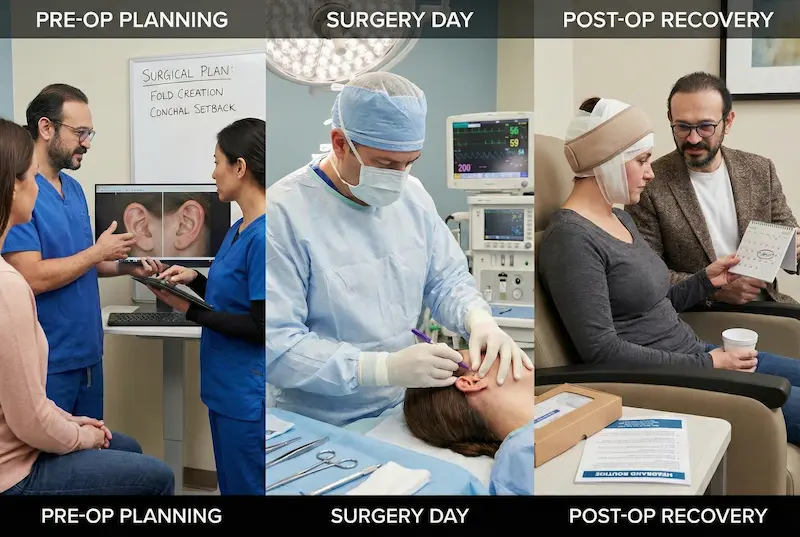
A good result starts before surgery day. We plan your ear surgery around your anatomy, your goals, and your recovery constraints. Then we execute with precision. Simple.
Pre-op screening and planning
We begin with a structured evaluation to confirm you’re a safe candidate and to define the exact correction your ears need. We also align on what “natural” means for you.
- Medical screening: Health history, medication review, and pre-op tests when indicated.
- Photo analysis: Front, oblique, and side views to map projection and asymmetry.
- Surgical plan: Fold creation, conchal setback, lobule refinement, or a combination.
- Anesthesia pathway: Local anesthesia, twilight sedation, or general anesthesia based on your needs.
Surgery day walkthrough
On surgery day, we confirm your plan in person, then mark your ears with you upright. Markings matter. They guide symmetry.
- Preparation: Sterile setup and final “mirror check” of your goals.
- Hidden access: In most classic cases, we place the incision behind the ear within the natural crease.
- Cartilage correction: We reshape folds and/or reduce conchal push using the least aggressive method that delivers stable support.
- Symmetry checks: We measure and fine-tune throughout the procedure.
- Closure: We close carefully to keep the incision discreet and support smooth healing.
Dressings, headband, and the first follow-up
After ear surgery, we apply dressings that protect your new shape. You’ll also use a headband protocol to reduce accidental bending while tissues settle.
- Protective dressing: Helps control swelling and supports early stability.
- Headband routine: We give clear wear-time instructions for day and night.
- Follow-up plan: Early checks are scheduled to monitor healing and catch issues fast.
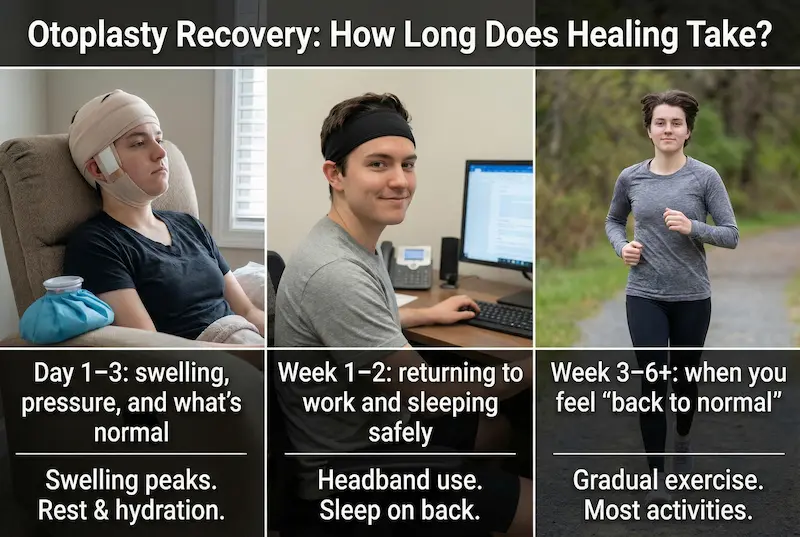
Otoplasty Recovery: How Long Does Healing Take?
Most patients recover faster than they expect. The first week is about protection and swelling control. After that, it’s mostly about patience and smart habits.
Day 1–3: swelling, pressure, and what’s normal
This phase is the most intense, but it’s still manageable. You may feel tightness, warmth, and pressure. That’s common.
- Swelling: Otoplasty swelling usually peaks early, then begins to settle.
- Discomfort: More “pressure” than sharp pain for most patients.
- Activity: Rest, hydration, short walks. No gym.
Week 1–2: returning to work and sleeping safely
Many patients return to desk work within a week, depending on swelling and comfort. This is the phase where protection matters most. One wrong bend can set you back.
- Headband use: Follow our schedule exactly. Consistency protects the result.
- Sleeping: If you’re searching how to sleep after otoplasty, the answer is simple: sleep on your back, elevate your head, and avoid pressure on the ears.
- Hygiene: Keep the area clean and dry based on your instructions.
Surgeon’s Insight: The surgery creates the shape. Recovery protects it. Your headband routine and sleep position are small actions that make a big difference.
Week 3–6+: when you feel “back to normal”
Swelling continues to improve in small steps. Most daily activities feel normal again. Contact sports and heavy pressure still need caution until we clear you.
- Exercise: Light workouts first. Then gradual progression.
- Side sleeping: Usually improves with time, but we clear it based on your healing.
- Scars: Otoplasty scar quality evolves over months, not days.
Our Rapid Recovery & Safety Protocol
We treat recovery like a clinical system, not an afterthought. That’s why we built our Rapid Recovery & Safety Protocol around technologies designed to support healing and reduce “social downtime.”
- Hyperbaric Oxygen Therapy (HBOT): We use HBOT to support tissue oxygenation, reduce inflammation, and strengthen early healing.
- Low-Level Laser Therapy (LLLT): We use LLLT to support cellular repair, help calm redness, and promote smoother recovery.
- Structured follow-up: Clear checkpoints, clear rules, and fast access to our team if something feels off.
If you want a personalized recovery plan and an estimated otoplasty recovery time for your anatomy, we can map it during a virtual consultation.
Safety & Risks: What Can Go Wrong With Otoplasty Surgery?
All surgery has risk. The goal is to minimize it with planning, sterile technique, and disciplined aftercare. We do not gamble with safety.
Common risks (and what they actually mean)
Most risks are uncommon, but you should know them. Transparency builds trust.
- Hematoma: A blood collection that may require drainage if significant.
- Infection: Typically treatable early; this is why follow-ups matter.
- Asymmetry: Small asymmetry is normal in human anatomy; larger differences are preventable with careful planning.
- Recurrence: Cartilage can “remember” its old shape, especially if the wrong technique is chosen for your cartilage type.
- Scar concerns: Usually hidden behind the ear, but healing varies by skin biology.
- Numbness or sensitivity: Often temporary while nerves settle.
How we reduce risk
Risk reduction is a process. We execute it step by step.
- Strict screening: We identify red flags early and optimize your readiness.
- Zero-compromise sterility: Multi-stage sterilization protocols and controlled operating conditions.
- Technique selection: Anatomy-first decisions to improve long-term stability.
- Recovery protocol: Supportive therapies and structured follow-up to catch problems early.
Red flags: when to contact us immediately
Do not “wait it out” if something feels wrong. Reach out.
- Sudden swelling on one side or rapidly increasing pain
- Active bleeding soaking the dressing
- Fever, chills, or worsening redness
- Foul-smelling drainage or a new open area near the incision
Is Otoplasty Safe In Turkey?
If you’re researching otoplasty in Turkey, the smartest way to judge safety is to ignore hype and evaluate systems. Safety is not a country. It’s a clinical standard, a surgical team, and a recovery protocol that is followed without shortcuts.
Clinical standards and patient privacy: what “safe” actually means
For an international patient, safety includes medical quality and operational discipline. We run strict pre-operative screening, use modern patient monitoring, and follow rigorous sterilization standards. Privacy matters too, especially if you’re a public-facing professional.
- Pre-op screening: We confirm candidacy and reduce avoidable risk before surgery.
- Operating standards: Controlled environment, modern monitoring, and a sterile surgical workflow.
- Confidentiality: We maintain USA-standard patient confidentiality and data security protocols.
Hospital access and materials: what an Expert Patient should verify
Serious outcomes require serious infrastructure. When the plan calls for hospital-level resources, we operate in fully accredited settings and use quality-controlled materials. The question isn’t “Is it cheaper?” The question is “Is it built like a system I can trust?”
- Accredited facilities: Access to JCI-accredited hospitals when clinically indicated.
- Materials: We use FDA-approved materials where applicable to the procedure plan.
- Documentation: Clear, written instructions and follow-up checkpoints.
Continuity of care after you return to the US
International care only works when follow-up is structured. We build continuity into the plan from day one. That includes scheduled virtual check-ins and fast access to our team if you have a question.
- Virtual follow-ups: 1, 3, 6, and 12-month checkpoints to monitor healing.
- Clear escalation rules: You know what’s normal, and what’s not.
- Coordination support: A dedicated host helps you stay organized throughout recovery.
If you’re comparing otoplasty surgery Turkey options, focus on consistency: screening, standards, technique selection, and follow-up. That’s where real safety lives.
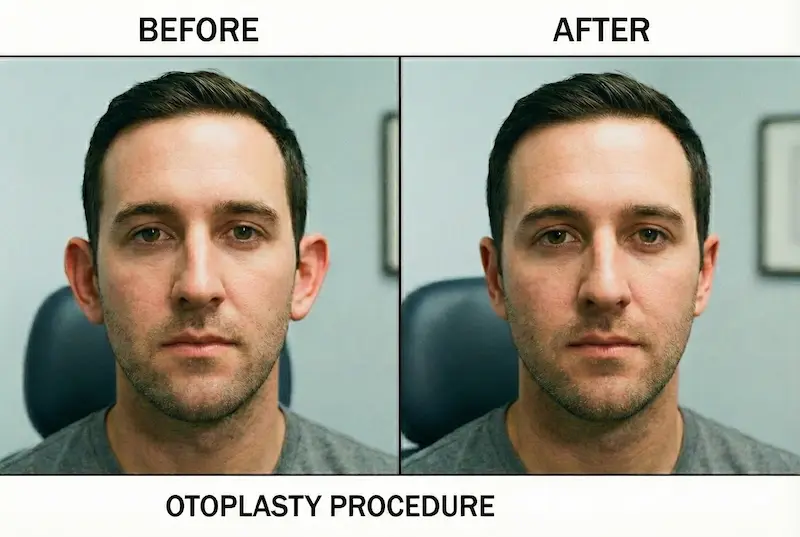
Otoplasty Before And After: Realistic Expectations & Results
Great results look quiet. They don’t announce themselves. They simply make the face feel more balanced. That’s the standard we aim for.
Symmetry vs perfection: the result you should actually want
Human faces are not perfectly symmetrical. Neither are ears. A good plan reduces the asymmetry that bothers you while keeping the ear anatomy believable.
- Realistic goal: Improved balance from the front and a softer profile projection.
- Not the goal: A rigid, identical “copy-paste” ear shape.
- Key success marker: The ear looks natural in motion and in candid photos.
Surgeon’s Insight: The best ear surgery results aren’t “tight.” They’re anatomically correct. When the fold and projection look like they’ve always belonged to your face, the outcome feels effortless.
Scar placement and how it matures
In classic otoplasty, the incision typically sits behind the ear within the natural crease. That keeps it discreet. Scar quality improves gradually, not instantly.
- Early phase: Mild redness and firmness are normal while tissues settle.
- Mid phase: The scar softens and fades over the following weeks and months.
- Long term: With good healing biology and proper care, it becomes difficult to notice.
When do you see final results?
You’ll see a meaningful change immediately after surgery, even with swelling. The refined contour becomes clearer as inflammation settles and the cartilage stabilizes. Most patients notice the biggest visual “drop” in swelling during the first few weeks, then slower refinement afterward.
- First 2 weeks: Swelling and sensitivity are the main story.
- Weeks 3–6: Shape looks more natural; daily life feels easier.
- 3+ months: Subtle refinements continue as tissues fully mature.
What “natural” means in practice
Natural results require restraint. We avoid over-correction and we protect the ear’s soft curves. Our philosophy is simple: “Rejuvenation, Not Alteration.”
If you’re planning otoplasty Istanbul, a virtual consult can help you understand what’s realistic for your exact ear anatomy before you travel.
How To Find The Best Otoplasty Surgeon
Choosing a surgeon for ear reshaping is not about hype. It’s about evidence. Your goal is to reduce risk, protect natural anatomy, and get a stable result that looks like it has always belonged to your face. That requires technique selection, precision, and a team that follows a strict safety system. We built our process for the “Expert Patient” who wants the clearest possible answers before booking.
Credentials and specialization: what matters most
Start with verified training and a focused surgical skill set. Ear cartilage behaves differently than skin. It needs an anatomy-first plan and long-term stability thinking.
- Board-level qualifications: Look for surgeons with European Board credentials and advanced facial plastic surgery training.
- Procedure focus: Ask how often they perform ear surgery and what ear anatomies they handle most.
- Facility standards: Confirm that surgery is performed in a fully accredited environment with modern monitoring.
Technique transparency: “Why this method for my ear?”
A high-quality consultation should feel like a clinical diagnosis, not a sales pitch. Your surgeon should explain what drives your prominence (fold, concha, lobule, or a mix), then justify the method. This is where you’ll hear the difference between a generic plan and a tailored plan.
- Ask whether your ear needs fold creation, conchal setback, or both.
- Ask how cartilage strength affects relapse risk.
- Ask what “natural” means in measurable terms (projection pattern across the ear’s thirds).
Surgeon’s Insight: The safest plan is the one that matches anatomy. When we choose the lightest technique that still delivers stable support, the result looks natural and holds.
Proof of quality: how to read results like an Expert Patient
Before-and-after photos are useful only if they are consistent. Look for standardized angles, similar lighting, and multiple views. Then evaluate contour, not just “distance.”
- Front view: Do the ears look balanced without looking flattened?
- Oblique view: Is the rim still soft and anatomical?
- Side view: Is the setback even, not over-tight in the upper third?

Cost Analysis: Otoplasty Cost 2026 (Turkey vs USA)
Most patients start with one question: how much does otoplasty cost? The better question is: what does that number include, and what does it protect you from? In the US, pricing is often driven by overhead and regional operating costs. In Istanbul, the value advantage is usually driven by macroeconomics and lower operational costs—not by cutting corners. Our job is to make the comparison transparent, so you can judge value like an Expert Patient.
What drives cost in any country?
Ear surgery pricing is not one fee. It’s a system of components. When quotes look “too simple,” details are usually missing.
- Surgeon fee: Expertise, technique complexity, and planning time.
- Facility + operating room: Standards, monitoring, staffing, sterility.
- Anesthesia: Local, twilight sedation, or general anesthesia based on your plan.
- Post-op care: Medications, garments/headband, scheduled follow-ups.
Turkey vs USA: comparing the system (not the headline number)
If you’re comparing otoplasty cost NYC, otoplasty cost Los Angeles, or otoplasty Miami cost to Istanbul, focus on what you get end-to-end. We position Istanbul as the smarter, high-value choice because the same quality standards can be delivered with a different cost structure.
| Cost Component | Typical USA (NYC / LA / Miami) | Istanbul (AKM Clinic-style model) |
|---|---|---|
| Surgeon fee | Often highest driver; regional demand impacts pricing | High expertise with a different overhead structure |
| Facility & OR fees | High hospital/ASC operational costs | Lower national operational costs; strict standards maintained |
| Anesthesia | Varies widely; general anesthesia can increase total cost | Awake / twilight pathways often help optimize comfort and efficiency when appropriate |
| Medications & garments | Frequently itemized separately | Typically included as part of a transparent all-inclusive plan |
| Follow-up structure | Often local visits; patient handles logistics | Structured long-term virtual follow-up built into the journey |
| Travel & hotel | Not applicable for local care | Often integrated with VIP transfers and 5-star hotel options |
What’s included in our all-inclusive plan (and what isn’t)
Transparency is part of safety. We prefer a clear, all-inclusive structure so you can plan without hidden variables. Your exact inclusions depend on your surgical plan, but the model is consistent.
- Typically included: your complete procedure, anesthesia & operating room fees, all pre-op tests, 5-star hotel accommodation, VIP airport & clinic transfers, post-op medications & garments, first post-op meal, and long-term virtual follow-up care.
- Typically not included: international flight tickets, personal travel insurance, visa fees (if applicable), personal expenses, and extra hotel nights if you extend your stay.
Is otoplasty covered by insurance?
Insurance coverage depends on your policy and the reason for surgery. Many plans treat ear pinning as cosmetic and do not cover it. In selected cases—especially when there is a documented functional or reconstructive element—coverage may be possible. We recommend confirming directly with your insurer and requesting written criteria before making assumptions.
If you want a tailored quote, we provide a transparent plan after a virtual consultation, based on your anatomy and the technique needed. That’s how you compare otoplasty price with confidence.
Your Medical Journey: What To Expect From The US To Istanbul
Planning surgery abroad should feel structured, not stressful. You should know exactly what happens first, what happens next, and who is responsible for each step. That’s why we built a VIP journey designed for international patients who want clarity, privacy, and consistency. You handle your flight. We handle the rest.
Step 1: Start from home with a virtual consultation
Your journey begins with a free video call. You share your goals, we review photos, and we give you a personalized plan with a transparent, all-inclusive quote. No pressure. Just answers.
Step 2: Secure your date and let us run VIP planning
Once you decide to proceed, your dedicated Patient Host coordinates your schedule. We book your 5-star hotel from our curated partner list and arrange VIP transfers. You simply book your international flight ticket.
Step 3: Arrival, procedure day, and recovery support
When you land, a private driver meets you at the arrivals gate with a sign showing your name and escorts you to a private luxury vehicle. On procedure day, we confirm your plan in person with our surgical team, complete any necessary pre-op tests, and perform your surgery in our fully accredited facility. Afterward, we monitor you closely and keep support simple: your Patient Host is available 24/7 via WhatsApp while you recover in Istanbul. Before you fly home, you come in for a final in-person check-up to ensure you’re cleared to travel.
- VIP airport welcome: meet-and-greet + private transfer
- In-person surgical confirmation: final planning review before surgery
- Post-op monitoring: structured checks and clear recovery rules
- 24/7 support: direct access to your Patient Host via WhatsApp
- Final clearance visit: a last check-up before departure
What’s included in our VIP package (and what isn’t)
Expert Patients don’t compare “headline prices.” They compare what’s actually covered. Our model is designed to be transparent, so you can plan with confidence.
- Typically included: your complete procedure, anesthesia and operating room fees, all pre-op tests, 5-star hotel accommodation, VIP airport and clinic transfers, a 24/7 dedicated Patient Host, post-op medications and garments, your first post-op meal, and long-term virtual follow-up care.
- Typically not included: international flight tickets, personal travel insurance, personal expenses (such as meals beyond the first post-op meal), visa fees (if applicable), and additional hotel nights if you extend your stay.
Long-term follow-up after you return home
Distance should never mean “abandoned.” It doesn’t with us. Your Patient Host schedules virtual follow-ups with the surgeon at 1, 3, 6, and 12 months to monitor healing and answer questions as your result settles.
If you want a fast, structured start, begin with a virtual consultation. We’ll confirm candidacy, recommend the right technique, and map a travel timeline that fits your life.
Frequently Asked Questions About Ear Surgery (FAQ):
These are the questions we hear most from US patients who do deep research before committing. Use them as a checklist. If your question isn’t here, bring it to your consultation. We prefer specifics.
How long do results last?
For most patients, results are long-lasting. The ear cartilage is reshaped and supported into a more balanced position. Long-term stability depends on choosing the right technique for your cartilage strength and following recovery instructions closely in the first weeks.
How many days should I plan to stay in Istanbul?
Plan enough time for surgery, early checks, and a final clearance visit before flying home. We’ll recommend the best timeline based on your surgical plan and your travel needs. If you searched otoplasty Istanbul, this planning phase is what turns “interest” into a safe, organized medical journey.
Is incisionless otoplasty right for me?
Sometimes. It can be a fit for selected mild cases with favorable cartilage. It is not ideal when conchal prominence or thick cartilage is the main driver of projection. We confirm candidacy by analyzing which structure is causing your prominence, then recommending the most stable option.
I searched otoplasty near me. Should I still consider traveling?
That depends on what you value most. If you want local convenience, a nearby surgeon can make sense. If you want a structured, all-inclusive system with optimized recovery support and a predictable process for international patients, traveling can be the smarter choice. The right decision is the one that matches your priorities: quality proof, surgeon-led planning, and a recovery plan you can actually follow.
I’m comparing New York and Miami surgeons. What should I focus on?
If you typed best otoplasty surgeon nyc or otoplasty surgeon miami, don’t stop at reviews. Ask for technique logic. Ask how they handle conchal prominence versus fold creation. Ask how they reduce relapse risk. That’s how Expert Patients separate marketing from clinical thinking.
When can I fly home after surgery?
We clear travel after we see you for a final check-up and confirm recovery is progressing normally. Flying is usually straightforward when swelling is controlled and you’re following your protection plan. We’ll give you travel-specific instructions so you know what to do in the airport, on the flight, and during the first nights back home.
How do virtual follow-ups work after I return to the US?
We schedule structured virtual check-ins at 1, 3, 6, and 12 months. You share photos, we review healing milestones, and we answer practical questions as your tissues mature. It’s a simple system designed to keep care continuous across borders.
Is an all-inclusive plan “lower quality” than the US?
No. The price difference is typically explained by macroeconomic factors, including the USD-to-TRY exchange rate and lower national operational costs, not by cutting corners. We reinforce quality by using FDA-approved materials and operating in JCI-accredited hospitals that meet or exceed Western standards when hospital-level resources are clinically indicated.
Medical Disclaimer: This content is provided for educational purposes only and has been reviewed by the AKM Medical Board. It does not replace medical advice, diagnosis, or treatment. Every patient is different. A consultation with a qualified medical professional is required to determine the safest and most appropriate treatment plan for you.