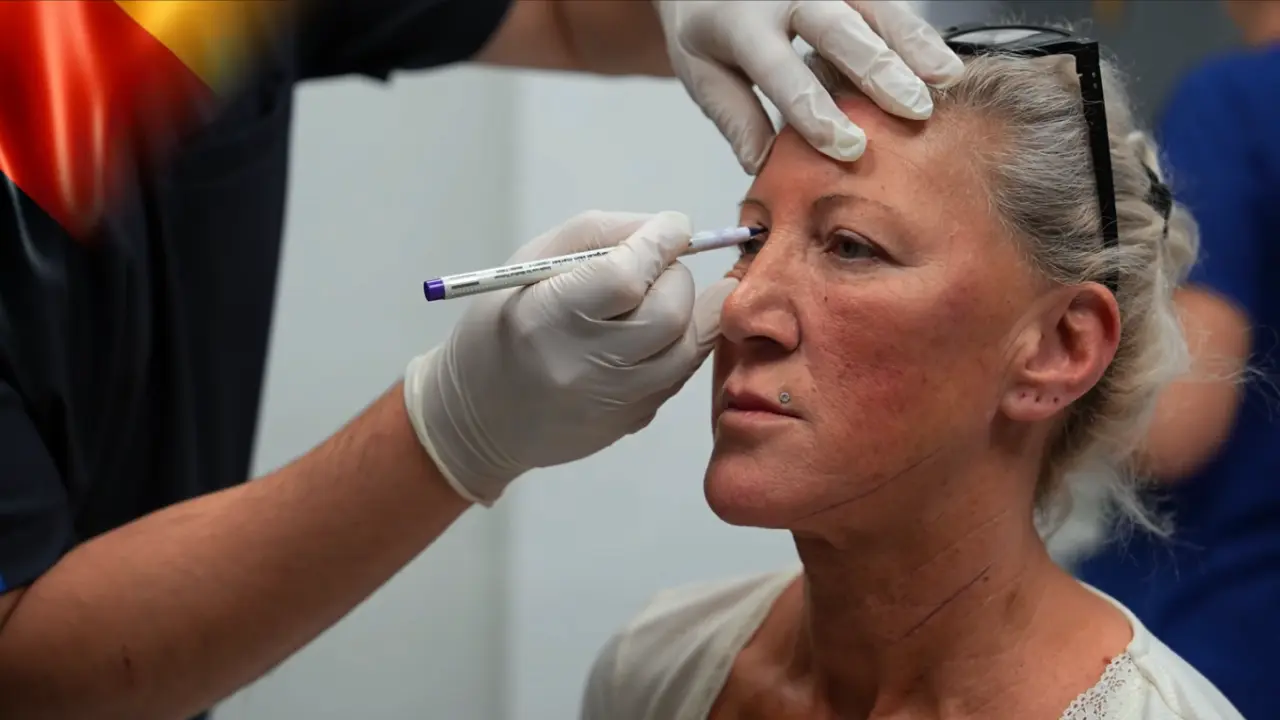





A mid facelift is a targeted facial rejuvenation surgery that lifts the descended cheek fat pad and repositions mid-face support to soften nasolabial folds and restore under-eye-to-cheek contours. It focuses on the central face—not the jawline—creating a rested, natural look. In skilled hands, it refreshes expression without changing identity.
“The most successful aesthetic surgery is one that goes unnoticed.”
Table of Contents
What Is a Mid Facelift?
If you’re searching “what is a mid facelift,” you’re usually noticing the same pattern: the cheeks look flatter, the under-eye area looks heavier, and the face reads tired even when you feel fine. This isn’t just “loose skin.” It’s a shift in support and volume in the mid-face, where the cheek fat pad and surrounding soft tissue gradually settle lower and change how light hits the face.
A mid facelift addresses that shift by repositioning deeper cheek structures—so the mid-face looks supported again, not simply “tightened.” If you want a clear clinical overview, the simplest way to think about it is this: the procedure restores mid-face architecture to soften the under-eye-to-cheek transition and reduce mid-face heaviness, while keeping your identity and expression intact. Done well, it refreshes contour and light reflection subtly—more “well-rested” than “surgically changed.”
Mid-Face Aging: Why Cheeks Start to Look “Heavy”
The mid-face changes in a predictable way over time. The cheek fat pad can descend, and the soft tissues that once sat higher on the cheekbone settle lower. When that happens, the transition from the lower eyelid to the cheek becomes less smooth. Nasolabial folds can look deeper, even if your skin quality is still good.
- A “tired” look that makeup can’t fix
- Flattening in the upper cheek
- Heaviness or shadowing around the mid-face
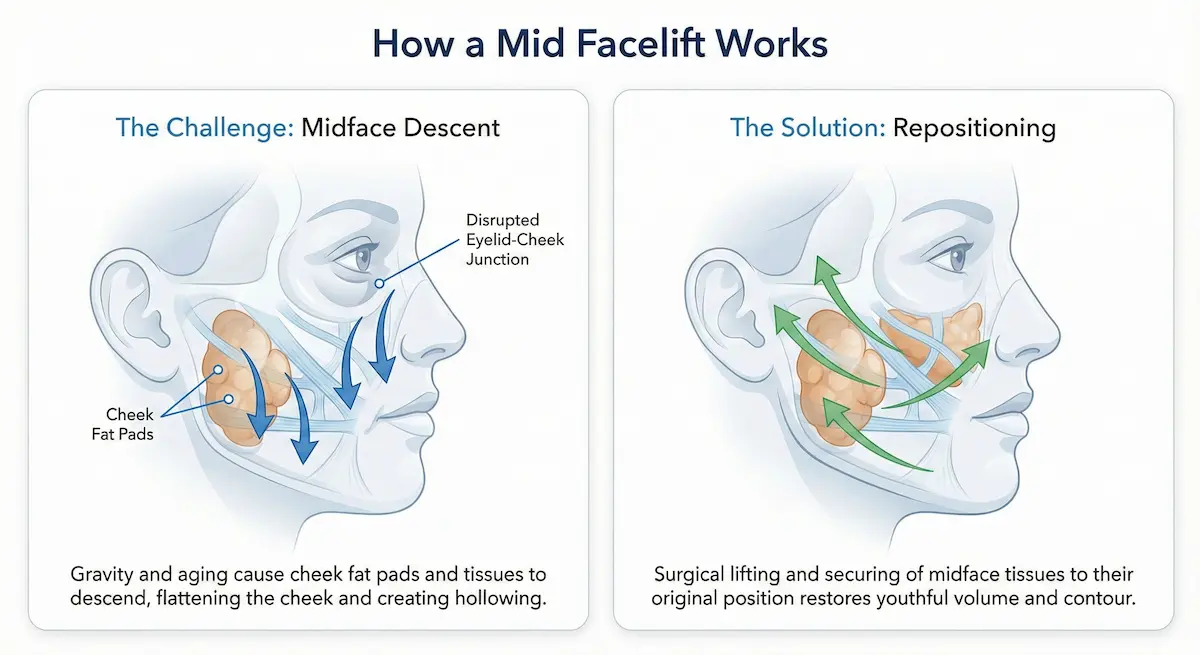
What the Surgery Targets (and What It Leaves Alone)
The goal is precision. A mid-face lift focuses on the cheek and central face to create lift where it matters most. It does not try to “tighten everything.” That’s why it can be a strong option for patients whose primary concern is mid-face descent rather than jawline laxity.
In a typical mid facelift procedure, our Facial Plastic Surgery Experts plan the lift around your anatomy and aesthetic goals. The exact approach varies by technique, but the intent stays the same: restore support to the mid-face while keeping your expression and proportions intact.
Mid Facelift vs “Cheek Lift”: Clearing Up the Terminology
You’ll see “mid facelift,” “mid-face lift,” and “cheek lift” used interchangeably online. That creates confusion. In practice, the best way to evaluate any recommendation is to ask two questions:
- What anatomical layer is being lifted? Skin-only tightening is not the same as repositioning deeper support.
- What area is being treated? Mid-face rejuvenation is different from jawline and neck correction.
Clear language matters because it helps you compare options honestly—especially when you’re weighing a mid-face lift against a mini facelift or a full facelift later in your research journey.
Benefits of a Mid-Face Lift: What Changes (and What Shouldn’t)
A mid-face lift is not about making you look “done.” It’s about restoring what aging has shifted. The best results look quiet. Friends may notice you look rested, not different. Our benchmark is simple: your face should still look like you—just less fatigued.
Mid-Face Lift for Sagging Cheeks: The Core Aesthetic Win
When sagging cheeks are the main issue, this is where a mid-face lift can deliver the most value. Elevating cheek support can reduce the visual weight of the mid-face and soften the appearance of nasolabial folds. It can also improve the contour at the cheekbone area, bringing back definition that’s often lost with time.
Natural Aesthetics: Avoiding the “Pulled” Look
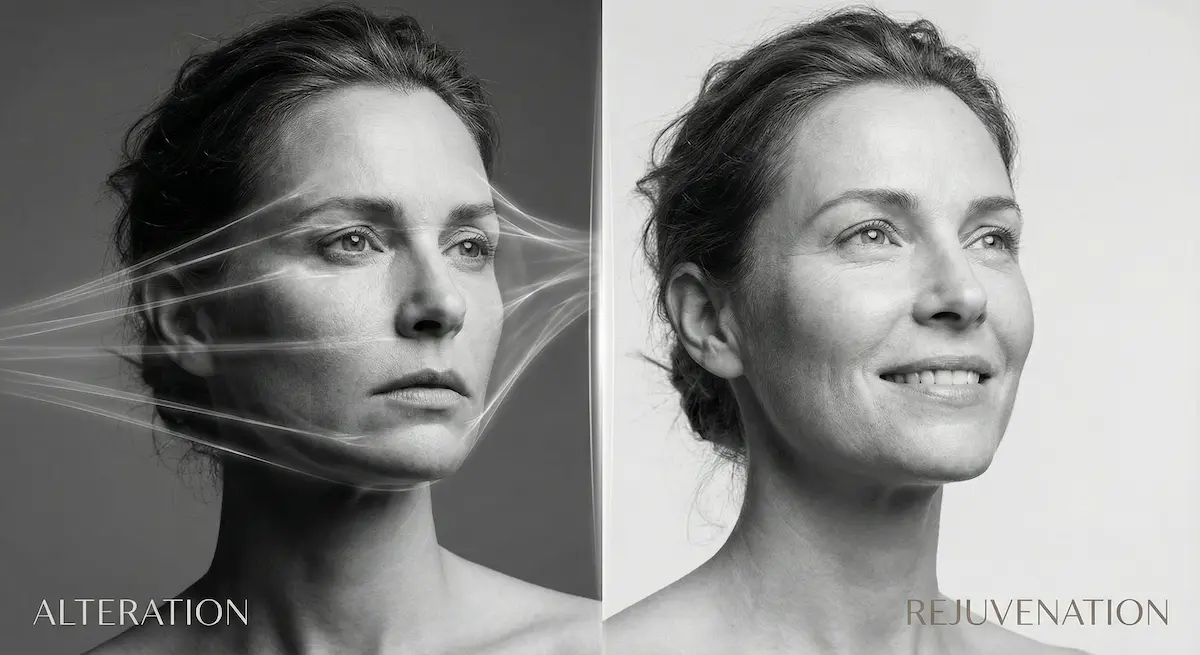
The fear is real. Nobody wants a tight, stretched, wind-swept result. Natural outcomes come from respecting facial anatomy and choosing an approach that lifts support, not just skin. That’s why we build every plan around the principle of Rejuvenation, Not Alteration.
- Lift should follow anatomy, not trends
- Improvement should be proportional, not extreme
- Your unique facial character should remain intact
What a Mid-Face Lift Won’t Fix (So Expectations Stay Realistic)
This procedure is powerful, but it’s not universal. If your primary concern is significant jowling, jawline blurring, or neck laxity, a mid-face lift alone may not be enough. If your main issue is skin texture, sun damage, or fine lines, you may need complementary treatments rather than more lift.
Expert patients do best when they define the outcome they want in plain terms—then match the procedure to that goal. We’ll help you do that during a structured consultation, using a plan that prioritizes safety, precision, and a natural result.
Am I a Good Candidate for a Mid Facelift?
Good outcomes start with one thing: the right indication. A mid-face lift is highly effective when the primary problem is mid-face descent, not just surface-level skin looseness. If your concern is “sagging cheeks” or a tired under-eye-to-cheek transition, you may be in the ideal window for this procedure. If your main issue is jawline and neck laxity, a different plan may make more sense.
Ideal Candidate Profile: Who Benefits Most
Most expert patients who consider a mid-face lift share a similar pattern of concerns. They notice that the cheek looks lower and flatter, and nasolabial folds look more pronounced because mid-face support has shifted. They often say they look “exhausted” in photos, even when they feel fine. The best candidates want improvement, not reinvention.
- Mid-face heaviness or descent with cheek flattening
- Deepening nasolabial folds driven by cheek descent
- A “tired” look around the cheeks and under-eye transition
- Stable weight and realistic expectations
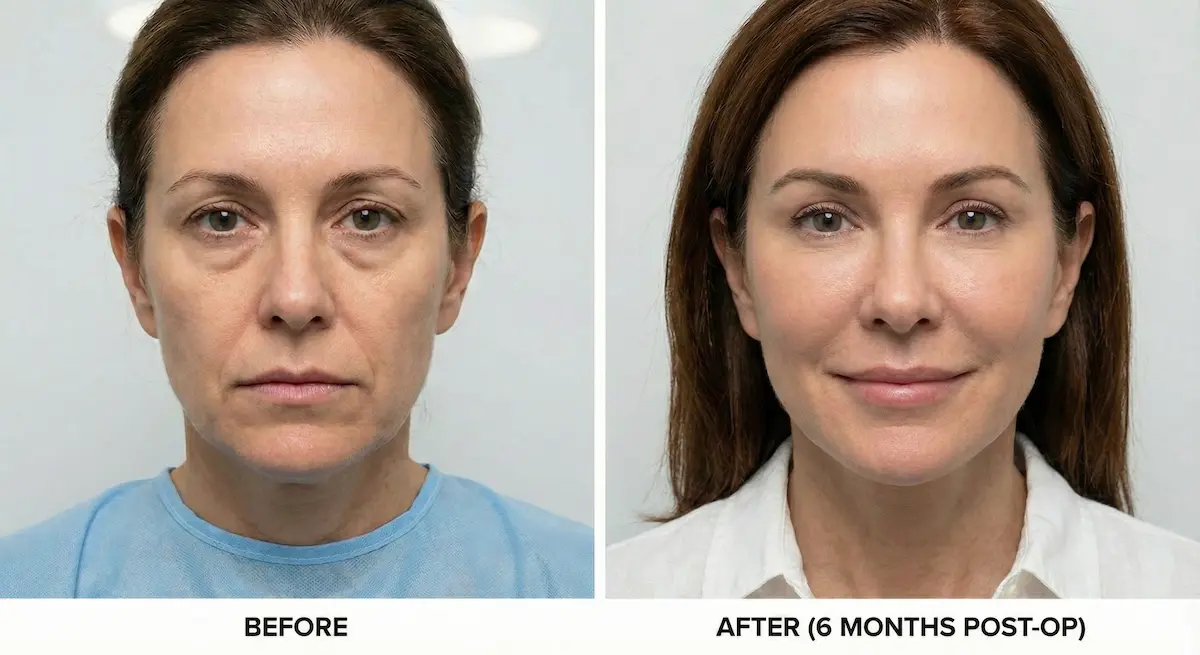
Who Should Avoid or Delay Surgery
Not everyone should move forward right away. Some patients need medical optimization first, and others simply need a different procedure to match their anatomy. Safety comes first, always. When risk factors are present, the smartest decision is often to delay, correct the risk variable, and proceed with a safer surgical plan.
- Uncontrolled medical conditions or poor surgical candidacy
- Active smoking or nicotine use (risk to healing and scar quality)
- Expectations focused on “perfection” or dramatic identity change
- Primary concern is neck/jawline laxity rather than the mid-face
Choosing the Right Scope: Mid Facelift vs Mini Facelift vs Full Facelift
Many patients arrive comparing options. That’s smart. The key difference is the “zone of correction.” A mid facelift vs mini facelift comparison usually comes down to whether your dominant issue is central cheek descent or early lower-face laxity.
A mid facelift vs full facelift decision depends on how much of the face needs structural repositioning. If the jawline and neck are a major part of your complaint, a comprehensive approach often produces a more coherent, natural result than trying to “patch” one area. For some anatomies, a targeted mid-face lift can be the perfect surgical precision; for others, it’s simply not enough.
“The best plan isn’t the biggest plan. It’s the plan that matches your anatomy.”
Surgical Techniques Explained: Endoscopic vs Deep Plane Approaches
Technique is not marketing. It’s mechanics. An expert patient should understand what is being lifted, what is being released, and why that matters for longevity and natural aesthetics. The mid-face can be approached through different modern strategies, and the “best” choice is anatomy-dependent. Our job is to match the method to your tissue quality, aging pattern, and risk profile.
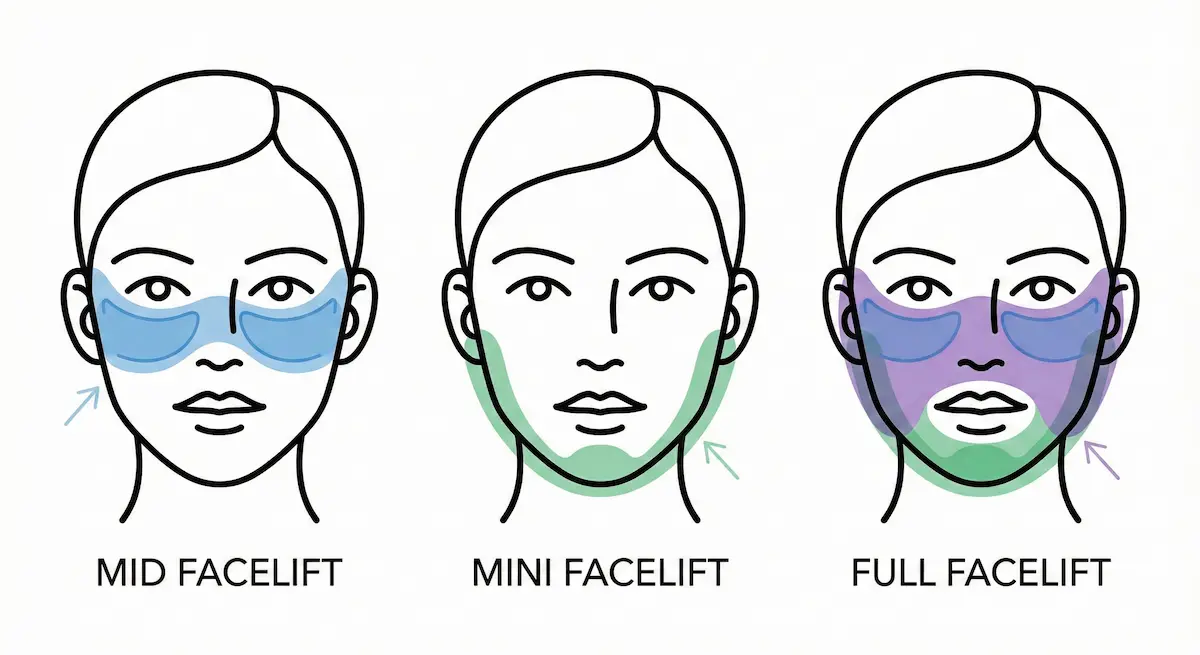
Endoscopic Mid Facelift: Precision With Smaller Access
An endoscopic mid facelift uses specialized visualization to work through smaller access points, aiming for controlled mid-face elevation with reduced surface disruption. It can be an excellent option when the primary goal is lifting mid-face soft tissue and improving cheek position without addressing extensive lower-face laxity. The trade-off is that it is not designed to correct significant jowling or neck changes. Think “targeted engineering,” not “full remodeling.”
Deep Plane Mid Facelift: Structural Repositioning for the Right Patient
A deep plane mid facelift focuses on repositioning deeper support rather than relying on skin tension. This matters because skin-only tension is where unnatural outcomes begin. When the deeper layers are addressed properly, the lift can look softer, more anatomical, and more durable. If you’re researching mid facelift vs deep plane facelift, the real question is whether your mid-face requires deeper release and vertical repositioning, or whether a more limited approach is sufficient.
Special Scenarios: Mini, Revision, and Male Mid-Face Lift Planning
Some patients need a customized plan that doesn’t fit a single label. A mini mid facelift approach may be appropriate for earlier changes where a subtle mid-face correction is enough. A revision mid facelift requires extra caution and strategy because prior surgery can change tissue planes and healing dynamics.
A male mid facelift plan must respect male facial proportions and avoid feminization. The goal is not “lifted.” It’s stronger structure and a rested look, while preserving masculine angles and natural hairline patterns.
| Approach | Best For | Core Strength | Key Trade-Off | Recovery Notes |
|---|---|---|---|---|
| Endoscopic | Targeted mid-face descent with limited lower-face laxity | Precision through smaller access and controlled elevation | Not designed to correct significant jowls/neck laxity | Swelling and bruising still occur; downtime varies by anatomy |
| Deep Plane (Mid-Face Focus) | Patients needing deeper structural repositioning for natural longevity | Tension-free, anatomical lift by addressing deeper support | Higher technical demand; must be done by true facial experts | Recovery is individualized; natural results depend on tissue handling |
| Mini / Limited Mid-Face Strategy | Early-stage descent, subtle correction goals | Conservative improvement with a smaller scope | May under-correct if descent is more advanced | Often shorter downtime, but still requires realistic timelines |
| Revision Strategy | Prior facelift patients with persistent mid-face concerns | Customized planning to account for altered anatomy | Higher complexity and stricter candidacy screening | Recovery can be less predictable; follow-up matters |
“Technique is only half the story. Tissue respect is the other half.”
Anesthesia: Why We Prefer Awake/Twilight Sedation
Anesthesia is not a minor detail. For many expert patients, it is the decision-making hinge—especially if you’ve read “botched” stories or you’ve had a difficult experience with general anesthesia in the past. We take that seriously. When it is medically appropriate, we prefer Awake Surgery using awake/twilight sedation to reduce fear, improve comfort, and support a smoother early recovery.
Awake/twilight sedation is not “white-knuckling” through surgery. You are kept calm and comfortable, while we maintain a safety-first environment with continuous monitoring. The goal is simple: make the experience less stressful without compromising surgical precision.
What Awake/Twilight Sedation Means in Real Life
In practice, “awake” does not mean alert and anxious. It means you are not placed under deep general anesthesia. Many patients describe it as drifting in and out of sleep, with little memory of the procedure. Your comfort remains the priority, and our team adjusts the plan around your medical profile and anxiety level.
- Calm, controlled sedation tailored to the individual
- Local anesthesia for targeted numbness and comfort
- Continuous vitals monitoring throughout the procedure
Why This Matters for Safety and Peace of Mind
Skeptical patients often ask one direct question: “What reduces risk?” We answer with systems, not slogans. When awake/twilight sedation is appropriate for the case, it can reduce the fear burden around general anesthesia and make the overall experience feel more manageable—especially for patients who have avoided surgery for years because of anesthesia anxiety.
Our testimonial analysis repeatedly highlights this advantage: the option to perform major facial procedures under local anesthesia (“Awake Surgery”) is described as a decisive factor for patients with strong fear of general anesthesia, and it is associated with a better recovery experience in those accounts.
“If anesthesia fear is the barrier, we focus on a plan that keeps you calm, monitored, and in control—without compromising precision.”
Who May Not Be a Candidate for Awake/Twilight Sedation
Not every patient—and not every surgical plan—is a fit for awake/twilight sedation. Your medical history matters. Your anatomy matters. The complexity of the planned work matters. If we believe general anesthesia is the safer option for your case, we tell you clearly and explain why. Safety is not a preference. It is the standard.
- Complex medical histories that require a different anesthesia strategy
- Patients who cannot tolerate the awake setting, even with sedation
- Cases where the surgical plan is better supported under general anesthesia
Step-by-Step: What Happens During Surgery Day?
Expert patients do better when the process is predictable. You should know what happens first, what happens next, and what is considered “normal” in the first hours after surgery. We run your experience as a structured pathway: medical screening, surgical planning, procedure day, and recovery support. The purpose is to reduce uncertainty and keep the focus where it belongs—on a safe, natural outcome.
You won’t be left guessing about logistics, either. Our VIP system is designed to remove friction for international patients, including coordinated transfers, hotel planning, and long-term follow-up once you return home.
1) Pre-Op Testing and Surgical Planning
Before surgery, we complete pre-operative tests and screenings to confirm candidacy and reduce avoidable risk. We then finalize the surgical plan based on your anatomy and your goal: looking well-rested, not surgically altered. Planning is where natural results begin. It is also where expert patients feel the most reassured—because decisions are explained, not rushed.
- Pre-operative tests and health screening
- Personalized surgical roadmap based on your facial structure
- Clear expectations around likely change, limits, and recovery pace
2) Procedure Day: What You’ll Actually Experience
On the day of surgery, your comfort and safety are managed by a coordinated team. Our European Board Certified Surgeons lead the surgical plan, and our clinical staff monitors you closely throughout the procedure. If awake/twilight sedation is part of your plan, you’ll be kept calm and comfortable while we maintain a high-control operating environment.
After surgery, the focus shifts quickly to protection and stability. You will receive your post-operative medications and any required garments, plus practical instructions for the first night and first week. Small steps matter here. Recovery is built on consistency.
3) First Hours After Surgery: Support, Transfers, and Follow-Up
The immediate post-op period is when international patients often feel the most vulnerable. That’s why we build support into the system: coordinated transfers, a dedicated patient host for guidance, and a structured follow-up plan. Your goal in the first hours is not to “test” your result. It’s to rest, hydrate, and let your tissues settle.
- VIP airport and clinic transfers for a frictionless experience
- A dedicated patient host available 24/7
- Long-term virtual follow-up care after you return home
Mid Facelift Incisions and Scars: What to Expect
Two of the most searched questions are mid facelift incisions and mid facelift scars—because expert patients want a predictable, discreet outcome. That’s exactly the right mindset. Scar visibility is not determined by “luck.” It’s shaped by incision design, tissue handling, closure technique, your biology, and your post-op discipline.
Mid Facelift Incisions: Where They Can Be Placed
Incision placement depends on the technique used and your anatomy. A mid facelift is typically designed to keep access points discreet and aligned with natural creases or hair-bearing areas when possible. During consultation, we explain the approach we recommend and why—so you can evaluate the plan logically, not emotionally.
- Hairline/temple access (common in endoscopic-style strategies): designed to hide scars in hair-bearing regions.
- Lower eyelid–adjacent access (in select plans): can provide direct mid-face access, but requires precise technique and candidacy screening.
- Combined approaches: occasionally used when your goals require more than one access point.
The key question is not “Where is the cut?” The key question is: What layer is being repositioned, and how is tension managed? Natural results come from lifting support—not pulling skin.
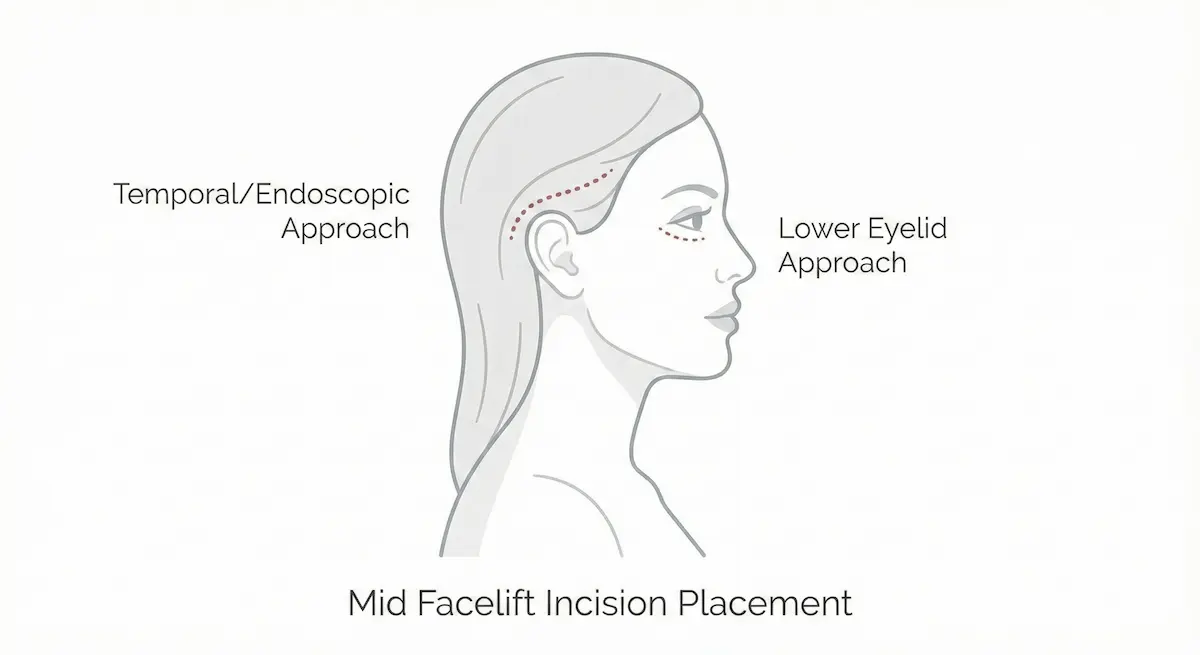
Mid Facelift Scars: What “Normal” Looks Like Over Time
Early scars can look pink or slightly firm. That is normal biology. Scar maturation is a gradual process, and most patients see steady improvement as swelling resolves and tissue settles. In a well-designed mid-face plan, the aim is for scars to become difficult to notice in everyday social distance.
- First 2–6 weeks: redness and firmness can be present; swelling can make scars look more visible than they will later.
- 3–6 months: scars typically soften and fade; the result looks more “yours” as tissues relax.
- 6–12 months: most scar maturation occurs across this window, depending on skin type and healing tendencies.
What Influences Scar Quality
Expert patients think in variables. Here are the factors that matter most:
- Nicotine exposure (including vaping): increases healing risk and can worsen scar quality.
- Sun exposure: can pigment scars and prolong redness—sun protection is not optional.
- Tension and swelling control: disciplined aftercare supports cleaner maturation.
- Your skin biology: some patients form thicker scars; we plan with that reality in mind.
“Scars don’t become invisible overnight. The goal is intelligent placement, tension-free closure, and disciplined aftercare—then time does its job.”
Recovery Timeline: Mid Facelift Recovery Time (Day-by-Day)
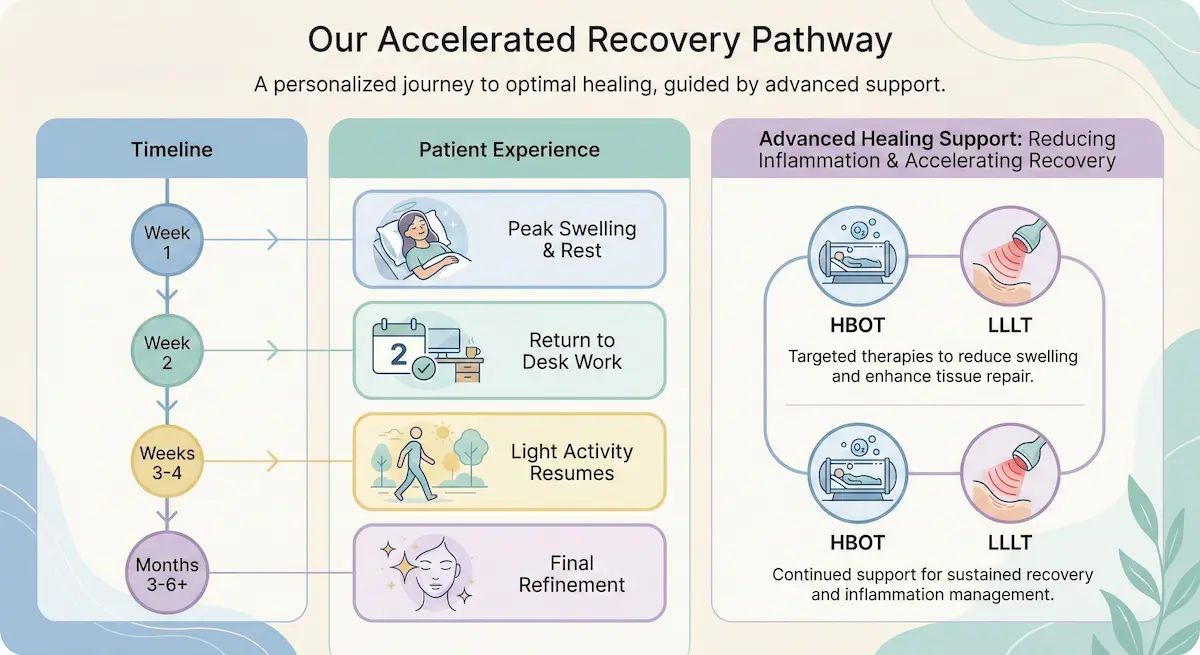
Recovery is not just “downtime.” It’s the phase where your final outcome is protected. If you’re searching mid facelift recovery or mid facelift recovery time, you’re likely trying to answer two questions: “When will I look normal?” and “When will I feel like myself?” The honest answer is that both happen in stages—and most patients feel dramatically better long before the last 10–15% of swelling resolves.
Day 0–2: The Protection Phase
Your job is simple: rest, hydrate, and keep swelling controlled. Expect tightness, swelling, and possibly bruising. This is not the time to judge the result. It’s the time to support circulation and minimize unnecessary inflammation.
- Sleep with your head elevated
- Take medications exactly as prescribed
- Short, gentle walking is often encouraged (when medically appropriate)
Days 3–7: Swelling Peaks, Then Starts to Shift
Many patients experience peak swelling in this window. Bruising can migrate downward due to gravity. This is normal. Discomfort is usually manageable, but patience matters. If you have a major event coming up, plan conservatively—expert planning prevents unnecessary stress.
Week 2: Social Recovery Begins
For many patients, this is the first period where they can feel comfortable being seen in public with minimal explanation. Residual swelling is common, especially in the morning or after activity. The result often begins to look more “rested,” even though you are not fully healed.
Weeks 3–6: Return to Normal Rhythm
Most patients gradually return to a full routine across this window. Exercise is typically reintroduced progressively based on your healing pace and our guidance. The face looks more natural week by week as tissues soften and settle into their new position.
Months 3–6: Refinement and Finalization
This is when the outcome becomes quietly polished. Small residual changes—especially subtle swelling and firmness—continue to improve. If you are an expert patient, this phase matters because it explains why early “mirror checks” can be misleading.
Our Recovery Support: HBOT + Low-Level Laser Therapy (LLLT)
For patients who want an optimized recovery environment, our protocol may include advanced recovery technologies such as Hyperbaric Oxygen Therapy (HBOT) and Low-Level Laser Therapy (LLLT), where appropriate. These modalities are used with the goal of supporting tissue recovery, helping manage swelling, and promoting a smoother healing trajectory. Individual response varies, and these are not “magic”—they are part of a systems-based recovery strategy.
Safety & Risks: Is a Mid-Face Lift Dangerous?
Any surgery carries risk. The expert patient doesn’t look for “zero risk”—they look for honest disclosure and a system that reduces preventable problems. A mid-face lift can be performed safely in appropriately selected patients, with an experienced surgical team, modern monitoring, and disciplined follow-up. The most important safety decision happens before surgery: choosing the correct candidate and the correct scope.
Common Short-Term Effects vs True Complications
Swelling, bruising, tightness, and temporary numbness are common in the early phase. They are expected and typically improve steadily. Complications are less common, but you should still understand what they are.
Potential Risks to Understand
- Bleeding / hematoma (rare but important): requires prompt evaluation if suspected.
- Infection: minimized with sterile technique and proper post-op care.
- Asymmetry: small differences can occur; most settle as swelling resolves.
- Numbness or altered sensation: often temporary; timing varies by individual.
- Unfavorable scarring: influenced by biology, technique, and aftercare.
- Revision surgery: sometimes needed for refinement, depending on anatomy and healing.
- Anesthesia-related risks: depend on health profile and anesthesia plan.
How We Reduce Risk: The Safety System
Risk reduction is not one tactic—it’s a chain of decisions.
- Strict candidacy screening and honest procedure selection
- Technique matched to anatomy to avoid tension-driven, unnatural outcomes
- When appropriate, awake/twilight sedation to reduce anesthesia fear and support a controlled experience
- Structured follow-up to catch issues early, before they become bigger problems
If your priority is the safest, most natural mid-face rejuvenation possible, this is the mindset to keep: choose expertise first, then evaluate everything else.
Is a Mid Facelift Safe in Turkey? (For US Patients)
If you’re asking whether a mid-face lift is safe in Turkey, you’re not really asking about geography. You’re asking about standards. You want to know where the procedure is performed, what safeguards exist, and whether the team’s credentials translate to predictable outcomes. That is exactly how an expert patient should think. Safety is a system, not a promise.
1) The Operating Environment: Accredited Hospitals and Modern Monitoring
When we perform facial surgery, we prioritize the same safety fundamentals you would expect in the US. That means operating in a fully accredited clinical environment with strict sterilization protocols and continuous monitoring. It also means using the same FDA-approved materials used in Western markets, because quality inputs matter.
- Procedures performed in JCI-accredited hospitals that meet or exceed Western standards
- Rigorous international sterilization standards (ISO/TÜV)
- Advanced patient vitals monitoring throughout every procedure
2) Surgeon Qualifications: What “Equivalent Expertise” Actually Means
Credentials should be clear and verifiable. Our facial procedures are performed by European Board Certified Surgeons and Facial Plastic Surgery Experts. Many top Turkish surgeons are certified through a rigorous national system, and European Board Certification (such as EBOPRAS) is widely considered the direct equivalent of US boards. The point isn’t the acronym. The point is that your surgeon’s training, volume, and outcomes must be at an international standard.
3) Safety Before the First Incision: Screening, Planning, and Follow-Up
Most preventable complications start with the wrong candidate or the wrong plan. That’s why we enforce strict pre-operative health screenings to confirm candidacy and reduce avoidable risk. We also run a structured follow-up pathway, including long-term virtual check-ins after you return to the US, so your recovery is guided—not improvised.
- Strict pre-operative health screening and medical clearance
- Surgeon-led planning focused on natural, anatomy-first correction
- Long-term virtual follow-up at 1, 3, 6, and 12 months
Realistic Expectations & Results: What a Mid-Face Lift Can Achieve
Mid-face rejuvenation is one of the most “quietly powerful” changes in facial surgery. When the plan is correct, people don’t see an operation. They see a rested version of you. The goal is not to erase every line or chase an artificial “snatched” look. The goal is to restore mid-face support so your face looks less tired and more structurally balanced.
1) What Changes First vs What Takes Time
Most patients feel better before they look fully “settled.” Swelling improves in stages, and subtle firmness can take weeks to soften. This is why early mirror checks can be misleading. A mid-face lift result often looks more natural over time, not instantly.
- Early phase: swelling, tightness, and bruising can mask contour
- Weeks 3–6: the face starts to look more like “you, but refreshed”
- Months 3–6: refinement becomes noticeable as tissue fully relaxes
2) The Natural Benchmark: “Rejuvenation, Not Alteration”
Our success metric is simple: your facial character should remain intact. A good mid-face lift restores cheek position and improves the under-eye-to-cheek transition without changing your identity. If a plan requires aggressive tension to look “dramatic,” that’s a red flag. Natural results come from structural repositioning, not pulling.
“The goal is a rested face—not a different face.”
3) Common Feedback We Hear From International Patients
We never fabricate stories. But across our international patient population—especially those who have researched for years—we consistently hear the same outcome language: natural-looking rejuvenation, minimal pain, and a smoother-than-expected recovery experience. Patients also describe the psychological benefit of removing uncertainty through an all-inclusive system and a dedicated host who guides the journey end-to-end.
- “It looks natural” is the most meaningful compliment
- Recovery is often described as more manageable than expected
- Clear logistics reduce stress for US-based patients
Mid Facelift Cost 2026 Analysis: Turkey vs USA
If you’re researching mid facelift cost or “how much does a mid facelift cost,” you’re likely seeing a wide spread—especially when comparing major US hubs like NYC, Los Angeles, and Miami to Istanbul. For an expert patient, the right way to evaluate price is not “cheapest vs most expensive.” It’s risk, predictability, and what’s actually included.
In the US, pricing is often unbundled: surgeon fee, facility fee, anesthesia, post-op visits, and recovery add-ons can be billed separately. In Istanbul, the model is frequently bundled and optimized for international patients, which can create a lower total cost while still maintaining high standards—if (and only if) you select the right team and environment.
Why the Price Difference Exists (Without Reducing It to “Cheap”)
The cost gap is typically driven by macro factors (operating costs, staffing structures, and local economics), not automatically by lower medical standards. That said, standards are provider-dependent. This is why we encourage expert patients to evaluate systems: accredited facilities, verifiable surgeon credentials, anesthesia strategy, and recovery support—then compare total value.
USA vs Istanbul: What “All-In” Really Means
| Category | Typical Major US Market (NYC / LA / Miami) | Istanbul High-Value Model (Expert-Level Providers) | Why It Matters |
|---|---|---|---|
| Surgeon & Facility Fees | Often unbundled; premium pricing common in top metro markets | Often bundled into a single transparent package | Bundling can reduce surprise costs and improve predictability |
| Anesthesia | General anesthesia is common; billed separately in many settings | Option for awake/twilight sedation when medically appropriate | For anesthesia-anxious patients, sedation strategy can be a decisive factor |
| Post-Op Care | Follow-ups may be split across visits; add-ons vary by practice | Structured follow-up pathway designed for international patients | Consistency reduces avoidable recovery mistakes |
| Recovery Technologies | Often premium add-ons (varies by provider) | May be integrated into recovery protocols (e.g., HBOT, LLLT where appropriate) | Advanced recovery support can help manage swelling and comfort |
| Travel / Logistics | Not applicable; patient self-manages | Often includes transfers, coordinated scheduling, and local guidance | Lower friction = lower stress (and better recovery discipline) |
| Hidden Costs | Potentially higher if revisions, extra visits, or add-ons occur | Can be lower if inclusions are truly comprehensive and transparent | Total cost is what matters—not the headline number |
“Value isn’t the lowest price. Value is predictable safety, intelligent technique, and a recovery system that prevents small problems from becoming big ones.”
Finding the Right Surgeon for a Mid Facelift
Queries like “best mid-face lift surgeon” or “mid facelift surgeon near me” often lead to marketing pages. Expert patients do something different: they verify. Your surgeon choice matters more than your destination, because technique, judgment, and tissue handling determine whether you look naturally refreshed—or visibly operated.
What to Verify (Not Just What to Read)
- Board certification and surgical focus: Look for surgeons who routinely perform facial rejuvenation—not occasional add-ons.
- Technique literacy: They should clearly explain endoscopic vs deep-plane logic and what layer is being lifted.
- Consistent, natural results: Before/after galleries should look like the same person—just rested.
- Safety systems: Accredited operating environment, modern monitoring, structured follow-up.
- Transparency: Clear scope, clear limitations, clear recovery expectations.
Consultation Questions Expert Patients Ask
- “Which anatomical layer are you lifting, and why is that right for my face?”
- “Where will the incisions be, and what is your scar-management protocol?”
- “What risks matter most for my health profile, and how do we reduce them?”
- “What does a realistic result look like at 2 weeks vs 3 months vs 6 months?”
- “If I’m not a perfect candidate for a mid-face lift alone, what is your alternative plan?”
Your Medical Journey in Istanbul: What to Expect
International patients don’t just choose a procedure. They choose a process. A well-designed Istanbul experience should feel structured, calm, and medically guided—not improvised. We build your pathway to reduce stress and protect recovery discipline.
1) Virtual Consultation and Surgical Planning
Your journey typically begins with a structured virtual consultation. We evaluate your facial anatomy, your goals, and the scope that makes sense—mid-face only versus a broader plan. The objective is a natural outcome aligned with your identity.
2) Arrival, Transfers, and Pre-Op Testing
Once you arrive in Istanbul, logistics should disappear from your mental load. Coordinated transfers, clear scheduling, and pre-op testing are part of a predictable system—especially important for US patients navigating a new country.
3) Procedure, Early Recovery, and Guided Follow-Up
After surgery, we focus on swelling control, comfort, and structured check-ins. If advanced recovery support (such as HBOT or LLLT) is appropriate for your plan, it is introduced as part of a broader protocol—not as a “miracle add-on.” After you return home, your follow-up continues virtually at defined intervals so you are not left without guidance.
Frequently Asked Questions
What is a mid facelift and what does it treat?
A mid facelift is a targeted lift of the mid-face that repositions cheek support to improve sagging cheeks, soften nasolabial folds, and restore a smoother under-eye-to-cheek contour. It primarily treats the central face, not the jawline.
How long is mid facelift recovery time?
Most patients see major improvement in swelling and bruising within 2–3 weeks, with continued refinement over 3–6 months. The final “quiet polish” can continue up to 12 months as tissues fully settle.
Are mid facelift scars visible?
Scars are expected with any surgery, but mid facelift incisions are typically designed to be discreet. Scar visibility improves over time, with most maturation occurring between 3–12 months, depending on skin type and aftercare.
Mid facelift vs mini facelift vs full facelift: which is right?
A mid facelift targets cheeks and central face. A mini facelift typically focuses more on early lower-face laxity. A full facelift addresses broader facial (and often neck) aging. The right choice depends on which “zone of correction” matches your anatomy and goals.
What is an endoscopic mid-face lift in Turkey?
An endoscopic mid facelift uses specialized visualization to reposition mid-face tissues through smaller access points. It can be ideal for targeted cheek descent but is not designed to correct significant jowls or neck laxity.
Can a mid facelift be combined with other procedures?
Yes. Depending on your anatomy and goals, a mid-face lift can sometimes be combined with complementary procedures. A safe combination plan depends on candidacy, the scope of surgery, and anesthesia strategy.
Medical Disclaimer: This page is for educational purposes only and does not provide medical advice. A mid-face lift plan must be personalized after an in-person or formal medical consultation, including review of your health history, anatomy, and risks. Results vary by individual, and all surgical procedures carry potential complications. If you have urgent medical concerns, seek immediate care from a licensed medical professional.