




If you’re researching Labiaplasty, you’re not looking for hype. You want clear anatomy, real technique differences, and a recovery plan you can trust. This guide is written for the “expert patient” mindset: informed, detail-oriented, and focused on safe, natural outcomes.
Our philosophy is simple: Rejuvenation, not alteration.
Table of Contents
What is Labiaplasty?
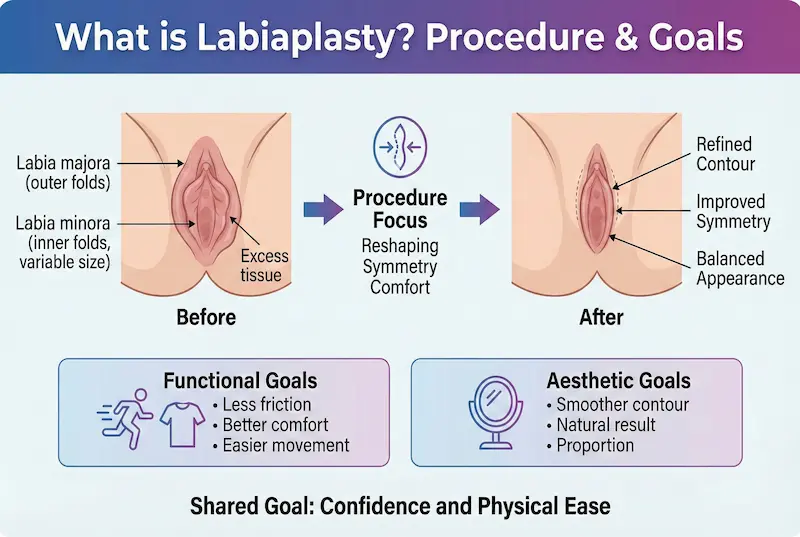
Labiaplasty is a surgical procedure that reshapes the labia, most commonly the labia minora (the inner lips). It can reduce excess tissue, refine symmetry, and relieve friction-related discomfort. The goal is not a standardized look. The goal is proportion, comfort, and a natural result.
Many searches start with “what is labiaplasty,” but the better question is what it can realistically improve for your anatomy. Some patients want relief during exercise or in fitted clothing. Others want a more balanced contour after childbirth, hormonal changes, or natural development. Both are valid.
Labia anatomy in plain English
Understanding the basic anatomy makes every later decision easier—especially when comparing techniques. The vulva includes multiple structures, and “labia” is only one part of the picture.
- Labia minora: Inner folds that can vary widely in size, thickness, and symmetry.
- Labia majora: Outer folds that provide coverage and cushioning.
- Clitoral hood: The tissue covering the clitoris; it may be addressed in selected cases for harmony.
What the procedure changes (and what it doesn’t)
Labiaplasty typically focuses on contour, proportion, and reducing tissue that causes pulling or irritation. It does not change your identity, erase normal anatomical variation, or guarantee a specific “ideal.”
- It can refine the edge contour and reduce protrusion.
- It can improve left-right symmetry when asymmetry is bothersome.
- It does not “tighten” the vaginal canal—that’s a different procedure.
Functional goals vs aesthetic goals
Most patients are not choosing between “medical” and “cosmetic.” They’re choosing between continuing a daily annoyance and resolving it. The best plans respect both comfort and appearance without chasing extremes.
- Functional goals: less friction, less pinching, easier movement, improved comfort in clothing.
- Aesthetic goals: a smoother, more balanced contour that still looks natural.
- Shared goal: confidence that comes from feeling physically at ease.
Why Do Patients Choose Labia Reduction Surgery?
The question “why would someone get a labiaplasty” usually has a practical core. People don’t wake up wanting surgery for fun. They get tired of adapting their life to anatomy—adjusting clothing, avoiding activities, or feeling self-conscious in intimate moments. When conservative measures don’t help, surgery becomes a rational option.
At AKM Clinic, we approach these motivations with a “rejuvenation, not alteration” mindset. That means we plan for a result that fits your body, respects function, and avoids an overdone look. Natural is the objective. Always.
Physical comfort: exercise, friction, and daily movement
This is one of the most common drivers, and it’s often under-discussed. Persistent rubbing can make workouts uncomfortable and even turn simple daily tasks into a source of irritation.
- Discomfort with cycling, running, yoga, or long walks
- Pinching or pulling in tight jeans, leggings, or swimwear
- Chafing during travel or extended sitting
Hygiene and chronic irritation
Some patients describe a constant “awareness” of the area—moisture, sensitivity, or recurring irritation that feels hard to manage. Labiaplasty can reduce tissue that traps sweat or causes repeated rubbing. It’s not a substitute for medical evaluation, but it can remove a structural trigger when anatomy is a contributor.
Confidence, intimacy, and body alignment
For the expert patient, this is rarely about chasing trends. It’s about alignment—feeling that your body matches how you want to feel in it. When a concern is persistent, well-considered, and affects quality of life, addressing it can be deeply validating.
The best result is the one that looks unoperated-on and feels effortless in daily life.
Am I a Good Candidate for Labiaplasty?
The best outcomes start with the right candidacy. That means your anatomy, your symptoms, and your goals all line up in a realistic way. A strong plan also accounts for healing, lifestyle, and how much downtime you can truly protect. The purpose of a labiaplasty consultation is to confirm that surgery solves the problem you actually have.
Common candidate profiles (a practical checklist)
There’s no “standard” anatomy. Variation is normal. Candidacy is usually about whether the tissue causes ongoing discomfort or a persistent concern that hasn’t resolved with conservative measures.
- Frequent irritation, rubbing, or pinching during daily movement or exercise
- Discomfort in fitted clothing (leggings, jeans, swimsuits)
- Asymmetry that feels distracting or physically uncomfortable
- Chronic sensitivity from friction that affects quality of life
- A long-standing aesthetic concern that feels stable and well-considered
Expert patients tend to do deep research before they ever reach out. That’s a good thing. The goal is to move from “I read about it” to “This fits my anatomy and my priorities.”
Who should postpone or avoid surgery
Sometimes the smartest choice is timing. We prioritize safety and predictability, which means we may recommend postponing until conditions are ideal. This isn’t a “no.” It’s a “not yet.”
- Pregnancy, early postpartum healing, or active breastfeeding-related tissue changes
- Active infection, unresolved irritation, or undiagnosed pain that needs medical evaluation
- Uncontrolled medical conditions that raise surgical risk (your medical team matters here)
- Nicotine use that can compromise healing and scar quality
- Expectations built around a “template” result rather than your natural anatomy
If your primary concern is emotional distress that feels urgent or unstable, we slow down and focus on clarity first. Surgery should feel like a confident decision, not an escape hatch.
Consultation essentials (what an expert patient should verify)
A high-quality consultation is specific. It should cover anatomy, technique options, and recovery logistics in plain language. It should also protect your privacy and handle your questions without defensiveness.
- Goal definition: comfort, symmetry, edge contour, or all of the above
- Technique matching: how your anatomy influences method selection (we’ll cover wedge vs trim labiaplasty in detail next)
- Safety screening: we use strict pre-operative health checks to confirm candidacy and reduce risk
- Confidentiality: we follow USA-standard privacy and data security protocols throughout your care
Bring your questions. The right plan should still make sense after the call ends.
Types of Labia Reduction Surgery: Techniques Explained
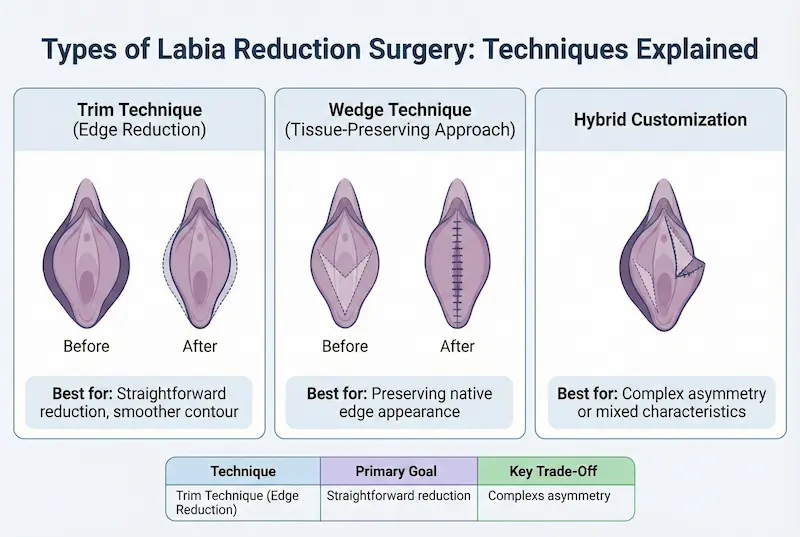
When people search for types of labiaplasty, they’re usually trying to answer one question: “Which method gives the most natural result with the least risk?” The honest answer is that technique choice is anatomy-first. The same method can look subtle in one patient and overdone in another. What matters is how the technique fits your tissue thickness, edge characteristics, and symmetry goals.
Trim technique (edge reduction)
Trim labiaplasty reduces tissue along the free edge of the labia minora. It can be a strong option when the primary goal is decreasing length and creating a smoother contour.
- Best for: patients who want a straightforward reduction of excess edge tissue
- Planning focus: keeping the contour soft and avoiding an “over-resected” look
- Trade-off to discuss: edge color/texture can change depending on anatomy
Wedge technique (tissue-preserving approach)
Wedge labiaplasty removes a wedge-shaped segment from the labia minora and then closes the tissue in a way that can preserve the natural edge. This can be useful when maintaining the original border is a priority.
- Best for: patients who want reduction while preserving the native edge appearance
- Planning focus: tension management and precise closure to support clean healing
- Trade-off to discuss: technique can be more sensitive to swelling and healing dynamics
Hybrid customization (when surgeons combine methods)
Some anatomies don’t fit neatly into one category. In those cases, a surgeon may combine elements of both approaches to balance reduction, symmetry, and edge aesthetics. In select patients, additional refinement may be discussed for overall harmony.
- Degree of asymmetry and where the excess tissue sits
- Tissue thickness and how it typically heals
- Your priority: maximum reduction vs the most subtle, “unoperated-on” contour
| Technique | Primary Goal | Who It Often Fits | Scar Concept | Key Trade-Off |
|---|---|---|---|---|
| Trim | Reduce excess edge tissue and smooth contour | Patients with prominent edge tissue seeking straightforward reduction | Along the edge line | Edge color/texture changes may be more noticeable in some anatomies |
| Wedge | Reduce size while preserving the natural border | Patients prioritizing native edge appearance and subtlety | Internal closure line within the labia | Closure tension and healing dynamics require precise planning |
| Hybrid | Balance reduction, symmetry, and edge aesthetics | Patients with complex asymmetry or mixed tissue characteristics | Customized based on anatomy | Requires careful expectation-setting and individualized technique selection |
Wedge vs Trim Labiaplasty: Which Is Better?
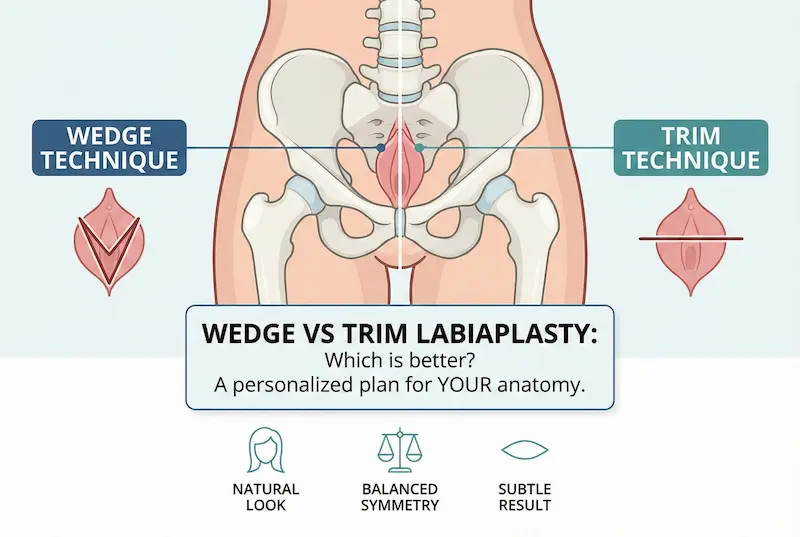
If you’re comparing techniques, you’ll quickly run into the same debate: wedge vs trim labiaplasty. The truth is simple. There isn’t one “best” method for everyone. There’s a best match for your anatomy and goals.
When technique selection is done correctly, both approaches can create a natural, balanced result. When it’s done poorly, either approach can look over-resected or heal unpredictably. Planning matters more than marketing.
Is there a “best” technique?
Not in a universal way. Your edge characteristics, tissue thickness, degree of asymmetry, and how much reduction you want all influence the safest plan.
- Trim can be ideal when the main issue is excess edge tissue that needs a clean, consistent reduction.
- Wedge can be ideal when preserving the native border is a priority and the anatomy supports a tension-free closure.
- Hybrid planning can be ideal when one side needs a different strategy than the other for symmetry.
During consultation, the key question is not “Which technique is trending?” It’s “Which technique preserves function and looks unoperated-on for my anatomy?” That’s the expert-patient question.
Aesthetic priorities: edge look, symmetry, subtlety
Most patients want a result that looks like them—just more comfortable and more proportional. That means the edge contour matters, but so does overall harmony.
- Edge appearance: Some anatomies have a distinct border that patients want to keep as natural as possible.
- Symmetry goals: Perfect symmetry is not realistic. Balanced symmetry is.
- “Natural” objective: The goal is a soft, proportional contour that doesn’t look “designed.”
A natural result isn’t a template. It’s a plan built around your anatomy.
Risk and revision logic: how expert patients think
Expert patients aren’t only thinking about the first two weeks. They’re thinking about the final contour, scar maturity, and the odds of needing a revision. That’s smart.
Here’s the practical way to evaluate the trade-offs:
- Healing dynamics: Swelling can temporarily exaggerate asymmetry. This is normal. Your plan should account for it.
- Closure tension: With wedge concepts, tension management is critical for predictable healing.
- Over-resection risk: With trim concepts, conservative planning protects against a result that feels “too small.”
- Revision planning: A quality surgeon explains what revision means, how often it’s needed, and how it’s handled.
If your biggest fear is a “botched” outcome, focus on decision-making quality. Technique is only one variable. Surgeon judgment is the differentiator.
Laser Labiaplasty and Non-Surgical Options: what’s real?
You’ll see the phrase laser labiaplasty used online as if it’s a unique procedure. Usually, it isn’t. In most cases, “laser” describes the tool used for cutting or refining tissue—not a fundamentally different surgical concept.
That distinction matters because tools don’t guarantee outcomes. Technique and planning do. A laser can be used in a careful plan. It can also be used in a rushed one.
What “laser labiaplasty” actually means
Think of laser as an instrument choice, similar to how a surgeon may choose different devices in an operating room. The key outcome drivers stay the same:
- How much tissue is removed (and where)
- How symmetry is created without over-correcting
- How the closure is designed to heal smoothly
- How post-op care is structured to reduce swelling and irritation
If a provider sells “laser” as the main reason for choosing them, pause. Ask what technique they use (trim, wedge, hybrid), and why it fits your anatomy.
Non-surgical options: realistic limits
Searches like “non surgical labiaplasty” are common because many patients want a lower-commitment solution. The hard truth: non-surgical treatments do not reliably reduce the size of labia minora in a meaningful, predictable way.
Some energy-based treatments may be discussed for selected concerns like tissue quality, tone, or comfort. They are not the same as a surgical reduction. They don’t replace precision reshaping.
- May help: mild tissue quality concerns or comfort goals in carefully selected cases
- Will not do: predictable size reduction or a true symmetry correction
- Key risk: marketing claims that promise “surgery-level” results without the reality
How to evaluate claims without getting misled
Here’s a simple filter that protects expert patients:
- Ask for outcome logic: “How does this method create the change I’m asking for?”
- Ask for recovery clarity: Any real intervention has a real healing timeline.
- Ask what happens if you’re unhappy: A serious provider can discuss revisions, not just sales.
Procedures to Combine Labiaplasty: Maximizing Your Results With Smart Planning
For many expert patients, labiaplasty is a focused, high-impact procedure—yet it’s not always the only goal. When timing, recovery bandwidth, and safety align, combining procedures can create a more efficient treatment plan with one coordinated surgical experience and one structured recovery period. The key is smart sequencing, clear priorities, and a plan that protects predictable healing.
Why patients consider combining procedures
Combining surgeries can make sense when multiple concerns are part of a single body-confidence or comfort objective. Instead of repeating anesthesia, travel logistics, and recovery phases, a combined approach can streamline the journey—especially for international patients. That said, we only recommend combination planning when it is medically appropriate and when it will not compromise healing quality or safety.
Most common procedure combinations
- Labiaplasty + vaginoplasty: Considered when patients want external refinement plus internal support as part of one cohesive plan. Technique selection remains anatomy-first.
- Labiaplasty + liposuction: Often discussed for patients aiming to refine overall body contours while addressing intimate comfort and symmetry.
- Mommy makeover planning: Some patients include labiaplasty as part of a broader postpartum reset. A mommy makeover may also include a tummy tuck and/or breast augmentation, depending on the patient’s goals and candidacy.
- Labiaplasty + Tummy tuck: These are frequently paired in body-restoration plans and may be staged or combined based on procedure length, health profile, and recovery support.
When combining is not the best decision
More surgery is not automatically better surgery. We may recommend staging procedures if overall operative time becomes too long, if your health screening suggests a safer phased approach, or if you can’t realistically protect your recovery window. If your primary goal is a smooth, natural outcome, the plan must respect the limits of healing biology.
Recovery planning that protects results
A combined plan requires disciplined downtime, friction management, and a follow-up structure you can rely on. We map travel, activity restrictions, and checkpoints in advance—so your recovery feels controlled, not improvised. The best combined outcomes come from conservative planning, not aggressive scheduling.
The best plan is the one that heals cleanly and looks unoperated-on.
Anesthesia Options: Why We Prefer Awake or Twilight Sedation When Appropriate
Many US patients have one major barrier: fear of general anesthesia. We take that seriously. Anesthesia should support comfort and safety, not add stress to the decision.
When the procedure and the patient are a fit, we often favor twilight sedation and local anesthesia. It’s a controlled, comfortable experience. You’re monitored closely the entire time.
Local anesthesia + twilight sedation basics
Twilight sedation is designed to keep you calm and comfortable without the depth of full general anesthesia. You won’t feel sharp pain. Many patients remember very little of the experience.
- Comfort-first: reduced anxiety, smoother experience in the operating room
- Controlled recovery: many patients feel more “clear” sooner after the procedure
- Flexible planning: can be a strong option for patients who want to avoid general anesthesia
Not every patient is a candidate for the same anesthesia plan. That’s normal. We individualize it.
Awake surgery: the clinical logic (and who it helps most)
Our clinic is known for mastering awake approaches in advanced aesthetic surgery, because it directly addresses a common patient fear. The principle is simple: use the least invasive anesthesia plan that still delivers a safe, comfortable procedure.
- Who tends to value it: patients with strong anxiety about general anesthesia
- What it changes: the psychological barrier, not the quality standard
- What it doesn’t mean: “no anesthesia” or “white-knuckle surgery”
Comfort is engineered. We plan it. We monitor it. We control it.
Safety framework: how we reduce risk
Safety is not a slogan. It’s a system. Before surgery, we run strict pre-operative health screenings to confirm candidacy and reduce preventable complications.
- Pre-op screening: clear medical review and testing based on your profile
- Continuous monitoring: advanced vitals monitoring throughout the procedure
- Privacy-by-design: USA-standard confidentiality and data security protocols
We also support recovery with our Rapid Recovery & Safety Protocol. This integrates Hyperbaric Oxygen Therapy (HBOT) and Low-Level Laser Therapy (LLLT) to help reduce inflammation, support tissue healing, and promote smoother scar maturation when clinically appropriate.
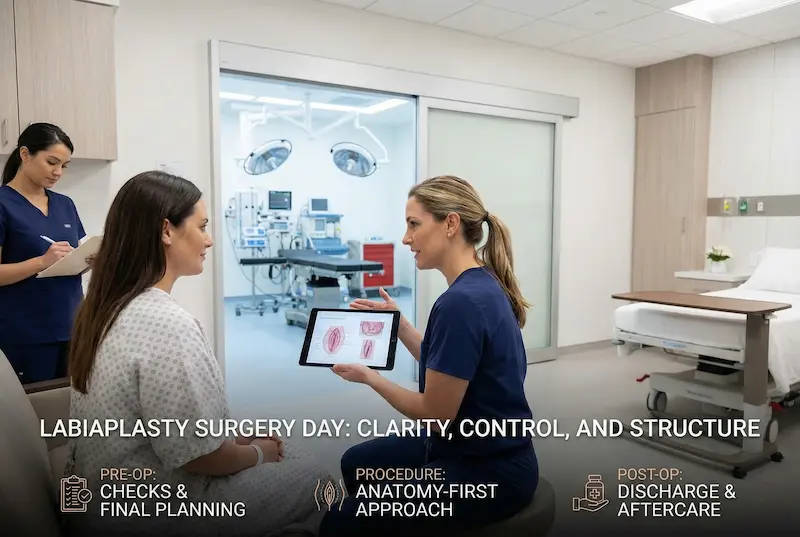
Step-By-Step: What Happens On Surgery Day For Labiaplasty?
Expert patients usually want two things on surgery day. Clarity. Control. We design the day to feel structured, private, and predictable from the moment you arrive.
Pre-op checks and final planning
We start with a focused safety check and a final conversation about goals. This is where we confirm the plan one last time, including symmetry priorities and the exact degree of reduction.
- Health verification: we confirm your pre-op screening is complete and review any last-minute changes
- Photography and mapping: we document baseline anatomy for accurate planning and follow-up
- Comfort plan: we confirm local anesthesia and sedation preferences based on your profile
If something doesn’t feel right, we pause. Safety comes first.
The procedure walkthrough (high-level, non-graphic)
Once you’re comfortable, our surgical team proceeds with the technique we selected during consultation. Trim, wedge, or a hybrid approach. The method is always anatomy-first.
- We aim for balanced symmetry, not perfection
- We protect function and natural contour
- We use meticulous closure to support smooth healing
Short version: we remove only what needs to be removed. Nothing more.
Immediate post-op and discharge planning
After the procedure, most patients rest briefly and then return to their hotel with clear instructions. You’ll receive a detailed aftercare plan designed to minimize swelling and reduce friction during early healing.
- Comfort management: a practical plan for soreness, swelling, and sleep positioning
- Hygiene guidance: simple steps that protect the incision line without over-cleaning
- Follow-up structure: scheduled checks to ensure healing stays on track
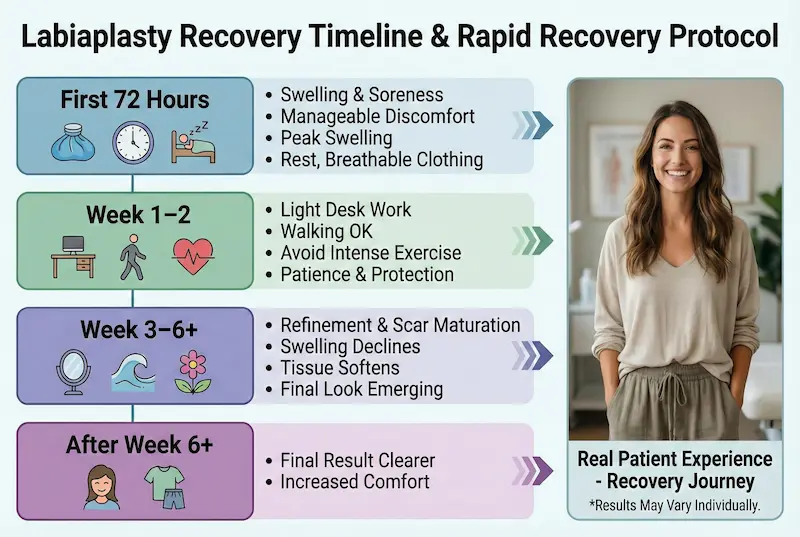
Labiaplasty Recovery Timeline: Week-by-Week Healing Stages
If you’re searching for a labiaplasty recovery timeline, you’re asking the right question. Recovery is where good planning becomes a good outcome. Expect swelling early. Expect gradual refinement. Your final contour takes time.
First 72 hours: swelling, soreness, and “normal anxiety”
This is the most reactive phase. Swelling and tenderness are expected. Many patients describe it as soreness and pressure more than sharp pain.
- Is labiaplasty painful? Most patients report discomfort that is manageable with a structured plan, especially when friction is minimized.
- Labiaplasty swelling: swelling usually peaks in the first few days, then begins to settle.
- What helps: rest, breathable clothing, careful hygiene, and avoiding unnecessary movement.
Small asymmetries at this stage are common. Swelling is rarely “even.”
Week 1–2: getting back to normal life safely
Week one is about protection. Week two is about stability. Many patients can return to light desk work during this window, depending on how they feel and what their day requires.
- Movement: walking is fine; intense exercise is not
- Work: many patients return to remote or desk work as comfort allows
- Intimacy and friction: this is the phase where patience prevents setbacks
This is also when expert patients notice the mind-game of healing. You’ll see daily changes. Don’t judge results too early.
Week 3–6+: refinement, scar maturation, and the “final look”
This is where your contour starts to feel more like you again. Swelling continues to decline. Tissue softens. The overall shape becomes more stable.
- Labiaplasty healing stages are not linear—some days look better than others
- Sensitivity can fluctuate as tissue settles
- The final result typically becomes clearer over the following weeks as healing completes
By this stage, most patients feel far more comfortable in clothing and during movement. That’s the point.
Our Rapid Recovery & Safety Protocol (HBOT + LLLT)
For international patients, downtime matters. We built our mandatory Rapid Recovery & Safety Protocol to support faster, cleaner healing when clinically appropriate.
- HBOT (Hyperbaric Oxygen Therapy): supports tissue recovery, reduces inflammation, and strengthens the body’s healing response
- LLLT (Low-Level Laser Therapy): supports cellular repair and helps calm inflammation without heat or damage
Think of it as recovery engineering. Fewer surprises. More predictability.
Labiaplasty Complications, Risks & Safety: Is Labiaplasty dangerous?
Any surgery has risk. Labiaplasty is no exception. The real question is how predictable the procedure is when it’s planned correctly, performed in a controlled environment, and supported with structured aftercare. Our job is to reduce avoidable risk and set honest expectations from day one.
Common side effects (what’s normal vs what’s not)
Most patients experience temporary swelling and tenderness. Bruising can happen, but it’s often mild. Sensitivity can feel “different” early on as tissue settles. These effects usually improve as healing progresses.
- labiaplasty side effects can include swelling, soreness, and temporary sensitivity changes.
- Early asymmetry is common because swelling is rarely even.
- Small amounts of spotting can occur in the first days.
What’s not normal is worsening pain, new heat and redness that spreads, or drainage that looks infected. Those are signals to act fast.
Red flags: signs of infection and when to contact us
Expert patients don’t ignore warning signs. They watch patterns. If something feels like it’s escalating instead of stabilizing, we want to know immediately. Early intervention protects outcomes.
- signs of infection after labiaplasty: increasing redness, warmth, or swelling that worsens after initial improvement
- Fever, chills, or feeling unusually unwell
- Foul-smelling drainage, pus-like discharge, or a wound that looks like it’s opening
- Pain that becomes sharper and more intense instead of gradually easing
We build follow-up into the journey, so you’re not left guessing. You have a clear communication channel and a defined plan for what to do if anything feels off.
“Botched” outcomes: what causes them and how we prevent them
Searches for botched labiaplasty usually reflect one fear: an unnatural look or a functional problem that could have been avoided. Most of these outcomes trace back to the same root causes. Over-resection. Poor technique selection. Rushed planning.
- Conservative, anatomy-first planning: we remove only what needs to be removed.
- Technique matching: trim, wedge, or hybrid based on your tissue and goals, not a one-method-fits-all habit.
- Strict pre-op screening: we confirm candidacy and reduce preventable complications before surgery day.
- Rapid Recovery & Safety Protocol: we integrate HBOT and LLLT when appropriate to reduce inflammation and support cleaner healing.
We also talk about revisions like professionals. If a patient needs refinement, the process should be transparent, not taboo.
Is The Labiaplasty Surgery Safe in Turkey? What Expert Patients Should Verify
If you’re a US patient, skepticism is healthy. Safety isn’t about geography. It’s about standards, systems, and surgeon training. When patients ask about labiaplasty safe in Turkey, we encourage them to verify the same non-negotiables they would demand in New York or Miami.
Standards that matter: sterilization, monitoring, and accreditation
A safe procedure is performed in a controlled, fully accredited setting. Sterilization isn’t “nice to have.” It’s a baseline requirement. Monitoring matters just as much as technique, especially for sedation-based comfort plans.
- Rigorous international sterilization standards (ISO/TÜV)
- Advanced patient vitals monitoring throughout every procedure
- Strict pre-operative health screenings to ensure patient candidacy and safety
These systems reduce variability. They also reduce anxiety, because the process feels structured and predictable.
Surgeon credentials: what you should look for (without guessing)
Credentials should be easy to explain and easy to verify. For an expert patient, “experience” is not a vague claim. It’s training, certification, and a consistent record of natural outcomes. We keep the conversation factual and specific.
- European Board Certified Surgeons and internationally trained specialists
- A technique-first discussion that matches your anatomy, not a sales script
- Clear explanation of risks, recovery, and revision policy
We avoid template thinking. We build a plan around your body, then we back it with a safety system.
How we de-risk the international journey for US patients
Medical travel adds logistics. We remove friction so your focus stays on preparation and recovery. Our VIP structure is designed for privacy, comfort, and clarity from start to finish. You are not navigating this alone.
- USA-standard patient confidentiality and data security protocols
- A clinic environment curated for comfort and absolute privacy
- VIP transfers, 5-star partner hotel planning, and structured follow-up
- Long-term virtual follow-up cadence after you return home
Safety is a system. So is peace of mind. We build both into the experience.
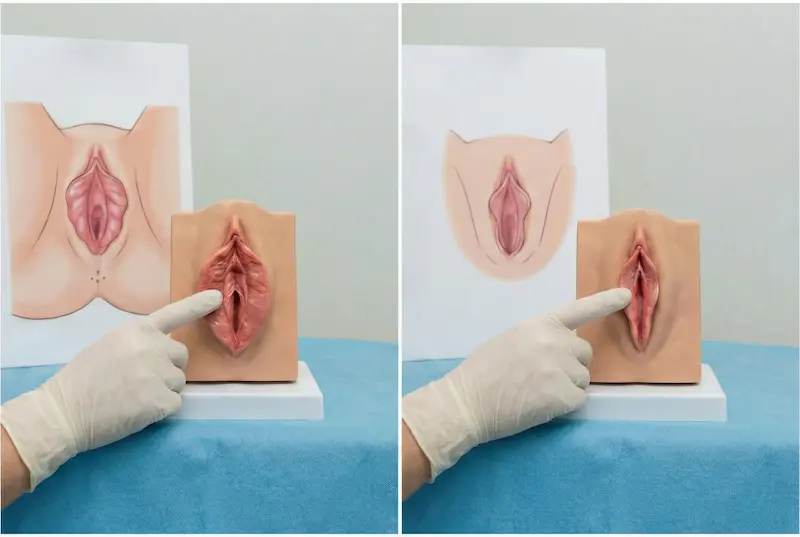
Realistic Expectations and Results: What “Natural” Should Look Like
Results are not just about reducing tissue. They’re about proportion, comfort, and a contour that looks unoperated-on. That’s why we plan with one guiding principle: Rejuvenation, Not Alteration. If your expectation is “perfect symmetry,” we’ll reset that early. Human anatomy is naturally asymmetrical. The goal is balanced harmony that feels effortless in real life—walking, exercising, wearing clothing, and being intimate without constant awareness or friction.
Expert patients also think long-term. The first two weeks are not the finish line. Swelling, tissue softness, and scar maturation evolve over time. Your “final” look is a process, not a moment.
What outcomes can realistically improve
When the plan is anatomy-first, most patients are looking for a practical upgrade: less friction, less irritation, and a more proportional contour that fits their body.
- Comfort upgrades: less rubbing, pinching, and sensitivity from daily movement
- Clothing confidence: fewer limitations with swimwear, leggings, and fitted clothing
- Visual balance: improved symmetry and a softer, more proportional edge contour
What outcomes cannot promise
There are limits, and we’re direct about them. Surgery can refine anatomy. It can’t guarantee a specific “template” look or eliminate every natural variation.
- No surgeon can promise “perfect” symmetry or a one-size-fits-all aesthetic
- Early swelling can temporarily distort shape and symmetry
- Final refinement takes time—especially for patients who heal with prolonged swelling
How to evaluate results the right way
Searches like labiaplasty before and after, labiaplasty results, and healed labiaplasty are common because visuals help you understand what “natural” can mean. The key is knowing what you’re looking at.
- Timing matters: early photos can look swollen and misleading
- Look for consistency: a surgeon’s work should show repeated natural outcomes across different anatomies
- Focus on balance: the best results look proportional, not “overdone”
A natural result is one you don’t have to explain.
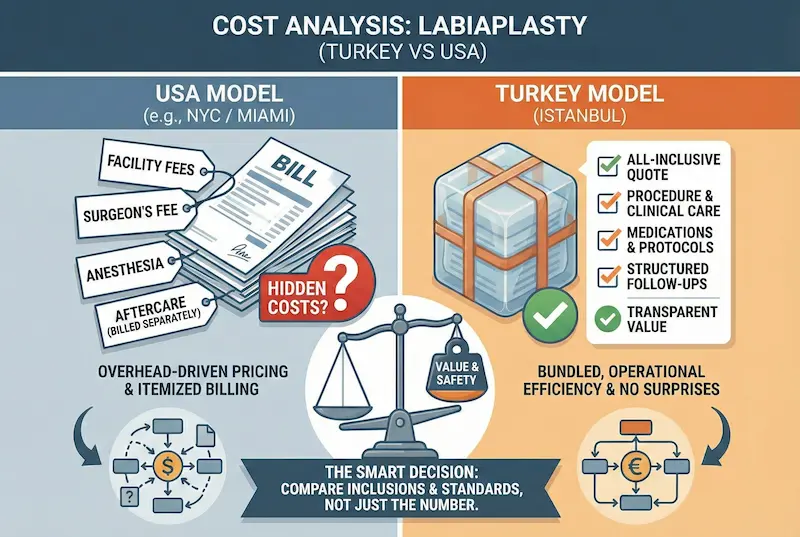
Cost Analysis: Labiaplasty 2026 Prices (Turkey vs USA)
Cost is a rational part of the decision—especially for US patients comparing high-cost cities with international centers. The key is to compare the same thing. Not just the surgeon’s fee. The full experience: safety standards, anesthesia plan, follow-up structure, and what’s included in the quote.
Search terms like how much does labiaplasty cost and average cost of labiaplasty often lead to confusing ranges. That’s because US pricing varies by city, facility fees, anesthesia model, and whether aftercare is bundled or billed separately. In Istanbul, the model is often more transparent and bundled—designed to reduce surprises for international patients.
We position the comparison as value, not “cheapness.” The smartest decision is the one that protects safety, results, and recovery while keeping the financial model clear.
What drives the price difference between the USA and Turkey?
In the US, a significant part of the final price is driven by overhead: facility costs, insurance-driven pricing structures, staffing, and regional market rates. In Turkey, operational costs are different, which can make the same level of clinical care more cost-effective—without compromising standards.
- Facility and staffing overhead: typically higher in major US markets
- Anesthesia and surgical setting: pricing shifts based on sedation vs general anesthesia and facility type
- Bundling vs itemized billing: international models often reduce hidden add-ons
What should be included in an expert-level quote?
A real comparison includes what happens outside the operating room. Expert patients ask what’s included, what’s optional, and what becomes an extra charge later.
- Pre-operative screening and safety testing
- Procedure-day clinical care and monitored recovery
- Medications and a clear aftercare protocol
- Structured follow-ups and post-return virtual check-ins
US benchmarks: NYC/Miami vs Istanbul (how to compare fairly)
Queries like labiaplasty cost nyc, labiaplasty cost miami, and labiaplasty cost turkey point to a common pattern: patients are trying to compare premium US markets to Istanbul. The fair way to do it is to compare like-for-like inclusions and clinical standards—not just the number.
| Comparison Point | Typical USA Model (e.g., NYC / Miami) | Typical Istanbul Model | How We Structure It |
|---|---|---|---|
| Pricing format | Often itemized (facility, anesthesia, surgeon, aftercare) | Often bundled for international patients | We provide a transparent, all-inclusive quote after your virtual consultation |
| Aftercare and follow-up | May be limited or billed separately | Often structured into the package model | We follow up on a defined cadence after you return home |
| Comfort model | Often general anesthesia depending on setting | Varies by clinic and plan | We individualize anesthesia planning, prioritizing awake/twilight sedation when appropriate |
| Recovery optimization | Often self-managed or separately arranged | Varies by provider | We integrate our mandatory Rapid Recovery & Safety Protocol to support smoother healing when clinically appropriate |
If you’re asking, is labiaplasty worth it, value is the lens. We focus on predictable healing, natural outcomes, and a process designed to remove friction—medical and logistical.
Insurance and “Medical Necessity” in the US: Why it’s a Common Roadblock
Many US patients start with a practical question: does insurance cover labiaplasty? The short answer is that coverage is often limited because many plans classify it as elective. Even when symptoms are real, insurance may require extensive documentation and still deny approval. That friction is why many expert patients eventually choose a transparent direct-pay path instead of a long administrative fight.
Why coverage is often difficult (even with real symptoms)
Insurance decisions are rarely about how much discomfort you feel. They’re about policy language, diagnostic codes, and whether your plan defines the procedure as covered. That gap creates frustration, especially for patients who have tried conservative solutions without relief.
- Many plans label the procedure as “cosmetic” by default, even when symptoms are functional.
- Approvals may require repeated documentation and time-consuming back-and-forth.
- Coverage can vary widely between employers, states, and plan types.
“Medically necessary” labiaplasty: what patients usually mean
When people search medically necessary labiaplasty, they’re typically describing persistent irritation, friction, or limitations in daily life. In the US system, the burden often shifts to the patient to prove that symptoms meet a plan’s strict criteria. That process can become stressful, slow, and unpredictable.
- Symptoms may be valid, but still fail to meet a plan’s coverage threshold.
- Paperwork can stretch the timeline for months.
- Denials are common, even with clinician notes.
Direct-pay clarity: control, speed, and no surprises
This is where the value conversation becomes rational. A direct-pay model is not about “cutting corners.” It’s about clarity: you know the plan, the timeline, and what’s included. For international patients, it also reduces the uncertainty that comes from waiting on insurance decisions before you can even schedule a surgery date.
- Clear pathway: consultation → candidacy → plan → scheduling
- Transparent inclusions: no hidden facility or anesthesia add-ons after the fact
- Time efficiency: fewer administrative bottlenecks between decision and treatment
Finding the Right Surgeon: What Expert Patients Should Look For
Searches like best labiaplasty surgeon and labiaplasty surgeons near me reflect a deeper intent: you want a predictable outcome with minimal risk. The strongest signal of quality is not marketing language. It’s how a surgeon thinks, how they plan, and how transparently they discuss trade-offs. We encourage patients to use a structured checklist so the decision feels clinical, not emotional.
Credentials and specialization signals (what to verify)
“Experienced” is not a credential. Expert patients verify training, specialization, and whether the provider is comfortable discussing technique choice (trim vs wedge vs hybrid) based on anatomy. When we discuss our team, we keep it professional and verifiable: our European Board Certified Surgeons lead care with a natural-first philosophy.
- Board certification and focused surgical training
- A clear, anatomy-first rationale for technique selection
- Defined safety systems: screening, monitoring, and structured aftercare
How to evaluate before/after results without getting misled
Many patients rely on labiaplasty reviews and photos, but the key is how you interpret them. Early photos can be swollen and misleading. Look for consistency across different anatomies and for results that read as “unoperated-on.”
- Prefer healed results over early post-op swelling photos
- Look for balanced symmetry, not a “template” appearance
- Evaluate edge contour and overall proportion, not just “smaller”
Questions to ask during a consultation (the expert checklist)
A high-quality labiaplasty consultation should feel like a medical planning session. You should leave with a clear technique recommendation, a recovery timeline that matches your lifestyle, and a direct discussion of risks. We also prioritize privacy, with USA-standard confidentiality and data security protocols built into the patient journey.
- “Which technique fits my anatomy, and why?”
- “How do you prevent over-resection and manage symmetry?”
- “What is your revision approach if refinement is needed?”
- “What does your aftercare and long-term follow-up look like once I’m back home?”
Your Medical Journey in Istanbul: What To Expect (arrival to departure)
For US patients, the procedure is only half the equation. The other half is logistics, privacy, and the feeling that you’re not navigating a foreign system alone. We built a structured VIP journey so your experience feels predictable, calm, and medically organized.
Everything starts remotely. Then it becomes simple. One plan. One timeline. One clear point of contact.
Free virtual consultation and surgical planning
Your first step is a no-obligation video consultation from home. We review your goals, your anatomy, and your timeline. If you’re a candidate, we create a personalized plan and a transparent, all-inclusive quote.
- Privacy-first: we handle photo sharing and communication with USA-standard confidentiality and data security protocols
- Clarity: we explain technique logic (trim, wedge, or hybrid) based on anatomy, not preference
- Timeline mapping: we match your travel window to realistic healing milestones
You should leave the call knowing exactly what will happen next. No guessing.
Secure your date and VIP planning (hotel, transfers, support)
Once you decide to proceed, we take over the planning details. Your dedicated Patient Host secures your surgery date, organizes your 5-star hotel accommodation from our curated partners, and schedules all VIP transfers. Your only job is booking your international flight.
- 5-star hotel accommodation in a safe, modern district
- All VIP airport and clinic transfers
- All pre-operative tests and post-operative medications
- 24/7 Patient Host support via WhatsApp
We design the experience to remove friction. That lowers stress. It also supports better recovery.
Arrival, procedure day, and recovery in Istanbul
When you land in Istanbul (IST or SAW), we greet you at arrivals and escort you to a private luxury vehicle for transfer to your hotel. Our clinic is located in Levent, one of Istanbul’s most prestigious and accessible modern districts, close to our 5-star partner hotels.
- Airport welcome: private driver meets you at arrivals with a sign
- In-person consultation: final review of your plan before surgery
- Safety system: strict pre-op screening and advanced monitoring during your procedure
After surgery, we monitor you closely and guide you through early aftercare. Before you fly home, we perform a final in-person check-up to confirm your recovery is progressing well and you’re cleared to travel.
Labiaplasty Reviews: How to Interpret Feedback The Expert Way
Searches like labiaplasty reviews and labiaplasty turkey reviews are common because patients want real-world proof. Reviews can be useful. They can also be misleading if you don’t know what to look for.
We encourage expert patients to treat reviews like data. Patterns matter more than one dramatic story. The best signal is consistency: natural outcomes, organized care, and clean follow-up.
What high-quality reviews usually have in common
Strong reviews tend to describe the process, not just the result. They talk about communication, planning, and how supported they felt during recovery. These details are hard to fake and easy to verify across multiple patients.
- Clear communication and structured planning before travel
- Supportive aftercare and easy access to the team during recovery
- Results described as natural, subtle, and life-enhancing
If a provider’s reviews only mention price, that’s a red flag. Value is about outcomes and safety, not a number.
Red flags in reviews (and what they can mean)
Some warning signs are obvious. Others are subtle. If you see these patterns repeatedly, take them seriously and ask direct questions during consultation.
- Vague technique explanations: “They do it their way” with no anatomy-based rationale
- Missing aftercare detail: no mention of follow-up, access, or recovery structure
- Unrealistic promises: guaranteed outcomes or “zero swelling” narratives
A credible team is comfortable discussing trade-offs. We don’t sell perfection. We plan for predictability.
How we build trust without hype
Trust comes from transparency and systems. We start with an expert-level consultation, explain technique logic clearly, and support recovery with a defined care pathway. For international patients, we also de-risk the experience with a seamless VIP model designed around privacy, comfort, and structured follow-up.
- European Board Certified Surgeons and internationally trained specialists
- Strict pre-operative health screenings and advanced monitoring
- Long-term virtual follow-ups after you return home
Labiaplasty Frequently Asked Questions (FAQ):
If you’ve read this far, you’re doing what expert patients do: pressure-testing the details before committing. These are the most common questions we hear from US patients who want a natural result, a predictable recovery, and a clear plan. We answer them directly. No sugarcoating. No panic language. If you have a unique medical situation, we confirm specifics during your private consultation.
Is it painful?
Most patients describe the experience as soreness and sensitivity rather than sharp pain. The first 72 hours are usually the most reactive because swelling peaks early. With a structured comfort plan, most patients find the discomfort manageable.
Expect swelling and tenderness early.
Friction is the main trigger for discomfort, so we focus on preventing it.
If pain intensifies instead of improving, we want to hear from you.
How long does swelling last?
Swelling is normal and rarely “even.” The biggest change usually happens in the first two weeks, then refinement continues gradually. Small day-to-day fluctuations are common, especially after activity. Final contour becomes clearer as tissue softens and healing completes.
Days 1–3: swelling typically peaks.
Weeks 1–2: visible swelling begins to settle.
Weeks 3–6+: ongoing refinement and scar maturation.
When can I exercise again?
Walking is usually fine early. Intense exercise is not. The risk isn’t just discomfort—it’s friction, increased swelling, and delayed healing. We guide you with a conservative timeline designed to protect your outcome.
Light walking: typically early, as tolerated.
Gym workouts, cycling, running: usually postponed until healing is stable.
Return-to-training: based on your progress at follow-up checkpoints.
When can I have sex again?
Intimacy requires patience. Tissue needs time to regain strength and stability. Returning too early can cause irritation, swelling flare-ups, and setbacks. We give you a clear timeframe and confirm readiness based on healing—not guesswork.
We prioritize friction avoidance during early healing.
We confirm readiness at follow-up, especially for international patients.
If something doesn’t feel right, we pause and reassess.
What are the most common side effects?
Temporary swelling, tenderness, and sensitivity changes are the most common. Mild bruising or spotting can also occur early. Most effects improve steadily as the tissue settles. We explain what’s normal, what’s not, and what to do if anything escalates.
Normal: swelling, soreness, temporary sensitivity shifts.
Watch closely: worsening redness, heat, unusual drainage, fever.
Our follow-up structure is designed so you’re never guessing alone.
How do I choose between wedge and trim techniques?
The right method is anatomy-first. Some patients prioritize preserving the natural border; others need a straightforward edge reduction. The best choice is the one that protects function, avoids over-resection, and supports predictable healing. During consultation, we explain the logic clearly and match the plan to your tissue characteristics and symmetry goals.
Trim: often selected for clear edge-tissue reduction goals.
Wedge: often selected when preserving the native edge is a priority.
Hybrid: used when symmetry and anatomy require customization.
What are the risks of a “botched” result?
Most feared outcomes trace back to the same issues: over-resection, poor technique matching, and rushed planning. That’s why we plan conservatively and prioritize a natural contour over extremes. If a patient needs refinement, we address it transparently and professionally.
We plan for balance, not a template.
We prioritize function and a natural, unoperated-on appearance.
We build recovery support into the journey—especially for US patients traveling internationally.
How does the consultation work if I’m in the USA?
We start with a private virtual consultation from home. You share your goals, we review your anatomy (with strict confidentiality), and we explain technique options and recovery timelines. If you’re a candidate, we provide a personalized plan and a transparent quote designed for international patients.
Virtual consultation first.
Clear technique recommendation with rationale.
Structured travel and recovery timeline planning.
What’s included in the VIP plan, and what isn’t?
Clarity matters. Our all-inclusive structure is designed to remove logistical friction so you can focus on preparation and healing. We cover the clinical pathway and the support system around it. Your international flight is the main item you arrange separately.
Included: procedure, operating room/anesthesia fees, pre-op tests, medications, VIP transfers, 5-star hotel accommodation, and long-term virtual follow-up.
Not included: international flights, personal travel insurance, personal expenses, and optional extra hotel nights if you extend your stay.