



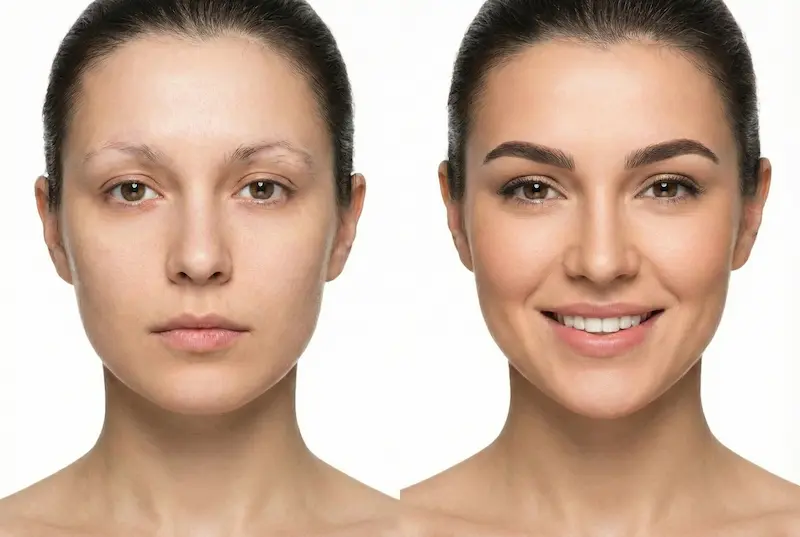
An Eyebrow Transplant is a microsurgical procedure that restores sparse, patchy, or missing eyebrows using real hair follicles placed one by one. The goal is not a “drawn-on” look, but natural brows that fit your facial anatomy—soft at the front, structured through the arch, and refined at the tail.
In this guide, you’ll learn how the procedure works, where donor hair comes from, what recovery looks like, and what “safe in Turkey” really means: surgeon-led planning, sterile protocols, and predictable follow-up. If you’re comparing options in the USA vs Turkey, we’ll also break down cost drivers and value—so you can choose based on standards, not hype.
Table of Contents
What is an Eyebrow Transplant?
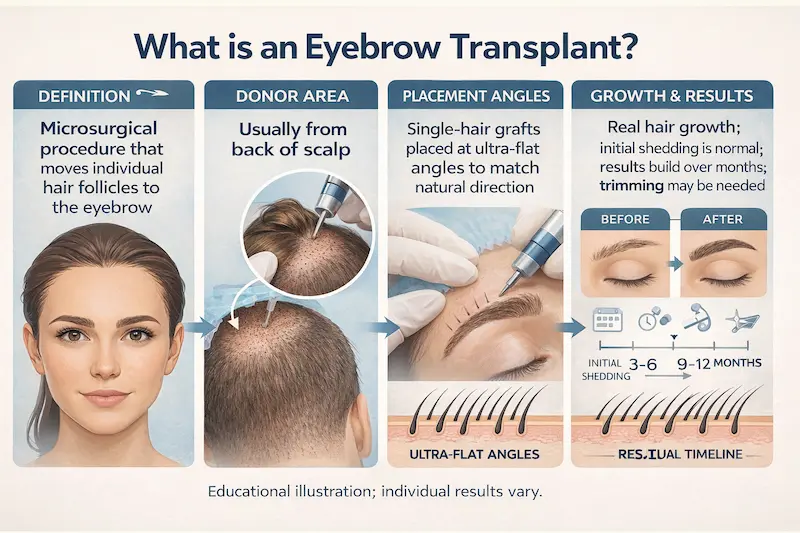
An Eyebrow Transplant is a microsurgical hair restoration procedure that moves individual hair follicles into the eyebrow area to rebuild or thicken the brows. Each follicle is placed one by one. The goal is real, living eyebrow hair that grows from your skin naturally. When it’s planned well, the result looks like it was never “done.”
People search what is an eyebrow transplant because they want a solution that doesn’t fade, smear, or disappear after a few weeks. This is not a makeup trick and it’s not a pigment procedure. It’s a permanent hair relocation technique that depends on precision. Angle, direction, curl, and density matter as much as the number of grafts.
How does an eyebrow transplant work?
To understand how does eyebrow transplant work, think of it as relocating healthy follicles from a donor area to the brow region. The follicles must stay intact during harvesting, sorting, and placement. Then, we implant them in a pattern that follows the natural eyebrow map: flatter angles, directional changes, and a soft transition at the front of the brow. Done right, the hair blends instead of standing up.
- Design: We plan shape and symmetry around your facial structure and expression.
- Harvesting: We collect follicles carefully to protect graft survival.
- Placement: We implant each graft at eyebrow-specific angles to mimic natural growth.
Why eyebrow anatomy makes this procedure different
Eyebrows are not mini scalps. Brow hairs sit closer to the skin and change direction as they travel from the head to the tail. The front needs a feathered look, not a harsh “wall” of hair. The arch needs flow. The tail needs refinement and consistent direction. Small errors become obvious because eyebrows sit in the center of the face.
- Angles are flatter than scalp work, so the hair lies naturally.
- Direction shifts across zones, especially around the arch.
- Density must look realistic up close, in daylight, and in motion.
What concerns can an eyebrow transplant solve?
This procedure works best when you want to rebuild what’s missing or enhance what you have without an artificial finish. It can restore brows after years of over-plucking. It can fill gaps from scarring or trauma. It can also add density for naturally sparse eyebrows, as long as expectations stay realistic.
- Sparse or thin eyebrows that never grew in fully
- Patchy areas or gaps that makeup can’t truly hide
- Asymmetry that changes your expression in photos
- Stable scars with missing hair growth
Why Do Eyebrows Thin, Break, Or Develop Gaps?
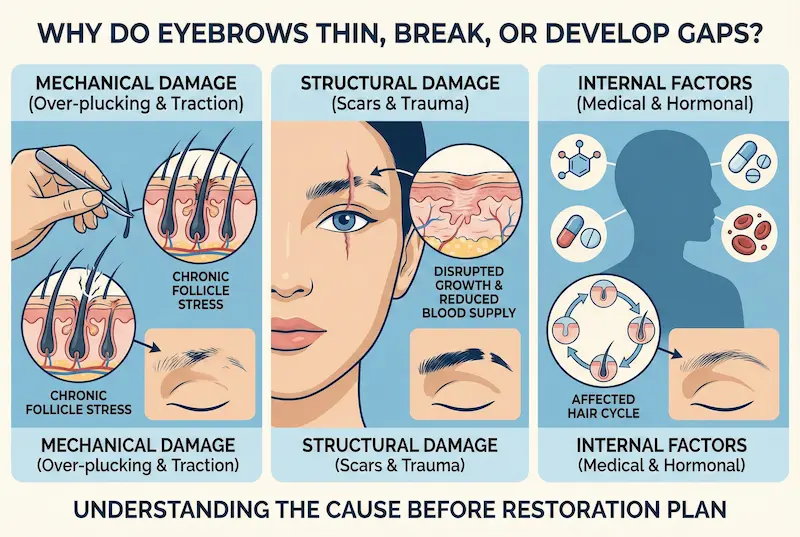
Eyebrow thinning usually has a story behind it. Sometimes it’s mechanical—years of tweezing, waxing, or thread work that gradually damages follicles. Sometimes it’s structural, like a scar that interrupts normal growth. And sometimes it’s internal, where changes in the body affect the hair cycle.
Before we plan a transplant, we focus on the “why.” If the cause is still active, results can be harder to predict. If the cause is stable, a surgical restoration plan becomes clearer. This is also where an honest consultation matters, because not every type of shedding behaves the same way.
Over-plucking and traction damage
Repeated hair removal can create chronic follicle stress. Over time, follicles may produce finer hair, then stop producing hair altogether. The “thin ends” and broken sections some patients notice often come from repeated trauma to the same zones. If the pattern has been stable for a long time, rebuilding density surgically can be a strong option.
- Common signs: persistent gaps, uneven density, weak regrowth
- Typical pattern: thinning at the tail or along the lower border
- Key factor: how long the loss has stayed stable
Scars, burns, and physical trauma
Scar tissue can disrupt hair growth because normal skin architecture changes. Some scars have reduced blood supply, altered collagen structure, or uneven thickness. That doesn’t automatically rule out a transplant, but it does change the strategy. We evaluate scar maturity and stability, then plan graft placement to improve survival and natural blending.
- Old injuries, burns, and surgical scars can create permanent gaps.
- Stable scars often require a more conservative density plan.
- Texture and direction become even more important for camouflage.
Medical and hormonal factors (general guidance)
Some people experience eyebrow thinning due to internal factors like hormonal shifts or systemic conditions that affect hair cycling. In those cases, the priority is stability. If shedding is ongoing, we may recommend medical evaluation before committing to surgery. A transplant works best when we’re rebuilding a stable pattern, not chasing active loss.
- If loss is sudden or rapidly progressing, get a medical assessment first.
- If the pattern is stable, surgical planning becomes more predictable.
- If medications are involved, timing and coordination matter.
Benefits: What Changes After Brow Restoration?
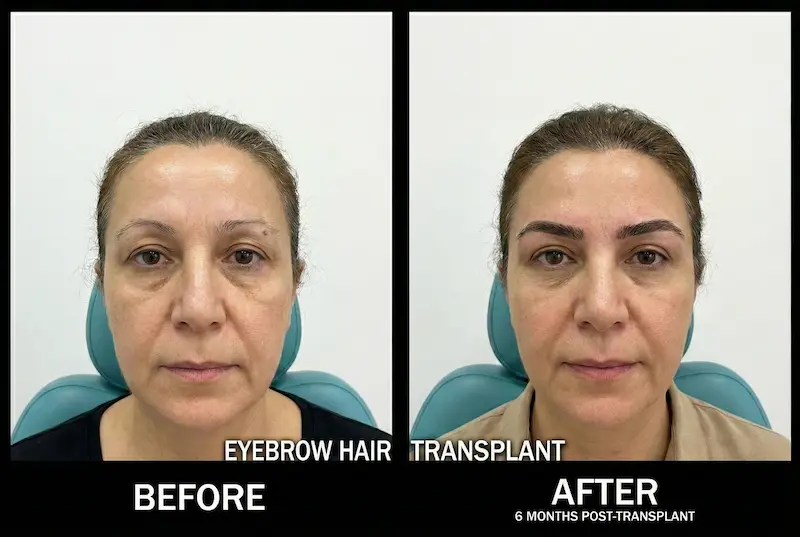
When you choose an Eyebrow Transplant, the “benefit” isn’t just more hair—it’s what that hair does for your face. Eyebrows are one of the strongest non-verbal features we have. They frame the eyes, balance facial proportions, and subtly shape how others read your expression. The right restoration plan can make you look more rested, more defined, and more like yourself—without changing your identity.
That said, the best results are rarely the boldest. Our philosophy is natural-first: the brow should belong to your face in every lighting condition, at every distance, and in motion. The goal is not a trend. The goal is a stable, long-term aesthetic.
Facial framing, symmetry, and expression
Even small eyebrow gaps can create a big visual imbalance. A missing tail can make the eyes look “open” on one side and “heavy” on the other. Sparse density at the front can flatten expression. Strategic graft placement can restore structure—especially when we respect the three key zones: head, body, and tail.
- Stronger eye framing: A well-defined brow border helps the eyes stand out naturally.
- Balanced symmetry: Brow restoration can reduce the “one brow higher” look that appears in photos.
- Softer expression: Filling certain gaps can reduce the appearance of tiredness or harshness.
Symmetry is never about forcing both brows to be identical. Natural brows are “sisters, not twins.” The benefit comes from restoring harmony—so your face reads as balanced, not manufactured.
Natural-first aesthetics (rejuvenation, not alteration)
Many patients come in worried about an obvious result: overly dense fronts, unnatural arches, or hairs that grow in the wrong direction. These are not “normal side effects”—they are design and angle problems. The advantage of surgical restoration is that we can control the plan with precision, but only if we commit to subtlety.
Natural-first planning means:
- Feathered transitions at the front: We avoid a harsh “block” look by keeping the leading edge soft.
- Directional flow that changes across the brow: Brows don’t grow in one direction—especially near the arch.
- Density that looks believable up close: More is not always better. Realism comes from spacing and angle control.
This is also where an eyebrow transplant becomes an “expert” procedure. The details that make results look effortless are the same details that require time, patience, and a surgeon-led process. If you want brows that look natural in daylight and on high-resolution cameras, the plan must be conservative, anatomical, and consistent.
Reducing dependence on makeup and daily camouflaging
Patients often underestimate how much mental energy goes into “brow management.” Pencils, powders, gels, and daily corrections can become a routine that feels like a requirement—especially if you’ve been covering gaps for years. One of the most appreciated benefits of an eyebrow transplant is psychological: you stop planning your face around your brows.
- Less daily correction: Many patients reduce or eliminate the need for filling and reshaping.
- More confidence in water, sweat, and close-up settings: Real hair doesn’t fade or smear.
- Consistent appearance: You don’t “lose” your brows depending on lighting or makeup quality.
It’s important to be honest about maintenance: transplanted hair can grow longer than typical eyebrow hair, which means trimming is usually part of long-term upkeep. But trimming real hair is a different kind of maintenance than recreating an eyebrow every morning. The benefit is permanence and realism—not zero effort.
Benefits in scar-related or reconstructive cases
For patients with gaps from scarring, burns, or trauma, the benefit is often deeper than aesthetics. Restoring eyebrows can help you feel like your face is “complete” again. In these cases, our goal is careful camouflage: improving continuity of hair growth across the affected zone without overloading the area.
- Improved visual continuity: Breaking the “gap line” that draws attention to scar borders.
- More natural texture than cosmetic cover-ups: Hair creates depth that pigment cannot replicate.
- Long-term stability: A living solution that doesn’t wash off or require frequent touch-ups.
Reconstructive planning is always individualized. Scar maturity, skin thickness, and vascularity can influence how we design density and placement. The benefit is still real—but the strategy is more conservative to protect outcomes.
Am I a Good Candidate?
“Good candidate” is not a vibe. It’s a checklist. We look at three pillars: the stability of your brow thinning, the quality of your donor hair, and the realism of your expectations. If the cause of loss is still active, the plan can change. If the pattern is stable, we can design with more confidence.
Your brows also sit in a high-visibility zone, which raises the standard for planning. Tiny direction errors show. Density decisions matter. That’s why candidacy is not just “Can we do it?” but “Can we do it and keep it looking natural for years?”
Who tends to get the best results?
The strongest candidates usually have a stable pattern of sparseness or gaps, plus a donor area that can provide the right kind of grafts. We prefer to work with patients who want believable brows—soft in the front, structured through the body, refined at the tail. The goal is harmony, not exaggeration.
- Stable thinning: The shape of the loss has stayed consistent over time.
- Clear design goals: You know what “natural” means for your face, not for a trend.
- Good donor supply: Enough healthy follicles to build density without overharvesting.
- Patience: You understand that growth is gradual and follows a hair cycle.
Who should postpone or avoid surgery?
Some situations call for caution, timing adjustments, or medical evaluation first. This is not about being “too picky.” It’s about predictability and safety. If something increases the chance of poor growth or complications, we slow down and plan intelligently.
- Active or rapidly progressing hair loss: If the pattern is changing quickly, we may recommend stabilizing first.
- Inflammation or skin issues in the brow area: Irritated skin can interfere with healing and graft survival.
- Uncontrolled health conditions: We prioritize safe healing conditions over rushing into surgery.
- High-risk scarring history: If you have a history of abnormal scarring, we evaluate carefully.
- Unrealistic expectations: If you want “perfect symmetry” or extremely high density, we reset the plan—or we don’t proceed.
If you’re unsure where you fall, that’s normal. A proper consultation should be calm, specific, and honest. It should never feel like pressure.
What “realistic expectations” look like (the expert-patient version)
The most common mistake patients make is focusing only on shape. Brows are shape, direction, and softness working together. Even with excellent technique, your result will still be your result—your skin, your hair characteristics, your facial movement. We design around those realities.
- Symmetry: We aim for balance, not identical twins.
- Density: Natural density is built with spacing and angle control, not “packing.”
- Texture: Donor hairs may behave slightly differently than native eyebrow hairs.
- Maintenance: Expect some grooming long-term (often trimming and training).
How to prepare for your consultation
You don’t need a “perfect” brow photo to start. You need information. Bring your brow history, your goals, and any concerns you want addressed directly. The better the inputs, the more accurate the plan.
- Share clear photos in natural light (front + angled views).
- Tell us about over-plucking, trauma, scars, or previous cosmetic brow work.
- List medications and relevant medical history so we can advise timing appropriately.
- Explain what you dislike most today (shape, gaps, thin tail, weak front).
Where Does The Hair Come From For An Eyebrow Transplant?
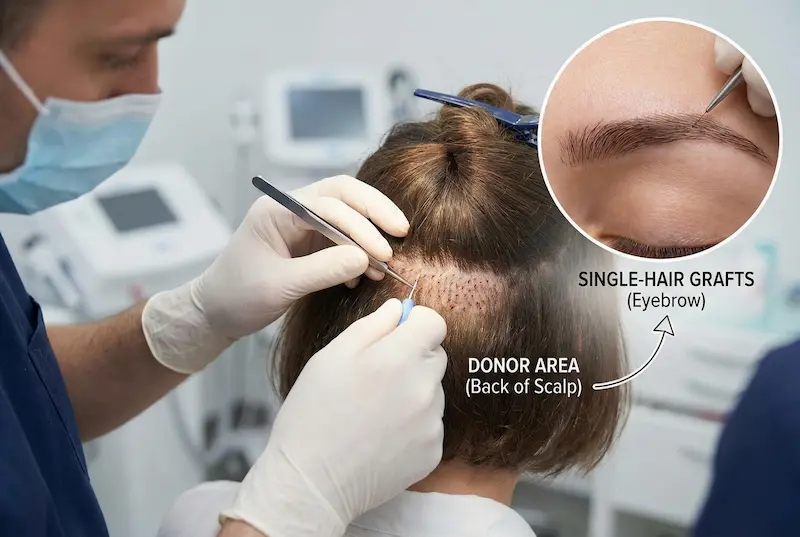
This question is one of the smartest ones to ask early. Donor selection influences everything: the softness of the result, how the hair grows, and how much grooming you’ll need long-term. Most people search where do they get the hair for eyebrow transplant because they’re worried about two things—whether the donor area will show, and whether the hair will look “wrong” in the brow.
Our approach is conservative. We focus on the safest donor zone, then select grafts that match eyebrow needs as closely as possible. Not every follicle is suitable. Brow work is about choosing the right hairs, not the most hairs.
The most common donor area (and why it’s used)
In most cases, donor hair is taken from the back of the scalp, where follicles tend to be stable and resilient. This area also allows discreet harvesting because surrounding hair can cover tiny extraction points as they heal. The goal is to protect both aesthetics: your brows and your donor area.
- Stability: Many scalp donor hairs are genetically more resistant to thinning.
- Availability: It typically provides enough grafts for natural eyebrow density.
- Discretion: When harvested properly, the donor area can heal without obvious signs.
Why single-hair graft selection matters for eyebrows
Eyebrows don’t grow in thick bundles. A natural brow is built from fine, single hairs arranged in a controlled pattern. That’s why we prioritize single-hair grafts and refine selection carefully before placement. This step is one of the biggest differences between “hair transplant thinking” and “eyebrow thinking.”
- Single-hair grafts help create a soft, realistic front edge.
- They allow better control of density without a pluggy appearance.
- They reduce the risk of bulky texture in a delicate facial zone.
Matching texture, curl, and growth behavior
Hair is not just hair. Some donor hairs are straighter, some are wavier, some have a stronger shaft. We evaluate how your donor hair behaves so we can place it in a way that looks natural in your brow design. This is also why the implantation angle is so strict—matching the “flat lay” pattern is what prevents hairs from sticking out.
- Texture: Finer hairs typically look softer in the brow.
- Curl orientation: We account for it during placement to reduce unruly growth.
- Growth characteristics: Donor hairs may grow longer than native eyebrow hairs.
Will the donor area look different afterward?
When harvesting is done carefully, healing is usually discreet. Most patients are concerned about visible thinning or noticeable marks. Our goal is to keep extraction patterns spread out and conservative, so the donor region maintains a natural look once healed.
- Donor healing typically involves tiny points that fade over time.
- Hair length and styling can help conceal early healing stages.
- Conservative planning protects donor density for the long term.
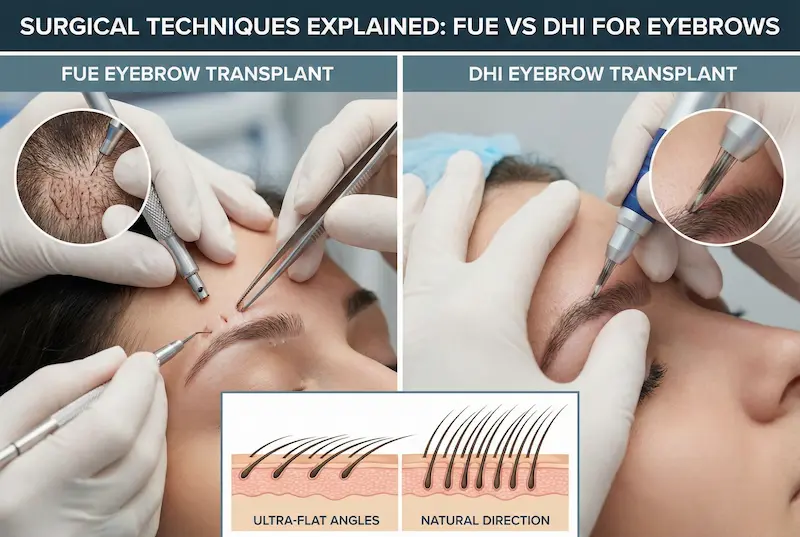
Surgical Techniques Explained: FUE vs DHI For Eyebrows
When patients research an eyebrow transplant, they often encounter two terms: FUE eyebrow transplant and DHI eyebrow transplant. Both are used in modern hair restoration, and both can be adapted for eyebrow work—but eyebrows are not a “standard” transplant site. The deciding factor is not the marketing label. The deciding factor is how precisely the team can protect grafts and control angle, direction, and depth during implantation.
In eyebrow transplantation, we make technique choices based on your skin characteristics, your design goals, and the level of micro-control required for a natural “flat-lay” brow pattern. The safest approach is the one that helps us execute the plan consistently—without rushing the details.
FUE eyebrow transplant: what it means in brow work
FUE (Follicular Unit Extraction) refers to how grafts are harvested—follicles are extracted individually from the donor area. In eyebrow cases, FUE harvesting is typically followed by careful graft refinement and then eyebrow-specific site creation and placement. This approach can be ideal when we want maximum control over how recipient sites are created to match your brow map.
- Strength: High control over site creation and directional planning.
- Best for: Patients who need precise flow changes across the brow (especially near the arch).
- Key requirement: Meticulous placement at ultra-flat angles to avoid “sticking out.”
DHI eyebrow transplant: what it means in brow work
DHI (Direct Hair Implantation) is commonly used to describe implantation with an implanter method. In experienced hands, this can streamline placement and help maintain rhythm and consistency during a long procedure. In eyebrow work, the priority remains the same: every graft must follow the brow’s natural direction and sit close to the skin.
- Strength: Efficient implantation flow when the team is highly trained in brow angles.
- Best for: Cases where controlled, consistent placement supports the design plan.
- Key requirement: Proper depth and angle control so hairs lie flat and blend naturally.
How we choose the technique (brow-specific criteria)
Rather than forcing every patient into one “signature” method, we choose the approach that best supports safety and natural aesthetics. Eyebrows demand micro-precision, and that means selecting the technique that helps us deliver stable graft handling and consistent angle execution across the entire brow.
- Design complexity: Strong directional shifts may benefit from a strategy that maximizes site-control.
- Skin and tissue factors: Thickness, sensitivity, and scar characteristics can affect placement strategy.
- Naturalness goal: Feathered front edge and realistic density matter more than speed.
| Factor | FUE (Eyebrow-Specific) | DHI (Eyebrow-Specific) |
|---|---|---|
| Main concept | Individual extraction + planned site creation + placement | Individual extraction + implanter-assisted placement workflow |
| Angle control | Excellent when sites are created with eyebrow mapping in mind | Excellent in experienced hands; relies heavily on implanter technique |
| Best use cases | Complex flow patterns, detailed symmetry work, scar-adjacent planning | Cases where consistent placement rhythm supports the design plan |
| What makes it look natural | Flat angles, correct direction changes, soft front-edge spacing | Flat angles, correct direction changes, controlled depth and spacing |
| What matters most | Surgeon-led design + graft protection + eyebrow-specific angle discipline | |
Design & Artistry: How We Plan Natural Brows
If you want a natural eyebrow transplant, design is not a cosmetic afterthought—it’s the foundation of the outcome. A beautiful brow is a balance of three things: shape, direction, and density. When any one of these is off, the result can look artificial. That’s why we treat brow planning like facial architecture, not like drawing a template.
Surgeon insight: “The most natural brows are the ones you don’t notice. Our job is to rebuild structure without creating a ‘done’ look—especially at the front edge, where a few hairs can change the entire expression.”
Mapping the head, body, and tail for proportion
We design your brow in zones because each zone behaves differently. The front (head) should be soft and feathered. The middle (body) carries structure and density. The tail needs refinement and consistent flow so it looks clean, not harsh. We also plan around how your face moves—smiling, frowning, raising the eyebrows—because your brows must look natural in motion.
- Head: Soft, gradual density, no “boxed” front.
- Body: Structured density with controlled direction changes.
- Tail: Refined flow and tapered finish for elegance.
Direction, angle, and the “flat-lay” placement strategy
This is where eyebrow transplantation becomes truly technical. Eyebrow hairs grow at flatter angles than scalp hair. They also change direction across the brow, especially near the arch. If grafts are placed too upright, hairs can stick out and look obvious. If direction is inconsistent, the brow can look messy even with good density.
- Angle discipline: Placing hairs so they lie close to the skin.
- Directional flow: Following the natural brow map across zones.
- Curl awareness: Accounting for hair behavior so it blends instead of fighting the design.
Density planning: how we build realism (not bulk)
Many clinics try to “sell” density. But eyebrows don’t look natural because they’re dense—they look natural because density is distributed correctly. We plan for a soft transition at the front, controlled structure through the body, and a tapered tail. This creates dimension without heaviness.
- Soft front edge: Spacing and single-hair placement to avoid harsh lines.
- Layered density: Building fullness where it matters while keeping realism up close.
- Long-term perspective: Designing a brow that will still look refined years later.
Procedures to Combine Eyebrow Transplant
An eyebrow transplant can be a powerful “framing” procedure on its own, but it’s often planned alongside other treatments when the goal is overall facial balance. The right combination depends on your anatomy, age-related changes, and the specific concern you want to address (brow gaps, eyelid heaviness, midface laxity, or lip length). Because every procedure has its own recovery curve, combining treatments should always be a surgeon-led decision focused on safety, timing, and realistic outcomes.
When combination planning makes sense
Combining procedures is usually considered when a single change would look incomplete. For example, rebuilding brow density may sharpen facial definition, but if the upper eyelids are heavy or the midface has significant laxity, you may benefit from a broader rejuvenation plan. Some patients also pair eyebrow restoration with hairline work—especially in a hair transplant for women strategy—when overall hair density and facial framing are part of the same aesthetic goal.
Common pairings that enhance facial harmony
- Blepharoplasty: If the upper eyelids feel heavy or tired-looking, blepharoplasty may refresh the eye area while the eyebrow transplant rebuilds brow shape and structure.
- Lip lift: In patients with a longer upper lip or reduced tooth show, a lip lift can balance the lower face while brows restore definition around the eyes.
- Facelift surgery: For more advanced laxity in the midface/jawline, facelift surgery may address structural aging while eyebrow restoration fine-tunes the facial frame.
Timing, safety, and recovery coordination
Not every procedure should be done on the same day. The safest approach is a personalized sequencing plan that considers anesthesia time, swelling patterns, and your ability to protect newly implanted brow grafts during early healing. We map your calendar, set downtime expectations, and coordinate aftercare so each step supports the next—without compromising graft survival or your overall recovery.
Is Eyebrow Hair Transplant Surgery Painful? (Comfort & anesthesia)
If you’re asking is eyebrow hair transplant surgery painful, you’re thinking like an expert patient—and that’s good. Comfort matters, but so does safety. In most cases, an Eyebrow Transplant is performed under local anesthesia, meaning the treatment area is numbed so you can remain comfortable while we work with precision. You may feel brief pressure, gentle movement, or vibration-like sensations during certain steps, but the goal is to avoid pain during the procedure.
Surgeon insight: “For eyebrow work, comfort supports precision. When a patient is calm and stable, we can focus on micro-angles and direction—details that make the result look natural.”
Local anesthesia: what you feel vs what you don’t
Local anesthesia is designed to block pain, but it doesn’t turn you into a statue. Most patients describe the experience as “comfortable but aware.” After numbing, you typically won’t feel sharp pain. What you might notice are normal, non-pain sensations—light touch, mild pressure, or the awareness that we’re working in a delicate facial area.
- What you usually don’t feel: sharp pain during harvesting or implantation.
- What you may feel: pressure, movement, or brief moments of sensitivity before additional numbing is applied.
- What we prioritize: comfort checks throughout the procedure, not just at the start.
Comfort strategies during a long procedure
Eyebrow transplantation is meticulous and can take time because every graft is placed intentionally. Our comfort approach is practical: stable positioning, scheduled breaks when appropriate, hydration, and constant feedback. This is not a “rush job.” A controlled pace protects both comfort and graft quality.
- Positioning support: reducing neck and shoulder strain during detailed work.
- Comfort pacing: maintaining a steady rhythm without sacrificing micro-precision.
- Continuous communication: you can tell us what you’re feeling, and we adjust accordingly.
Some patients also ask about sedation options. If comfort anxiety is high, we discuss suitable approaches case-by-case—always within a safety-first framework. The goal is to keep you calm without compromising careful surgical control.
Post-op sensations: what’s normal vs what’s not
After the procedure, it’s normal to experience mild tenderness, tightness, and a “sunburn-like” sensitivity in the brow area. You may also see temporary redness and micro-scabbing where grafts were placed. These are expected parts of early healing. Most discomfort is manageable and tends to improve gradually as the skin settles.
- Common and expected: mild swelling, redness, tightness, micro-scabs, light itchiness.
- Often short-lived: tenderness that decreases over the first several days.
- When to contact us: increasing pain, unusual warmth, concerning discharge, or symptoms that feel “worse instead of better.”
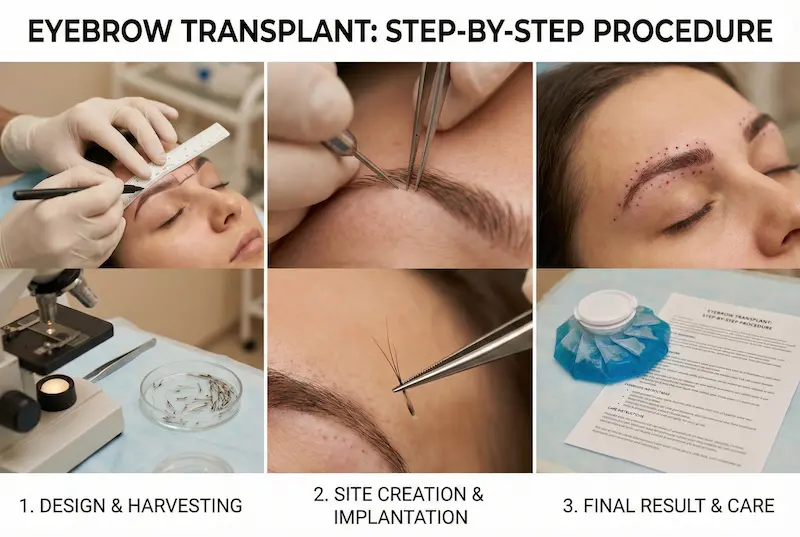
Step-By-Step: How An Eyebrow Transplant Is Done
When patients search how is eyebrow transplant done or eyebrow transplant procedure, they want clarity—not vague promises. The procedure can be summarized in five phases: design, harvesting, graft preparation, recipient site creation, and implantation. In eyebrow work, the difference between “okay” and “excellent” is almost always found in the details of site creation and placement angles.
Pre-op plan & final design confirmation
We start with a design that respects your facial proportions and expression. On procedure day, we confirm the plan in real-time—because brows must look right on your face, not on a template. We map zones (head/body/tail), define soft transitions, and plan direction changes across the brow so the hair flow is believable.
- Shape: refined to match your facial structure and long-term aesthetic goals.
- Symmetry: balanced, not identical—natural brows aren’t perfect twins.
- Flow map: directional plan across the entire brow, especially near the arch.
Harvesting + graft preparation (quality control)
Next, we harvest donor follicles individually and protect them throughout handling. For eyebrows, graft selection is more selective than many scalp cases because we prioritize single-hair grafts and a softer look. Then we prepare and sort grafts to support realistic density distribution—especially at the front edge.
- Conservative harvesting: protecting donor aesthetics and long-term density.
- Single-hair focus: creating a natural, feathered brow—especially at the head.
- Graft care: minimizing trauma and dehydration to protect survival.
Recipient site creation + implantation (angle discipline)
This is the make-or-break phase. Recipient sites are created to match your brow’s natural direction and flat angle. Then we implant grafts one by one, following the map with strict consistency. The goal is for hairs to lie close to the skin and blend into a natural pattern, rather than standing upright or crossing against the flow.
- Ultra-flat angles: helping hairs “lay down” like real brow hair.
- Directional precision: respecting the natural shift from head to tail.
- Density strategy: soft front, structured body, refined tail—built gradually.
At the end, we review immediate post-op care instructions carefully. The first days are about protecting grafts, keeping the area clean, and allowing the skin to calm. The real transformation happens over the coming months as the growth cycle progresses.
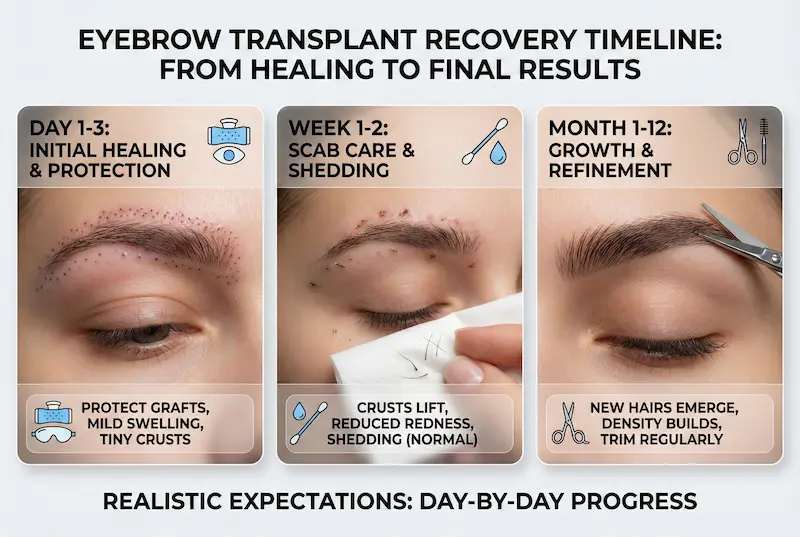
Recovery Timeline: Eyebrow Transplant Recovery Time (day-by-day)
Recovery is usually straightforward, but it’s not instant. Your brows will look “busy” early on—tiny scabs, mild redness, and sometimes light swelling. Then comes the part that surprises many patients: the transplanted hairs often shed before they regrow. That shedding is normal, and it’s one of the reasons we set expectations clearly from day one.
When patients search eyebrow transplant recovery time, they’re really asking two questions: “When will I look normal?” and “When will I see final density?” Those timelines are different. The visible healing happens first. The growth phase comes later.
First 72 hours: protecting grafts and controlling swelling
The first three days are about protection. We want the grafts to stay undisturbed while the skin calms. Mild swelling around the brow or upper eyelids can happen, especially in the first 24–48 hours, and then it typically settles. Small crusts form around each graft—think “micro-scabs,” not thick scabbing.
- What you’ll likely see: redness, tiny crusts, mild swelling, a slightly “textured” look.
- What we focus on: clean aftercare, no rubbing, no pressure on the brow area.
- What to avoid: heavy sweating, steam/sauna, intense exercise, and anything that risks friction.
Week 1–2: scab care, hygiene, and the early shedding phase
By the end of week one, many patients look significantly more presentable. The crusts begin to loosen as the skin heals, and the area feels less tender. Itchiness can show up. That’s usually a healing signal, not a problem—unless you scratch or pick.
During this period, it’s also common to notice early shedding. The follicles are still there, but the hair shafts can fall out as the follicles reset into a new growth cycle. This is why we measure progress in months, not days.
- Typical changes: reduced redness, scabs lifting, less sensitivity.
- Common worry: “My hair is falling out.” This is often a normal transition phase.
- Our guidance: follow cleansing instructions exactly and keep the area calm.
Months 1–12: the growth cycle and what “progress” looks like
Eyebrow growth is gradual. The first visible new hairs may appear in the early months, but density and refinement build over time. The hair can initially look finer or a bit inconsistent. Then it strengthens and becomes easier to groom as it matures.
We also plan for long-term realism. Transplanted hairs can grow longer than typical eyebrow hair, which means trimming is usually part of normal maintenance. It’s not a downside. It’s simply how donor follicles behave.
- Early months: new hairs begin to emerge; density may look uneven at first.
- Mid-term: improved consistency, better blending, easier styling.
- Long-term: the brow looks softer, more stable, and more “yours.”
Our Rapid Recovery & Safety Protocol (HBOT + LLLT)
Some patients want the most controlled, “low-drama” recovery possible—especially international travelers who care about social downtime. That’s why we integrate our Rapid Recovery & Safety Protocol built around HBOT and LLLT. HBOT supports tissue oxygenation and helps the body reduce inflammation. LLLT supports cellular recovery and is used as a targeted adjunct for healing and hair restoration.
- HBOT: supports recovery biology by improving oxygen delivery where tissues are healing.
- LLLT: supports cellular repair and can help create a healthier recovery environment for grafts.
- Why it matters: less swelling, a calmer healing phase, and a more predictable post-op experience.
Side Effects, Risks, And “Gone Wrong” Scenarios—Honest Answers
Every surgical procedure has trade-offs. The key is knowing what’s normal, what’s preventable, and what’s genuinely rare. Most eyebrow transplant “problems” people see online fall into two buckets: predictable early healing (mistaken as failure) and avoidable technical errors (usually angle or direction mistakes). Our job is to reduce the second category to the lowest possible level through planning, graft protection, and strict implantation discipline.
If you’re searching eyebrow transplant side effects, you’re doing the right thing. Informed patients make better decisions. Below is a clear breakdown of what to expect—and what we actively do to reduce risk.
Common side effects (usually temporary)
Most side effects are mild and time-limited. They’re part of normal healing in a delicate facial area. Redness and micro-scabbing are expected early on. Itchiness can occur as the skin repairs itself, especially when scabs begin to lift.
- Redness and micro-scabs: common in the first days and gradually settle.
- Mild swelling: possible around the brows/upper eyelids, often early and short-lived.
- Itchiness: common as healing progresses—scratching is the real risk.
- Shedding: transplanted hairs may shed before regrowth starts.
Preventable risks: what causes poor growth or an unnatural look?
When patients worry about a botched eyebrow transplant or an eyebrow transplant gone wrong, they’re usually reacting to unnatural direction, overly upright hairs, or harsh density at the front. These outcomes are not “bad luck.” They are planning and execution problems. Eyebrows demand ultra-flat angles and consistent flow changes across zones.
- Angle errors: hairs can stick out instead of lying flat.
- Direction mistakes: flow looks messy, especially near the arch and tail.
- Over-dense fronts: creates a blocky, obvious leading edge.
- Poor graft handling: can reduce survival and lead to patchy growth.
Infection and inflammation risks (and how we reduce them)
Infection is uncommon when proper sterile protocols and aftercare are followed, but it’s a real risk in any transplant procedure. Prevention is a system, not a promise. We focus on a sterile clinical environment, careful post-op instructions, and clear follow-up so small concerns don’t become big ones. Your role matters too: keeping the area clean and avoiding friction in the early days protects outcomes.
- Prevention strategy: sterile technique + controlled aftercare routines.
- Early warning signs: increasing pain, unusual warmth, concerning discharge, worsening redness.
- What we do: structured check-ins and clear guidance if anything feels off.
Regret prevention: the difference between “not ready” and “not a good candidate”
Eyebrow transplant regret often comes from misaligned expectations, not medical failure. Some patients want a heavily stylized brow that’s hard to maintain long-term. Others expect instant density without a shedding phase. We prevent regret by designing for your face (not a trend) and by being direct about timelines, maintenance, and realistic density.
- We align on goals: natural framing, balanced symmetry, believable density.
- We set timeline expectations: early healing first, growth later.
- We discuss maintenance: trimming and grooming are normal for transplanted brow hair.
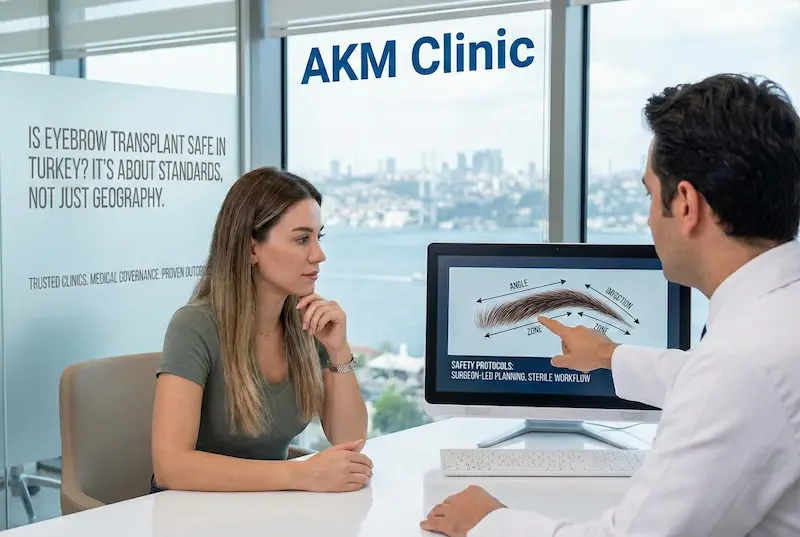
Is Eyebrow Transplant Safe in Turkey?
If you’re asking “Is eyebrow transplant safe in Turkey?” you’re not really asking about geography—you’re asking about standards. Safety depends on systems: surgeon involvement, sterile protocols, anesthesia planning, graft handling, and structured follow-up. Turkey can be an excellent destination when the clinic operates with transparent medical governance and does not treat eyebrow transplantation like a quick cosmetic service.
For an “expert patient,” the safest path is not choosing a country—it’s choosing a clinic that can prove how it protects outcomes. Below is the framework we use to define safety in practical terms.
What “safe” actually means (standards, systems, outcomes)
Real safety is built before the first graft is placed. It includes proper patient selection, a controlled surgical environment, and a plan designed to reduce avoidable risks—especially the ones that lead to unnatural results (angle and direction errors). A safe clinic should be able to explain its workflow clearly, without vague promises.
- Pre-op screening: identifying risks, stabilizing active issues, and confirming candidacy.
- Medical governance: surgeon-led planning and decision-making, not a “technician-only” process.
- Infection control: sterile operating standards and structured aftercare protocols.
- Outcome transparency: consistent before/after patterns that show natural direction and soft fronts—not just “density.”
Surgeon-led planning: why eyebrows are not “routine”
Eyebrows sit at the center of the face, and they don’t forgive sloppy technique. Safety here isn’t only about avoiding complications—it’s also about preventing the results patients describe as gone wrong: upright hairs, chaotic direction, harsh fronts, or unnatural symmetry. Those issues are typically design and angle failures, which is why surgeon-led planning matters.
- Design safety: mapping the brow into zones (head/body/tail) to prevent harsh or trendy shapes.
- Angle safety: ensuring an ultra-flat “lay-down” pattern so hairs don’t stick outward.
- Direction safety: respecting the flow changes around the arch and through the tail.
Clinic protocols that reduce risk (sterility, monitoring, aftercare)
Whether a procedure is performed in the US or abroad, the basics of surgical safety remain the same: a sterile environment, careful handling of grafts, and ongoing monitoring. We approach eyebrow transplantation as a medical procedure—because it is one.
- Sterile workflow: controlled operating conditions and disciplined hygiene protocols.
- Graft protection: minimizing trauma and dehydration to support graft survival.
- Comfort and monitoring: safe anesthesia planning with consistent patient checks throughout the day.
- Structured aftercare: clear instructions for cleansing, protection, and what to avoid during early healing.
Travel safety: timing, follow-up, and contingency planning
International patients often worry about what happens after they fly home. That’s a valid concern—and it’s part of safety. A responsible clinic plans your timeline so you’re not traveling at the worst moment for swelling, sensitivity, or aftercare complexity. We also structure follow-ups so you’re not left alone with “Google advice” if something feels unusual.
- Travel timing: planning your itinerary around the early healing window.
- Follow-up structure: scheduled check-ins and clear guidance for normal vs not-normal signs.
- Contingency clarity: knowing exactly who to contact and what to do if you have concerns.
Is An Eyebrow Transplant Permanent? (And Does The Hair Grow Long?)
Two of the most common “expert patient” questions are is eyebrow transplant permanent and does eyebrow transplant hair grow long. The honest answer is: transplanted follicles are intended to be long-lasting, and yes—transplanted hairs often grow more like donor hair than like native eyebrow hair. That’s why long-term success is not only about growth. It’s also about maintenance, grooming habits, and a design that stays natural as the hair matures.
Permanence: what “lasting” realistically means
In most cases, transplanted follicles are chosen from a donor area with stable growth characteristics. Once they heal and establish, they can continue producing hair long-term. However, “permanent” does not mean “instant” and it does not mean “no aftercare.” Healing and the hair growth cycle take time.
- Long-term intent: a lasting restoration using stable donor follicles.
- Normal timeline: early healing first, then growth phases over months.
- Reality check: final refinement is gradual, not immediate.
Does the hair grow long? Yes—here’s what that means for you
Because donor follicles often come from the scalp, transplanted eyebrow hairs may keep a longer growth cycle than native brow hair. Practically, that means trimming is usually part of routine maintenance. Most patients prefer this trade-off because it’s real hair that can be shaped and groomed.
- Trimming: typically needed to keep a tidy brow length.
- Training: early on, some hairs may need gentle styling to lay in the desired direction.
- Consistency: once you establish a simple grooming rhythm, maintenance becomes easy.
Long-term care plan: how we keep results natural
Natural-looking permanence is a system: conservative design, correct angles, and practical grooming. We aim for brows that age well—soft where they should be soft, structured where they should be structured, and realistic at conversational distance.
- Design that ages well: avoiding harsh fronts and overly trendy arches.
- Angle discipline: helping hairs lay flatter for a natural brow texture.
- Simple maintenance guidance: trimming and grooming tips tailored to your hair behavior.
Eyebrow Transplant vs Microblading
If you’re comparing eyebrow transplant vs microblading, you’re essentially choosing between two very different categories: real hair versus pigment. Microblading can be a helpful cosmetic option for some patients, especially if you want a temporary visual boost and you’re comfortable with ongoing touch-ups. An Eyebrow Transplant, on the other hand, is a surgical solution designed to create real, living eyebrow hairs that you can see and feel—because they grow from your skin.
The best choice depends on your starting point, your skin type, your tolerance for maintenance, and how important “3D realism” is to you in daylight and close-up settings.
Real hair vs pigment: what looks more natural in real life?
Microblading is a surface-level illusion. It can create the appearance of hair strokes, but it’s still ink in the skin. In certain lighting (or when the pigment fades unevenly), it can look less natural than patients expect. A transplant produces real hair, which creates real texture, shadow, and movement—especially important when someone is near you, not just when you’re facing a camera.
- Eyebrow transplant: real hair texture, depth, and movement.
- Microblading: visual strokes that can look flatter up close.
- Key difference: hair behaves like hair; pigment behaves like pigment.
Longevity, maintenance, and “the long game”
Microblading typically requires periodic touch-ups to maintain color and shape. The frequency depends on skin type, sun exposure, skincare products, and pigment retention. An eyebrow transplant is designed for long-term growth, but it comes with a different kind of maintenance: transplanted hairs often need trimming because donor hair may grow longer than native eyebrow hair.
- Microblading maintenance: touch-ups to refresh color and crispness.
- Transplant maintenance: trimming + light grooming as part of normal upkeep.
- Practical takeaway: microblading = repeat sessions; transplant = real hair grooming.
Who should choose which option?
There’s no universal winner—only the option that fits your goals and lifestyle. We often recommend thinking in terms of “commitment type.” If you want a reversible cosmetic enhancement, microblading may fit. If you want a structural, living restoration (especially for gaps, scars, or true sparseness), an eyebrow transplant is usually the stronger solution.
- Microblading may fit if: you want a temporary enhancement and you’re comfortable with regular upkeep.
- An eyebrow transplant may fit if: you want real hair, permanent structure, and natural texture.
- If you’ve had microblading already: we evaluate the skin and plan the safest path for natural blending.
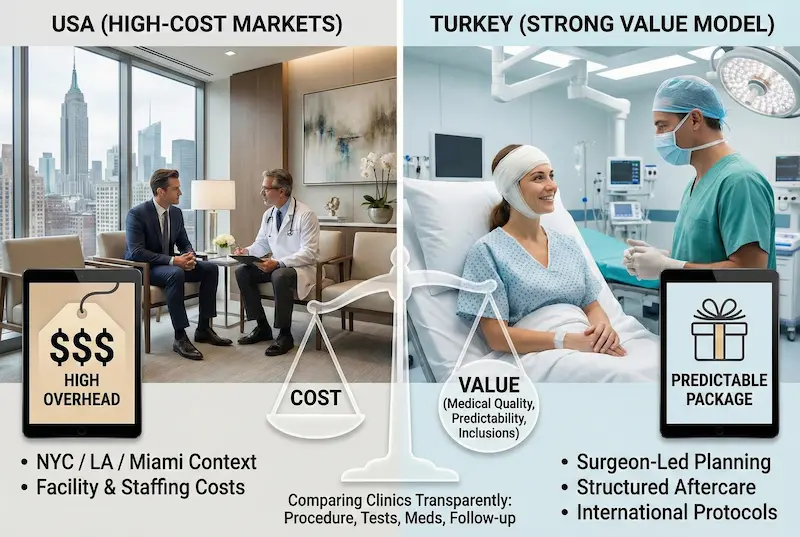
Cost & Value: How Much Does An Eyebrow Transplant Cost? 2026 (USA vs Turkey)
Patients ask how much does an eyebrow transplant cost because they want a transparent way to compare clinics. The most important point is this: cost should be evaluated as value—what’s included medically, how the procedure is performed, and how predictable the outcome is. A lower quote is not a deal if it removes surgeon involvement, skips safety steps, or treats eyebrows like a high-volume add-on.
In the United States, pricing can be significantly higher—especially in major markets like NYC, Los Angeles, and Miami—where facility costs, staffing, and overhead are typically elevated. In Turkey, patients often find a stronger value equation when the clinic delivers surgeon-led planning, strict protocols, and structured aftercare within an international patient model.
What’s included (procedure, tests, meds, aftercare)
When you compare clinics, don’t compare the headline price alone. Compare what’s inside the package. For an expert patient, inclusions and medical structure matter more than a single number.
- Medical evaluation: candidacy assessment and planning.
- Procedure: harvesting, graft refinement, and eyebrow-specific implantation.
- Medications and aftercare: clear post-op care protocol and support.
- Follow-up structure: scheduled check-ins and guidance during the growth cycle.
Why US pricing differs (NYC / LA / Miami context)
Searches like eyebrow hair transplant cost nyc, eyebrow transplant los angeles, and eyebrow transplant miami reflect a real pattern: large metro clinics often have higher facility costs and higher operating expenses. That doesn’t automatically mean better outcomes—but it does often mean higher pricing.
- Metro overhead: facilities and staffing costs in major US cities can raise fees.
- Clinic model differences: some centers price heavily around brand and location.
- Value lens: the safest comparison is surgeon involvement + protocol depth + outcome consistency.
How to compare clinics transparently (hidden fees checklist)
If you’re searching compare the prices of eyebrow transplant clinics, use a checklist approach. You’re not only buying grafts—you’re buying a system that protects graft survival and natural aesthetics.
- Is the design and implantation plan surgeon-led?
- Are single-hair grafts prioritized for a soft front edge?
- Is aftercare structured with clear follow-up points?
- Are medications, check-ins, and recovery support included—or billed later?
- Does the clinic address risk prevention (angles, direction, infection control) in detail?
| Comparison Category | Typical USA Clinic (High-Cost Markets) | High-Standard Turkey Clinic Model |
|---|---|---|
| Primary cost drivers | Metro overhead (facility, staffing), brand positioning, operating costs | Integrated medical + hospitality model, efficient infrastructure, international patient pathways |
| What you should verify | Surgeon involvement, eyebrow-specific angle discipline, follow-up structure | Surgeon-led planning, sterile protocols, graft handling controls, long-term follow-up |
| Common inclusions | Procedure + standard post-op instructions (varies widely by clinic) | Procedure + structured aftercare + coordinated international patient support (varies by clinic) |
| Common “hidden” variables | Separate charges for follow-ups, add-ons, medications, revision planning | Package structure can differ; confirm exactly what’s included and the follow-up timeline |
| Best way to decide | Compare the medical system behind the result: design quality, angle control, graft protection, safety protocols, and transparent follow-up | |
Finding The Best Eyebrow Transplant Surgeon & Clinic
Searches like best eyebrow transplant surgeon usually come from one fear: “What if this looks obvious?” That fear is valid. Eyebrows are unforgiving. A few degrees of angle error can change your entire expression.
“Best” is not a title a clinic claims. It’s a standard you verify. Use the checklist below to compare providers like an expert patient.
Credentials and training signals that matter
For eyebrow work, you want surgeon-led planning and verifiable training—not a high-volume model that treats brows like an add-on. We recommend looking for board certification, international education, and evidence that the surgeon understands facial aesthetics as a complete system. That matters because brows don’t live in isolation. They change how your eyes, lids, and midface read.
- Board-certified expertise: look for credentials that can be verified, not just claimed.
- International standards mindset: training and continuing education in US and European systems is a strong signal.
- Surgeon-led design: the person responsible for the plan should be involved in the plan.
- Natural-first philosophy: you want subtle structure, not a trendy template.
Surgeon insight: “Eyebrows aren’t about adding hair. They’re about controlling direction, softness, and balance so the result disappears into your face. If a clinic can’t explain its design logic, don’t let it design your brows.”
How to judge before/after photos like an expert patient
Before/after galleries can help, but only if you know what to look for. Density alone is not proof of quality. The real markers are direction, flatness, and a believable front edge.
- Front edge softness: the leading edge should look feathered, not boxed.
- Direction consistency: hairs should flow naturally across zones, especially around the arch.
- Flat-lay look: hairs should lie close to the skin, not stand up.
- Lighting honesty: ask for results in natural daylight, not only studio lighting.
- Scar cases: if you have a scar, look for examples with realistic, conservative density.
Also look for consistency across many patients. One perfect photo proves nothing. A pattern of natural results proves a system.
Reviews: how to read them without getting misled
When you search eyebrow transplant reviews, avoid getting hypnotized by “10/10” language alone. Look for recurring themes that match real-world care: honest expectation-setting, responsive communication, and structured follow-up. Those are the details that reduce anxiety and protect outcomes.
- Trust-building before travel: patients mention feeling informed, not pressured.
- Surgeon involvement: reviews that describe surgeon-led consultations are a strong credibility signal.
- Continuum of care: the best experiences include support after patients return home.
- Natural result language: phrases like “refreshed” and “not done” align with high-standard aesthetics.
Your Istanbul Journey With Us (From Online Consult To Follow-Up)
For international patients, the procedure is only half the product. The other half is the experience: how predictable your timeline feels, how supported you are in a new country, and how confidently you can return home knowing follow-up is built in. We designed our VIP pathway to remove friction so you can focus on healing and results.
Free virtual consultation and a personalized plan
Your journey starts at home. We schedule a no-obligation video consultation where you share photos, explain your brow history, and describe your goals. Then we build a plan around your face and your timeline, including a transparent, all-inclusive quote.
- Goal clarity: what “natural” means for you, not for a trend.
- Feasibility check: candidacy, donor suitability, and realistic density targets.
- Timeline planning: aligning procedure timing with work, events, and travel windows.
VIP logistics: hotel, transfers, and a dedicated Patient Host
Once you secure your date, your dedicated Patient Host coordinates the entire logistics plan. We arrange 5-star hotel accommodation from our curated partner list and schedule VIP transfers. When you land at Istanbul Airport (IST or SAW), a private driver greets you at arrivals and escorts you to a luxury vehicle for your hotel transfer.
- Airport welcome: private meet-and-greet at arrivals.
- Private transfers: comfortable transport between airport, hotel, and clinic.
- 5-star hotel planning: curated partner options designed for rest and privacy.
- High-touch support: your Patient Host stays available throughout your stay.
Procedure day, recovery support in Istanbul, and long-term follow-up
On procedure day, we finalize your plan in person and complete necessary pre-operative checks before surgery. After the procedure, our medical team monitors your early recovery and your Patient Host remains reachable 24/7 via WhatsApp. Before you leave Istanbul, we perform a final in-person check-up and clear you to fly home.
Then we stay involved. We schedule virtual follow-ups at 1, 3, 6, and 12 months to monitor healing, answer questions, and guide long-term grooming and maintenance as your brows mature.
- In-person confirmation: final design review and plan alignment before the procedure.
- Early recovery monitoring: structured support right after surgery.
- 24/7 access: fast answers when you need reassurance or guidance.
- Long-term follow-up: scheduled checkpoints through the full growth cycle.
What’s included in our all-inclusive VIP package (and what’s not)
Transparent pricing reduces stress. It also makes comparisons fair. Our VIP package is designed to remove hidden variables so you can plan confidently.
- Typically included: your complete procedure, anesthesia and operating room fees, all pre-operative tests, 5-star hotel accommodation, VIP airport and clinic transfers, a 24/7 dedicated Patient Host, post-operative medications and necessary garments, your first post-op meal, and long-term virtual follow-up care.
- Typically not included: international flight tickets, personal travel insurance, visa fees (if applicable), personal expenses (for example meals beyond what’s provided), and additional hotel nights if you extend your stay.
Eyebrow Transplant Frequently Asked Questions (FAQ):
Below are clear, no-drama answers to the questions we hear most often from patients researching an Eyebrow Transplant. If your question isn’t listed, we’ll address it during your virtual consultation with a personalized plan.
What is an eyebrow transplant?
An eyebrow transplant is a microsurgical procedure that relocates individual hair follicles into the brow area to rebuild shape and density with real, growing hair. Each graft is placed one by one to match natural direction and a soft front edge.
How does an eyebrow transplant work?
We harvest follicles from a donor area (most commonly the back of the scalp), refine grafts—often prioritizing single-hair grafts—and implant them at ultra-flat angles following your brow’s growth map (head/body/tail zones).
Where do they get the hair for eyebrow transplant?
In most cases, donor hair comes from the back of the scalp. We select hairs that best match brow needs and place them to blend naturally. The donor plan is conservative to keep the donor area discreet and protected long-term.
How many grafts do I need?
It depends on your starting density, the size of gaps, and your design goal. For eyebrows, the focus is realism—soft transitions and correct direction—rather than “maximum graft count.” We confirm an estimate after reviewing your photos and goals.
Is eyebrow hair transplant surgery painful?
Most patients are comfortable under local anesthesia. You may feel pressure or movement, but pain is not the goal. Afterward, mild tenderness, redness, and micro-scabbing are common and typically improve as healing progresses.
What is eyebrow transplant recovery time?
Visible healing (redness/scabbing settling) usually happens first, while growth takes months. Many patients look “socially presentable” relatively early, but final density and refinement build gradually through the hair cycle.
What are eyebrow transplant side effects?
Common, temporary effects include redness, micro-scabs, mild swelling, and itchiness during healing. Shedding of transplanted hairs before regrowth can also occur. We explain what’s normal and what signs should prompt a check-in.
Is eyebrow transplant safe in Turkey?
Safety depends on the clinic’s medical standards—not the country label. The safest choice is a surgeon-led system with sterile protocols, careful graft handling, and structured follow-up. You should be able to evaluate the clinic’s workflow, transparency, and consistency of natural results.
What can go wrong—and how do you prevent it?
The most preventable “gone wrong” outcomes are unnatural direction, upright hairs, and harsh front edges—typically caused by angle and design errors. Prevention comes from eyebrow-specific mapping, ultra-flat implantation angles, careful graft selection, and a conservative density strategy that prioritizes realism.
Is an eyebrow transplant permanent?
The goal is long-lasting growth using stable donor follicles. While results are intended to be durable, your final outcome still depends on healing, aftercare, and hair-cycle timing. “Permanent” does not mean “instant.”
Does eyebrow transplant hair grow long?
It often can—especially when donor follicles are taken from the scalp. That’s why trimming is usually part of routine maintenance. Most patients prefer this trade-off because it’s real hair with natural texture and depth.
Eyebrow transplant vs microblading—what’s better?
Microblading is pigment and typically requires touch-ups over time. An eyebrow transplant produces real hair and long-term structure, but requires grooming (often trimming). The best choice depends on whether you want a temporary cosmetic effect or a living hair-based restoration.
Can I get a transplant if I’ve had microblading?
Often yes, but it depends on skin condition and how the area heals. We evaluate the brow skin and design a plan that prioritizes safe implantation and natural blending.
How much does an eyebrow transplant cost?
Pricing varies based on complexity, design goals, and what’s included (medical evaluation, procedure details, aftercare, follow-ups). The safest comparison is value: surgeon involvement, protocols, graft handling, and reliable follow-up—rather than the headline price alone.
Why does cost differ between the USA and Turkey?
US pricing—especially in major markets like NYC, LA, and Miami—often reflects higher overhead and operating costs. In Turkey, patients may find stronger value when the clinic offers surgeon-led planning, strict medical standards, and an integrated international patient pathway.
How long should I stay in Istanbul?
Your itinerary depends on your procedure schedule and early recovery plan. We coordinate your timeline so you’re supported during the most important early healing window and receive clear instructions before you fly home.
What happens after I return home?
A responsible clinic stays involved. We plan structured virtual follow-ups and give you clear guidance for normal healing vs signs that should be reviewed. You should never feel like you’re managing recovery alone.
Medical Disclaimer (Educational Use Only): This page provides general information and does not replace personalized medical advice, diagnosis, or treatment. Candidacy and outcomes vary by individual. Always consult a qualified medical professional for advice tailored to your health history. Reviewed by AKM Medical Board.