



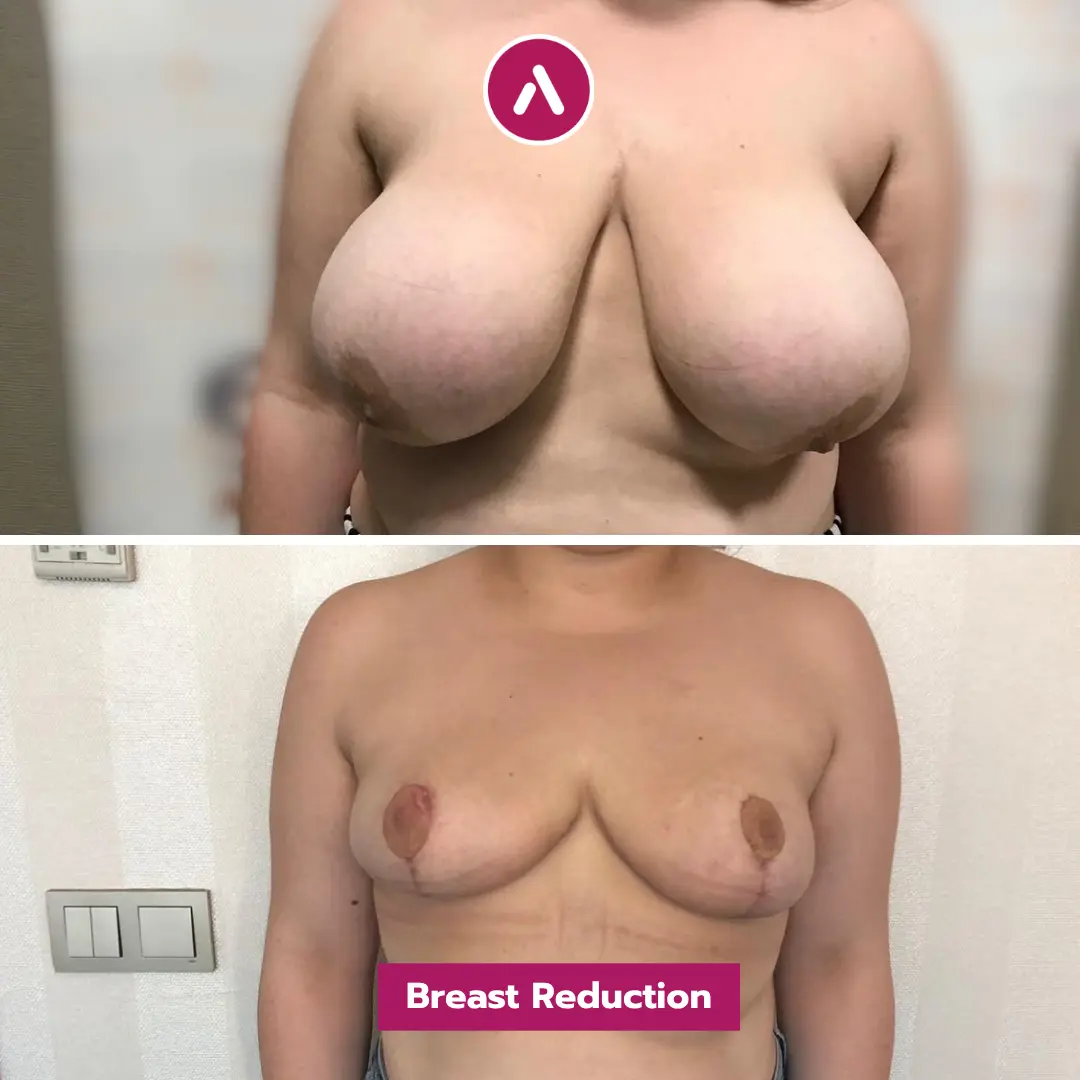
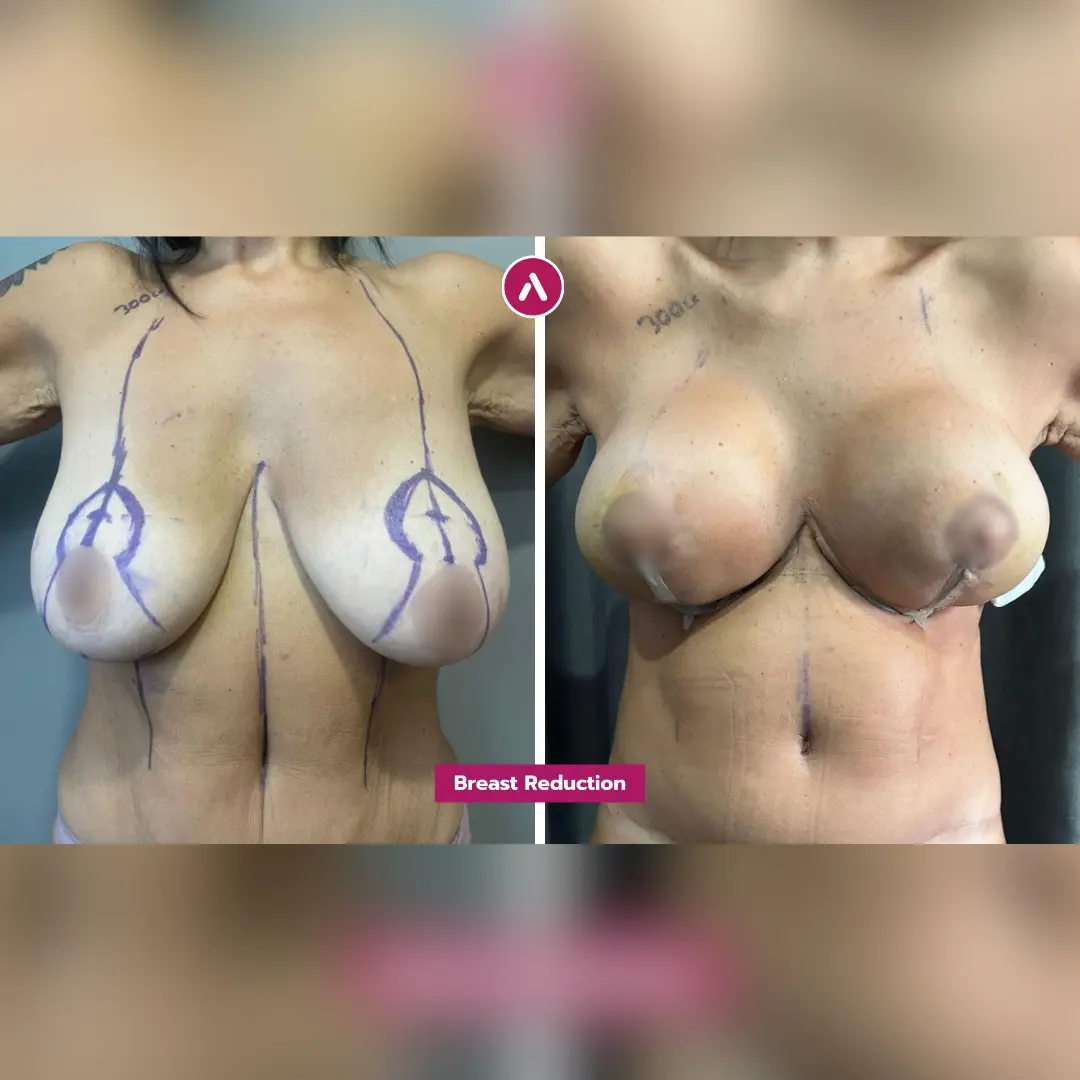
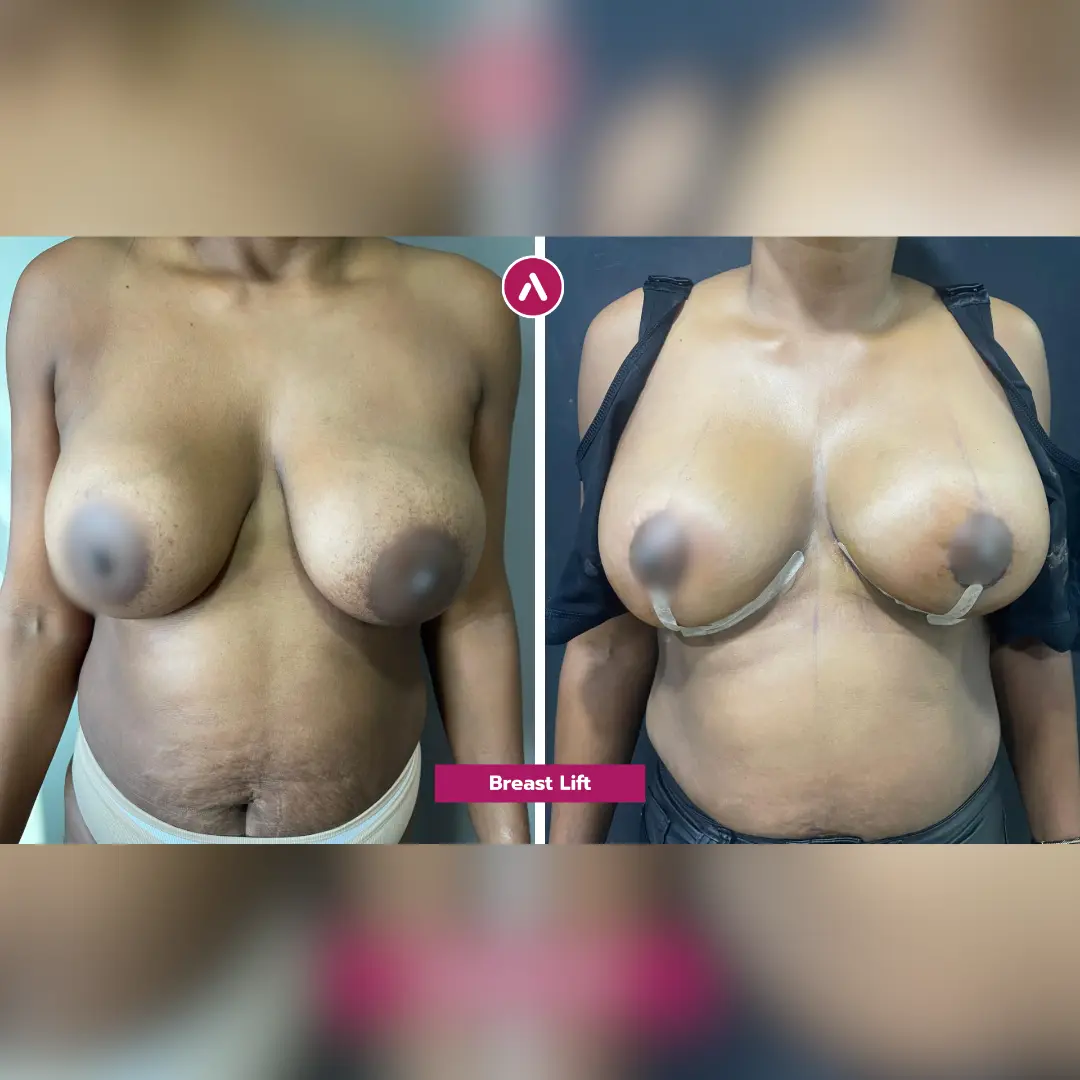
Large, heavy breasts can affect posture, exercise, clothing, and daily comfort. Many US patients begin researching Breast Reduction after years of neck or back strain, bra strap grooves, and skin irritation. If you want a natural looking result, this guide explains how reduction mammoplasty works, who qualifies, and what to expect from planning to recovery including scars, risks, and timelines.
Comparing the USA with Istanbul is about standards and predictability, not chasing the lowest price. Quality care depends on surgeon expertise, modern facilities, attentive anesthesia, and structured follow up after you fly home. Turkey pricing often reflects economic factors, but only a disciplined clinic protects outcomes. A virtual consultation clarifies candidacy, technique, and an all inclusive package plan with clear steps.
Table of Contents
What is Breast Reduction?
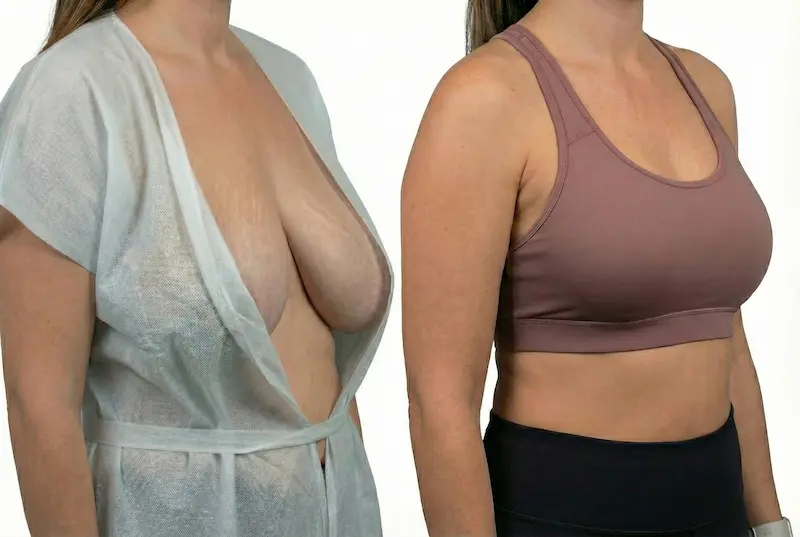
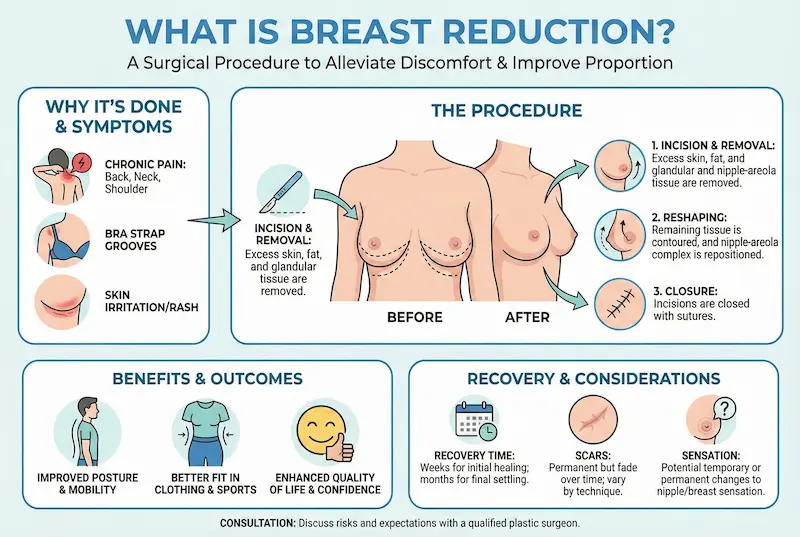
Breast Reduction is a surgical procedure that reduces the weight and volume of overly large breasts by removing excess glandular tissue, fat, and skin—then reshaping the breast for a more balanced, lifted contour. In medical terms, it’s called reduction mammoplasty. The goal is proportional comfort, not a “different you.”
Many patients first ask, what is a breast reduction really doing—size change, symptom relief, or both. The honest answer is: both, when planned correctly. A well-executed reduction is not just “taking away volume.” It is structural reshaping. It is also a long-term quality-of-life upgrade for the right candidate.
Definition: How does breast reduction surgery work?
At its core, breast reduction surgery removes the components that create excess size and weight, then rebuilds the breast mound in a way that looks natural on your frame. That includes reshaping the internal tissue, not only tightening skin.
- Excess breast tissue is reduced to the planned volume.
- Skin is tailored to match the new shape (not to “force” the shape).
- The nipple–areola complex (NAC) may be repositioned to a more youthful location.
Because every breast has different density, skin quality, and degree of droop, “one-size-fits-all” planning fails. We plan reductions around proportion, symmetry, and stability—so the result ages gracefully.
The anatomy: What changes during the procedure?
Breasts are made of glandular tissue, fatty tissue, and skin—supported by internal ligaments. In many patients with macromastia (overly large breasts), the issue is not only volume, but also stretch and descent over time.
- Glandular tissue: the firm tissue responsible for breast structure.
- Fat: softer volume that varies with weight changes.
- Skin envelope: the “outer shell” that may be overstretched.
A reduction balances all three elements. If you only remove volume without reshaping, the breast can look flattened or wide. If you only tighten skin, weight remains—and symptoms often return.
The core goal: Proportion, comfort, and a natural silhouette
Our guiding philosophy is “Rejuvenation, Not Alteration.” That matters in breast surgery, too. The best reductions do not look “operated.” They look like you—just proportionate, lighter, and more aligned with your frame.
- Functional goal: reduce physical strain and friction-related skin issues.
- Aesthetic goal: a lifted, balanced shape with stable long-term support.
- Psychological goal: relief—feeling like your body finally matches your life.
Benefits of Breast Reduction: What changes (and why patients do it)
Breast reduction is often described as “life-changing,” and that phrase isn’t hype when the indication is clear. Large, heavy breasts can affect posture, activity, clothing choices, and even sleep. Reducing that constant load can create immediate physical relief—then long-term freedom.
When patients research the pros and cons of breast reduction, they are usually weighing comfort against scars, recovery time, and the permanence of the decision. That’s a smart way to think. A high-quality result comes from honest planning, appropriate technique selection, and disciplined recovery.
Functional benefits: Relief you can feel every day
The most consistent benefit is reduced mechanical strain. Many patients report that their shoulders and neck feel “lighter” within days, even before swelling fully resolves.
- Reduced neck, upper-back, and shoulder discomfort caused by weight and bra-strap pressure
- Less skin irritation and rash under the breast fold
- Improved posture and more comfortable movement
Lifestyle benefits: Exercise, clothing, and daily confidence
Breasts that are disproportionately large can make high-impact movement uncomfortable and limit wardrobe options. After a well-planned reduction, patients often describe a “return to normal life.” Simple things become easy again.
- More comfortable running, strength training, yoga, and general fitness
- Clothes fit as intended—less tailoring, less compromise
- Improved comfort with bras, swimwear, and professional attire
Aesthetic benefits: Lifted shape without looking “done”
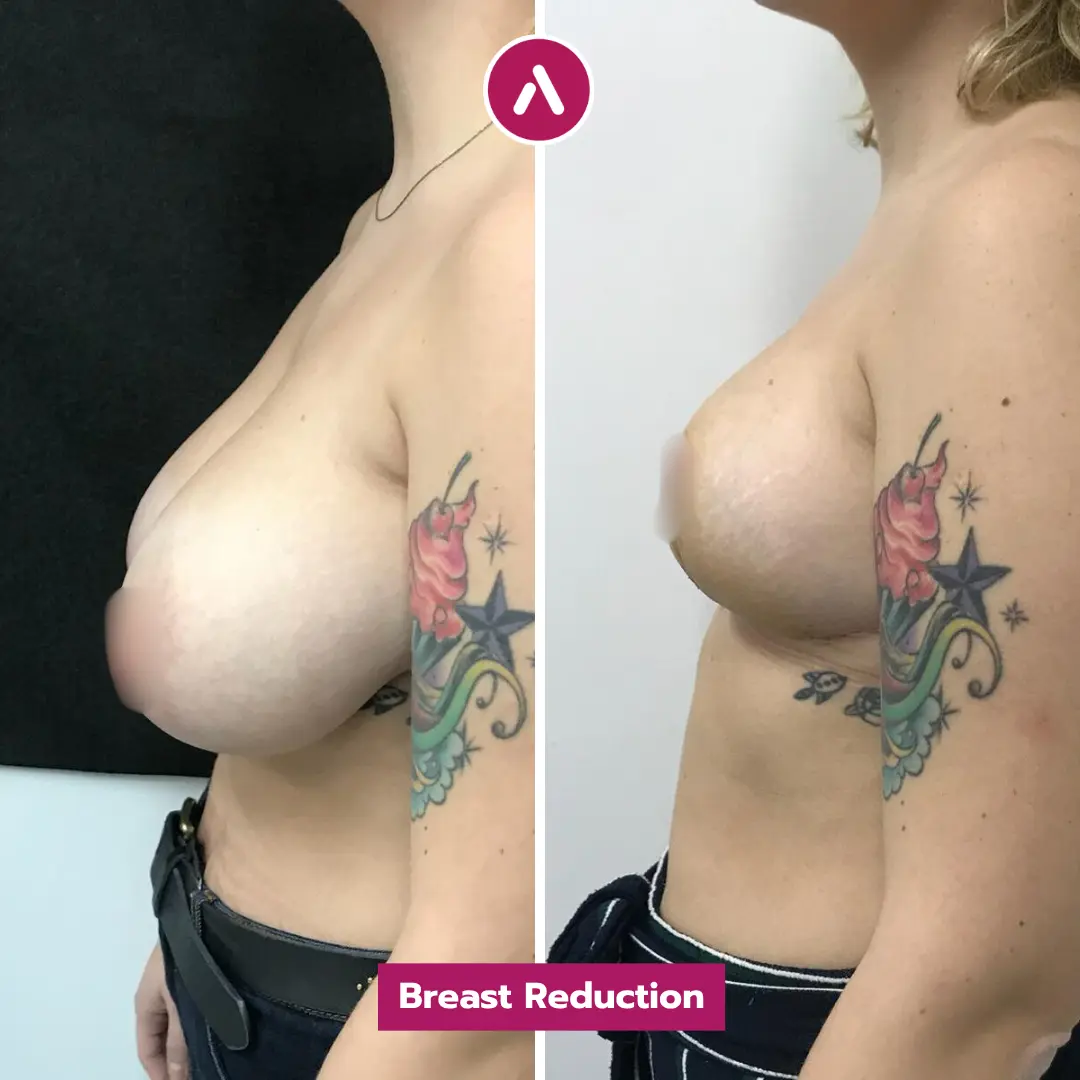
Reduction is also a reshaping procedure. That means the breast usually looks lifted and better supported—not only smaller. The goal is a natural contour that matches your torso and shoulder width.
- Better upper-pole balance (not “implanted” fullness, just structure)
- Improved nipple position and breast footprint on the chest wall
- More harmonious proportions from front and side views
Surgeon’s Insight: “A refined breast reduction isn’t about going small. It’s about restoring proportion—so the result looks natural today, and still looks natural years from now.”
Am I a Good Candidate?
Most people don’t start researching breast reduction because they want a trendy change. They start because their body feels out of balance. Pain, skin irritation, limited activity, and constant wardrobe compromises are common drivers. If this sounds familiar, you may be a strong candidate—assuming your health profile supports safe surgery.
We treat candidacy as a medical decision first. Your aesthetic goal matters, but safety comes first. That’s why we rely on strict pre-operative screenings and a surgeon-led plan, not guesswork.
Common candidacy signals (symptoms + lifestyle limitations)
Large, heavy breasts can create a predictable pattern of daily problems. Many patients recognize themselves in this list immediately.
- Persistent neck, back, or shoulder discomfort tied to breast weight
- Deep bra strap grooves that don’t improve with different support bras
- Rashes or irritation under the breast fold (especially in warm climates or during workouts)
- Exercise limitations or discomfort with running, jumping, or strength training
- Difficulty finding clothing that fits your chest without oversizing everything else
Medical criteria: the factors that impact safety and healing
A technically perfect surgery can still heal poorly if the body isn’t ready. These are the practical variables we review with you.
- Stable weight: significant weight fluctuations can change breast volume after surgery
- Nicotine use: smoking and vaping increase the risk of wound-healing problems
- General health: anemia, uncontrolled diabetes, or clotting risks require careful planning
- Skin quality: elasticity influences which technique gives the most stable shape
If something raises your risk profile, the answer isn’t always “no.” Sometimes it’s “not yet.” We optimize what we can. We don’t rush what we can’t.
Who should wait (or think twice) before surgery?
Timing matters. For some patients, the best decision is to delay so the results stay consistent and the recovery is smoother.
- Planning pregnancy soon (breast size and tissue can change)
- Actively breastfeeding or recently finished breastfeeding
- Currently pursuing major weight loss goals
- Uncontrolled medical conditions that raise anesthesia or healing risks
What to prepare for your consultation
A high-quality plan starts with clear inputs. Bring clarity, and we can give you precision.
- A short symptom list: what hurts, what limits you, what you’ve tried
- Your medical history and current medications/supplements
- Photos that show your goals (proportion and shape, not a single bra size)
- Your priorities: symptom relief, scar minimization, lift, upper-pole shape, long-term support
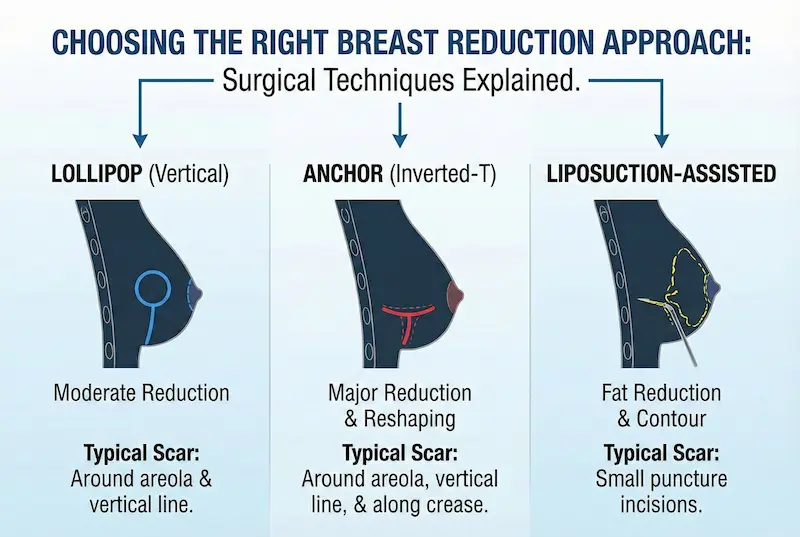
Surgical Techniques Explained: Choosing the Right Breast Reduction Approach
Patients often search for types of breast reduction techniques because they want control over the outcome. That’s reasonable. Technique influences shape, scars, and how stable the result feels over time. Still, the “best” method isn’t a trend. It’s a match between your anatomy and your priorities.
Our European Board Certified Surgeons choose technique based on structure: tissue density, skin quality, degree of droop, and how much reduction is needed. Then we simulate and plan for proportion—because predictable planning creates predictable results.
Incision patterns: lollipop vs anchor breast reduction
These are the two most common incision patterns used to reshape and reduce volume. Both can produce natural results when used appropriately.
- Lollipop (vertical): incision around the areola + a vertical line down to the breast crease
- Anchor (inverted-T): lollipop pattern plus a line hidden along the breast crease
Lollipop is often used when the reduction is moderate and skin quality is favorable. Anchor is typically used when more skin needs to be removed or when the breast footprint must be reshaped more extensively.
Limited-scar options: keyhole breast reduction (who qualifies)
“Keyhole” approaches are often discussed online as if they’re universally available. They aren’t. Limited-scar options can be excellent for carefully selected patients, but only if the anatomy supports it.
- Best for: smaller reductions with minimal excess skin
- Trade-off: less ability to reshape and lift when skin laxity is significant
- Bottom line: a smaller scar is not a win if the breast shape is compromised
Adjunct methods: breast reduction liposuction (what it can and can’t do)
Liposuction can reduce fatty volume, especially in the outer breast and side chest. It can also help refine contour. It cannot replace reshaping when glandular tissue and excess skin are major contributors.
- Works best when the breast is fat-dominant and skin elasticity is strong
- Helps contour the lateral chest (“side boob”) in the right candidate
- Does not reliably lift a significantly drooping breast on its own
How technique affects shape, scarring, and long-term support
Scars matter. Shape matters more. The goal is a refined silhouette that stays stable as swelling resolves and tissues settle.
- Shape: internal reshaping is what prevents a flat or wide look
- Scars: most scars fade over time, but their placement depends on what needs correction
- Support: stronger structural planning tends to age better than “skin-only tightening”
| Technique | Best For | Typical Scar Pattern | Primary Trade-Off |
|---|---|---|---|
| Lollipop (Vertical) | Moderate reduction, good skin quality | Around areola + vertical line | Less skin removal than anchor in major droop cases |
| Anchor (Inverted-T) | Larger reduction, significant excess skin | Around areola + vertical + crease line | More scar length, often worth it for control and shape |
| Keyhole / Limited-Scar | Small reductions with minimal laxity | More limited, case-dependent | Not suitable if lift and reshaping demands are high |
| Liposuction-Assisted | Fat-dominant volume, contour refinement | Small puncture incisions | Limited lift; cannot replace structural reshaping |
Surgeon’s Insight: “A smaller scar is not a surgical strategy. The right strategy is the one that gives you a natural shape, stable support, and a recovery you can predict.”
Procedures to Combine Breast Reduction: Maximizing Results With One Recovery
For many patients, breast reduction isn’t just about removing volume—it’s about restoring overall balance. Depending on your anatomy and goals, combining procedures can be an efficient way to improve harmony while keeping recovery consolidated. The key is choosing combinations that make medical sense, protect safety margins, and deliver predictable, natural-looking outcomes.
Breast Reduction + Breast Lift: When “lift” is already part of the plan
A common question is whether you need a breast lift in addition to reduction. In many cases, reduction planning includes lifting elements because reshaping and repositioning are often necessary to achieve a proportional contour. When a lift is discussed separately, it’s usually because the goal is more upper-pole support or refined shape control. We plan this based on skin quality, degree of droop, tissue density, and how much reduction is needed—so the result looks balanced, not over-corrected.
Breast Reduction + Liposuction: Contour refinement (in the right candidate)
Liposuction can be a useful add-on when there is fatty fullness along the lateral chest (the “side roll”) or when contour blending is needed for a smoother silhouette. It’s important to understand what liposuction can and cannot do: it can refine contour and reduce fat-dominant fullness, but it does not replace structural reshaping when glandular tissue and excess skin are major contributors. Used strategically, it can enhance overall proportion without adding unnecessary complexity.
Mommy Makeover Combinations: Planning a single recovery window
A mommy makeover often pairs breast procedures with abdominal reshaping for patients who want a more comprehensive change after pregnancy. Breast reduction may be combined with a tummy tuck to address loose skin, muscle laxity, or contour changes in one surgical journey—when your health profile supports it. The advantage is obvious: one anesthesia event and one structured recovery timeline. The decision, however, must be medically disciplined, with careful attention to operative time, risk factors, and realistic recovery demands.
When we recommend staging instead of combining
Not every patient benefits from “doing it all at once.” We may advise staging procedures if operative time becomes too long, if healing risk is elevated (for example, nicotine use or certain medical conditions), or if your best aesthetic outcome requires a phased approach. Our priority is simple: a safe plan that heals well—because predictable healing is what protects the final result.
“One anesthesia, one recovery” logic—and when we do not combine
The advantage of combining is convenience and efficiency—when it doesn’t increase risk. We may recommend staging procedures (separate surgeries) when:
- Operative time would become excessively long for your health profile
- Your healing risk is elevated (for example, active nicotine use or unstable medical conditions)
- Your goals require a phased approach to achieve the most controlled result
Surgeon’s Insight: “A combined plan is only ‘efficient’ if it stays medically disciplined. We choose strategy based on safety margins first—and aesthetics second.”
Anesthesia Options: Why We Prefer Awake/Twilight Sedation When Appropriate
Patients searching for awake breast reduction are usually looking for two things: a safer-feeling experience and a smoother recovery profile. The term “awake” can be misleading, so we explain it clearly. Most “awake” reductions are performed under twilight sedation (often called IV sedation), where you are deeply relaxed and comfortable, breathing on your own, and typically remember little—while the surgical area is fully numbed.
Not every case is suitable for twilight sedation. For some patients, general anesthesia remains the best choice. Our job is to match the anesthesia plan to your body, your procedure complexity, and your safety profile—not to force a trend.
What “awake” / twilight sedation means in real terms
- You are not “wide awake”: you’re comfortably sedated, drowsy, and monitored continuously.
- The surgical area is fully numbed: local anesthetic is used to control pain during and after.
- You keep spontaneous breathing: in appropriate candidates, this can reduce certain anesthesia-related burdens.
The experience is designed to be calm and controlled. You’re supported by an anesthesia team whose sole focus is physiologic stability and comfort.
Who is a candidate for twilight sedation vs when general anesthesia is better
Candidate selection matters. We evaluate the extent of reduction needed, your medical history, and procedural complexity.
- Twilight sedation may be appropriate for carefully selected patients with predictable operative complexity and stable health status.
- General anesthesia may be preferred when a large reduction, extensive reshaping, or additional procedures make deeper anesthesia safer or more controlled.
- Patient comfort matters: anxiety level, airway considerations, and medical conditions guide the best choice.
Safety + comfort: How the plan supports a smoother recovery
From a patient perspective, the anesthesia plan should support two outcomes: a stable intraoperative course and a more manageable early recovery. Our protocols focus on:
- Continuous monitoring (heart rhythm, oxygenation, blood pressure, temperature)
- Nausea prevention strategies when clinically appropriate
- Pain-control planning that doesn’t rely on “toughing it out”
- A structured discharge pathway with clear instructions and direct contact access
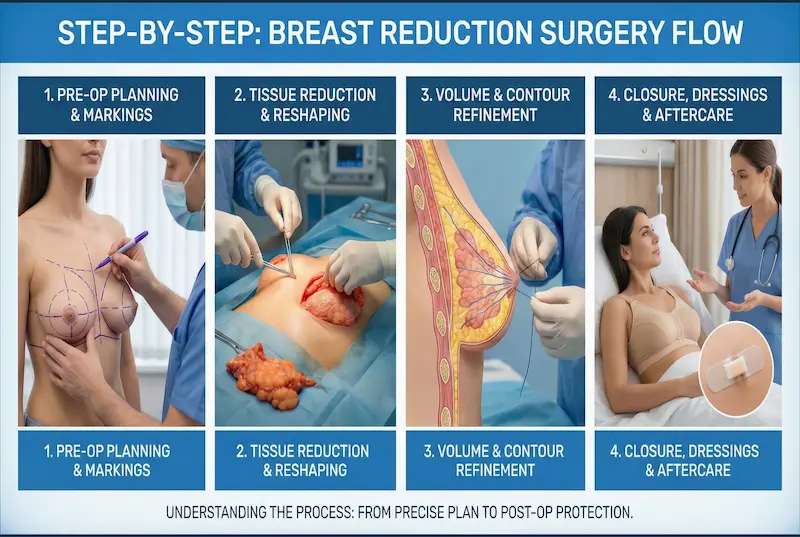
Step-by-Step: What Happens During Surgery?
Understanding the flow of surgery helps reduce anxiety and sets realistic expectations. While technique details vary by anatomy and planned reduction level, the core sequence is consistent: plan precisely, reshape structurally, close carefully, and protect the result.
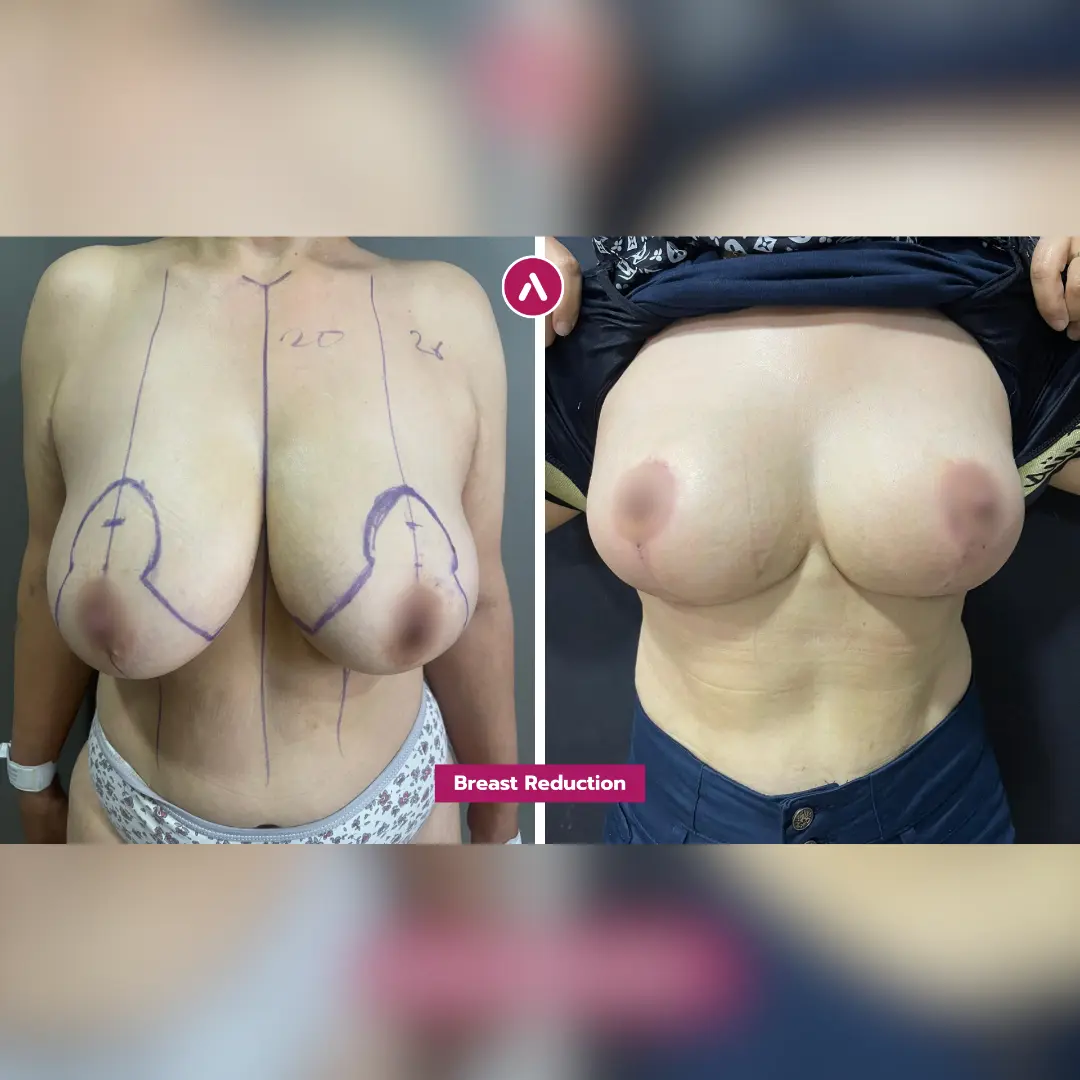
Pre-op planning, markings, and proportional design
Planning starts before the first incision. We map breast landmarks, nipple position goals, and symmetry targets with you upright—because gravity shows the true shape. We also discuss what “smaller” means in proportional terms rather than relying on a single bra size (which varies widely by brand and fit).
Tissue reduction + reshaping + nipple/areola positioning
During surgery, excess glandular tissue, fat, and skin are reduced according to the plan. The remaining tissue is reshaped to create a stable breast mound that looks natural on your chest. If indicated, the nipple–areola complex is repositioned to align with the new contour and balance.
- Volume is reduced based on proportion, not extremes.
- Internal shaping supports a lifted contour that ages more gracefully.
- Symmetry is refined with careful intraoperative evaluation.
Closure strategy, dressings, and immediate aftercare
Closure is not just “stitching skin.” It is a structural step that supports healing quality and scar refinement. After closure, you’ll be placed in supportive dressings and a surgical bra to stabilize the new shape.
Before you leave recovery, we confirm comfort, safety parameters, and instructions—so you know exactly what to do that night, what to avoid, and what “normal” looks like in the first 24–48 hours.
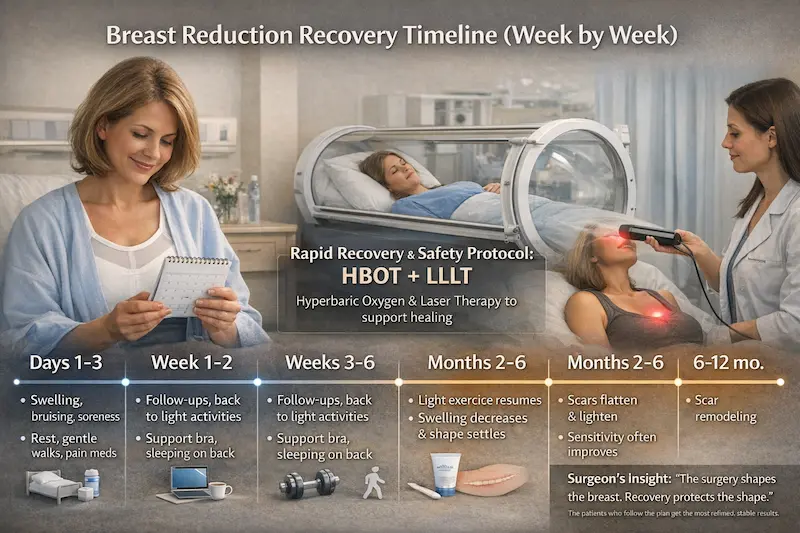
Recovery Timeline: Breast Reduction Recovery Week by Week
Recovery is a timeline. It’s not a single day. If you’re searching for breast reduction recovery week by week, you’re asking the right question—because the best outcomes come from disciplined aftercare and realistic pacing.
Your exact recovery depends on your reduction level, incision pattern, skin quality, and how your body heals. Still, the milestones are consistent enough that you can plan your work, travel, and support at home with confidence.
Days 1–3: Swelling, pressure, and “what’s normal”
The first 72 hours are about comfort and safety. You’ll feel tightness, heaviness, and swelling. That’s expected.
- Moderate soreness and pressure, usually controlled with a structured pain plan
- Swelling and bruising that peaks early, then slowly improves
- Limited arm range of motion (you’ll want help with reaching and lifting)
- Short walks encouraged to support circulation
What you should avoid: lifting, stretching overhead, and “testing” your strength. Quiet, consistent movement wins.
Week 1–2: Getting back to routine (safely)
This is when most patients feel noticeably better. You’re still healing, but daily life starts to normalize.
- Follow-up checks to assess incision healing and swelling progression
- Many patients return to desk-based work in 7–14 days (varies by comfort and job demands)
- Support bra use is non-negotiable to protect shape while tissues stabilize
- Sleeping on your back remains important to reduce tension and swelling
It’s also a mental shift. You may feel excited one day and impatient the next. That’s normal too.
Weeks 3–6: Activity ramp-up and “settling” begins
Energy returns in phases. Swelling improves, shape starts to look more natural, and the breasts feel less “high and firm.”
- Light, lower-body workouts often resume first (with surgeon guidance)
- Upper-body training and high-impact movement typically wait longer
- Sensation changes may come and go as nerves recover
- Incisions continue strengthening—so “feeling better” doesn’t mean “fully healed”
Most patients can do more at week 4 than week 2. Still, pushing too hard can delay healing and worsen scars. Stay disciplined.
Scars over time: What do breast reduction scars look like?
Patients often ask, what do breast reduction scars look like at different stages. Early scars can look darker, raised, or pink. That’s part of normal biology.
- First weeks: redness and firmness are common
- Months 2–6: scars often flatten and lighten gradually
- 6–12 months: most scars soften further as collagen remodels
When patients search breast reduction scars healed, they’re usually looking for reassurance that scars won’t stay “angry” forever. In most cases, they don’t—when scar care is consistent and tension is minimized.
Our Rapid Recovery & Safety Protocol: HBOT + LLLT
We built our post-op care around a clear priority: faster healing with lower risk. Our Rapid Recovery & Safety Protocol combines Hyperbaric Oxygen Therapy (HBOT) and Low-Level Laser Therapy (LLLT) as an integrated support system during the recovery window.
- HBOT: helps support tissue recovery by increasing oxygen delivery in a controlled, pressurized environment
- LLLT: supports cellular repair and collagen activity without heat or damage
- Why it matters: reduced swelling, improved tissue support, and scar-healing optimization
We tailor timing and frequency to your procedure and healing needs. The goal stays the same: protect the result while your body does the work.
Surgeon’s Insight: “The surgery shapes the breast. Recovery protects the shape. The patients who follow the plan get the most refined, stable results.”
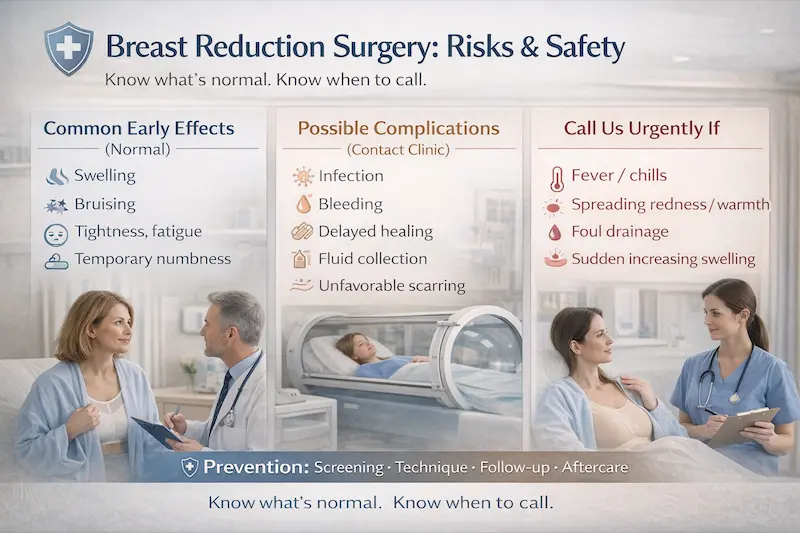
Breast Reduction Surgery Complications, Risks & Safety
Patients often search is breast reduction surgery safe because they’re weighing a permanent decision. That’s smart. Breast reduction is a common procedure, but it’s still real surgery—with real variables.
Our job is to reduce risk through candidacy screening, disciplined technique selection, and structured follow-up. Your job is to follow recovery rules and communicate early if something feels off.
Common side effects vs. true complications
Early swelling, bruising, tightness, and fatigue are expected side effects. They improve with time. Complications are different. They require medical attention and sometimes intervention.
- Common early effects: swelling, bruising, temporary numbness, sensitivity changes
- Possible complications: bleeding, infection, delayed wound healing, fluid collection, unfavorable scarring
- Shape variables: mild asymmetry is normal; meaningful asymmetry is evaluated and managed
Risks of breast reduction: What we plan for
When patients ask about the risks of breast reduction, they want specifics. Here are the key categories we discuss openly:
- Wound healing delays: higher risk with nicotine use, poor circulation, uncontrolled diabetes
- Sensation changes: can be temporary or long-term, depending on anatomy and reduction level
- Scarring variability: genetics and tension influence scar thickness and color
- Breastfeeding impact: depends on technique and how much glandular tissue is affected
Most issues are preventable or manageable when we plan properly and you follow aftercare closely.
Common problems after breast reduction surgery (and what they usually mean)
People search common problems after breast reduction surgery because they don’t want surprises. Here’s what we consider “common,” and how we interpret it clinically:
- Swelling that looks uneven: often normal early on; we track trends over time
- Firm areas: can be part of healing; we evaluate for fluid or scar tissue if persistent
- Itching or pulling: common as nerves and skin recover
- Emotional ups and downs: a normal response to swelling, sleep changes, and recovery limits
Signs of infection after breast reduction: When to contact us immediately
Infection is uncommon when standards and aftercare are strong, but it can happen. Knowing the signs of infection after breast reduction is part of smart recovery.
- Fever or chills
- Increasing redness that spreads, warmth, or worsening tenderness at the incision
- Thick drainage or foul odor
- Sudden swelling that escalates instead of improving
If you notice these signs, contact our team right away. Early action prevents escalation.
Is Breast Reduction Safe in Turkey?
This is the value-comparison question many US patients eventually reach. The best answer is direct: safety depends on standards, not geography. Facility quality, surgeon training, anesthesia protocols, sterilization discipline, and follow-up structure matter more than the country name on a map.
We built our international patient model around “USA-level” expectations—because our patients compare Istanbul to premium US markets, not budget alternatives.
Standards that actually change outcomes
- Strict pre-operative screenings to confirm candidacy and reduce avoidable risk
- Continuous vitals monitoring and an anesthesia plan matched to your medical profile
- Rigorous sterilization protocols designed for zero compromise
- A structured aftercare pathway with clear escalation steps if anything feels abnormal
Surgeon authority (without the marketing noise)
Your result is only as good as the plan behind it. Our European Board Certified Surgeons focus on structural reshaping and long-term stability—so the result looks natural now and stays natural later.
- Technique selection based on anatomy, not trends
- Proportion-focused planning to avoid over-correction
- Predictable scarring strategy built into the surgical design
Privacy and continuity of care for US patients
International surgery only makes sense if follow-up is real. We run a high-touch communication model designed for distance.
- Clear post-op instructions written for real life, not medical jargon
- Direct access to your coordinator for questions during recovery
- Scheduled virtual check-ins after you return home to track healing milestones
Surgeon’s Insight: “Safety is a system. When standards, screening, and aftercare are built into the model, distance stops being the risk factor patients fear.”
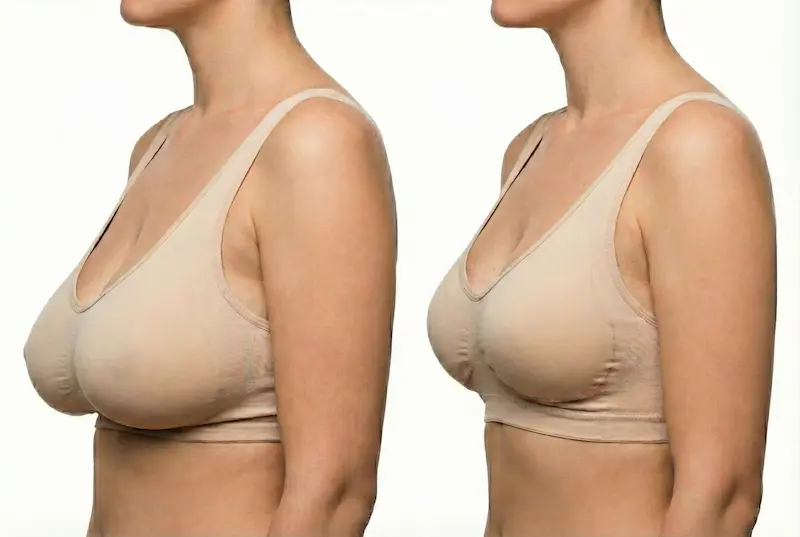
Realistic Expectations & Results
The best results don’t look “surgical.” They look like balance. That’s why we plan reduction surgery around proportion, not a single bra size. Bra sizing is inconsistent between brands, and it doesn’t describe your frame, shoulder width, or tissue density.
If you’re an “Expert Patient,” you’re also thinking long-term. Smart. A refined result should feel lighter immediately, look natural once swelling settles, and stay stable as your body changes over time.
Early results vs. settled results: What changes over time?
Right after surgery, breasts often sit higher and feel firmer than expected. Swelling is doing that. Internal tissues also need time to relax into their new shape.
- Weeks 1–2: swelling, tightness, and an “over-corrected” feel can be normal
- Weeks 3–6: the breast starts to soften and look more like a natural contour
- Months 3–6: shape refinement becomes more obvious as swelling continues to resolve
- 6–12 months: scars and tissue texture typically mature further
Photos taken too early can be misleading. We track trends, not single-day snapshots.
Breastfeeding and sensation: What you should know
Many patients ask, can you breastfeed after a breast reduction. The honest answer depends on technique, anatomy, and how much glandular tissue needs to be reshaped. Some patients breastfeed successfully after reduction. Others experience reduced capacity.
- Breastfeeding: preservation strategies may be possible in some cases, but it can’t be guaranteed
- Nipple sensation: temporary numbness or hypersensitivity is common early on
- Long-term sensation: many patients see improvement over months, but outcomes vary
If breastfeeding is a priority, we plan with that in mind and discuss trade-offs clearly.
Long-term stability: What affects how your result ages?
Reduction results are durable, but your biology still matters. Pregnancy, major weight changes, and time will influence breast tissue and skin. Surgery doesn’t pause life. It resets the baseline.
- Weight stability: helps maintain predictable size and shape
- Skin quality: influences how well the breast stays supported over time
- Pregnancy: can change volume and stretch the skin envelope again
- Support habits: consistent bra support during exercise protects long-term contour
Surgeon’s Insight: “The goal isn’t ‘small.’ The goal is proportional—so you feel relief, look natural, and don’t feel like you have to ‘manage’ your body every day.”
Cost Analysis: How Breast Reduction Pricing Works in 2026 (Turkey vs. USA)
When US patients compare costs, they’re not looking for the lowest number. They’re trying to understand the equation. What’s included? What’s extra? Where do surprises happen? That’s exactly how you should approach it.
If you’re searching breast reduction surgery cost without insurance or wondering how much is a breast reduction with insurance, the key is separating two realities: US billing complexity versus all-inclusive care models. Istanbul pricing differences are primarily driven by macroeconomic factors—exchange rate and operational costs—not by cutting corners on safety.
What drives price differences between locations?
In premium US markets—think breast reduction surgery nyc, breast reduction los angeles, or breast reduction miami—pricing reflects higher facility overhead, staffing costs, and layered billing structures. Turkey’s cost structure is different. That changes the final number, even when quality standards remain high.
- Operating room and facility fees
- Anesthesia team and monitoring
- Pre-op testing and medical clearance
- Post-op garments, medications, and follow-up structure
Insurance in the USA: How to get a breast reduction covered
People also ask how to get a breast reduction covered by insurance. Coverage varies by plan, and approval is typically documentation-driven. Some plans treat reduction as medically necessary when specific criteria are met.
- Symptom history (back/neck pain, skin irritation, activity limitation)
- Proof of conservative treatment attempts (support bras, physical therapy, dermatology care)
- Medical documentation and photos (often required for pre-authorization)
- Plan-specific tissue reduction thresholds (varies by insurer)
Even with insurance, out-of-pocket costs can remain significant due to deductibles, co-insurance, facility billing, and time off work.
Turkey pricing: High-value, all-inclusive structure (what matters most)
When patients search breast reduction turkey cost, what they usually want is clarity on the total experience—not a teaser number. Our model is built around predictability: pre-op testing, the surgical plan, and recovery support are coordinated as a single journey.
| Category | USA (Typical Structure) | Istanbul (Our Structure) | Why It Matters |
|---|---|---|---|
| Billing | Multiple invoices (surgeon, facility, anesthesia) | Single coordinated plan | Reduces “surprise costs” and confusion |
| Pre-Op Testing | Often billed separately | Coordinated within the surgical pathway | Streamlines medical clearance |
| Aftercare Support | Varies widely by provider | Structured follow-up + virtual continuity | Distance works only with real support |
| Recovery Optimization | Usually optional add-ons | Integrated HBOT + LLLT protocol (case-dependent) | Protects healing quality and scar outcome |
| Logistics | Self-managed | VIP transfers + hotel coordination | Removes friction during a vulnerable window |
If you want a precise quote, we don’t guess. We build it around your anatomy, reduction goals, and whether you’re combining procedures. The cleanest next step is a virtual consultation so our surgical team can plan your safest, most predictable path.
Finding the Right Surgeon
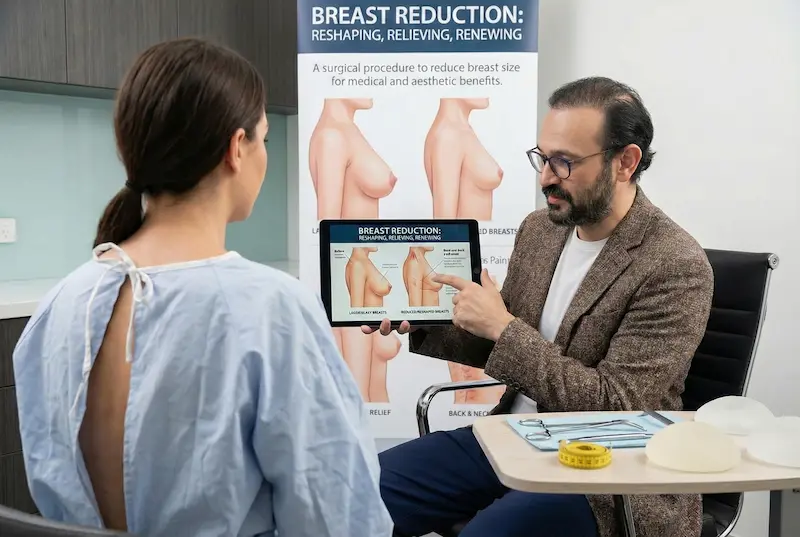
Search terms like best breast reduction surgeon are common for a reason: the procedure is equal parts engineering and aesthetics. You’re not just choosing “a reduction.” You’re choosing a plan, a technique, and a safety system—built around your anatomy and your long-term comfort.
Our recommendation is simple: evaluate surgeons like an expert would—by process, standards, and consistency.
What “best” should mean in practice (criteria that actually matter)
- Specialized experience: consistent focus on breast surgery and reduction techniques
- Planning discipline: proportion-based design, not “cup-size guessing”
- Safety systems: screening, anesthesia protocols, sterile standards, structured follow-up
- Scar strategy: not “scarless claims,” but realistic placement and long-term scar management
- Consistency of results: similar quality across different body types, not one “hero” case
How to assess expertise: technique match, complication planning, and consistency
Technique is not a menu item. It’s a match. A surgeon should clearly explain why a lollipop vs. anchor pattern is appropriate in your case—and what trade-offs come with it.
- Ask what drives technique choice in your anatomy (skin quality, droop level, tissue density)
- Ask how they reduce healing risks (especially if you have any risk factors)
- Ask what their follow-up structure is (and what happens if you have concerns after traveling home)
Using reviews correctly: what to look for (and what to ignore)
Patients also search breast reduction reviews to find “proof.” Reviews can help—but only if you read them intelligently.
- Look for patterns: consistent comments about care, communication, follow-up, and healing quality
- Prioritize specifics: mentions of comfort management, responsiveness, and transparency
- Ignore extremes: one perfect review or one angry review rarely tells the whole story
Consultation questions checklist (copy/paste-ready)
- Which technique do you recommend for me, and why?
- What size range is realistic for my frame while keeping a natural shape?
- What are my top risks based on my health profile—and how do you reduce them?
- How do you handle scar care and long-term scar refinement?
- What is the follow-up plan after I return to the USA?
Your Medical Journey With Us: From Virtual Consult to Flying Home
If you’re searching breast reduction surgery turkey, breast reduction istanbul, or even breast reduction consultation near me, your real goal is the same: clarity. You want to know exactly what happens, when it happens, and who supports you at each step.
We built our international pathway to remove friction—without rushing medical decisions.
Step 1: Virtual consultation (surgeon-led planning)
Your journey starts with a structured virtual consultation. We review your goals, symptoms, medical history, and photo-based assessment to determine candidacy and likely technique options.
- Goal alignment: proportion, comfort, lift, scar priorities
- Technique discussion: what fits your anatomy and why
- Safety review: factors that impact anesthesia and healing
- Timeline planning: travel window, recovery milestones, follow-up schedule
Step 2: Arrival in Istanbul (VIP logistics + medical readiness)
Travel should not be a stress multiplier. Our team coordinates the essentials so you can focus on recovery.
- VIP airport transfers and hotel coordination
- Pre-op testing and in-person evaluation
- Final plan confirmation with your surgeon (including incision approach and sizing goals)
Step 3: Surgery day + immediate aftercare
On surgery day, the focus is stability, comfort, and clear instructions.
- Pre-op markings and surgical plan confirmation
- Anesthesia plan aligned to your medical profile and procedure complexity
- Post-op recovery monitoring and step-by-step home-care guidance
- Support garments and a clear activity plan
Step 4: Follow-up before departure + continuity when you return home
Distance only works when follow-up is real. Before you fly, we confirm healing progress and review the next phase of care.
- In-person checks in Istanbul to assess swelling, incisions, and comfort
- Scar-care guidance and “what’s normal” education
- Scheduled virtual check-ins after you return to the USA
- Direct escalation pathway if you have concerns
Breast Reduction Frequently Asked Questions (FAQ):
These are the questions US patients ask most often when considering a premium, safety-first Breast Reduction experience in Istanbul.
How long before I can work out again?
Most patients return to light movement early (walking), then gradually increase activity over weeks. Lower-body workouts often come back first; high-impact and upper-body training typically require more time. The safest approach is milestone-based clearance—not “feeling fine.”
What do breast reduction scars look like long-term?
Scars mature over months, not days. Early redness and firmness are normal. Most scars soften and fade with time—especially when tension is minimized and scar care is consistent. Your incision pattern (lollipop vs. anchor) affects scar placement, but healing biology also matters.
When can I travel after surgery?
Travel is planned around safety and follow-up. We schedule in-person checks in Istanbul before you fly home, then maintain virtual continuity once you’re back in the USA. Your exact timeline depends on how your swelling and healing progress.
Will I need a revision?
Most patients do not need revision when planning and recovery are disciplined. Still, no surgery can guarantee a “perfectly identical” outcome because humans are not perfectly symmetrical. If a meaningful concern arises, we evaluate it clinically, track healing trends, and guide next steps with transparency.
How long does breast reduction surgery take?
Time varies based on technique and complexity. During consultation, we estimate operative time based on your anatomy and reduction goals.
How much smaller will I be after breast reduction?
We plan around proportion and comfort rather than a single cup size. During your consult, we align on a realistic size range for your frame.
Will I have drains?
Drain use depends on technique and your tissue characteristics. We explain your plan clearly before surgery.
When can I return to work?
Many patients return to desk work in 7–14 days, depending on comfort and job demands. Physically demanding roles require more time.
What do breast reduction scars look like long-term?
Scars mature over months. Early redness is common. Most scars soften and fade with time, consistent scar care, and minimized tension.
Can you breastfeed after a breast reduction?
Sometimes, yes—but it can’t be guaranteed. It depends on anatomy and technique. If breastfeeding is a priority, we plan with that in mind and discuss trade-offs honestly.
Will nipple sensation change?
Temporary numbness or hypersensitivity is common early. Many patients see improvement over time, but outcomes vary.
What are signs of infection after breast reduction?
Fever/chills, spreading redness/warmth, thick drainage or odor, or swelling that suddenly worsens should be reported immediately.
Do I need a mammogram before surgery?
We review age and risk-based screening expectations during consultation and coordinate appropriate pre-op clearance when indicated.