




Considering a Breast Lift (Mastopexy) means you want breasts that sit higher, look more youthful, and feel better in clothing—without an overdone appearance. This definitive guide explains what the surgery changes, why sagging happens, and how we choose the right lift technique for your anatomy, from periareolar options to lollipop and anchor patterns.
You’ll also learn what to expect from scars and a week-by-week recovery timeline, plus the most important safety and complication warning signs. For US patients comparing costs, we break down the 2026 value equation of having surgery in Turkey with structured follow-up and supportive recovery options today.
What Is a Breast Lift (Mastopexy)?
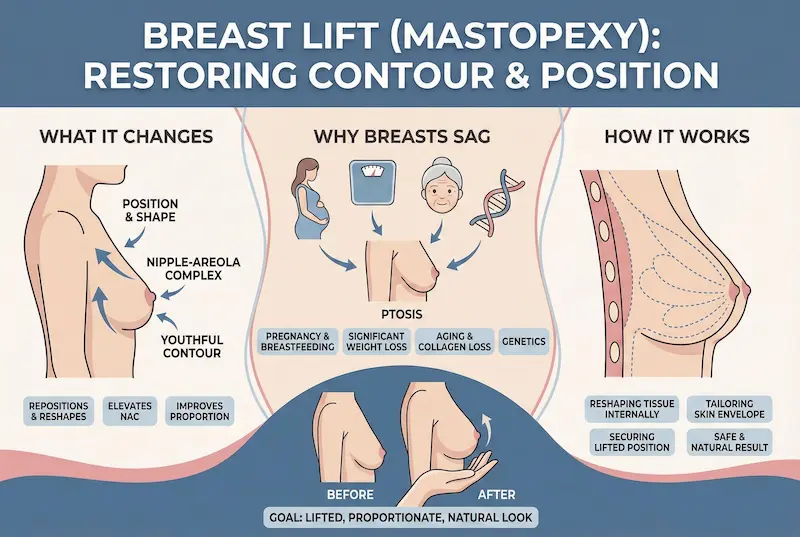
Featured snippet: A Breast Lift (Mastopexy) is a surgical procedure that repositions and reshapes the breast by tightening the skin envelope and lifting the breast tissue to a more youthful contour. It can also elevate and resize the nipple–areola complex when needed, improving breast position and proportion.
What a breast lift changes (position, shape, nipple-areola complex)
A breast lift focuses on position and shape, not primarily on adding volume. During mastopexy, we elevate the breast mound on the chest wall, reshape the internal tissue for a more supported contour, and address the nipple–areola complex (NAC) if it sits too low or points downward. Many patients also request areola resizing when the areola has stretched after pregnancy, breastfeeding, or weight changes.
The goal is a breast that looks more lifted and proportionate in clothing and without support, with a natural slope and a nipple position that aligns with the new breast contour. While every anatomy is different, the guiding principle is predictable, stable elevation without an “over-operated” look.
Why breasts sag (pregnancy, weight loss, aging, genetics)
Breast sagging (ptosis) is typically caused by a combination of skin laxity, changes in breast tissue density, and stretching of the supporting structures over time. Common contributors include pregnancy and breastfeeding (expansion and deflation of the breast), significant weight loss, and the natural effects of aging on collagen and elastin. Genetics also play a role—some patients have thinner skin, weaker support, or a breast shape that is more prone to descent.
It’s important to know that “sagging” is not only about how low the breast sits; it also involves the relationship between the nipple position, the inframammary fold (the crease under the breast), and the distribution of tissue in the upper vs. lower breast. These factors guide technique selection later in the planning process.
How a breast lift works (reshaping + skin envelope management)
Mastopexy works through two coordinated steps: reshaping the breast tissue internally and tailoring the skin envelope externally. First, we reposition and secure the breast tissue to create a more supported contour. Next, we remove and tighten excess skin so the new breast shape is held in a stable, elevated position. When needed, we reposition the nipple–areola complex to sit naturally on the newly lifted breast mound.
The incision pattern varies by anatomy and degree of ptosis, which is why you may see different breast lift types discussed online. In general, more significant sagging requires techniques that provide stronger lifting power and more comprehensive reshaping. Our role is to match the technique to your anatomy and goals—prioritizing safety, long-term stability, and a natural result.
Benefits: What Can a Breast Lift (Mastopexy) Realistically Improve?
A more youthful breast position and contour
The primary benefit of a breast lift is a higher, more youthful breast position with improved contour. Patients often notice a more balanced silhouette, with the breast mound sitting in a more harmonious relationship to the torso. A lift can also improve the appearance of “bottom-heavy” breasts by reshaping and supporting tissue so the breast looks more centered and projected.
While a lift does not add significant volume, many patients perceive an improved upper-breast appearance because the tissue is repositioned and supported. If your goal includes a meaningful increase in size, we may discuss a lift combined with augmentation in a separate planning step.
Nipple position and areola aesthetics
When the nipple sits low or points downward, the breast can appear aged even if the overall size is acceptable. Mastopexy can elevate the nipple–areola complex to a more natural location and, when appropriate, reduce areola diameter for improved proportion. This can be especially helpful after pregnancy or weight loss when the areola has stretched.
The guiding principle is balance: the nipple should sit on the most projecting part of the breast mound and look natural from multiple angles. This is planned carefully with pre-operative markings and individualized technique selection.
Confidence and clothing fit (without overpromising)
Many patients pursue mastopexy because they want their breasts to look lifted in bras, swimwear, and fitted clothing without relying on heavy support. A breast lift can improve how clothing fits and how the breasts sit relative to the chest, which often translates to greater comfort and confidence.
It’s equally important to be realistic: a lift does not “freeze time,” and long-term breast shape can still change with future pregnancies, major weight fluctuations, and natural aging. However, with stable weight and a thoughtful surgical plan, patients typically achieve a durable improvement in position and contour.
Am I a Good Candidate For a Breast Lift?
Best candidates (ptosis, postpartum changes, weight loss)
You may be a strong candidate for a breast lift if your breasts have descended on the chest, feel “deflated” after pregnancy or weight loss, or the nipple sits at or below the inframammary fold (the natural crease under the breast). Many patients describe needing more bra support than before, noticing a flatter upper breast, or seeing the nipple point downward. These are common signs of breast ptosis and skin laxity that mastopexy is designed to address.
A good candidate typically has stable weight, realistic expectations, and a clear goal: improving breast position, shape, and proportion. If you also want a noticeable size increase, we will discuss whether a lift alone can meet your goals or whether combining a lift with augmentation or fat transfer is more appropriate.
Who should delay or avoid surgery (smoking, unstable weight, medical considerations)
We may recommend delaying surgery if you are actively losing weight, planning pregnancy in the near future, or unable to pause nicotine use. Nicotine (including vaping) can significantly reduce blood flow to healing tissues and increase the risk of wound-healing problems. Uncontrolled medical conditions (such as poorly managed diabetes), certain medications, or a history of blood clots may also require additional coordination and clearance before proceeding.
The safest path is always individualized. During consultation, we review your health history, lifestyle factors, and surgical goals to confirm that the procedure is appropriate and to reduce avoidable risks.
Your consultation checklist (goals, photos, measurements, plan)
A high-quality consultation should end with a clear surgical plan—what technique is recommended, why it fits your anatomy, what scars to expect, and what recovery will realistically look like. To make your consultation as productive as possible, we suggest preparing:
- Your top 2–3 goals (e.g., higher position, improved shape, areola resizing).
- Reference photos (helpful for style and proportion, not a promise of identical results).
- Medical history, medications/supplements, and any prior breast surgery details.
- Questions about technique, safety, and the expected scar pattern.
If you’ve searched “breast lift near me,” you’re likely comparing convenience with expertise, safety protocols, and outcome consistency. Our role is to help you make a decision based on evidence and fit—wherever you choose to have surgery.
Breast Lift Types: Incision Patterns and Technique Selection
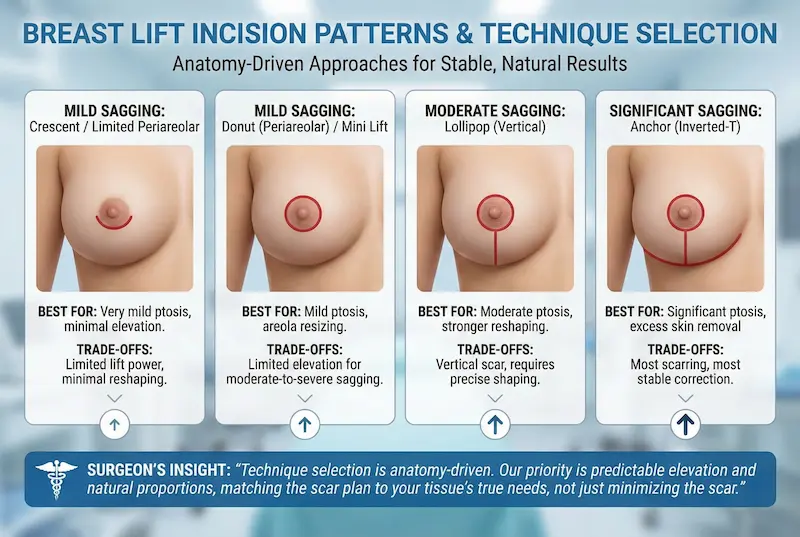
Breast lift techniques are defined by incision patterns and the amount of reshaping they enable. In general, the more significant the sagging, the more lifting power and tissue support the technique must provide. The “best” method is not the one with the smallest scar—it’s the one that can deliver a stable, natural result for your anatomy with a scar pattern that is planned thoughtfully.
Surgeon’s Insight: “Technique selection is anatomy-driven. When the lift is underpowered for the degree of sagging, results can look short-lived. Our priority is predictable elevation, natural proportions, and a scar plan that matches what your tissue truly needs.”
Mild sagging: crescent/periareolar concepts (limitations)
For very mild ptosis, limited-incision approaches may offer subtle improvement. A crescent lift (a small incision along the upper areola border) can provide minimal elevation in carefully selected cases. Periareolar concepts can also help with areola resizing and mild tightening of the skin envelope. The key limitation is lift strength—these options typically cannot correct moderate nipple descent or significant lower-breast laxity.
Donut Breast Lift (Periareolar Lift)
A donut breast lift uses an incision that circles the areola, allowing us to tighten a small amount of skin and subtly reshape the breast. It can fit mild sagging and patients who also want areola resizing. The trade-off is lift power. If sagging is moderate or significant, this approach often cannot deliver a stable elevation on its own.
Mini Breast Lift
A mini breast lift is designed for patients with minimal to mild ptosis who want modest elevation with limited scarring. It improves position and shape, but only within a narrow range. It does not reliably correct significant lower-breast laxity or major nipple descent. If stronger lifting is needed, vertical (lollipop) or anchor patterns are typically more predictable.
Moderate sagging: lollipop breast lift (vertical scar)
The lollipop breast lift (also called a vertical lift) is commonly used for moderate ptosis because it provides stronger reshaping and elevation than periareolar-only approaches. The incision typically circles the areola and extends vertically down to the breast crease. This allows more meaningful repositioning of breast tissue and improved contour while keeping the scar pattern more limited than an anchor lift. For many anatomies, it offers an excellent balance of lift power and scar placement.
Significant sagging: anchor breast lift (inverted-T)
The anchor breast lift (inverted-T) is often recommended for significant sagging, excess skin, or more complex reshaping needs. In addition to the areola and vertical incision, it includes a horizontal incision along the breast crease. This pattern provides the greatest ability to remove excess skin and shape the breast for stable, long-term elevation. While it involves more scarring, it can be the most reliable option when the anatomy requires maximal lifting and tightening.
Technique comparison: what each option can achieve
| Technique | Best for | Incision pattern | Typical scar locations | Lift power | Key trade-offs |
|---|---|---|---|---|---|
| Crescent / Limited Periareolar | Very mild ptosis | Small crescent or limited areolar incision | Upper areola border | Low | Minimal lift; limited reshaping capability |
| Donut (Periareolar) | Mild ptosis + areola resizing | Incision around the areola | Around the areola | Low–Moderate | Limited elevation for moderate-to-severe sagging |
| Mini Lift | Minimal to mild ptosis | Limited incision pattern (case-dependent) | Often around areola; may include short extension | Low–Moderate | Not suitable for significant skin excess or nipple descent |
| Lollipop (Vertical) | Moderate ptosis | Around areola + vertical line to crease | Around areola + vertical scar | Moderate–High | Vertical scar; requires precise shaping for best contour |
| Anchor (Inverted-T) | Significant ptosis / excess skin | Around areola + vertical + crease incision | Around areola + vertical + under-breast crease | High | Most scarring, but often the most stable correction |
Breast Lift Scars: Where They Are and How They Mature
Scars are a normal part of mastopexy because lifting the breast requires tailoring the skin envelope and reshaping tissue. The goal is not “no scars,” but rather a scar plan that is placed strategically, closed meticulously, and supported with evidence-based aftercare so scars soften and blend over time.
Surgeon’s Insight: “The best scar is the one you can live with confidently—because it delivered the lift your anatomy actually needed. We focus on precise planning, tension management, and structured aftercare to support the most discreet maturation possible.”
Typical scar locations by technique (what’s normal)
Scar placement depends on the incision pattern used. Periareolar-based approaches place scars around the edge of the areola. A vertical lift adds a line from the areola down to the breast crease. An anchor-pattern lift includes an additional line hidden along the inframammary fold (under-breast crease), which often sits in a naturally concealed area when standing.
While it’s common to focus on “shorter scars,” incision choice should be guided by the degree of sagging and skin excess. When the technique is underpowered, the breast can settle early and the result may look less stable—sometimes leading to revision considerations later.
Healed breast lift scars: a realistic timeline (months, not weeks)
When patients search for “healed breast lift scars,” they’re often trying to understand what scars look like long-term. In most cases, scar maturation is a gradual process that evolves over many months. Early scars can look pink or firm; as they mature, they typically become flatter, softer, and lighter.
- First 6–8 weeks: scars may be pink/red and slightly raised as healing is active.
- 3–6 months: scars often soften and begin to fade, though they can still fluctuate with activity and sun exposure.
- 6–12+ months: many scars continue to lighten and flatten as collagen remodeling progresses.
Individual factors matter—skin type, genetics, incision tension, and aftercare all influence how scars mature. The most important mindset is patience paired with consistent scar care.
Scar optimization plan (aftercare, silicone, sun protection, follow-up)
Our scar optimization approach focuses on supporting healthy healing and minimizing avoidable irritation. We typically guide patients through a structured plan that may include:
- Keeping incisions clean and protected during the early healing phase.
- Silicone-based scar therapy once the skin is fully closed (as directed).
- Sun avoidance and high-SPF protection to reduce the risk of pigment changes.
- Support garments to reduce pull and motion during early recovery.
- Scheduled follow-ups so we can adjust care based on how your skin is responding.
If you’re researching “breast lift scar removal,” it’s helpful to know that most scars improve significantly with time and disciplined aftercare. For scars that remain raised or pigmented after adequate maturation, we can discuss targeted options (such as medical-grade topical protocols or in-clinic treatments) based on your individual scar pattern and skin type.
Breast Lift vs Augmentation: Do You Need Volume, Position, or Both?
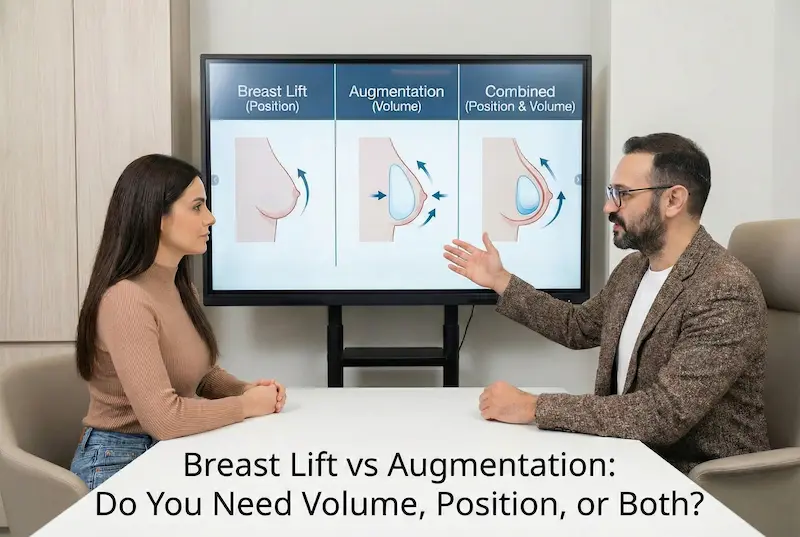
One of the most common decision points is understanding whether you need a lift, augmentation, or a combination. The simplest way to think about it: a lift improves position and shape, while augmentation primarily adds volume. Many patients benefit from one approach; some benefit from both—depending on anatomy and goals.
Breast lift vs augmentation: the core difference
A breast lift addresses sagging by elevating and reshaping the breast tissue and tightening the skin envelope. Breast Augmentation typically uses implants (or, in select cases, fat transfer) to increase breast size and fullness. Augmentation alone can improve upper-pole fullness, but it does not reliably correct significant nipple descent or skin laxity—and in some anatomies, adding volume without lifting can actually emphasize lower-breast heaviness.
The right choice depends on what you see in the mirror: if your main concern is “my breasts sit too low,” a lift is usually the foundation. If your main concern is “I want to be bigger,” augmentation may be the priority. If you want both higher position and more volume, a combined plan may be appropriate.
Lift with implants: when it makes sense (and key trade-offs)
Combining a breast lift with implants can be a strong option for patients who want a lifted position plus a noticeable increase in size and upper fullness. The benefit is comprehensive transformation: reshaping, elevating, and augmenting in one plan. However, it also requires careful planning to balance skin tension, implant selection, and long-term stability.
Trade-offs can include more complexity, potentially more swelling, and a stricter recovery protocol. It’s also important to understand that combining procedures can influence scar behavior and healing demands, which is why technique selection and aftercare become even more critical.
Breast lift with fat transfer: a softer volume option
A breast lift with fat transfer can add subtle, natural-feeling volume while improving breast position. It’s typically best for patients who want a modest size increase and have adequate donor fat (often from the abdomen, flanks, or thighs). Fat transfer can enhance contour and softness, but it’s not designed to create dramatic size jumps, and some fat resorption is expected over time.
If you’re comparing procedure combinations (including searches like “average cost of breast augmentation and lift”), keep in mind that combined approaches are inherently more involved than a lift alone. Later in this guide, we’ll explain how pricing is structured and what’s typically included—so you can compare options transparently.
“Scarless” and Non-Surgical Breast Lift Options: What’s Real?
It’s completely normal to look for the least invasive option first. Online, you’ll see terms like scarless breast lift, non surgical breast lift, and even the vampire breast lift. The key is understanding what these phrases can realistically deliver for true breast sagging (ptosis). A meaningful lift requires repositioning tissue and managing the skin envelope—and that typically involves incisions.
Scarless breast lift: what it usually means (and limits)
A “scarless” breast lift is rarely scar-free in the literal sense. Most commonly, it refers to approaches that aim to minimize visible scarring (for example, limiting incisions to around the areola) or using energy-based skin tightening to create subtle improvements. These options can be appropriate for very mild sagging or minor areola adjustments, but they do not replace the lifting power of vertical or anchor techniques when ptosis is moderate to significant.
If your nipple sits at or below the breast crease, or the lower breast skin is noticeably lax, a truly stable lift almost always requires a surgical plan that can reshape and support tissue—not only tighten skin.
Non surgical breast lift: what it can and can’t do
Non-surgical options (like radiofrequency, ultrasound, or similar skin-tightening technologies) may help with mild skin laxity by stimulating collagen. They can improve skin texture and firmness for selected patients, but they do not reliably reposition breast tissue or elevate a descended nipple–areola complex. In other words, they may create a subtle “tightening” effect, but they are not a true substitute for mastopexy when the core issue is structural descent.
If you are considering a non-surgical option, the most important step is a professional assessment of your anatomy and goals. The right question is not “Can this avoid scars?” but “Will this achieve a meaningful, lasting lift for my level of ptosis?”
Vampire breast lift: expectation management
The term vampire breast lift is often used to describe platelet-rich plasma (PRP)-based treatments aimed at improving skin quality or hydration. PRP may support skin texture and overall tone in some patients, but it does not produce a true lift for moderate or significant sagging. If a clinic implies that PRP can replicate the outcome of mastopexy, that is a sign to pause and ask for clear, anatomical explanations and realistic outcome examples.
If your goal is a visible elevation, improved nipple position, and a reshaped breast contour, surgical mastopexy remains the most predictable option—and the scar plan is tailored to achieve the lift your tissue genuinely needs.
Anesthesia: Why We Often Prefer Awake / Twilight Sedation
Anesthesia should never feel like a one-size-fits-all decision. The safest approach is individualized: we match the plan to your procedure, medical history, comfort needs, and whether you are combining surgeries. For many breast lift patients, we often prefer Awake / Twilight Sedation because it can offer a smoother experience for selected candidates while maintaining rigorous safety monitoring.
Surgeon’s Insight: “The best anesthesia plan is the one that balances comfort and safety for the specific surgery you’re having—and for your body. We plan it the same way we plan the lift: thoughtfully, personally, and without shortcuts.”
Awake vs general anesthesia: what’s different?
General anesthesia typically means you are fully asleep with airway support, and it can be a strong choice for longer procedures or multi-procedure plans. Twilight sedation (often combined with local anesthetic) generally means you are deeply relaxed and sleepy, with reduced awareness and comfort-focused medication—while your vital signs are continuously monitored. Many patients remember little to nothing of the procedure with twilight sedation, but the exact experience varies by person.
The decision is based on clinical factors, not trends. Our goal is a calm, controlled surgical environment with a plan that supports both safety and recovery.
Comfort and anxiety management (what patients usually worry about)
It’s common to worry about feeling anxious, hearing surgical sounds, or being uncomfortable. When we use twilight sedation, the intent is to keep you comfortable and relaxed while maintaining stable physiology and close monitoring. We also plan proactively: we discuss your anxiety level, prior anesthesia experiences, and sensitivities so we can tailor medication choices and set clear expectations about how the day typically feels.
If you’re highly anxious, we don’t dismiss it—we plan around it. Feeling psychologically safe is part of safe surgery.
Who may still need general anesthesia (combined cases and medical factors)
Some patients are better served by general anesthesia, especially when the operation is expected to be longer, when multiple procedures are combined, or when medical considerations make sedation less appropriate. The final decision is made after reviewing your history, your procedure plan, and anesthesia evaluation.
No matter which approach is chosen, our standard is consistent: careful pre-op assessment, continuous monitoring, and a recovery plan that prioritizes stability, comfort, and a clear pathway back to normal activity.
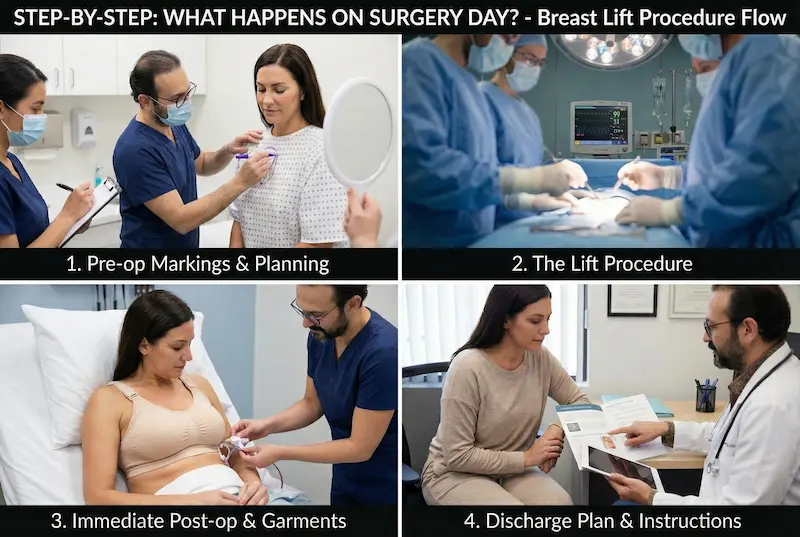
Step-by-Step: What Happens On Surgery Day?
Knowing what to expect reduces anxiety and helps you prepare for a smoother recovery. While every surgical plan is personalized, most breast lift procedures follow a consistent flow: final markings, a safety checklist, the lift itself, and a structured post-operative plan. Our team guides you through each step so you’re never guessing what comes next.
Pre-op markings and final plan confirmation
On the day of surgery, we begin with pre-operative markings. This is where we map the lift strategy on your anatomy while you are standing, because breast position and skin behavior change with posture. We confirm the chosen technique (for example, vertical vs anchor patterns), nipple–areola positioning, and any planned areola resizing.
We also review your checklist: medications, allergies, recent health changes, and your recovery plan. If you’re traveling for care, we confirm your accommodation logistics, follow-up timing, and how you’ll reach us if you have questions after discharge.
The lift: reshaping, nipple-areola repositioning, and closure
During mastopexy, we reshape the breast tissue to create a more supported contour, then tailor the skin envelope to hold that new shape in a stable, elevated position. If needed, we reposition the nipple–areola complex to sit naturally on the new breast mound. The goal is a balanced result from multiple angles, not an overly tight or artificial look.
Closure is performed with careful attention to tissue tension and alignment, because that influences both scar quality and long-term stability. Your exact scar pattern depends on the technique required for your degree of ptosis and skin excess—this is why we prioritize anatomy-driven planning rather than “smallest scar at all costs.”
Immediate post-op: garments, drains (if used), and the discharge plan
After surgery, you’ll be monitored as you wake up and stabilize. We apply a surgical bra or supportive garment to help control swelling and reduce unnecessary motion. Some patients may have drains, depending on surgical complexity and tissue behavior, but drains are not universal for breast lifts.
Before discharge, we review your instructions in plain language: how to take medications, how to sleep, what normal swelling looks like, and which signs mean you should contact us immediately. If you’re staying in Istanbul, we also confirm your first follow-up time and how to reach our team 24/7 during the early recovery window.

Breast Lift Recovery Week by Week: What To Expect
Many patients search for “breast lift recovery week by week” because they want an honest roadmap: what you’ll feel, what you can do, and when you’ll look “presentable.” The most important principle is that healing is progressive. Swelling and tightness improve in stages, and scar maturation takes months—not days. Below is a realistic overview of breast lift recovery time and how we typically guide patients through each phase.
First 72 hours: swelling, tightness, and pain control
The first three days are usually the most intense in terms of swelling, pressure-like tightness, and fatigue. Most patients describe discomfort as soreness and heaviness rather than sharp pain. If you’re asking “how painful is breast lift recovery,” the honest answer is that it varies—your baseline pain sensitivity, the extent of reshaping, and whether procedures are combined all matter.
- Sleep: We typically recommend sleeping on your back, slightly elevated, to reduce swelling and protect incisions.
- Movement: Short, gentle walks are encouraged to support circulation, but lifting and reaching should be limited.
- Support: Wear your surgical bra as instructed; it stabilizes tissue and reduces strain during early healing.
What’s normal: swelling, bruising, and a “tight” feeling across the chest. What’s not normal: escalating pain with redness, fever, shortness of breath, sudden asymmetric swelling, or drainage that concerns you—if any of these occur, we want to hear from you.
Week 1–2: mobility improves, and routine returns gradually
In weeks one and two, most patients feel noticeably better day by day. You may still feel tenderness, intermittent swelling, and sensitivity around the nipple–areola complex. Many patients can return to desk work during this window, provided they avoid heavy lifting and intense physical activity.
- Showering: We’ll give clear guidance on when you can shower and how to protect incision lines.
- Driving: Typically possible once you are off prescription pain medication and can move comfortably and safely.
- Activity limits: Avoid gym training, high-impact movement, and lifting heavier items (including luggage).
This is also when patients start to think about scars. Early incision lines can appear pink and slightly firm. That’s expected. Consistent aftercare and patience are more important than “quick fixes.”
Weeks 3–6+: exercise, scar maturation, and the breasts settling into shape
From week three onward, many patients feel significantly more normal, but internal healing is still ongoing. Light activity is often expanded gradually, and we typically guide the return to exercise based on your healing status, swelling, and comfort. Your breasts may look higher initially and then “settle” as swelling decreases and tissues adapt to the new support.
Scar maturation continues for months. The goal during this phase is consistency: follow garment guidance, protect scars from sun exposure, and attend scheduled follow-ups so we can personalize your scar and recovery plan. If you’re traveling, we structure follow-up to keep your care continuous—both in person early on and virtually over time.
Our Rapid Recovery & Safety Protocol: HBOT + LLLT
Healing quality matters just as much as surgical technique. That’s why we support breast lift recovery with a structured, medically guided protocol designed to reduce avoidable healing setbacks and help patients feel more comfortable during the early phase. When appropriate, we integrate two supportive technologies: Hyperbaric Oxygen Therapy (HBOT) and Low-Level Laser Therapy (LLLT). These are not “magic fixes” and they do not replace good surgery or proper aftercare— but for selected patients, they can meaningfully support tissue recovery.
Surgeon’s Insight: “A beautiful result depends on two things: the plan we execute in surgery and the way your tissues heal afterward. Our protocol is built to support blood flow, reduce inflammation, and protect the quality of healing—especially in patients who want the most predictable recovery experience.”
HBOT: supporting oxygen delivery, swelling control, and tissue recovery
HBOT involves breathing oxygen in a pressurized environment. The clinical rationale is straightforward: higher oxygen availability can support tissue metabolism and recovery, particularly in the early healing window when swelling and microvascular changes can temporarily reduce oxygen delivery at the incision level. When used in a structured way, HBOT may help support tissue vitality, comfort, and the overall healing environment.
In breast surgery, the most practical goals are: (1) supporting healthy soft tissue recovery, (2) helping manage swelling, and (3) reinforcing the healing conditions that influence scar quality over time. HBOT is not a substitute for smoking cessation, stable blood sugar, or a safe surgical plan—but it can be a helpful layer of support for selected patients.
LLLT: gentle support for cellular repair and collagen organization
Low-Level Laser Therapy (LLLT) is used to support tissue recovery by encouraging cellular activity involved in repair. In practical terms, we use LLLT to support comfort and help guide orderly healing in the weeks when the body is actively rebuilding. Patients often care about one thing: “Will I heal smoothly and look natural?” LLLT is one of the tools we may use to support that goal—alongside precise surgical technique and disciplined aftercare.
We position LLLT as a supportive measure, not a promise. Scars still require time to mature, and your long-term scar appearance is influenced by genetics, skin type, incision tension, sun exposure, and consistency with scar care.
Who benefits most from HBOT + LLLT (and who may not need it)
Not every patient needs supportive technologies. We typically consider these options most strongly when a patient has higher healing demands or wants to optimize recovery quality—especially if they are traveling and value a highly structured early post-op pathway. Examples may include patients with a history of slower healing, patients combining procedures, or patients who want every reasonable step taken to support a calm, controlled recovery experience.
During consultation, we explain what we recommend and why—based on your anatomy, your surgical plan, and your individual risk factors. We also make it clear what these therapies can and cannot do. Our standard is simple: evidence-based support, realistic expectations, and a protocol that complements (not replaces) excellent surgery and attentive follow-up.
Safety & Risks: Is a Breast Lift Dangerous?
A breast lift is a commonly performed procedure, but it is still surgery—so it carries real risks. The safest outcome comes from proper patient selection, a precise surgical plan, disciplined aftercare, and a team that takes early warning signs seriously. Below, we outline common risks, what breast lift complications can look like, and when to contact us urgently.
Common risks (bleeding, infection, delayed healing, asymmetry)
The most common risks after mastopexy include bleeding (hematoma), infection, delayed wound healing, unfavorable scarring, asymmetry, changes in nipple sensation, and fluid collection (seroma). Most of these risks are manageable when identified early, which is why post-op guidance and follow-up are not “optional details”—they are part of safe surgery.
It’s also important to understand trade-offs: stronger lifting techniques (like vertical or anchor patterns) can be more effective for significant sagging, but they also involve more incision length. That does not mean “more dangerous,” but it does mean the plan must be executed carefully and the recovery protocol must be followed precisely.
Breast lift complications: warning signs and when to contact us
Most patients experience expected recovery symptoms—swelling, bruising, tightness, and mild to moderate soreness. What we watch for are symptoms that suggest a complication may be developing. Contact us promptly if you notice:
- Sudden, increasing swelling on one side, especially with pressure or firmness (possible hematoma).
- Worsening redness that spreads, increasing warmth, fever, or chills (possible infection).
- New drainage that is foul-smelling, thick, or rapidly increasing.
- Severe pain that escalates instead of improving day by day.
- Shortness of breath, chest pain, or calf swelling (urgent evaluation is required).
If you’re traveling, we plan for this. You’ll have clear instructions on how to reach us 24/7 during the early recovery period, and we provide step-by-step guidance on what to do if a symptom concerns you. Early evaluation is protective—waiting “to see if it goes away” is one of the most common reasons minor issues become bigger problems.
Signs of necrosis after breast lift: rare but urgent red flags
Patients sometimes search for signs of necrosis after breast lift because they’ve read about blood supply risks to skin or the nipple–areola complex. Tissue necrosis is uncommon, but it is serious—so we treat education here with real clarity. Contact us urgently if you notice:
- Skin turning dusky, gray, or black near an incision line or around the areola.
- Blistering or a rapidly worsening wound appearance.
- Loss of normal color with a “mottled” or progressively darkening area.
- Increasing pain localized to a specific area paired with concerning color change.
The best prevention is smart planning: matching technique to anatomy, protecting blood supply during surgery, and eliminating avoidable risk factors such as nicotine exposure. If you use nicotine in any form, stopping is not a “nice-to-have”—it’s one of the most important risk-reduction steps you can take for safe healing.
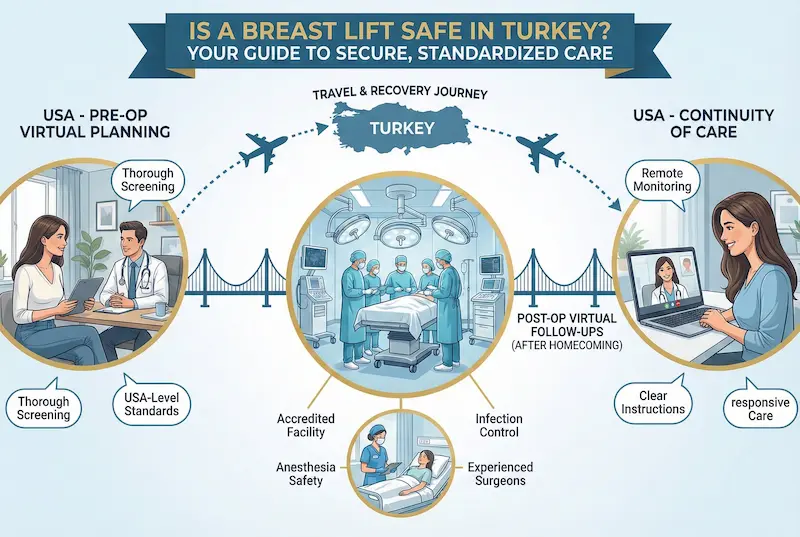
Is a Breast Lift Safe In Turkey?
If you’re considering surgery abroad, you’re not just evaluating the procedure—you’re evaluating the entire system around it: hospital standards, anesthesia safety, infection control, surgeon experience, and (most importantly) continuity of care after you return home. A breast lift can be performed safely in Turkey when these factors are handled at an international standard and the clinic’s process is structured for overseas patients.
What “USA-level standards” should mean in practice
“Safe” is not a slogan—it’s a checklist. In practice, high standards include thorough pre-op screening, clear surgical planning, evidence-based anesthesia protocols, sterile operating environments, and structured follow-up. It also means honest patient selection: the right answer is sometimes “not yet” (for example, if a patient is actively using nicotine, is still losing weight, or has uncontrolled medical issues).
We approach international patients with an added layer of responsibility: your plan must work not only in the operating room, but also across travel, recovery timelines, and remote follow-up after you return to the US.
Hospital accreditation, materials, and safety systems
When comparing clinics, focus on systems rather than marketing. Ask where the surgery is performed, what the hospital’s accreditation status is, how anesthesia is managed, and what infection-control protocols are in place. You should also ask what materials are used (for example, sutures and implants when relevant) and whether they meet globally recognized standards (such as FDA-cleared and/or CE-marked medical products where applicable).
Our model prioritizes operating in high-standard hospital environments and using regulated, reputable medical materials. Just as importantly, we provide transparent documentation and a clear pathway for follow-up—because safety is also about what happens after you leave the OR.
Continuity of care for international patients (before and after travel)
A major concern for US-based patients is, “What happens if I have a question once I’m home?” That’s the right question. We structure care in phases: pre-op virtual planning, in-person early recovery support while you’re in Istanbul, and scheduled virtual follow-ups after you return to the US. You’ll receive clear instructions on what is normal, what is not, and how to reach us promptly if something concerns you.
The best clinics don’t promise “zero risk.” They show you their process for risk reduction, early identification, and responsive care. That’s the standard we believe international patients deserve.
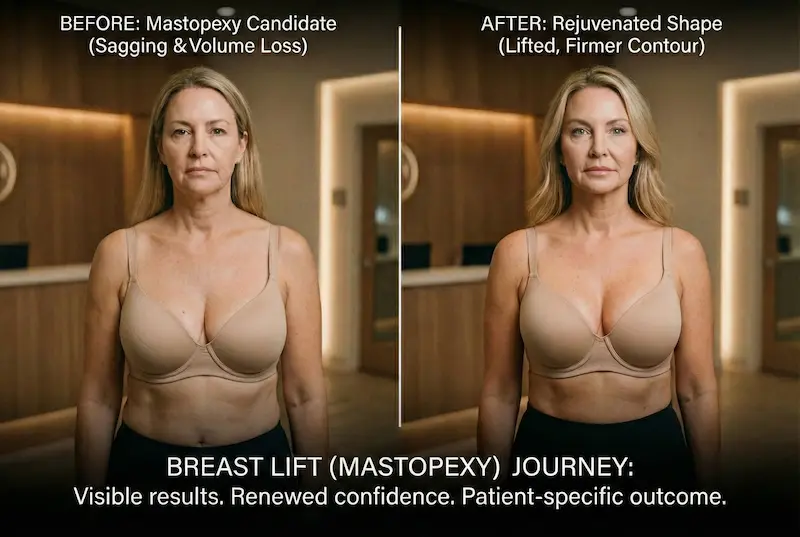
Realistic Expectations & Results: The “Natural-First” Approach
A breast lift can create a meaningful, confidence-building improvement—but the best results come from alignment between your anatomy, your goals, and the technique required to get there. Our planning philosophy is simple: natural proportions, stable elevation, and a result that looks like you—just refreshed.
Surgeon’s Insight: “Our goal is Rejuvenation, Not Alteration. A successful lift looks natural in motion, in real light, and in real life—not just in a single photo angle.”
What “natural” looks like (proportion, symmetry, anatomy-respecting lift)
“Natural” is not a single cup size or a single shape. It’s proportion: how the breasts relate to your shoulders, waist, and chest, and how the nipple position aligns with the new breast contour. We plan for a balanced silhouette—avoiding an overly tight or over-lifted appearance that can look artificial.
Symmetry is also part of the conversation. Nearly all patients have natural asymmetries. A lift can improve balance, but it cannot make two breasts mathematically identical. A high-quality plan aims for harmonious, visually consistent results while respecting your tissue behavior and safety.
What a breast lift cannot do (and what combination surgery changes)
A breast lift improves position and shape, but it does not automatically create a large increase in volume. If your primary goal is a fuller or larger breast, you may need augmentation (implants) or a lift with fat transfer—depending on your anatomy and how much volume you want. On the other hand, if your main concern is sagging, a lift is often the foundation, and volume decisions are made second.
It’s also important to understand what can influence long-term durability. Future pregnancies, major weight changes, and aging can change breast shape over time. The goal is a stable, well-supported correction now—with a plan that respects the reality of biology.
Results timeline: early vs final (how breasts “settle” over months)
Immediately after surgery, breasts often appear higher and firmer due to swelling and the new internal support. As swelling decreases, the breasts begin to “settle” into a more natural position. This is normal and expected.
- First weeks: swelling, tightness, and a higher-than-final position are common.
- First 3 months: shape becomes more natural as tissues relax and scars begin early maturation.
- 6–12+ months: scars continue to fade and soften; final contour becomes clearer.
The best mindset is long-term: we plan for an outcome that looks natural not only at week two, but also at month six and beyond.
Choosing The Right Surgeon: What To Look For
If you’re an “expert patient,” you already know that outcomes vary widely—even for the same procedure name. The best way to protect your result is to evaluate the surgeon and the system around them: experience, planning quality, safety protocols, and how transparently they discuss trade-offs. A breast lift is not just about lifting—it’s about creating a stable shape that still looks natural months later.
Board certification, specialization, and consistent technique
Look for a best surgeon who performs breast surgery routinely and can explain technique selection in anatomical terms (not marketing terms). During consultation, you should hear a clear rationale: which lift pattern fits your degree of ptosis, how the nipple–areola complex will be positioned, and how the plan supports long-term stability. A confident surgeon should also be comfortable discussing risk reduction, not only best-case outcomes.
Ask direct questions: How often do you perform mastopexy? How do you decide between a vertical and anchor approach? What is your plan for scar placement and scar care? The quality of answers matters more than buzzwords.
How to evaluate before/after photos (scar quality, proportions, repeatability)
Before/after galleries are useful when you evaluate them critically. Focus on cases similar to your starting anatomy (degree of sagging, skin quality, breast size, and tissue density). Look for consistency in shape and nipple position, and pay attention to scar quality in longer-term photos—early images can hide how scars mature.
- Consistency: Do results look repeatable across many patients, not just one “perfect” example?
- Proportion: Do the breasts look balanced with the patient’s frame, not overly tight or unnatural?
- Scars: Are there examples at 6–12+ months showing realistic maturation?
- Angles: Are multiple views shown (front, oblique, side), with comparable lighting?
A trustworthy clinic will also explain what is realistic for your anatomy, instead of promising you will match someone else’s photos.
Red flags checklist (overpromising, vague plans, no risk discussion)
Some warning signs are subtle but important. Be cautious if you experience:
- Overpromising: “No scars,” “no pain,” or “guaranteed perfect symmetry.”
- Vague planning: No clear explanation of which technique will be used and why.
- Dismissed concerns: If risks, complications, or recovery questions are minimized or avoided.
- Pressure tactics: Urgency-based selling or discounts that override medical decision-making.
- No continuity plan: Unclear post-op access, follow-up structure, or responsibility after you travel home.
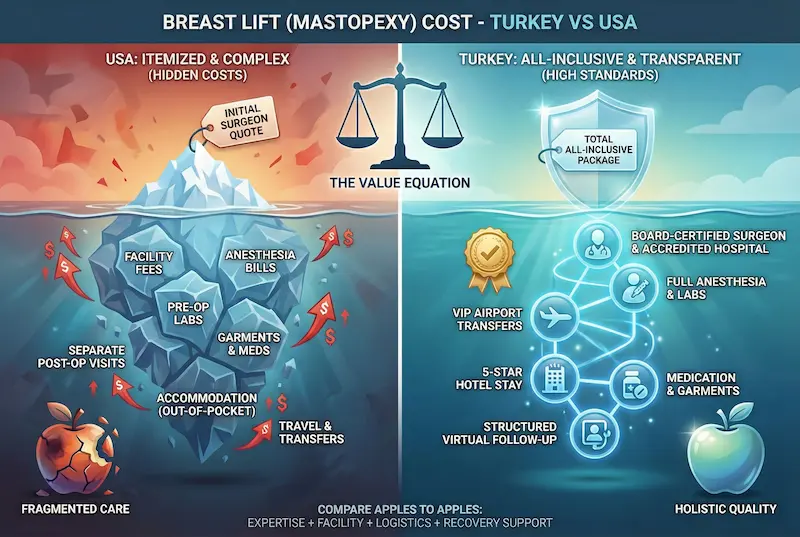
Cost analysis: Breast Lift (Mastopexy) Prices In 2026 (Turkey vs USA)
Cost is rarely just a number. It’s the total of surgeon expertise, facility standards, anesthesia, follow-up structure, and what’s actually included in your plan. If you’ve searched how much is a breast lift, you’ve likely noticed that quotes can feel confusing because some are itemized and others are packaged. The smartest comparison is “apples to apples”: what you receive, what you’re responsible for, and what happens if you need support after you travel home. Below, we break the logic down in a way that helps you compare objectively.
What influences the cost of breast lift (and what should be included)
A breast lift is a surgical procedure with meaningful planning and post-op support requirements. Pricing typically changes based on the degree of ptosis, the technique required (mini vs vertical vs anchor), and whether you’re combining procedures. Beyond that, what’s “included” matters more than most patients realize. A quote that looks lower can become higher once you add hospital fees, anesthesia fees, garments, medications, and follow-up visits.
In our all-inclusive model, we organize the experience so you’re not piecing it together across multiple providers. That includes the procedure itself, hospital-based surgical costs, and the core logistics that make recovery calmer and more predictable.
Why major US cities are priced differently (NYC, Los Angeles, Miami)
Searches like breast lift cost nyc, breast lift los angeles, and breast lift miami often reflect a real pricing pattern: large metropolitan markets tend to be more expensive due to higher operational overhead, facility costs, staffing, and insurance structures. Another key factor is that many US quotes are itemized. You may see one number for the surgeon fee, then separate line items for the operating facility, anesthesia, labs, garments, and post-op care.
That’s why the “average cost of breast lift” can be misleading without context. Two patients can receive the same procedure name but a very different level of included service, hospital environment, and follow-up structure.
Understanding breast lift cost turkey: the “value equation,” not shortcuts
The price difference between Turkey and the USA is primarily driven by macroeconomic factors—especially the USD-to-TRY exchange rate and lower national operational costs such as staffing and facility overhead. The point is not “cheapness.” The point is efficiency: you can access a high-standard surgical environment with a more rational total spend when the cost base is different.
We reinforce the “quality stays high” side of this equation by operating in accredited hospital environments and using regulated, internationally recognized medical materials. Our surgeries are performed by European Board Certified Surgeons, and our process is structured around international-patient safety and continuity of care.
All-inclusive vs itemized: a clear comparison you can use
Use this table to compare quotes without assumptions. The best plan is the one that is transparent from day one and doesn’t leave essential recovery elements as “extras.”
| Category | Typical itemized model (common in the USA) | Our all-inclusive model (Istanbul) | Hidden costs to watch |
|---|---|---|---|
| Surgery & hospital fees | Surgeon fee + separate facility/OR fees | Included as a complete surgical plan | Facility add-ons, after-hours fees |
| Anesthesia | Often billed separately | Included | Anesthesia time extensions |
| Pre-op testing | Often separate (labs, clearance) | Included | Extra labs, last-minute repeats |
| Medications & garments | Often separate | Included | Garment upgrades, pharmacy costs |
| Accommodation & transfers | Patient-arranged | 5-star hotel + VIP transfers included | Extra hotel nights, local transport |
| Support & follow-up | Office visits billed or limited | Structured follow-up + long-term virtual care included | Paid revision consults, limited access |
Does insurance cover a breast lift?
Patients often ask does insurance cover breast lift. In many cases, mastopexy is considered elective and is not routinely covered. Coverage can differ by plan and by whether a functional/medical indication is documented. If insurance coverage is part of your decision, we recommend confirming directly with your provider and requesting written clarity on what they define as medically necessary.
If you want a precise, anatomy-based quote, we can review your goals and photos during a virtual consultation and provide a clear, all-inclusive plan that details what is included and what is not. No guessing. No vague ranges.
Your VIP Journey In Istanbul: What To Expect (Logistics)
Traveling for surgery should feel organized, not stressful. For US-based patients, the biggest concerns are usually practical: scheduling, airport transfers, accommodation, language barriers, and what happens after you return home. Our process is designed to keep the experience structured from the first virtual consult through long-term follow-up.
Virtual consult, personalized plan, and a transparent quote
We begin with a virtual consultation to understand your anatomy and goals, review your medical history, and recommend the most appropriate breast lift technique. You’ll receive a clear plan that outlines what the procedure aims to improve, what scars to expect, and what the recovery timeline looks like. We also provide a transparent quote so you can compare options logically rather than guessing what is or isn’t included.
5-star hotel, VIP transfers, and a dedicated patient host
Your trip is coordinated end-to-end. We arrange VIP airport transfers, comfortable accommodation in a 5-star hotel, and a dedicated patient host to support you throughout your stay. If you’ve never been to Istanbul, this structure matters—it reduces friction and allows you to focus on recovery rather than logistics.
We also build in practical support: clear instructions for what to pack, how to manage travel before and after surgery, and how to keep movement gentle and safe during the first days of healing.
Long-term virtual follow-up (1, 3, 6, 12 months)
Your care does not end when you leave Turkey. We schedule virtual follow-ups to monitor healing milestones and scar maturation over time. This continuity is essential for international patients: it provides reassurance, allows early intervention if something looks off, and helps you stay on track with scar care and activity progression.
You’ll also have clear guidance on what is normal at each stage, what symptoms require urgent attention, and how to reach our team if you have questions after
Breast Lift (Mastopexy) Frequently Asked Questions (FAQ):
Below are the most common questions we receive from US-based patients researching breast lift surgery. We answer these as clearly as possible so you can make a confident decision based on anatomy, safety, and realistic expectations.
What is a mastopexy?
A mastopexy is a surgical procedure that elevates and reshapes the breast by tightening the skin envelope and repositioning the breast tissue to a more youthful contour. It can also reposition and resize the nipple–areola complex when needed.
How does a breast lift work?
We reshape the breast tissue internally and tailor the skin externally to hold the new contour in a stable, elevated position. Technique selection (donut/mini/vertical/anchor) depends on your degree of ptosis and skin excess—because lift power must match anatomy.
What are the different breast lift types?
The most common patterns include periareolar-based lifts (limited lift power), vertical (“lollipop”) lifts for moderate ptosis, and anchor (inverted-T) lifts for significant ptosis or excess skin. We recommend the option that provides predictable elevation and natural proportions for your anatomy.
What is a donut breast lift?
A donut (periareolar) lift uses an incision around the areola to tighten a small amount of skin and can reduce areola diameter. It is best suited for mild sagging; it typically cannot deliver strong, stable elevation for moderate-to-severe ptosis.
What is a mini breast lift?
A mini lift is designed for minimal to mild sagging with modest elevation and limited scarring. It can improve shape and position within a narrow range, but it is not a reliable solution for significant lower-breast laxity or major nipple descent.
What does breast lift recovery week by week look like?
The first 72 hours usually involve the most swelling and tightness. Weeks 1–2 typically bring steady improvement and a gradual return to routine (with lifting restrictions). Weeks 3–6+ often involve progressive activity increases and “settling” as swelling decreases. We provide a structured plan so you know what’s normal at each stage.
How painful is breast lift recovery?
Many patients describe it as soreness and tightness rather than sharp pain. Discomfort varies based on your sensitivity, how much reshaping was required, and whether procedures were combined. Our focus is safe pain control, clear activity guidance, and early support if something feels off.
Where will breast lift scars be?
Scar location depends on the technique. Periareolar approaches place scars around the areola. Vertical lifts add a line from the areola to the breast crease. Anchor lifts add a crease incision that often sits in a naturally hidden area under the breast.
What do healed breast lift scars look like?
Early scars are often pink or firm. Over months, many scars flatten, soften, and fade. Genetics, skin type, incision tension, and aftercare all influence scar maturation. We guide silicone-based therapy (when appropriate), sun protection, and follow-up to support the best possible outcome.
Can you remove breast lift scars?
Most scars improve significantly with time and consistent care. If a scar remains raised, pigmented, or symptomatic after adequate maturation, we can discuss targeted options based on your scar type and skin. The first step is always proper healing and patience during the normal remodeling window.
What are breast lift complications?
Potential risks include bleeding (hematoma), infection, delayed healing, fluid collection (seroma), unfavorable scarring, asymmetry, and changes in nipple sensation. Most risks are manageable when identified early—which is why structured follow-up and clear warning signs matter.
What are signs of necrosis after breast lift?
Necrosis is uncommon but serious. Urgent red flags include skin turning dusky/gray/black near incisions or the areola, blistering, a rapidly worsening wound appearance, and escalating localized pain paired with concerning color change. Nicotine exposure is a major risk factor—stopping nicotine is one of the most important steps for safer healing.
How much is a breast lift, and what should be included?
Pricing varies by technique, degree of ptosis, and whether procedures are combined. The most important comparison is what’s included: hospital/OR costs, anesthesia, garments, medications, follow-up, and (for international patients) logistics that reduce recovery stress. We provide transparent, all-inclusive planning so you can compare objectively.
Medical Disclaimer
General information only
The information on this page is provided for educational purposes and does not replace an in-person medical evaluation. Every patient’s anatomy, health history, and surgical plan are different, and outcomes can vary.
No individualized medical advice without consultation
Treatment decisions, technique selection, and recovery guidance should be based on a personalized assessment by a qualified medical professional. If you have symptoms that concern you after surgery—especially severe pain, fever, shortness of breath, sudden swelling, or concerning skin color changes—seek urgent medical evaluation.
Results and risk statements
All surgical procedures carry risks. While we aim for safe, natural-looking outcomes, no result can be guaranteed, and scar maturation takes time. Your final result depends on surgical planning, tissue behavior, genetics, and adherence to post-operative instructions. Last reviewed by AKM Medical Board. This content is not a substitute for professional medical advice, diagnosis, or treatment.