If you’re comparing temporal lift vs brow lift, you’re probably trying to solve a very specific problem: your eyes look heavier or more tired, especially at the outer corners, but you don’t want an “overlifted” or surprised look. The confusing part is that both procedures can make the upper face look more rested—yet they work on different anatomy and produce different types of change.
This guide is written for the detail-oriented patient who wants a decision based on medical science and practical, surgeon-level logic—not buzzwords. You’ll see where brow lift vs temporal lift truly diverges, what “endoscopic” actually changes, and how to match the procedure to your exact pattern of aging and anatomy.
Key idea: The “right” choice isn’t about trends. It’s about which part of the brow complex has descended—the tail (outer brow), the entire brow, or the eyelid skin itself.
Table of Contents
The Real Difference: What Each Lift Actually Changes
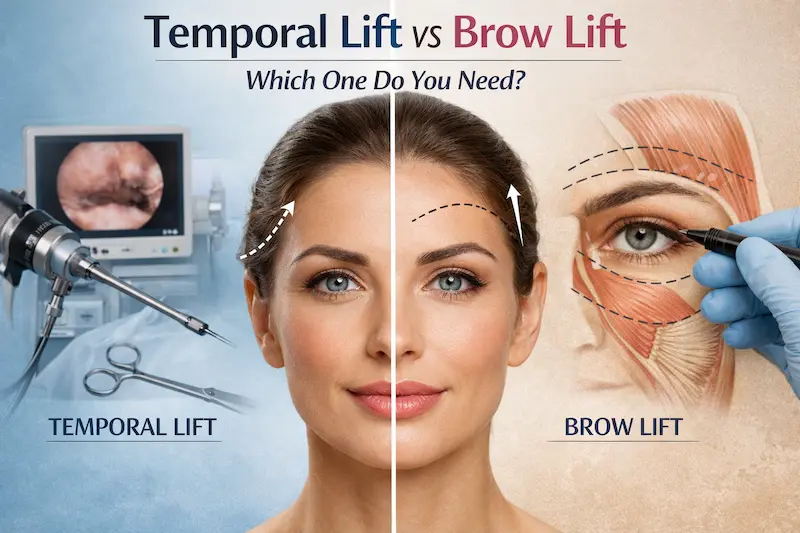
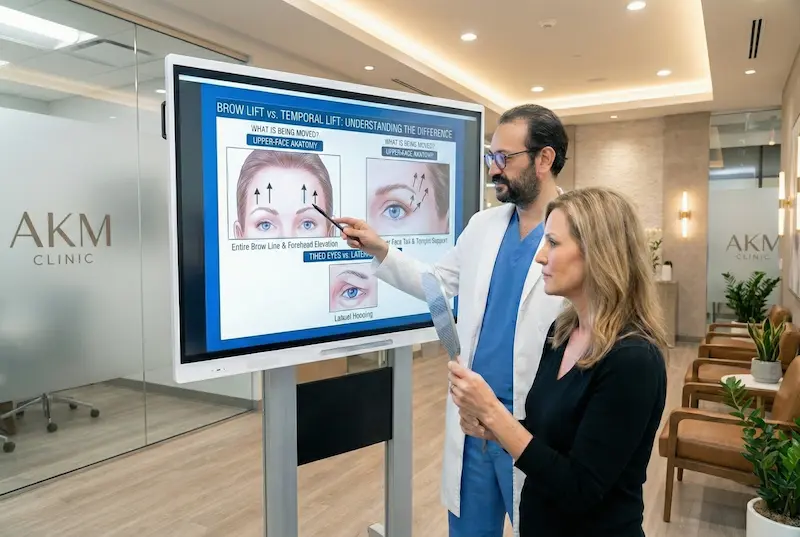
Before comparing techniques like endoscopic brow lift vs temporal brow lift, it helps to define what is being moved. The brow is not a single point—it’s a curve with a medial (inner) portion and a lateral (outer) tail. A procedure that primarily supports the lateral brow tail can relieve “outer corner heaviness” without significantly raising the inner brow. A procedure designed to elevate the entire brow line (often via endoscopic fixation) can address broader brow descent and asymmetry—sometimes with different trade-offs.
Upper-face anatomy in plain English (brow position vs temple support)
The “temple” area is a support zone for the outer brow tail. When this region loosens, the outer brow can drift down and in, creating a shadowing effect over the outer eyelid. A temporal lift mainly targets this lateral support. A brow lift addresses the brow as a whole (including central/medial components) and may also influence forehead dynamics.
“Lateral hooding” and why it’s often not an eyelid-only problem
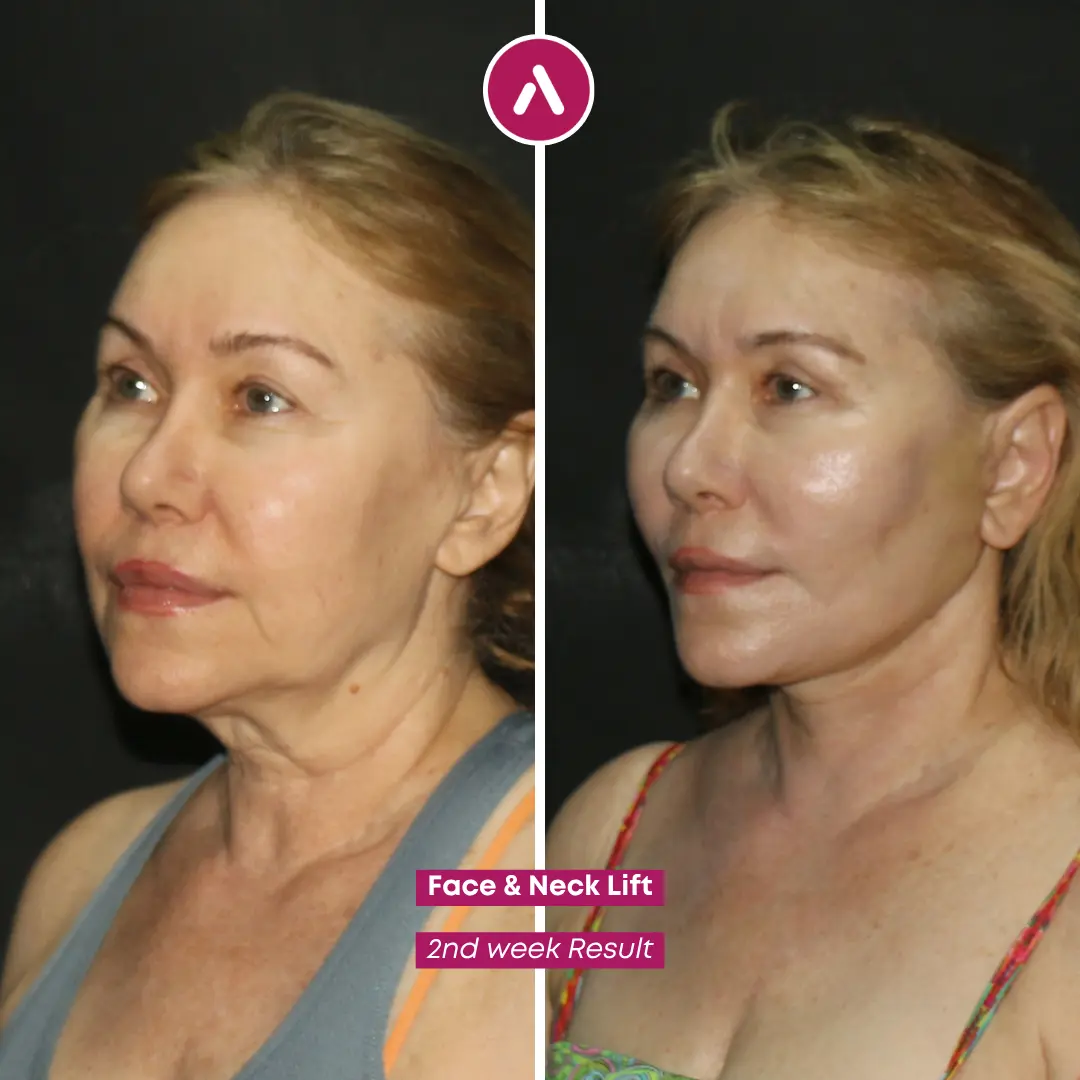
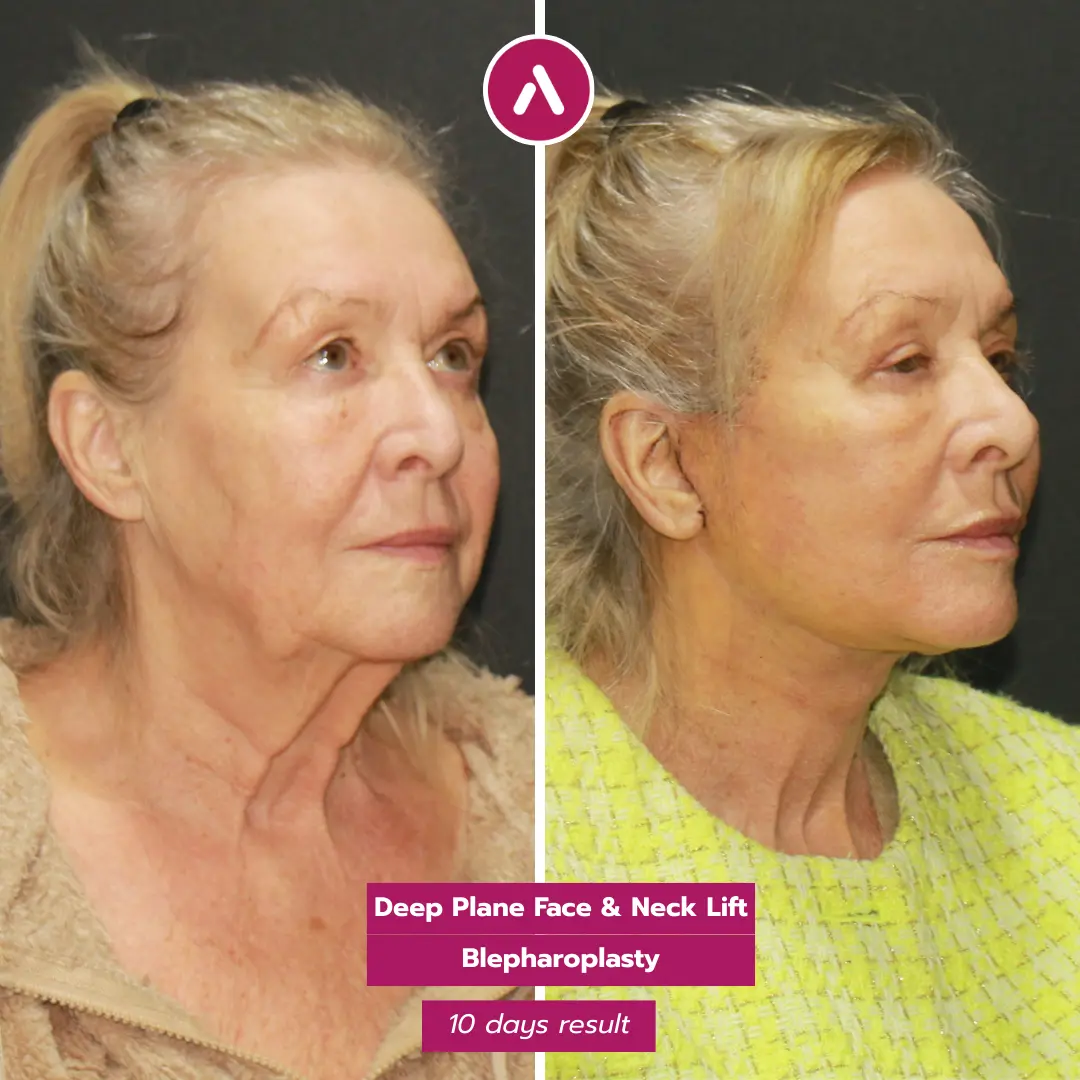
Many patients assume hooding equals “too much eyelid skin.” Sometimes that’s true. But in a large number of cases, the eyelid looks heavy because the brow tail has dropped, pushing tissue downward over the outer eyelid. That’s why comparing temporal vs endoscopic brow lift matters: if the issue is primarily lateral, a focused lift may be more natural than a full-brow elevation.
What patients mean by “tired eyes” vs what surgeons measure
Patients usually describe how they look in photos: droopy outer corners, a smaller-looking eye opening, or a “sad” shape. Surgeons translate that into measurable patterns—brow position at key points, symmetry, eyelid show, and the relationship between the brow tail and the lateral canthus (outer corner of the eye).
Temporal Lift Explained
A temporal lift is typically chosen when the main complaint is outer brow tail descent and heaviness at the outer upper eyelid. It aims to restore support in the temple region and subtly improve the lateral brow position—often without dramatically changing the center of the brow. For the patient who wants refinement rather than a visible “lift,” this can be appealing—if the anatomy and goals match.
What a temporal lift treats (outer brow tail, temple laxity, eye “outer heaviness”)
In practical terms, a temporal lift can help when:
- The outer brow tail sits lower than it used to (or lower than the inner brow curve).
- You see “lateral hooding” that worsens by the end of the day or in certain expressions.
- You want a modest, targeted change rather than full-brow repositioning.
Incision locations and scar visibility (hairline/temple placement)
Temporal approaches typically use incisions placed within the hair-bearing temple region or at the hairline, designed to be discreet. Scar visibility depends on hair density, incision planning, and healing tendency. For patients with thinner temple hair or certain hairline patterns, careful planning becomes more important.
Technique variations (suture suspension vs endoscopic support) and who benefits most
You may see different names online—“temporal brow lift,” “lateral brow lift,” or variations involving suture suspension. The common theme is that the lift is focused laterally. In contrast, an endoscopic approach can also be used to support tissues with visualization and fixation strategies—one reason people compare endoscopic brow lift vs temporal techniques. The best fit depends on whether the descent is isolated to the brow tail or part of a broader brow/forehead pattern.
Brow Lift Explained
A brow lift is designed to reposition the brow more comprehensively than a purely lateral/temporal approach. This matters when the descent is not limited to the brow tail, or when asymmetry involves the central brow. Many modern techniques use an endoscopic approach, which is why patients frequently search comparisons like endoscopic brow lift vs temporal brow lift and endoscopic brow lift vs temporal. The key is not the buzzword “endoscopic,” but what it allows the surgeon to visualize, release, and fixate safely and predictably.
Endoscopic brow lift vs other approaches (key differences at a glance)
An endoscopic brow lift typically uses small incisions hidden in the hair-bearing scalp_listing. Through these, a camera-assisted (endoscopic) view can help the surgeon release specific tethering points and reposition the brow with controlled fixation. Other brow lift approaches may use different incision patterns and are sometimes chosen for very specific anatomy or hairline considerations. For the “comparison shopper,” the most meaningful difference is often the extent of lift and vector of elevation, rather than the instrument itself.
What a brow lift treats (overall brow position, symmetry, forehead lines—when relevant)
A brow lift can be appropriate when:
- The entire brow line has descended, not just the outer tail.
- There is noticeable brow asymmetry that affects facial balance.
- The heaviness is central as well as lateral, making a purely temporal approach less effective.
Some patients also notice improvement in the “crowded” upper-face appearance that can accompany brow descent. However, not every concern is solved by lifting—this is where a surgeon’s diagnostic approach, supported by scientific research on facial aging patterns and safe fixation, becomes important in choosing the right plan.
Incisions, nerve safety, and how “natural” is protected during elevation
Natural results depend on subtle, anatomy-respecting elevation—not excessive lift. A careful approach focuses on:
- Nerve awareness: protecting sensory nerves in the forehead/scalp region to reduce numbness risk.
- Controlled release: freeing the tissues that actually restrict brow movement, rather than “yanking” skin.
- Fixation strategy: stabilizing the brow position in a way that matches your facial proportions and goal.
Temporal Lift vs Brow Lift: Side-by-Side Comparison
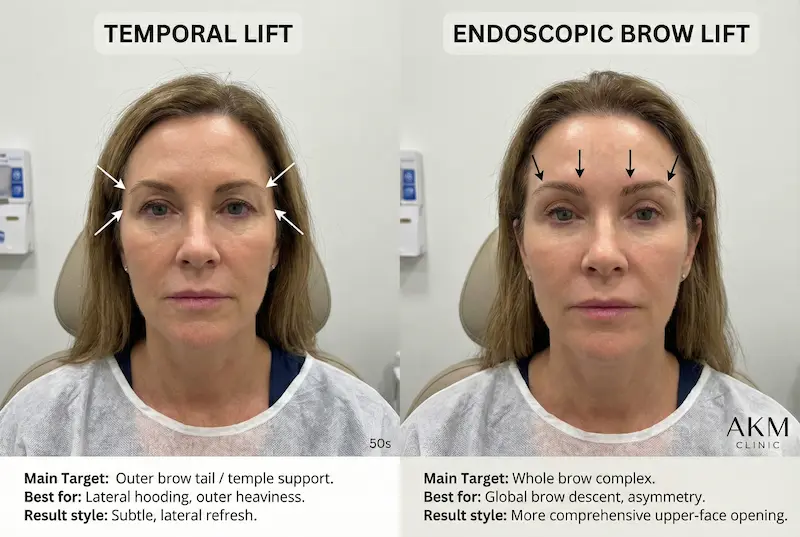
When people compare brow lift vs temporal lift, the biggest misunderstanding is assuming these procedures are interchangeable. They overlap in the upper face, but their “center of action” is different. In many patients, the most accurate question is: do you need a lateral support correction, a whole-brow repositioning, or an eyelid procedure (or a combination)? Below is a practical, patient-friendly comparison that also answers why searches like temporal vs endoscopic brow lift are so common.
Goals: outer brow tail vs full brow elevation (how to choose by problem pattern)
- Temporal lift: best when the issue is mainly the outer brow tail and lateral eyelid heaviness.
- Brow lift: best when descent involves the whole brow (central + lateral), or meaningful asymmetry exists.
If you’re torn between endoscopic brow lift vs temporal options, pay attention to whether your inner brow looks “okay” while only the outer tail feels heavy. That pattern often points toward a more targeted approach.
Scars & visibility: temple hairline vs scalp incisions (practical expectations)
Both procedures aim to hide incisions in hair-bearing areas. The difference is more about location than “scar vs no scar.”
- Temporal lift: incisions often closer to the temple/hairline region.
- Endoscopic brow lift: small incisions placed within the scalp, typically farther back from the hairline.
Healing quality depends on incision planning, individual scarring tendency, aftercare, and avoiding tension. A reputable clinic will discuss what is realistic for your hairline, density, and styling habits.
Typical recovery, downtime, and longevity (what’s realistic)
Recovery is individual, but most patients should plan for visible swelling/bruising and a “social downtime” period. Longevity depends on tissue quality, technique, and how much lift is needed.
| Feature | Temporal Lift | Brow Lift (Often Endoscopic) |
|---|---|---|
| Main target | Outer brow tail / temple support | Whole brow complex (more global repositioning) |
| Best for | Lateral hooding, outer heaviness | Global brow descent, asymmetry |
| Downtime (typical planning) | Usually shorter to “camera-ready” for mild cases | May require a bit more time for swelling to settle |
| Result style | Subtle, lateral refresh | More comprehensive upper-face opening |
Reality check: If most of the “heaviness” is actually eyelid skin excess, neither lift replaces a well-planned upper blepharoplasty. The best plan is the one that matches the true cause.
Which One Do You Need? A Symptom-Based Decision Guide
Most people don’t actually need a “bigger” procedure—they need the correct procedure. If your research history includes phrases like brow lift vs temporal lift and temporal vs endoscopic brow lift, you’re already doing the right thing: matching the solution to the pattern. Use the symptom guide below as a starting point (final decisions should always come from an in-person exam and dynamic assessment—how your brow moves when you speak, smile, and relax).
If your concern is mainly “outer corner heaviness” → what usually fits best
If the outer upper eyelid feels heavy, your eyeliner disappears at the outer third, and your inner brow looks relatively “fine,” a temporal approach may be the more proportional match. This is often why people compare endoscopic brow lift vs temporal brow lift: in lateral-predominant aging, a targeted lift can refresh the eye area without changing the central brow as much.
- Typical pattern: lateral hooding + brow tail drop
- Often aligns with: temporal lift / temporal brow lift (depending on technique and nomenclature)
- Common goal: subtle, natural outer-eye opening
If your concern is “overall brow droop / asymmetry” → what usually fits best
If the brow looks lower across its length (not just the tail), or you notice significant left-right difference that affects your facial balance, a brow lift may be more appropriate. This is the scenario where endoscopic brow lift vs temporal becomes a meaningful distinction—because the aim is not only lateral support, but broader repositioning and controlled fixation.
- Typical pattern: global brow descent, central heaviness, asymmetry
- Often aligns with: brow lift (frequently endoscopic in modern planning)
- Common goal: restore brow position while keeping expressions natural
If you want a subtle refresh (not a dramatic “lifted” look) → strategy and limits
Subtlety is a planning decision. The most “natural-looking” results usually come from correcting the minimum necessary displacement. In many cases, the answer is not “more lift,” but a better diagnosis (brow tail vs full brow vs eyelid skin). When patients ask about temporal lift vs brow lift, they’re often trying to avoid an overdone look—so the strategy is: target the correct anatomical driver, elevate conservatively, and respect your baseline brow shape.
Clinical logic: A procedure should correct the cause, not just the symptom. That principle is consistent with medical science and long-standing surgical decision-making.
When the Answer Is “Neither”: Procedures That Mimic Lift Results
It’s completely possible that neither a temporal lift nor a brow lift is the best first step. Many “lift” concerns are actually eyelid skin redundancy, volume loss, or skin quality issues. The goal is to avoid over-treating one area to compensate for another—one of the main reasons patients end up unhappy after the wrong procedure.
Upper blepharoplasty vs brow/temporal lift (how to avoid over-removing eyelid skin)
If eyelid skin excess is the primary issue, an upper blepharoplasty may provide the cleanest improvement. The risk of choosing blepharoplasty alone—when brow descent is the real driver—is that too much eyelid skin can be removed to “chase” a brow problem. A careful surgeon evaluates brow position first, then decides whether a lift (temporal or brow) should be done before or alongside eyelid work.
Non-surgical options (their role, limits, and when they delay the inevitable)
Neuromodulators and energy-based tightening can offer modest improvement for selected patients, particularly earlier aging patterns. But they do not replicate the structural repositioning of a lift. If your research has narrowed to brow lift vs temporal lift, you may already be beyond the point where non-surgical options deliver the kind of predictable, long-lasting change you want.
Skin quality and texture: why results can look “off” without addressing skin health
Even a perfectly positioned brow can look “unfinished” if skin laxity, texture, or sun damage dominates the visual impression. This is where comprehensive planning matters: great outcomes are a blend of structure (position) and skin (quality). Patients who value science-driven planning often appreciate a clinic that treats healing and skin biology as part of the outcome—not an afterthought.
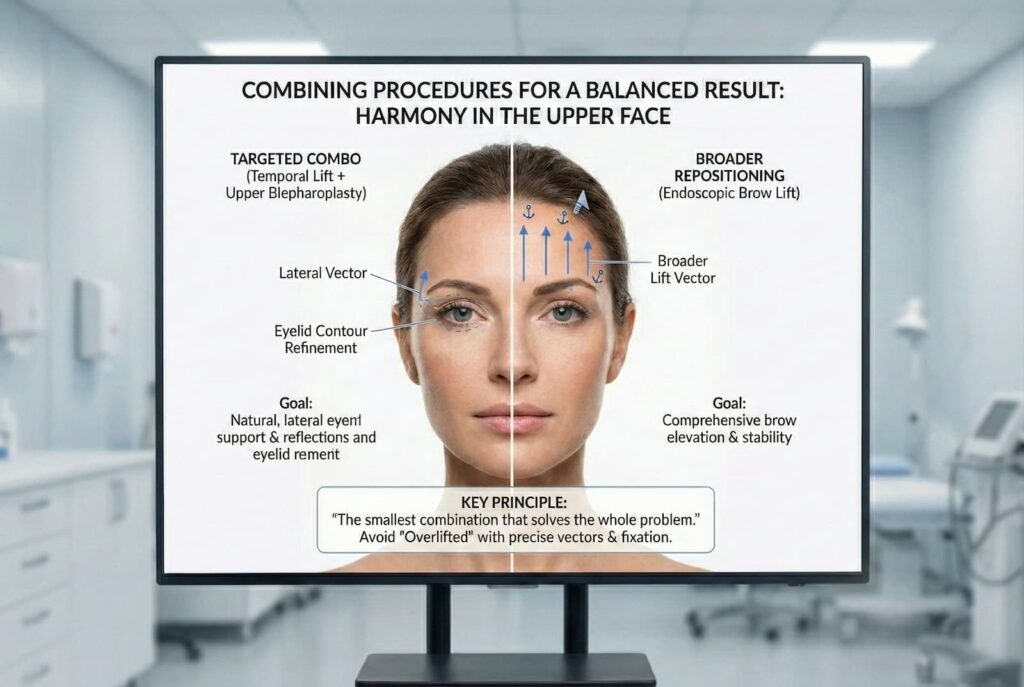
Combining Procedures for a Balanced Result
In real clinical practice, many patients benefit from a combination plan—especially when brow position and eyelid skin both contribute. The decision isn’t “more surgery is better,” but “the smallest combination that solves the whole problem.” This is also where comparisons like endoscopic brow lift vs temporal brow lift can be misleading, because sometimes the best answer is “a targeted lift + conservative eyelid refinement.”
Temporal lift + upper blepharoplasty: when it’s safer and more natural together
This combination can be ideal when lateral brow tail descent creates outer eyelid heaviness and there is true eyelid skin redundancy. The lift reduces the downward pressure from above, and the blepharoplasty refines the eyelid contour. Done thoughtfully, it can reduce the temptation to over-remove eyelid skin.
Brow lift + midface/upper-face planning: harmony and “pull direction” logic
For patients needing broader brow repositioning, the surgeon’s “vector” (direction of lift) matters as much as the amount. A controlled endoscopic approach may help achieve stable, natural elevation with well-concealed incisions—one reason patients compare endoscopic brow lift vs temporal techniques when they’re focused on precision and scar minimization.
Avoiding the “overlifted” look: vectors, fixation, and surgeon judgment
The “surprised” look is typically a planning failure, not a necessary consequence of brow surgery. Natural results come from conservative elevation, correct vector choice, and fixation that respects your facial proportions. Ask your surgeon to describe the exact aesthetic goal (e.g., “restore” vs “raise”) and to show cases matching your age, sex, and baseline brow shape.
Safety, Recovery, and Aftercare That Matter to Expert Patient
For an “expert patient,” the decision is rarely just about aesthetics—it’s about risk control, predictability, and recovery quality. Whether you’re weighing brow lift vs temporal lift or comparing endoscopic brow lift vs temporal brow lift, you’ll want to evaluate (1) how the clinic prevents complications, (2) what recovery realistically looks like, and (3) which recovery-support protocols are in place to reduce swelling and downtime.
Key risks and how reputable clinics reduce them (nerve safety, bleeding, healing)
All upper-face lifting procedures share a common safety theme: they occur near sensory nerves, blood vessels, and delicate soft tissues that can swell easily. A safety-first plan typically focuses on:
- Precise dissection and visualization to reduce nerve irritation and uneven elevation.
- Meticulous bleeding control to lower hematoma risk and minimize bruising.
- Thoughtful vector planning to avoid the “overlifted” look (often a sign of excessive or misdirected elevation rather than “too much endoscopy”).
- Strict sterilization and hygiene protocols to reduce infection risk and support clean healing.
Recovery timeline week-by-week (swelling pattern, bruising, social downtime)
While the exact course depends on your anatomy and surgical plan, the general pattern is predictable:
| Timeframe | What You May Notice | Practical Guidance |
|---|---|---|
| Days 1–3 | Peak swelling, tightness, variable bruising | Prioritize rest, head elevation, and clinic-approved cold/warm protocols |
| Days 4–10 | Swelling begins to settle; bruising shifts color | Most patients start feeling “human” again; avoid strenuous activity |
| Weeks 2–4 | Visible improvements, lingering puffiness possible | Social downtime often ends here for many patients, depending on bruising |
| Months 2–6 | Refinement phase; tissues soften and stabilize | This is when “naturalness” becomes most obvious and consistent |
When patients search endoscopic brow lift vs temporal or temporal vs endoscopic brow lift, they’re often trying to estimate downtime. The truth: recovery depends more on extent of tissue release, fixation strategy, and your healing biology than on a single label.
Supportive recovery tech (HBOT & LLLT) and what they aim to improve
Some clinics integrate recovery technologies to support healing physiology. At AKM Clinic, two commonly discussed options are:
- HBOT (Hyperbaric Oxygen Therapy): breathing 100% oxygen under increased pressure to support tissue oxygenation—often positioned to help swelling reduction, tissue recovery, and scar quality.
- LLLT (Low-Level Laser Therapy): a non-thermal light-based therapy (commonly cited around 650nm) used to support cellular repair, collagen activity, and inflammation reduction—often described as complementary to HBOT.
From a medical science standpoint, these technologies are generally framed as recovery support—not a replacement for good surgery. The best question to ask is: “How does your protocol integrate with my specific procedure and risk profile?”
Patient perspective: Barbara (USA) described a “natural-looking rejuvenation,” saying she “literally look[s] like nothing happened but probably 20 years younger.”
Choosing the Right Surgeon and Clinic (Istanbul Focus)
Procedure selection is only half the equation. The other half is who plans (and performs) it, and how well the clinic matches technique to anatomy. If you’re weighing endoscopic brow lift vs temporal brow lift, choose a team that can explain the diagnostic logic clearly—why one approach fits your pattern, and why the other doesn’t.
What to look for in credentials and case selection (not just photos)
Go beyond “before/after” galleries. Look for:
- Consistent natural outcomes across different ages and brow shapes (not one “signature look”).
- Clear documentation of approach (what was done, and why).
- Safety infrastructure (sterility standards, licensed facility, anesthesia planning, post-op monitoring).
- Ability to say “neither” when the right solution is eyelid surgery or a combined plan.
Why a dermatosurgeon perspective can improve “naturalness” (skin + structure synergy)
Upper-face rejuvenation isn’t only about lifting—it’s also about how the skin heals, drapes, and reads in real life lighting. At AKM Clinic, the surgeon-led model emphasizes dermatosurgical expertise alongside facial plastic surgery planning. For example, Dr. Akif Mehmetoğlu, MD is presented as a Dermatosurgeon & Face Expert, which can add value when the plan needs to address both skin quality and structural positioning for a more natural finish.
Consultation checklist: the exact questions to ask to avoid mismatched procedures
- “Is my heaviness primarily from brow descent, eyelid skin, or both?”
- “Is my issue lateral-only (brow tail) or global? Why?”
- “If comparing temporal vs endoscopic brow lift, what exactly changes in my case—vector, amount, fixation?”
- “What would you NOT recommend for me, and why?”
- “How do you avoid an overdone look—what’s your approach to conservative elevation?”
- “What is your plan for swelling control, scar support, and follow-up?”
Frequently Asked Questions (FAQ): Temporal Lift vs Brow Lift
These quick answers are designed to remove the most common decision blockers. For anything that affects candidacy (hairline, asymmetry, prior surgery), a surgeon’s exam is essential.
Does a temporal lift raise the entire brow or only the tail?
Most temporal approaches primarily affect the outer brow tail. They usually do not raise the entire brow line as much as a full brow lift.
Is an endoscopic brow lift truly “scarless”?
No—there are still small incisions, typically hidden in hair-bearing scalp. “Scarless” usually means “well-concealed,” not “no scar.”
Will a brow lift fix hooded eyelids, or do I still need blepharoplasty?
Sometimes a brow lift improves hooding if brow descent is the driver. But if eyelid skin redundancy is significant, you may still need upper blepharoplasty (or a combined plan).
How do I decide between brow lift vs temporal lift?
If the problem is mostly lateral heaviness and brow tail drop, temporal may fit. If the issue is global brow descent or asymmetry, a brow lift may fit better.
What’s the difference between endoscopic brow lift vs temporal brow lift?
In simple terms: endoscopic brow lift planning often targets broader brow repositioning with camera-assisted visualization, while temporal brow lift focuses more on the lateral brow tail/temple support.
How long do results last for temporal vs endoscopic brow lift?
Longevity varies by tissue quality, technique, and the amount of correction needed. In general, more comprehensive structural repositioning can be longer-lasting—but “best” depends on the correct match.
How do I avoid an “overlifted / surprised” look?
Choose a conservative, anatomy-driven plan: correct vector, controlled elevation, and fixation that respects your natural brow shape. Ask to see cases similar to your baseline.
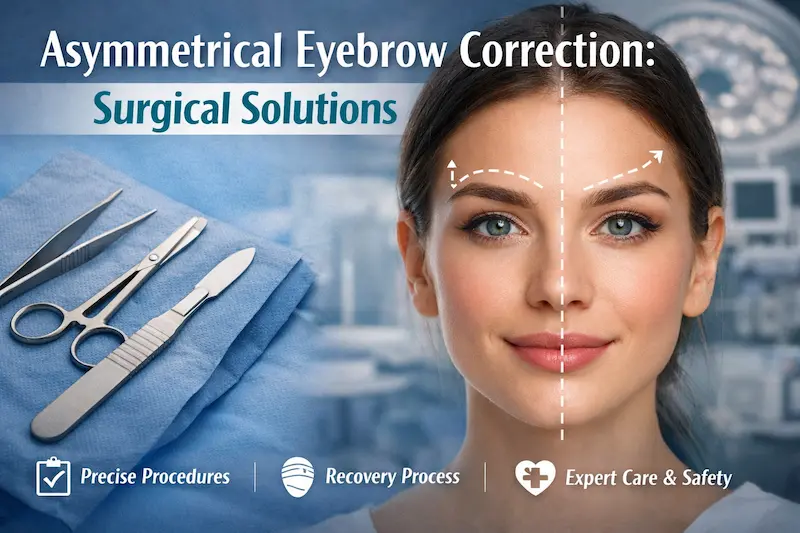
If you’d like, you can also explore related topics beyond this comparison—such as Plastic Surgeon Board Certification, a practical Questions to Ask Plastic Surgeon checklist, and how to avoid risks like Ghost Surgery in Turkey. Many patients also benefit from an Online Plastic Surgery Consultation before traveling, especially when choosing English Speaking Plastic Surgeons in Turkey for clear communication. And if brow imbalance is part of your concern, you may want to read about Asymmetrical Eyebrow Correction to understand diagnosis and treatment options.
Medical Disclaimer: This page is provided for general educational purposes only and does not replace a face-to-face medical consultation, diagnosis, or personalised treatment plan. All surgery carries risks and outcomes vary between individuals. Suitability for a temporal brow lift, procedure selection, and anaesthesia choice can only be determined after a full clinical assessment by a qualified surgeon. Always follow your clinician’s instructions and seek urgent medical attention if you develop concerning symptoms during recovery.