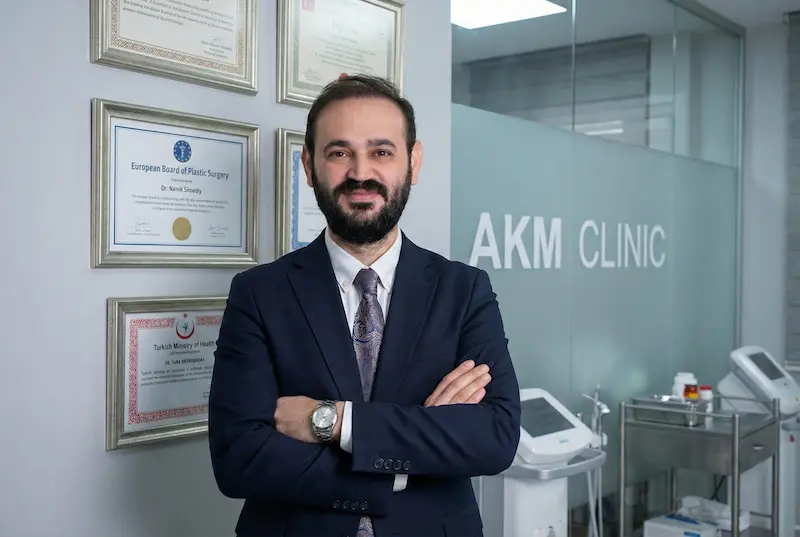
If you’re researching cosmetic surgery, plastic surgeon board certification is one of the few credentials that can meaningfully reduce your risk—when you understand what it actually proves (and what it doesn’t). In a space where marketing language often sounds similar, board certification is meant to be a standards-based signal tied to training, testing, and ethics—not just a title on a website.
In this guide, we’ll break down board certification with a “research-minded” lens—using clear definitions, practical verification steps, and the safety logic behind why credentialing matters in medical science and clinical practice. You’ll also learn how to spot misleading labels and how to ask consultation questions that reveal real expertise.
- What “board certified” really means vs. a medical license
- How marketing labels can confuse patients
- What to look for when you check board certification plastic surgeon claims
Table of Contents
What “Board Certified” Really Means (And What It Doesn’t)
Explanation: “Board certified” is often treated like a simple yes/no badge. In reality, it’s a structured credential that usually reflects advanced, specialty-focused training and assessment beyond basic medical licensure. But it’s not a guarantee of perfection—and it doesn’t automatically tell you whether a surgeon is the right match for your goals.
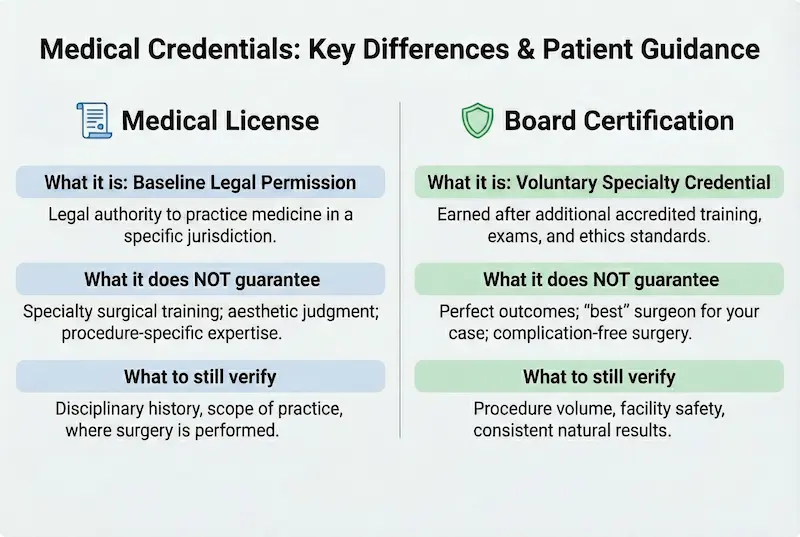
Board certification vs. medical license: the key difference
A medical license is the legal permission to practice medicine in a specific jurisdiction. It’s essential—but it’s also a baseline. A license alone doesn’t confirm specialty-level surgical training in plastic surgery.
Board certification is typically a voluntary specialty credential earned after additional training and evaluation. In patient terms: licensure says “this person can practice medicine,” while board certification aims to say “this person has met specialty standards in a defined field.”
| Credential | What it usually indicates | What it does NOT guarantee | What you should still verify |
|---|---|---|---|
| Medical License | Legal authority to practice medicine; baseline professional requirements | Specialty surgical training; aesthetic judgment; procedure-specific expertise | Disciplinary history (if available), scope of practice, where surgery is performed |
| Board Certification | Specialty-level training and assessment standards (varies by board) | Perfect outcomes; “best” surgeon for your case; complication-free surgery | Procedure volume, complication plan, facility safety, consistent natural results |
The wording on a credential matters, but so does seeing what an actual surgeon’s documented training pathway looks like in practice. European Board–certified status, ACGME-equivalent residency, and a documented case log are the kind of structural details a patient should be able to read on a single, well-organized profile — not piece together from scattered marketing pages.
That is the level of detail patients can review on Dr. Akif Mehmetoğlu’s individual surgeon credentials page, which lays out training pathway, board status, and procedure focus side by side.
Important nuance: the phrase “board certified” can be used in misleading ways if the “board” is not widely recognized or if the certification is not actually in plastic surgery. That’s why your next step is understanding what boards require.
What it typically requires: accredited training, exams, ethics standards
While requirements differ by country and certifying body, legitimate board certification pathways commonly include:
- Structured specialty training (often years of surgical training plus plastic surgery specialization)
- Standardized examinations that evaluate knowledge and decision-making
- Case-based evaluation or review of surgical experience (varies by system)
- Ethics and professionalism standards with disciplinary mechanisms
From a scientific research perspective, credentialing functions like a quality filter: it doesn’t measure artistry directly, but it increases the probability that a surgeon has been rigorously trained, tested, and held accountable within a defined specialty framework.
This is where patients often get tripped up: they see “board certified” and assume it automatically means “plastic surgery board certified.” But sometimes it means certified in a different field—or certified by a “board” that does not reflect specialty surgical standards.
Tip: When you see the phrase plastic surgeon certification board, treat it as a prompt to verify the exact certifying body and what it represents—not as proof on its own.
Maintenance of certification: why “once certified” isn’t the full story
Medicine evolves. Techniques, safety protocols, anesthesia monitoring, infection prevention, and complication management are influenced by ongoing learning and updated standards. Some boards require surgeons to periodically demonstrate continued education or ongoing professional development.
Why this matters to you:
- Up-to-date safety practices reduce preventable complications.
- Modern technique refinement can improve scarring, swelling control, and natural-looking outcomes.
- Better patient selection (knowing who should not have a certain procedure) can be as important as surgical skill.
Even if a system doesn’t formally mandate maintenance, you can still assess “recency” in a practical way—by asking about case volume, revision rates, and how the surgeon handles complications. Credentialing is one layer; real-world practice patterns are another.
Key takeaway: Board certification is a meaningful safety signal when it’s legitimate and relevant to plastic surgery—but it’s a starting point, not the finish line.
Legitimate Boards vs. Marketing Labels (How Patients Get Misled)
Explanation: The cosmetic surgery marketplace is full of impressive-sounding titles. Some are legitimate; some are vague; some are designed to sound equivalent to specialty certification. Your job as an “expert patient” is to separate regulated credentials from branding.
“Board-certified” in plastic surgery vs. “cosmetic surgery” claims
Patients often assume “cosmetic surgeon” and “plastic surgeon” are interchangeable. In reality, the terminology can vary by region, and marketing language may not reflect standardized specialty training.
What to watch for:
- Certification in an unrelated specialty (e.g., a physician certified in a different field advertising aesthetic procedures)
- Vague claims like “board certified cosmetic surgeon” without naming the certifying board
- Procedure-heavy marketing that avoids discussing training pathways and safety protocols
If you’re aiming to reduce risk, prioritize transparency: you want to know exactly what the surgeon is certified in, who certifies them, and whether that certification is specifically relevant to plastic surgery.
The label “board certified” can hide four very different training pathways. ABPS, ABCS, ABFCS, and ABFPRS each issue certificates — but the underlying requirements aren’t equivalent.
A 2024 Aesthetic Surgery Journal Open Forum analysis of US plastic surgery certifying boards documented that only ABPS requires an ACGME-accredited plastic surgery residency plus case collection plus ongoing maintenance — and only ABPS is recognized by the American Board of Medical Specialties. For Turkey, the comparable specialty pathway runs through the European Board of Plastic, Reconstructive and Aesthetic Surgery (EBOPRAS) — a different system, but with similarly defined residency requirements and examination structure.
Memberships and societies ≠ board certification (why wording matters)
Many excellent surgeons belong to professional societies, attend conferences, publish, and train others. Those are positives. But membership is not the same as board certification.
Marketing pages sometimes list multiple logos and organizations to create “credential density.” That can be legitimate—but it can also distract from the one question that matters:
Is this surgeon’s board certification real, current, and relevant to plastic surgery?
To keep it simple, treat credentials as three separate buckets:
- Legal: medical license, legal right to practice
- Specialty certification: the board credential (the core safety signal)
- Professional involvement: societies, courses, conferences (useful but not equivalent)
This is exactly why patients search for plastic surgeon board certification verification—because the internet makes it easy to claim credentials, but verification makes it real.
Logos on a website are easy to collect. A documented team page is harder to fake. What patients actually want to see is who operates, who assists, who handles anesthesia, and who is responsible for follow-up — with names attached, not just titles. The clinic’s full surgical team profiles page lays out each team member’s training pathway and procedure focus.
Red-flag phrases: “international board,” “academy-certified,” and other unclear titles
Be cautious with titles that sound official but are hard to verify or define. Red flags include:
- Unclear certifier: “board certified” with no board name listed
- Overly broad “international” boards with vague standards and no transparent process
- “Academy-certified” or “certified by an institute” with unclear requirements
- Certification that doesn’t match the procedure (e.g., facial surgery marketed without relevant specialty training)
Here’s a quick “credibility check” table you can use while reading a surgeon’s website:
| What you see online | What it might mean | What you should do next |
|---|---|---|
| “Board certified” (no board name) | Could be legitimate—or could be vague marketing | Ask for the exact board name and verify via official directory |
| Multiple society logos listed | Professional involvement (good), not proof of specialty certification | Separate “membership” from “board certification” in your notes |
| “International board,” “academy-certified” | May not reflect standardized specialty training | Look for transparent requirements, exams, accountability, and verifiable listings |
| Certification in a different specialty | Training may not match complex plastic surgery procedures | Ask who performs the surgery, what training they have in that exact procedure |
Bottom line: if you want to check board certification plastic surgeon claims responsibly, you need two things—(1) the exact board name, and (2) an official verification method. In the next section, we’ll walk through a step-by-step verification checklist you can use in minutes.
Key takeaway: When credential language is vague, treat it as a warning—not reassurance. Legitimate credentials are usually easy to name and easy to verify.
Why Board Certification Impacts Safety and Outcomes
The relationship between credentialing and patient outcomes isn’t theoretical — it has been measured at population scale. A JAMA Surgery analysis of 1.9 million Medicare procedures performed by 14,598 surgeons across orthopedics, general surgery, urology, and neurosurgery found that board-certified surgeons were significantly less likely to be high-complication outliers (odds ratio 0.79, 95% CI 0.66–0.94).
The same analysis flagged a separate caveat: maintenance-of-certification completion alone did not correlate with lower complication rates in every specialty. The signal lives in the initial certification, not in renewal bureaucracy.
Explanation: Board certification matters because it is designed to correlate with structured surgical training, standardized assessment, and accountability. In practical terms, it can influence how a surgeon plans your procedure, prevents avoidable complications, and manages problems if they arise—areas where “experience” is not just a marketing term, but a patient-safety factor grounded in medical science.
Board certification doesn’t exist in isolation. It sits inside a broader safety frame: regulation, accreditation, anesthesia oversight, and how a country’s system handles complications. For US/UK/Canada patients evaluating Turkey specifically, this wider safety frame is usually the missing piece — the part marketing pages skip. An honest plastic surgery safety overview covers the statistics, regulation, and risk-management context that credentialing alone won’t answer.
Training depth: anatomy, reconstruction, complication management
High-quality plastic surgery training is not only about aesthetics—it’s also about anatomy, tissue handling, wound healing, and managing complex complications. A surgeon who has been trained and tested within a recognized specialty framework is more likely to:
- Recognize anatomical variations that raise risk (blood supply, nerve pathways, scar-prone areas)
- Select the safest technique for your tissue quality, age, and medical history
- Prevent “over-resection” and tension that can worsen scarring or distort natural contours
- Identify early warning signs of complications before they become emergencies
From a scientific research viewpoint, the value of standardization is simple: when training and evaluation are consistent, outcomes tend to become more predictable across large groups—even though individual results can vary.
Decision-making under pressure: how experienced surgeons prevent cascade complications
Many serious problems in cosmetic surgery don’t start as dramatic emergencies. They often begin with subtle warning signs (unusual swelling, pain patterns, skin color change, early infection). What separates safer care is not just noticing the sign—it’s knowing what to do next, quickly and correctly.
Board-certified specialists are typically trained to handle complications such as:
- Bleeding/hematoma (especially relevant in facial surgery)
- Infection and wound separation
- Skin compromise (poor blood supply, delayed healing)
- Nerve irritation or injury (risk varies by procedure)
Key takeaway: The real safety advantage is often “what happens next.” A credential doesn’t remove risk, but it can raise the probability that the surgeon will recognize risk early and respond with the right protocol.
Facility standards and privileges: why credentialing often connects to safer settings
Credentials don’t exist in a vacuum. In many systems, best surgeons who meet higher professional standards are more likely to operate in settings with stronger safety infrastructure—proper monitoring, qualified anesthesia teams, emergency readiness, and hygiene protocols.
When you review a surgeon’s claims, don’t stop at the surgeon. Ask:
- Where exactly will surgery be performed (hospital vs. clinic vs. office suite)?
- Who provides anesthesia, and what monitoring is used?
- What is the clinic’s emergency escalation plan?
This is why patients who care about safety often treat “board certification” as the first filter, and facility standards as the second filter.
The surgeon’s certificate is the first filter. The facility behind them is the second. Anesthesia leadership, monitoring standards, emergency readiness, and infection prevention are all clinic-level variables — and they’re often what separates an uneventful recovery from a preventable complication. For a closer look at what an internationally recognized hospital accreditation actually audits, see this writeup on hospital accreditation safety standards.
How to Verify a Surgeon’s Credentials (Step-by-Step Checklist)
Explanation: Verification is where patients turn a marketing claim into a fact. If you’ve ever searched plastic surgeon board certification verification, you already know the goal: confirm that the surgeon is certified by a legitimate, relevant board—and that the status is current. Below is a practical checklist you can use in minutes.
Verification sounds simple in theory and breaks down in practice. Patients pull up a screenshot, see a logo, and assume the work is done. The harder thing is checking the exact board name against the board’s own directory — and confirming the listing is current, in the correct specialty, and matches the legal name on paper.
For a longer, country-specific walkthrough of what that looks like for someone evaluating a Turkish surgeon from abroad, see this credential check walkthrough.
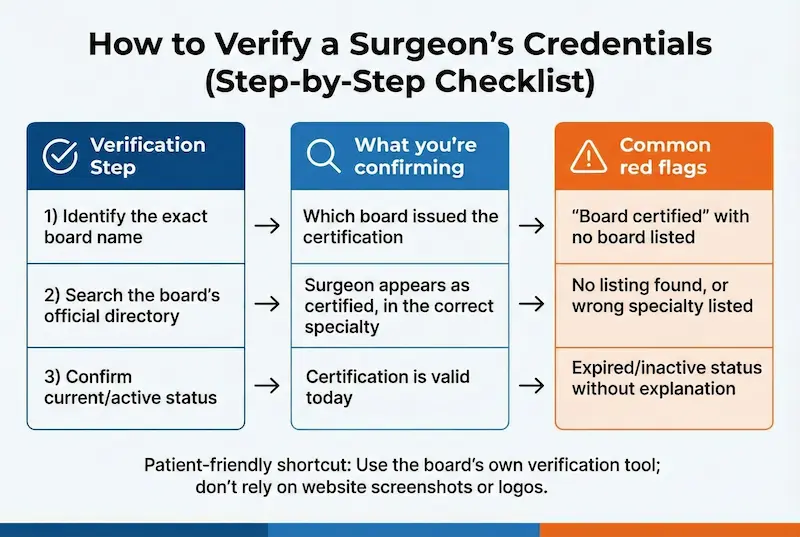
Verify board status on official directories (what to look for on the listing)
Step 1 is to identify the exact certifying board name. A credible surgeon (or clinic coordinator) should be able to provide it clearly. Then verify it using the board’s official directory.
What to look for in an official listing:
- The surgeon’s full legal name (watch for spelling variations)
- Certification specialty (ensure it is relevant to plastic surgery / the procedure)
- Active/current status (not “expired,” “inactive,” or “candidate” unless explained)
Patient-friendly shortcut: If you want to check board certification plastic surgeon claims, don’t rely on screenshots, PDFs, or logos on a website—use the board’s own verification tool.
| Verification Step | What you’re confirming | Common red flags |
|---|---|---|
| 1) Identify the exact board name | Which board issued the certification | “Board certified” with no board listed |
| 2) Search the board’s official directory | Surgeon appears as certified, in the correct specialty | No listing found, or wrong specialty listed |
| 3) Confirm current/active status | Certification is valid today | Expired/inactive status without explanation |
If a clinic uses vague phrasing like plastic surgeon certification board without naming the specific board, treat that as a prompt to request clarity. Legitimate credentials can be named and verified.
Confirm active medical license + check disciplinary history where available
Board certification is important—but licensure is non-negotiable. In most jurisdictions, you can check a physician’s license status through an official medical council or medical board website.
What you want to confirm:
- Active license (and in good standing)
- Specialty registration if your region records it
- Disciplinary actions where publicly available
Note: Not every country provides the same level of public detail. If public records are limited, you can still ask direct questions during consultation (and request written confirmation of who will perform the surgery and where).
Verify the operating team: “Who will actually perform my surgery?” (avoid ghost surgeon risk)
“Who is actually holding the scalpel” sounds like a strange question to ask out loud. It isn’t. Substitute-surgeon situations — sometimes marketed under a different name, sometimes hidden in fine print — are a documented risk specifically tied to high-volume cosmetic destinations and short visit windows. If you want to understand how this scenario unfolds and what contractual protection looks like, this ghost surgery risk explainer walks through the red flags and the documentation patients can request.
One of the most overlooked patient-safety questions is also one of the simplest: Who, exactly, will perform the key parts of my surgery?
To reduce risk, ask for:
- The name of the primary surgeon
- Whether any parts are delegated (and to whom)
- Who is responsible for post-op decisions and complication management
- Who provides anesthesia and monitors you during the procedure
Request that these details be consistent across your consultation summary, consent forms, and treatment plan. Transparency is a safety signal.
Key takeaway: True verification is simple: exact board name + official directory listing + current status. Anything less is just marketing.
Consultation Questions That Reveal Real Expertise
Explanation: Even after plastic surgeon board certification (and after you complete plastic surgeon board certification verification), the consultation is where you learn whether a surgeon is truly the right fit for your anatomy, goals, and risk profile. Think of this as your “clinical interview.” In medical science, the best outcomes come from good diagnosis, good planning, and good execution—consultation questions help you evaluate all three.
Case volume and specialty focus (facial, body, revisions)
A good consultation feels less like a sales pitch and more like a structured interview. The surgeon answers; you take notes. What separates a useful exchange from a forgettable one is having the right questions ready before you walk in. If you want a ready-made set you can adapt to your own procedure, this consultation question checklist covers the credentialing, technique, and complication questions in one place.
Not all “plastic surgery” experience is interchangeable. A surgeon may be excellent in body contouring but do fewer complex facelifts—or vice versa. Ask questions that uncover procedure-specific depth:
- “How many of this exact procedure do you perform per month/year?”
- “What percentage of your practice is this procedure?”
- “How often do you do revision cases for this area?”
Then listen for specificity. A credible answer sounds like: “X per month, mostly patients like you, here’s what changes based on age/skin quality/tissue laxity.” A weaker answer stays vague (“a lot,” “many,” “for years”).
Pro tip: Ask to see consistent patterns in results—similar lighting, angles, and timelines—rather than only dramatic “best-case” transformations.
Complication plan: hematoma, infection, nerve injury—“What happens if…?”
High-trust surgeons don’t dodge risk—they manage it. This is where board certification can translate into real-world safety behavior: planning for complications before they happen. Ask:
- “What are the top 3 complications for this procedure, and how often do you see them?”
- “If I develop a hematoma/infection, what is the exact plan in the first 24 hours?”
- “Who makes the decision if I need urgent evaluation—your team or a third party?”
- “If a revision is needed, what is your revision policy and typical timeline?”
What you want to hear is process: clear early-warning signs, clear escalation steps, and a realistic explanation of what “normal” vs. “not normal” looks like in recovery.
| Complication Topic | Strong Answer Signals | Weak Answer Signals |
|---|---|---|
| Bleeding / Hematoma | Considered an urgent issue; clear monitoring + rapid evaluation plan | “That never happens” or no concrete steps |
| Infection | Early symptoms explained; antibiotic plan + follow-up cadence described | Vague reassurance; unclear follow-up process |
| Nerve concerns | Explains temporary vs. persistent changes; outlines documentation + reassessment | Dismisses concerns; avoids discussing risks |
Key takeaway: A safe surgeon can describe “what we do if X happens” without defensiveness. Transparency is a clinical maturity signal.
Anesthesia safety and monitoring: who provides it and where it happens
Anesthesia is not a footnote—it’s a core safety variable. Many adverse events in surgery relate to monitoring, airway management, sedation depth, and emergency readiness. Ask:
- “Who administers anesthesia—an anesthesiologist or a dedicated anesthesia provider?”
- “What type of anesthesia is planned and why is it the safest choice for me?”
- “What monitoring is used during the procedure?”
- “If there’s an emergency, what equipment and protocols are in place?”
If your procedure involves lighter sedation (sometimes marketed under different names), still treat it like anesthesia: you want qualified providers, continuous monitoring, and clear documentation. This is also a moment where your verification mindset applies—just like you check board certification plastic surgeon claims, you can verify who is responsible for anesthesia and what their credentials are.
Anesthesia is one of those variables that quietly determines whether a surgery is safe or not. Patients rarely ask about it. Continuous monitoring, qualified providers, and a documented emergency protocol aren’t accessories — they’re the infrastructure underneath everything board certification is supposed to support. You can review the equipment standards, monitoring protocols, and safety technologies the clinic operates under in this clinical safety technology directory.
Board Certification in Medical Tourism (US Patients)
Explanation: Traveling for surgery adds additional variables: unfamiliar systems, different credentialing structures, language differences, and distance-based follow-up challenges. Board certification remains important—but you also need a framework to interpret international equivalents and evaluate the clinic environment with the same rigor you would at home.
Understanding international equivalents without false comparisons
Different countries have different certification bodies and training pathways. The correct approach is not to assume “different” means “lower,” or “international” means “better.” The scientific approach is to verify:
- The surgeon’s formal specialty training pathway (what, where, how long)
- The certifying authority’s transparency (requirements, exams, accountability)
- The surgeon’s procedure-specific focus (case volume, revisions, long-term results)
When a website uses broad phrases like plastic surgeon certification board, treat that as incomplete until it’s clarified with a specific, verifiable certifying body and current status.
Clinic/hospital quality markers beyond the surgeon’s certificate
In medical tourism, the facility and the care system matter as much as the surgeon. Look for operational safety markers such as:
- Clear anesthesia leadership and monitoring standards
- Documented hygiene and infection prevention protocols
- Emergency readiness and escalation pathways
- Transparent staffing: who covers nights/weekends, who answers urgent concerns
A surgeon’s certification is a strong starting filter, but your outcome also depends on how the clinic executes perioperative care—pre-op assessment, intra-op monitoring, and post-op management.
Follow-up planning: what safe aftercare looks like when you fly home
Distance changes follow-up. A safe plan includes:
- A written post-op schedule (first 24–72 hours, first 2 weeks, first 3 months)
- Clear guidance on “normal vs. urgent” symptoms
- Easy access to the surgical team (not only a general hotline)
- A contingency plan if you need in-person evaluation after returning home
From a scientific research standpoint, aftercare reduces risk by catching issues early—especially swelling patterns, wound healing problems, infection signs, or unusual pain. If a clinic cannot describe a concrete follow-up pathway, treat that as a risk factor.
Verification ends the moment the surgery does. Aftercare is a different system entirely. For international patients, follow-up has to be designed around distance: who you reach in the first 72 hours, what counts as “normal vs urgent,” and how the surgical team coordinates with your provider at home. The end-to-end structure — pre-op assessment, surgery week, and post-flight recovery — is laid out in this international patient process map.
Key takeaway: In medical tourism, verification expands: surgeon credential + facility standards + aftercare plan. You need all three.
Beyond Certification: What Actually Predicts a Natural Result
Explanation: After you confirm plastic surgeon board certification (and complete plastic surgeon board certification verification), the next question is outcomes: “How likely am I to get a natural result that still looks like me?” Certification is an important safety filter, but aesthetic outcomes depend on planning, technique selection, tissue handling, and honest patient-surgeon alignment. In other words: verification reduces risk; good clinical judgment improves results.
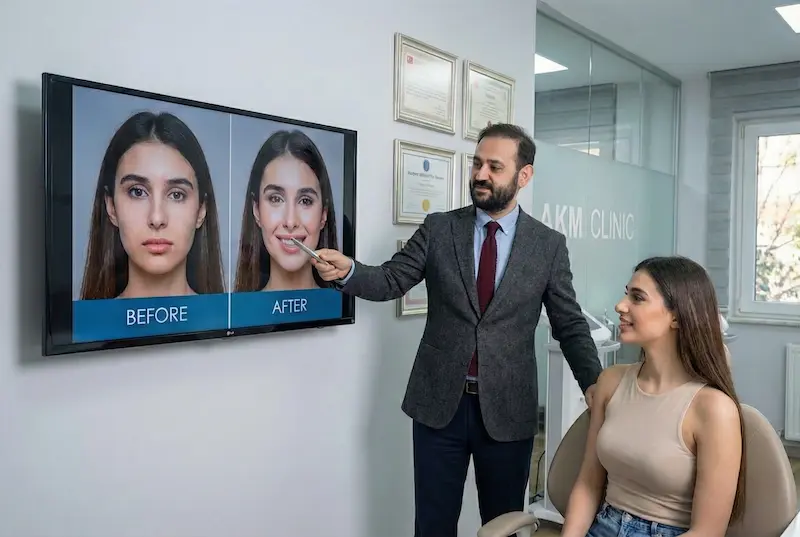
Before/after analysis like a pro: consistency, scars, long-term results
Most patients are shown “best day” photos. A more scientific approach is to look for consistency across many patients, not one dramatic highlight.
Use this checklist when reviewing before/after galleries:
- Consistency: Are results consistently natural across different faces/bodies, ages, and skin types?
- Angles & lighting: Are the photos standardized (same angle, lighting, distance)?
- Timeline: Do they show results at realistic milestones (not only very early swelling or only “perfect” late shots)?
- Scar placement: Are scars discussed openly and shown when relevant?
- Identity preservation: Do patients still look like themselves, or do results trend toward a “one-style-fits-all” look?
If a clinic’s photos feel inconsistent, heavily filtered, or lack timelines, treat that as a data-quality problem—just like you would in scientific research.
Patient reviews don’t replace credentials, but they fill in a different gap. They tell you how the surgeon performs across time and across personalities — not just on one good day. What’s worth reading is volume and consistency: many patients, similar phrasing patterns, and complaints that are addressed rather than buried. You can scan that kind of volume on the clinic’s verified patient feedback hub, which collects long-form reviews across destinations.
Technique-match matters: choosing the right procedure for your anatomy and goals
Natural results are not only about “skill”; they’re about choosing the correct procedure for your tissue, anatomy, and goals. A best surgeon will explain the logic behind the plan:
- Why this technique fits your skin quality and laxity
- What trade-offs exist (scar placement, recovery time, degree of change)
- What would be “too much” for your face/body—and why that matters
Here are signals of good planning:
- Specific anatomy discussion (not generic promises)
- Clear limits (“Here’s what we can and cannot achieve safely”)
- Alternatives offered (including “do nothing yet” when appropriate)
This is also where you can cross-check credibility: a surgeon who encourages you to check board certification plastic surgeon claims and verify credentials is usually more comfortable with transparency than a surgeon who relies on urgency and vague assurances.
Team-based advantage in facial aesthetics: skin quality + structure for more natural outcomes
For facial procedures in particular, “natural” often depends on addressing both:
- Structure (deeper support, tension vectors, anatomical preservation)
- Skin quality (texture, elasticity, pigmentation, healing behavior)
That’s why some high-standard practices emphasize team-based evaluation—combining plastic surgery expertise (structure and surgical planning) with skin-focused expertise (how skin behaves, heals, and ages). If you’re evaluating facial surgery, ask whether the plan considers skin quality as a clinical variable, not just a cosmetic afterthought.
| Factor | Why it matters for “natural” results | What to ask in consultation |
|---|---|---|
| Procedure selection | Wrong procedure = unnatural tension, odd contours, or insufficient improvement | “Why this technique for my anatomy? What are the alternatives?” |
| Tissue handling | Better technique can reduce swelling, scarring, and distortion | “How do you minimize tension and protect blood supply?” |
| Skin quality planning | Skin quality affects scarring, texture, and healing predictability | “How do you assess skin quality, and how does it change the plan?” |
| Aftercare + monitoring | Early detection prevents minor issues becoming visible long-term problems | “What is your follow-up schedule and escalation plan?” |
Key takeaway: Board certification is a safety filter. Natural outcomes come from the right plan, the right technique match, and transparent follow-up—supported by a team and systems, not just a title.
Frequently Asked Questions (FAQ): Plastic Surgeon Board Certification
Explanation: These are the most common “expert patient” questions about plastic surgeon board certification, what it actually signals, and how to verify it correctly. Use this section as a practical reference—especially if you’re trying to check board certification plastic surgeon claims quickly and confidently.
Is board certification legally required to perform cosmetic surgery?
Not always. In many regions, a physician may legally perform cosmetic procedures with an active medical license, even without specialty board certification in plastic surgery. That’s why plastic surgeon board certification verification is important: it helps you confirm specialty-level training rather than relying on legality alone.
What’s the difference between a plastic surgeon and a cosmetic surgeon?
“Plastic surgeon” typically refers to a surgeon trained in plastic surgery as a specialty (often including reconstructive work), while “cosmetic surgeon” is sometimes used as a marketing descriptor and may not always reflect standardized specialty training. Because terms vary by country and advertising rules, the safest approach is to verify the exact credentials and certifying body—don’t rely on titles alone.
Can a non–board-certified surgeon still be “good”? What are the risks?
It’s possible for a surgeon without board certification to deliver good outcomes, but the risk is that you may have less reliable evidence of standardized specialty training, assessment, and accountability. Board certification doesn’t guarantee perfection, but it can increase the probability of appropriate training and safer decision-making—principles aligned with medical science and outcomes-based care.
How do I confirm I won’t get a substitute/“ghost” surgeon?
Get it in writing: the name of the primary surgeon, what parts they will personally perform, and who covers post-op decisions. Ensure the surgeon name matches across your consultation summary, consent forms, and treatment plan. Transparency here is as important as plastic surgeon board certification itself.
Does board certification guarantee a complication-free surgery?
No. All surgery carries risk, and complications can occur even with highly qualified surgeons. What certification can influence is preparedness: correct patient selection, preventive protocols, early detection, and a structured response plan if a complication develops.
What credentials matter most for facelift / rhinoplasty / liposuction specifically?
Start with specialty relevance: confirm plastic surgeon board certification (or the most recognized equivalent where the surgeon practices), then verify procedure-specific experience. Ask how many of that exact procedure the surgeon performs yearly, how they manage complications, and request standardized before/after examples with timelines. Think of it like scientific research: credentials are the framework, but procedure-specific data predicts outcomes.
If I’m traveling for surgery, what are the must-verify safety standards?
In medical tourism, expand your checklist beyond the surgeon:
Credential verification: confirm board status via official directory (don’t rely on a plastic surgeon certification board claim without specifics)
Anesthesia: who provides it and what monitoring is used
Facility readiness: emergency escalation plan and hygiene protocols
Aftercare: written follow-up schedule, clear “urgent vs normal” guidance, and contingency planning after you return home
Medical Disclaimer: This content is for educational purposes only and does not replace medical advice, diagnosis, or treatment. Surgical options, anesthesia choices, risks, costs, and recovery vary by individual. Always consult a qualified, board-certified clinician for personalized guidance. If you have urgent symptoms, seek emergency care.