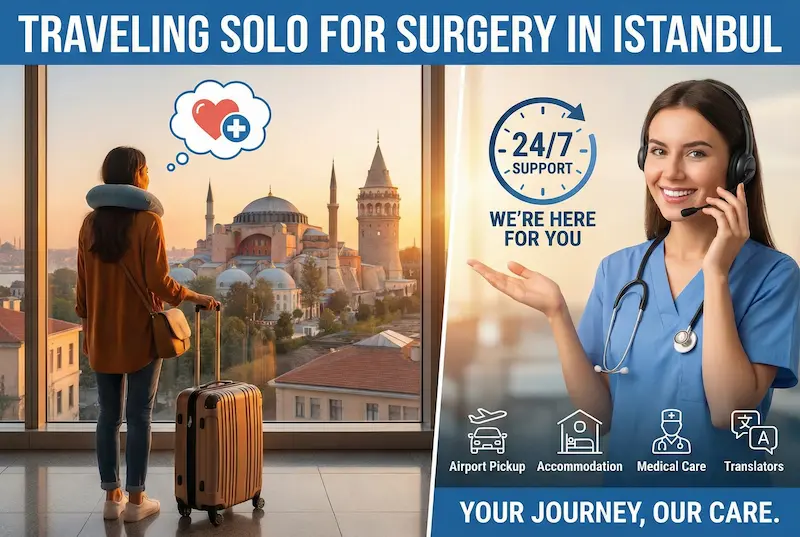
If you’re researching solo travel surgery Istanbul, you’re probably not wondering whether Istanbul has great hotels or good food—you’re asking a more serious question:
“If I travel alone for surgery, will I be safe, supported, and taken care of—especially when I’m vulnerable?”
This guide is written for the high-consideration patient planning solo travel for surgery Istanbul (or even solo travel for plastic surgery to Istanbul) who wants a clear, process-based answer—not vague reassurance.
At AKM Clinic, the solution is not “just be brave.” It’s a structured, all-inclusive care pathway designed specifically for international patients traveling alone: private VIP transfers, 5-star hotel accommodation, a 24/7 dedicated Patient Host, and a post-op plan that continues after you fly home. This is how we reduce the friction and uncertainty that makes solo travel and surgery feel risky.
The phrase “all-inclusive” gets overused in medical tourism marketing — but for solo travelers, the actual content of the bundle determines whether you spend recovery resting or troubleshooting. What should be bundled at the package level rather than left as patient errands: post-op medications and garments staged before discharge, transfer scheduling between hotel and clinic, 24/7 coordinator access, and the long-term virtual follow-up calendar after return. When any of these is sold separately, solo travelers carry the coordination load themselves.
The bundled inclusions and structural alternatives by procedure are detailed on the structured solo travel package.
What you’ll get from this article:
- A realistic breakdown of what feels scary about traveling solo for surgery—and what actually matters clinically.
- How 24/7 support works in real life (not marketing language).
- How we plan your journey step-by-step so you’re not “figuring it out” in a foreign country.
Table of Contents
Why Traveling Solo for Surgery Feels Risky (and What Actually Matters)
Whether you’re researching travel for plastic surgery, travel for surgery in Turkey, or asking “safe to travel to Turkey for surgery?”, the anxiety usually comes from the same place: loss of control. When you’re alone, every unknown feels bigger—and the stakes feel higher.
Solo medical travel doesn’t work on improvisation. What separates a calm experience from a stressful one is whether each handoff — virtual consultation, in-Istanbul days, surgery day, recovery hotel, fit-to-fly, return flight, post-arrival follow-up — has named ownership rather than “we’ll figure it out.” That sequence isn’t unique to solo travelers, but solo travelers feel the gaps faster. When there’s no companion to absorb logistical slippage, every undocumented step compounds into anxiety.
The full handoff sequence with named ownership at each stage is mapped in the solo international patient pathway.
The #1 fear: being “alone” during vulnerable moments
Most people don’t fear the flight. They fear the in-between moments: arriving late at night, navigating an unfamiliar airport, waking up post-op and needing something, or wondering who to call if swelling looks “off.”
The emotional version of this fear is simple: “What if I need help and nobody answers?” That’s why truly supportive solo medical travel isn’t about tourism—it’s about continuity.
Worth flagging here: a lot of solo-travel anxiety isn’t actually about the surgery — it’s downstream of misinformation about what Turkey-based medical care looks like in 2026. The “language barrier,” “no aftercare,” and “cheap means unsafe” assumptions persist online despite operational data that contradicts them. The honest breakdown of which fears are evidence-based and which are recycled tropes is in our review of common Turkey medical travel misconceptions.
Language, navigation, and “what if something happens at night?”
When patients search for safe plastic surgery in Turkey, they’re often trying to avoid two practical risks:
- Communication gaps (explaining symptoms, medications, or concerns clearly)
- Logistics gaps (getting from point A to point B without stress, delays, or confusion)
It’s not dramatic to say that these issues can amplify normal recovery anxiety. Even a routine question—“Is this bruising normal?”—feels heavier at 2:00 AM when you’re alone.
The real safety markers: continuity of care + clear escalation paths
Here’s the perspective many “expert patients” adopt: the safest international experience isn’t defined by a single feature. It’s defined by a system.
Look for these safety markers:
- A surgeon-led model (your medical decisions are owned by the clinical team—not outsourced)
- Planned logistics (so you’re not relying on taxis, guesswork, or last-minute arrangements)
- 24/7 access to a responsible point of contact who can triage concerns and coordinate next steps
- Structured follow-up after you return home (so you don’t feel “dropped” once you leave Istanbul)
The harder question is how you verify that distinction before booking, not after. Title claims on a website don’t equal board certification, and even photo-rich Instagram accounts don’t tell you whether the surgeon performing your procedure is the one you researched. The verification framework — what to ask, what to cross-check against which registries, and what red flags actually mean — is laid out in our step-by-step surgeon credentials verification guide.
“We are not an agency; we are the surgeons.”
“We are not an agency; we are the surgeons.” — that quote shows up twice in the article above for a reason. It marks the structural line between a travel-broker model (where clinical decisions get outsourced or buffered through intermediaries) and a clinic that retains direct ownership of the medical outcome. For solo patients the difference is operational, not philosophical: when something needs a decision at 11 PM, the chain “patient → surgeon” is one step instead of three.
The accountability model, ownership structure, and decision-making chain are documented on the surgeon-led care ownership.
That statement matters because it draws a hard line between a medically accountable provider and a travel-style broker model—especially relevant if your primary fear is a “botched” outcome or unclear responsibility.
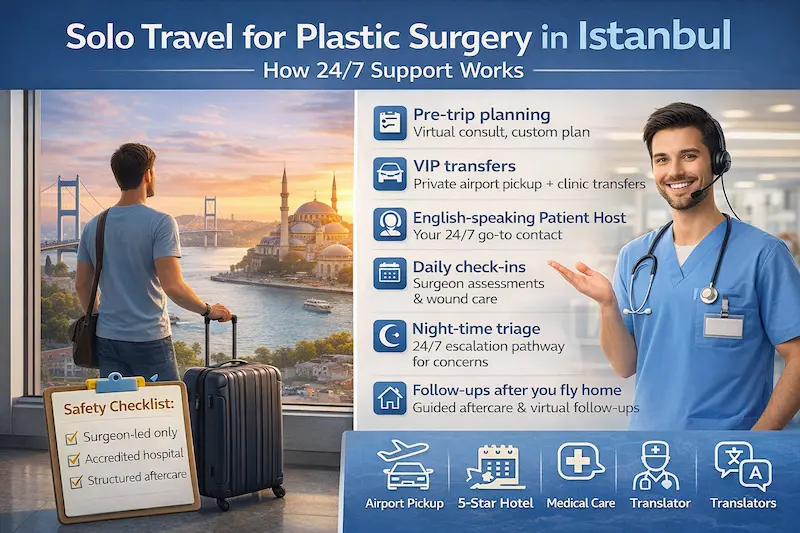
Your 24/7 Support System at AKM Clinic (Solo Travel Surgery Istanbul)
If you’re considering solo travel to Turkey for surgery, the biggest relief is knowing you don’t have to “manage” Istanbul while preparing for (and recovering from) a procedure. The entire journey is intentionally built for solo travelers so your energy goes into healing—not logistics.
| Support Element | Why It Matters When You’re Alone |
|---|---|
| 5-star hotel accommodation | A predictable, comfortable recovery base—no last-minute searching or problem-solving. |
| Private VIP airport–hotel–clinic transfers | Removes navigation stress (and the “what if I get lost?” spiral), especially on arrival and post-op. |
| 24/7 dedicated Patient Host | You have a real person to reach—especially for the “night-time questions” that cause the most anxiety. |
| Post-operative medications and garments | Fewer errands, fewer unknowns, and a smoother first week. |
| Long-term virtual follow-ups | Prevents the “abandonment fear” after you fly home—support continues at set milestones. |
The 5-star accommodation and VIP transfer setup isn’t a luxury upsell — it’s a logistical insurance policy. What you’re paying for is the elimination of decision points: no taxi negotiation while medicated, no GPS troubleshooting after surgery, no last-minute hotel hunting if your flight shifts. Each removed decision saves cognitive load you’d otherwise spend on recovery.
The hotel-tier breakdown, vehicle types, and meet-and-greet protocol live on the VIP transfer and accommodation.
24/7 dedicated Patient Host: what they do (and what they don’t)
Your Patient Host is your continuous point of contact for the practical side of your journey—coordination, communication, and making sure you’re not alone in the moments that feel uncertain.
In practice, this typically includes:
- Coordinating your transfers and appointment timing
- Helping you understand your next step in the schedule (so you’re never guessing)
- Supporting your communication with the surgical team for post-op questions
- Scheduling structured follow-ups after you return home (so your care doesn’t stop at the airport)
Fluent English communication—who you can reach and how
When people search solo travel for surgery Istanbul or solo travel and surgery, they’re often trying to avoid one specific nightmare scenario: having a concern and not being able to explain it—or not knowing who is responsible for answering.
Our model is designed to reduce that uncertainty. From Patient Hosts to surgeons, English communication is built into the system—so you’re not relying on “maybe someone at the hotel can translate” during recovery.
| When you need help | Who you contact | What happens next |
|---|---|---|
| Logistics (transfer timing, appointment reminders, hotel coordination) | Your Patient Host (24/7) | They coordinate the next step and keep your schedule friction-free. |
| Recovery questions (swelling, bruising anxiety, garment concerns, “is this normal?”) | Your Patient Host → Surgical team escalation | Your concern is triaged quickly and directed to the right clinical decision-maker. |
| Urgent symptoms (sudden worsening pain, breathing issues, heavy bleeding) | Emergency pathway | You’re directed to immediate medical evaluation in a hospital setting when needed. |
A practical note for solo travelers: you’ll never be expected to “navigate Istanbul” while stressed, medicated, or tired. The point is to make solo travel for plastic surgery feel structured—because structure is calming.
Surgeon-led care model: clarity, accountability, and decision-making
There’s a big difference between a travel broker arranging a procedure and a clinic owning the medical outcome. If your priority is safe plastic surgery in Turkey, accountability matters.
“We are not an agency; we are the surgeons.”
That philosophy shows up in the patient experience as:
- Direct clinical ownership of your plan, your procedure, and your aftercare—before, during, and after you fly home.
- Clear decision-making when something feels uncertain (rather than bouncing between multiple intermediaries).
- Safety infrastructure: procedures are performed within a hospital environment designed for comprehensive care if escalation is ever needed.
The evidence base on safety as a core variable in cosmetic surgery has matured beyond procedure-level technique studies into broader integrative reviews. A June 2025 integrative review published in Medicine (Baltimore) by Korean authors synthesized the literature on safety as a foundational aspect of cosmetic surgery — emphasizing thorough explanation by qualified medical professionals and informed-consumer decision-making before procedure selection: cosmetic surgery safety review. The review reinforces what operational safety markers in international care should look like — board-certified clinician ownership, transparent risk communication, and informed patient consent as the baseline rather than an add-on.
Worth flagging the boundary: this is an integrative review of safety research methodology, not a randomized comparison of solo vs. companion travel outcomes. The transferable takeaway is structural — safety in cosmetic surgery is consistently framed by the literature as a function of clinician qualification and communication clarity, both of which are precisely what solo travelers need to verify before booking.
What “24/7 support” means in real life (and what it doesn’t)
For patients planning solo travel for plastic surgery to Istanbul or solo travel for plastic surgery to Turkey, “24/7 support” should be concrete—not a vague promise.
It means:
- You have a reachable point of contact at any hour for coordination and triage.
- Your questions don’t sit unanswered overnight.
- Concerns are routed to the surgical team when clinical judgment is required.
- Your follow-up continues after you leave Turkey (scheduled milestones, not “message us if you need something”).
It does not mean:
- Non-stop bedside nursing in a hotel room.
- Replacing emergency services for true emergencies.
- Ignoring medical boundaries—your clinical care decisions come from the surgical team.
This clarity is important because it helps you set realistic expectations—especially if you’re comparing clinics while researching travel for surgery in Turkey.
The Step-by-Step Journey Timeline (From “Landing” to “Landing Back Home”)
If you’re asking “Is it safe to travel to Turkey for surgery?”, part of the answer is clinical standards—but a big part is logistics. The safest-feeling solo journeys are the ones where you’re never improvising.
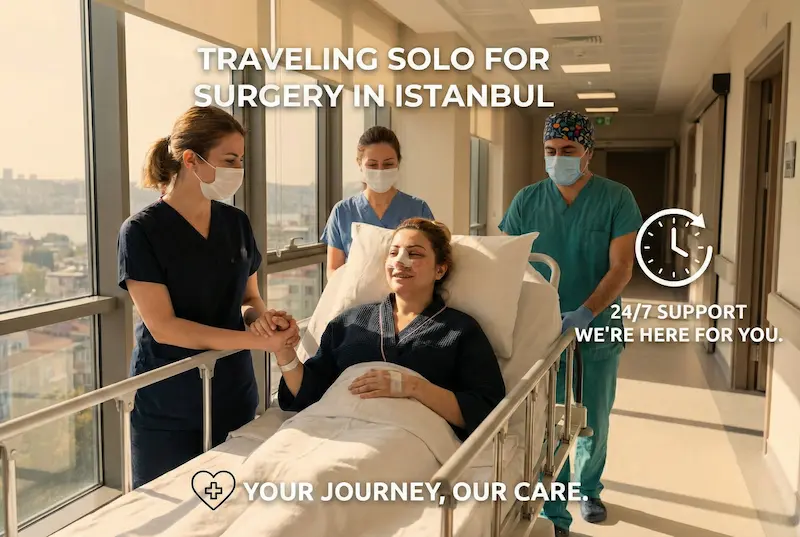
Below is what a structured trip typically looks like when you’re planning solo travel surgery Istanbul (or more broadly, travel for plastic surgery).
Remote planning: virtual consult + personalized plan + transparent quote
Your journey starts before you ever book a flight. In a virtual consultation, the surgical team reviews your goals and photos to outline a plan and provide a transparent quote designed to minimize “surprise costs.”
This step matters for solo travelers because it removes uncertainty early—so you’re not arriving in Istanbul still wondering what’s included, what’s extra, and who coordinates what.
Arrival day: VIP airport pickup → hotel check-in (no guessing, no taxis)
For many patients, the most stressful moment of solo travel to Turkey for surgery is the first hour after landing. You’re tired, you may not have local data yet, and navigating a large airport can feel overwhelming.
That’s why the journey is designed to eliminate “DIY arrival.” A personal driver meets you at arrivals with a name sign and escorts you to your hotel for a private transfer—so you’re not problem-solving transportation on the spot.
Pre-op day: in-person consultation + safety checks
Your in-person consultation is where the plan is confirmed face-to-face and your questions are addressed in full. This is also where pre-op assessments and any required checks are completed so the procedure day is calm, predictable, and not rushed.
| Day | What you do | What we handle for you |
|---|---|---|
| Before travel | Share goals + medical history, review plan | Virtual consult coordination + scheduling + clear roadmap |
| Arrival day | Land + rest | Private airport pickup + transfer to hotel |
| Pre-op day | Meet surgeon + finalize plan | Appointments, timing, and step-by-step guidance |
Surgery day: what happens before/after + your first night
For anyone considering solo travel for surgery Istanbul, surgery day is usually the emotional peak—because it’s when you feel most vulnerable and least interested in “figuring things out.” The goal is to keep the day predictable, quiet, and clinician-led.
While the exact plan depends on your procedure, a well-structured day typically includes:
- Pre-op check-in: confirming your plan, answering last questions, and reviewing safety steps.
- The procedure: performed in a medical setting designed for safe monitoring and escalation if needed.
- Immediate recovery: observation, comfort measures, and clear instructions tailored to your procedure.
- First-night support pathway: you know exactly who to contact if anything feels “off.”
“Performed in a medical setting designed for safe monitoring and escalation if needed” — the phrasing from the section above is doing specific work. It draws the boundary between an in-office clinic suite and a hospital-grade infrastructure where critical care escalation is on the same site rather than across town. For solo travelers this is the single most undervalued safety variable: the time between “something is wrong” and “the right team is at the bedside” should not include a transfer through Istanbul traffic.
The accreditation status, OR specifications, and on-site escalation capability are documented under the hospital surgical facility.
Solo traveler rule: you should never be left guessing who to call, what’s normal, or where to go after surgery.
What patients often need most on the first night: reassurance about normal swelling/bruising, help interpreting symptoms, and fast answers to practical questions (meds schedule, garment fit, positioning, hydration). This is where 24/7 triage access matters—especially for patients researching safe to travel to Turkey for surgery.
Post-op days in Istanbul: check-ups, wound care guidance, comfort logistics
When you’re doing solo travel for plastic surgery to Istanbul, recovery is not only medical—it’s also logistical. The safer and calmer you feel, the better you rest, and the smoother the early recovery tends to be.
During your days in Istanbul, support generally focuses on:
- Scheduled check-ups to monitor healing and answer questions in person.
- Clear wound-care guidance (simple, written, and repeatable).
- Medication and garment routine support (so you’re not improvising).
- Transfers and timing coordination so you can conserve energy.
| Recovery Moment | What you may notice | What support should look like (especially when alone) |
|---|---|---|
| Days 1–2 | Swelling, bruising, fatigue, “Is this normal?” anxiety | Fast answers + structured check-ins + clear comfort instructions |
| Days 3–5 | Improvement, but fluctuations can worry you | Reassurance based on your case + guidance on routine and activity |
| Days 6–10 | Feeling more “human,” still mindful of healing | Planning for travel home + what to watch for + follow-up schedule |
Key point: If your trip feels like constant decision-making, it’s harder. A well-supported plan reduces “decision fatigue,” which is a major hidden stressor in solo travel and surgery.
Planning your return flight: how we reduce risk and stress
Patients exploring travel for surgery in Turkey often ask, “When is it safe to fly?” That depends on the procedure, your healing, and your surgeon’s advice—so we won’t generalize.
What a responsible process does is:
- Build your itinerary around clinically appropriate recovery time (not the shortest possible trip).
- Give you a clear travel-day plan (meds timing, comfort strategy, hydration reminders, and what to do if anxiety spikes).
- Make sure you leave Istanbul with written instructions and a direct line for follow-up questions.
After you fly home: long-term follow-ups (so you’re not “dropped”)
One of the biggest fears behind searches like solo travel to Turkey for surgery is not the first 48 hours—it’s what happens after you land back home:
“If something worries me two weeks later, will anyone still care?”
A strong aftercare system includes scheduled follow-up touchpoints (not only “message us anytime”), so your recovery has structure and oversight beyond the trip itself. This is especially important for international patients who want to feel confident that safe plastic surgery in Turkey includes safe, organized aftercare.
Typical follow-up support may include:
- Milestone check-ins to review healing progress and answer new questions as swelling evolves.
- Photo-based assessments when appropriate, so your team can track changes over time.
- Clear red-flag guidance (when to contact the clinic vs. when to seek immediate local evaluation).
“What If…?” Scenarios (How We Handle the Moments That Cause Anxiety)
If you’re planning solo travel surgery Istanbul, the biggest stress isn’t usually the operation itself—it’s the uncertainty around the “what if” moments: late-night swelling panic, medication confusion, or simply not knowing whether something is normal.
Our approach is to remove improvisation. You’re given a clear point of contact, a clear escalation pathway, and written guidance so you can act calmly—without guessing.
Night-time concerns: swelling, bleeding worries, fever, unusual pain—what to do
Night-time is when anxiety spikes for people doing solo travel for surgery Istanbul. It’s quiet, you’re alone, and normal post-op changes can feel alarming. The key is having a simple decision framework and fast access to support.
Rule of thumb: If you’re unsure, reach out. It’s always better to ask than to “wait and worry” overnight.
| Concern | Often normal (but confirm with your team) | Contact your 24/7 support now | Seek urgent evaluation immediately |
|---|---|---|---|
| Swelling / bruising | Gradual swelling and bruising that fluctuates | Sudden worsening that feels “different” from earlier | Swelling with breathing difficulty, fainting, or severe sudden symptoms |
| Bleeding / oozing | Minor spotting (depending on procedure) | Bleeding that doesn’t settle quickly or increases | Heavy bleeding or rapid soaking of dressings |
| Pain | Expected discomfort controlled by prescribed meds | Pain that escalates or isn’t controlled as expected | Severe, sudden pain with other alarming symptoms |
| Fever / chills | Mild temperature changes can happen | Fever or chills that concern you or persist | High fever with confusion, shortness of breath, or significant weakness |
Medical note: This is general guidance. Your surgeon’s instructions for your specific procedure always come first.
Medication questions + garment issues + mobility support
When patients research solo travel and surgery or solo travel for plastic surgery, they’re often worried about practical recovery tasks they normally would ask a family member for help with.
Common solo-traveler concerns include:
- Medication timing: “Did I miss a dose?” “Can I take this with food?” “Is nausea normal?”
- Garments/dressings: “Is it too tight?” “Did it shift?” “How do I re-secure this safely?”
- Mobility: getting comfortable, positioning, moving slowly and safely after anesthesia or sedation
For these issues, the goal is not self-diagnosis. The goal is fast clarification and safe, simple next steps. Your 24/7 support pathway exists so you don’t change routines, remove dressings, or adjust compression in a way that conflicts with your surgical plan.
If something needs urgent evaluation: a clear escalation pathway
A big part of feeling safe during solo travel to Turkey for surgery is knowing that “urgent” doesn’t mean “you’re on your own.” A responsible system includes a clear plan for when a symptom needs in-person medical evaluation.
In practice, that means:
- You report the concern through your 24/7 contact.
- Your concern is triaged and escalated to the clinical team when needed.
- If in-person evaluation is required, it’s coordinated within a medical setting designed for comprehensive care.
This is one reason patients looking for safe plastic surgery in Turkey should evaluate more than before/after photos. Ask: “What’s your escalation plan if something worries me at night?”
Procedure-specific safety models follow the same logic — they’re either built into the operating protocol or they’re marketing. BBL is a useful test case here: the difference between visual estimation of fat depth and real-time ultrasound guidance during transfer is the difference between a hopeful technique and a verifiable one. The procedural rationale, imaging workflow, and risk-reduction mechanism are detailed in our breakdown of BBL safety with ultrasound guidance.
Communication with family back home (updates without overwhelm)
Traveling alone doesn’t mean your loved ones have to feel powerless. For many patients planning travel for surgery in Turkey, a structured communication plan reduces stress on both sides.
Helpful options include:
- Planned check-ins (e.g., arrival message, post-op “I’m okay,” daily short update)
- One primary contact person back home to avoid repeating the same updates to multiple people
- Consent-based updates when appropriate (you remain in control of what’s shared)
Solo travel isn’t about being isolated. It’s about having a system that keeps you supported while protecting your privacy and comfort.
Comfort Logistics That Matter When You’re Alone
People often assume the hardest part of solo travel for plastic surgery to Istanbul is medical. But for most “expert patients,” the real burden is friction: too many small decisions when you’re tired. The comfort plan is designed to reduce that friction so recovery feels calmer and safer.
Hotel recovery setup: rest, hydration, meals, and minimizing friction
Your hotel becomes your recovery base—so the setup matters. The goal is a “low-effort environment” where basic needs are easy to meet.
Simple, high-impact comfort principles:
- Rest first: prioritize quiet, sleep, and short walks only as advised.
- Hydration routine: keep water within reach; set gentle reminders if needed.
- Food simplicity: choose easy-to-eat meals that don’t require you to “hunt” for options.
- Keep essentials bedside: meds schedule, tissues, lip balm, charger, a notepad for questions.
Transfers between hotel/clinic/hospital—removing decision fatigue
For patients comparing travel for plastic surgery options, transportation logistics are an underrated safety factor. When transfers are pre-arranged, you avoid:
- navigating unfamiliar pick-up points while stressed
- negotiating rides or routes
- standing for long periods post-op
This matters even more for solo travel for plastic surgery to Turkey, because you don’t have a companion to troubleshoot delays or misunderstandings.
Practical tools: SIM/WhatsApp, translation needs, and essentials
When planning solo travel surgery Istanbul, practical tools reduce anxiety fast:
- Reliable messaging: WhatsApp is commonly used for coordination and quick communication.
- Mobile data: a local SIM/eSIM plan can reduce stress (maps, messaging, flight updates).
- Power + charging: travel adapter, long charging cable, and a small power bank.
- Comfort add-ons: a light scarf/hoodie for privacy, sunglasses, and a hat (procedure-dependent and only if permitted).
Packing checklist for solo travel and surgery (mini list)
Here’s a practical, non-overwhelming packing list for solo travel for surgery Istanbul. Adjust based on your procedure and surgeon guidance.
- Documents
- Passport + printed/digital copies
- Flight + hotel details
- A simple medical summary (medications, allergies)
- Communication
- Unlocked phone + eSIM/SIM plan
- WhatsApp installed + key contacts pinned
- Noise-canceling earbuds (rest improves recovery)
- Recovery comfort
- Button-up/zip-up tops (easier than pulling over your head)
- Loose, soft pants
- Slip-on shoes
- Travel pillow (comfort positioning)
- Basics
- Travel adapter + long charging cable
- Lip balm, gentle skincare basics (only what’s allowed)
- Small notebook: questions, medication times, key instructions
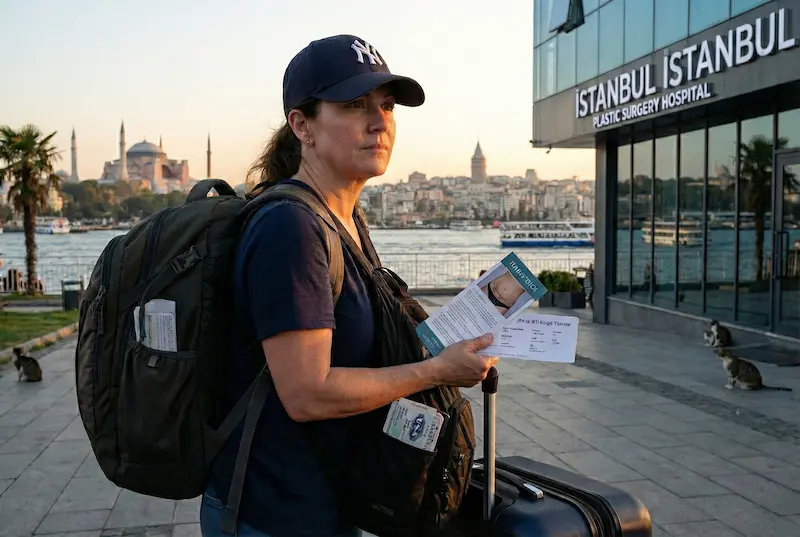
Recovery Support That Helps You Get Back to Life Faster
When you’re planning solo travel surgery Istanbul, recovery planning is not a “nice-to-have.” It’s the difference between feeling calm and feeling stranded. The best outcomes—medically and emotionally—come from a recovery pathway that is structured, evidence-aware, and tracked over time.
Reducing visible downtime: swelling, bruising, and “social readiness” planning
Whether you’re researching solo travel for surgery Istanbul or travel for plastic surgery more broadly, you’ll notice the same question keeps coming up:
“How long until I can look normal in public?”
Your surgeon’s specific instructions always come first, but in general, downtime feels shorter when three things are planned in advance:
- Predictable routine: rest, hydration, and positioning guidance that’s easy to follow when you’re alone.
- Decision reduction: transfers, appointments, and supplies pre-arranged so you’re not problem-solving post-op.
- Fast answers: anxiety drops when questions don’t “sit” overnight.
For solo travelers, reducing “visible downtime” is also about reducing stress. When your schedule is managed, you can focus on healing—one step at a time.
Advanced recovery tools (HBOT & LLLT): where they fit in the plan
For patients prioritizing safe to travel to Turkey for surgery and safe plastic surgery in Turkey, it helps to look beyond logistics and ask: What supports the biology of healing?
AKM Clinic highlights two recovery-focused technologies that are used to support healing at the cellular level:
| Recovery Technology | What it is | How it may help (clinic-stated mechanisms) | Where it’s commonly discussed |
|---|---|---|---|
| HBOT (Hyperbaric Oxygen Therapy) | Breathing 100% oxygen in a pressurized chamber | Oxygen-rich plasma diffusion into tissues; reduced swelling & downtime; improved scar healing; infection-risk mitigation | Often positioned as a post-facelift recovery support |
| LLLT (Low-Level Laser Therapy) | Non-thermal “soft laser” light therapy (650nm) | Boosted cellular energy (ATP); enhanced collagen support (fibroblast stimulation); reduced inflammation | Discussed for post-surgical skin healing (and also used in hair restoration contexts) |
Why this matters for solo travel: When recovery support is built into a protocol (rather than “optional extras”), you’re less likely to feel like you’re managing recovery alone in a hotel room.
What “normal healing” can look like vs. red flags
One of the hardest parts of solo travel and surgery is interpreting what you’re seeing. Mild swelling or bruising can be normal, but uncertainty can feel dangerous when you’re alone. A good clinic gives you clear boundaries.
| Category | Often expected (procedure-dependent) | Contact your team promptly | Seek urgent evaluation |
|---|---|---|---|
| Swelling / bruising | Gradual changes that fluctuate | Sudden worsening or a change that feels unusual for you | Swelling with breathing issues, fainting, or severe sudden symptoms |
| Pain | Discomfort controlled by prescribed meds | Pain that escalates or doesn’t respond as expected | Severe sudden pain with other alarming signs |
| Bleeding | Minor spotting (depending on procedure) | Bleeding that increases or doesn’t settle quickly | Heavy bleeding or rapidly soaking dressings |
| Temperature / chills | Mild changes can occur | Persistent fever or symptoms that worry you | High fever with confusion, shortness of breath, or significant weakness |
Medical note: This is general education, not medical advice. Your surgeon’s instructions and your individual health factors always take priority.
Pain interpretation gets harder when you’re alone, because there’s no second observer to compare your reaction against. Procedure-specific pain profiles also matter — recovery sensations after a facelift, for example, follow a different rhythm than abdominal or breast procedures, and knowing what’s typical at day 2 vs day 5 changes how you read your own discomfort. The technique-specific pain trajectory, what’s controlled by which medications, and when to escalate is detailed in our facelift recovery pain protocol.
How we keep expectations realistic and trackable (especially after you fly home)
A common fear behind solo travel for plastic surgery is the “fear of abandonment” once you leave the country. That’s why aftercare should be structured and scheduled.
AKM Clinic’s model emphasizes that support continues after you return home, with long-term virtual follow-ups typically scheduled at milestone points (for example: 1 month, 3 months, 6 months, and 1 year). This creates a trackable recovery timeline and reduces the mental load on solo travelers.
Best practice for solo recovery: If follow-up is only “message us if you need us,” it’s easy to hesitate. Scheduled checkpoints remove hesitation.
Real Patient Perspective (Solo Travel Anxiety → Confidence)
For many people researching solo travel for plastic surgery to Istanbul or solo travel for plastic surgery to Turkey, the emotional question is simple: “Will I feel safe and cared for, or will I feel alone?”
The psychology of solo travel for surgery: what patients fear most
Across international patient stories, recurring anxieties include navigating a foreign country alone, uncertainty around logistics, and worrying that support will end once they return home. These concerns are normal—and they’re exactly why a structured support model matters for travel for surgery in Turkey.
A real example: an “expert patient” traveling from the USA
Barbara, a US-based “expert patient” with extensive prior procedure experience, describes a journey that included end-to-end VIP support, perfect English communication, proactive instructions, and even reassuring calls to her husband during the process.
Barbara’s outcome (her words): “I actually look like nothing happened but probably 20 years younger.”
Barbara’s account in the section above does a specific kind of work that aggregate testimonials can’t replicate. What makes the expert-patient case archive useful for solo travelers researching this trip is the operational detail — what the proactive instructions actually looked like day-by-day, what got communicated to family, what the patient noticed about the coordinator’s response time. The aggregate star ratings tell you about averages; the case-level write-ups tell you about texture.
The full set of expert-patient case studies sits in the expert patient case archive.
For solo travelers, the takeaway isn’t just the result—it’s the process: proactive guidance, predictable steps, and support that reduces fear during vulnerable moments.
What patients say surprised them most (support + organization)
When patients reflect on medical travel experiences, what often stands out isn’t just the procedure—it’s how much calmer recovery feels when logistics are managed: hotel, transfers, medications, and a coordinator who provides consistent attention.
If you’re trying to decide whether solo travel to Turkey for surgery is right for you, this is a useful decision filter:
- Do you know exactly who answers you at night?
- Do you know the escalation pathway if something worries you?
- Is follow-up scheduled, not improvised?
Final takeaway: Solo doesn’t mean unsupported
It’s normal to feel cautious when researching solo travel surgery Istanbul—especially if your top priority is safe plastic surgery in Turkey. The deciding factor is not bravery; it’s structure: planned logistics, fluent communication, 24/7 support access, and scheduled aftercare after you return home.
If you’d like, you can request a personalized travel and recovery roadmap based on your procedure, your timeline, and your comfort level—so you can make a decision with clarity.
Solo Travel Surgery Istanbul Frequently Asked Questions (FAQ):
If you’re planning solo travel surgery Istanbul, these are the questions that most often determine whether you feel calm—or overwhelmed—before you even book your flight.
The same operational questions surface for almost every solo international patient — typically about evening contact protocol, what to send in a 2 AM check-in message, whether the airport pickup adjusts for delayed flights, and what to do if the medication schedule slips after travel fatigue. Having those answers in one categorized place reduces the messaging cycle and lets you act on routine concerns without waiting for time-zone overlap.
The structured answer set for solo international aftercare logistics lives on the solo travel question list.
Do I need to bring a companion for surgery in Istanbul?
Not necessarily. Many patients do solo travel for surgery Istanbul successfully—especially when logistics and communication are fully structured. The key question is not “Can I do it alone?” but:
Do I have a 24/7 point of contact for coordination and triage?
Is there a clear escalation pathway if something worries me at night?
Is aftercare scheduled after I fly home?
If you have high anxiety, complex medical history, or limited mobility, bringing a companion may still be worth considering.
Who meets me at the airport—and what if my flight is delayed?
For solo travel to Turkey for surgery, arrival is often the most stressful moment. A structured plan typically includes a private driver meeting you at arrivals (often with a name sign), then taking you directly to your hotel—so you’re not navigating taxis or directions while tired. If your flight changes, the solution should be simple: you message your support contact and the pickup plan is adjusted.
Can I communicate in English at every step?
When people search safe to travel to Turkey for surgery, language is a real safety concern—not just a comfort issue. In AKM Clinic’s model, fluent English communication is built into the system across staff (including Patient Hosts and surgeons), so you’re not left trying to translate symptoms or instructions during recovery.
What happens if I feel unwell late at night?
This is the core fear behind solo travel and surgery. The safest setups have two layers:
24/7 contact for immediate triage and coordination.
Clear escalation rules for when you should be evaluated in person in a medical setting.
If you experience severe or rapidly worsening symptoms (for example: breathing difficulty, heavy bleeding, fainting, severe sudden pain), do not “wait it out”—seek urgent medical evaluation immediately. This article is educational; your surgeon’s specific instructions always come first.
How do you handle medications, garments, and post-op supplies if I’m traveling alone?
One reason solo travel for plastic surgery feels hard is the “errand burden” during recovery. A structured care model includes post-operative medications and garments as part of the overall plan, reducing the number of decisions and tasks you need to manage alone in the first days.
How does aftercare work once I’m back in the US?
This is where many medical tourism experiences succeed—or fail. If you’re considering travel for surgery in Turkey, look for scheduled follow-ups rather than “message us anytime.” AKM Clinic states that long-term virtual follow-ups are scheduled at milestone points (for example: 1 month, 3 months, 6 months, and 1 year), which helps solo travelers feel supported long after they leave Istanbul.
What should I pack if I’m doing solo travel for plastic surgery to Istanbul?
Keep it simple. Your goal is comfort and low effort. For solo travel for plastic surgery to Istanbul (and solo travel for plastic surgery to Turkey), the highest-impact items are:
Button-up / zip-up clothing (easier than pulling over your head)
Slip-on shoes
Travel adapter + long charging cable
Printed/digital document copies (passport, flights, hotel)
WhatsApp + mobile data plan (for coordination)
A small notebook for medication times and questions
For a full, procedure-ready packing list, see our dedicated guide linked below.
If you’d like to go beyond this topic, you can also explore our related guides on Solo Travel Surgery Istanbul, including how we support patients traveling alone. We also cover key safety and decision-making topics such as BBL Safety Turkey, how to verify Plastic Surgeon Credentials Turkey, and common Turkey Plastic Surgery Myths that can confuse first-time medical travelers. If your main concern is recovery comfort, we also explain practical, surgeon-guided strategies for Facelift Pain Management so you know what to expect and how discomfort is typically controlled.
Medical Disclaimer: This content is for educational purposes only and does not replace medical advice, diagnosis, or treatment. Surgical options, anesthesia choices, risks, costs, and recovery vary by individual. Always consult a qualified, board-certified clinician for personalized guidance. If you have urgent symptoms, seek emergency care.