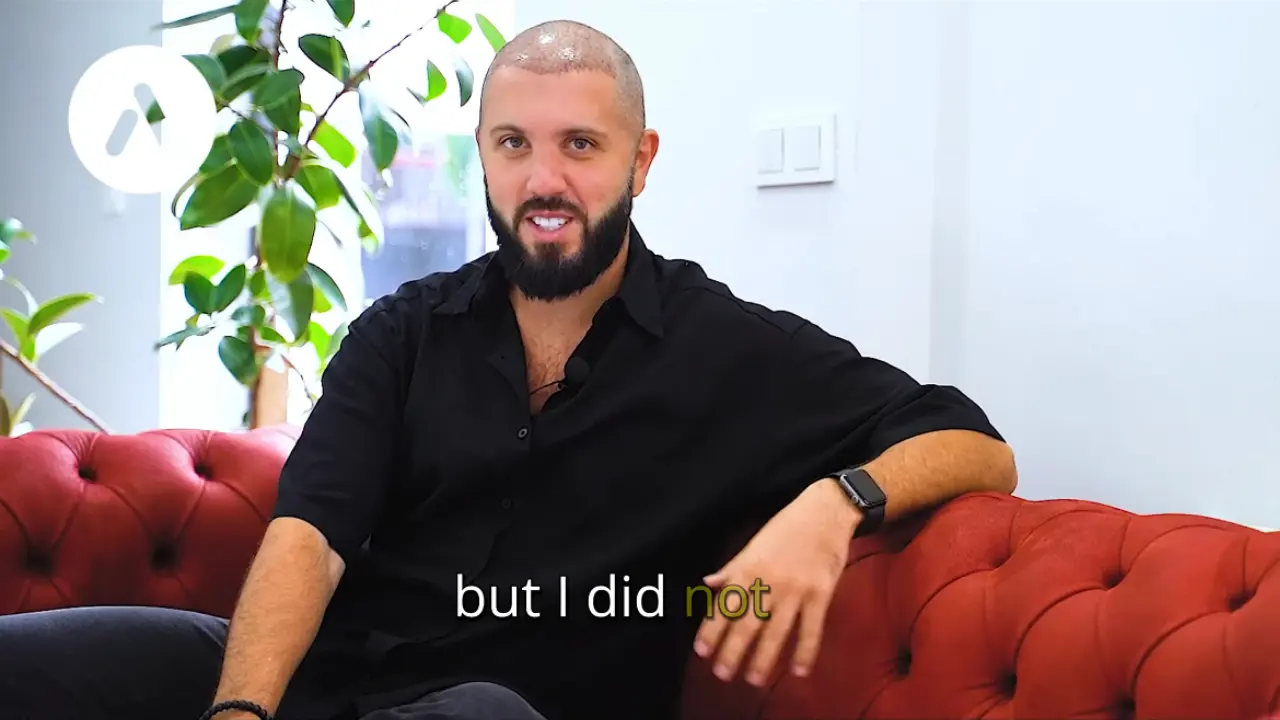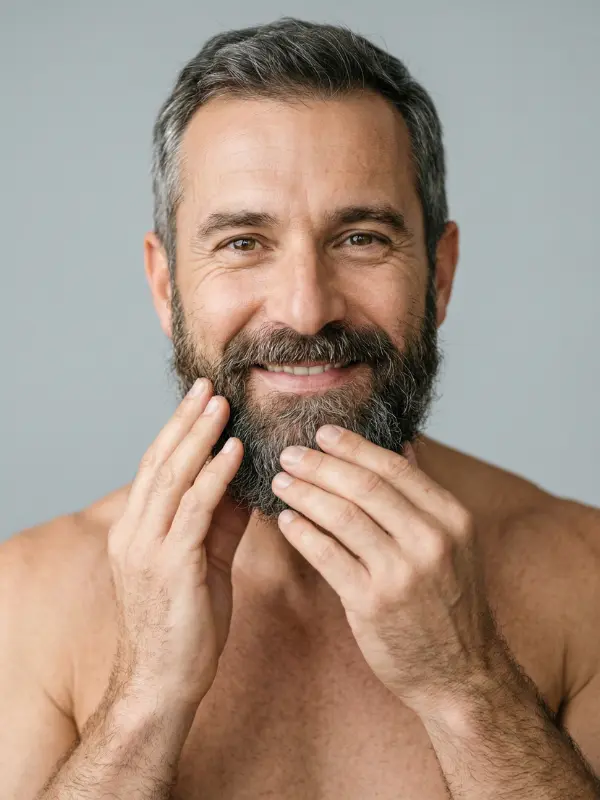




Beard Mustache Transplant is a facial hair restoration procedure designed to create believable density where growth is sparse, patchy, or absent. The goal is not to “add hair.” It is to rebuild natural framing. That means the right graft selection, the right angles, and a design that fits your face.
This guide focuses on anatomy, candidacy, and outcomes—so you can make a high-confidence decision as an informed, research-driven patient. We plan every case around one principle: Rejuvenation, Not Alteration.
Table of Contents
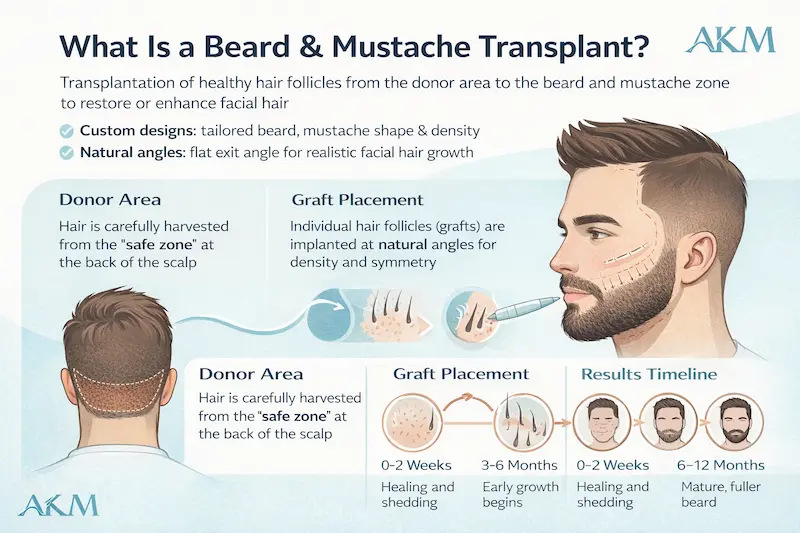
What Is a Beard and Mustache Transplant?
What a “Beard and Mustache Transplant” actually means
A beard and mustache transplant is a type of follicular unit transfer. We relocate healthy hair follicles from a donor area to the beard, mustache, or both. Each follicle is placed to mimic natural growth patterns, including density transitions and hair direction.
Many people call this a hair transplant for beard. The concept is simple. The execution is not. Facial hair sits at sharper angles, and even small errors can look obvious in bright light.
- Beard restoration often focuses on cheek density, jawline definition, and filling patchy zones.
- Mustache restoration requires extreme precision to keep the border clean and the direction consistent.
- Both require a plan for “density gradients,” so the result doesn’t look stamped on.
We design facial hair the way nature does: soft transitions, correct direction, and density that fits your facial structure—never a harsh, artificial wall of hair.
Beard vs. mustache anatomy (density, direction, skin characteristics)
Facial hair is unforgiving because it is “read” instantly. The mustache sits at the center of the face, where symmetry matters more. The beard covers larger surface area, where density distribution matters more.
- Angle and exit direction: Facial hair grows flatter to the skin than scalp hair. Placement has to respect that.
- Caliber and texture: Beard hair tends to look thicker than scalp hair. Matching matters for realism.
- Skin differences: The upper lip and chin can respond differently than the cheeks during healing.
This is why a beard and mustache transplant is not a “copy-paste” version of scalp surgery. It is facial design plus surgical precision.
Can you get a mustache transplant?
Yes. When people search can you get a mustache transplant, they usually have one of two concerns: “Is it technically possible?” and “Will it look natural?”
Technically, it is possible when you have a suitable donor supply and realistic density goals. Aesthetically, natural results depend on three variables: border design, correct direction, and conservative density in the first session.
Common reasons men seek facial hair restoration
The motivation is rarely vanity. It is usually identity and symmetry. Common reasons include genetics, patchy growth, scarring, traction, prior injury, or asymmetry between sides.
- Patchy cheeks that never filled in
- Gaps in the goatee area
- An uneven or “broken” mustache line
- Scar camouflage goals (when appropriate and medically evaluated)
Benefits of a Beard and Mustache Transplant
Creating density without looking “transplanted”
The best results look like you were born with them. That is the benchmark. A well-planned transplant rebuilds density in a way that still allows you to shave, trim, and style normally.
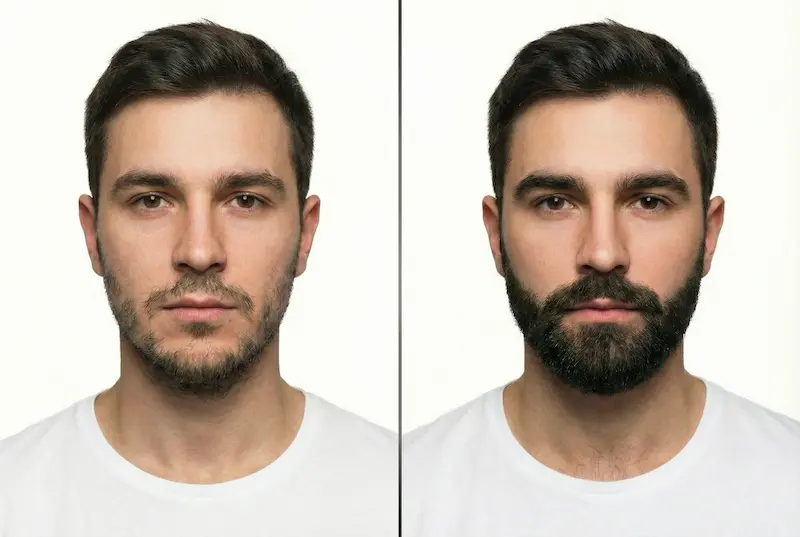
When people search beard transplant before and after, they are trying to answer one question: “Will this look real in daily life?” Realism comes from restraint. Too much density too fast is a common mistake.
- Natural density gradients (lighter at edges, denser where it should be)
- Direction control for believable texture
- Balanced distribution so one zone doesn’t look “overbuilt”
Our standard is simple: if a result looks obvious, it fails our philosophy. Natural is the only acceptable endpoint.
Restoring symmetry and defining facial proportions
Facial hair changes how the face is perceived. A defined mustache line can sharpen the upper lip area. A structured beard can reinforce the jawline and balance facial proportions.
- Improves left-right symmetry in patchy zones
- Strengthens visual framing of the lower face
- Creates predictable styling options (stubble, short beard, fuller beard)
Scar coverage and reconstruction use-cases
In selected cases, transplantation can help soften the visibility of certain scars by adding hair coverage. Not every scar behaves the same. Vascularity, thickness, and prior treatments matter.
A responsible plan starts with an honest assessment and conservative expectations. If coverage is achievable, the goal is subtle integration—not a dramatic, high-risk density push.
Am I a Good Candidate for Facial Hair Transplantation?
Good results start long before the procedure. Candidacy is the filter that protects you from disappointment. It determines whether grafts can survive, whether the design will look natural, and whether your donor area can support your long-term goals. Some patients are ideal candidates. Others need treatment of an underlying condition first.
In our consultations, we approach this like a medical decision, not a cosmetic impulse. The goal is a predictable outcome with a conservative safety margin. That is how we protect the final look.
Donor area quality and realistic density goals
Facial hair restoration depends on the donor area. If the donor supply is weak, overharvesting can create visible thinning. If the donor hair is very different in caliber, the texture mismatch can look unnatural once the hair grows out.
This is where a beard hair transplant differs from scalp density work. You are not chasing maximum coverage. You are chasing believable distribution.
- Donor density: Enough follicles to build facial zones without “robbing” the scalp.
- Hair caliber match: A realistic plan for texture consistency.
- Styling expectations: Stubble, short beard, and full beard goals require different density targets.
Skin condition, scarring, and underlying causes of patchiness
Not all patchy facial hair is “just genetics.” Sometimes it reflects an inflammatory skin condition, an autoimmune process, or persistent irritation. If the root cause is active, placing grafts can be less predictable.
Scarring can also change the equation. Some scars have reduced blood supply. That can impact graft survival. A responsible plan may require conservative graft numbers or staged sessions depending on the tissue quality.
- Stable, healthy skin supports the most predictable growth.
- Active inflammation should be evaluated and managed first.
- Scar tissue may require a different density strategy to stay natural.
We never “force” density into tissue that isn’t ready. Predictability comes from respecting biology first, then design.
Who should delay or avoid a transplant?
Some situations call for patience. Others require a different treatment approach entirely. The key is to avoid a procedure that can’t meet your expectations.
- Unstable hair loss patterns: If the pattern is changing quickly, design targets may shift.
- Untreated medical factors: Hormonal issues, autoimmune triggers, or chronic inflammation can reduce predictability.
- Unrealistic density demands: Wanting “full beard in one session” can push graft counts beyond a natural look.
If we recommend waiting, it is not a “no.” It is a better “yes” later. That protects your result.
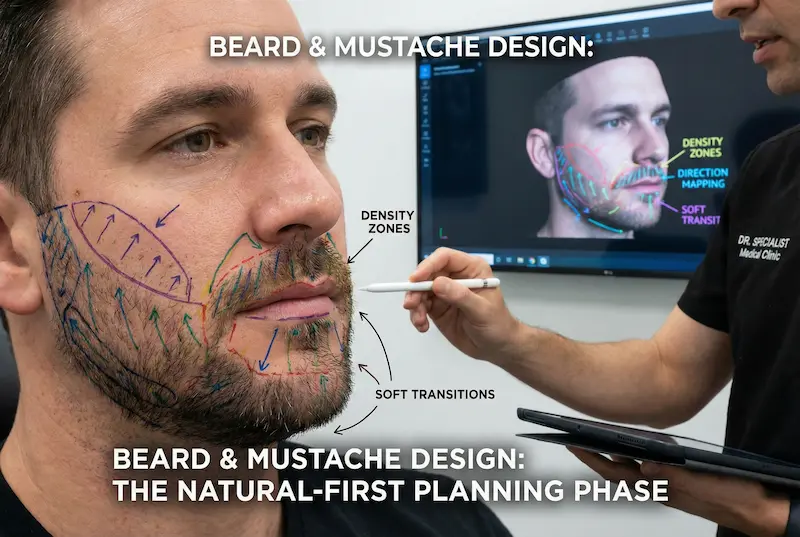
Beard & Mustache Design: The Natural-First Planning Phase
Design is where most clinics look similar on paper—and completely different in real life. Facial hair has no forgiveness. A few degrees of wrong direction can stand out every time you look in the mirror. Overbuilding density can look heavy. Underbuilding can look incomplete.
Our approach is simple: plan like nature. That means soft transitions, facial symmetry, and direction patterns that match how beard and mustache hair actually grows. We prioritize long-term realism over short-term “wow.”
Mapping density zones (cheeks, jawline, goatee, mustache)
A natural beard is not uniformly dense. The cheeks typically carry softer density. The jawline and chin can handle stronger visual weight. The mustache has its own anatomy, with a defined border and a visible midline.
We plan in zones so the final result looks integrated—not placed.
- Cheeks: Often the first target for patchiness and symmetry correction.
- Jawline: Can add definition, but requires careful density control.
- Goatee/chin: Usually needs stronger direction planning because the hair is more noticeable.
- Mustache: Precision work—border and direction matter more than raw density.
Angle and direction—why facial hair is less forgiving than scalp hair
Facial hair exits the skin at flatter angles than scalp hair. The direction also changes rapidly across small distances—especially around the chin, under-lip area, and corners of the mustache. If placement ignores those patterns, the hair can grow upward, outward, or in conflicting directions.
That is the difference between “it grows” and “it belongs.”
- Direction mapping is done before placement, not guessed during surgery.
- Small zones (like the mustache) require tighter control per graft.
- Whorl-like patterns around the chin must be respected for realism.
The “overdone” risk and how we avoid it
The most common aesthetic mistake is chasing density too aggressively. Facial hair that looks “painted on” is usually the result of a harsh border, uniform density, or incorrect gradients. A natural result needs space. It needs softness at the edges.
We avoid the overdone look by building density like a sculptor—not a printer.
- Soft borders: No sharp, artificial lines unless your natural anatomy supports it.
- Density gradients: Lighter at edges, stronger in core zones.
- Staged planning: When needed, we plan for refinement rather than forcing everything into one session.
Natural is not an accident. It’s a design decision—made before the first graft is placed.
Procedures to Combine Beard and Mustache Transplant
Many patients choose to pair a beard and mustache transplant with other facial refinements to create a more balanced, natural-looking result. The key is sequencing. We plan combined treatments around swelling patterns, recovery time, and the visibility of each area—so the outcome looks cohesive, not “done.”
Hair Transplant Technique Add-Ons: FUE vs DHI
Your facial hair plan can be coordinated with a scalp procedure when donor strategy and healing windows align. A fue hair transplant is often preferred when we want selective graft harvesting while protecting the donor area for future needs. In areas requiring ultra-precise placement control, a dhi hair transplant approach can be considered to support detailed implantation planning. The goal is not to do “more.” It’s to do the right amount, in the right order, with a natural-first design.
Facial Harmonization Options
Some patients also explore facial surgeries that improve harmony with a stronger beard frame. For example, rhinoplasty can refine nasal proportions so the beard and mustache enhance the overall facial balance rather than compete with it. Similarly, blepharoplasty may be considered to refresh the eye area—helping the entire face look more rested when facial hair density increases.
Volume & Definition: Subtle Soft-Tissue Support
When appropriate, fat injection to face can be used to restore gentle volume in areas that appear hollow, creating smoother transitions between the midface and lower face. This can complement a beard and mustache transplant by improving overall contour without changing your identity.
Important: Not every procedure should be combined in the same trip. We tailor recommendations based on medical eligibility, downtime goals, and the safest recovery sequence.
Surgical Techniques Explained (FUE vs DHI vs Sapphire)
The technique matters because facial hair is detail work. The angles are flatter. The transitions are more visible. Small placement errors can show up every morning in the mirror.
We choose the method based on your design goals, donor characteristics, and skin features. The best technique is the one that lets us control direction, density, and safety without forcing the tissue.
FUE for beard & mustache—where it fits best
FUE (Follicular Unit Extraction) is a graft harvesting method where follicles are extracted individually from the donor area. For facial hair restoration, FUE is a reliable foundation because it allows careful graft selection and controlled distribution.
When patients ask about a hair transplant for beard, FUE is often the core technique behind the plan. The real differentiator is not “whether we do FUE.” It is how we handle direction, spacing, and graft integrity.
- Best fit: Patchy cheeks, jawline refinement, goatee density balancing
- Key advantage: Precise graft selection (single-hair vs multi-hair units)
- Design benefit: Smooth density gradients for a natural transition
DHI—control, placement, and precision considerations
DHI (Direct Hair Implantation) is an implantation approach that focuses on controlled placement. In facial zones like the mustache, where direction changes quickly, implantation control becomes the whole game.
We use DHI when it helps us fine-tune angles and reduce unnecessary handling of grafts. It can be especially helpful in tight, high-visibility areas where the border must stay clean.
- Best fit: Mustache detailing, defined borders, small high-precision zones
- Key advantage: Controlled placement for direction-critical areas
- Trade-off: Not every case needs it; technique selection should stay patient-specific
Sapphire approach—what it changes in practice
Sapphire refers to using sapphire blades during site creation. The goal is consistent, clean micro-incisions that support precise placement and predictable healing patterns.
For facial hair work, site creation is not just a “step.” It is the blueprint. If the blueprint is off, the hair grows off.
- Best fit: Cases where micro-site precision and uniformity support the design plan
- Key advantage: Fine control during recipient site creation
- What it supports: Natural direction, spacing, and soft edge transitions
| Method | What It Focuses On | Strengths for Facial Hair | What We Watch Closely |
|---|---|---|---|
| FUE | Individual graft harvesting | Selective graft choice for natural density gradients | Donor protection and graft integrity |
| DHI | Controlled implantation | Precision placement in direction-sensitive zones (especially mustache) | Matching angle changes across small facial areas |
| Sapphire | Recipient site creation | Consistent micro-sites that support clean direction and spacing | Blueprint accuracy (direction, distribution, symmetry) |
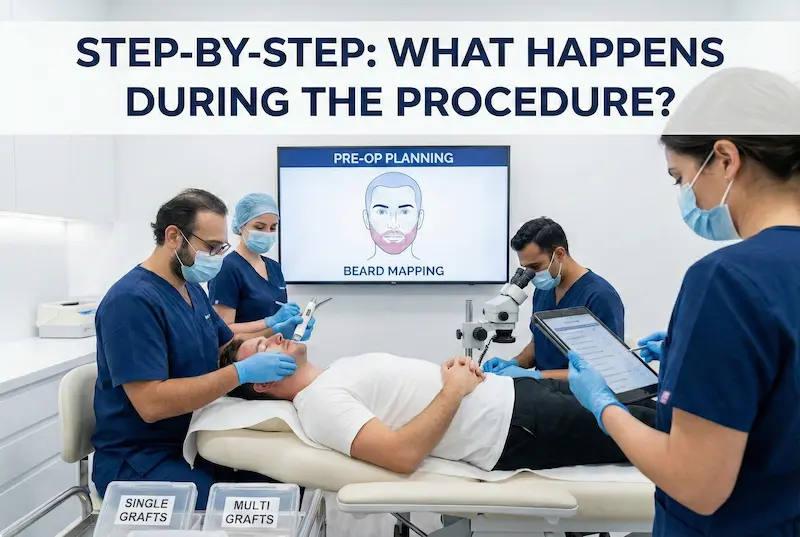
Step-by-Step: What Happens During the Procedure?
A well-run procedure feels organized, calm, and predictable. That is not luck. It comes from structured planning, strict screening, and an experienced surgical team that understands facial anatomy.
We keep the process transparent. You always know what happens next, why it matters, and how each step protects your result.
Pre-op screening and planning (safety-first)
We start with a health-first screening. This protects you and protects the outcome. If something increases risk, we address it before we place a single graft.
Next comes design mapping. We use detailed photography and structured facial planning to define borders, density zones, and direction patterns before surgery begins.
- Medical candidacy screening and pre-op tests
- Beard and/or mustache design confirmation (zones, borders, symmetry)
- Direction mapping to avoid unnatural growth patterns
Donor harvesting and graft preparation
Donor work is where long-term quality begins. Harvesting must respect the donor area so it stays natural-looking. Overharvesting is never worth it.
We then prepare grafts carefully. Facial zones often need a higher proportion of single-hair grafts for softer edges and believable transitions.
- Individual graft harvesting (FUE-based extraction)
- Graft sorting (single-hair vs multi-hair units) based on zone needs
- Hydration and handling protocols to protect graft viability
Recipient site creation and implantation (beard vs mustache differences)
Recipient sites define how your hair will grow. Angle, direction, and spacing are set here. This is where “natural” is engineered.
Mustache work requires tighter directional control because the upper lip is central and highly visible. Beard work often requires broader distribution control to avoid a heavy, uniform look.
- Beard: density gradients across cheeks, jawline, and goatee zones
- Mustache: clean border design and direction consistency across the midline
- Final checks: symmetry review, direction review, and post-op care instructions
Our standard is not “it grows.” Our standard is “it belongs.” Direction, density, and transitions decide that.
Anesthesia: Do You Need General Anesthesia for a Beard or Mustache Transplant?
Most facial hair transplantation is performed under local anesthesia. That keeps the procedure controlled, predictable, and typically easier on the body than general anesthesia. For many patients, the real question is comfort: “Will I feel anything?” Our approach is to keep you calm, pain-controlled, and fully informed at every step.
Local anesthesia fundamentals (awake comfort)
Local anesthesia numbs the donor and recipient areas so you do not feel sharp pain during extraction or placement. You may still notice pressure or movement. That is normal. We explain what you may feel before we begin, so there are no surprises.
- What you should expect: numbness in the treated areas, pressure sensations, and frequent check-ins
- What we avoid: “pushing through” discomfort—comfort control is part of precision
- Why it matters: a calm patient experience supports steady, accurate placement
Twilight sedation—when it can make sense
Some patients are calm about the procedure itself but anxious about being in a medical setting for several hours. In those cases, twilight sedation can be a smart option when medically appropriate. It is not about “sleeping through” the surgery. It is about smoothing anxiety so we can work with consistent conditions.
- Best fit: high anxiety, sensitivity to prolonged procedures, or difficulty staying relaxed
- Key benefit: comfort without the intensity of full general anesthesia for many candidates
- Decision rule: we choose the safest option that still supports a precise, natural result
Comfort is not a luxury. It’s a clinical variable. When you’re relaxed, we can focus on what matters most—direction, spacing, and natural transitions.
Safety-first monitoring and patient experience standards
Safety is not one step. It is a system. We combine pre-operative screening with continuous monitoring during the procedure, because predictable outcomes start with predictable physiology.
- Structured pre-operative health screening
- Ongoing vitals monitoring throughout the procedure
- Clear aftercare instructions and long-distance follow-up support
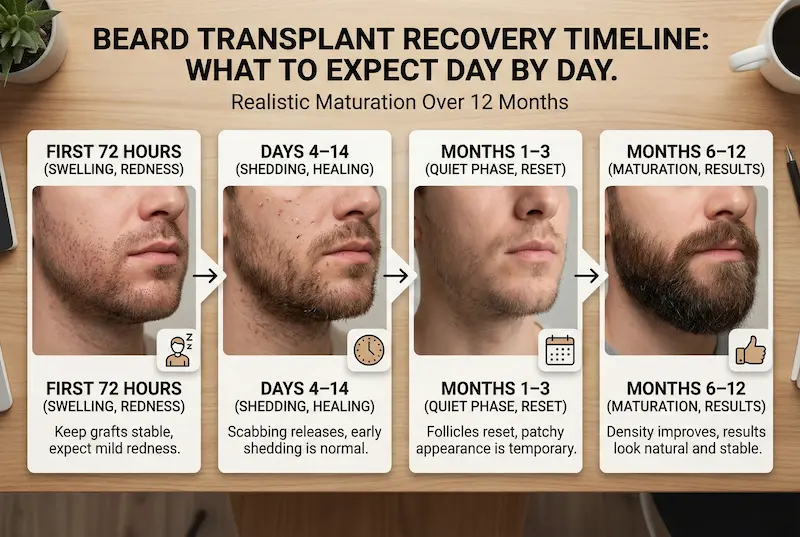
Beard Transplant Recovery Timeline: What to Expect Day by Day
Recovery from facial hair transplantation is usually more about patience than pain. The first two weeks are about healing the skin and protecting grafts. The next few months are about biology: follicles cycle, shed, and then re-enter growth. If you understand the timeline before you start, the process feels far more predictable.
First 72 hours (swelling, redness, care basics)
The early phase is focused on keeping grafts stable and the skin calm. Mild redness is common. Some swelling can occur, especially depending on individual sensitivity and the treated zones.
- Do: follow cleansing instructions exactly and keep hands off the recipient area
- Do: sleep in a position that protects the treated zones
- Avoid: heat, heavy sweating, and friction from tight masks or collars
Days 4–14 (shedding, texture changes, visible healing)
This is when many patients get nervous—often unnecessarily. Scabbing gradually releases. The area can look uneven as healing progresses. Early shedding is expected in many cases, and it does not mean the transplant failed.
- Redness typically fades gradually, but timing varies by skin type
- Shedding can begin as follicles enter a resting phase
- Patchy appearance during healing is common and temporary
Month-by-month maturation (when it starts to look “settled”)
New growth is a process. Early hairs can look finer or inconsistent before they mature. Over time, density improves and texture begins to blend more naturally with surrounding facial hair.
- Months 1–3: shedding and “quiet phase” are common while follicles reset
- Months 3–6: early visible growth, still developing in texture and direction
- Months 6–12: maturation phase—results typically look more natural and stable
Our Rapid Recovery & Safety Protocol (HBOT + LLLT)
Facial hair transplantation is precision work, but healing still follows biology. The first two weeks shape how calm the skin looks, how comfortable you feel, and how confidently you return to normal life. That is why we built a structured Rapid Recovery & Safety Protocol around two proven, clinic-integrated technologies: Hyperbaric Oxygen Therapy (HBOT) and Low-Level Laser Therapy (LLLT). We use them to support recovery at both the systemic and cellular level.
HBOT: oxygenation support when tissues are healing
HBOT places you in a pressurized environment with 100% oxygen. This increases oxygen delivery by saturating blood plasma, helping oxygen diffuse into healing tissues even when circulation is temporarily stressed. The goal is not “magic growth.” It is disciplined recovery support.
- Tissue support: oxygen-rich conditions help fragile post-procedure tissues recover
- Swelling control: HBOT is used to reduce inflammation and support lymphatic drainage
- Scar-quality focus: oxygenation can support collagen-related healing pathways
- Infection defense: hyper-oxygenated environments are hostile to many bacteria while supporting immune response
We plan your recovery the same way we plan your design: with precision, structure, and a safety-first margin.
LLLT: targeted cellular stimulation for graft recovery and growth support
Our LLLT system uses medical-grade laser diodes (not simple LEDs) delivering a validated 650nm “soft laser” wavelength. It is designed to stimulate cellular activity without heat or tissue damage. In post-transplant care, we use LLLT to support healing and to help follicles transition toward an active growth phase.
- Cellular energy: supports ATP production, fueling cellular repair processes
- Microcirculation support: promotes blood flow, oxygen, and nutrient delivery to follicles
- Post-transplant role: supports graft healing and stimulates subsequent growth
Why we combine HBOT + LLLT (macro-to-micro strategy)
These technologies are more effective as a system than as standalone add-ons. We apply HBOT first to support whole-body oxygenation and reduce systemic inflammation. We then use LLLT as a targeted cellular-level intervention in that oxygen-rich environment. This macro-to-micro sequence is designed to reduce visible downtime and improve recovery quality.
Who benefits most from this accelerated pathway?
Not every patient has the same recovery priorities. Some want the calmest early appearance possible because they travel internationally or return to work quickly. Others have skin that tends to stay red longer or swell more. We tailor the protocol based on your goals, your skin characteristics, and your procedure plan.
If you are comparing clinics, ask one direct question: “What is your recovery system?” A clinic that can explain it clearly usually runs the entire patient journey with the same level of control.
Safety & Risks: What Can Go Wrong (And How We Reduce the Risk)
Search terms like beard transplant gone wrong exist for a reason. Poor planning, rushed placement, weak sterility standards, and unrealistic density targets can create visible problems. A safe outcome is not only about what happens during implantation. It is about screening, hygiene, monitoring, and disciplined aftercare that keeps risk low and healing predictable.
The reality behind “beard transplant gone wrong”
Most “gone wrong” stories come down to fundamentals. Wrong direction leads to hair that sticks out. Uniform density creates an unnatural “painted” look. Overharvesting can thin the donor area. These are preventable problems when the team respects facial anatomy and designs for realism.
- Direction errors: the most obvious and hardest to hide once hair grows
- Overbuilding density: heavy borders and uniform coverage look artificial
- Donor damage: aggressive harvesting can create visible thinning or patchiness
We never chase density at the cost of believability. Natural transitions are the goal, not maximum graft numbers.
“Botched beard transplant” concerns: root causes and prevention
When patients search botched beard transplant, they are usually worried about clinic standards, not the concept of transplantation itself. Prevention starts with a safety system you can verify: strict pre-op screening, continuous vitals monitoring, and a sterile surgical environment. We run procedures with advanced monitoring and rigorous hygiene protocols, because predictability comes from process.
- Screening: we confirm candidacy before scheduling surgery
- Monitoring: we monitor vitals throughout the procedure
- Sterility: we operate with uncompromising sterilization standards and a controlled clinical environment
Mustache transplant side effects: what’s common vs. what needs evaluation
Mustache transplant side effects are typically mild and temporary when aftercare is followed. Early redness, swelling, tenderness, and scabbing are common in the first days. The upper lip is a sensitive area, so sensation changes can also occur. What matters is the pattern and persistence of symptoms.
- Common early effects: redness, swelling, scabbing, temporary tenderness
- Normal timeline: visible healing evolves over the first 1–2 weeks
- Needs evaluation: increasing pain, spreading redness, fever, or unusual discharge
How we reduce infection risk and support scar-quality healing
Infection risk stays low when sterility and aftercare are handled like a system, not a checklist. We pair strict hygiene standards with structured post-op instructions and long-term virtual follow-up care after you return home. We also integrate HBOT and LLLT when your plan calls for accelerated recovery support.
If you want a surgeon-led assessment, we can review your facial hair goals, donor capacity, and skin characteristics in a virtual consultation and map a safety-focused plan before you travel.
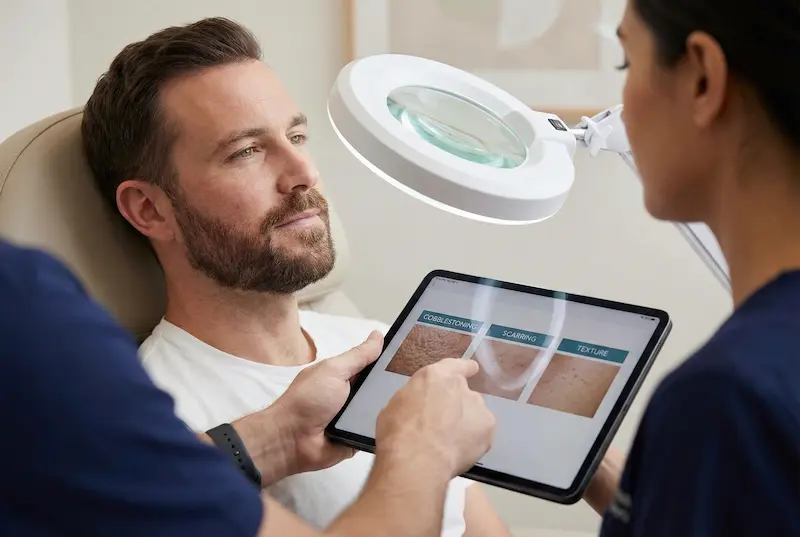
Advanced Aesthetic Concerns in a Beard Mustache Transplant: Cobblestoning, Scarring, and Texture
If you’ve done deep research, you’ve probably seen terms like cobblestoning beard transplant and scar mustache transplant. These searches come from a real fear: “What if it grows, but looks unnatural?” That fear is rational. Facial hair sits in the most visible real estate on your face.
We address these concerns at the design stage, during implantation, and through structured recovery support. Natural isn’t a finish line. It’s a system.
Cobblestoning beard transplant: what it is and why it happens
“Cobblestoning” describes a bumpy, uneven skin surface in the recipient area. It can be subtle. It can be obvious. Either way, it’s not what you want.
It’s usually linked to technique variables: site size, depth control, spacing, and how grafts sit in the skin as swelling resolves.
- Site creation precision: micro-sites must match graft size and skin characteristics.
- Depth control: placement that is too shallow or inconsistent can affect surface texture.
- Density strategy: forcing density into a small area can increase visible irregularity.
Our prevention strategy is simple. We keep the blueprint accurate, and we respect biology. That includes conservative density where the skin is less forgiving.
Scarring risk: what’s normal, what’s preventable
All surgical procedures involve healing. Healing can leave marks. The goal is to make them minimal and hard to detect.
For facial hair transplantation, scarring concerns usually fall into two categories: donor-area marks and recipient-area marks.
- Donor area: FUE-based extraction is designed to leave tiny, scattered marks that typically blend into surrounding hair.
- Recipient area: well-executed micro-sites are intended to heal cleanly, with redness fading over time.
- Risk factors: skin sensitivity, previous scarring behavior, and aftercare compliance can influence healing quality.
When someone searches “scar mustache transplant,” they’re usually worried about the upper lip because it’s central and high-contrast. That’s why we keep mustache planning conservative and direction-focused. Overbuilding the mustache is a common mistake.
Texture and direction mismatch: the subtle problem that looks loud
Texture issues aren’t always about the hair itself. They’re often about direction. Hair that grows at the wrong angle catches light differently. It looks “off” even when density is good.
This is why facial hair transplantation is not just graft placement. It’s directional engineering.
- Mustache: small directional errors can disrupt the border and the midline symmetry.
- Chin/goatee: direction patterns change quickly across short distances.
- Cheeks: uniform direction can look unnatural if it ignores native growth patterns.
We reduce this risk by mapping direction before placement and by building density in gradients. Soft edges matter.
What you can do to protect the aesthetic result
Great technique needs great aftercare. The first two weeks are where most avoidable problems happen. Friction, picking, and early aggressive grooming can damage healing tissue.
- Avoid shaving the recipient zone until we clear you for it.
- Do not “test” grafts with rubbing or scratching.
- Follow cleansing instructions exactly, even when you feel fine.
Recovery takes time. That’s normal. Calm healing is a competitive advantage.
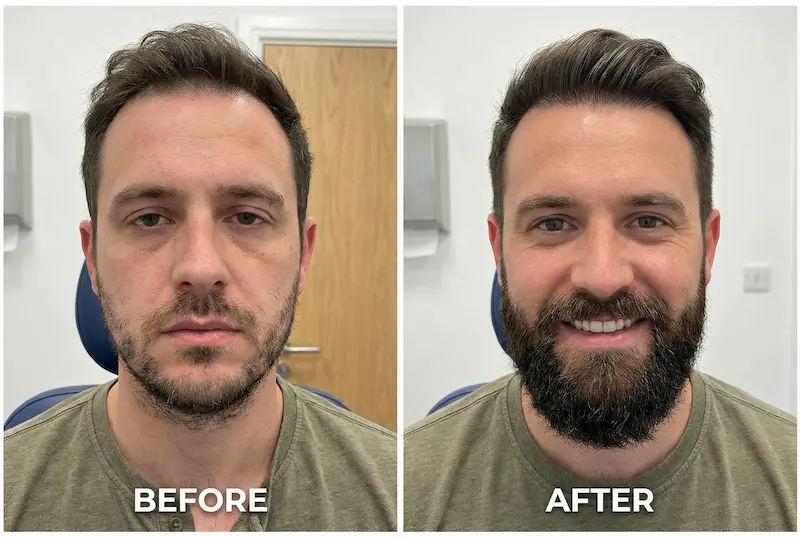
Realistic Expectations: Beard Transplant Before And After
Most patients start with visuals. That’s why beard transplant before and after photos is such a common search. Photos can help you set expectations. They can also mislead you if you don’t know what you’re looking at.
We guide expectations the same way we guide design: with structure, honesty, and a natural-first endpoint.
What “beard transplant before and after” really shows
Before-and-after images often reflect a specific moment in the timeline. One month can look rough. Three months can look incomplete. Twelve months is where the result typically looks “settled.”
Photos can also be influenced by lighting, camera distance, facial expression, and how the beard is trimmed.
- Lighting: harsh overhead light exaggerates gaps and texture.
- Length: a few millimeters of growth can make density look dramatically different.
- Angles: slight head turns can change how beard lines read.
We recommend you judge results by pattern and realism, not by the darkest, densest photo.
Typical density milestones and when results look natural
Facial hair follows a cycle. Early shedding can happen. That’s expected. Growth then restarts gradually.
Here’s a realistic timeline framework many expert patients find helpful.
- Weeks 1–2: redness, scabbing, and visible healing changes.
- Months 1–3: shedding and a quiet phase while follicles reset.
- Months 3–6: early growth becomes visible but can look uneven.
- Months 6–12: maturation phase where texture and density blend more naturally.
Patience isn’t motivational talk. It’s biology.
Natural result philosophy: Rejuvenation, Not Alteration
The best facial hair restoration does not look “new.” It looks native. That’s why we avoid harsh borders, uniform density, and aggressive one-session goals that can age poorly.
We build a beard and mustache that fits your face today and still looks believable years from now.
Our standard is a result that blends into your identity. No telltale signs. No “transplant look.” Just you—restored.
Is a Facial Hair Transplant Safe in Turkey?
Safety is not a country. It’s a system. The same procedure can be low-risk in one setting and high-risk in another, depending on screening, sterility, monitoring, and surgical skill. If you’re comparing options, focus on verifiable standards rather than marketing promises. That mindset is what separates an “expert patient” decision from a gamble.
What actually determines safety: screening, sterility, and monitoring
Facial hair restoration is a minor-looking procedure with major aesthetic consequences. The risk isn’t only medical. It’s also aesthetic risk: wrong direction, poor healing, and donor damage. The safest environment is one that treats facial transplantation like precision surgery, not a high-volume service.
- Pre-op screening: We confirm candidacy and risk factors before we schedule surgery.
- Sterile environment: We operate in a fully controlled clinical setting with strict sterilization standards.
- Continuous monitoring: We track vitals during the procedure to keep conditions stable and predictable.
Why expertise matters more than geography (and how to evaluate it)
When patients search best beard transplant in turkey, they’re rarely looking for a bargain. They’re looking for a clinic that can deliver natural direction, realistic density, and a low-complication pathway. The fastest way to filter options is to ask how the team plans direction, how they protect the donor area, and who is accountable for the design decisions.
- Surgeon-led planning: We confirm borders, density zones, and direction patterns before implantation begins.
- Credential signals that matter: We position our surgical leadership as European Board Certified and US-trained specialists where appropriate.
- Natural-first endpoint: We plan for believable gradients, not aggressive “one-session density.”
Safety includes aesthetics. A result that looks obvious is a preventable complication.
International patient safety: continuity of care after you fly home
For many travelers, the biggest fear is what happens after departure. You want a team that stays responsive, structured, and accountable once you’re back in the USA. That is why we built our care model around long-distance follow-up and clear post-op decision rules. If you’re exploring beard transplant istanbul or istanbul mustache transplant options, continuity is the part you should audit hardest.
- Clear aftercare plan: You leave with step-by-step instructions and expected milestones.
- Responsive support: We keep communication open for questions during the healing window.
- Structured check-ins: We track your progress with planned follow-ups so issues are addressed early.
Cost Analysis: Beard Transplant Cost 2026 (Turkey vs USA)
Cost is a real part of the decision, but it should never be the decision. The smarter comparison is value: what standards are included, what recovery support exists, and what happens if you need guidance after you return home. In the USA, pricing often reflects overhead, staffing costs, and local operating expenses as much as surgical quality. In Istanbul, the financial structure can be more cost-effective without cutting corners—if the clinic invests in systems, safety, and expertise.
What drives price differences between markets?
If you’re searching how much is a beard transplant in turkey, the most honest answer is: it depends on graft counts, design complexity, and what’s included. The same is true for the USA. The difference is that US pricing often bundles high operational costs into the procedure fee, while Istanbul clinics can offer a more high-value structure due to lower overhead—if they maintain international-level standards.
- Operational costs: facility, staffing, and insurance structures vary by region.
- Scope: beard-only vs combined beard-and-mustache design changes planning time and graft strategy.
- Included care: medications, recovery support, and follow-up can be included or billed separately.
What an all-inclusive plan typically covers (and why it matters)
Many comparisons fail because patients compare a single number to a complete system. If you’re reviewing turkey beard transplant cost or mustache transplant price turkey, look for transparency. Our all-inclusive structure is designed to remove hidden variables so you can evaluate the full medical journey, not just the day of surgery.
- Pre-op testing and structured planning
- Procedure-day clinical care and monitoring
- Post-op medications and aftercare guidance
- VIP logistics support (hotel and private transfers in partnered plans)
- Long-distance follow-up after you return home
How to compare quotes without getting misled
Searches like beard transplant cost los angeles and beard transplant cost nyc vs istanbul make sense—but only if you compare the same scope. Ask each clinic to list what is included, who performs the design and placement, and what support exists after the first week. Then compare on safety, predictability, and long-term naturalism. That’s how an expert patient avoids regret.
| Cost Component | Typical USA Quote (Common Pattern) | Our Istanbul Model (High-Value Structure) |
|---|---|---|
| Clinical facility & surgical team | Often itemized into the base fee | Included within a transparent, all-inclusive structure |
| Pre-op testing & screening | May be billed separately | We include structured screening as part of safety planning |
| Anesthesia approach | General anesthesia can add complexity and cost | We prioritize awake/twilight pathways when appropriate |
| Medications & aftercare | Often separate prescriptions and follow-up fees | We include a guided aftercare plan with clear milestones |
| Recovery optimization | Not always integrated as a system | We integrate our Rapid Recovery & Safety Protocol when your plan calls for it |
| Travel logistics | Not relevant / self-managed | VIP support options can bundle hotel and private transfers |
Practical note: If you want a precise estimate for mustache hair transplant cost or beard density work, we can only give a reliable range after reviewing your donor supply, target zones, and design goals in a virtual consultation.
Finding the Best Beard Transplant Surgeon
Facial hair transplantation is not a volume procedure. It’s detail work. The difference between “it grew” and “it looks natural” comes down to planning, direction control, and the standards behind the procedure.
If you’re searching for the best mustache transplant clinic turkey, don’t start with marketing. Start with proof. Then verify the system behind the proof.
Why facial hair transplantation is a different skill set
The beard and mustache sit in high-visibility zones with complex growth patterns. Direction changes quickly, especially around the mustache midline, the chin, and the corners of the mouth. Small errors become obvious.
- Angle control: facial hair exits flatter to the skin than scalp hair.
- Density gradients: natural facial hair is not evenly dense across every zone.
- Design accuracy: borders, symmetry, and transitions matter more than raw graft counts.
The credentials that actually matter (board certification and advanced training)
Credentials are not decoration. They are risk control. Board certification signals structured training and adherence to external standards. Advanced international training signals exposure to high-expectation patient markets and modern techniques.
- Board certification: We position our surgical leadership with European Board-level credentials where applicable.
- US-level exposure: We emphasize US-based training experiences as a signal of familiarity with US patient expectations.
- Natural-first philosophy: Credentials matter most when they align with consistent, subtle outcomes.
Natural results don’t come from luck. They come from standards, training, and a disciplined plan—built before the first graft is placed.
What to ask before you commit (and what we answer transparently)
An expert patient asks expert questions. So do we. Here’s what matters in real life, not on a brochure.
- Who designs the beard and mustache pattern? Design decisions must be surgeon-led, not improvised.
- How is direction mapped? Direction planning should be confirmed before implantation begins.
- How is donor safety protected? Overharvesting is a permanent mistake.
- What is the recovery system? Aftercare should be structured, not “good luck and text us.”
Red flags to avoid when choosing a clinic
Most bad outcomes are predictable from the consultation. If a clinic can’t explain its process clearly, that’s the process.
- Promises of “maximum density in one session” without discussing natural gradients
- Vague answers about who is accountable for design and placement decisions
- No clear follow-up structure once you return home
- Pressure tactics instead of evidence-based planning

Your Medical Journey: From Virtual Consultation to Return Home
International care should feel controlled, not chaotic. We built a structured VIP journey so you can focus on one thing: your result. Everything else is handled with a clear plan.
If you’re planning a beard transplant istanbul trip, the question isn’t only “How good is the surgery?” It’s also “How predictable is the journey?”
Virtual consultation and personalized treatment planning
Your journey starts at home with a free virtual consultation. You share photos. We review your goals, donor characteristics, and target zones. Then we provide a personalized treatment plan with a transparent, all-inclusive package quote.
- Goal review (beard, mustache, or combined design)
- Donor assessment and realistic density targets
- Clear timeline expectations and aftercare planning
Arrival, airport welcome, and hotel coordination
Once you secure your date, your dedicated Patient Host coordinates the details. We book 5-star hotel accommodation from our partner list and schedule VIP transfers. You manage your international flight. We handle the rest.
- Private airport welcome and transfer to your hotel
- Planned clinic transfers for consultation and procedure day
- Comfort-first logistics that reduce stress and support recovery
Procedure day, post-op care, and long-term follow-up
On procedure day, you have a final in-person consultation to confirm the plan. After pre-operative tests, surgery is performed in a fully accredited, safety-focused clinical environment with strict screening and vitals monitoring. Afterward, we monitor you closely and keep support active through your healing window.
- 24/7 support: Your Patient Host stays available via WhatsApp while you recover in Istanbul.
- Clearance to fly: You have a final in-person check-up before departure.
- Structured follow-up: We schedule virtual check-ins at 1, 3, 6, and 12 months after you return home.
Distance doesn’t reduce responsibility. Our care continues after you fly home, with scheduled follow-ups and clear decision rules during recovery.
If you’re comparing istanbul mustache transplant options, judge the full system: screening, standards, recovery support, and long-term follow-up. That’s what protects your outcome.
Beard Transplant and Mustache Transplant Frequently Asked Questions (FAQ):
Can you get a mustache transplant?
Yes—you can get a mustache transplant when you have sufficient donor supply and realistic density goals. The mustache is a high-visibility zone, so we plan it conservatively and prioritize direction, border design, and symmetry. If your concern is scarring or uneven texture, we evaluate skin quality first and plan graft distribution to keep the result natural rather than “overbuilt.”
What are mustache transplant side effects?
Mustache transplant side effects are typically mild and temporary when aftercare is followed. Common early effects include redness, swelling, tenderness, and scabbing in the first days. Because the upper lip is sensitive, some patients notice temporary sensation changes. What matters is the pattern: symptoms should gradually improve—not intensify.
Common: redness, mild swelling, tenderness, scabbing (early healing period)
Expected: temporary shedding as follicles reset before regrowth
Needs evaluation: increasing pain, expanding redness, fever, or unusual discharge
How long until a beard transplant looks natural?
Most patients want one simple answer: “When will it look real?” A realistic framework is that the beard starts looking progressively more natural between months 6 and 12 as the hair matures in texture and density. Early phases can look uneven because follicles shed and restart growth on their own schedule.
Weeks 1–2: visible healing, scabbing release, redness fading gradually
Months 1–3: shedding and quiet phase are common (this is normal)
Months 3–6: early growth becomes noticeable, still developing
Months 6–12: maturation phase—texture blends and density looks more “settled”
What causes cobblestoning in a beard transplant?
Cobblestoning beard transplant concerns usually come from uneven surface texture in the recipient area. It’s most often linked to technique variables: site size, spacing, depth control, and density strategy in skin that’s less forgiving. Prevention is built into the plan—precise micro-site creation, consistent depth, and natural density gradients instead of “packing” grafts aggressively.
How much is a beard transplant in Turkey?
If you’re searching how much is a beard transplant in Turkey, the honest answer is: it depends. Pricing varies based on how many zones you’re restoring (beard only vs beard + mustache), the complexity of design, donor characteristics, and the graft strategy needed for natural density transitions. The most important comparison is not just the number—it’s what’s included: screening, monitoring, aftercare, recovery support, and long-distance follow-up once you return home.
For a reliable estimate, we assess your donor supply and your target design in a virtual consultation and provide a transparent, all-inclusive quote.
Will transplanted beard hair grow like normal facial hair?
Once grafts are established, transplanted hair typically grows and can be trimmed, styled, and shaved like the rest of your facial hair. The early phase can feel different because you’re healing and the hair cycle is resetting. We guide you through when to start trimming and how to avoid early friction that can stress healing tissue.
When can I shave after a beard or mustache transplant?
Shaving timing depends on how your skin heals and which zones were treated. In general, we recommend avoiding shaving over the recipient area in the early healing window to prevent friction and irritation. We give you a zone-by-zone timeline and clear “green light” instructions so you don’t have to guess.
How do I reduce the risk of a bad result?
Most negative outcomes are preventable. Choose a clinic that plans direction and density gradients, protects the donor area, uses strict sterility standards, and provides structured follow-up after you travel home. Then follow aftercare exactly—especially in the first two weeks.
Medical Disclaimer: This page is for general educational purposes and does not constitute medical advice or a diagnosis. Every patient’s anatomy, healing response, and results are different. A definitive treatment plan can only be provided after a medical evaluation by a qualified clinician.