




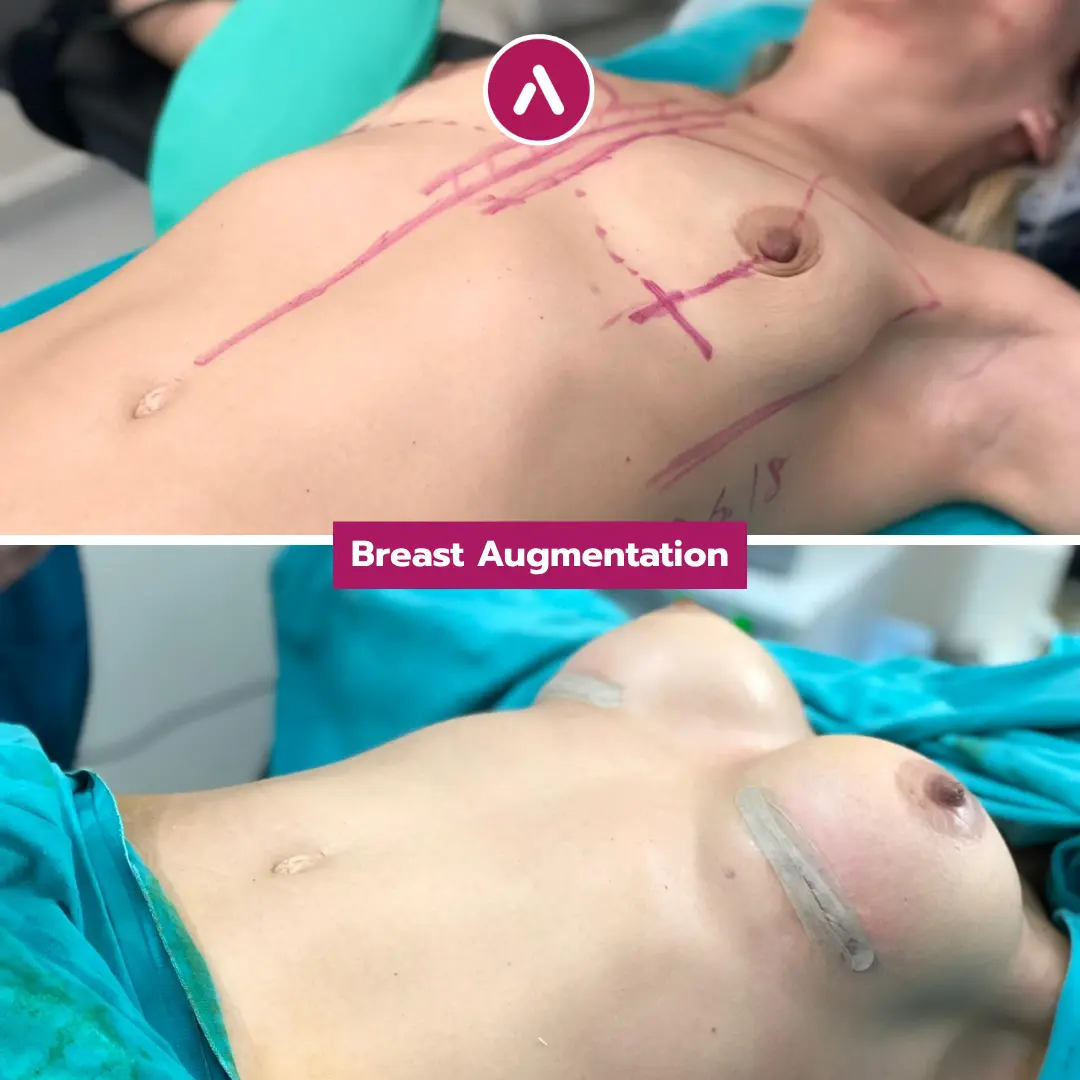
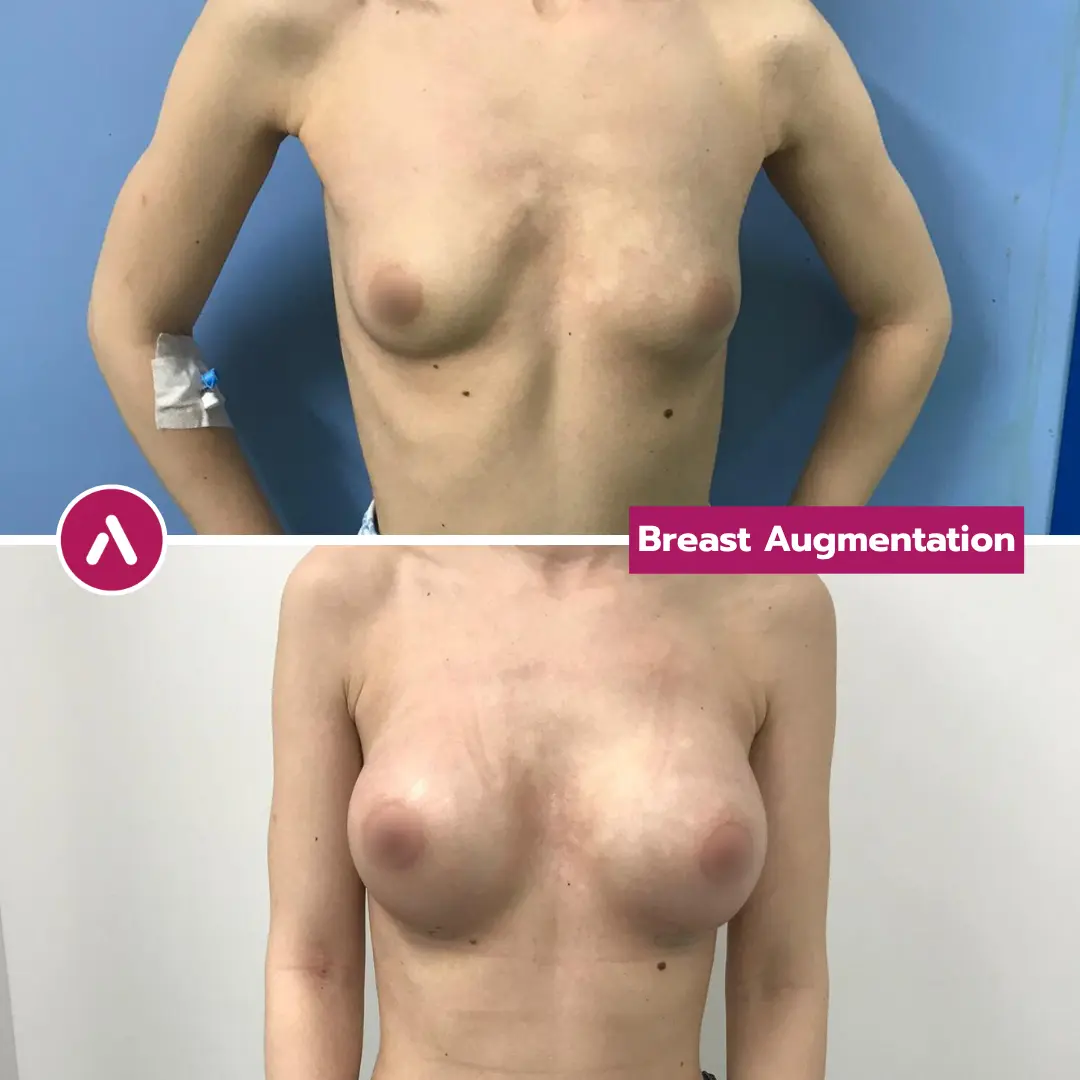
Fat Transfer Breast Augmentation is a surgical approach for patients who want a soft, natural breast enhancement without a synthetic implant. It combines precision liposuction with fat grafting to reshape both the donor area and the breasts. The goal is refinement, not a dramatic “done” look.
This guide explains how the procedure works, what outcomes are realistic, and why some patients prefer fat over implants. We focus on anatomy, technique fundamentals, and decision-making. Clear expectations are the foundation of a confident plan.
Table of Contents
Fat Transfer Breast Augmentation: What It Is and How It Works
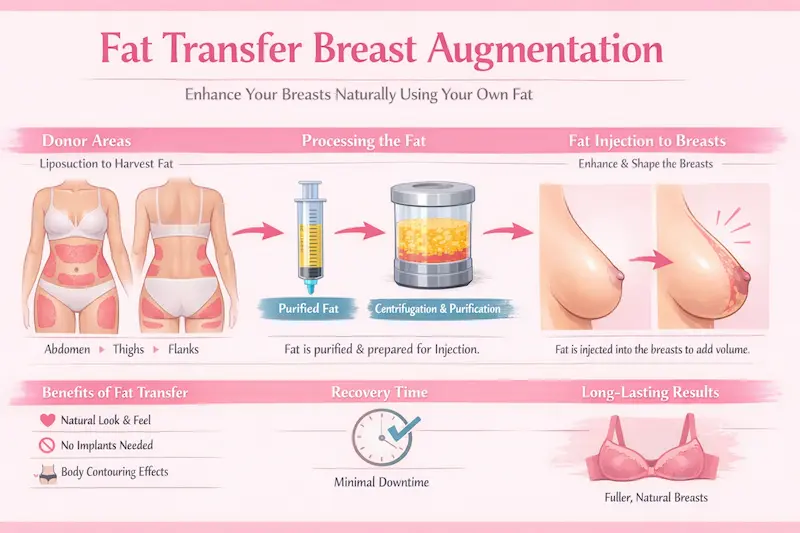
Fat transfer breast augmentation uses your own purified fat to add volume and improve breast contour. Fat is gently harvested from areas like the abdomen, flanks, or thighs, processed, and then strategically injected into the breast. The goal is a natural-looking enhancement using living tissue rather than a device.
If you’ve searched how does fat transfer breast augmentation work, the key idea is “fat survival.” Not every fat cell will establish a lasting blood supply. Technique, patient biology, and aftercare all influence how much volume remains long-term. That is why the procedure is planned as a precise tissue-transfer surgery, not a simple “filler.”
Where the Fat Comes From: Harvesting and Purifying
The process begins with liposuction, but the intent is different from aggressive contouring. We want viable, healthy fat cells with minimal trauma. After harvesting, the fat is purified to separate it from excess fluid and non-fat components before transfer.
- Harvest: Fat is collected from selected donor areas based on your anatomy and goals.
- Process: The fat is refined to improve consistency and readiness for grafting.
- Plan: The breast is assessed for where volume will look most natural and balanced.
How the Fat Is Placed: The “Micro-Droplet” Concept
Fat must be injected in small amounts across multiple tissue layers. This increases the surface area of each “micro-droplet” to receive oxygen and nutrients while new blood vessels form. The technique is about building shape gradually, not forcing volume in one spot.
- Small-volume placement in multiple passes helps support graft integration.
- Layering can improve contour control and reduce the risk of irregularities.
- Careful symmetry planning is essential because the breasts are rarely identical to start.
How It Differs From Implants
With implants, volume is immediate and highly predictable in size. With fat transfer, the change is typically more subtle and tailored, with a softer feel. You also avoid a permanent foreign device. If you’re weighing fat transfer breast augmentation vs implants, it helps to match the method to your priorities: natural texture and modest enhancement vs maximum size change.
- Best for: patients seeking a natural contour improvement and a modest size increase.
- Not ideal for: patients who want a large, guaranteed jump in cup size in one step.
- Unique advantage: body contouring benefits from donor-area liposuction.
Why Patients Choose Fat Transfer (Benefits & “Natural Look” Goals)
Most patients choosing fat transfer are not trying to “change who they are.” They want proportion, softness, and balance. Our philosophy is “Rejuvenation, Not Alteration.” That means the plan should respect your frame, your tissue quality, and what looks believable in real life.
There is also a psychological benefit for some patients: the concept of using your own tissue feels more intuitive than placing an implant. That does not make one option “better.” It just makes the decision more personal.
Natural Look and Feel: What “Natural” Actually Means
A natural result is not only about size. It is about how the breast sits on the chest, how the upper pole transitions, and how softness feels in motion. Fat can be excellent for subtle upper-pole refinement and smoothing transitions, especially when your goal is elegance rather than exaggeration.
- Soft, tissue-like feel because the volume is your own fat
- Contour refinement rather than a sharp implant outline
- Results designed to look “you,” just more proportional
Two-in-One Benefit: Liposuction + Breast Enhancement
The donor-area change is not a side note. It is part of the aesthetic value. Strategic liposuction can improve waist-to-hip balance or soften stubborn pockets of fat while providing graft material for the breast. For many patients, this synergy is as meaningful as the breast change itself.
- Common donor areas include abdomen, flanks, and thighs.
- Donor selection is individualized based on fat availability and contour goals.
- Balanced body proportions often read as “natural” more than size alone.
Incisions and Scar Profile
Fat transfer typically uses small entry points for liposuction and injection. Scars are usually minimal compared to traditional implant incisions. The tradeoff is that you are recovering from two treatment zones: the donor area and the breasts.
Surgeon’s Insight: The best fat transfer outcomes come from restraint and precision. When the plan is proportional, the result looks effortless—and that is the point.
If you’re early in your research and comparing fat transfer to breast pros and cons, start by defining your “non-negotiables.” Do you want the most natural texture? Do you need a bigger size change? Your answer usually points to the right strategy.
Pros and Cons of Fat Transfer to the Breast
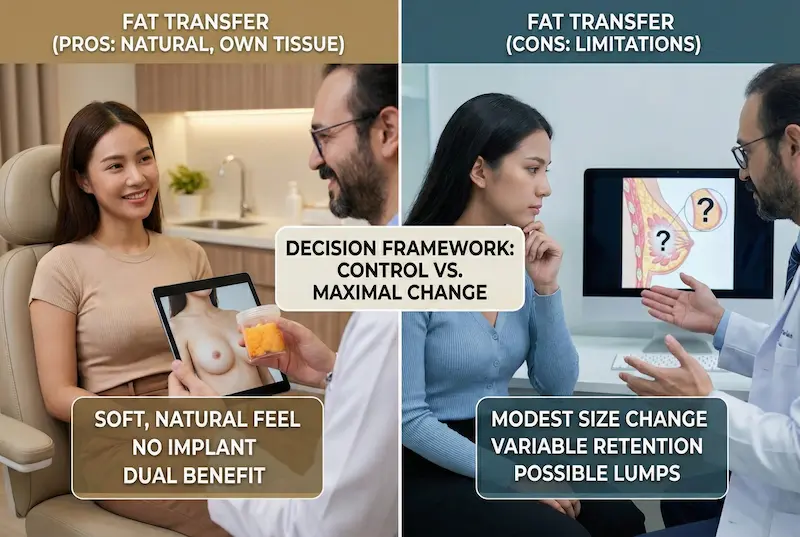
When patients compare fat grafting to implants, the decision often comes down to control versus maximal change. Fat transfer can look and feel exceptionally natural, but it has real boundaries. The safest plan is the one that respects your anatomy, your tissue quality, and what your body can reliably support. We’ll always frame this as a surgical strategy, not a “quick enhancement.”
Pros: Why Patients Love the “Own Tissue” Approach
The strongest advantage is that the added volume is living tissue. That tends to translate into softness, a natural slope, and a result that moves like you. Many patients also value the fact that there is no permanent device involved, which can feel like a more intuitive choice.
- Natural look and feel: fat behaves like breast tissue because it is tissue.
- No synthetic implant: some patients prefer avoiding a foreign device.
- Dual benefit: body contouring improvements from donor-area liposuction.
- Scar profile: typically small access points rather than a larger breast incision.
Cons and Limitations: What Fat Transfer Can’t Guarantee
The most important limitation is predictability in size. A portion of the transferred fat may not survive, and the “final” volume takes time to declare itself. Some patients need a second session to reach their target, especially if they want more than a subtle increase.
- Modest size change: ideal for refinement, not for a dramatic one-step jump.
- Two-zone recovery: you heal from liposuction and breast grafting at the same time.
- Variable retention: fat survival differs between patients and even between breasts.
- Possible lumps: issues like fat necrosis after fat transfer to breast can occur and must be managed properly.
If you’re asking is fat transfer to breast safe, that question usually sits behind a bigger concern: “What can go wrong, and how would it be handled?” We address safety and risk details in a dedicated section later in this guide, including what to watch for and how we reduce avoidable complications.
A Quick Decision Framework (Pros vs Cons in Real Life)
Here’s the simplest way to think about it. If your priority is a soft, believable enhancement and you have adequate donor fat, fat transfer can be an excellent match. If your priority is a guaranteed, larger size increase in one operation, implants may be the more direct path. If you want “natural plus more,” a hybrid plan can sometimes bridge the gap.
- Choose fat transfer if your goal is natural contour, subtle volume, and no implant.
- Choose implants if you need maximum, predictable volume in one step.
- Consider hybrid if you want implant structure with fat used for smoothing and refinement.
Am I a Good Candidate?
Candidacy is not just about “wanting” fat transfer—it’s about whether your body can deliver a stable, proportional result. Your current breast shape, skin quality, and fat availability all matter. Your health profile matters, too, because this is surgery and safety is non-negotiable. A strong plan starts with honest screening and a goal that fits your anatomy.
Ideal Candidate Criteria
In general, the best candidates want a modest to moderate enhancement and a natural feel. They also have enough donor fat to harvest without creating contour issues in the donor area. Stable lifestyle habits help, because large weight fluctuations can change long-term results.
- A clear preference for natural-looking volume and soft contours
- Adequate donor fat (abdomen, flanks, thighs) for a balanced harvest
- Realistic expectations about size increase and the possibility of a second session
- Stable weight and consistent nutrition habits to support healing
Who May Not Be a Candidate (or May Need a Different Plan)
Some situations call for a different approach. If a patient wants a large, guaranteed increase, fat transfer alone may not satisfy the goal. If the breast has significant sagging, fat alone cannot reposition tissue; a lift may be necessary to rebuild shape first.
- Patients seeking a dramatic one-step size increase
- Patients with significant ptosis (sagging) who may need a lift
- Patients who cannot pause nicotine use, as it can compromise healing
- Patients with uncontrolled medical conditions that increase surgical risk
How We Evaluate You: Planning, Measurements, and Risk Screening
Our approach is structured. We evaluate donor areas, breast dimensions, skin quality, and symmetry. We also focus on safety screening before we talk about aesthetics, because the best result is the one you can achieve safely.
- Goal setting: we align expectations with what fat transfer can realistically deliver.
- Anatomy review: we assess breast width, tissue quality, and contour priorities.
- Donor strategy: we plan harvesting in a way that supports both breast and body proportions.
- Pre-op screening: we use structured health checks to confirm candidacy and reduce avoidable risk.
Patients also ask, how long does fat transfer to breast last. Longevity depends on how well the transferred fat establishes blood supply and how stable your weight remains afterward. We break down long-term durability in detail later, including what to expect as results “settle.”
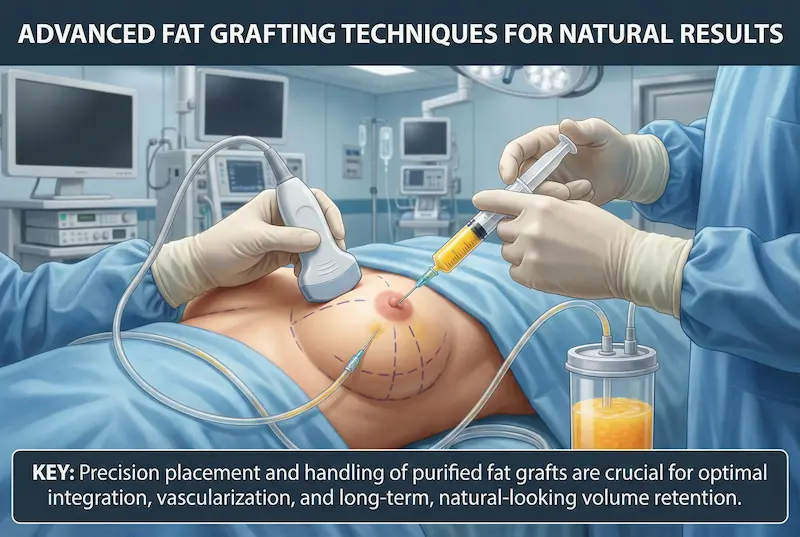
Surgical Techniques Explained: How We Maximize Fat Graft Survival
Breast fat grafting looks simple on social media. In reality, it’s a tissue-transfer procedure with one central goal: help as many transferred fat cells as possible establish a stable blood supply. That’s what drives long-term retention. It’s also why technique matters more than “how much fat we inject.”
When patients ask about the success rate of fat transfer to breast, the honest answer is that success is not one number. It’s a chain of decisions. Harvest too aggressively, process the fat poorly, or inject it in a way that creates pressure and you reduce survival. We build the plan around biology, not hype.
Fat Harvesting: Gentle Liposuction Principles
Harvesting is not about taking the maximum volume. It’s about taking high-quality, viable fat with minimal trauma. The donor area is chosen for both fat availability and how we can improve body proportions at the same time.
- Donor planning: We select areas where fat can be removed smoothly without creating contour irregularities.
- Low-trauma technique: A controlled, gentle approach supports fat cell integrity.
- Balanced contouring: The donor result matters because you will see it every day.
Fat Processing and Purification
Not all harvested material belongs in the breast. The goal of processing is to refine the graft so it is more consistent and more predictable to place. This step also helps us avoid transferring excess fluid and unwanted components that can interfere with a clean result.
- Purification improves consistency and handling during placement.
- Better consistency supports smoother contouring decisions.
- Refinement is part of risk management, not a “nice-to-have.”
Fat Injection Strategy: Micro-Droplet Layering
Placement is where artistry meets physiology. Fat is introduced in small amounts, spread across multiple tissue planes, rather than packed into one pocket. This “micro-droplet” logic increases the surface area of the graft that can access oxygen early on.
- Layering: Builds shape gradually and supports even integration.
- Symmetry control: Small, repeated passes allow fine-tuning.
- Pressure awareness: Overfilling one zone can compromise oxygen delivery.
What Determines Retention and Predictability?
Retention is not only about technique. Your tissue quality, circulation, and post-op behavior matter, too. So does the starting anatomy. This is why we set expectations carefully and tailor volume goals to what your body can support.
- Patient factors: tissue quality, baseline breast volume, and lifestyle stability.
- Procedure factors: gentle harvest, clean processing, and layered placement.
- Plan factors: realistic volume goals and clear follow-up milestones.
Technique Comparison Table (Required)
| Step | High-Quality Principle | Why It Matters |
|---|---|---|
| Harvest | Low-trauma fat collection | Supports fat cell integrity and improves the odds of long-term survival. |
| Processing | Refined, consistent graft | Helps create smoother contours and more controlled placement. |
| Injection | Micro-droplet layering | Improves oxygen access during the early “take” phase and reduces irregularities. |
| Volume Goals | Proportional planning | Reduces the temptation to overfill and supports a natural breast shape. |
| Follow-Up | Structured monitoring | Helps identify issues early and keeps the recovery process predictable. |
Fat Transfer vs Breast Implants (and Hybrid Options): Which Is Right for You?
This decision is rarely about “good vs bad.” It’s about matching a method to your priorities. Implants are engineered for volume. Fat transfer is designed for softness and subtle shaping. Both can create beautiful outcomes when the plan is honest.
If you’re comparing fat transfer breast augmentation vs implants, start with the end result you actually want in real life. Do you want a noticeable, guaranteed size jump? Or do you want a refined, natural look with no implant? Your answer usually makes the choice clear.
When Implants May Be the Better Choice
Implants are the most direct path to a larger, predictable size change. They can also help patients who have limited donor fat or who want upper-pole fullness that fat alone may not reliably deliver in one session.
- You want a larger, guaranteed size increase in one operation.
- You have limited donor fat available for harvesting.
- You prefer a more defined, rounder upper-pole look.
When Fat Transfer May Be the Better Choice
Fat transfer is a strong match for patients who prioritize softness, natural movement, and a subtle-to-moderate volume increase. It can also be ideal if you value the “two-in-one” benefit of body contouring plus breast enhancement.
- You want a natural look and feel with modest enhancement.
- You prefer avoiding a permanent synthetic device.
- You want body contour refinement from liposuction at the same time.
Hybrid Breast Augmentation (Implant + Fat): When It’s Considered
Sometimes the best plan is not either/or. A hybrid approach can use an implant to create the core volume, then use fat to soften transitions and refine shape. This can be especially useful for patients who want more size but still want the most natural contour possible.
- Implant provides volume; fat refines edges and contour.
- Fat can help smooth visible transitions in select anatomies.
- The plan is individualized based on tissue thickness and goals.
Comparison Table: Fat Transfer vs Implants vs Hybrid
| Factor | Fat Transfer | Implants | Hybrid |
|---|---|---|---|
| Size Change | Typically subtle-to-moderate | Moderate-to-significant, highly predictable | Significant with contour refinement |
| Look & Feel | Very natural softness | Depends on implant type and tissue | Volume plus a softer transition |
| Scars | Small access points | Incision-based placement | Both access points and implant incision |
| Recovery Consideration | Breast + donor-area recovery | Primarily breast recovery | Both elements combined |
| Best For | Patients prioritizing “no implant” | Patients prioritizing predictable size | Patients wanting both size and refinement |
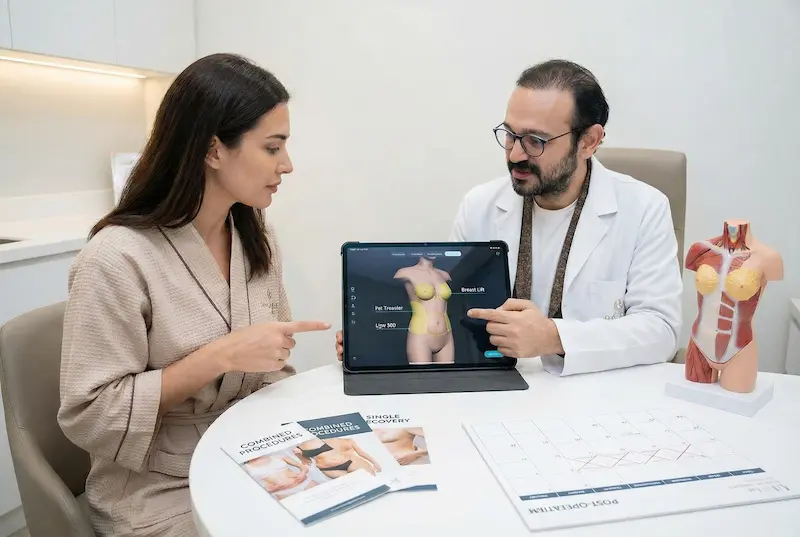
Combined Procedures: Maximize Results with One Recovery
Many patients don’t want a single isolated change—they want proportion. Because fat transfer breast augmentation requires donor fat, it often pairs naturally with body-contouring procedures. When planned responsibly, combining procedures can mean one anesthesia, one recovery, and a more cohesive aesthetic outcome.
That said, combining surgeries isn’t automatically “better.” It has to fit your health profile, operative time limits, and recovery resources. Our job is to build the safest plan that achieves your goals without pushing beyond what your body can comfortably handle.
Lipo 360 with Fat Transfer to the Breast
Lipo 360 with fat transfer to breast is a common combination for patients who want a more defined waistline while enhancing breast volume with their own tissue. The concept is simple: sculpt the torso circumferentially (front, sides, and back as appropriate), then use carefully processed fat to refine breast contour.
- Why patients choose it: improved waist-to-hip balance can make the breast result look even more natural and proportional.
- Planning priority: donor-area contour must look smooth, not “overdone,” because it’s part of the final aesthetic.
- Recovery reality: you’ll manage compression and soreness in the donor area while the breasts are settling.
Fat Transfer to the Breast with a Breast Lift
Fat transfer adds volume; it does not “lift” tissue into a higher position. If a patient has significant ptosis (sagging) or stretched skin, a lift may be necessary to restore shape. In these cases, fat transfer to breast with lift can combine structure (lift) with softness (fat) for a balanced result.
- Lift: reshapes and repositions the breast envelope and nipple-areola complex when needed.
- Fat: adds gentle volume and can refine contour transitions.
- Goal: a breast that looks supported, not simply “bigger.”
We plan these cases carefully because scar placement, tissue tension, and vascular considerations matter. The best outcomes come from matching the technique to the tissue—especially when both shaping and volume are being addressed in one surgery.
“Mommy Makeover” Scenarios (Common Combinations)
Some patients seek a broader postpartum reset of proportions. A “mommy makeover” is not one standardized operation—it’s a tailored combination that may include liposuction, breast surgery (fat transfer, lift, implants, or a hybrid), and sometimes abdominal contouring. The key is customization and safety-based staging when appropriate.
- Most common theme: restoring balance between the waist/abdomen and the breast silhouette.
- Smart sequencing: the safest plan is the one that respects operative time and recovery bandwidth.
- Expectation setting: combining procedures can enhance harmony, but it doesn’t eliminate normal healing time.
Surgeon’s Insight: Combining procedures can be powerful—when it’s done with restraint. The goal isn’t “more surgery.” The goal is a single, cohesive result with a recovery plan you can realistically follow.
Anesthesia Options: Awake/Twilight Sedation vs General Anesthesia
Anesthesia is not a minor detail—it’s part of your safety strategy. Patients searching awake fat transfer to breast are usually looking for a more controlled, less “heavy” anesthesia experience. In practice, anesthesia choice depends on your health profile, procedure complexity, anticipated operative time, and the clinical judgment of the anesthesia team.
Our role is to explain options clearly and help you understand what is appropriate for your specific plan. Not every patient is a candidate for the same anesthesia approach, and not every procedure is suitable for the same level of sedation.
Twilight Sedation vs General Anesthesia: Key Differences
Twilight sedation (often called IV sedation) is designed to keep you deeply relaxed and comfortable while still breathing on your own. General anesthesia renders you fully unconscious and is typically used for longer or more complex procedures, or when multiple procedures are combined.
- Twilight sedation: typically involves IV medications; you may be sleepy and unaware, but not fully “put under.”
- General anesthesia: you are fully unconscious; airway management and deeper anesthetic control are used.
- Decision drivers: procedure length, combination plan, medical history, and safety parameters.
“Awake Fat Transfer to Breast”: Who May Be Eligible?
Patients use “awake” in different ways. Some mean local anesthesia plus sedation; others mean minimal sedation. Eligibility depends on how extensive the liposuction is, how much grafting is planned, your anxiety level, and your clinical safety profile. Comfort and safety must align—there is no “one-size-fits-all.”
- May be considered: selected patients with straightforward plans and appropriate medical screening.
- May not be ideal: extensive combinations, longer operative time, or patient factors that favor deeper control.
- Primary objective: safe anesthesia, stable physiology, and a calm, controlled surgical environment.
How Anesthesia Choice Is Determined
We don’t “sell” an anesthesia type. We select what is appropriate. That starts with a thorough pre-op evaluation and an anesthesia plan tailored to the surgical scope. The goal is to minimize avoidable risk while ensuring you are comfortable and monitored to the highest standard.
- Pre-op assessment: medical history, medications, and anesthesia risk screening.
- Procedure scope: fat harvest zones, grafting complexity, and whether additional procedures are included.
- Recovery planning: postoperative monitoring, pain control strategy, and safe discharge criteria.
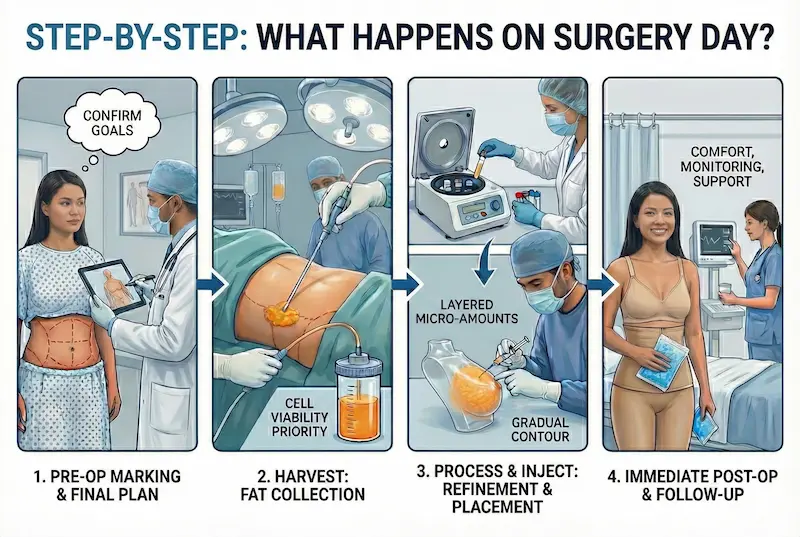
Step-by-Step: What Happens on Surgery Day?
Knowing the flow of surgery day helps you feel in control. Most anxiety comes from the unknown—not from the procedure itself. While every plan is individualized, fat transfer breast augmentation typically follows a structured sequence: confirm the plan, harvest fat, refine it, and then place it with precision.
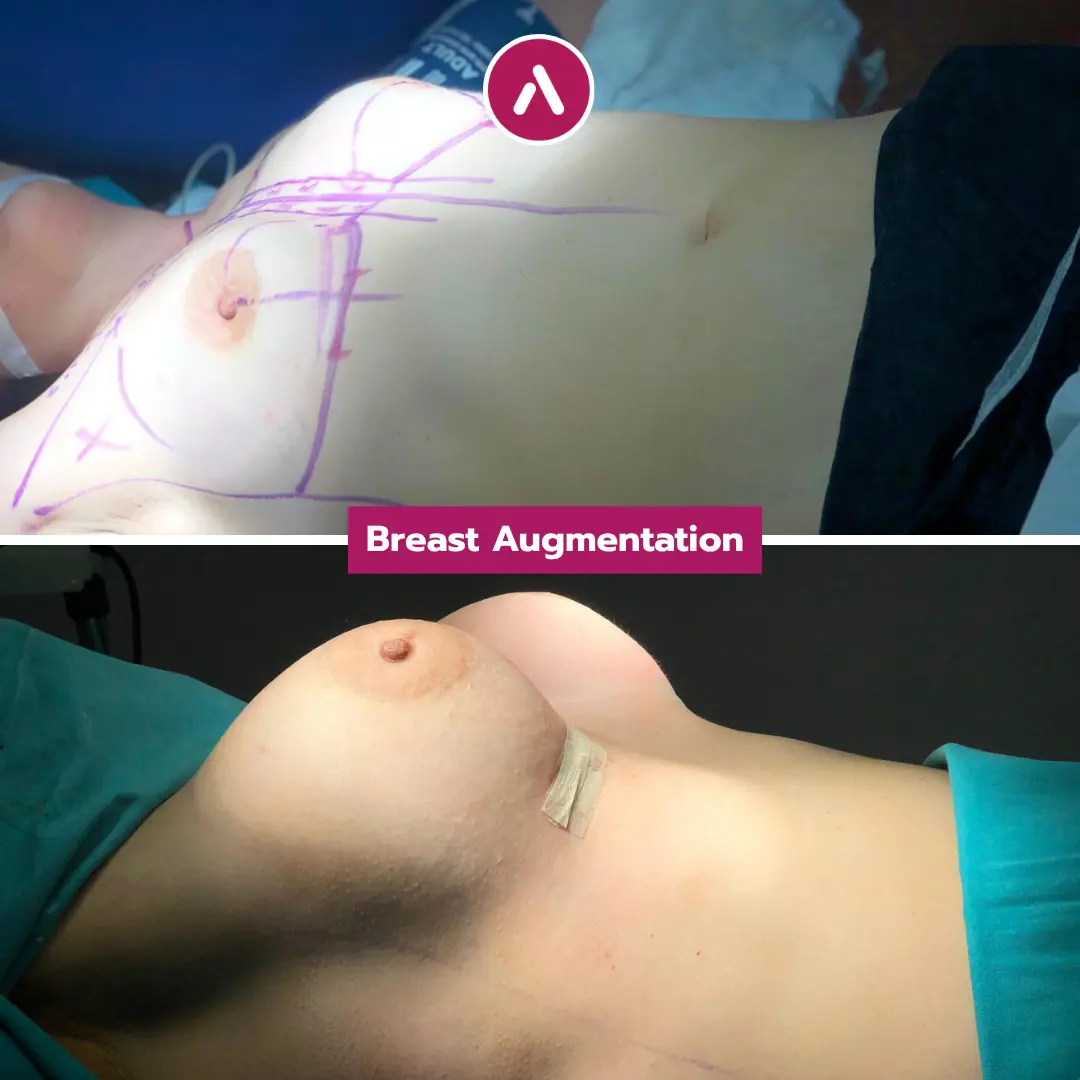
Pre-Op Marking and Final Plan Confirmation
Before surgery, we confirm goals and map the details. This includes donor-area markings and a breast contour plan that accounts for your natural asymmetry. We also review safety checkpoints and post-op expectations so you know what your first week will look like.
- Measurements and symmetry review: we align your goals with your anatomy.
- Donor-area strategy: we confirm where fat will be harvested and how contour will be managed.
- Breast shaping plan: we identify priority zones (upper pole refinement, central projection, or overall balance).
Procedure Flow: Harvest → Process → Inject
The surgical steps are designed to protect fat cell viability and support long-term retention. We treat the fat as living tissue that needs careful handling from the moment it is harvested.
- Harvest: fat is collected using controlled liposuction techniques that prioritize cell integrity.
- Process: the fat is refined for consistency before transfer.
- Inject: fat is layered in micro-amounts to build contour gradually and support integration.
Immediate Post-Op Care and First Follow-Up
After surgery, we focus on comfort, monitoring, and clear instructions. You’ll typically have swelling and tenderness in both the donor area and the breasts. This is normal and expected. We also guide garment use, activity level, and early warning signs—because good outcomes depend on smart recovery behavior.
- Compression: typically emphasized for donor areas to support contour and reduce swelling.
- Breast support: we guide you on appropriate support garments based on your plan.
- Early follow-up: we confirm you are healing as expected and adjust guidance if needed.
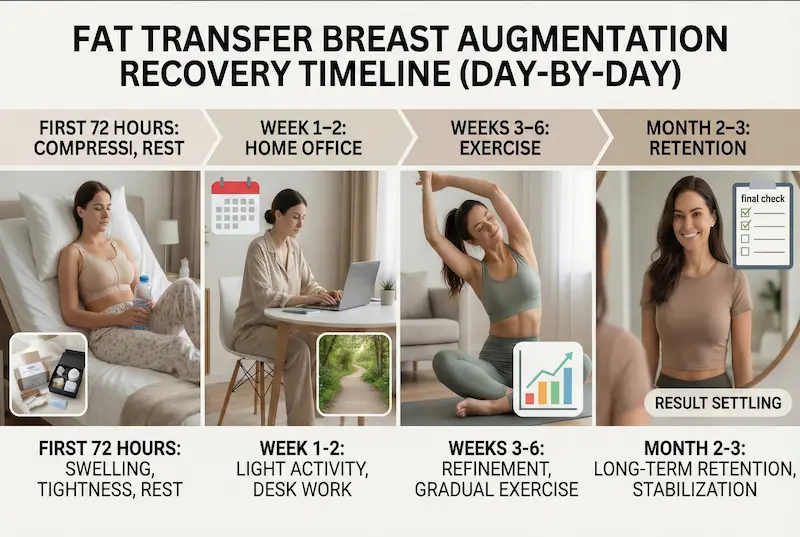
Recovery Timeline: Fat Transfer Breast Augmentation Recovery Time (Day-by-Day)
Patients often search fat transfer breast augmentation recovery time because they want one clear answer. In reality, recovery is a timeline with phases. Most patients feel “presentable” long before results are fully settled. The early focus is swelling control and comfort; the later focus is letting the transferred fat stabilize and the body contour smooth out.
First 72 Hours: Swelling, Tightness, and Protection
The first three days are typically the most intense in terms of swelling and tenderness. Breasts may feel firm and fuller than expected, and donor areas can feel sore and tight. We guide you on walking, hydration, and gentle movement—because circulation supports healing.
- What to expect after fat transfer to breast: swelling, bruising, and pressure sensations are common.
- Activity: short walks are typically encouraged, while strenuous movement is avoided.
- Garments: donor-area compression is usually important; breast support is individualized.
Week 1–2: Getting Back to Normal Life (With Limits)
Most patients can move around comfortably and return to light activities during this phase. Bruising often fades, and swelling begins to soften—though donor areas can remain sensitive. You may feel “better” before you look fully settled, which is normal.
- Work: many patients return to desk-based work within this window, depending on the extent of liposuction and how they feel.
- Exercise: light walking is typically fine; higher-impact training is usually delayed.
- Breast appearance: early fullness can gradually decrease as swelling resolves and fat retention declares itself.
How to Sleep After Fat Transfer to the Breast
Sleep position matters because we want to avoid unnecessary pressure on the breasts while the graft is stabilizing. We provide personalized guidance, but the general principle is simple: protect the transfer sites and prioritize comfort.
- Typical recommendation: sleep on your back with your upper body slightly elevated in the early phase.
- Avoid: sleeping on your stomach or applying direct pressure to the breasts.
- Comfort strategy: supportive pillows can reduce rolling and protect donor-area tenderness.
Weeks 3–6: Shape Refinement and “Settling”
This is the phase where many patients start to feel more like themselves. Swelling continues to improve, donor areas look smoother, and breast contours begin to look more natural in clothing. If you’ve been comparing fat transfer to breast pros and cons, this is when the “pro” becomes obvious: the result often looks quietly elegant rather than surgically obvious.
- Exercise: activity is typically increased gradually with guidance.
- Donor areas: firmness or uneven swelling can occur and usually improves over time.
- Breasts: contour becomes more consistent as swelling continues to resolve.
Month 2–3: Long-Term Retention Becomes Clear
Long-term results are not judged at two weeks. Around the 2–3 month mark, your body has had time to stabilize swelling and declare fat retention more clearly. This is also when we can have a more meaningful conversation about whether a second session would add value for your goals.
- Outcome review: we evaluate symmetry, contour, and overall proportionality.
- Retention reality: some patients retain more, some less—this is why planning is conservative and honest.
- Next steps: if more volume is desired, a staged approach may be discussed.
Enhanced Recovery: HBOT and LLLT (When Appropriate)
Some patients ask about advanced recovery support, especially when they’re traveling internationally and want a smooth, well-structured healing plan. Depending on your case, we may integrate supportive modalities such as Hyperbaric Oxygen Therapy (HBOT) and Low-Level Light Therapy (LLLT) as part of a broader recovery protocol. These modalities are not “shortcuts,” but they may support comfort, tissue recovery, and overall healing when appropriately selected.
Safety & Risks: Is Fat Transfer to the Breast Safe?
If you’re asking is fat transfer to breast safe, you’re thinking like an expert patient—and you should. Any surgery has risk. The right question is: what are the realistic risks, how common are they, and what systems are in place to reduce avoidable problems and manage issues early if they arise?
Fat transfer breast augmentation is widely performed and can be safe in appropriately selected patients when done with disciplined technique and structured follow-up. Safety depends on the full chain: candidacy screening, surgical planning, sterile practice, thoughtful volume goals, and recovery guidance that protects both the breasts and the donor area.
Common Risks and How They’re Managed
Most risks are not “headline scary,” but they are real. We treat them seriously because small issues can become bigger problems if ignored. The most common concerns relate to swelling, bruising, contour irregularities in the donor area, and temporary firmness in the breasts as tissues heal.
- Infection: uncommon, but possible with any surgery. Managed with sterile technique and clear post-op monitoring.
- Asymmetry: normal breasts are not identical; we plan for that, but subtle differences can still occur.
- Contour irregularities (donor area): minimized by balanced harvesting and proper compression.
- Under-correction: if retention is lower than desired, a staged second session may be considered.
It’s also important to understand that “normal healing changes” can feel alarming early on. Temporary firmness, swelling, or unevenness often improves as inflammation resolves and tissues soften over time.
Fat Necrosis After Fat Transfer to the Breast: What It Is, What It Isn’t
Fat necrosis after fat transfer to breast refers to fat cells that do not establish a lasting blood supply. When this happens, the body can encapsulate the area, leading to firmness, small nodules, oil cysts, or localized tenderness. This can be unsettling, but it does not automatically mean something dangerous. It does mean we take evaluation seriously and follow a structured plan for assessment.
- What you might notice: a firm spot, a small lump, or localized sensitivity.
- Why it happens: biology varies, and overly dense graft placement can compromise early oxygen delivery.
- How it’s handled: monitoring, clinical exams, and imaging when appropriate to confirm what’s going on.
The strongest prevention strategy is disciplined technique: conservative volume goals, layered micro-placement, and careful patient selection. When patients want “as much as possible” in one pass, we explain the tradeoff clearly—overfilling can work against long-term retention and can raise the risk of irregularities.
Breast Imaging After Fat Transfer (Mammogram/Ultrasound/MRI)
Another common expert-level concern is how fat transfer affects future breast imaging. After fat grafting, imaging can show benign changes such as oil cysts or calcifications related to fat healing. That’s why we emphasize transparent documentation and appropriate follow-up. If you have routine screenings, it’s important to tell your radiologist you’ve had fat transfer so they interpret findings in the right context.
- Ultrasound: can help characterize cystic vs solid findings.
- Mammogram: may show benign post-procedural changes that require experienced interpretation.
- MRI: can be used in select cases for further clarity when indicated.
How We Reduce Risk: Patient Selection + Technique + Follow-Up
Risk reduction is not one thing—it’s a system. We focus on candidacy screening, conservative planning, and structured recovery guidance. We also encourage patients to prepare intelligently: pause nicotine, follow medication instructions, and build a realistic recovery schedule. The best outcomes come from alignment between the surgical plan and the patient’s day-to-day recovery behavior.
- Selection: candidacy screening and goal alignment before scheduling surgery.
- Technique: low-trauma harvesting, clean processing, layered placement, and proportional goals.
- Aftercare: clear monitoring, early check-ins, and guidance on sleep, activity, and garments.
How Long Does Fat Transfer to the Breast Last?
Patients searching how long does fat transfer to breast last usually want a simple answer: “Is this permanent?” The most accurate answer is: the fat that successfully integrates can behave like your own tissue long-term. However, not every transferred fat cell survives, and the final “kept” volume becomes clearer over the first months.
When Results “Settle” (and Why Early Volume Can Be Misleading)
In the early weeks, swelling can make the breasts look fuller than the final outcome. As swelling resolves, the breasts soften and the true retained volume becomes more apparent. This is why we discourage judging results too early.
- Early phase: swelling and firmness are common and can temporarily exaggerate volume.
- Settling phase: the body stabilizes, and fat retention becomes more predictable.
- Long-term phase: integrated fat behaves like living tissue.
Weight Changes and Lifestyle: What Affects Long-Term Stability?
Because the volume is living fat, weight changes can influence your result. Significant weight loss may reduce volume; weight gain may increase volume in both the breasts and other areas. This isn’t “good” or “bad”—it’s simply how fat behaves in the body. We generally recommend aiming for a stable weight before surgery and maintaining stable habits afterward for the most consistent outcome.
- Stable weight supports stable results.
- Large fluctuations can change breast volume and donor-area contour over time.
- Healthy recovery habits support tissue healing and predictability.
When a Second Session May Be Recommended
Some patients achieve their goal in one session. Others benefit from staging. If you want a more noticeable size increase than your anatomy can safely support in one transfer, a second session can be the safest way to build volume gradually while protecting contour quality and minimizing irregularities.
- Most common reason: you want more volume than can be reliably transferred in one pass.
- Another reason: you retain less volume than expected (individual biology varies).
- Best timing: after your tissues have stabilized enough to evaluate the true baseline result.
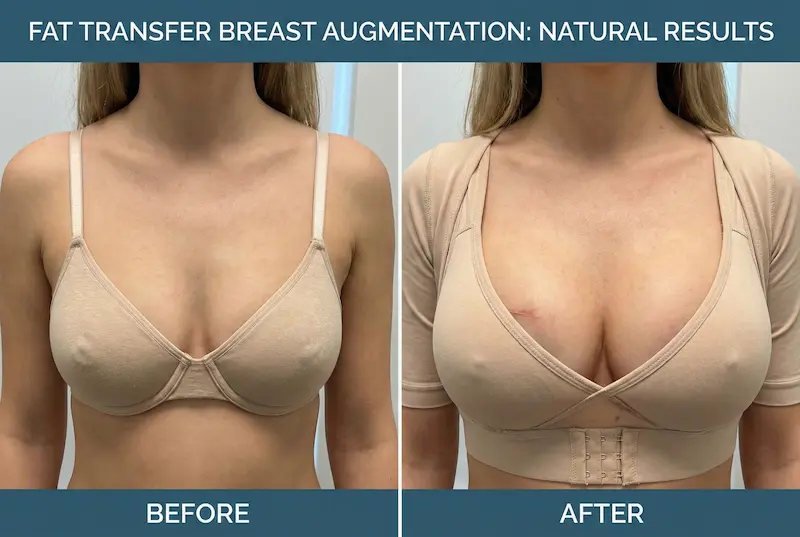
Realistic Expectations & Results: What “Natural” Looks Like in Practice
The best outcomes in Fat Transfer Breast Augmentation come from aligning goals with anatomy. Fat transfer is not designed to create an extreme, instant transformation. It’s designed to refine shape, improve proportion, and produce a soft, believable result that fits your frame.
Patients who are happiest with fat transfer usually share one trait: they value authenticity over amplification. They want to look subtly enhanced in fitted clothing and natural in motion—without the “implant look.” When expectations match what the procedure is built to deliver, satisfaction tends to be high.
How Much Bigger Can You Realistically Expect to Be?
Because some of the transferred fat will not survive, we plan with realism rather than promises. Your starting breast volume, tissue quality, and donor fat availability all influence what is achievable. In many cases, the change is best described as a modest-to-moderate increase with a meaningful improvement in contour and upper-pole transition.
- Best-case mindset: aim for refinement and proportional enhancement, not an extreme size jump.
- Volume reality: retention varies—this is why we evaluate results after swelling resolves and tissues settle.
- Staged strategy: if you want more volume than can be safely transferred in one pass, a second session may be the safest path.
Skin Quality, Ptosis (Sagging), and When a Lift Is Needed
Fat can add volume, but it does not tighten loose skin or reposition the nipple-areola complex. If skin is significantly stretched or the breast sits low on the chest (ptosis), a breast lift may be required to rebuild shape. In those cases, fat transfer can still play a valuable role—especially to soften contours and enhance fullness after structural reshaping.
- If your main issue is sagging: a lift addresses position and shape.
- If your main issue is volume: fat transfer can enhance contour and softness.
- If you need both: combining a lift with fat transfer can create a more stable, elegant result.
What Your Timeline Will Look Like (So You Don’t Judge Too Early)
Early breast fullness can be misleading because swelling and firmness are part of normal healing. Over time, tissues soften and the “true” retained volume becomes clearer. This is why we emphasize timeline-based decision-making—especially if you are considering whether a second session would add value.
- Early weeks: swelling and tightness can exaggerate volume.
- Weeks 6–12: shape becomes more natural; retention becomes clearer.
- Long-term: integrated fat behaves like your own tissue and can remain stable with a steady weight.
Surgeon’s Insight: The most “natural” results are built, not forced. Conservative volume goals, precise layering, and a realistic timeline are what make fat transfer look effortless.
Patient Experience Themes (What People Commonly Say)
Every patient is different, but certain themes come up repeatedly in consultations and follow-ups. Many patients say they love the softness and natural movement of their result. They also often underestimate how much the donor-area recovery affects comfort early on. Understanding both zones of healing—breasts and donor areas—helps you prepare realistically.
- “It feels like me—just more balanced.”
- “The breast recovery was easier than I expected; the liposuction soreness lasted longer.”
- “The result improved month by month. I’m glad I didn’t judge it at two weeks.”
Is Fat Transfer Breast Augmentation Safe in Turkey (Istanbul)?
Patients researching fat transfer breast augmentation Turkey or fat transfer breast augmentation Istanbul are often weighing two things at once: outcome quality and travel logistics. The most important point is this: safety is not defined by geography—it’s defined by standards. The right clinic will have structured patient selection, disciplined technique, and clear continuity of care before and after surgery.
It’s also normal to be skeptical. If you’ve had consultations in major US markets, you may be asking: “Will the medical standards match what I’m used to?” A credible approach should address that question directly with process transparency, not marketing language.
What “Safety Standards” Should Look Like (Anywhere in the World)
Regardless of location, we believe safe surgery follows the same principles: proper screening, a controlled operating environment, a skilled surgical team, and a recovery plan with real monitoring—not vague reassurance.
- Pre-op evaluation: health screening, medication review, and risk assessment.
- Clear surgical plan: proportional volume goals and an anatomy-based approach.
- Post-op structure: scheduled check-ins and clear “what to do if” instructions.
Continuity of Care for International Patients
International care only works when follow-up is designed into the journey. We plan your timeline with recovery milestones in mind, including in-person post-op assessments before you travel home and a clear communication pathway afterward.
- In-person checks: early evaluation while you are still in Istanbul.
- Remote support: guided follow-up after you return home, with clear escalation steps if needed.
- Documentation: procedure details and guidance you can share with local providers if required.
Why Patients Choose Istanbul: Value Without Compromising on Outcomes
For many patients, the decision is not about finding the “cheapest” option. It’s about accessing high-quality care without the cost inflation tied to certain primary US markets. When done responsibly, traveling for fat transfer to breast in Turkey can be a rational, outcome-driven decision—especially for patients who prioritize expertise, process, and aftercare.
Cost Analysis: Breast Fat Transfer Pricing in 2026 (Turkey vs USA)
When patients search fat transfer breast augmentation cost, they usually want one clear number. Real pricing is built from components. The biggest variables are how extensive liposuction must be, how much fat is transferred, anesthesia type, facility standards, and the intensity of follow-up care.
We approach cost like a safety checklist. If a quote feels “too good to be true,” it often means something is missing. Your goal is not the lowest line item. Your goal is a controlled operating environment, predictable planning, and continuity of care.
What the Price Typically Includes
Fat transfer breast augmentation is two procedures in one: liposuction plus grafting. That’s why the “base fee” alone is not the full story. A complete quote should clearly define what is included.
- Surgical planning: measurements, donor-area mapping, symmetry strategy
- Facility + anesthesia: operating room standards and monitored anesthesia care
- Liposuction + fat grafting: harvesting, processing, and micro-layered placement
- Post-op care: scheduled checks, garments, medications when prescribed
Why Costs Differ (NYC vs Los Angeles vs Miami vs Istanbul)
Major US markets like fat transfer to breast NYC and fat transfer to breast Los Angeles often carry “city overhead.” That’s not a judgment. It’s economics—higher facility costs, staffing, insurance, and operational pricing in premium metros.
In Istanbul, the cost structure can be more high-value because national operating costs are different. This price difference is typically driven by macroeconomic factors and overhead—not by cutting corners. We still plan for a USA-level standard of screening, sterile practice, and monitored recovery.
How We Frame Value for International Patients
Patients searching fat transfer breast augmentation Turkey or fat transfer to breast cost Turkey often want to know what they get beyond surgery. International care only makes sense when logistics are structured, not improvised.
- Bundled structure: many patients prefer one coordinated plan rather than managing vendors separately.
- Privacy and control: a smooth journey reduces stress, which supports recovery.
- Continuity of care: follow-up should continue after you return home, not end at the airport.
Cost Comparison Table (Required)
| Cost Component | Typical in Major US Markets | Typical in Istanbul (Turkey) |
|---|---|---|
| Surgeon Fee | Varies widely; often higher in premium metros | Often more cost-effective due to different overhead |
| Facility + Anesthesia | Commonly a major driver of total price | Often lower operationally, while still requiring high standards |
| Liposuction Scope | Increases cost with more donor areas | Same clinical rule: more areas = more complexity |
| Post-Op Care | May be itemized (visits, garments, meds) | Often organized as part of a coordinated care plan |
| Travel Logistics | Not applicable | May be bundled (transfers/hotel support) depending on package |
Surgeon’s Insight: Price should never be the headline. The real value is a plan that protects fat survival, reduces avoidable risk, and gives you a predictable recovery—without compromise.
If you want a precise quote, we typically start with an online evaluation. Your anatomy and goals determine complexity, and complexity drives cost.
Choosing the Right Surgeon: What Matters Most for Predictable Outcomes
Search terms like best fat transfer to breast surgeons can be misleading, because “best” isn’t a trophy. It’s a process. For fat transfer, predictable outcomes come from disciplined technique, conservative volume planning, and honest candidacy screening.
We recommend focusing on standards you can verify. You’re selecting a surgical system, not a social media highlight reel.
Credentials and Case Volume
Fat grafting is sensitive to technique. Experience matters, and so does case selection. Our European Board Certified Surgeons and US-trained specialists plan each transfer around tissue biology, not trend-driven volume goals.
- Board certification and a dedicated focus in aesthetic surgery
- Consistent experience with fat grafting and body contouring
- Clear safety protocols and structured follow-up
How to Evaluate Before/After Photos
Look for consistency, not extremes. Lighting tricks and posing can hide problems. Reliable galleries show balanced results across different body types.
- Similar starting anatomy to yours (skin quality, chest width, baseline volume)
- Natural contours and symmetry that looks believable
- Donor-area smoothness (a key part of overall satisfaction)
Consultation Checklist: Questions an Expert Patient Should Ask
If you’re looking for the best surgeon for fat transfer to breast, ask questions that reveal process discipline.
- How do you plan volume to support fat survival and reduce lump risk?
- What is your strategy if my goal requires staging or a second session?
- How do you structure follow-up if I’m traveling internationally?

Your Medical Journey in Istanbul: Travel and Logistics (For US Patients)
If you’re considering fat transfer breast augmentation Istanbul, the clinical plan is only half the equation. The other half is logistics—because a smooth experience reduces stress, and lower stress supports better recovery behavior. We structure your journey so you know what happens before you fly, what happens while you’re in Istanbul, and what follow-up looks like after you return home.
Online Evaluation and Treatment Planning
Most international patients start with a remote evaluation. This step helps us understand your anatomy, goals, and safety profile before you commit to travel. It’s also where we set expectations clearly—especially around realistic volume, donor-area needs, and whether a lift or staged approach would better match your outcome goals.
- Goal alignment: we clarify what “natural” means for your frame and tissue quality.
- Donor assessment: we estimate whether you have enough available fat for your target result.
- Procedure strategy: fat transfer alone vs lift vs implant vs hybrid (when appropriate).
- Timeline planning: we map the safest recovery window before you fly home.
Arrival, Transfers, and Patient Coordination
Travel shouldn’t feel like a puzzle. When your surgery is scheduled, we coordinate the practical steps around your clinical plan—arrival timing, pre-op preparation, and post-op check-ins. The goal is a controlled, calm experience that keeps you focused on healing.
- Pre-op day structure: check-ins, instructions, and preparation milestones are clearly scheduled.
- Communication: you know who to contact for questions before and after surgery.
- Recovery readiness: we help you plan clothing, compression garments, and comfort essentials.
Post-Op Visits, Flight Readiness, and Return-Home Support
We plan your in-person follow-ups in Istanbul before you fly. This is where we confirm early healing, review garments and activity, and answer practical questions—like how to sit comfortably, how to manage swelling, and what “normal” looks like during the first week.
- In-person evaluations: scheduled assessments before departure help ensure you’re traveling safely.
- Travel guidance: we discuss hydration, walking, and comfort strategies for flights.
- Remote follow-up: after you return to the US, we provide structured check-ins and clear escalation steps.
If you’ve been searching fat transfer breast augmentation near me but are comparing outcomes, approach, and value, an international option can make sense—when the clinical standards and follow-up pathway are built into the process.
Fat Transfer Breast Augmentation Frequently Asked Questions (FAQ):
Is fat transfer to the breast safe?
It can be safe for appropriately selected patients when performed with disciplined technique and structured follow-up. Safety depends on candidacy screening, conservative volume goals, precise layered placement, sterile practice, and clear recovery guidance. We focus on reducing avoidable risks and monitoring early healing so issues are identified promptly.
What is the recovery time for fat transfer breast augmentation?
Most patients feel significantly better after the first 1–2 weeks, but “final” results take longer. Early swelling and firmness improve gradually, and fat retention becomes clearer over the first months. You’re typically recovering from two zones—donor areas and the breasts—so donor-area soreness can last longer than many patients expect.
How long does fat transfer to the breast last?
The fat that successfully integrates can behave like living tissue long-term. The “kept” volume becomes clearer as swelling resolves and retention declares itself. Stable weight supports stable results, since weight changes can affect fat volume in the breasts and elsewhere.
What is fat necrosis after fat transfer to the breast?
Fat necrosis refers to fat cells that do not establish a lasting blood supply. It can present as firmness, small nodules, oil cysts, or localized tenderness. Many findings are benign, but any new lump should be evaluated with clinical assessment and imaging when appropriate. Prevention focuses on proportional planning and careful micro-layered placement rather than overfilling.
How should I sleep after fat transfer to the breast?
In the early phase, we typically recommend sleeping on your back with your upper body slightly elevated, avoiding direct pressure on the breasts. Comfort strategies (like supportive pillows) can help prevent rolling and protect tender donor areas.
Fat transfer vs implants: which is better for me?
Neither is universally “better.” Implants offer a more predictable, larger size change in one operation. Fat transfer tends to deliver a softer, more natural-feeling result with a subtle-to-moderate increase and the added benefit of body contouring. If you want both size and refinement, a hybrid approach may be considered in select cases.
What affects the cost of fat transfer breast augmentation?
Key drivers include the scope of liposuction (how many donor areas), the planned fat transfer volume, anesthesia approach, facility standards, and the level of post-op care and monitoring. A quote should clearly define what is included, not just a headline number.
How do I start if I’m traveling from the US?
Start with an online evaluation so we can assess candidacy, align expectations, and build a safe timeline for travel and follow-up. From there, we coordinate scheduling and the step-by-step plan for pre-op preparation, surgery, in-person checks in Istanbul, and remote follow-up after you return home.
Medical Disclaimer: This page is for educational purposes only and does not replace a consultation with a qualified medical professional. Surgical candidacy, risks, recovery, and outcomes vary by individual. Only an in-person or formal clinical evaluation can determine the safest and most appropriate treatment plan for you.