




Penis Enlargement is a broad term for cosmetic procedures designed to change the appearance of penile size—most often by improving perceived girth, length, or overall proportions. It is not one single operation. It is a category that includes different techniques, different trade-offs, and different recovery realities.
If you are the kind of person who researches anatomy, risks, and long-term outcomes before you ever book a consultation, you are in the right place. This guide is written for that “expert patient” mindset. Clear definitions first. Realistic expectations next.
Table of Contents
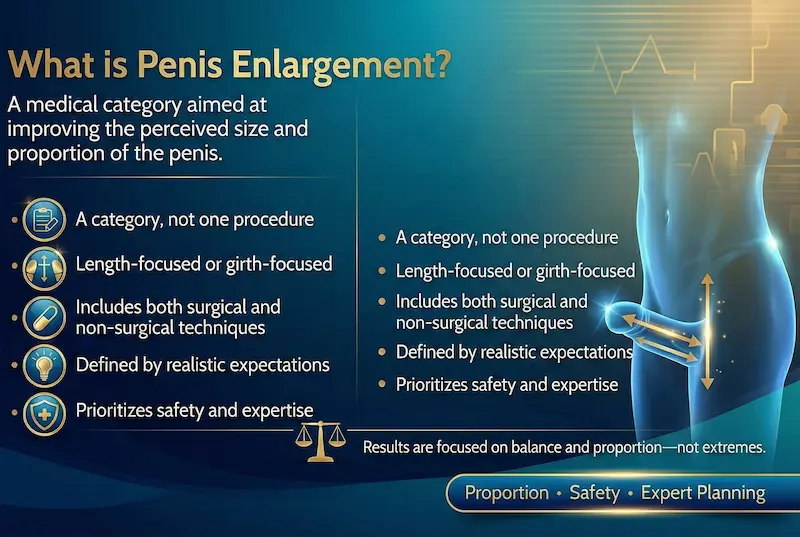
What is Penis Enlargement?
Penis Enlargement refers to cosmetic approaches—surgical and non-surgical—used to alter penile dimensions or proportions for aesthetic reasons. The goal is typically visual: how the shaft looks at rest and, in some cases, during erection. The best plans start with anatomy, not marketing. They also start with a hard question: what change are you actually trying to achieve?
Some patients are comparing penis enhancement surgery options after years of frustration with “quick fixes.” Others want a refined improvement that still looks like them. Either way, the core decision is the same: choose a method that matches your anatomy, your goals, and your tolerance for downtime.
The anatomy that matters (and why it limits what’s possible)
Penile aesthetics are shaped by more than “length.” Skin mobility, fat distribution at the base, and the way tissues anchor to the pelvis all influence what you see. That is why two people can have the same measurements and a completely different visual impression.
- Skin envelope: how much the skin can expand without tightness or irregularity
- Base and fat pad: how much of the shaft is visually “hidden” at the pubic area
- Attachment and support: how the penis sits and projects from the body
- Tissue quality: scarring tendency, healing capacity, and swelling patterns
Length vs. girth: what “enlargement” usually means in real life
Most cosmetic patients care about proportions. They want a more confident look in everyday situations, not a dramatic transformation that draws attention. For many, that means girth-focused changes matter as much as, or more than, pure length.
- Length-focused goals are often about the appearance at rest and perceived projection.
- Girth-focused goals are about thickness, contour, and a smooth, natural transition from base to tip.
- “Natural” outcomes depend on symmetry, soft-tissue behavior, and conservative planning.
Penis enlargement vs. phalloplasty: why these terms get mixed up
People often type phalloplasty when they really mean cosmetic enhancement. In reconstructive medicine, phalloplasty is a fundamentally different operation with different indications, complexity, and goals. phalloplasty is typically discussed in contexts where a new phallus is created or major reconstruction is needed, not simply aesthetic refinement.
- phalloplasty is reconstructive surgery; cosmetic enlargement is typically proportion-focused.
- phalloplasty often involves complex tissue transfer; cosmetic approaches usually aim to work within existing anatomy.
- phalloplasty has a different risk profile and recovery path than cosmetic enhancement plans.
- phalloplasty belongs in the hands of specialized reconstructive teams with dedicated follow-up pathways.
If you are researching phalloplasty for reconstructive reasons, you deserve a surgeon and center that focus on that specific field. If you are researching phalloplasty because you want a cosmetic change, it helps to reframe the conversation around proportional goals and realistic trade-offs.
Benefits of Penis Enlargement (What changes—and what doesn’t)
The most meaningful benefit is often psychological. Patients typically seek a stronger sense of confidence and comfort in intimate settings, locker-room anxiety, or long-standing body-image tension. The best outcomes look intentional but not obvious. That requires restraint, good planning, and a “natural-first” aesthetic standard.
It also requires honesty about limits. Cosmetic enhancement does not “fix” sexual function problems by default. It does not replace therapy for performance anxiety. And it is not interchangeable with phalloplasty, which serves a different set of needs and goals.
Aesthetic confidence and body image (without hype)
Confidence is not a number. Most patients describe the goal as feeling “more proportional” and less self-conscious, especially in everyday, non-sexual situations. When expectations are grounded, the emotional impact can be significant—without chasing extremes.
- Less visual self-consciousness in intimate and social contexts
- A stronger sense of alignment between self-image and appearance
- More comfort with partners and in changing-room scenarios
Proportion and the “natural look” principle
Natural outcomes follow anatomy. Smooth contour, symmetry, and predictable healing matter more than “maximal size.” Our guiding principle is simple: rejuvenation, not alteration.
Surgeon’s Insight: “The best cosmetic result is the one that looks like you—just more confident. When a plan ignores proportion, it stops looking natural.”
Functional expectations: what this surgery is not designed to treat
Cosmetic enhancement is not a primary treatment for erectile dysfunction, hormonal issues, infertility, or chronic pelvic pain. It can coexist with a healthy sex life, but it should not be framed as a cure. If your primary concern is reconstructive in nature, phalloplasty may be the more relevant term to explore—with the right specialty team guiding you.
Am I a Good Candidate For Penis Enlargement?
Good candidates are healthy adults who want a proportional, natural-looking change and understand that every technique has trade-offs. You should be able to describe your goal clearly: more visible projection at rest, improved girth contour, or better overall balance with your body. Vague goals usually lead to disappointment. Precision helps.
Who tends to be a strong candidate
Most suitable patients share the same core traits: stable health, realistic expectations, and anatomy that supports predictable healing. If you’ve spent time comparing options and reading about recovery, you’re already thinking like an expert patient. That mindset matters. It lowers risk and improves satisfaction.
- Stable weight: major weight changes can alter the visual baseline at the pubic area and shaft.
- Good skin quality: elasticity and tissue behavior influence contour and symmetry.
- Clear priorities: knowing whether you care more about length, girth, or overall proportion.
- Comfort with downtime: you can follow restrictions without “testing” the result too early.
Who should pause or avoid surgery
Some situations call for a different plan, or no surgery at all. The biggest red flag is chasing extremes. Another is believing surgery will solve a relationship or self-esteem crisis on its own.
- Uncontrolled medical conditions that increase anesthesia or healing risk
- Active infections or untreated skin issues in the surgical area
- Heavy smoking or vaping that compromises circulation and tissue repair
- Expectation of a “guaranteed” measurement change
- Difficulty following post-op restrictions
Expectation alignment: the quiet factor that decides outcomes
This is where most consults succeed or fail. The right plan matches anatomy and goals, then stays conservative enough to look natural. If your research path keeps circling back to phalloplasty, it’s worth clarifying why. phalloplasty is a reconstructive term with a different purpose and complexity than cosmetic enhancement.
Surgeon’s Insight: “When goals are proportional and specific, planning becomes straightforward. When goals are extreme or vague, no technique can make the result feel ‘right.’”
Safety reality check: risks you should understand before choosing a technique
Every option has a risk profile. Some risks are minor and temporary. Others can require revision.
- Swelling, bruising, and temporary sensitivity changes
- Contour irregularity or asymmetry
- Scar-related texture changes
- Complications that may require additional treatment (rare, but real)
If your primary need is reconstructive rather than aesthetic, phalloplasty discussions belong with specialized reconstructive teams. If your goal is cosmetic refinement, stay focused on proportional planning and technique selection. phalloplasty is not a shortcut for cosmetic change, and cosmetic change is not a substitute for phalloplasty.
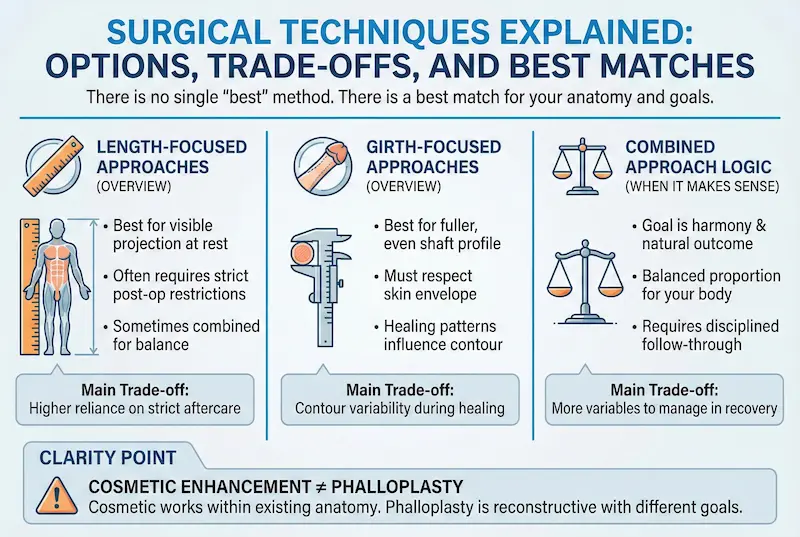
Surgical Techniques Explained: Options, Trade-Offs, And What Each One Is Really For
There is no single “best” method. There is a best match. Technique choice depends on your baseline anatomy, what you want to change, and how much variability you can tolerate in healing.
Length-focused approaches (overview)
Length-focused planning usually targets visible projection at rest rather than dramatic erect-length change. The key question is what is visually limiting you now. Sometimes it’s tissue attachment. Sometimes it’s the fat pad at the base.
- Best suited for patients prioritizing visible projection at rest
- Often requires strict adherence to post-op restrictions
- May be combined with other approaches for balance
Girth-focused approaches (overview)
Girth-focused enhancement is about contour. Smoothness matters. Symmetry matters more.
- Best suited for patients who want a fuller, more even shaft profile
- Planning must respect the skin envelope to avoid an “overfilled” look
- Healing patterns can influence the final contour over time
Combined approach logic (when it makes sense)
Combined plans are not about doing more. They’re about doing what creates harmony. The goal is an outcome that looks intentional and unforced.
| Approach | Best for | Main trade-off | Downtime reality |
|---|---|---|---|
| Length-focused | More visible projection at rest | Higher reliance on strict aftercare and activity limits | Return to light routine first; full activities later |
| Girth-focused | Fuller contour and improved proportions | Contour variability during healing | Swelling settles gradually; contour matures over weeks to months |
| Combined planning | Balanced proportion for your body | More variables to manage in recovery | Requires disciplined follow-through for predictable outcomes |
One final clarity point: if you’re reading technique lists and still thinking “Is this basically phalloplasty?” the answer is no. Cosmetic enhancement works within existing anatomy. phalloplasty is reconstructive surgery with different goals, steps, and follow-up needs.
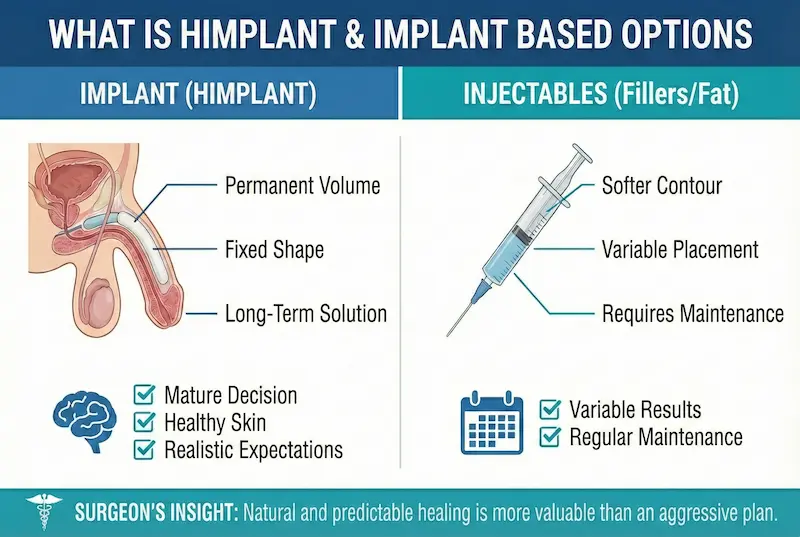
What is Himplant And How Do Implant-Based Options Work?
When people search what is a himplant, they are usually looking for an “implant-based” route to cosmetic enhancement. Implant-based approaches aim to change the external contour and perceived volume by adding a device or structure around existing anatomy. That can sound simple on paper. In practice, the decision is about fit, tissue behavior, safety planning, and what you are willing to manage long-term.
This is also where terms get confused. Implant-based cosmetic enhancement is not phalloplasty. phalloplasty is a reconstructive pathway with different surgical steps, different goals, and a different follow-up reality. If your need is reconstructive, phalloplasty deserves a dedicated consult with a reconstructive team, not a cosmetic menu approach.
How implant-based enhancement differs from fillers and fat
Implants and injectables behave differently because they occupy space in different ways. Injectables can be shaped and can change over time as tissues settle. An implant is a fixed form. That means planning must be stricter, and the “right size” is rarely the biggest option.
- Implants: fixed shape, long-term device considerations, revision planning matters.
- Fat/filler approaches: softer contour options, potential variability during healing, may require maintenance.
- Hybrid planning: sometimes used to refine transitions and proportions, depending on anatomy.
Candidate fit: what matters most for implants
Implant candidacy is about soft-tissue quality and what your skin can comfortably accommodate. Skin envelope behavior matters. Baseline symmetry matters. Your ability to follow restrictions matters even more, because early “stress testing” is where avoidable problems start.
- Skin elasticity and tissue thickness that can support a smooth contour
- Stable weight and stable health (healing predictability)
- Realistic proportional goals (natural-first, not extreme)
- Willingness to follow a structured recovery plan
Safety questions: “Is it safe?” is the right question
Many patients ask is himplant safe before they ask anything else. That’s the right order. Safety depends on proper patient selection, sterile technique, appropriate anesthesia planning, and disciplined aftercare. Device-based options also require a mature mindset: you are choosing a long-term solution, not a temporary experiment.
- Ask about the surgeon’s implant-specific experience and revision strategy.
- Ask how complications are handled and what follow-up looks like after you fly home.
- Ask what “normal” swelling and contour changes look like week-by-week.
Surgeon’s Insight: “In intimate aesthetics, subtle wins. A natural-looking contour that heals predictably is worth more than an aggressive plan that looks forced.”
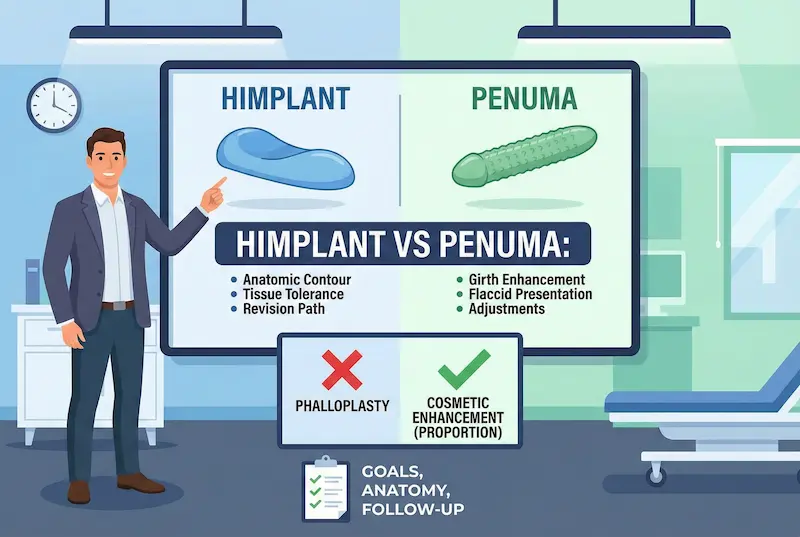
Himplant vs Penuma: How To Compare Them Fairly
The internet turns brand comparisons into a fight. Your body doesn’t care about online arguments. It cares about anatomy, tissue tolerance, and what can heal smoothly. A fair comparison focuses on fundamentals: how a device is intended to sit, what kind of contour it typically aims to create, and how revisions or adjustments are managed over time.
It also helps to keep language clean. Cosmetic implants are not phalloplasty. phalloplasty is reconstructive surgery, often discussed when creating or rebuilding anatomy after major loss or congenital conditions. If you are typing phalloplasty because you want cosmetic enlargement, pause and reframe your goal in proportion terms. If you truly need phalloplasty for reconstruction, choose a center that specializes in phalloplasty from day one.
Start with the only comparison that matters: your goals
Brand names are not the plan. Your plan should define what “success” looks like for you: more even girth contour, improved flaccid presentation, or better overall balance with your body. Once goals are clear, the surgeon can tell you whether an implant-based approach is even the right category.
- If your priority is a conservative, natural contour, size selection must reflect that.
- If your priority is “maximum change,” you should expect higher trade-offs.
- If your priorities are mixed, a staged plan may be safer than “all at once.”
Compare surgeon access and follow-up, not marketing claims
Device-based enhancement is not a one-and-done relationship. You want a team that stays reachable after you leave. In our model, continuity is a non-negotiable standard: structured remote check-ins matter because questions often show up at home, not in the clinic.
Use a practical checklist (and keep it brand-neutral)
A clean comparison uses the same questions for every option. That keeps the decision grounded and protects you from persuasion. Here is a neutral framework you can apply to himplant vs penuma or any other device being discussed.
| Comparison factor | What to ask | Why it matters | What a strong answer sounds like |
|---|---|---|---|
| Candidacy fit | “What makes someone a good candidate for this device?” | Reduces mismatch and avoidable complications | Clear criteria, clear exclusions, no hype |
| Contour goal | “What aesthetic look does it typically aim for?” | Aligns expectations with likely outcomes | Proportion-first language, natural-first planning |
| Revision strategy | “If I need an adjustment, what is the pathway?” | Device choices require long-term thinking | A defined revision plan, not vague reassurance |
| Aftercare & follow-up | “How do you support patients after they return home?” | Most anxiety happens post-op, away from the clinic | Scheduled virtual follow-ups, fast communication access |
One more clarity point, because it keeps coming up in consultations: phalloplasty is not a cosmetic synonym. phalloplasty is reconstructive. Cosmetic enhancement is proportion-focused. Mixing the two can lead to the wrong expectations and the wrong provider choice.
Non-Surgical Options: What Works, What’s Marketing
It’s normal to explore non-surgical routes before considering a procedure. Most people want the lowest-risk path first. The problem is that this space is packed with exaggerated claims, vague “proof,” and advice that ignores anatomy. We prefer a simple filter: if a method promises dramatic size change with zero trade-offs, it is probably selling hope, not results.
This section is not meant to shame curiosity. It’s meant to protect you. Some non-surgical steps can improve appearance, comfort, and confidence—especially when the real issue is proportion, posture, or the pubic fat pad. But if your underlying need is reconstructive, this is where terminology matters again: phalloplasty sits in a different category than cosmetic enhancement, and it should be evaluated through a reconstructive lens, not a marketing lens.
Penis enlargement exercises: a reality check on what they can and can’t do
Searches for penis enlargement exercises often spike because they feel accessible and “natural.” In reality, exercise-based approaches cannot create new penile tissue volume in a predictable way. What they can do, in some cases, is improve pelvic floor control, posture, and self-awareness—factors that may affect confidence more than measurements.
- What exercises may help: pelvic floor strength, perceived control, confidence and comfort.
- What they do not reliably change: structural dimensions of the shaft.
- The real risk: aggressive stretching or “manual techniques” can irritate tissues and create avoidable pain.
If you try any routine, keep it conservative. Pain is a stop sign. If your goal remains purely aesthetic, exercises can be a “supportive” step, not the core solution.
Traction devices and vacuum concepts: where the caution belongs
Devices are another common rabbit hole. Some traction concepts exist in medical contexts, but consumer messaging tends to overpromise. The bigger issue is safety. Too much pressure, too much time, or poor device fit can cause swelling, bruising, and sensitivity changes. That can also complicate future planning if you later choose a procedure.
- Be skeptical of “guaranteed inches” language.
- Avoid protocols that encourage pain, numbness, or discoloration.
- If you have any medical condition affecting circulation or sensation, device use deserves extra caution.
And again, if you are researching phalloplasty because your situation is reconstructive, device experimentation is not the right pathway. phalloplasty planning should be structured, specialty-led, and medically supervised.
When non-surgical steps actually help (and why we sometimes recommend them first)
Some changes are not about adding volume. They are about revealing what’s already there, improving symmetry, and reducing visual “distractions” around the base. For expert patients, these steps can clarify goals before any surgical decision is made.
- Weight stability: fluctuating weight changes the pubic area and alters the visual baseline.
- Pubic fat pad management: lowering that “coverage” can improve visible projection at rest.
- Skin health: irritation and inflammation can distort appearance and comfort.
- Expectation refinement: defining whether you want length, girth, or proportion reduces regret later.
When we see a patient who is unsure, we often start here. It’s a clean way to reduce variables before you invest in a more permanent step.
Combined Procedures: Maximizing Outcomes With One Plan
Combination planning is not about doing “more.” It’s about doing what creates balance. Some patients have a single dominant concern. Others have a proportional concern that cannot be solved with one lever. In those cases, a combined plan can create a more harmonious result—if the plan stays conservative and respects tissue behavior.
There is also a practical advantage: one anesthesia event and one organized recovery window. That matters for international patients and busy professionals. Still, it only works when safety leads the decision. If combining increases risk beyond a reasonable boundary, we do not combine.
When combining makes sense
The most common reason to combine is proportion. A plan that addresses only one dimension can sometimes create an “unfinished” look. Thoughtful combinations may be discussed when a patient’s goals clearly require synergy and the anatomy supports predictable healing.
- Balanced proportion goals: when improving one dimension alone would look incomplete.
- Structured aesthetic planning: when the plan prioritizes smooth contour and symmetry.
- Clear recovery capacity: when a patient can follow restrictions without shortcuts.
This is also where we clarify boundaries. Cosmetic combination planning is not phalloplasty. phalloplasty is reconstructive surgery with different goals, steps, and follow-up demands.
Body contouring combinations (liposuction, ab etching, gynecomastia)
For some patients, confidence is not tied to one area. A proportion-focused plan may involve body contouring elements that improve overall balance and silhouette. Depending on candidacy, this can include liposuction for targeted contour refinement, ab etching for a more athletic definition goal, or gynecomastia surgery when chest contour is a primary concern.
The principle stays the same: conservative planning, anatomy-first decisions, and a recovery plan that protects healing. Adding procedures is never the objective—creating a cohesive, natural result is.
One anesthesia, one recovery: what that really means
“One anesthesia, one recovery” sounds effortless. It isn’t. It means fewer separate procedure days, fewer repeated pre-op tests, and a single structured healing schedule. It can also mean a longer procedure time and more swelling to manage upfront.
- Pros: consolidated planning, fewer separate downtime periods, one coordinated follow-up pathway.
- Trade-off: recovery can feel more “intense” early on because more variables are healing at once.
- What protects results: disciplined restrictions and a predictable, monitored aftercare plan.
Surgeon’s Insight: “A combined plan should look simpler than it is. If the result looks ‘done,’ the plan was too aggressive. Natural-first wins.”
Daddy makeover: what it means (and who it’s for)
Some patients describe their goals as a “daddy makeover”—a practical, proportion-driven reset that may combine core contour procedures (often liposuction, sometimes ab etching, and/or gynecomastia) into one coordinated plan. The right candidate is not the person chasing extremes. It’s the person who wants a natural-looking improvement with a realistic recovery timeline and the discipline to follow restrictions.
Safety boundaries: when combining is not recommended
Not every body benefits from stacking variables. Sometimes the smartest decision is staging. We lean toward staging when predictability matters more than speed, or when risk factors raise the chance of complications.
- Uncontrolled medical conditions that increase healing or anesthesia risk
- Active smoking/vaping that compromises circulation
- High likelihood of non-compliance with restrictions
- Unstable weight or short timeline pressure (“I need it fast”)
- Goals that drift toward extremes rather than proportion
If your situation is reconstructive, the conversation should return to phalloplasty and the right specialty pathway. If your goals are cosmetic, we keep the plan proportional, conservative, and built around safety.constructive, the conversation should return to phalloplasty and the right specialty pathway. If your goals are cosmetic, we keep the plan proportional, conservative, and built around safety.
Anesthesia: Why We Often Prefer Awake / Twilight Sedation
Anesthesia is not a technical footnote. It shapes your comfort, your stress level, and often your first 24 hours after surgery. For many patients, the fear of general anesthesia is the biggest barrier to taking action. We address it directly, with options and clear trade-offs. If you’re researching phalloplasty for reconstructive reasons, anesthesia planning is a different conversation with different complexity and follow-up needs.
Awake vs. twilight vs. general: what each option typically feels like
There are three common categories of anesthesia planning. The right choice depends on the technique, your medical history, and what keeps you calm and safe. No option is “tougher” or “braver.” It’s simply a match.
- Awake (local anesthesia): the area is numbed. You may feel pressure or movement, not sharp pain. You stay responsive.
- Twilight sedation: you are deeply relaxed and often remember very little. You breathe on your own in most cases.
- General anesthesia: you are fully asleep. It’s sometimes the best fit for longer or more complex plans.
Why we often choose Awake / Twilight when it’s appropriate
When the surgical plan allows it, we often prefer Awake Surgery or twilight sedation because it can reduce the overall anesthesia load and make the early recovery experience feel simpler. Many patients also like the idea of avoiding a “black box” experience. It can feel more controlled. This is especially relevant for expert patients who want clarity at every step.
| Option | Common patient concern | Typical advantage | What we monitor closely |
|---|---|---|---|
| Awake (local) | “Will I feel pain?” | Often a lighter post-op anesthesia “hangover” | Comfort, anxiety, blood pressure, local anesthetic limits |
| Twilight sedation | “I don’t want to remember anything.” | Deep relaxation with a softer early recovery for many patients | Airway safety, breathing, level of sedation |
| General anesthesia | “Is it riskier?” | Best for plans that require full immobility or longer operating time | Airway, vitals, nausea prevention, hydration |
When general anesthesia may be the smarter choice
We don’t force an anesthesia philosophy onto a plan that doesn’t fit it. Some techniques and some patients do better under general anesthesia. Safety wins every time. If you have medical conditions that affect breathing, heart rhythm, or medication response, we plan more conservatively.
- Complex or longer surgical plans where full immobility is required
- High anxiety that would make an awake approach stressful
- Medical factors that make sedation depth unpredictable
One more clarity point: phalloplasty is reconstructive surgery, not a cosmetic synonym. phalloplasty often involves a different anesthesia pathway and a different recovery framework. Cosmetic enhancement decisions should not be made through a phalloplasty lens unless reconstruction is truly the goal.
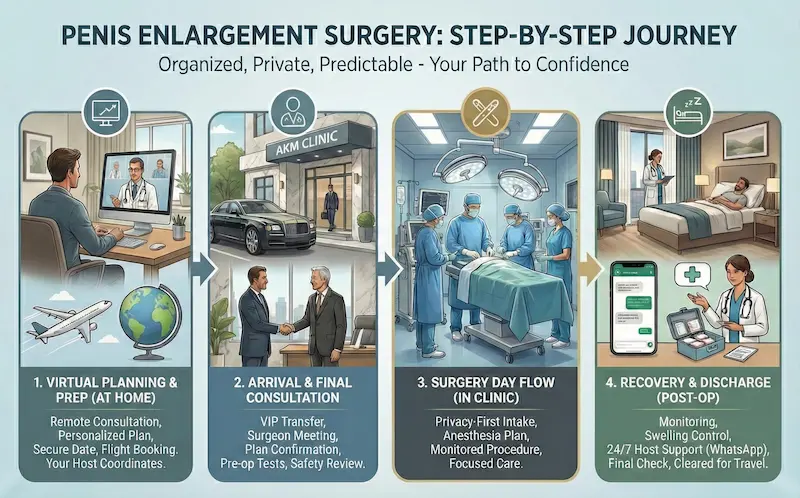
Step-By-Step: What Happens On Surgery Day?
Expert patients don’t want mystery. They want a clean sequence and clear checkpoints. Surgery day should feel organized, private, and predictable. We structure the day to reduce friction, especially for international patients. If you are exploring phalloplasty, your surgery-day timeline may look very different, because phalloplasty planning and aftercare are reconstructive by nature.
Before you arrive: virtual planning and medical preparation
Your process starts at home with a remote consultation. You share your goals and photos for review, then we build a personalized plan and give a transparent, all-inclusive quote. Once you secure your date, your dedicated Patient Host coordinates your hotel and transfers. Your only job is booking your flight.
Arrival and final in-person consultation
On the day of your procedure, we bring you to the clinic with VIP transfer support. You meet your surgeon for the final review and confirmation of the plan. We complete the required pre-operative tests. Then we move into the operating phase in a fully monitored environment.
- Check-in and privacy-first intake
- Surgeon-led confirmation of goals and boundaries
- Pre-op tests and safety screening
- Anesthesia plan review and comfort planning
Immediately after surgery: monitoring, discharge, and first-night support
After the procedure, we monitor you closely before discharge. For many patients, the first night is about rest and swelling control, not “pushing through.” Your Patient Host stays reachable 24/7 via WhatsApp, so questions don’t build into anxiety at the hotel. Before you fly home, we perform a final in-person check to confirm you’re healing well and cleared for travel.
- Recovery monitoring and comfort stabilization
- Medication plan and aftercare instructions
- Clear “red flag” guidance (what requires urgent contact)
- Structured follow-up schedule after you return home
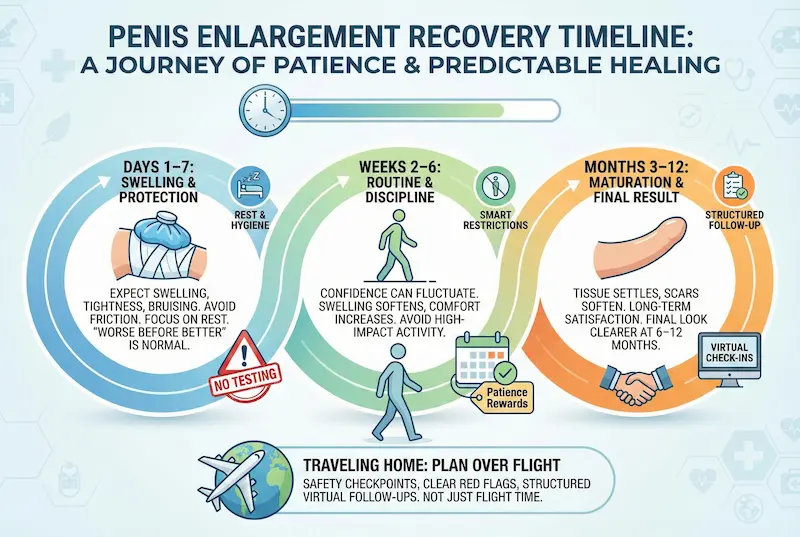
Recovery Timeline: How Long Does Healing Take?
Recovery is not one moment. It’s a sequence. Swelling changes. Sensation can fluctuate. Your mind also catches up in stages.
The most common mistake is “testing” the result too early. Healing rewards patience. The goal is predictable recovery, not speed.
Days 1–7: swelling management and protecting the plan
The first week is about protection. Expect swelling, tightness, and bruising to some degree. Most patients feel better day-by-day, but the area can look “worse before it looks better.” That’s normal.
- What you’ll likely notice: swelling, sensitivity changes, firmness, mild asymmetry from uneven swelling
- Your job: rest, follow hygiene instructions, avoid friction, avoid “checking” the area too often
- What we watch for: increasing redness, fever, sudden worsening pain, unusual discharge
If you’re researching phalloplasty, pause here. phalloplasty recovery is a different pathway with different milestones and follow-up needs than cosmetic enhancement.
Weeks 2–6: returning to routine (with smart restrictions)
This phase is where confidence can rise and fall. You may have days where things look nearly settled, then swelling returns after activity. That swing can feel confusing. It’s still normal.
- What improves: bruising fades, swelling gradually softens, comfort increases
- What still matters: avoiding high-impact movement, minimizing irritation, respecting restrictions
- Why discipline matters: early overactivity is a common driver of delayed healing and contour issues
Months 3–12: maturation and the “final result” window
Cosmetic outcomes mature. Tissue settles. Scars soften. Contour becomes more predictable.
This is also the phase where expert patients appreciate structured follow-up. If you travel for care, you should not feel “on your own” once you fly home.
- What changes slowly: texture, contour smoothness, scar quality
- What we track: symmetry, comfort, long-term satisfaction, any need for adjustment planning
- Reality check: your “final” look is often clearer at months 6–12 than at week 6
Again, phalloplasty is not a cosmetic synonym. phalloplasty is reconstructive surgery. It deserves a reconstructive care team and a reconstructive timeline.
Traveling home: what matters more than flight time
For international patients, the key is not the flight. It’s the plan. We build that plan around safety checkpoints, clear “red flags,” and structured virtual follow-ups after you return home.
- We confirm you’re healing well before you depart.
- We keep communication simple and direct (no guessing games).
- We schedule long-term virtual check-ins so progress stays monitored.
Our Rapid Recovery & Safety Protocol: HBOT + LLLT
Good surgery is only half the outcome. Recovery is the other half. That’s why we treat post-operative healing as a protocol, not a hope.
Our approach is built around two advanced systems: Hyperbaric Oxygen Therapy (HBOT) and Low-Level Laser Therapy (LLLT). Used together, they support healing from the “macro” level (oxygenation) down to the “micro” level (cellular activity).
Why oxygenation matters after surgery
After any procedure, tissues can be temporarily stressed. Swelling can limit circulation. That can slow healing and increase frustration.
We focus on creating the best biological conditions for recovery early. Less inflammation. Better tissue support. Cleaner healing signals.
HBOT: systemic support for tissue survival, swelling control, and infection defense
HBOT exposes you to 100% oxygen in a pressurized environment. The goal is to super-saturate oxygen delivery so it can reach tissues even when circulation is temporarily compromised.
- Why we use it: to support tissue survival and regeneration
- Recovery value: helps reduce inflammation and supports lymphatic drainage
- Safety value: supports infection prevention by strengthening the body’s defense mechanisms
If you’re comparing cosmetic enhancement to phalloplasty, note the difference: phalloplasty protocols are reconstructive and often involve different staging and aftercare logic.
LLLT: targeted cellular acceleration (ATP + collagen support)
LLLT uses a validated therapeutic wavelength to stimulate cellular activity without heat damage. In plain terms, it helps cells produce more usable energy (ATP) and supports collagen-related healing responses.
- Why we use it: to support cellular repair and tissue recovery
- Aesthetic value: supports smoother healing by assisting collagen activity
- Synergy: works as an adjunct to HBOT in a structured “macro-to-micro” sequence
How we integrate this protocol into your plan
Not every patient needs the same intensity. That’s why we tailor recovery support to your candidacy, technique, and healing patterns.
What stays constant is structure. Clear steps. Clear monitoring. Clear follow-up.
Safety & Risks: Is Penis Enlargement Dangerous?
Every surgical decision carries risk. Honest discussion is not pessimism. It’s how expert patients make smart choices.
Risk is not only about the technique. It’s also about patient selection, sterile standards, anesthesia planning, and aftercare discipline. We treat those factors as non-negotiables.
Common side effects (expected, usually temporary)
Most patients experience temporary changes as tissues heal. These are usually manageable with proper aftercare and patience.
- Swelling and bruising
- Temporary sensitivity changes
- Firmness or uneven swelling early on
- Mild discomfort that improves steadily
Less common risks (the ones you should actually ask about)
This is where quality and follow-up matter most. Not because complications are “likely,” but because your plan should be prepared for them if they occur.
- Infection: requires prompt assessment and treatment
- Contour irregularity: may improve with time, sometimes requires adjustment planning
- Scarring issues: texture changes or visible scarring in some individuals
- Revision need: rare, but should be discussed as a realistic possibility
If your situation is reconstructive, this is another key distinction: phalloplasty carries a different risk profile and often a different revision framework than cosmetic enhancement.
How we reduce risk: the parts patients don’t see
Our risk-reduction strategy is built around standards and systems. Not slogans. That includes strict pre-operative screening, advanced monitoring, and a recovery protocol designed to support predictable healing.
- Before surgery: candidacy screening and clear expectation boundaries
- During surgery: monitored environment and anesthesia planning built for safety
- After surgery: structured follow-up and our HBOT + LLLT protocol when appropriate
One final clarity point: phalloplasty is reconstructive surgery. If you need phalloplasty, your safest path is a center that specializes in phalloplasty—start there.
Is Penis Enlargement Safe In Turkey?
“Safe” is not a destination. It’s a system. The safest outcomes come from a clinic that treats safety as a protocol: strict screening, strict sterilization, real monitoring, and structured follow-up after you fly home.
This matters even more for international patients. Distance doesn’t create risk by itself. Unstructured care does.
What “safe” actually means (a checklist you can use anywhere)
If you want an expert-patient way to judge a provider, ignore the marketing and look for operational proof. Ask for specifics. A serious clinic can answer without hesitation.
- Pre-op screening: clear medical criteria and documented “no-go” situations
- Sterilization standards: multi-stage protocols aligned with international guidelines
- Vitals monitoring: modern monitoring during the full procedure, not “basic observation”
- Facility accreditation: verifiable licensing and a regulated surgical environment
- Follow-up model: a defined plan after you return home, not “message us if you need us”
Our safety philosophy: world-class standards without the guessing
We operate with a zero-compromise mindset around hygiene and safety. That means strict pre-operative screening, rigorous sterilization standards, and advanced vitals monitoring throughout every procedure. We also maintain USA-standard confidentiality and data security protocols, because privacy is part of safety.
Then we extend safety beyond the operating room. Our VIP model includes structured support in Istanbul, 24/7 access to your Patient Host via WhatsApp, and long-term virtual follow-ups at 1, 3, 6, and 12 months once you’re back home.
Choosing “near me” vs. choosing a system of care
Search terms like “penis enhancement near me” or “penis enlargement surgery near me” can feel logical. But the highest-value question is often different: “Who has the most reliable system for safety and follow-up?”
This is also where terminology matters. If your situation is reconstructive, phalloplasty belongs in a reconstructive center with a phalloplasty-specific pathway. Cosmetic enhancement and phalloplasty are not interchangeable. phalloplasty is a different operation with different goals and a different recovery reality.
Surgeon’s Insight: “Real safety is boring. It’s checklists, monitoring, and follow-up. That’s what protects results.”
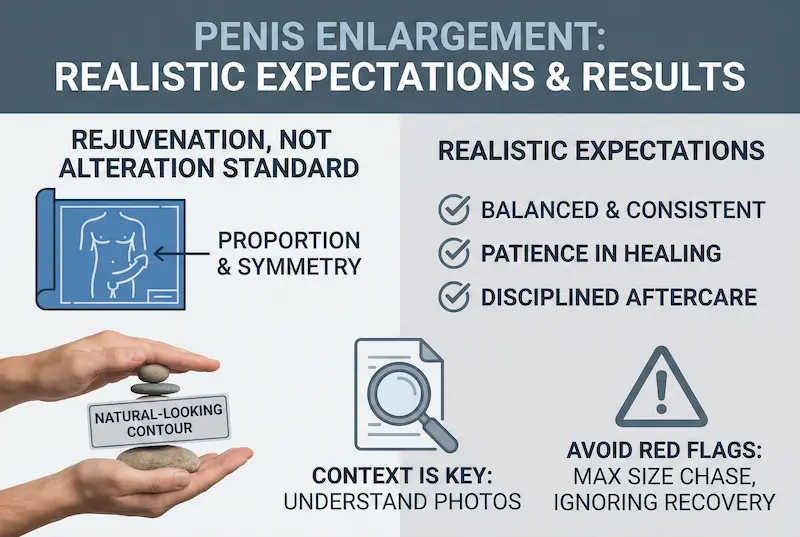
Realistic Expectations & Results: our “Rejuvenation, Not Alteration” Standard
Most disappointment comes from one problem: the wrong mental model. Cosmetic enhancement is not magic. It is planning, anatomy, and controlled change. Our philosophy is simple: rejuvenation, not alteration.
That’s why we focus on proportion, symmetry, and a natural-looking contour. A result can be meaningful without being extreme.
What results usually look like (when planning is honest)
Expert patients tend to describe the goal the same way: “more proportional,” “more confident,” “less self-conscious.” That’s a healthy target. It’s also how you avoid a result that looks forced.
- Best-case outcomes look natural, balanced, and consistent with your body type.
- Early healing can look uneven due to swelling. Final contour takes time.
- Long-term satisfaction correlates with conservative planning and disciplined aftercare.
Why “before and after” needs context
Photos can be helpful, but only if you understand what you’re seeing. Lighting, angle, posture, and swelling stage can distort perception. Ask a provider to explain timeline and technique, not just show a dramatic image.
If you’re comparing options online, you’ll also see searches like himplant reviews and “himplant complications.” Use that intent wisely: look for consistency, transparency, and how a clinic handles follow-up, not just the highlight reel.
Red flags that predict regret
These patterns show up again and again in unhappy outcomes—anywhere in the world.
- Chasing maximum size instead of a natural proportion
- Choosing a technique without accepting its recovery trade-offs
- Ignoring contraindications (smoking, unstable weight, poor healing capacity)
- Expecting a cosmetic procedure to solve a relationship or identity crisis
The phalloplasty confusion: when the keyword is a warning sign
If you keep searching phalloplasty while planning a cosmetic change, pause. phalloplasty is a reconstructive term. phalloplasty is typically discussed when creating or rebuilding anatomy, not when refining proportions. phalloplasty also carries a different risk profile and a different follow-up framework than cosmetic enhancement.
If reconstruction is truly your goal, the safest move is to seek a center that specializes in phalloplasty from day one. If your goal is cosmetic refinement, stay anchored to proportion, safety, and predictable healing.
Cost Analysis: Penis Enlargement Surgery Cost 2026 (USA vs Turkey)
Most expert patients start here. You want a clear baseline before you waste time on consultations that won’t fit your budget or your standards. The problem is that “cost” on the internet is often incomplete, because it mixes surgeon fees, facility fees, anesthesia fees, and aftercare into one vague number. Real planning is simpler when pricing is transparent.
When you search penis enlargement surgery cost or penis enlargement surgery cost us, you’ll see a wide spread. That spread is normal. Technique choice, anesthesia type, and aftercare structure change the total more than people realize.
What drives the total cost
Two patients can request the same goal and end up with different plans. That means different resource needs. Cost follows resources. Not hype.
- Technique category: length-focused, girth-focused, or a combined plan
- Anesthesia: awake/local, twilight sedation, or general anesthesia
- Facility and monitoring: sterile standards, vitals monitoring, safety staffing
- Aftercare system: medications, garments, structured follow-up, rapid recovery support
- Revision planning: responsible surgeons plan for the “what if,” not just the ideal
If your research keeps pulling you toward phalloplasty, that’s another cost reality. phalloplasty is reconstructive surgery. phalloplasty typically involves different steps, different staging, and different follow-up demands than cosmetic enhancement.
Why prices differ internationally (and what this is not about)
International price differences are usually macroeconomics. Exchange rate dynamics and national operational costs change what a clinic must charge to run a high-standard facility. That does not automatically mean lower quality. It does mean you must verify standards, materials, and follow-up structure.
We use an all-inclusive model to remove “hidden variables.” You should know what is included before you fly. You should also know what is not included.
All-inclusive planning: what you should demand in writing
Transparent pricing is a safety tool. It reduces stress, reduces surprises, and lets you compare providers fairly. Here is a practical comparison framework you can use when evaluating the USA vs Turkey value equation.
| Cost component | Often itemized in the USA | How we structure it | Why it matters |
|---|---|---|---|
| Surgeon + facility + OR fees | Separate line items | Included in one transparent quote | Prevents “base price” confusion |
| Anesthesia and monitoring | Often billed separately | Included | Safety is not optional |
| Pre-operative tests | Separate billing is common | Included | Screening reduces risk |
| Medications + garments | May be partial | Included | Consistency improves recovery |
| Hotel + VIP transfers | Almost always out-of-pocket | Included (5-star hotel + VIP airport/clinic transfers) | Reduces logistics stress while healing |
| Long-term follow-up | Varies by provider | Included (virtual follow-ups after you return home) | Distance is safer with structure |
Cost question you should ask every clinic: “What is the full, all-in cost I should plan for, and what is excluded?” If you want implant pricing clarity, ask directly: himplant cost and how much does himplant cost should be answered with a written plan, not a vague estimate.
Contextual next step: If you want a transparent quote built around your anatomy and goals, we start with a free virtual consultation. You share photos for review. We return a personalized plan with a clear, all-inclusive price framework.

Finding The Right Surgeon: What “Best” Really Means
Search engines reward dramatic claims. Your body does not. Choosing the right surgeon is mostly about standards and judgment—how decisions are made when no one is watching. If you search best penis enlargement surgeon in us, you’ll see marketing-heavy pages that avoid specifics. We recommend a stricter approach: verify training, verify board alignment, verify safety systems, and verify follow-up.
This is also where some patients get misdirected by terminology. If your need is reconstructive, phalloplasty belongs in a reconstructive center with a phalloplasty-specific pathway. phalloplasty is not a cosmetic synonym. phalloplasty is a different goal with a different surgical reality.
Credentials that matter (and the questions to ask)
Credentials alone aren’t enough. You want credentials plus a track record plus an honest consultation style. Our standard is European Board Certified-level expertise, with a planning mindset that prioritizes natural results and predictable healing.
- Are they board-certified (or European board equivalent) in a relevant surgical specialty?
- Do they explain options with trade-offs, or do they sell one “perfect” method?
- Do they describe how they prevent complications and how they manage them if they occur?
- Do they offer structured follow-up after you travel home?
What to look for in before/after methodology (without getting fooled)
Photos can inform you, but they can also manipulate you. Ask for consistency, not drama. Same angles. Same lighting. Clear timelines. If a provider avoids details, that’s a signal.
- Multiple time points (early healing vs mature results)
- Consistent framing and lighting
- Honest discussion of swelling and variability
- Clear revision policy if adjustments are needed
Follow-up is part of the surgery
International care is safest when follow-up is designed, not improvised. We build continuity into the journey: 24/7 access to your dedicated Patient Host during your stay, a final in-person clearance before you fly, and scheduled virtual follow-ups after you return home.
If you’re comparing clinics, ask a blunt question: “What happens if I have concerns at week two, from another country?” A confident clinic answers with a system. Not a slogan.
Surgeon’s Insight: “The ‘best’ surgeon is the one who protects your long-term result. That means conservative planning, strict safety standards, and follow-up that doesn’t disappear after you leave.”
Contextual next step: If you want a surgeon-led plan with clear boundaries and a structured follow-up pathway, we can review your goals in a free virtual consultation and tell you—directly—what makes sense for your anatomy.

Your Medical Journey With Us: What To Expect (Arrival To Departure)
For international patients, the journey is part of the medical product. Logistics shape stress. Stress shapes recovery. We built our process to feel structured, private, and predictable from the first call to long-term follow-up.
You should never feel like you’re “figuring it out” in a foreign country. You should feel guided. Step by step.
Free virtual consultation: what we review (and what you receive)
Your journey starts at home with a no-obligation video consultation. You share your goals, your questions, and photos for review. We assess candidacy, define realistic boundaries, and outline what a proportional plan would look like.
Then we give you something concrete: a personalized treatment plan and a transparent, all-inclusive quote.
- Goal clarification (length vs. girth vs. proportion)
- Medical screening questions (risk reduction starts here)
- Recovery expectations and timeline planning
- Clear next steps if you choose to proceed
Secure your date & VIP planning: we remove the friction
Once you decide to proceed, your dedicated Patient Host coordinates the details. We secure your procedure date, arrange your 5-star hotel, and schedule VIP transfers. Your only task is booking your flight.
This matters because recovery is easier when your brain isn’t managing logistics.
- Procedure scheduling and pre-op preparation checklist
- 5-star hotel booking from our curated partner list
- VIP airport and clinic transfers
- Clear instructions so you arrive confident, not anxious
Your personal airport welcome in Istanbul
On arrival (IST or SAW), a private driver meets you at the arrivals gate holding a sign with your name. You’re escorted to a private luxury vehicle and transferred to your hotel to settle in and rest.
No confusion. No “Where do I go?” moments. Just a clean handoff.
Consultation & procedure day: confirm, screen, then operate in a monitored setting
On the day of your procedure, your host arranges your transfer to the clinic. You meet your surgeon for the final review and confirmation of the plan. We complete pre-operative tests, then proceed in a fully accredited, fully monitored environment.
Safety is not a promise. It’s a system.
- Final surgeon-led plan confirmation
- All required pre-op tests completed before surgery
- Advanced vitals monitoring throughout the procedure
- Privacy-first experience from check-in to discharge
Post-op care in Istanbul: 24/7 access and a real clearance step
After your procedure, we monitor you closely before discharge. Your Patient Host remains available 24/7 via WhatsApp, so questions don’t build into anxiety at the hotel. Before you fly home, you have a final in-person check-up to confirm you’re healing well and cleared for travel.
Recovery feels safer when support is reachable.
Long-term follow-up: continuity after you return home
Our commitment doesn’t end when you leave Istanbul. We schedule regular virtual follow-up appointments with your surgeon at 1, 3, 6, and 12 months. It’s structured. It’s predictable. It protects long-term outcomes.
If you ever felt “abandoned” after a procedure in the past, this is the opposite experience.
What’s included package (and what isn’t): clarity protects trust
All-inclusive package pricing is not a marketing trick. It’s a stress reducer. You can compare providers fairly when the quote is comprehensive.
- Typically included: your complete surgical procedure, anesthesia & operating room fees, all pre-operative tests
- Typically included: 5-star hotel accommodation, all VIP airport & clinic transfers
- Typically included: all post-operative medications & garments, first post-op meal
- Typically included: your 24/7 dedicated Patient Host and long-term virtual follow-up care
- Typically not included: international flight tickets, personal travel insurance, personal expenses
- Typically not included: visa fees (if applicable) and additional hotel nights if you extend your stay
Surgeon’s Insight: “Patients remember two things: how safe they felt, and how natural the result looks. A structured journey supports both.”
Penis Enlargemen Surgery Frequently Asked Questions (FAQ):
These are the questions we hear from expert patients every week—especially from the USA. We answer them in a way that helps you compare options safely, not emotionally.
Is penis enlargement the same as phalloplasty?
No. phalloplasty is a reconstructive term with different goals, complexity, and follow-up needs. Cosmetic enhancement focuses on proportion and appearance within existing anatomy, while phalloplasty is typically discussed when creating or rebuilding anatomy.
I keep searching phalloplasty—does that mean I need the wrong procedure?
Not always, but it’s a signal to clarify your intent. If you’re seeking reconstruction, phalloplasty may be the correct pathway and should be evaluated by a reconstructive team. If you’re seeking proportional cosmetic refinement, your plan should be built around cosmetic techniques—not a phalloplasty framework.
“Penis enhancement near me” vs. traveling—what matters more?
Proximity feels safe, but real safety comes from a system: screening, sterile standards, monitoring, and structured follow-up. If your need is reconstructive, phalloplasty belongs in a center that specifically specializes in phalloplasty care pathways.
Is “penis enlargement surgery near me” always the smartest choice?
Not necessarily. The better question is: “Who can plan conservatively, operate safely, and support me long-term?” Distance is manageable when follow-up is structured. For reconstructive needs, phalloplasty requires a dedicated phalloplasty team and timeline.
How do I verify providers when I search “himplant surgeons usa” or “himplant clinic usa”?
Use a strict checklist:
Credentials in a relevant surgical specialty
Consistent before/after methodology (same angles, lighting, timepoints)
A written revision strategy (not vague reassurance)
A structured follow-up model after you return home
If your situation is reconstructive, reframe your search toward phalloplasty centers and phalloplasty outcomes—not cosmetic implant marketing.
How long is himplant recovery time, realistically?
Think in phases: early swelling (days), settling (weeks), maturation (months). Your plan should include restrictions and a week-by-week roadmap—not a one-line promise. If you are comparing to phalloplasty, note that phalloplasty recovery milestones are typically different and often more complex.
Is it normal to compare “himplant miami”, “himplant nyc”, and “himplant turkey”?
Yes. Expert patients compare value across locations. Just compare the right things first: surgeon experience, safety standards, monitoring, and follow-up structure—then compare geography and price. If you actually need phalloplasty, compare phalloplasty expertise and reconstructive follow-up pathways first.
What about international pricing searches like “himplant cost in mexico”?
Cross-border pricing varies for macroeconomic reasons. The key question is what the quote includes in writing: anesthesia, OR fees, pre-op tests, medications, garments, monitoring, and long-term follow-up. If reconstruction is the real goal, phalloplasty costs and planning logic are different from cosmetic enhancement.
What should I do if I’m worried about “himplant reviews” or “himplant complications”?
Don’t look only for praise. Look for transparency and systems:
How the clinic defines “normal” swelling and contour changes week-by-week
Clear red flags that require urgent review
How revisions are handled if needed
For reconstructive needs, prioritize phalloplasty teams that publish clear phalloplasty protocols and long-term follow-up standards.
Does penis enlargement treat erectile dysfunction or performance anxiety?
Cosmetic enhancement is not a primary treatment for erectile dysfunction, hormonal issues, infertility, or chronic pelvic pain. If your concern is reconstructive rather than cosmetic, phalloplasty may be the more relevant term—again, evaluated by a reconstructive team that performs phalloplasty regularly.
“penis enhancement near me” vs choosing a center of excellence: what matters more?
Searching “penis enhancement near me” is logical. Convenience feels like safety. The real safety driver is the system: screening, standards, monitoring, and follow-up.
If two clinics are equal in standards, proximity can break the tie. If they’re not equal, proximity should not be the deciding factor.
Is phalloplasty the same thing as cosmetic enlargement?
No. phalloplasty is a reconstructive term. phalloplasty is typically discussed when creating or rebuilding anatomy, not simply refining proportions. phalloplasty also has a different complexity level, risk profile, and follow-up pathway than cosmetic enhancement.
If reconstruction is your goal, phalloplasty deserves a reconstructive team and a phalloplasty-specific consult. If your goal is cosmetic refinement, keep the planning proportional and safety-led.
What questions should I ask in a consultation?
Bring your “expert patient” mindset:
“Am I a candidate—and who do you turn down?”
“What technique fits my anatomy and why?”
“What are the common side effects, and what are the rare complications?”
“What does week-by-week recovery look like?”
“If I need an adjustment, what is the pathway?”
If the consult keeps drifting into reconstructive territory, ask directly whether phalloplasty is the appropriate pathway and who performs phalloplasty in that system.
Medical Disclaimer: This page is for educational purposes only and does not constitute medical advice. Individual outcomes and recovery timelines vary based on anatomy, health status, and the selected technique. A formal consultation is required to determine candidacy and the most appropriate treatment plan. This content has been reviewed by the AKM Medical Board.