




Chin Augmentation can improve facial harmony by strengthening the lower third and refining the profile. This guide explains chin implants and sliding genioplasty, who benefits most, and what a natural-looking result means. We focus on proportion, conservative planning, and clear decision points—without marketing hype so you can choose the approach.
For U.S. patients comparing costs, Turkey can offer high standards when credentials and hospital systems are verified. At AKM, European Board Certified surgeons plan with 3D imaging, prioritize Awake/Twilight Sedation when appropriate, and support recovery with HBOT and LLLT protocols. You’ll also receive structured virtual follow-up after you return home.
Table of Contents
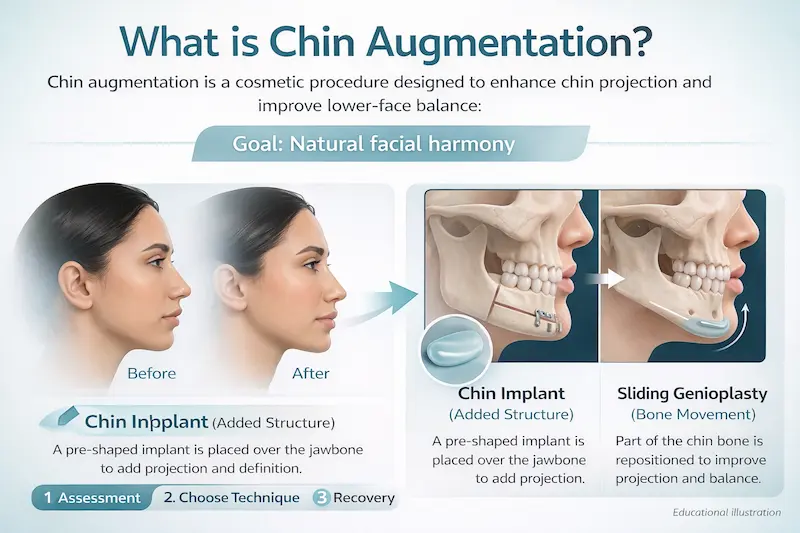
What is Chin Augmentation?
Chin Augmentation is a facial shaping procedure that increases chin projection and improves lower-face balance. Surgeons can do this by moving the chin bone (Genioplasty) or by placing a chin implant. The goal is a natural, proportional profile—not a different face—while preserving your unique features.
Most people notice the chin only when it is out of harmony with the nose, lips, and jawline. A small change can create a big shift in how the lower third of the face reads in photos and real life. The best plans prioritize structure first. We call it “Rejuvenation, Not Alteration.”
Chin anatomy and facial balance: why the lower third matters
The chin is the front “anchor point” of the lower face. Its position influences how defined the jawline appears and how the neck transitions into the jaw. It also affects the perception of lip support and the depth of the labiomental fold (the crease between the lower lip and chin).
- Projection: how far the chin sits forward in profile
- Vertical height: the length of the lower third of the face
- Midline symmetry: how centered the chin point is
- Soft-tissue contour: how smoothly the chin blends into the jawline
That’s why “what is chin augmentation” is rarely just a cosmetic question. It’s really a question about facial proportions.
Terminology: genioplasty, mentoplasty, chin implants, and chin fat grafting
Patients often use several terms for the same goal. The details matter, because the technique changes the recovery, predictability, and the type of improvement you can expect.
- Genioplasty: a surgical repositioning of your chin bone to adjust projection, height, or asymmetry
- Mentoplasty: a broader term that can include bone work or implants to reshape the chin
- Chin implant: a pre-shaped medical implant placed to add projection and contour
- Chin fat grafting: a technique that uses your own purified fat (harvested from another area of the body) to add subtle volume, improve contour, and refine soft-tissue transitions around the chin; it’s typically best for mild enhancement or fine-tuning rather than major structural projection
In real planning, we don’t start with a label. We start with anatomy, bite alignment considerations, soft-tissue thickness, and your aesthetic goal.
The goal: natural definition, not an “operated” look
The “expert patient” usually has one non-negotiable: the result must look like you, just better balanced. That means avoiding over-projection, keeping the chin shape aligned with your jaw width, and respecting your facial identity.
Our European Board Certified Surgeons plan chin enhancement around one principle: create harmony first. If a change looks obvious, it was probably too much.— AKM Surgical Team
Good planning also accounts for how swelling can temporarily exaggerate shape. Early photos are not the final story.
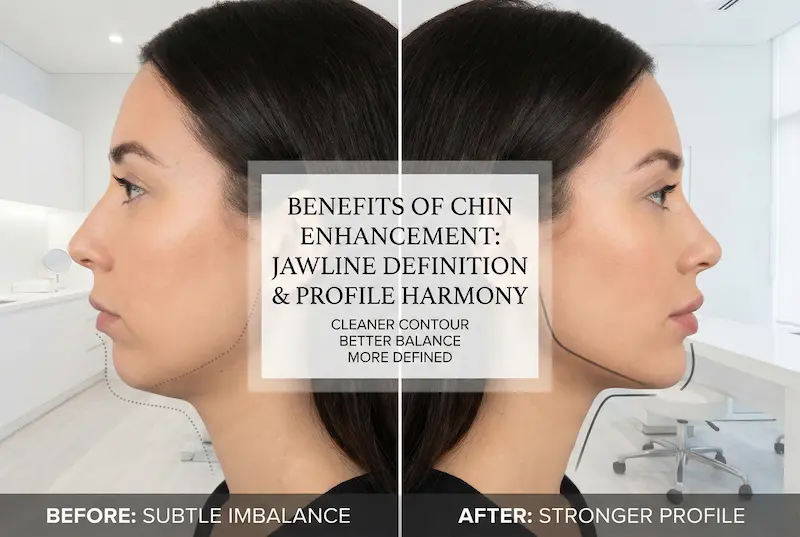
Benefits Of Chin Enhancement: What Changes With a Stronger Profile?
A chin that sits slightly behind ideal balance can make the nose look larger, soften the jawline, and reduce definition between the face and neck. When you restore proportion, the entire lower face often looks cleaner and more structured. It’s a subtle domino effect. You still look like yourself.
Benefits are not “one size fits all.” They depend on your baseline anatomy, skin quality, and whether the goal is projection, symmetry, or jawline definition. The most satisfying outcomes are the ones that match your natural facial architecture.
Jawline definition and lower-face harmony
When the chin gains appropriate support, the jawline often appears sharper even if the jaw bone itself does not change. This is especially true when the improvement reduces visual “collapse” in the front of the jawline.
- More defined separation between jawline and upper neck
- Cleaner contour in three-quarter angles (the “Instagram angle”)
- Better balance between chin point and jaw width
- A profile that reads stronger without looking heavy
Profile balance: the nose–lip–chin relationship
Many patients pursue chin enhancement after noticing a profile imbalance in side photos. In some cases, the chin is the missing piece. In others, a combined approach with rhinoplasty may make more sense.
- A more proportional relationship between the nasal tip and chin point
- Improved lower-face support under the lower lip
- A smoother transition from lip to chin (less “tucked in” look)
Even modest projection can change how “strong” or “soft” a profile appears.
Male goals: definition without overcorrection
male chin augmentation planning typically prioritizes a straight, confident profile and stronger lower-face structure. The target is often a firmer chin-jaw continuity, not a pointed or overly narrow shape.
- Emphasis on forward projection with natural width
- Support for a more defined jawline appearance
- Avoiding exaggerated height or an artificial “blocky” look
The best male results look unremarkable to others. They just make the face look more balanced.
Am I a Good Candidate For Chin Augmentation?
Good chin enhancement starts with honest candidacy. Not everyone benefits from adding projection, and not every “weak chin” is a chin problem. Sometimes the issue is bite alignment, soft-tissue thickness, or neck-chin contour rather than bone position. The goal is to choose the option that improves balance without creating tension, distortion, or an overdone profile.
In our consultations, we look at your face in motion and at rest. Photos help, but real-life dynamics matter. We also screen your health history carefully, because safety is not negotiable. A beautiful plan that ignores candidacy is a risky plan.
Who typically benefits from chin enhancement?
Most ideal candidates share one trait: their lower face looks slightly under-supported in profile or three-quarter views. You may be a strong candidate if you notice:
- A chin that sits behind the lips in profile (creating a softer jawline)
- A less defined transition between the jawline and upper neck
- Lower-face imbalance where the nose appears more dominant than it is
- Mild chin asymmetry that becomes obvious in photos
Age matters less than anatomy. A younger patient may want structural definition. A mature patient may want better lower-face harmony as tissues shift over time.
Who should delay, avoid, or get a different evaluation first?
Some situations need extra caution. Chin enhancement can still be possible, but only after the right assessment and timing. Common reasons to pause include:
- Active infection, uncontrolled medical conditions, or smoking habits that raise healing risk
- Unstable dental or bite issues that should be evaluated first
- Severe jaw discrepancies where orthognathic evaluation may be more appropriate
- Expectations that require a “perfect” or instantly final result
Recovery takes time. Swelling can temporarily exaggerate shape, especially in the first weeks. If you need a specific “event date,” we plan backward from that.
What we evaluate during candidacy screening
Our approach is structured and practical. We focus on facial proportions, symmetry, and the safest path to your goal. During candidacy screening, we typically review:
- Profile balance: nose–lip–chin relationship and overall facial harmony
- Chin height and projection needs (not just “more” or “less”)
- Soft-tissue thickness and how it may influence definition
- General health screening to confirm surgical readiness
Our European Board Certified Surgeons plan conservatively. We’d rather under-correct slightly than chase an aggressive look that doesn’t age well.— AKM Surgical Team
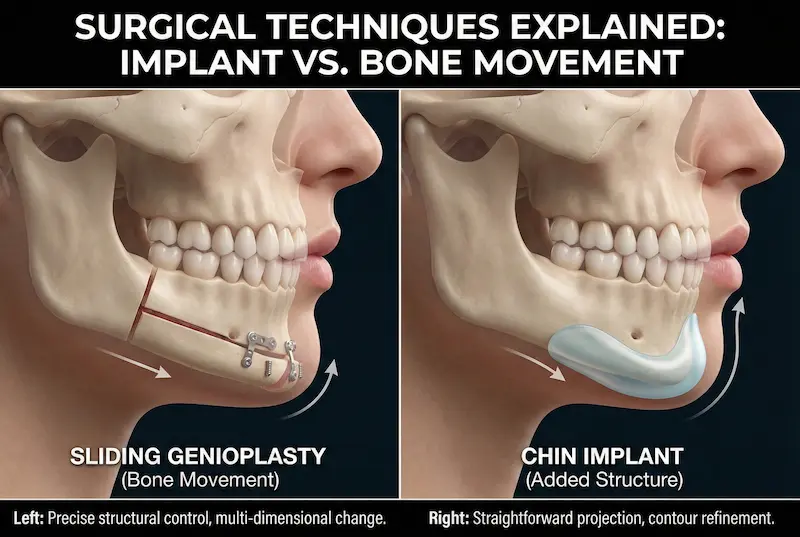
Surgical Techniques Explained: Implant vs Bone Movement
There are two main surgical paths: moving your own bone or adding structure with an implant. Both can produce natural results when chosen for the right anatomy. The best option depends on what needs to change: projection, vertical height, asymmetry, or contour. This is where “expert patients” usually want specifics, not marketing language.
Technique choice also affects recovery and predictability. Bone movement offers powerful structural control. Implants can be a clean solution for straightforward projection needs. The key is matching the tool to the problem.
Sliding genioplasty: structural control with your own bone
A sliding genioplasty is a form of bone-based chin surgery where the chin segment is repositioned to improve projection, height, or symmetry. Because it uses your own bone, it can be ideal when the plan requires more than simple forward projection.
This category also includes variations often searched as types of genioplasty. For example, if the chin is too prominent or too tall, a surgeon may discuss a reduction genioplasty approach as part of the planning logic.
- Best for: multi-dimensional change (projection + height and/or asymmetry)
- Key advantage: precise structural control without relying on an implant
- Trade-off: typically a more involved recovery than a simple implant case
Chin fat grafting: subtle contour refinement using your own fat
Chin fat grafting uses purified fat (harvested from another area of the body) to add gentle volume, smooth transitions, and refine chin and lower-face contour. It can be used as a standalone option for mild enhancement or as a finishing step alongside other procedures to improve soft-tissue balance.
- Best for: mild projection needs, soft-tissue contour refinement, and “fine-tuning” rather than major structural change
- Key advantage: uses your own tissue to create natural-looking softness and improved transitions
- Trade-off: results can be less precisely predictable than bone movement, and some volume may resorb over time
Chin implant types: when straightforward projection is the goal
A chin implant adds definition by placing a medical-grade implant over the chin bone. This can be a smart choice when you want predictable forward projection and contour with a simpler surgical plan.
Implants come in different shapes and profiles. The “right” design depends on your jaw width, chin point shape, and how much definition you need in the front versus the sides. Oversizing is the biggest mistake. It can create an obvious, unnatural look.
- Best for: projection and contour when bone height and asymmetry are not primary issues
- Key advantage: efficient approach with a focused change
- Trade-off: less control over vertical height and complex asymmetry
Chin implant vs genioplasty: how we decide
Patients often search sliding genioplasty vs chin implant because they want a clear answer. The truth is simple: if you need multi-dimensional structural correction, bone movement tends to make more sense. If you need clean projection and contour, an implant can be enough. Your soft tissues, bite considerations, and symmetry goals guide the final decision.
| Decision Factor | Implant-Based Chin Enhancement | Sliding Genioplasty |
|---|---|---|
| Main strength | Forward projection and contour | Projection + height + symmetry control |
| Best for | Straightforward “under-projection” | Multi-dimensional structural planning |
| Adjusts vertical height? | Limited | Yes (when planned) |
| Handles asymmetry? | Mild cases | Stronger option for structural asymmetry |
| Recovery complexity | Often simpler | Often more involved |
| Natural-look risk | Highest if oversized | Highest if over-advanced |
Whichever path you choose, the goal stays the same: balanced proportion and a result that doesn’t announce itself.
Non Surgical Chin Augmentation: When It Helps, When It Doesn’t
Non surgical chin augmentation is usually done with injectable dermal fillers to improve projection, soften a chin crease, and enhance contour. It can be a smart “test-drive” for patients who want a subtle improvement without committing to surgery. That said, fillers have limits. They cannot truly reposition bone, and they are not the best solution for significant recession, structural asymmetry, or patients seeking long-term definition.
For the expert patient, the key question isn’t “Can filler add volume?” It’s “Will filler create the right shape safely, predictably, and proportionally?”
Dermal fillers for chin projection: what they can realistically do
Fillers can add forward projection and improve the visual balance of the lower face. They can also refine the chin point and help smooth transitions along the jawline in selected cases.
- Best for: mild under-projection, early contour refinement, and patients exploring a subtle change
- Strength: immediate improvement with minimal downtime
- Limit: volume alone can’t solve structural problems, and too much filler can look puffy rather than defined
When filler is used to compensate for a structural deficiency, the face can lose definition over time instead of gaining it. That’s why a conservative, anatomy-first plan matters.
How long does non-surgical chin enhancement last?
Longevity depends on the product used, how much is placed, your metabolism, and how your tissues respond. In general, non-surgical results are temporary and require maintenance. This can be an advantage if you want flexibility, but it can become a drawback if your goal is a long-term structural improvement.
- Expect a maintenance mindset rather than a “one-and-done” outcome
- Understand that repeat treatments may be needed to maintain definition
- Be cautious with frequent high-volume treatments that can blur facial contours
When surgery is the smarter choice
If you want a durable structural change, surgery is often the better fit. We typically discuss surgical options when a patient has:
- Moderate-to-significant chin recession that needs true structural correction
- Chin asymmetry that requires bone-based planning rather than volume camouflage
- A strong preference for long-term definition and one recovery period
- Concerns about repeated filler costs and upkeep over time
Non-surgical treatment can be a bridge, but it should not be a compromise that delivers an unstable or unnatural contour.
Combined Procedures: Maximizing Balance With One Recovery
Chin enhancement rarely exists in isolation. The chin is part of a system: nose, lips, jawline, and neck contour all contribute to how your face reads. For many patients, combining procedures can produce a more complete, natural-looking result—while consolidating recovery time.
Our planning philosophy is simple: combine only when it improves harmony and safety, not because it sounds “more dramatic.”
Rhinoplasty + chin balancing: the profile strategy
One of the most powerful combinations is rhinoplasty with chin support. Many patients assume the nose is “too big,” when the chin is simply under-projected. In the right patient, chin augmentation can make the nose look more proportional—sometimes even without major nasal change.
- Why it works: the profile is a relationship, not a single feature
- Planning focus: proportion and facial identity, not a template result
- Outcome goal: a balanced side view that still looks like you
Jawline definition bundles: chin + lower-face contour
If your goal is a cleaner jawline, we may discuss adjunct contour strategies depending on your anatomy—especially around the chin–neck transition. In selected patients, improving chin support can enhance jawline definition, and targeted contouring can amplify that effect.
- Chin support can sharpen the front of the jawline
- Neck–jaw transition can look cleaner when lower-face proportions improve
- Combination planning should remain conservative to keep the result natural
When a facelift or temporal lift may be considered
In patients whose primary concern is lower-face heaviness, jowling, or neck laxity—not just chin projection—chin enhancement may be paired with facial lifting approaches to restore a more defined contour. Depending on anatomy and goals, this can include a deep plane facelift or a SMAS facelift to address deeper support and improve lower-face definition. For upper-face balance and lateral brow/temple concerns, a temporal lift may be discussed to refine the frame of the face.
- Deep plane facelift: may be considered for more comprehensive midface-to-jawline support in appropriate candidates
- SMAS facelift: may be considered to improve lower-face structure and jawline definition when laxity is a key driver
- Temporal lift: may complement overall facial balance when temple/brow position affects facial harmony
These combinations are never “default.” They’re considered only when they improve harmony and safety based on a structured evaluation.
When bite and jaw alignment should be evaluated first
Not every lower-face imbalance is solved at the chin. If you have significant bite concerns, jaw discrepancies, or functional symptoms, the correct pathway may start with a jaw alignment evaluation. Cosmetic chin surgery can still be part of the journey—but it must be planned responsibly around function and long-term stability.
For the expert patient, this is a critical safety signal: the best plan is the one that respects function first and aesthetics second—because stable results depend on both.this is a major safety signal: a clinic should never “sell” chin surgery if the real driver is skeletal alignment that needs a different specialist pathway.
Anesthesia: Why We Prefer Awake / Twilight Sedation
Anesthesia choice is not just a comfort issue—it is a safety and recovery issue. At AKM Clinic, we often prefer Awake / Twilight Sedation for appropriate candidates because it can provide a calmer experience, support smoother early recovery, and align with a safety-first philosophy. Not every patient qualifies, and not every plan can be done under sedation—but when it fits, it can be a meaningful differentiator.
We select the anesthesia approach based on the procedure complexity, your health profile, and what creates the safest environment for you.
What “Awake / Twilight Sedation” actually means
Twilight sedation is designed to keep you deeply relaxed and comfortable while maintaining stable, controlled responsiveness. Patients typically have limited memory of the procedure and experience reduced anxiety compared to a fully awake state. The goal is a smooth surgical experience without the intensity of deep general anesthesia when it isn’t necessary.
- Patient experience: calm, comfortable, minimal awareness of time passing
- Clinical goal: stable physiology, controlled comfort, predictable recovery
- Planning principle: match anesthesia depth to surgical need
Why sedation can support a smoother recovery
Recovery is not only about the surgery itself. Nausea, grogginess, and early discomfort can shape how patients feel during the first 24 hours. When sedation is appropriate, it can help reduce the intensity of the immediate post-procedure period and support a more controlled start to healing.
- Many patients report a more manageable early post-op experience
- Reduced anxiety can support better early rest and recovery compliance
- Our approach prioritizes comfort without compromising safety standards
When general anesthesia may be the better choice
General anesthesia is sometimes the safest and most practical option—especially for more complex combinations or when a patient’s medical profile or anxiety level makes sedation less suitable. We never force a “one-method-fits-all” approach. The right choice is the one that supports safety, surgical precision, and a stable recovery.
- Complex plans: multi-procedure combinations may require deeper anesthesia
- Medical considerations: individual health factors can influence the safest option
- Patient comfort: a calm, controlled experience is part of responsible care
If you are comparing options internationally, anesthesia strategy is one of the most important “expert-level” evaluation points—not a small detail.
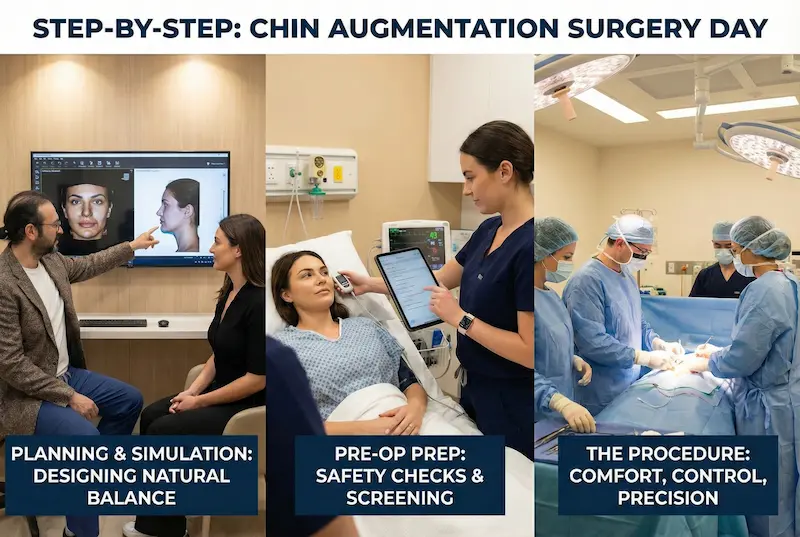
Step-By-Step: What Happens On Surgery Day?
For most patients, the experience is smoother when the timeline is predictable. We structure chin augmentation around three priorities: (1) precise planning, (2) controlled surgical execution, and (3) a recovery protocol that supports comfort and safety. Whether you choose a chin implant or a form of genioplasty, the day-of process is designed to feel organized—not rushed.
Planning and simulation: how we design a natural result
Before surgery, we focus on proportion, not “maximum projection.” When appropriate, we use 3D imaging to help visualize facial balance and guide decision-making. The objective is not to chase a template chin—it’s to build harmony with your nose, lips, and jaw width.
- Profile evaluation: nose–lip–chin relationship in multiple angles
- Symmetry check: midline alignment and chin point position
- Technique selection: implant vs bone movement based on anatomy and goals
Expert-level planning also anticipates swelling patterns so early post-op photos aren’t misread as “final results.”
Pre-op preparation: safety checks that matter
We do not treat pre-op steps as paperwork. They are part of risk reduction. Your medical history, medication use, and lifestyle factors (including smoking) can meaningfully affect healing and complication risk.
- Medical screening and required tests based on your case
- Medication guidance (what to pause and what to continue, as medically appropriate)
- Clear instructions for nutrition, hydration, and post-op support planning
If something doesn’t look right, we slow down and reassess. A good outcome starts with a safe “green light.”
The procedure experience: comfort, control, and precision
On the day of surgery, your care team guides you through a structured flow: admission, marking and final confirmation, anesthesia/sedation, and the procedure itself. If you are a candidate for awake/twilight sedation, the goal is a calm experience without unnecessary intensity—while maintaining a safety-first environment.
- Final verification: confirm the plan and expected change in simple terms
- Anesthesia plan: tailored approach based on complexity and candidacy
- Procedure execution: focused, conservative shaping for a natural result
After surgery, we prioritize monitoring, clear home-care instructions, and a follow-up schedule that keeps you supported—especially if you’re traveling internationally.
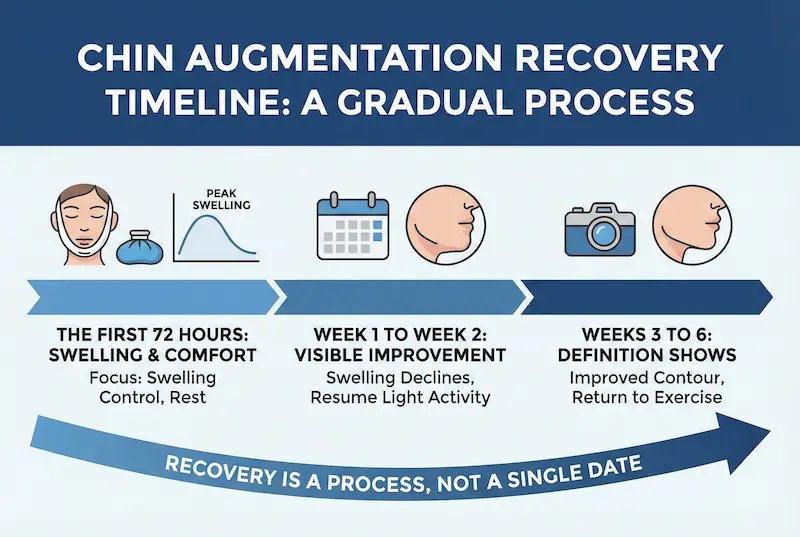
Chin Augmentation Recovery Timeline: How Long Does Healing Take?
Recovery is a process, not a single date. Most patients feel significantly better week by week, but tissues continue to settle over time. Your technique (implant vs genioplasty), your biology, and how well you follow instructions all influence the timeline. We plan recovery with realism: controlled swelling, safe return to routine, and steady improvement—not overnight perfection.
The first 72 hours: swelling management and comfort
The first few days are usually about swelling control, rest, and keeping things simple. You may feel tightness, pressure, and temporary changes in sensation. This is expected. The goal is to reduce inflammation, protect the surgical area, and support calm healing.
- Swelling and mild bruising typically peak early
- Comfort improves with rest, hydration, and following the prescribed plan
- We give clear guidance on hygiene, diet texture, and activity limits
Expert tip: if you are judging your result in the first week, you are judging swelling—not outcome.
Week 1 to Week 2: visible improvement and routine return
Many patients start feeling “more like themselves” during this phase, even though swelling is still present. Social downtime varies by technique and individual healing response. Our job is to help you return to routine safely—not prematurely.
- Swelling begins to decline, but may fluctuate during the day
- Most patients can resume light activity with guidance
- We monitor for early warning signs and keep instructions simple and specific
Weeks 3 to 6: definition starts to show
This is often when patients begin to see the “shape” emerging more clearly. The chin looks less puffy, facial angles look cleaner, and photos start to reflect the true direction of the outcome. Minor asymmetries can still be swelling-related and usually settle gradually.
- Improved contour and more stable appearance in photos
- Progressive return to normal exercise (as cleared for your case)
- Ongoing tissue settling, especially for more involved structural changes
Our Rapid Recovery & Safety Protocol: HBOT + LLLT support
When clinically appropriate, we integrate supportive technologies aimed at optimizing comfort and recovery quality. This may include Hyperbaric Oxygen Therapy (HBOT) and Low-Level Laser Therapy (LLLT) as part of a broader recovery strategy. These are not “magic shortcuts.” They are tools we use to support tissue recovery and swelling management in a structured, monitored way.
- HBOT: used in selected cases to support recovery conditions under medical supervision
- LLLT: used to support swelling and comfort as part of a planned post-op pathway
- Protocol mindset: consistent follow-up, clear instructions, and risk-aware monitoring
What matters most is not a single therapy—it’s the entire system: planning, execution, and follow-through.
Safety & Risks: Is Chin Augmentation Dangerous?
Every surgery carries risk, and responsible clinics address this directly. Chin augmentation is generally safe in appropriately selected patients when performed by experienced, board-certified surgeons in a properly equipped hospital environment. The expert patient should ask two questions: “What are the realistic risks?” and “What systems reduce those risks?”
General surgical risks (in plain language)
General surgical risks can include infection, bleeding, delayed healing, scarring concerns, and anesthesia-related issues. Most risks are uncommon, but they are real—and they should be discussed clearly before you decide.
- Infection risk and how it’s minimized with protocols
- Swelling patterns and temporary discomfort expectations
- Individual healing variation and the importance of follow-up
Technique-specific considerations: implant vs genioplasty
Different techniques come with different risk profiles. That’s why “chin implant vs genioplasty” is not just an aesthetic choice—it’s also a safety decision.
- Implant-specific considerations: positioning stability, infection risk, and the importance of correct sizing
- Genioplasty-specific considerations: bone healing, temporary sensation changes, and precision planning
- Key principle: most avoidable problems start with poor candidacy or overly aggressive planning
We plan conservatively because long-term natural results are usually built on restraint, not extremes.
How we reduce risk: our safety-first framework
Risk reduction is not a single step—it’s a chain. We focus on surgeon credentials, hospital-grade standards, pre-op screening, and structured follow-up. For international patients, continuity of care matters even more.
- Proper setting: hospital-based environment with appropriate monitoring
- Material standards: appropriate, medically approved implant materials when implants are used
- Planning discipline: correct technique choice, conservative sizing, and symmetry control
- Aftercare: scheduled follow-ups and clear escalation pathways if you have concerns
If a clinic avoids talking about risks, that is a red flag. Professional care is transparent care.
Is Chin Augmentation Safe in Turkey?
This is the question behind most “medical tourism” searches—and the expert patient is right to ask it. “Turkey” is not a safety credential by itself, just like “USA” is not a guarantee. Safety depends on the surgeon’s credentials, the hospital standard, the anesthesia system, and the follow-up structure. If you evaluate those elements rigorously, you can make a smart, safety-first decision.
Hospital standards: where your surgery is performed matters
One of the strongest safety signals is the setting. Chin augmentation should be performed in a properly equipped, hospital-grade environment with monitoring and protocols that support surgical safety and controlled recovery.
- Operating environment: hospital-grade sterility and monitoring standards
- Anesthesia safety: structured sedation/anesthesia planning and oversight
- Post-op monitoring: immediate recovery observation and clear escalation pathways
If a clinic cannot clearly explain the surgical setting and safety systems, that’s a red flag—regardless of country.
Surgeon credentials: the “expert patient” filter
For patients searching “best genioplasty surgeon” or “best chin augmentation,” the real answer is not a ranking list—it’s verified credentials and a consistent, conservative planning philosophy. Your surgeon should be able to explain technique selection (implant vs sliding genioplasty), show stable outcomes, and discuss risks without minimizing them.
- Board certification: credentials that reflect verified training and standards
- Case appropriateness: a surgeon who can say “no” when needed
- Transparency: clear discussion of risks, recovery, and realistic limits
Privacy and patient experience: what VIP care should actually mean
VIP medical travel should not mean “luxury marketing.” It should mean clarity, privacy, and coordination: protected logistics, discreet scheduling, and a team that manages your steps so you can focus on healing.
- Private coordination for transfers, accommodations, and scheduling
- Clear communication and documentation before and after surgery
- Structured follow-up for international patients (not “good luck after you fly home”)
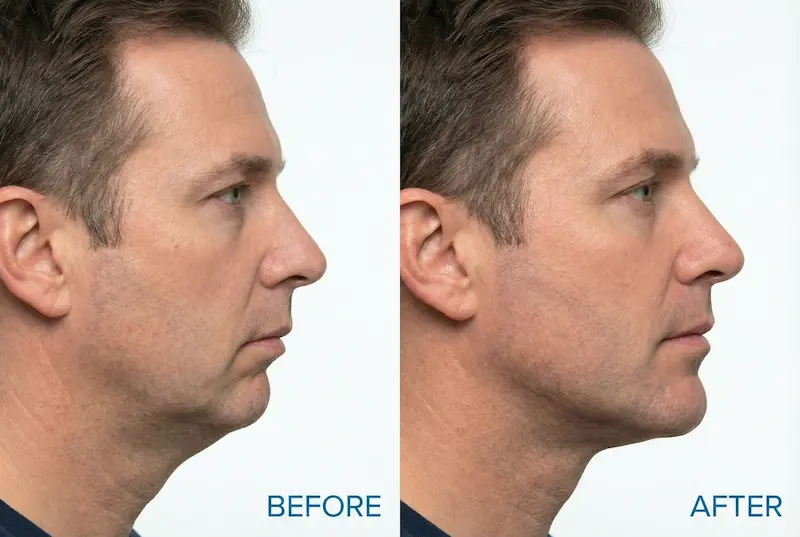
Realistic Expectations & Results: The Natural-Looking Goal
The best chin augmentation is the one nobody notices as “surgery.” People just think you look more balanced. That outcome comes from conservative planning, correct technique selection, and patience during the healing timeline. Expert patients do well when they treat recovery as a process—because it is.
When you’ll see the “real” result
Early changes can look dramatic because swelling temporarily increases volume and blunts definition. The direction of improvement is visible early, but refinement continues as tissues settle.
- Early phase: swelling can make the chin look larger or less defined than intended
- Mid phase: contour becomes clearer as inflammation declines
- Settling phase: definition and symmetry stabilize progressively
If you’re comparing photos, compare “later to later,” not “day 5 to final.”
Scars, incisions, and what “minimal” really means
Scar visibility depends on incision location and how your body heals. The goal is always strategic access with minimal external evidence. Your surgeon should explain the approach in plain language and how it fits your anatomy and technique choice.
- Implant cases: approach is selected to balance access and discreet healing
- Genioplasty cases: planning focuses on structure and safe bone healing
- Healing reality: “minimal scar” still requires good aftercare and time
Sensation and stiffness: what can be normal during healing
Temporary tightness and altered sensation can occur during healing. This is usually part of tissue recovery and swelling dynamics, not a “bad outcome.” What matters is how it trends over time and how your clinic monitors you.
- Expect tightness and firmness early as swelling resolves
- Temporary sensation changes can occur and typically improve gradually
- Follow-up is essential—especially if you’re traveling internationally
Cost Analysis: Chin Augmentation Cost 2026 (Turkey vs USA)
Cost research is rational—especially for patients in high-cost U.S. cities. Searches like “genioplasty cost NYC,” “chin augmentation cost Los Angeles,” or “chin implant Miami” often reflect a deeper question: Can I get the same or better standard of care for a more rational total cost? The expert approach is to compare value, not just price.
What drives the cost of chin augmentation?
Chin augmentation cost is shaped by more than the procedure itself. The total cost typically reflects:
- Surgeon expertise: training, credentials, and complexity of planning
- Hospital and anesthesia: safety infrastructure and monitoring standards
- Technique: implant vs sliding genioplasty (complexity and operative time)
- Recovery system: structured aftercare and follow-up pathways
This is why two “chin augmentation” quotes can be fundamentally different products.
Turkey vs USA: the expert way to compare NYC, LA, and Miami
In the U.S., pricing in NYC, Los Angeles, and Miami often reflects overhead, staffing, and facility costs as much as surgical complexity. In Istanbul, the economic structure can make high-standard care more accessible—without requiring a “budget clinic” compromise.
- Use U.S. quotes as reference points (NYC/LA/Miami) to understand the premium you’re paying for location
- Compare safety systems (hospital standards, anesthesia planning, surgeon credentials)
- Compare recovery support (structured follow-up and protocols, not just the operating room)
If your search includes “genioplasty cost Turkey” or “chin implant cost Turkey,” make sure the comparison includes what’s included—and what’s missing.
What a responsible “all-inclusive” plan should include
For international patients, value includes coordination and continuity. A strong all inclusive package should clearly outline what’s included so you can compare honestly across borders.
- Pre-op evaluation and clear documentation
- Hospital, anesthesia, and surgical team coordination
- Post-op follow-ups and guidance for your return to the U.S.
- Optional recovery-support tools (when clinically appropriate)
We design the journey to remove friction, reduce uncertainty, and keep safety central.
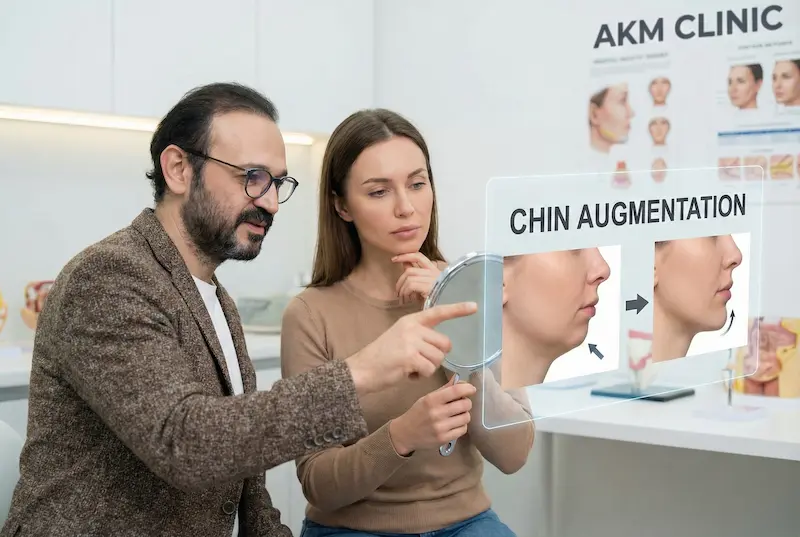
Finding The Right Surgeon: What Matters For Outcomes
Search terms like “best genioplasty surgeon” or “best chin implant surgeon Los Angeles” are common—but “best” is not a marketing claim. It’s a set of verifiable standards. The right surgeon is the one who can plan conservatively, explain clearly, and prioritize safety over speed.
Credentials and standards: what to verify
Start with credentials you can verify, not testimonials alone. Your surgeon should be transparent about training, board recognition, and the clinical environment where surgery is performed.
- Verified board credentials and surgical focus
- Hospital-grade operating environment
- Clear, documented safety protocols and follow-up structure
What to ask in a consultation (expert-level questions)
A good consultation should feel like a planning session, not a sales call. Consider asking:
- “Which technique fits my anatomy: chin implant vs genioplasty—and why?”
- “How do you prevent over-projection and keep results natural?”
- “What is my realistic recovery timeline and when will I look ‘socially normal’?”
- “What follow-up system do you provide after I travel home?”
Red flags that should make you pause
The biggest red flags are not always medical—they’re behavioral. If a clinic discourages questions, avoids risks, or promises perfection, be cautious.
- Guaranteed outcomes or “no risk” claims
- Pressure tactics or rushed decision-making
- Vague answers about anesthesia, hospital setting, or follow-up
Your Medical Journey With AKM: From First Call To Follow-Up
International care should feel structured and predictable. We built our system around the expert patient’s priorities: clarity, verified standards, and continuity after you return home. If you’re searching “chin implant Turkey” or “genioplasty surgery near me” but want a safer, more coordinated alternative, the journey structure matters.
Virtual consultation: clear planning before you travel
We begin with a remote evaluation designed to clarify candidacy and technique direction. You should leave the consultation understanding the “why” behind the plan—not just a procedure name.
- Goal clarification (projection, symmetry, definition, or combined strategy)
- Technique discussion: implants vs sliding genioplasty and expected trade-offs
- Realistic timeline planning for recovery and travel
Travel and logistics: coordinated steps, less uncertainty
Medical travel should not feel chaotic. We help coordinate key logistics so your focus stays on recovery.
- Airport transfers and scheduling coordination
- Clear pre-op instructions and documentation
- A calm, structured surgery-day flow
Aftercare and long-distance follow-up: continuity matters
The end of surgery is the start of recovery. We provide structured follow-up and guidance designed for international patients, including clear milestones and escalation steps if you have concerns.
- Post-op check schedule and recovery instructions
- Support for swelling management and activity progression
- Long-distance follow-up framework after returning to the U.S.
Chin Augmentation Frequently Asked Questions (FAQ):
Below are the questions we hear most from U.S.-based patients researching chin enhancement. The goal is clarity, not hype. Every face has different bone structure, soft-tissue thickness, and healing behavior, so the “right” option depends on anatomy and goals. If you want a precise recommendation, a consultation is the safest way to confirm candidacy and technique.
What is chin augmentation?
Chin augmentation is a procedure that improves lower-face balance by increasing chin projection and refining contour. We achieve this either by repositioning the chin bone (genioplasty) or adding structure with a chin implant. The goal is a natural-looking profile that still looks like you.
Sliding Genioplasty vs Chin Implant: Which Is Better?
Neither is universally “better.” The right choice depends on what needs to change: projection only, vertical height, asymmetry, or overall contour. Sliding genioplasty offers stronger structural control because it repositions your own bone, while a chin implant can be a clean solution for straightforward projection needs.
Choose genioplasty when you need multi-dimensional change (projection + height and/or asymmetry).
Choose an implant when your goal is primarily forward projection and contour.
Types Of Genioplasty: What Does That Include?
“Types of genioplasty” usually refers to different ways the chin bone can be repositioned to correct specific problems. Some plans focus on forward movement for projection, while others address height or asymmetry. In selected cases, a surgeon may discuss a reduction approach when the chin is overly prominent or too tall.
What Is The Difference Between Mentoplasty And Genioplasty?
Genioplasty specifically means repositioning the chin bone. Mentoplasty is a broader term that can include bone work, implants, or other reshaping methods to change the chin’s appearance. In real planning, the label matters less than matching technique to anatomy.
Chin Implant Recovery Time: How Long Until I Feel Normal?
Most patients feel progressively better week by week, but swelling can last longer than expected. Early tightness and “firmness” are common during healing. The timeline depends on your biology, how much change was done, and how closely you follow post-op instructions.
Genioplasty Recovery Timeline: Is It Longer Than an Implant?
Often, yes. Bone-based procedures can feel more involved because they rely on bone healing and deeper structural recovery. The direction of improvement is visible early, but refinement continues as tissues settle over time.
Chin Implant Swelling: When Does It Go Down?
Swelling is typically most noticeable early and improves steadily, but it can fluctuate day to day. Many patients look “more social” as swelling declines, then see definition sharpen further as tissue settling continues. We guide you through a structured recovery plan so you don’t misread temporary swelling as your final result.
Non Surgical Chin Augmentation: Can Filler Replace Surgery?
Non-surgical chin augmentation (usually with dermal fillers) can help with mild enhancement and contour refinement. It cannot truly reposition bone, and high-volume filler can look puffy instead of defined. If you want a durable structural change, surgery is often the smarter option.
Can Chin Enhancement Be Combined With Rhinoplasty?
Yes. The profile is a relationship between the nose, lips, and chin. In the right patient, adding chin support can make the nose look more proportional, sometimes with less nasal change than expected. We plan conservatively to keep the result natural.
Is Chin Implant Safe In Turkey?
Safety is not a country label. It depends on surgeon credentials, hospital standards, anesthesia systems, and follow-up structure. We encourage patients to evaluate those factors carefully and prioritize verified standards over marketing claims.
Chin Augmentation Cost: What Determines Pricing?
Cost reflects more than the procedure name. Technique (implant vs bone movement), surgical setting, anesthesia, surgeon expertise, and the aftercare system all influence total value. When comparing across cities or countries, compare what is included and how follow-up is handled.
Genioplasty Cost NYC vs Turkey: Why Is There a Big Difference?
Many U.S. city prices reflect overhead costs as much as surgical complexity. In Istanbul, macroeconomic factors can make high-standard care more accessible. The expert comparison is not “lowest price,” it’s safety systems + predictable outcomes + structured follow-up.
Best Genioplasty Surgeon: What Should I Look For?
Look for verified credentials, conservative planning, and transparent risk discussion. A strong surgeon can explain why a technique fits your anatomy, how they avoid overcorrection, and what your realistic recovery will look like. If you feel pressured or get vague answers, pause.
Male Chin Augmentation: Is The Approach Different?
Often, yes. Male planning typically prioritizes definition with natural width and a straight, confident profile. The goal is strength without an artificial, over-projected look.
Genioplasty Surgery Near Me vs Traveling: How Do I Decide?
Start with standards: surgeon credentials, surgical setting, anesthesia plan, and follow-up. If you travel, continuity matters even more. We structure virtual follow-ups and clear recovery milestones so you stay supported after you return home.
What’s The Difference Between Genioplasty And a Chin Implant?
Genioplasty moves your chin bone for multi-dimensional control (projection/height/symmetry). A chin implant adds contour and forward projection when the goal is more straightforward.
Medical Disclaimer: This content is provided for educational purposes only and does not constitute medical advice or a diagnosis. Every patient’s anatomy, health status, and surgical candidacy are different. A consultation with a qualified surgeon is required to determine the safest and most appropriate treatment plan for you. This article has been reviewed by the AKM Medical Board.