



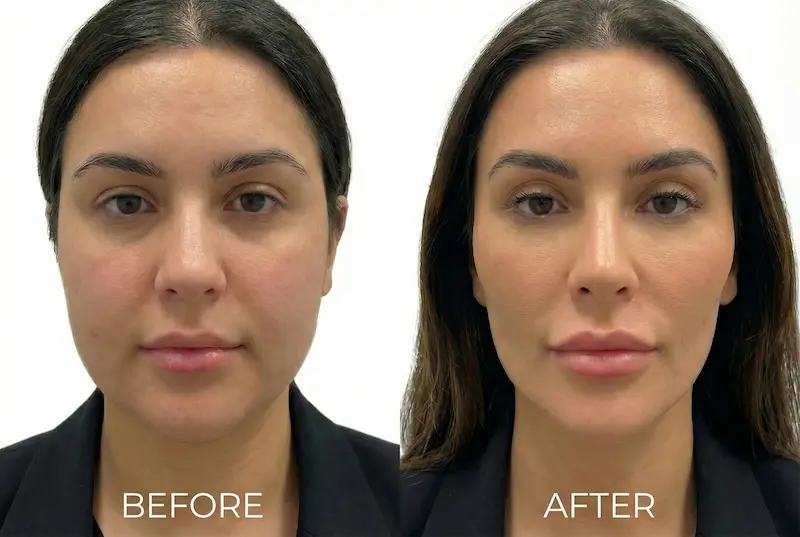
Buccal Fat Removal is a precise facial contouring surgery designed to refine the lower cheeks, not “shrink your whole face.” The best results look effortless. No harsh angles. No trend-driven overcorrection. Our philosophy is simple: Rejuvenation, Not Alteration.
Table of Contents
What Is Buccal Fat Removal?
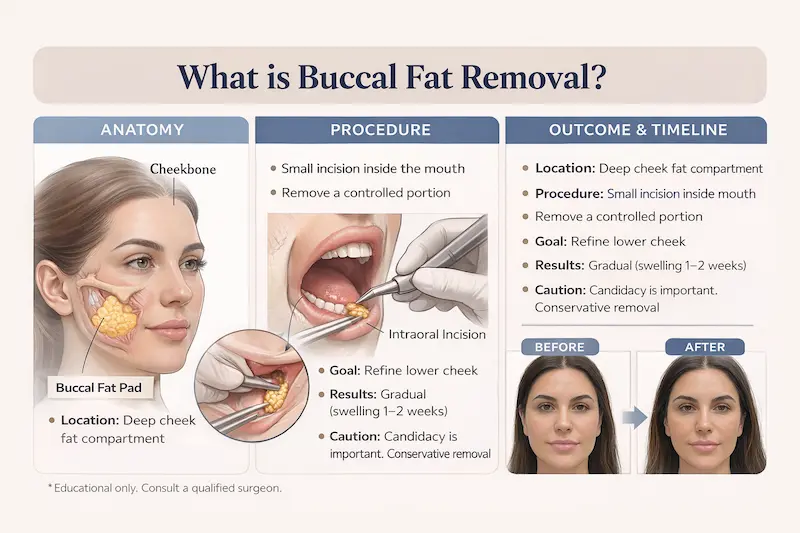
Buccal fat removal is a surgical procedure that reduces the size of the buccal fat pads—natural fat pockets that sit deep in the mid-cheek. The goal is to create more definition between the cheekbones and jawline by decreasing lower-cheek fullness. It is also called bichectomy. Done well, it refines facial shape without changing your identity.
Many people searching “what is buccal fat removal” are really asking one question: will this make my face look sculpted, or just smaller? The answer depends on anatomy, technique, and restraint. This is not a one-size-fits-all surgery. Patient selection is the difference between a refined result and a regrettable one.
The Buccal Fat Pad: Where It Sits and What It Does
The buccal fat pad sits beneath the cheek muscle, closer to the inside of the mouth than most people expect. It helps the cheeks glide smoothly as you chew and speak. It also contributes to facial softness—especially in the lower cheek, near the corners of the mouth.
- Key point: Buccal fat is not the same as superficial “cheek fat” under the skin.
- It can be prominent even in lean patients with low body fat.
- Its size and position are largely genetic.
How Does Buccal Fat Removal Work?
Surgeons access the buccal fat pad through a small incision inside the mouth, then remove a controlled portion of the pad. The goal is reduction, not elimination. The remaining fat continues to provide natural support, while the lower cheek appears less “rounded.”
Results are gradual. Swelling can mask early definition, and the final contour typically emerges over weeks to months as tissues settle. If you are researching how does buccal fat removal work, focus on “controlled removal” as the main concept. That one phrase protects long-term aesthetics.
Bichectomy vs. “Cheek Fat”: What We Remove (and What We Don’t)
A common misconception is that buccal fat removal is a shortcut for overall weight loss in the face. It isn’t. We remove a specific deep fat compartment, not generalized facial fat and not skin.
- We remove: a measured portion of the buccal fat pad to reduce lower-cheek fullness.
- We do not remove: skin, superficial fat under the skin, or the “upper cheek” volume that supports a youthful midface.
- We do not aim for: hollow cheeks or exaggerated sharpness.
Benefits: What Changes (and What Shouldn’t)
The most important benefit of buccal fat removal is not “a thinner face.” It is better facial balance. For the right candidate, lowering excessive cheek roundness can make cheekbones appear more defined and the jawline look cleaner—without looking artificial. The key word is subtle. When the change is measured, people notice you look sharper, not “surgical.”
There are also limits. Buccal fat removal will not correct loose skin, jowls, or midface descent. If those are the primary concerns, the right plan may involve different techniques or a combined approach later in the guide.
The Goal: Midface Refinement Without an “Operated” Look
Great outcomes follow one principle: keep natural facial support while refining excess fullness. That means conservative removal and symmetry checks, not aggressive extraction. The face should still look soft in motion. It should still look like you at every angle.
- Sharper transition from cheek to jawline
- Less “baby-face” roundness in the lower cheeks
- More definition that reads naturally in photos
Photogenic Angles: Why Some Faces Look “Round” on Camera
Cameras flatten depth. Soft light and wide-angle lenses can make lower cheeks look fuller than they appear in person. This is why candidacy needs real evaluation—not just selfies.
In consultation, we compare multiple angles and neutral lighting to confirm whether fullness is truly buccal fat prominence or something else (like skin thickness, posture, or jawline definition). That distinction prevents disappointment.
Facial Harmony: When Subtle Reduction Beats Aggressive Removal
Trends reward extremes. Anatomy does not. Over-removal can create excessive hollowness, especially as natural facial volume changes with age.
Surgeon’s Insight: “The most natural results come from doing less. We aim for refinement that still preserves support—because the face has to look good today and years from now.”
Our approach prioritizes long-term harmony: a defined lower cheek that still looks healthy, soft, and balanced with the rest of your facial structure.
Am I a Good Candidate for Buccal Fat Removal?
This surgery works best when we are solving a specific anatomical problem: a prominent buccal fat pad that creates persistent lower-cheek roundness. Some patients see it as a “shortcut” to a slimmer face, but that mindset leads to disappointment. Your bone structure, skin thickness, and natural midface volume matter as much as the fat pad itself. The safest way to think about candidacy is simple: the right patient gets refinement, not hollowness.
Ideal Candidates: Facial Shape, Tissue Thickness, and Goals
The ideal candidate has stable weight, good skin quality, and a consistent pattern of fullness in the lower cheek that does not respond to diet or training. We look for a strong cheekbone-to-jawline framework where subtle reduction improves definition. We also assess how your face behaves in motion, not just in photos. That is where “natural-looking” is decided.
- Genetically full lower cheeks (“round” or “baby-face” appearance)
- Healthy skin elasticity and good baseline facial support
- Realistic goals: refinement, not a dramatic transformation
- Stable weight and stable facial volume
In our planning, we use objective measurements and photographic analysis to avoid trend-driven decisions. When it is appropriate, we also utilize the 3D Vectra Imaging System to visualize facial proportions and confirm that buccal reduction supports overall harmony.
Who Should Avoid It (or Delay It)
Buccal fat is a support structure. If you remove too much in a face that already has low volume, the result can look tired over time. This is why patient selection is not a marketing phrase for us. It is the procedure.
- Very thin faces with minimal midface volume
- Patients with early signs of midface hollowing
- Anyone chasing a short-term trend or a “celebrity look”
- Unstable weight or major planned weight loss
- Patients whose primary issue is skin laxity or jowling (different solution)
Safety starts before surgery. We run strict pre-operative health screenings and confirm candidacy first, because a fast “yes” is not a clinical strategy.
The “Aging” Question: Could It Make Me Look Older?
This is one of the most searched concerns for a reason. When people type does buccal fat removal age you, they are really asking whether they will lose youthful softness too early. The honest answer is that it can happen in the wrong candidate or with aggressive removal. It is far less likely when we choose the right patient and remove conservatively, preserving natural support while improving contour.
We also plan with time in mind. Faces change. That is normal. Our job is to make sure your result still looks balanced years from now, not just on day 30.
Surgical Techniques Explained: The Modern Bichectomy Approach
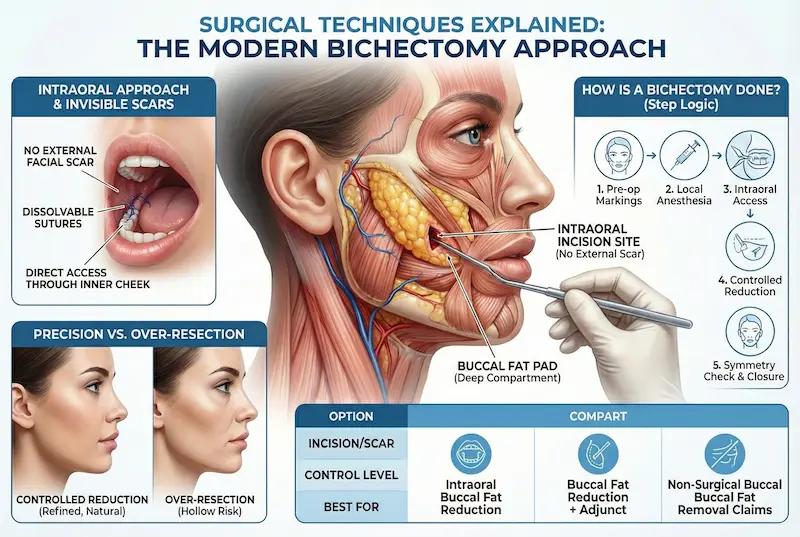
Most patients want to know exactly what happens during surgery, in plain language. Fair request. Buccal fat removal is performed from inside the mouth, using a controlled approach to access a deep fat compartment safely. The skill is not “getting the fat out.” The skill is deciding how much to take, and when to stop. Precision protects the long-term look.
Intraoral Approach: Incision Site and Why Scars Aren’t Visible
The procedure uses a small incision inside the cheek, so there is no external scar on the face. Patients often search buccal fat removal incision site because they worry about visible marks. The incision sits on the inner lining of the mouth and is closed with dissolvable sutures. With proper oral hygiene and aftercare, it typically heals cleanly.
- No external facial scar
- Direct access to the buccal fat pad through the inner cheek
- Dissolvable stitches in most cases
How Is a Bichectomy Done? (Step Logic, Not Hype)
When patients ask how is buccal fat removal done, they deserve a clear sequence. We confirm the plan, apply anesthesia, and create a small intraoral access point. Then our European Board Certified Surgeons identify the buccal fat pad and remove a measured portion. The area is checked for symmetry, bleeding control, and tissue stability before closure.
- Pre-op markings and proportion checks
- Local anesthesia (often with twilight sedation when appropriate)
- Small intraoral incision and careful access
- Controlled reduction of the buccal fat pad
- Symmetry check and closure
Precision vs. Over-Resection: The Key Technical Decision
The biggest technical mistake is treating buccal fat like “extra” tissue. It is not extra. It is support. Over-resection increases the risk of a hollow, severe look that can be difficult to correct later.
Our approach is conservative by design. We prioritize facial harmony, preserve support, and aim for a refined transition between the cheek and jawline. That is how the result stays natural in real life, not just in staged photos.
| Option | Incision / Scar Visibility | Control Level | Best For |
|---|---|---|---|
| Intraoral Buccal Fat Reduction (Standard) | Inside the mouth; no visible facial scar | High (direct visualization and measured removal) | Genetically full lower cheeks with good facial support |
| Buccal Fat Reduction + Adjunct Contouring (Combined Plan) | Inside the mouth; adjunct areas vary by plan | High (multi-structure balancing, not “more removal”) | Patients needing better harmony between midface, jawline, and chin |
| “Non-Surgical Buccal Fat Removal” Claims | No incision | Low (cannot precisely target the buccal fat pad) | Patients who are not surgical candidates and want temporary skin-tightening effects instead |
Combined Procedures: Maximizing Definition With One Recovery
Buccal fat reduction rarely lives in isolation. Your facial shape is a system, not a single feature. In some patients, the best result comes from balancing the cheek with the chin, jawline, or neck—not from removing more fat. That is where “one anesthesia, one recovery” becomes a strategic advantage. We design combinations to create harmony while protecting long-term support and a natural look.
Buccal Fat Removal + Chin Shaping: When the Chin Is the Missing Anchor
A weak or retrusive chin can make the midface look heavier, even when cheek volume is normal. When we improve lower-face projection, the cheeks often read slimmer without aggressive reduction. That is why pairing cheek refinement with chin aesthetics can create a more balanced profile and cleaner front-facing definition.
- Best for: patients who want a sharper lower face but show limited chin projection in profile
- What changes: facial balance, jawline continuity, and “V-line” perception
- What we avoid: chasing hollowness to compensate for structural imbalance
When needed, we plan this with proportion checks and objective analysis. The goal is always the same: refined contours that still look like you.
Buccal Fat Removal + Jawline / Double Chin Liposuction
Patients often compare cheek liposuction vs buccal fat removal as if they solve the same problem. They do not. Jawline or double-chin liposuction targets superficial fat under the skin. Buccal fat removal targets a deep fat compartment inside the cheek. If both issues exist, combining them can create a clearer transition from the lower cheek to the jawline.
- Buccal fat removal: reduces deep lower-cheek roundness
- Jawline liposuction: reduces superficial fullness under the jaw and chin
- Combined benefit: better definition from cheek-to-jawline with one recovery plan
We do not add procedures to “sell a package.” We add them only when anatomy demands it. If the fullness is skin laxity—not fat—liposuction is not the answer.
Buccal Fat Removal + Facial Rejuvenation Procedures
Buccal fat removal is not designed to treat loose skin, jowling, or midface descent. If those are the real drivers of facial heaviness, you may need a different strategy. In select cases, combining cheek refinement with a tightening or lifting procedure can improve definition without forcing excessive fat removal.
- When it helps: early jowling, neck heaviness, or structural descent that blunts the jawline
- How we plan it: diagnose the primary cause first (fat vs skin vs structure)
- Why it matters: the most natural results come from correcting the right layer
We prioritize facial support. Always. It is the difference between a refined outcome and a “trend result” that fades into regret.
Anesthesia: Why We Prefer Awake/Twilight Sedation
For many patients, the biggest fear is not the incision. It is anesthesia. That anxiety is rational, and we address it directly. When a patient is suitable, we often prefer awake surgery protocols with local anesthesia or twilight sedation because they can reduce the intensity of recovery and the emotional burden of general anesthesia. This is also where trust is built: we explain what you will feel, what you will not feel, and why a specific anesthesia plan fits your health profile.
Local Anesthesia, Twilight Sedation, and General Anesthesia: The Practical Differences
There is no “one best” anesthesia for every patient. There is only the safest option for your procedure plan and your profile. Buccal fat removal is commonly performed with local anesthesia, and some patients prefer twilight sedation for comfort. General anesthesia may be recommended when multiple procedures or complexity makes it the most appropriate choice.
- Local anesthesia: targeted numbing, you stay awake, recovery is often smoother
- Twilight sedation: relaxed, drowsy comfort while maintaining protective reflexes
- General anesthesia: fully asleep, can be appropriate for extensive combined plans
We do not “default” to one approach for everyone. We match anesthesia to the surgical plan—and we document why.
Who Qualifies for Awake Surgery or Twilight Sedation?
Qualification is medical, not preference-based. We confirm candidacy through strict pre-operative screenings and a detailed review of your history. Factors like overall health, airway considerations, anxiety levels, and the scope of the surgical plan matter. If we believe general anesthesia is the safest choice for your specific combination, we will say so clearly.
- Stable health profile and appropriate procedural scope
- Clear understanding of the process and realistic expectations
- A plan designed for comfort, monitoring, and control
For the Expert Patient, transparency matters. We explain the “why,” not just the “what.”
What the Day Feels Like: Comfort, Control, and Anxiety Management
Patients often imagine “awake surgery” as stressful. In reality, the goal is controlled comfort. You are numb where it matters. You are monitored closely. If twilight sedation is used, most patients describe the experience as calm and surprisingly uneventful.
- We walk you through each phase before we begin.
- We keep communication simple and direct during the procedure.
- We prioritize comfort without over-sedation.
Surgeon’s Insight: “When a patient is a good candidate, awake or twilight sedation can turn a high-anxiety experience into a controlled, calm process. Safety comes first. Comfort is part of safety.”
If your biggest fear is general anesthesia, tell us early. We build the plan around safety, predictability, and your peace of mind.
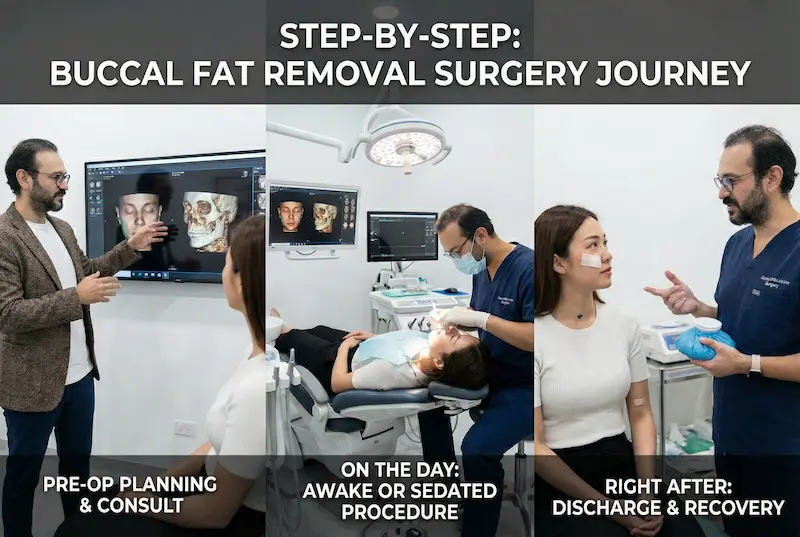
Step-by-Step: What Happens During the Surgery?
You should know exactly what your day looks like. Not a vague “it’s quick.” A real sequence. We build predictability into every step, because predictability lowers stress and reduces risk. It also makes recovery smoother.
Pre-Op Planning: Photos, Proportions, and a Clear Surgical Endpoint
We start with an anatomy-first plan. We document your baseline with standardized photos, then define what “refinement” means for your face shape. When appropriate, we use the 3D Vectra Imaging System to simulate proportion changes and align expectations before surgery. We also run strict pre-operative health screenings to confirm you are a safe candidate.
- Goal alignment: refined lower cheeks, preserved facial support
- Photo analysis in neutral lighting (not selfie-dependent)
- 3D planning when needed (Vectra imaging)
- Pre-op tests and medical clearance checks
On the Day: Awake Surgery or Twilight Sedation (When Appropriate)
Many patients prefer local anesthesia with an “awake” protocol or twilight sedation, because it can feel more controlled than general anesthesia. If your plan is simple and your medical profile allows it, we often recommend this approach. If your surgical plan is combined or complex, general anesthesia may be the safest choice. Either way, we monitor your vitals throughout the procedure with advanced patient monitoring systems.
- Local anesthesia for targeted numbness
- Twilight sedation for comfort when appropriate
- Continuous vitals monitoring during every procedure
The Procedure: Intraoral Access, Controlled Reduction, and Symmetry Checks
The incision is inside the mouth. That means no external facial scar. Our European Board Certified Surgeons access the buccal fat pad through a small intraoral entry point, remove a measured portion, and stop at the planned endpoint. Symmetry is checked before closure, then the incision is closed with dissolvable sutures in most cases.
- Intraoral incision (scar hidden inside the mouth)
- Measured removal, not aggressive extraction
- Bleeding control and final symmetry verification
Right After: Discharge, Instructions, and the First 72 Hours
Most patients go back to their hotel the same day. We give you clear written instructions for oral hygiene, diet texture, and swelling management. Your post-operative medications are planned in advance, so there is no guessing. We also remain available for guidance, because the first 72 hours shape the entire recovery experience.
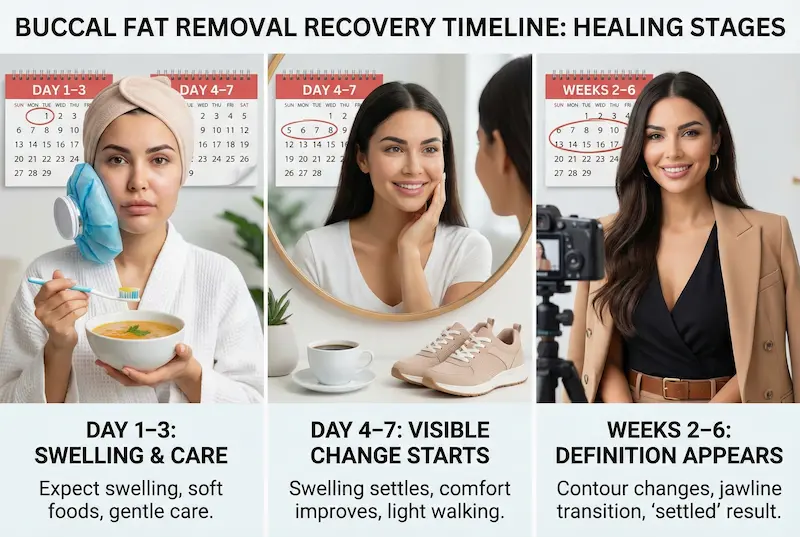
Buccal Fat Removal Recovery Timeline: How Long Does Healing Take?
Most swelling is temporary. Still, the recovery is real, and you need a plan for it. When patients search “buccal fat removal recovery time,” they want one answer: when will I look normal again? The honest answer depends on your biology, your aftercare, and how closely you follow the protocol. We reduce downtime by engineering recovery, not hoping for it.
Day 1–3: Swelling, Diet, and Oral Hygiene
The first few days are about protecting the incision and controlling inflammation. Swelling inside the cheeks is common, and chewing can feel awkward. Soft foods help. Consistent oral hygiene lowers infection risk.
- Expect swelling and a “full” feeling inside the cheeks
- Soft diet (no sharp, crunchy foods)
- Gentle mouth care exactly as instructed
- Sleep with head elevated to reduce swelling
Day 4–7: When “Social Downtime” Starts to Drop
Most patients feel more like themselves by the end of the first week. Swelling begins to settle, and day-to-day comfort improves. Bruising is usually mild because the incision is intraoral, but every body responds differently. This is also when many patients realize the change is subtle early on—and that is normal.
- Visible swelling decreases gradually
- Oral incision continues to seal and strengthen
- Light walking is encouraged; intense exercise waits
Weeks 2–6: Definition Appears (Gradually, Not Overnight)
This is when contour changes start to show in photos. The lower cheek looks less rounded, and the transition to the jawline can appear cleaner. Some patients see definition sooner; others take longer. We set expectations early: the final result is a “settled” result, not a day-10 snapshot.
- Weeks 2–3: noticeable improvement in swelling and comfort
- Weeks 4–6: facial definition becomes clearer
- Longer timeline is normal if you swell easily
Our Rapid Recovery & Safety Protocol: HBOT + LLLT
When recovery is faster, confidence returns faster. This is why we integrate Hyperbaric Oxygen Therapy (HBOT) and Low-Level Laser Therapy (LLLT) into a structured Rapid Recovery & Safety Protocol. HBOT saturates tissues with oxygen to support healing, reduce inflammation, and strengthen the body’s defense against infection. LLLT then delivers targeted cellular support—boosting ATP production and collagen activity—helping reduce swelling and redness while accelerating repair.
- HBOT: supports tissue recovery, reduces inflammation, strengthens infection control
- LLLT: boosts cellular energy (ATP), supports collagen response, calms post-op redness
- Together: a macro-to-micro recovery sequence designed to reduce downtime
Safety & Risks: Is Buccal Fat Removal Dangerous?
Every surgery has risk. The difference is how we plan for it, how we reduce it, and how we respond if something doesn’t look right. Buccal fat removal is usually a small procedure, but it sits in a complex area of facial anatomy. That’s why “simple” does not mean “casual.” We treat it with the same discipline as major facial surgery.
People search for complications because they want honesty. They should get it. The most preventable problems come from two sources: wrong patient selection and over-resection. Our strategy is conservative by design, because long-term facial support matters.
Common Side Effects vs. True Complications
Most early changes are expected and temporary. They feel alarming if no one explained them. That is why we map out what is normal, what is not, and when to contact us.
- Typical early effects: swelling, tenderness, mild bruising, temporary chewing sensitivity
- Inside-the-mouth healing: a “tight” feeling as the incision seals
- Diet changes: soft foods for a short period to protect the incision
When patients search buccal fat removal side effects, they often mix normal swelling with rare complications. True complications can include infection, bleeding, prolonged swelling, asymmetry, unfavorable scarring inside the mouth, or injury to nearby structures. They are uncommon, but they are real. We discuss them directly in consultation.
“Gone Wrong” Cases: Why They Happen
Search terms like buccal fat removal gone wrong usually point to one of three patterns. The first is removing too much fat. The second is operating on a patient who should never have been a candidate. The third is poor aftercare and follow-up.
- Over-resection: creates hollowing that can look harsh in certain lighting
- Wrong candidate: thin faces or low midface volume can look “aged” sooner
- Weak aftercare: oral hygiene mistakes increase infection risk
Some patients also search “botched” because they fear nerve injury. The facial nerve branches are not the target in a proper intraoral approach, but anatomy varies from person to person. Precision matters. Experience matters. Planning matters.
Risk Reduction: What We Control (and How We Control It)
We reduce risk by engineering the process around control points. Before surgery, we confirm candidacy with strict pre-operative health screenings. During surgery, our European Board Certified Surgeons use conservative, measured removal with symmetry checks. After surgery, we keep instructions simple and follow-up structured.
- Selection: we say “no” when anatomy suggests long-term hollowing risk
- Technique: controlled reduction, not aggressive extraction
- Monitoring: advanced patient monitoring systems during the procedure
- Recovery support: our Rapid Recovery & Safety Protocol (HBOT + LLLT) to reduce inflammation and support healing
If you are worried about buccal fat removal regret, the best prevention is alignment. We set the endpoint before surgery. We do not chase a trend mid-procedure.
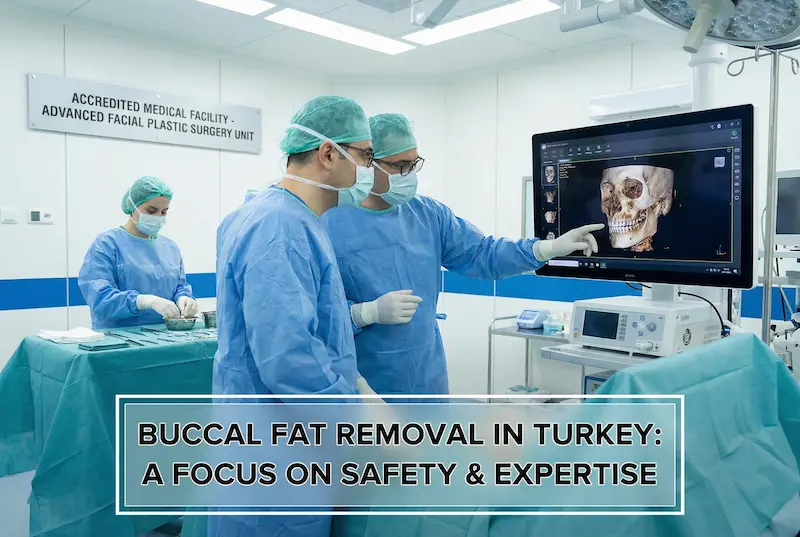
Is Buccal Fat Removal Surgery Safe in Turkey?
For many U.S. patients, “Turkey” is not a cosmetic question. It’s a safety question. Fair. The safest way to evaluate any destination is to ignore marketing and audit the system: surgeon qualifications, facility standards, sterility, anesthesia protocols, and post-op follow-up. Those are the pillars that determine outcomes.
Our model is built for international patients who want structure and transparency. We do not treat travel as a side detail. We treat it as part of the clinical product. That is how we reduce uncertainty and protect recovery.
Facility Standards, Sterility, and Real-World Safety Protocols
We perform surgery in a state-of-the-art, fully accredited facility and apply strict pre-operative screening to confirm patient candidacy. Safety is not one feature. It is a chain. If one link fails, the whole experience degrades.
- Strict pre-operative health screenings to reduce avoidable risk
- Continuous monitoring during procedures
- Clear discharge instructions and recovery planning from day one
This matters because complications are rarely “random.” They are often predictable failures in preparation, sterility discipline, or aftercare compliance.
Surgeon Qualifications: What Actually Signals Expertise
Patients searching “best surgeon” usually look for a name. We focus on signals. Training background, board-level standards, procedural discipline, conservative planning, and an evidence-based approach to long-term facial aesthetics. That is why we refer to our team as European Board Certified Surgeons and facial plastic surgery experts, rather than turning the page into a personality contest.
- Conservative decision-making that protects facial support
- Planning tools for proportion analysis when needed
- A “Natural-First” philosophy: Rejuvenation, Not Alteration
Confidentiality, Privacy, and Long-Term Follow-Up After You Fly Home
Safety includes privacy. We maintain USA-standard patient confidentiality and data security protocols. We also build continuity into the process, because distance should not mean abandonment.
- Free virtual consultation and a personalized treatment plan
- 24/7 support access during your stay via your dedicated Patient Host
- Long-term virtual follow-ups scheduled at 1, 3, 6, and 12 months post-procedure
If you are comparing buccal fat removal in turkey to “near me” options, focus on the complete system of care. Surgery is one day. Follow-up is the year that protects the result.
Long-Term Results: Is Buccal Fat Removal Permanent? What About 10 Years Later?
People rarely regret the first two weeks. They regret the long term. That’s why searches like buccal fat removal 10 years later and long term effects of buccal fat removal matter more than any “day-7 update.” We plan for the future face, not the temporary post-op face.
Is Buccal Fat Removal Permanent?
The portion of buccal fat we remove does not “grow back.” In that sense, the change is lasting. Your face, however, is not static. Weight changes, skin quality, and natural aging still affect how your cheeks look over time.
- Lasting change: the removed buccal fat portion does not return
- Still changes: overall facial volume, skin elasticity, and superficial fat can shift with time
- What protects the outcome: conservative planning and correct candidacy
Buccal Fat Removal 10 Years Later: What Actually Changes
If you are a strong candidate, the long-term result is usually a refined lower cheek that still looks healthy. The biggest variable is not “time.” It’s whether your face had enough natural support from the start. Thin faces that undergo aggressive removal are the ones most vulnerable to a harsh look years later.
This is why we avoid one-size-fits-all surgery. We keep support. We remove what is truly excessive. We stop.
- Faces naturally lose volume with age, regardless of surgery
- Over-removal can exaggerate that volume loss
- Measured reduction protects a softer, natural contour long term
The “Aging” Concern: Does It Make You Look Older?
Some patients worry that buccal reduction will create premature hollowing. That fear is valid in the wrong candidate. The safest approach is selection plus restraint.
When you see “before and after” images that look overly sharp, the issue is usually not the concept of the surgery. It’s the execution. Or the candidacy. Sometimes both.
Surgeon’s Insight: “A great bichectomy preserves support. If your face needs structure, we build structure. We don’t chase hollowness.”
Buccal Fat Removal Regret: Why It Happens (and How We Prevent It)
Regret rarely comes from normal swelling or a slow reveal. It comes from mismatch. The procedure didn’t match the anatomy. Or the expectation didn’t match the reality.
- Mistake #1: using the surgery to “fix” problems caused by weak chin/jaw structure
- Mistake #2: operating on a naturally thin or already hollow midface
- Mistake #3: chasing a trend instead of facial harmony
Our prevention is direct. We plan the endpoint before surgery and stay conservative. If your anatomy suggests long-term hollowing risk, we will recommend alternatives or a combined plan instead of forcing a “yes.”
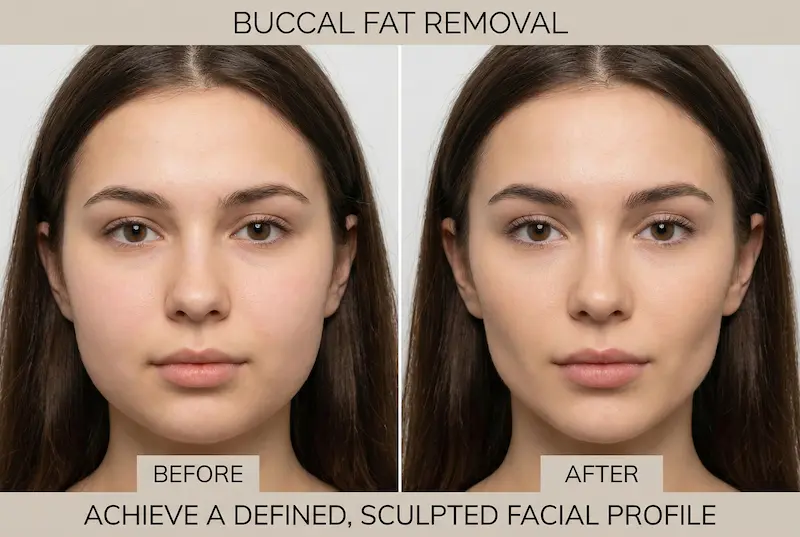
Buccal Fat Removal Before And After: Realistic Expectations
Good outcomes are not dramatic. They are believable. The goal is that people notice definition, not surgery. If you are an “Expert Patient,” you already know the real question: can this look natural in daylight, at rest, and in motion? That’s the standard we use.
How to Evaluate Before/After Photos Like an Expert
One photo can sell anything. We focus on consistency. Lighting, angle, expression, and time post-op should be comparable. Early photos can be misleading because swelling can create false “bulk” or false “sharpness.”
- Look for neutral lighting and relaxed facial expression
- Compare multiple angles, not one hero shot
- Confirm the timeline (weeks vs months)
- Watch for signs of over-resection: excessive hollowing near the mouth corners
When You’ll Look “Camera-Ready” vs When You’ll Be “Fully Settled”
Social downtime and final results are not the same thing. Many patients feel socially comfortable within the first 1–2 weeks, depending on swelling. Final definition takes longer. That slower timeline is normal.
- Early phase: swelling and internal healing dominate the first week
- Visible refinement: often begins over weeks 2–6
- Settled contour: continues to refine as tissues mature
Social Media, “Celebrity” Searches, and Trend-Chasing
Some people arrive after searching celebrities with buccal fat removal or a specific celebrity name. We can’t confirm what any public figure has or hasn’t done. Photos also change with lighting, weight shifts, styling, and aging.
What we can do is translate the trend into anatomy. Not every face can carry buccal reduction well. Your plan has to match your structure, not someone else’s highlight reel.
Common Feedback We Hear From Prepared Patients
We do not invent stories. Still, we see consistent patterns in well-informed patients who prepare properly and follow aftercare closely. They tend to describe the change the same way: subtle, clean, and natural.
- “My face looks more defined, but still like me.”
- “The change is clearer in photos than in the mirror.”
- “It looks better month by month.”
Cost Analysis: Buccal Fat Removal Cost 2026 (Turkey vs USA)
When patients search buccal fat removal cost, they are rarely looking for a number alone. They are asking what the price actually includes, what the risks are, and whether “lower cost” means lower standards. We approach cost the way an Expert Patient does: as a value equation.
If you are comparing buccal fat removal cost NYC, buccal fat removal cost Los Angeles, or buccal fat removal cost Miami, you’ll notice wide variability. That’s normal. Pricing shifts based on surgeon expertise, facility level, anesthesia type, and the amount of planning and follow-up built into the process.
How Much Is Buccal Fat Removal? What You’re Actually Paying For
The safest way to evaluate cost is to break it into components. This prevents “apples-to-oranges” comparisons and exposes hidden gaps in aftercare.
- Surgeon expertise: planning discipline, conservative technique, symmetry control
- Facility standards: sterility protocols, monitoring, operating room resources
- Anesthesia plan: local, twilight sedation, or general anesthesia (when medically appropriate)
- Pre-op screening: testing and clearance to reduce avoidable risks
- Aftercare: medications, oral-hygiene guidance, structured follow-up
- Recovery optimization: our Rapid Recovery & Safety Protocol (HBOT + LLLT)
Why the USA vs Turkey Cost Gap Exists
Many patients also search buccal fat removal cost Turkey or cost of buccal fat removal in Turkey to understand the difference. The core driver is macroeconomics, not quality compromise. Operational costs and currency dynamics change the baseline pricing structure.
Our responsibility is to make sure the clinical standards stay “USA-level” regardless of geography. That means strict pre-operative health screenings, advanced monitoring during the procedure, and a recovery protocol designed to reduce inflammation and protect healing.
What Our All-Inclusive Plan Typically Covers
For international patients, cost is not only the surgery. It’s the predictability of the full experience. We designed our VIP system to remove friction, reduce anxiety, and protect recovery.
- Your complete surgical procedure
- Anesthesia and operating room fees
- All pre-operative tests
- 5-star hotel accommodation
- All VIP airport and clinic transfers
- Your 24/7 dedicated Patient Host
- All post-operative medications (and garments when applicable)
- First post-op meal
- Long-term virtual follow-up care
What Is Not Included (So There Are No Surprises)
- International flight tickets
- Personal travel insurance
- Personal expenses (meals beyond the provided first post-op meal)
- Visa fees (if applicable)
- Additional hotel nights (if extending your stay)
| Cost Element | USA (NYC / Los Angeles / Miami) | Turkey (Planned Surgical Trip) |
|---|---|---|
| Pricing Structure | Often itemized; facility/anesthesia/follow-up may be separate | Often bundled into a predictable all-inclusive plan |
| Main Cost Drivers | High overhead, facility costs, staffing, insurance environment | Macroeconomic factors (operational costs and currency dynamics) |
| Patient Support | Local access is easy, but coordination varies widely | Dedicated host model designed for international continuity |
| Recovery Optimization | Varies by provider | Structured Rapid Recovery & Safety Protocol (HBOT + LLLT) |

Finding the Right Surgeon: What “Best” Should Actually Mean
Search terms like best buccal fat removal surgeon and buccal fat removal near me show one thing: you want certainty. You want a predictable result. The right surgeon doesn’t “sell” buccal fat removal. They diagnose whether you truly need it, then execute conservatively.
What Expertise Looks Like in Buccal Fat Surgery
This procedure is small, but the aesthetic stakes are high. Expertise shows up in restraint. It shows up in patient selection. It shows up in long-term thinking.
- Conservative planning with a defined surgical endpoint
- Comfort with facial anatomy and symmetry control
- A candid discussion of aging, hollowing risk, and alternatives
- Structured aftercare and virtual follow-up if you travel
Red Flags That Should Make You Pause
- Promises of “dramatic” slimming as the main selling point
- No discussion of long-term facial volume and aging
- Overuse of trendy, celebrity-driven marketing
- Unclear aftercare plan or vague recovery guidance
- A “yes” without a real candidacy evaluation
Expert Patient Consultation Checklist (Copy/Paste)
- How do you determine if my fullness is buccal fat vs skin thickness or structure?
- How much do you typically remove, and how do you avoid over-resection?
- What is your plan if I’m at risk of looking hollow long term?
- What anesthesia do you recommend for my exact plan, and why?
- What does follow-up look like after I return home?
If you want a surgeon who treats this as facial architecture—not a trend—we are ready to review your case. Our European Board Certified Surgeons build the plan around harmony and longevity, guided by the principle: Rejuvenation, Not Alteration.
Your Medical Journey: What to Expect (Arrival to Departure)
If you are traveling for buccal fat removal in Turkey, the experience should feel structured—not improvised. We design your journey to protect safety, reduce stress, and keep your recovery predictable. From your first virtual consultation to your long-term follow-up back home, we treat logistics as part of the clinical plan.
1) Free Virtual Consultation & Personalized Surgical Plan
We begin with a free virtual consultation. You share photos and your goals, and we evaluate whether the concern is truly buccal fat prominence—or something else (skin thickness, jawline structure, or overall facial balance). If you are a candidate, we build a personalized plan and explain what “natural” means for your anatomy.
- Photo-based anatomy review (multiple angles, neutral lighting)
- Candidacy confirmation (including long-term “aging” risk assessment)
- Plan options: buccal reduction alone vs combined balancing procedures
- Clear instructions for travel timing and recovery planning
2) Arrival & VIP Transfers
When you arrive, our VIP transfer service brings you to your hotel. International patients often worry about coordination. We eliminate that friction with a dedicated system designed specifically for surgical travelers.
- VIP airport-to-hotel transfer
- 5-star hotel accommodation (as part of the all-inclusive plan)
- Dedicated Patient Host for coordination and support
3) Pre-Op Tests, In-Person Evaluation, and Final Safety Checks
Before any procedure, we complete your pre-operative tests and confirm your surgical plan in person. This is where we finalize details like anesthesia type, symmetry strategy, and recovery instructions. If anything in your health screening suggests a safer alternative approach, we adjust the plan accordingly.
4) Surgery Day: Procedure, Monitoring, and Discharge Plan
Buccal fat removal is typically a same-day procedure. Your anesthesia plan is selected based on your medical profile and whether you are combining procedures. Throughout surgery, we use continuous monitoring to keep the process controlled and safe.
- Procedure performed by European Board Certified Surgeons
- Advanced monitoring during the procedure
- Clear post-op instructions: oral hygiene, diet texture, swelling management
5) Post-Op Checks & Recovery Optimization (HBOT + LLLT)
Recovery is not a guessing game. We guide you through the first critical days, and when appropriate, integrate our Rapid Recovery & Safety Protocol:
- HBOT: supports tissue recovery and helps reduce inflammation
- LLLT: supports cellular energy and helps calm post-op redness and swelling
Your Patient Host helps coordinate your check-ups and keeps communication easy while you focus on healing.
6) Departure & Follow-Up Back Home
Distance should not reduce accountability. After you return home, we continue with structured virtual follow-ups so your healing remains supervised—especially important for international patients who want predictability.
- Virtual follow-ups scheduled at key milestones
- Direct guidance if you experience unusual swelling, discomfort, or asymmetry concerns
- Long-term aesthetic guidance focused on natural support and facial harmony
Frequently Asked Questions (FAQ):
Does buccal fat removal age you?
It can in the wrong candidate or with aggressive removal. In the right candidate, with conservative technique and preserved facial support, the risk is significantly reduced. Selection and restraint are the safeguards.
How long is buccal fat removal recovery time?
Most patients see swelling reduce noticeably within 1–2 weeks, with definition developing gradually over weeks 2–6. Final “settled” contour can take longer as tissues mature.
Is buccal fat removal permanent?
The portion removed does not grow back, so the change is lasting. However, your face can still change over time due to weight shifts and natural aging.
What are the side effects and risks of buccal fat removal?
Common early effects include swelling, tenderness, and temporary chewing sensitivity. Less common risks include infection, prolonged swelling, asymmetry, bleeding, unfavorable scarring inside the mouth, or injury to nearby structures. A structured aftercare plan helps reduce preventable risk.
Can buccal fat removal be reversed?
Not in a simple way. Because removed tissue does not return, “reversal” usually means restoring volume with other techniques (when appropriate). This is exactly why conservative removal and correct candidacy are essential.
Buccal fat removal gone wrong—what usually causes it?
Most “gone wrong” narratives come from over-resection, wrong patient selection, or weak aftercare guidance. A plan that prioritizes long-term facial support prevents the most common regret patterns.
Non surgical buccal fat removal: is it real?
There is no truly “non-surgical” method that precisely removes the buccal fat pad. Some non-surgical treatments can tighten skin or reduce superficial fullness, but they do not replicate a true bichectomy result.
Cheek liposuction vs buccal fat removal: which is better?
They treat different layers. Buccal fat removal targets a deep cheek fat compartment; liposuction targets superficial fat under the skin (often under the jawline or chin). The “better” option depends on what is actually causing fullness.
How soon can I exercise after buccal fat removal?
Light walking is typically fine early, but intense training should wait until your surgeon clears you. Overexertion too soon can worsen swelling and delay healing.
What should I eat after surgery?
Soft foods protect the intraoral incision during early healing. Crunchy, sharp, or spicy foods can irritate the area. We provide a clear diet progression based on healing milestones.
Buccal fat removal near me vs traveling—what should I consider?
Compare complete systems of care, not just location. Surgeon experience, conservative planning, facility standards, anesthesia protocols, and follow-up structure matter more than distance. If you travel, long-term virtual follow-up is a major advantage.
How do I know if I’m a good candidate?
If your lower-cheek fullness is genetic and persistent (even at stable weight), and your face has sufficient natural support, you may be a strong candidate. The safest way to confirm is a structured evaluation—photos, proportion review, and a long-term aesthetic plan.
Medical Disclaimer: This page is for educational purposes and does not replace an in-person medical evaluation. All surgical procedures carry risks and outcomes vary by anatomy, health profile, and aftercare compliance. A personalized assessment by a qualified surgeon is required to determine candidacy and the most appropriate treatment plan.