




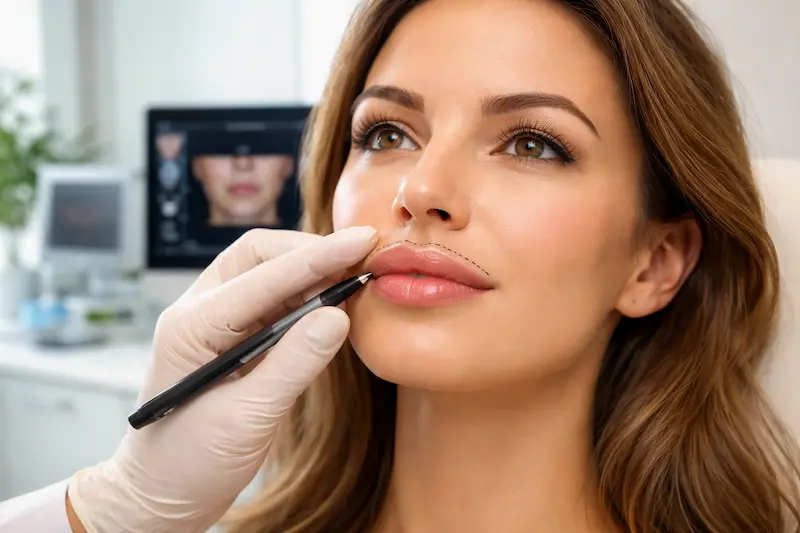
A lip lift is a surgical procedure designed to refine the proportions of the upper lip and improve how the upper lip relates to the teeth, the nose, and the rest of the face. Unlike injectables that add volume, a lip lift primarily changes position—shortening a long philtrum (the skin between the nose and upper lip) and subtly “rolling” the pink part of the upper lip (vermilion) outward so it’s more visible. The goal is not to create an exaggerated “done” look, but to restore balance and a naturally youthful upper-lip shape.
This guide explains what a lip lift is, who it helps most, how different techniques compare, what healing is really like, and how to think about scars, permanence, risks, and value. If you’ve found yourself searching terms like “what is a lip lift,” “lip lift vs lip filler,” “types of lip lift,” or “does a lip lift leave a scar,” you’re in the right place.
Table of Contents
What Is a Lip Lift? (Definition, Anatomy, and “Why”)
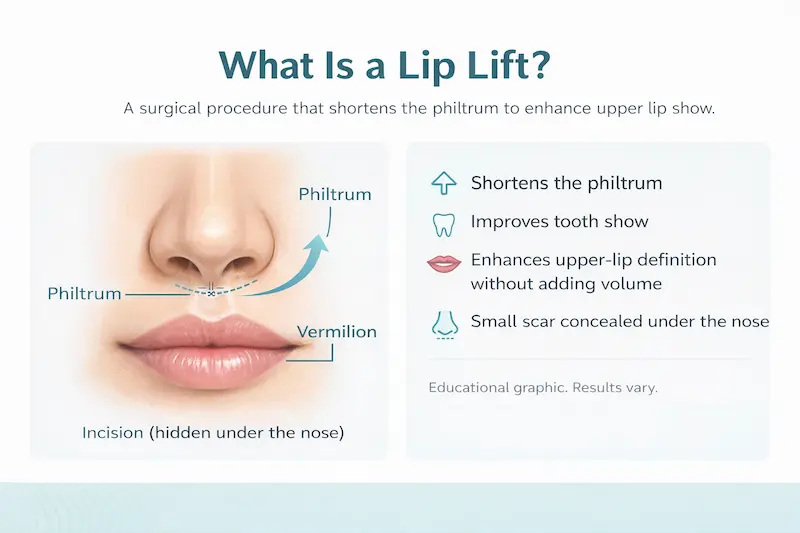
From a facial-anatomy perspective, the upper lip is not just the visible “pink” tissue. It’s a complex aesthetic unit defined by the philtrum columns, the Cupid’s bow, the vermilion border, and the way the lip moves when you speak and smile. In clinical overview, a lip lift works by adjusting the skin and soft-tissue envelope so the upper lip sits in a more favorable position—often improving tooth show, restoring a crisp vermilion border, and reducing the “flat” look that can come from an elongated philtrum.
Upper Lip Anatomy: Philtrum, Vermilion, and Cupid’s Bow
The philtrum is the vertical segment of skin between the base of the nose and the upper lip. With time (and sometimes by genetics), the philtrum can lengthen, which may reduce the amount of upper teeth visible at rest and flatten the upper lip. The vermilion is the pink/red portion of the lip. The Cupid’s bow is the central contour at the top of the upper lip, and the philtral columns are the subtle ridges that frame it.
When these features are in proportion, the upper lip can look defined without being overfilled. When proportions shift—especially with a longer philtrum—patients may notice that lipstick “disappears,” the lip looks thinner at rest, or the smile looks less bright even if the teeth are healthy.
What a Lip Lift Changes (and What It Does Not)
A lip lift is best understood as a procedure that changes upper-lip height and lip display, not a procedure that simply makes lips bigger. By shortening the philtrum, the upper lip can rotate slightly outward. This often makes the vermilion appear fuller without adding bulk. It can also enhance tooth show in a way that looks youthful and natural—especially for patients whose upper lip covers the upper teeth more than they’d like.
What it does not do: it doesn’t directly increase the internal volume of the lip tissue the way filler does, and it doesn’t correct every perioral aging concern by itself. For example, deep lines around the mouth, volume loss in the midface, or lower-face laxity may need additional treatments if those are primary concerns.
Common Aesthetic Goals: Tooth Show, Upper-Lip “Roll,” and Balance
Most expert patients pursue a lip lift for one (or more) of the following reasons:
- Reduce a long philtrum that creates a top-heavy look in the midface.
- Increase upper-tooth show at rest or on a relaxed smile.
- Define the vermilion border and improve upper-lip shape without “inflating” the lip.
- Improve facial harmony—especially the relationship between the nose, upper lip, and chin.
The best outcomes are typically those designed around facial proportions, movement, and the patient’s baseline anatomy—not a one-size-fits-all measurement.
Lip Lift vs Lip Filler vs Other Options
When patients compare a lip lift to filler, they’re often trying to answer one question: “Do I need volume—or do I need a structural change in position and proportion?” In many cases, the right choice depends on the philtrum length, lip shape, and how the upper lip behaves at rest and during a full smile. Below is a high-level framework to help you think clearly about the trade-offs.
Lip Lift vs Lip Filler: Position vs Volume
Lip filler is designed to add volume (and sometimes improve hydration and contour). It can be a good option for patients who want a reversible change, a subtle border definition, or improved symmetry. However, filler does not shorten the philtrum. If the philtrum is long, adding volume can sometimes create projection without improving the “distance” issue—leading some patients to feel their lip looks heavier without looking more youthful.
A lip lift is a structural procedure that changes the distance between the nose and upper lip. For the right candidate, this can create a more youthful look that filler alone cannot replicate. The trade-off is that surgery involves an incision and healing time, and scar quality becomes part of the decision-making process.
What About a Lip Flip?
A “lip flip” (often performed with a neuromodulator) relaxes the muscle that pulls the upper lip inward, allowing a small amount of the lip to roll outward. This can create a mild enhancement, particularly for patients who like the idea of a subtle change without volume. The effect is temporary and generally modest.
For patients with a long philtrum or minimal tooth show, a lip flip can be an experiment—but it won’t produce the proportion changes that a surgical lip lift can achieve. If your concern is fundamentally about distance and facial balance, it’s usually not the definitive solution.
Fat Transfer and Other Surgical Pairings
Fat transfer can add soft, natural-feeling volume to the lips and perioral area by using your own tissue. It may be considered when volume deficiency is the main issue, or as a complementary procedure when global facial balance is being addressed. Some patients benefit from a combined approach—using surgical techniques to improve proportion while using volume-based treatments (filler or fat) to refine shape.
It’s also common for the upper lip area to be evaluated alongside other facial procedures (for example, rhinoplasty or facial rejuvenation surgery) to ensure the final result looks cohesive. A lip lift should be planned with the entire facial “frame” in mind—especially the base of the nose, the upper teeth, and the chin profile.
Ideal Candidates: Who Is a Good Fit for a Lip Lift?
The best lip lift results come from matching the procedure to the right anatomy and goals. In general, candidates are people who want a more favorable upper-lip proportion, improved tooth show, or a more defined upper-lip contour that does not rely on added volume. A thorough consultation typically evaluates your facial proportions at rest and in motion (speaking and smiling), because a lip lift is as much about dynamic expression as it is about static appearance.
Signs You May Be a Strong Candidate
Many patients who benefit from a lip lift describe one or more of these concerns:
- A long philtrum (the space between the base of the nose and the upper lip) that makes the midface feel “stretched.”
- Minimal upper-tooth show at rest (even when your teeth are healthy and aligned).
- Upper lip appears thin at rest despite having normal lip tissue—often because the lip is turned inward.
- Lip filler fatigue: repeated filler gives projection but doesn’t improve proportion, or starts to look heavy or less natural.
Importantly, “wanting fuller lips” alone doesn’t automatically mean you need a lip lift. If your proportions are already balanced and your main goal is volume, filler or fat transfer may be a more direct solution.
Facial Proportions and Smile Analysis (Why Movement Matters)
Expert evaluation usually includes a facial proportion check at rest, then a smile analysis. Tooth show is one common metric, but it’s not the only one. Surgeons also consider:
- How the upper lip moves when you smile fully (does it elevate evenly, does it “tuck,” does it pull to one side?).
- How the lip looks in conversation, not just in posed photos.
- The nose–lip relationship (especially the base of the nose and columella) to avoid distorting nasal aesthetics.
This matters because a lip lift can improve tooth show and vermilion display, but an overly aggressive plan can make the upper lip look tight or unnatural in motion.
When a Lip Lift May Not Be the Best Choice
There are scenarios where surgeons may recommend caution, optimization first, or a different approach:
- Active smoking or nicotine use, which can increase risks related to wound healing and scar quality.
- A history of poor scarring (for example, thick or raised scars), where scar management must be discussed carefully.
- Unrealistic aesthetic goals—for example, expecting a dramatic “filler-like” plumpness from a proportion-based surgery.
- Very short philtrum already, where further shortening could look overcorrected.
A good consultation should include an honest discussion of what is achievable for your anatomy and what trade-offs (like an incision and scar care) are part of the procedure.
Types of Lip Lift Techniques (Subnasal, Italian, Corner, Direct, and More)
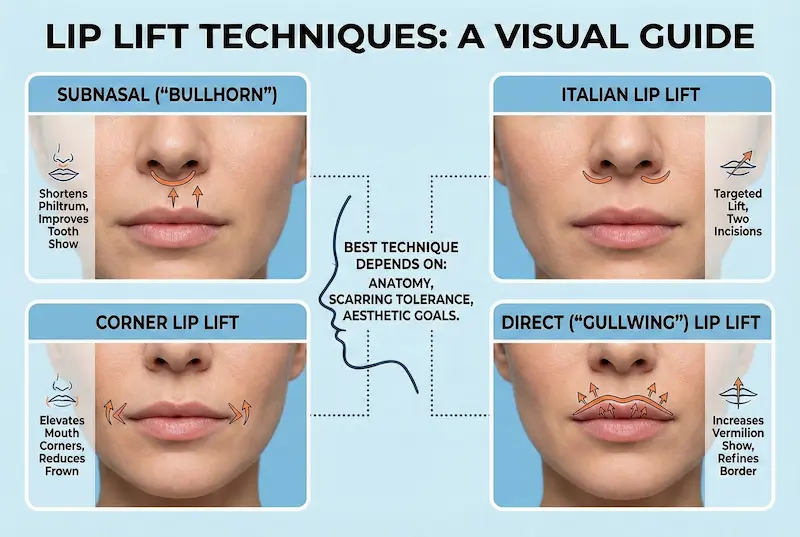
“Lip lift” is an umbrella term. Multiple techniques exist, and each uses a different incision placement and lift vector to shape the final outcome. The best technique depends on your anatomy (philtrum length, lip shape, nasal base), your scarring tolerance, and your aesthetic target (more tooth show, better Cupid’s bow definition, improved mouth-corner position, etc.). Below are the most commonly discussed types of lip lift and how they compare at a high level.
Subnasal (“Bullhorn”) Lip Lift
The subnasal lip lift—often called the bullhorn lip lift—is among the most commonly performed techniques. The incision is placed at the base of the nose, typically designed to hide within the natural shadows and contours where the nose meets the upper lip. A measured amount of skin is removed, which effectively shortens the philtrum and allows the upper lip to rotate outward.
Why patients choose it: it can improve tooth show, enhance vermilion display without adding volume, and preserve a natural look when planned conservatively.
Main trade-off: scar management is central. While many scars heal very discreetly, outcomes depend on incision design, closure technique, biology, and aftercare.
Italian Lip Lift
The Italian lip lift is a variant of the subnasal concept using two smaller incisions positioned beneath each nostril rather than a single continuous incision across the nasal base. Some surgeons prefer it for select anatomies, aiming to reduce the visibility of a longer incision line and tailor lift under each nostril.
Why it can be useful: it may be considered when a patient’s anatomy supports the smaller-incision approach and when symmetry can be carefully controlled.
Main trade-off: it does not automatically mean a “scar-free” outcome. Two incisions still require excellent technique and scar care, and it may not be ideal for every philtrum shape or lift requirement.
Corner Lip Lift (Mouth Corner Lift)
A corner lip lift targets the outer corners of the mouth rather than the philtrum. It’s designed for patients whose mouth corners naturally turn downward (even slightly), which can create a tired, stern, or sad appearance at rest. The incision is typically small and placed near the mouth corner, where tissue is adjusted to subtly elevate the corner position.
Why patients choose it: it can improve resting expression and reduce a downturned-corner look that filler alone may not reliably correct.
Main trade-off: incision placement is closer to the lip border, so scar visibility must be discussed carefully, and the goal should remain subtle to avoid an unnatural “pulled” look.
Direct (“Gullwing”) Lip Lift
The direct lip lift—sometimes called a gullwing lip lift—places the incision along the border of the upper lip (near the vermilion edge). This approach can directly increase the visible vermilion height and refine the lip border shape.
Why it can be effective: it offers strong control over vermilion show and can be used to address specific shape goals.
Main trade-off: because the incision sits closer to the lip itself, scar concealment can be more challenging for some patients. This technique is often considered more selectively and demands careful patient selection and scar counseling.
Technique Comparison Table (High-Level)
This table is intentionally simplified to help you understand the big-picture differences. A personalized plan should be based on your anatomy and how your upper lip looks in motion.
| Technique | Primary Target | Incision Location | Typical Benefit | Key Trade-Off |
|---|---|---|---|---|
| Subnasal / Bullhorn | Philtrum shortening | Base of the nose | Improves tooth show and lip “roll” | Scar quality depends on technique + biology |
| Italian | Philtrum shortening (select cases) | Two incisions under nostrils | Targeted lift under each nostril | Not ideal for every anatomy; still requires scar care |
| Corner Lip Lift | Mouth corner position | Near mouth corners | Improves downturned corners at rest | Must be subtle to avoid “pulled” look; scar considerations |
| Direct / Gullwing | Vermilion height & border definition | Along upper lip border | Strong control of visible upper lip | Scar sits closer to lip edge; careful selection needed |
How Surgeons Choose the Right Technique (Not One-Size-Fits-All)
The decision is usually driven by what needs to change: philtrum length, vermilion show, mouth-corner position, or a combination. Many patients who search “types of lip lift” are actually trying to avoid two things: an obvious scar and an unnatural result. The solution is rarely “pick the trendiest technique.” It’s typically:
- Start with proportion goals (how much shortening is appropriate for your face).
- Plan the lift vector (where the lip should rotate and how symmetry is maintained).
- Choose an incision strategy that balances concealment and control.
If you’re comparing procedures across clinics, ask how the surgeon decides on technique selection and how they evaluate your smile—not just your resting photos.
Consultation & Planning: How Surgeons Design a Natural Result
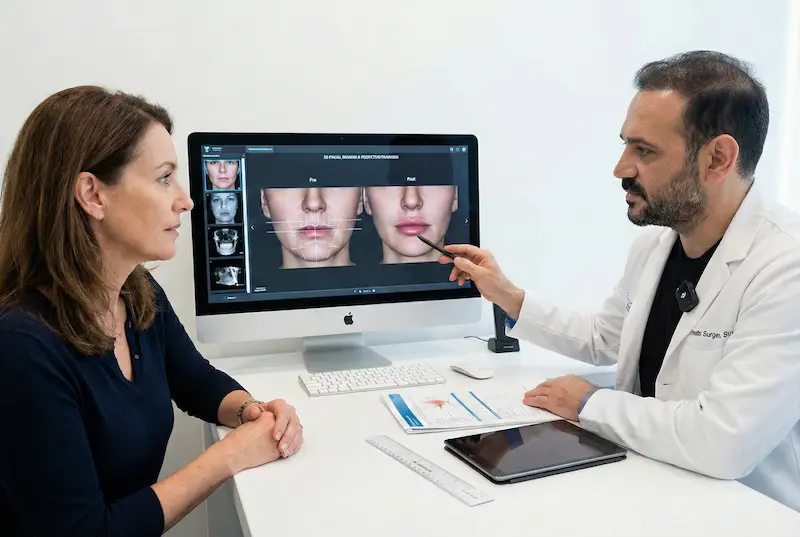
A natural-looking lip lift is engineered—not guessed. The most consistent outcomes come from conservative planning, dynamic evaluation (how your lip looks when you speak and smile), and an approach that prioritizes harmony over dramatic change. In expert hands, a lip lift should read as “refreshed” rather than “operated.” That means the plan must account for your baseline philtrum length, nasal base anatomy, tooth show, lip shape, and how much upper-lip rotation will look balanced on your face.
Proportion Planning: Setting the Right Target for Philtrum Shortening
One of the most common reasons patients feel unsure about a lip lift is the fear of overcorrection. In practice, “how much lift” is a carefully measured decision—not a standardized number. A surgeon typically considers:
- Your baseline philtrum length and how it compares to your other facial proportions.
- Upper-tooth show at rest (some patients want a subtle increase, others need a more meaningful change).
- Upper-lip thickness and shape (how the vermilion border is defined, and how the lip turns in or out).
- Balance with the nose and chin (a lip lift can change the perceived relationship between these features).
The objective is to choose a lift that improves proportion while preserving a relaxed, unstrained look. If you’ve seen “lip lift gone wrong” images online, many involve an excessive lift, poor symmetry planning, or inadequate scar strategy.
3D Imaging & Predictive Planning (Why Precision Matters)
In a high-standards consultation, planning often goes beyond a mirror and a few photos. Advanced imaging can help a surgeon and patient align on goals and anticipate how subtle changes might affect the overall facial frame. When available, 3D facial imaging can support:
- Proportion visualization (understanding how philtrum shortening changes the midface balance).
- Smile-based evaluation (how the lip behaves in a full smile vs at rest).
- Expectation management by modeling plausible outcomes rather than idealized outcomes.
In AKM’s planning philosophy, this is part of a broader commitment to precision and natural outcomes—rejuvenation rather than alteration.
Surgeon’s Insight: The goal is to refine proportion and restore youthfulness without changing your identity. A well-designed lip lift should look like you—just more balanced.
Setting Expectations: What Surgery Can and Can’t Do
Expert patients tend to make better decisions when the “limits” are clear. A lip lift can be transformative for the right anatomy, but it is not a universal substitute for volume. In a responsible consultation, you should expect discussion of:
- Scar reality: there will be an incision—your result depends on technique, biology, and aftercare.
- Shape vs volume: some patients benefit from a combined strategy (structural lift + subtle volume refinement).
- Timeline reality: early swelling and tightness can temporarily alter expression.
- Naturalness standard: the best outcomes prioritize “undetectable work,” not obvious change.
If your primary goal is “bigger lips,” the best plan may be filler, fat transfer, or a blended approach. If your primary goal is “better proportions and tooth show,” surgery may offer the most direct path.
Anesthesia Options: Awake, Twilight Sedation, or General Anesthesia
Anesthesia is not just a comfort preference—it’s part of the safety profile and the overall surgical experience. Many lip lifts can be performed under local anesthesia, sometimes paired with twilight sedation. In select cases, general anesthesia may be appropriate, especially if the lip lift is combined with other procedures. The right approach depends on your health history, procedure complexity, and how you tolerate medical environments.
Local Anesthesia (Fully Awake): What It Involves
With local anesthesia, the surgical area is numbed so you do not feel pain, while you remain awake. For the right patient, this approach can be efficient and avoids the deeper physiologic impact of general anesthesia. Patients may feel pressure or movement, but discomfort should be controlled.
Local anesthesia can be a strong option for patients who want a shorter recovery from anesthesia and who are comfortable remaining awake during a minor facial procedure.
Twilight Sedation: A Middle Ground for Comfort and Control
Twilight sedation is often described as a “lighter” sedation approach that can reduce anxiety and improve comfort while maintaining spontaneous breathing. For many patients, it offers a balance: you’re deeply relaxed, often with limited memory of the experience, but without the full physiologic footprint of general anesthesia.
At AKM, the awake/twilight philosophy is positioned around a safety-first, comfort-forward experience when clinically appropriate—particularly for patients who prioritize minimizing unnecessary anesthesia exposure.
Surgeon’s Insight: When a procedure can be performed safely under local or twilight sedation, many expert patients prefer it. The key is individualized selection and proper monitoring—not a one-size-fits-all rule.
General Anesthesia: When It May Be Considered
General anesthesia may be recommended in situations such as:
- Multiple procedures in one session (for example, combining a lip lift with rhinoplasty or facial surgery).
- Patient comfort needs when anxiety is significant and sedation options are insufficient.
- Complexity where operative time or technical demands make a deeper anesthetic plan more appropriate.
If general anesthesia is part of the plan, it should be discussed transparently: what monitoring is used, what screening is done pre-op, and how postoperative nausea, fatigue, and recovery are managed.
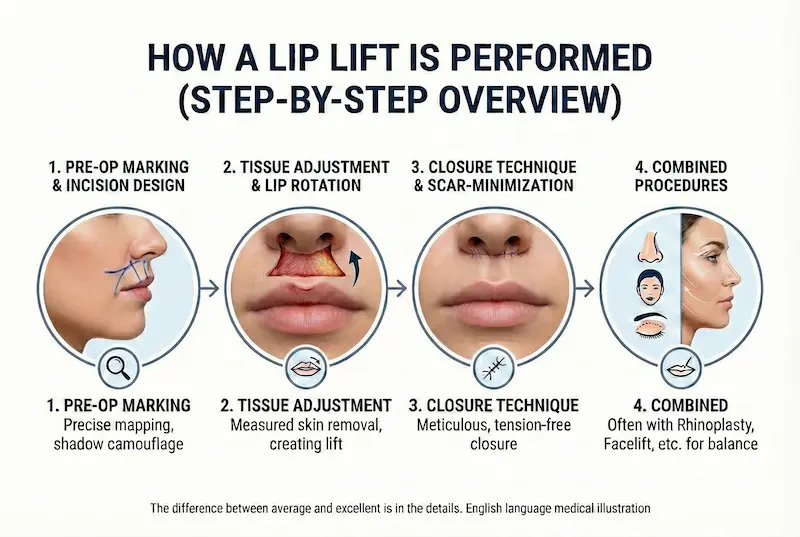
How a Lip Lift Is Performed (Step-by-Step Overview)
While technique details vary, most lip lifts follow a structured sequence: precise marking, incision placement, tissue adjustment, and meticulous closure. The difference between an average and excellent result often comes down to millimeters—how much skin is removed, the lift vector, symmetry control, and the quality of closure. Below is a step-by-step overview of the surgical logic without overwhelming you with operative jargon.
Pre-Op Marking and Incision Design
Marking is where the result is “built.” The surgeon typically maps the desired reduction of philtrum height and plans an incision that fits your anatomy and your scar concealment needs. In subnasal approaches, the incision is designed to sit in the natural contours beneath the nose so that it can heal as discreetly as possible.
High-level principle: the incision is placed where shadow and natural creases can help camouflage it—while still allowing enough control to achieve the planned lift.
Tissue Adjustment and Lip Rotation
After the incision, a measured segment of skin is removed, and the underlying tissues are adjusted to allow the upper lip to rotate outward. This rotation is what often creates the appearance of more vermilion show and a more defined upper lip—without adding internal bulk.
Surgeons aim to preserve a soft, natural curvature. The goal is not a tight or overly elevated upper lip, but a balanced result that looks natural at rest and in a full smile.
Closure Technique and Scar-Minimization Principles
Closure is a major determinant of scar quality. Meticulous technique focuses on tension distribution, precise edge alignment, and layered closure when appropriate. The objective is to create a fine-line scar that matures well over time.
Even with excellent technique, scar outcomes can vary due to individual biology. That’s why aftercare and scar management (discussed in the recovery section) are part of the surgical plan—not an afterthought.
When Lip Lift Is Combined with Other Procedures
When a lip lift is combined with other procedures, it’s usually done to create a more balanced, cohesive facial result. A lip lift may be performed on its own, or as part of a broader plan—especially when a patient is already undergoing surgery that affects facial proportions, such as rhinoplasty, or rejuvenation procedures like a facelift, neck lift, or upper and lower eyelid surgery.
In combined cases, timing and anesthesia planning become especially important. Your surgeon should explain how each procedure influences the others, how the recovery timelines overlap, and whether doing them together (or staging them separately) offers the best balance of safety, healing, and aesthetic harmony.
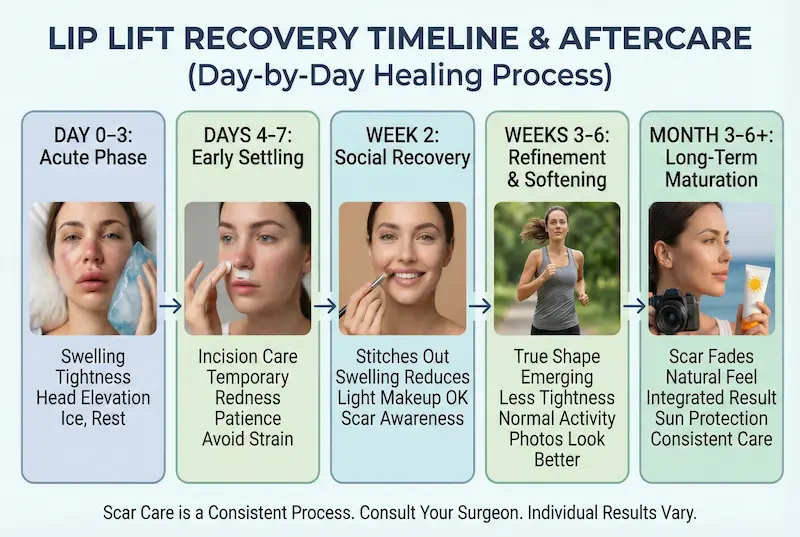
Recovery Timeline & Aftercare (Day-by-Day Healing Process)
Healing after a lip lift is usually straightforward, but it is rarely “instant.” The first days are dominated by swelling, tightness, and incision care; the first weeks are about scar maturation, symmetry settling, and returning to normal routines; and the first months are where the scar typically becomes more discreet and the result starts to look increasingly natural. If you’ve been searching for “lip lift recovery timeline” or “lip lift recovery day by day,” the key is to understand what’s normal, what’s not, and how to support predictable healing.
Day 0–3: Swelling, Tightness, and Incision Protection
In the first 72 hours, swelling is expected. Many patients describe a feeling of tightness under the nose or along the incision line. Bruising varies: some people have minimal bruising, while others notice mild discoloration around the upper lip or base of the nose.
- What you may notice: swelling, firmness, asymmetry that shifts day to day, mild oozing or crusting at the incision edges.
- What helps: head elevation (including during sleep), cold compresses if instructed, gentle cleansing as directed, and avoiding excessive facial movement.
- What to avoid: smoking/nicotine, alcohol excess, heavy exercise, and any activity that increases facial blood pressure (straining, bending over for extended periods).
During this window, “over-analyzing” the lip shape can create unnecessary anxiety. Swelling temporarily changes lip position and can make the result look tighter or more lifted than it will ultimately settle.
Days 4–7: Early Settling and the “Looks Worse Before It Looks Better” Phase
As swelling begins to shift, some patients feel the lip looks uneven or stiff. This phase is normal. The incision may look more obvious than you expected—often due to temporary redness, swelling, and the fact that scars are typically most noticeable early on.
- Hygiene and ointment: follow your surgeon’s exact instructions. Over-cleaning can irritate tissue; under-cleaning can cause crusting.
- Talking and smiling: normal facial movement is fine, but avoid exaggerated expressions early if advised.
- Comfort: mild discomfort is common; escalating pain is not “something to push through” and should be discussed.
Many patients are comfortable being seen publicly by the end of week one, but “camera-ready” typically takes longer, especially if you’re sensitive to mild redness.
Week 2: Stitches, Social Recovery, and Scar Awareness
By week two, most patients feel significantly more like themselves. Swelling usually decreases, and the lip begins to soften. This is often the point when patients start asking, “Is this my final result?” The answer is: you’re seeing the direction, but not the finish line.
- Swelling trend: typically improving, but not gone—especially after long days, travel, or salty meals.
- Scar appearance: may still be pink/red and slightly firm.
- Makeup: some patients can use concealer around the area (not directly on the incision until cleared).
At this stage, your surgeon may discuss a scar care plan. Scar management is not a single product—it’s a consistent process matched to your skin’s behavior.
Weeks 3–6: Softening, Refinement, and “True Shape” Emerging
Between weeks three and six, most patients notice the lip feels less tight and looks more natural in motion. This is also when subtle asymmetries often reduce as swelling resolves and tissues adapt. The incision line usually becomes flatter, though it may remain pink for some time.
- Activity: many patients return to normal workouts gradually (per surgeon guidance).
- Photos: your result often looks better in real life than in harsh close-up selfies during early healing.
- Scar maturation: redness gradually reduces; firmness can persist longer, especially in thicker skin.
If you’re comparing your result to “before and after” photos online, ensure you’re looking at comparable time points. A 10-day photo and a 6-month photo can look dramatically different even for the same patient.
Month 3–6+: Scar Maturation and Long-Term Result
Scar maturation is a long game. Many lip lift scars continue to improve for months as collagen reorganizes and redness fades. By this stage, the lip typically looks and feels more natural, and the “new proportion” becomes integrated into your facial expression.
- What improves over time: scar color, scar texture, residual firmness, and subtle tightness during facial movement.
- What persists: you will always have an incision line—ideally fine and discreet, but not literally nonexistent.
- What matters most: conservative planning, excellent closure technique, and consistent aftercare.
Scar Care: What Helps a Lip Lift Scar Heal Discreetly
“Does a lip lift leave a scar?” Yes—any incision heals as a scar. The practical question is whether it becomes discreet. Scar outcomes depend on surgical design and technique, but also on biology and aftercare. A responsible scar plan may include:
- Sun protection: UV exposure can worsen redness and pigment changes in healing scars.
- Silicone-based care: often used to support scar maturation (when the incision is fully closed and cleared).
- Gentle massage: sometimes introduced later to reduce firmness (only when recommended).
- Consistency: scar care works best when it’s steady and not constantly switched.
If you have a history of raised scars or pigment changes, this should be discussed before surgery so the plan can be tailored accordingly.
AKM Rapid Recovery & Safety Protocol (Supportive Modalities)
Some clinics incorporate supportive recovery technologies to help patients feel more comfortable during early healing and to optimize the recovery experience. At AKM, a structured “Rapid Recovery & Safety Protocol” may include supportive modalities such as:
- HBOT (Hyperbaric Oxygen Therapy): used in some settings to support tissue recovery in the early postoperative period.
- LLLT (Low-Level Laser Therapy): sometimes used as a supportive option for comfort and swelling management during healing.
These modalities are not a substitute for surgical technique or proper aftercare. They are best understood as supportive tools—most valuable when paired with precise planning, meticulous closure, and a disciplined recovery routine.
Red Flags: When to Contact Your Surgeon Urgently
Most recovery concerns are normal, but certain symptoms should be addressed promptly. Contact your surgical team urgently if you experience:
- Rapidly worsening pain that does not respond to prescribed guidance.
- Significant bleeding or sudden swelling that increases sharply on one side.
- Fever, chills, or signs of infection (worsening redness, warmth, pus-like drainage).
- Breathing concerns or an allergic reaction.
Expert patients don’t “wait it out” with red flags. Early communication protects outcomes.
Considering a lip lift and want a surgeon-level assessment of your proportions and scar strategy? You can request a free evaluation to understand what technique fits your anatomy and what your realistic recovery timeline would look like.
Risks, Complications, and Revision Strategy (A Transparent View)
Every surgical procedure has trade-offs, and a lip lift is no exception. The goal of a responsible plan is not to pretend risk doesn’t exist—it’s to reduce risk through technique, patient selection, and realistic expectations. Many “botched lip lift” or “lip lift regrets” stories online trace back to one of three root causes: an aggressive lift that overwhelms the patient’s anatomy, poor scar strategy, or a mismatch between what the patient wanted (often “volume”) and what the surgery is designed to deliver (proportion and lip display). Understanding these risk categories helps you make a clear, calm decision.
Common Risks (What Can Happen Even with Good Technique)
Commonly discussed risks include:
- Visible or unfavorable scarring: scars can be more noticeable than expected early on, and a small subset of patients may develop thicker or pigment-altered scars.
- Asymmetry: mild asymmetry is common during healing; persistent asymmetry can occur due to anatomy or scar behavior.
- Under-correction: the change may feel too subtle, especially if the plan was conservative or the anatomy limits lift amount.
- Over-correction: too much lift can create an unnatural look, excessive tooth show at rest, or a tight appearance in motion.
- Healing issues: delayed wound healing can occur, especially with nicotine use or uncontrolled health factors.
Less common but important risks exist in all facial surgeries (including infection or unfavorable tissue response). Your consultation should include how those risks are monitored and managed.
“Botched Lip Lift” Scenarios: Why They Happen
The term “botched” is often used loosely online. In practice, concerns typically fall into a few patterns:
- Too aggressive a lift: the philtrum is shortened beyond what the face can carry naturally, creating a “pulled” or overly toothy look.
- Scar placement or tension issues: a scar that is widened or uneven can draw attention, especially in the early months.
- Distorted nasal base aesthetics: when planning doesn’t respect nasal anatomy, the area under the nose can look altered in an unflattering way.
- Mismatch of goals: patients seeking “plumpness” may feel disappointed if they expected a filler-like volume effect.
In high-quality planning, these scenarios are actively mitigated by conservative measurement, careful incision design, a closure technique that minimizes tension, and a clear discussion of what you can realistically expect.
Lip Lift Regrets: The Most Common Reasons (and How to Avoid Them)
Regret is usually not about the idea of a lip lift—it’s about an outcome that wasn’t aligned with the patient’s priorities. The most common drivers of regret include:
- Not understanding the scar timeline: scars often look most noticeable early and improve gradually over months.
- Choosing “maximum lift” over “best proportion”: more is not always better; subtle changes often look the most refined long-term.
- Skipping a dynamic evaluation: outcomes must be assessed at rest and during a full smile.
- Underestimating aftercare: disciplined scar care and follow-up matter.
A strong way to reduce regret is to choose a surgeon whose portfolio aligns with your taste (natural vs dramatic), and to ensure the consultation includes realistic examples at similar time points in healing.
Revision Lip Lift: When It’s Considered and What’s Different
Revision is not “common,” but it is part of the broader reality of aesthetic surgery. A revision lip lift may be considered if there is:
- Functionally or aesthetically meaningful over-correction (for example, an upper lip that appears too short for the face).
- Unfavorable scar behavior that does not respond to conservative scar management over time.
- Persistent asymmetry that remains after full healing and maturation.
Revision planning is typically more conservative and more individualized than primary surgery. Timing matters: surgeons often prefer to allow adequate scar maturation before deciding what truly needs adjustment. A revision consult should be especially detailed, including a review of the original incision design, your healing pattern, and your current goals.
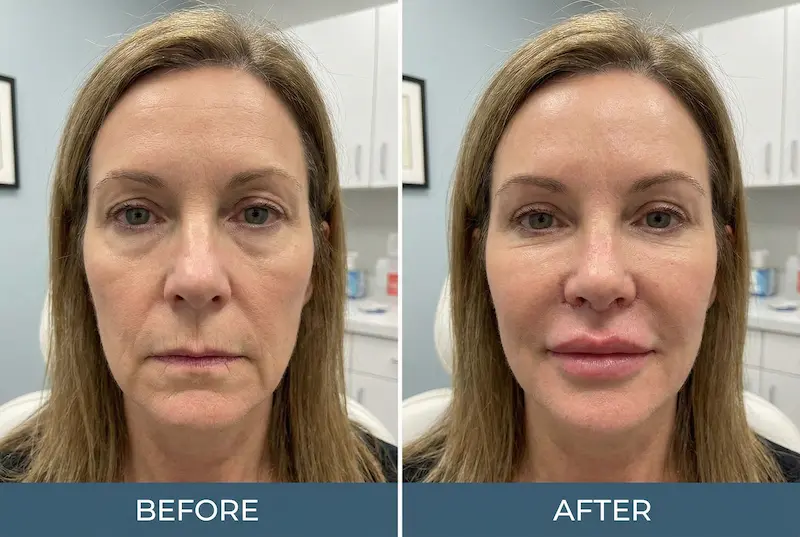
Results: What “Natural” Looks Like, Scars, and Permanence
A well-executed lip lift should improve the upper-lip proportion in a way that reads as effortless. The best outcomes are usually not those that look the most dramatic on day 10—they are the ones that look balanced and believable at month 6 and beyond. To evaluate results realistically, you need the right framework: assess the face at rest, during a relaxed smile, and during a full smile, and judge the result over the correct healing timeline.
What Realistic Results Look Like (Rest vs Full Smile)
Because a lip lift changes position and display, results should be evaluated in motion. Many patients notice:
- Improved upper-tooth show at rest or on a relaxed smile.
- More visible vermilion without the “inflated” look that can occur with excessive volume.
- Sharper upper-lip definition (especially the Cupid’s bow and vermilion border) when planned carefully.
It’s also normal for early swelling to create a temporarily “tighter” look. As tissues soften, the result typically becomes more natural and integrated into your expressions.
Does a Lip Lift Leave a Scar?
Yes—any incision heals as a scar. The meaningful question is: “How discreet does it become?” For many patients, a subnasal scar can heal very subtly because it sits at the base of the nose where natural contour and shadow can help camouflage it. However, scar visibility varies based on:
- Incision design and placement
- Closure technique and tension management
- Your biology (thicker skin, pigmentation tendencies, scar history)
- Aftercare and sun protection
Expect the scar to look more noticeable early (pink/red), then gradually fade and flatten. If you tend to hyper-focus on minor skin changes, it’s worth discussing this openly in consultation so the scar plan and timeline are fully understood.
Is a Lip Lift Permanent?
A lip lift creates a structural change in philtrum length and upper-lip position. In that sense, the improvement is long-lasting. However, aging continues. Over time, tissue characteristics and facial balance can shift, and the upper lip can gradually change with natural aging. Most expert patients think of permanence like this:
- The structural correction is durable (you’re not “back to baseline” in a year like a temporary injectable).
- Long-term appearance evolves with your natural aging process.
- Quality of planning matters: conservative, proportion-based outcomes tend to age more gracefully than overcorrected ones.
Before-and-After Thinking: How to Compare Results Correctly
If you’re reviewing lip lift before-and-after images, compare apples to apples:
- Check the timeline: early photos can exaggerate tightness and redness; later photos show true integration.
- Look for rest + smile views: the best documentation includes multiple angles and facial expressions.
- Assess naturalness: a “good” result typically improves proportion without looking artificially lifted.
If a clinic only shows one angle, one expression, or only very early results, ask for more comprehensive documentation.
If you want a surgeon-level recommendation (technique, scar strategy, and a realistic day-by-day timeline), you can request a free assessment and share neutral, well-lit photos at rest and smiling for an accurate proportion review.

Lip Lift Cost 2026: USA vs Turkey
“How much does a lip lift cost?” is a legitimate question—and the right way to think about it is as a blend of surgical expertise, safety infrastructure, and the total care experience (not just the procedure itself). In the US, lip lift pricing can vary widely by city and surgeon demand. In high-overhead markets such as NYC and Los Angeles, costs tend to sit at the top end of the spectrum. In Turkey, many expert patients explore care for a different reason: access to specialized surgical teams and comprehensive service models at a lower total cost—often described more accurately as better value, not “bargain surgery.”
What Drives Lip Lift Cost (The Variables That Matter)
Pricing is not simply “the surgeon’s fee.” The final cost is typically driven by several variables:
- Surgeon expertise and demand: facial specialists with consistent, natural portfolios generally command higher fees.
- Technique complexity: the plan may be more involved in revision cases or asymmetry-focused corrections.
- Anesthesia plan: local/twilight vs general anesthesia can affect facility and staffing requirements.
- Facility standards and safety: accredited operating environments, monitoring, and postoperative protocols matter.
- Included services: follow-up structure, medications, scar-care guidance, and (for international patients) logistics.
If you’re comparing two quotes that look very different, ask what is included and what assumptions are being made about anesthesia, follow-up, and contingency planning.
NYC / Los Angeles vs Turkey: Why the Difference Exists
In premium US markets, overhead costs (facility expenses, staffing costs, malpractice environment, and real estate) contribute significantly to pricing. In Turkey, the economics are different, and many clinics operate with structured packages that bundle core services. This can shift the cost conversation from “line-item billing” to a more predictable all-in model—particularly relevant for patients traveling from the US who want clarity.
For an expert patient, the best comparison is not “cheapest vs most expensive.” It’s:
- Does the surgeon’s work align with my aesthetic standard?
- Are the safety protocols clear and credible?
- Is the postoperative plan robust, including scar strategy and follow-up?
- Is the total travel + care experience organized and low-friction?
Cost Comparison Table (Illustrative Framework)
Actual prices vary by patient anatomy, technique selection, and whether procedures are combined. The table below is a decision framework to help you compare what you’re truly buying: procedure-only pricing vs a comprehensive care model.
| Cost Category | USA (NYC / Los Angeles Typical Model) | Turkey (All-Inclusive Care Model) |
|---|---|---|
| Surgeon Fee | Often the largest component; varies by reputation and market demand | Often competitive due to different overhead structure |
| Facility / OR Fees | Commonly billed separately; can be substantial in premium markets | Frequently included in packaged pricing |
| Anesthesia | Often billed separately (especially with general anesthesia) | Often included; anesthesia approach depends on case and plan |
| Post-Op Care & Follow-Up | Follow-ups included, but structure varies; aftercare supplies may be separate | Typically packaged with structured check-ins and coordination |
| Travel Logistics | Not applicable | May be included (airport transfers, hotel coordination) depending on clinic model |
| Total Predictability | Can vary; line items may increase the total | Often higher predictability with all-in pricing |
Key point: the best “value” option is the one where the surgeon’s aesthetic outcomes, scar strategy, safety infrastructure, and follow-up plan match your standards—and where you can clearly understand what is included before you commit.
If you’re comparing “lip lift cost NYC,” “lip lift cost Los Angeles,” and “lip lift cost in Turkey,” a free assessment can help you get a tailored estimate based on your anatomy and your preferred technique (bullhorn, Italian, corner, etc.).
Choosing the Best Lip Lift Surgeon
If you’re an expert patient, you’re not just buying a procedure—you’re choosing a surgeon whose judgment, technique, and aesthetic philosophy align with your risk tolerance and your definition of “natural.” The most reliable way to select a provider is to evaluate credentials, safety infrastructure, documentation quality, and consistency of results over time. A lip lift is a millimeter-level procedure, and subtle errors can produce visible consequences, especially around scar placement and symmetry.
Credentials and Specialty Focus (What to Look For)
Look for a surgeon whose training and practice demonstrate deep facial specialization. In general, expert patients prioritize:
- Board-level credentials and a verifiable professional track record.
- High procedure familiarity (a consistent history of performing lip lifts and managing variations).
- Aesthetic consistency—results that repeatedly match your taste (natural, proportion-based outcomes).
Credentials alone are not a guarantee of aesthetic alignment, but they are a baseline filter for professionalism and accountability.
Safety Standards and Clinical Infrastructure
Because a lip lift involves an incision at a highly visible location, safety and process matter. Evaluate:
- Pre-op screening and how the clinic evaluates risk factors like nicotine use and healing concerns.
- Monitoring and protocols during and after surgery (especially if sedation is used).
- Follow-up structure: scheduled visits, access to your care team, and guidance for normal vs abnormal healing.
Clinics that operate with a clear, structured process tend to produce more predictable patient experiences—particularly for international patients who need high clarity.
Before/After Documentation Quality (The “Evidence Standard”)
When evaluating results, prioritize documentation quality over marketing polish. Strong evidence typically includes:
- Multiple angles (front, oblique, profile).
- Rest and full-smile views to show dynamic outcomes.
- Comparable lighting and distance, avoiding heavy filters or different head positions that distort comparison.
- Time-point transparency (early vs late healing photos clearly labeled).
If your main anxiety is scarring, ask specifically for healed results at later time points (months, not days), and ask what scar care protocols are typically recommended.
Questions Expert Patients Should Ask in Consultation
- Which technique do you recommend for my anatomy, and why?
- How do you plan the amount of lift to avoid an overcorrected look?
- Where will the incision sit on my face, and what scar outcomes do you see most often?
- What is your plan if scar behavior is not ideal?
- What does my recovery look like day by day, and when do you expect the scar to start fading?
Ready for a proportion-based recommendation? You can request a free evaluation and receive guidance on technique selection, scar strategy, and a realistic recovery timeline tailored to your anatomy.
The Medical Journey for International Patients
For US patients considering a lip lift abroad, the decision usually comes down to two questions: “Can I get an outcome that meets my aesthetic standard?” and “Will the process feel safe, organized, and medically responsible from start to finish?” A well-run international patient journey should reduce uncertainty—not add it. That means structured pre-op screening, clear surgical planning, predictable logistics, and a follow-up plan that extends beyond the flight home.
Remote Consultation: Getting an Accurate Plan Before You Fly
A remote assessment should be more than a quick “yes/no” reply. A strong pre-travel plan typically includes a proportion-based evaluation and a discussion of technique selection (for example, bullhorn/subnasal vs Italian vs corner lift when relevant). For the best accuracy, clinics commonly request:
- Neutral, well-lit photos from the front and 45-degree angles
- Profile photos to assess nose–lip–chin balance
- Rest and full-smile photos (because tooth show and movement matter)
- Your goals in plain language (natural refinement vs dramatic change)
The goal is to arrive with clarity: the recommended technique, the anesthesia plan (awake/twilight vs general if combined), and a realistic recovery roadmap. Expert patients should also expect honest discussion of scar strategy and the true healing timeline.
Arrival, Transfers, and a Low-Friction Patient Experience
When traveling internationally for surgery, comfort and organization are not “luxury extras”—they help protect recovery. A structured VIP logistics model typically includes coordinated airport transfers, accommodation planning, and streamlined scheduling so patients can focus on healing instead of navigation stress.
In an AKM-style all-inclusive pathway, the operational objective is simple: minimize friction, keep timelines predictable, and provide clear guidance at each step so patients know exactly what happens on surgery day, what happens at follow-up visits, and what the first week should look like.
In-Clinic Care Pathway: Screening, Surgery Day, and Early Follow-Ups
A medically responsible pathway is built around predictable checkpoints. While exact schedules vary, many international journeys include:
- Pre-op evaluation (history review, risk factor screening such as nicotine use, and consent alignment)
- Final surgical marking and plan confirmation (including a dynamic smile review)
- Procedure day with a defined anesthesia approach and monitoring
- Early follow-up visits to evaluate incision integrity, swelling pattern, and scar plan
If supportive recovery modalities are offered (for example, HBOT or low-level laser), they should be explained as adjuncts—useful for comfort and recovery experience, but not substitutes for precision surgery and disciplined aftercare.
Long-Term Follow-Up After You Return to the US
Long-term follow-up is one of the most important differentiators for international care. Because lip lift scars continue to mature for months, expert patients benefit from structured check-ins after returning home. A high-quality follow-up model may include scheduled evaluations at typical milestones (for example, 1, 3, 6, and 12 months), plus easy access for questions during the early healing window.
From a practical standpoint, a clinic should be able to guide you through:
- Scar care adjustments based on how your skin is responding
- Normal vs abnormal healing so you don’t self-diagnose from the internet
- Photo-based progress checks to track maturation and symmetry
If you are choosing an international provider, ask specifically how follow-up is structured once you’re back in the US—and who you can contact if you have a concern outside business hours.
Lip Lift: Frequently Asked Questions
The questions below are written in the same way patients ask them out loud—clear, direct, and practical. Use these answers as a starting point, and treat your consultation as the place where the details are customized to your anatomy and goals.
What is a lip lift?
A lip lift is a surgical procedure that shortens the philtrum (the skin between the base of the nose and the upper lip) and rotates the upper lip slightly outward. This typically increases visible upper-lip vermilion and improves tooth show at rest, creating a more balanced, youthful upper-lip proportion.
Is a lip lift permanent?
The structural change from a lip lift is long-lasting, because skin is removed and the lip position is altered. However, aging continues, so your face will still evolve over time. Most patients think of it as a durable correction rather than a temporary treatment like injectables.
Does a lip lift leave a scar?
Yes. Any incision heals as a scar. In subnasal (“bullhorn”) techniques, the incision is typically placed at the base of the nose to help conceal it. Scar visibility varies by surgical technique, tension management, your biology, and consistent aftercare (especially sun protection and scar care when cleared).
What is lip lift recovery day by day?
Days 0–3 are typically swelling and tightness; days 4–7 are early settling (the scar can look red/pink and more noticeable); weeks 2–6 are gradual softening and refinement; and months 3–6+ are scar maturation and long-term settling. Your exact timeline depends on technique, biology, and aftercare.
Lip lift vs lip filler: which is better for me?
Filler adds volume and is temporary. A lip lift changes proportion and position by shortening the philtrum and increasing lip display. If your primary issue is a long philtrum or minimal tooth show, a lip lift may be more direct. If your primary issue is volume, filler or fat transfer may be better—or you may benefit from a combined strategy.
What is a bullhorn lip lift?
A bullhorn lip lift is a common subnasal lip lift technique where the incision is placed at the base of the nose in a shape that resembles a bullhorn. It aims to shorten the philtrum and rotate the upper lip outward to improve tooth show and upper-lip definition.
Will a lip lift look unnatural?
It can if the plan is overly aggressive or not matched to your anatomy. Natural results usually come from conservative, proportion-based planning, careful symmetry control, and realistic expectations. Evaluating rest and full-smile movement is essential.
What are signs of a botched lip lift?
Common concerns include an over-lifted upper lip with excessive tooth show at rest, noticeable or widened scarring, persistent asymmetry after full healing, or a tight/pulled look in motion. Early swelling can mimic some of these temporarily, so timelines matter when judging results.
How soon can I wear makeup after a lip lift?
It depends on your surgeon’s protocol and incision healing. Many patients can use makeup around the area relatively early, but you should avoid applying products directly on the incision until it is fully closed and your surgeon clears it.
How do I choose the right lip lift surgeon?
Prioritize a surgeon with verifiable credentials, a consistent portfolio of natural-looking lip lift outcomes, strong documentation (multiple angles, rest and smile views, and clear timelines), and a transparent approach to risks and scar strategy. Ask how they decide technique selection and what their plan is if scar behavior is not ideal.
Medical Disclaimer: This content is for educational purposes only and does not replace medical advice. A lip lift is a surgical procedure with risks and variable outcomes. Only a qualified clinician can determine candidacy, technique, and recovery expectations after evaluating your anatomy and medical history. If you have urgent symptoms, seek immediate care.