



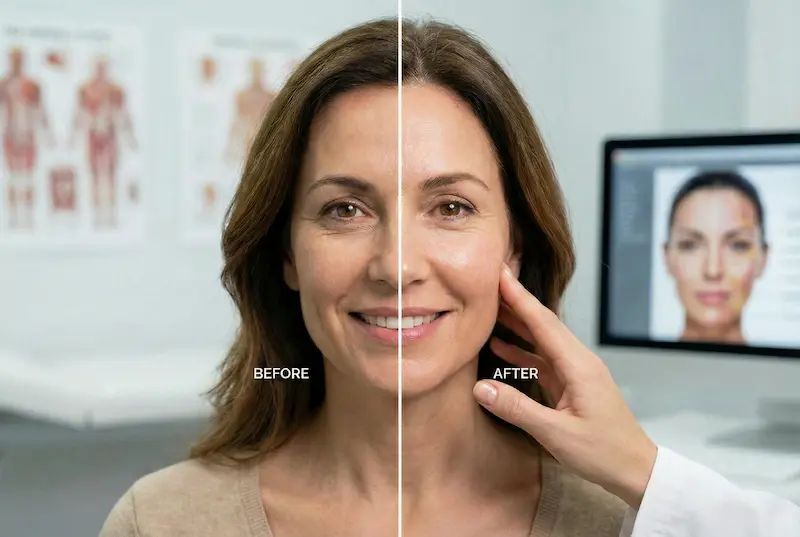
Fat Transfer to Face restores facial volume using your own purified fat, placed in micro-droplets to smooth hollows in the cheeks, temples, and under-eyes. We plan each zone conservatively so the result looks rested, not overfilled, and evolves naturally as swelling fades. Because this is living tissue, part of the graft integrates and can remain stable for years over time.
Recovery is gradual: days 1–3 bring peak swelling, days 4–14 are your social downtime window, and weeks 3–12 reveal the final contour. In Istanbul, our Rapid Recovery & Safety Protocol may include HBOT and LLLT when appropriate to support comfort. Comparing USA costs with Turkey value, we offer transparent inclusions and a free virtual consultation for your personalized facial plan.
Table of Contents
What is Fat Transfer to Face?
Fat Transfer to Face is a facial rejuvenation procedure that uses your own purified fat—typically harvested from a donor area—to restore volume and refine contours. Surgeons inject the fat in precise micro-amounts to soften hollows and certain folds. It’s also known as facial fat grafting or autologous fat transfer.
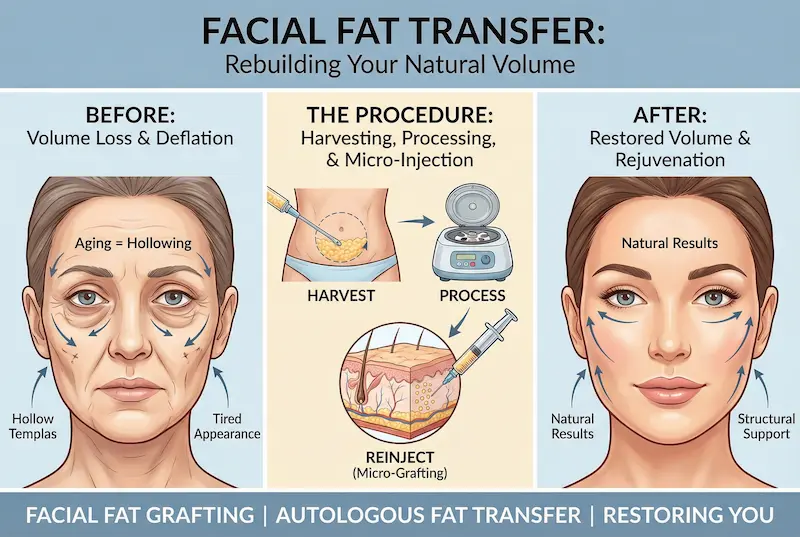
Think of it as “rebuilding” facial volume rather than masking it. Aging often shows up as deflation in the cheeks, temples, and under-eye region, not just loose skin. Because we’re using your own tissue, the result can look and feel more natural than some synthetic options. The goal is simple: a rested, structurally supported version of you.
Facial fat grafting vs. facial fat transfer: the terminology
Facial fat grafting and facial fat transfer are used interchangeably in most patient education. Both describe the same three-step sequence: harvesting, processing, and reinjecting fat. You may also see the phrase autologous fat transfer to face, which simply means “using your own fat.”
- Facial fat transfer: common, patient-friendly wording.
- Fat grafting for facial rejuvenation: emphasizes the restorative goal.
- Autologous: clarifies that the filler material is your own tissue.
If you’re comparing providers, the label matters less than the technique and planning behind it. Precision is the entire game.
What facial volume loss really is (and why you look “tired”)
Volume loss doesn’t happen evenly. The midface can flatten, the temples can hollow, and the transition under the eyes can look sharper. When those structural supports fade, the face can read as fatigued even if you feel great.
Patients often describe this as looking “drawn,” “older,” or “less defined” in photos. It’s not vanity. It’s geometry. Restoring volume in the right layer can rebalance proportions and bring back soft highlights in a controlled, natural way.
How grafted fat survives: the “take rate” basics
Not every transferred fat cell will survive. The portion that “takes” is the portion that reconnects with a blood supply in its new location. That’s why surgeons inject fat in tiny, layered deposits rather than large pools.
- Smaller droplets integrate more reliably.
- Overfilling can increase irregularity risk.
- Results evolve as swelling fades and the surviving fat stabilizes.
This is also why the procedure is part art, part science. You want structure. You also want restraint.
Benefits: Why Do Patients Choose Facial Fat Grafting?
The biggest benefit is natural-looking restoration. Fat is soft tissue, so it can blend smoothly when it’s placed correctly. Many patients like the idea of using their own tissue rather than a synthetic product. They also like that the improvement can be long-lasting once the result stabilizes.
That said, the best outcomes are planned, not chased. The goal isn’t to look “done.” The goal is to look like you slept well, lost stress, and regained facial balance.
Natural-looking volume, not an “overfilled” look
When facial rejuvenation looks unnatural, it’s often because volume was added in the wrong place or in the wrong amount. Our approach is guided by a simple principle: restore what time removed, then stop. We plan for harmony, not shock value.
“Rejuvenation, not alteration. The best result is the one people can’t pinpoint.”
This is where expert planning matters most. Cheeks, temples, and the midface need different strategies. One-size-fits-all never looks natural.
It can do two jobs: contour support and skin quality potential
The primary job is structural: filling hollows and supporting contours. Some patients also notice an improvement in how “fresh” the skin appears over time. That isn’t a guarantee, and it isn’t the main reason to do the procedure. It’s a potential secondary benefit that varies by person.
- Volume restoration can soften shadowing and deepen facial highlights.
- Contour support can make the face look less “collapsed.”
- Subtle surface improvement may occur, depending on your baseline skin quality.
Where fat transfer can help most (common target zones)
Fat transfer is most powerful in areas where the face has deflated rather than simply wrinkled. Zone-based planning creates the most believable change. It also helps us avoid the “same face” look that patients fear.
- Cheeks and midface: restoring projection and softer contours
- Temples: reducing hollowing that can age the upper face
- Nasolabial and marionette regions: softening depth when volume loss is a driver
- Under-eyes: carefully selected cases, conservative placement
If your main concern is fine surface texture alone, a different treatment may be a better fit. Fat transfer is a structural tool first.
Am I a Good Candidate For Facial Fat Grafting?
Good candidates want true structural support, not a temporary “cover-up.” They typically notice hollowing in the cheeks, temples, or under-eye transition, and they want a result that looks like their own face—just rested. Your baseline skin quality matters, but volume loss is usually the main driver. The other key factor is simple: you need enough donor fat to harvest safely.
In our consultations, we look for balance. That means matching your goals to what fat can realistically do, planning conservatively, and prioritizing safety from the start.
Who is usually an ideal candidate?
You may be a strong candidate if your concerns are primarily about deflation rather than only fine surface wrinkles. Patients often describe looking “tired” in photos, even when they feel fine. Fat transfer can be a smart option when you want soft, natural volume restoration and you’re comfortable with a healing phase where the face changes week by week.
- Visible hollowing (midface, temples) and shadowing that makeup can’t fix
- Desire for your own tissue (autologous approach) instead of synthetic products
- Reasonable expectations about gradual settling and final refinement
Who should avoid or postpone the procedure?
Some situations call for caution or a different plan. We take a “right procedure, right timing” approach, because rushing the wrong candidate leads to disappointment. If your health status increases surgical risk, or if lifestyle factors reduce graft survival, we would rather delay than compromise your outcome.
- Uncontrolled medical conditions that affect healing or increase anesthesia risk
- Active smoking or nicotine use (it can compromise circulation and tissue repair)
- Unrealistic expectations (for example, expecting instant, permanent perfection)
If your main issue is skin laxity rather than volume loss, a lifting procedure—or a combined plan—may create a more predictable result.
What we evaluate in a consultation (and why it matters)
Facial fat transfer is not a one-size procedure. We evaluate donor fat availability, facial symmetry, skin thickness, and where the face is losing support. We also assess your tolerance for downtime, because swelling and bruising are part of the short-term reality. When needed, we use detailed planning tools to map volume deficits and align expectations before surgery.
“The goal isn’t to add volume everywhere. The goal is to restore structure where time removed it—then stop.”
Surgical Techniques Explained: How a Facial Fat Grafting Procedure Is Actually Done
The success of fat transfer to the face depends on technique, not just the concept. The process has three stages: harvesting, processing, and injecting. Each stage is designed to protect fat cell viability and improve the chance that transferred fat will integrate and survive. This is why the same procedure name can produce very different outcomes across different providers.
We focus on precision and restraint. Micro-placements in the right plane help create natural contours, while reducing the risk of lumps, irregularities, and an “overfilled” look.
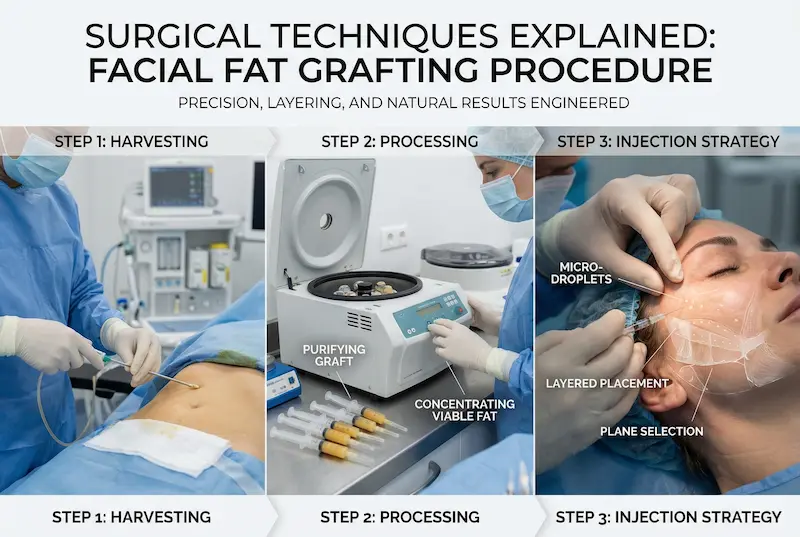
Step 1: harvesting (where the fat comes from)
Fat is typically harvested from areas where it can be collected safely and predictably, such as the abdomen or flanks. The goal is gentle extraction. Trauma during harvesting can reduce the quality of the graft, which can affect how well it performs after transfer.
- We aim for smooth harvesting with minimal tissue disruption.
- Donor selection is based on availability, safety, and aesthetic considerations.
- The harvest is only one piece—what happens next is just as important.
Step 2: processing (purifying and preparing the graft)
Processing is where the harvested material is refined into a cleaner, more usable graft. The objective is to concentrate viable fat while reducing excess fluids and unwanted components. Cleaner graft material supports smoother placement and more predictable integration.
Processing approaches vary by clinic and by the target zone. Delicate areas such as the under-eye region often require more conservative planning and, in some cases, different fat “formats.”
Step 3: injection strategy (micro-droplets, layering, and plane selection)
Injection technique is the artistic and anatomical core of facial fat transfer. Rather than placing large volumes in one spot, experienced surgeons place tiny amounts across multiple layers. This “micro-aliquot” approach improves contact with surrounding tissue and supports healthier integration.
- Layered placement helps create natural highlights and soft transitions.
- Conservative dosing reduces the risk of irregularities.
- Plane selection (depth) changes the visible effect and the feel of the result.
| Technique / Fat Type | Best Use | Primary Effect | Limitations |
|---|---|---|---|
| Structural (Microfat) Grafting | Cheeks, temples, midface support | Volume restoration and contour support | Requires precise placement; overcorrection can look heavy |
| Nano fat transfer | Surface-level skin support in select plans | Targets skin quality potential more than bulk volume | Not designed to replace major volume loss |
| Hybrid / Zone-Based Planning | Combining formats by facial zone | Customized balance of structure + refinement | More complex; results depend heavily on surgeon experience |
If you’re comparing providers, ask exactly how they plan zones, layers, and volumes. A natural result is engineered—one careful placement at a time.
Treating Specific Zones: Under-Eyes, Cheeks, Temples, And Smile Lines
Facial fat grafting works best when it is planned by zones, not by a single “total volume” number. Each area has different skin thickness, different movement, and different tolerance for volume. The under-eye region is unforgiving. The midface is more forgiving, but it still demands restraint.
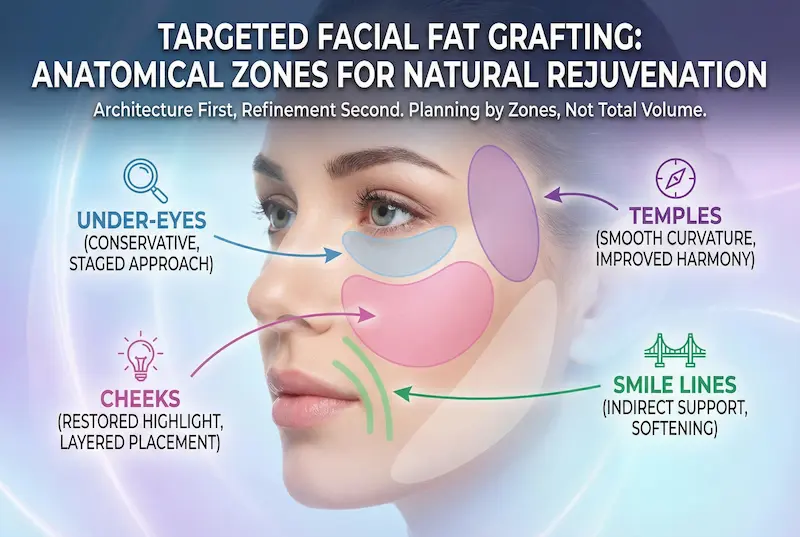
Planning runs zone by zone, in a fixed order: midface support first, then temples, then the fine transitions around the eyes and mouth. The reason is mechanical. Once the cheek is supported, the tear trough and nasolabial shadow often need less volume than they appeared to need in the pre-op photo, and treating them first would mean overfilling both.
Facial fat transfer under eyes: why this area needs a conservative strategy
The tear trough (under-eye hollow) is a high-reward, high-precision area. Small placement errors can show as contour irregularities, puffiness, or visible texture changes. That’s why under-eye fat grafting is not “more is better.” It’s often “less is safer.”
- We evaluate skin thickness, eyelid support, and how you look in motion—not just in still photos.
- We prioritize smooth transitions over dramatic projection.
- In select cases, a staged approach can reduce the risk of overcorrection.
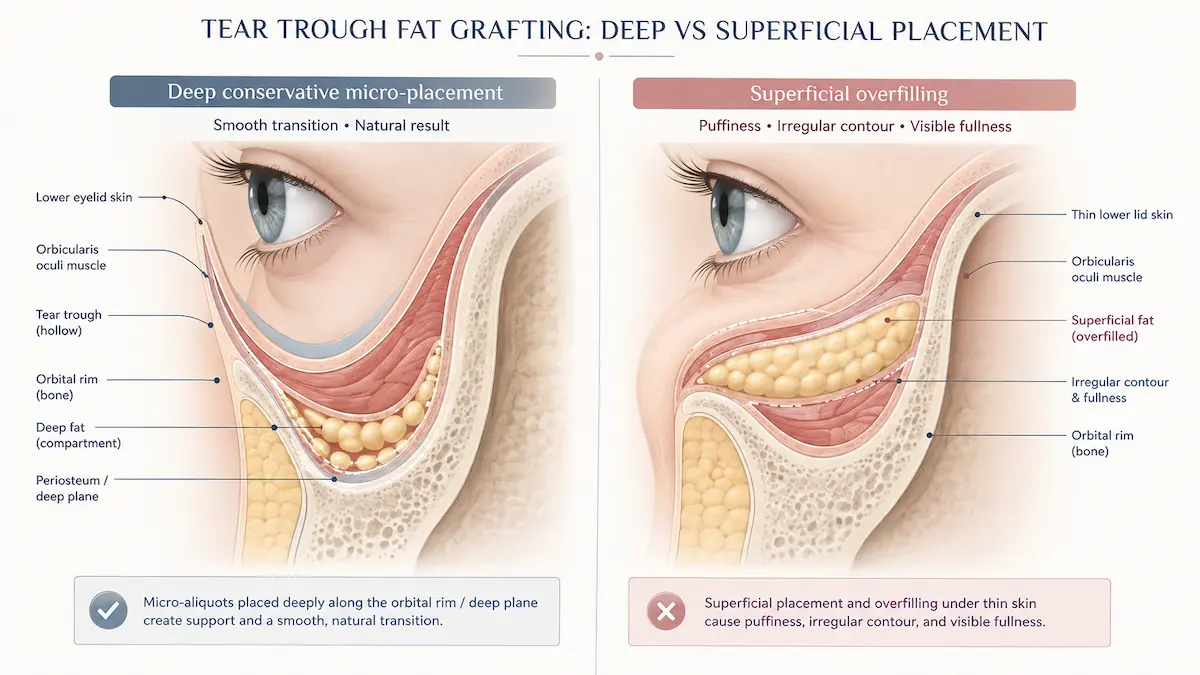
Two questions come up in almost every under-eye consultation. First: how much can be placed safely? In thin lower-lid skin the answer is usually a fraction of what the midface tolerates, placed deep and in more than one pass rather than a single deposit. Second: should the eyelid be addressed at the same time? If there is fat herniation or excess skin, volume alone can make the area look heavier, and a lower blepharoplasty with repositioning is the more predictable route. For a detailed breakdown of what under-eye and full-face grafting costs in Istanbul, see our fat transfer to face cost in Turkey page.
“The under-eye isn’t a place to chase volume. It’s a place to restore a clean transition—quietly.”
Cheeks and midface: restoring the “rested” highlight
Midface volume loss is one of the most common reasons patients look fatigued. A well-planned midface graft can soften shadowing around the nose and mouth and restore gentle cheek projection. Placement and layering matter more than the number of milliliters used.
- We aim for natural light reflection on the cheek, not a “pillow” look.
- Layered micro-placement helps the graft integrate more evenly.
- When midface descent is significant, fat alone may not be enough—lifting may be the missing piece.
Temples: the detail that changes the whole upper face
Temple hollowing can make the upper face look sharper and more aged. It can also change the balance between the forehead, brow, and cheek. When temples are treated correctly, the entire face can read as softer without looking “filled.”
- Temple anatomy is vascular. Safety and technique are non-negotiable.
- We focus on smooth curvature, not bulges.
- Small improvements here can have an outsized impact on harmony.
Nasolabial folds and marionette regions: when fat helps, and when it doesn’t
Deep folds around the mouth are not always a pure “volume problem.” Sometimes they are created by descent, skin laxity, and repetitive movement. Fat grafting can soften the fold when deflation is a major driver, but it won’t erase dynamic creasing like an Instagram filter.
- We treat the cause: support in the midface often improves the fold indirectly.
- Direct placement near the fold is planned carefully to avoid heaviness.
- For some faces, a combined plan delivers the most believable change.
Fat Transfer to Face vs Fillers: Which Option Is Better For You?
Patients often compare facial fat transfer vs fillers because both can restore volume. The similarity ends there. Fillers are manufactured gels placed in specific planes. Fat grafting is living tissue that must integrate to survive.
The smarter question is not “which is best?” It’s “which matches my goals, timeline, and tolerance for change?” Some patients do well with fillers for targeted, reversible correction. Others want a more durable, natural-feeling restoration and accept a longer recovery curve.
Longevity and maintenance: predictable schedules vs biological settling
Fillers tend to follow a more predictable maintenance cycle. Facial fat grafting follows biology. You will see swelling early, then refinement as tissues settle, and then stabilization of the surviving graft over the following weeks.
- Fillers: planned touch-ups to maintain a consistent look.
- Fat grafting: a “settling” phase, then longer-term persistence of what survives.
- Weight fluctuations can affect fat graft volume more than filler appearance.
Look and feel: integration, softness, and the risk of looking overdone
Many patients choose fat because it can integrate like native tissue when placed well. That can translate into a softer feel and a less “product-like” look. Fillers can also look natural in expert hands, but they may feel different depending on type, depth, and amount.
- Fat can create a gentle, blended contour across broader zones.
- Fillers can be ideal for precise, small corrections in a short visit.
- Overcorrection is possible with both—planning and restraint prevent it.
Risk profile: reversibility vs long-term responsibility
One practical difference is reversibility. Many hyaluronic acid fillers can be dissolved, which offers a safety net. Fat cannot be “dissolved” in the same way, so the strategy must be conservative from the start.
| Factor | Fat Grafting | Dermal Fillers |
|---|---|---|
| Downtime | More swelling/bruising early; gradual settling | Usually minimal; faster “back to routine” |
| Longevity | What survives can be long-lasting | Temporary; maintenance required |
| Reversibility | Not easily reversible | Often reversible (depending on filler type) |
| Best fit | Broader structural restoration and contour support | Targeted, precise correction with short downtime |
A decision framework we use in consultations
We keep the decision simple. If your goal is quick, targeted correction with minimal downtime, fillers may fit. If your goal is structural rejuvenation with a natural feel—and you accept a healing curve—fat grafting may be the better match.
- Choose fat grafting when you want durable volume support and are comfortable with swelling and settling.
- Choose fillers when you want reversibility, precision, and a faster return to social life.
- Consider a combined plan when you need both structural support and fine-tuned finishing.
Combined Procedures: How We Maximize Results With One Recovery
Facial aging is rarely a single-issue problem. Volume loss, skin laxity, and eyelid changes often appear together, which is why many patients explore a combined plan instead of chasing one “perfect” procedure. A thoughtful combination can improve overall harmony and reduce the need for multiple separate recoveries. It can also be more efficient if you’re traveling, because it consolidates pre-op testing, anesthesia planning, and post-op monitoring into one journey. The key is precision—pairing procedures that complement each other, not compete with each other.
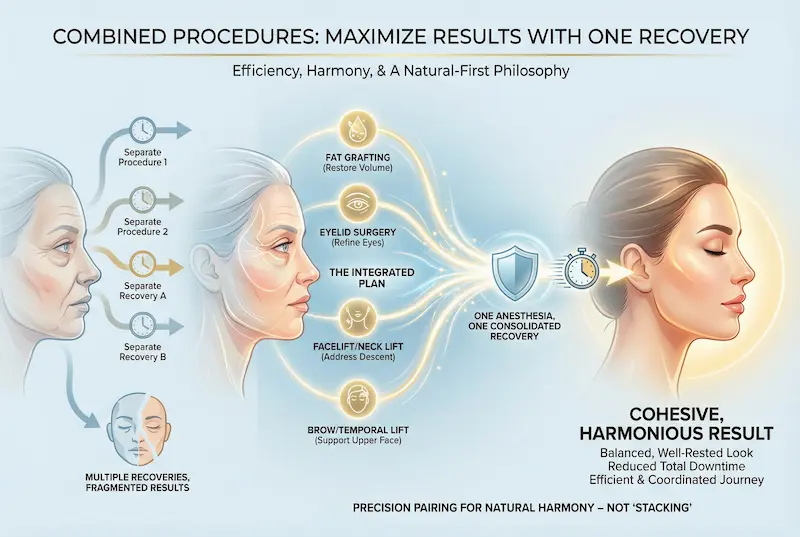
We plan combination surgery with a Natural-First philosophy. That means we aim for a balanced, well-rested look, not a dramatic transformation that looks unfamiliar. When the plan is integrated, the face reads as younger without looking “treated.”
Common pairings with facial fat grafting
Fat transfer restores structure. It becomes even more powerful when we pair it with procedures that address lift, eyelid shape, or skin quality. The right combination depends on what is driving your concern: deflation, descent, or both.
- Upper or lower eyelid surgery: helps refine the eye area when volume alone won’t correct lid-related changes.
- Endoscopic brow or temporal lift: supports the upper face when the brow position contributes to a heavy, tired look.
- Facelift and/or neck lift: addresses tissue descent when the “gravity effect” is the real issue.
- Lip lift: can improve upper-lip length and definition in select facial aging patterns.
- Deep plane facelift: when midface descent, not deflation, is the dominant problem, lifting comes first and grafting fine-tunes the result.
- Chin augmentation: adds lower-face projection that fat grafting alone cannot create in a weak chin profile.
- Buccal fat removal: occasionally paired with upper-cheek grafting in round lower faces, but only when the lower cheek fullness is genuinely excess rather than youthful volume.
“One anesthesia, one recovery”: why it can be a smart strategy
Many expert patients want efficiency without compromise. A combined plan can reduce the total number of anesthesia events and compress overall downtime into one recovery window. It can also produce a more cohesive result because we’re addressing multiple layers of the same aging pattern at once.
- One coordinated surgical plan instead of separate treatments with separate swelling cycles
- One structured post-op support timeline
- One set of travel logistics if you’re coming to Istanbul
“Harmony is the target. We don’t ‘stack’ procedures. We build a plan that solves the real cause—then we stop.”
When we recommend staging instead of combining
Not every patient benefits from doing everything at once. If your goals are highly specific, if the plan becomes too extensive, or if medical factors call for a more conservative approach, staging can be safer and more predictable. Staging can also help when you want to evaluate how fat settles before making additional changes.
- Health factors that increase surgical risk or complicate recovery
- Cases where a lift should be prioritized before volume refinement
- Patients who prefer smaller, step-by-step changes
Anesthesia Options: Why We Often Prefer Awake Or Twilight Sedation
Anesthesia is a major decision point for many patients—especially the “Expert Patient” who has researched risks and recovery in detail. Some people are comfortable with general anesthesia. Others have strong anxiety about it, or they simply prefer a less intensive approach when the procedure allows. This is where planning matters as much as surgical technique. We match the anesthesia method to your procedure scope, medical profile, and comfort level.
In our clinic, awake surgery and twilight sedation are not marketing phrases. They are clinical tools. Used appropriately, they can reduce fear, support a smoother early recovery experience, and keep the focus on safety and control.
What “awake surgery” really means (and what it does not)
Awake surgery typically means local anesthesia with careful, continuous monitoring—so you stay comfortable while avoiding full general anesthesia. You are not expected to “tough it out.” Comfort is the standard. We use a structured approach so you remain calm, protected, and supported throughout the procedure.
- Local anesthesia targets sensation in the treatment area.
- Our team monitors your vitals closely throughout the procedure.
- Communication stays clear and reassuring from start to finish.
Twilight sedation: the middle ground many patients prefer
Twilight sedation is often a great fit when you want deeper relaxation without the experience of full general anesthesia. It can help patients who feel anxious, who want less awareness of time passing, or who are combining procedures and prefer more comfort. We still prioritize safety-first monitoring and a calm, controlled environment.
- Many patients describe it as “sleepy” and comfortable.
- It can reduce stress response during longer procedures.
- It supports a more relaxed overall experience for patients who travel for care.
If anaesthesia is your main hesitation, our awake and twilight surgery programme explains how monitoring, local blocks and sedation depth are managed step by step, including which facial procedures are and are not suitable for it.
How we decide what’s right for you
There is no one “best” anesthesia choice for every face. We decide based on what you’re having done, how long the plan will take, and how your medical history affects risk. We also take your personal fear profile seriously—especially fear of general anesthesia—because stress changes the entire experience.
- Procedure scope: targeted fat grafting vs a broader combination plan
- Medical screening: safety markers that guide anesthesia selection
- Patient comfort: anxiety level, past anesthesia experiences, and preferences
Step-By-Step: What Happens On Procedure Day
For an expert patient, clarity reduces anxiety. Our process is structured, predictable, and designed to protect graft quality at every step. While every plan is personalized, the overall flow is consistent: safety checks, precise markings, gentle harvesting, careful processing, and layered micro-injection.
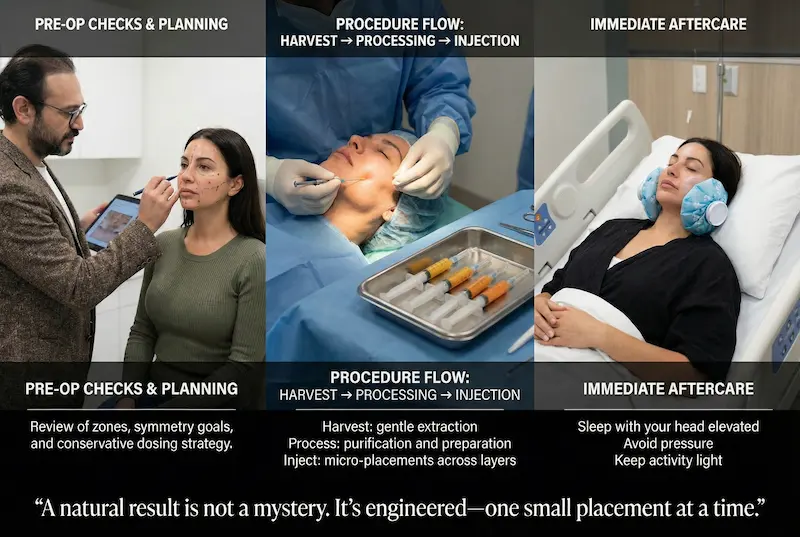
Pre-op checks and planning (the part that protects outcomes)
We begin with a final review of your plan, target zones, and donor area strategy. This is also when we confirm practical factors that influence healing—medications, supplements, nicotine exposure, and any last-minute health changes. Then we mark the face in an upright position to plan volume restoration in the way you actually appear day to day.
- Pre-op screening and vital checks
- Review of zones, symmetry goals, and conservative dosing strategy
- Markings done with facial movement and gravity in mind
The procedure flow: harvest → processing → injection
Facial fat grafting is a sequence, not a single act. We harvest fat gently, refine it into a usable graft, and then place it with a micro-droplet technique across the planned layers. The goal is controlled structure and smooth transitions, not bulk volume in one spot.
- Harvest: gentle extraction to protect fat cell integrity
- Process: purification and preparation for clean, precise placement
- Inject: micro-placements across layers for natural contour and integration
“A natural result is not a mystery. It’s engineered—one small placement at a time.”
Immediate aftercare: what you’ll do in the first 24 hours
Right after the procedure, your face will look fuller than the final result due to swelling. That’s expected. We guide you through positioning, cold management, and activity limits to reduce early inflammation and support a smoother healing curve.
- Sleep with your head elevated
- Avoid pressure or massage on treated zones unless we specifically instruct it
- Keep activity light and focus on hydration and rest
Recovery Timeline: Day By Day Fat Transfer To Face Recovery Time
Recovery after Fat Transfer to Face is a process of change, not a single “down day.” Swelling and bruising are normal early on, and your appearance evolves as tissues settle. The most important mindset shift is this: you’re not judging final results in the first two weeks.
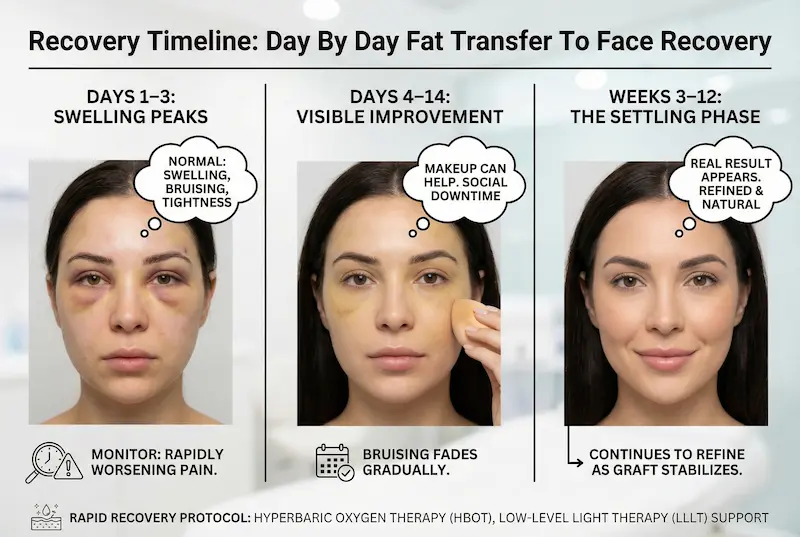
To support a more comfortable recovery, we use a technology-driven approach we call our Rapid Recovery & Safety Protocol. This includes options such as Hyperbaric Oxygen Therapy (HBOT) and Low-Level Light Therapy (LLLT), selected when appropriate to help manage swelling and support tissue recovery.
Days 1–3: swelling peaks (what is normal vs. what is not)
Most patients experience the most noticeable swelling in the first 72 hours. This is when the face can look “too full,” especially in the cheeks and midface. Mild asymmetry can also happen because swelling rarely develops perfectly evenly.
- Normal: swelling, bruising, tightness, mild unevenness
- Normal: tenderness at donor site and facial injection points
- Not normal: rapidly worsening pain, sudden vision changes, or severe one-sided swelling—these require immediate medical attention
Days 4–14: social downtime and visible improvement
By the end of the first week, most patients see a meaningful reduction in bruising and swelling. Many feel comfortable returning to social settings sometime during this window, depending on how quickly their bruising resolves and what zones were treated.
- Bruising typically shifts in color and fades gradually
- Swelling decreases, but the face may still look “in transition”
- Makeup can help once skin integrity is stable and we approve it
If you’re searching “swelling after fat transfer to face,” the honest answer is: it’s common early, improves week by week, and becomes significantly less noticeable for most patients by weeks 2–3.
Weeks 3–12: the settling phase (where the real result appears)
This is when the result becomes more “you.” The face continues to refine as swelling resolves and the surviving graft stabilizes. You may notice that some areas look more natural earlier than others—this is normal and depends on skin thickness and movement.
- Contours look softer and more integrated
- Final shape becomes clearer as the face de-puffs
- Photos often start matching the mirror more consistently
What day-by-day recovery photos actually show
Patients ask for day-by-day photos because they want to know when they will look like themselves again. Here is what a photo diary typically captures after facial fat grafting, so you can compare your own mirror to a realistic reference instead of a highlight reel.
- Day 1: the face looks fuller and rounder than the plan. Donor-site dressing is in place. Photos taken lying down or under overhead light exaggerate the fullness.
- Day 2–3: peak swelling. Cheeks and midface dominate the photo; bruising, if present, is usually darkest here.
- Day 4–7: bruising shifts colour and starts to fade. The jaw and temple outline reappears in profile shots first.
- Day 8–14: most patients photograph well enough for video calls and casual social settings. Under-eye and lower-lid areas can stay slightly puffy in morning photos.
- Week 3–6: contour transitions look smoother; the difference between your day-3 and week-4 photo is usually larger than the difference between week 4 and week 12.
- Week 12: the surviving graft has stabilised. This is the photo we compare against your pre-op set.
Practical tip: take your photos at the same time of day, same distance, same light source, without makeup. Front, three-quarter and profile. Mixed lighting is the single most common reason patients think they have lost volume overnight.
HBOT and LLLT: how our Rapid Recovery & Safety Protocol supports healing
For suitable patients, we may recommend supportive recovery technologies to help manage inflammation and improve comfort. These are not “magic shortcuts.” They are structured tools used alongside smart aftercare.
- HBOT: involves breathing oxygen in a pressurized environment; some patients use it as part of a recovery plan to support tissue healing.
- LLLT: uses low-level light to support comfort and help with swelling management.
- Protocol thinking: the goal is smoother recovery, better comfort, and disciplined aftercare—not aggressive interventions.
“Fast recovery isn’t luck. It’s a protocol—built around safety, consistency, and discipline.”
How Long Does Facial Fat Transfer Last? Is It Permanent?
Patients often ask whether facial fat grafting is “permanent.” The most accurate answer is: the fat that survives can be long-lasting, but your face will still continue to age naturally. Fat transfer is living tissue. A portion of the transferred fat integrates with its new blood supply (the “take”), and that surviving portion can persist for years. The rest is absorbed during the settling phase.
This is why fat transfer is not judged in week one—and why smart planning is conservative. We plan for biology, not for instant perfection.
What “permanent” really means (and what it doesn’t)
“Permanent” does not mean your face freezes in time. It means that once the graft stabilizes, the surviving fat behaves like the rest of your native fat. Your result can remain stable, but it will still be influenced by normal aging, lifestyle, and weight changes.
- Early phase: swelling makes the face look fuller than the final result.
- Settling phase: the body absorbs the portion that doesn’t integrate.
- Stabilization: what survives becomes part of your facial tissue.
“We don’t promise permanence. We plan for stability—then protect it with conservative technique.”
Factors that affect longevity (the details expert patients care about)
Longevity is influenced by technique and by patient factors. That’s why comparing “how long it lasts” across the internet is frustrating—different zones, different volumes, and different methods create different experiences.
- Technique: micro-placements and correct plane selection support healthier integration.
- Zone: highly mobile or delicate areas may behave differently than midface support zones.
- Nicotine exposure: can compromise circulation and healing, which may affect tissue recovery.
- Weight fluctuations: significant gain or loss can change facial fat volume over time.
Do you need a touch-up?
Some patients never need a touch-up. Others may benefit from a conservative refinement—especially if the initial plan intentionally prioritized safety and restraint. If a touch-up is considered, we prefer to evaluate after the face has clearly stabilized rather than reacting too early.
- We typically assess results after the settling phase, not during peak swelling.
- Touch-ups are about refinement—not chasing an overfilled look.
- A staged approach can be the safest path for delicate zones.
Safety & Risks: What Can Go Wrong—And How We Reduce Risk
Every procedure has risks, and facial fat grafting is no exception. The good news is that most concerns patients experience are temporary and expected: swelling, bruising, and short-term unevenness. The more important conversation is about preventable problems—like lumps, irregular contours, or unnatural volume—and the planning choices that reduce those risks.
Our strategy is simple: conservative dosing, precise placement, and a structured follow-up process. A natural result is usually a safer result.
Common, expected effects (often searched as “complications”)
These are common and usually improve steadily:
- Swelling after fat transfer to face: typically most noticeable in the first 1–2 weeks, then fades.
- Bruising: varies by person and treated zones; improves progressively.
- Temporary asymmetry: swelling is rarely perfectly even.
- Donor-site soreness: mild tenderness where fat was harvested.
We give you a clear recovery roadmap so you don’t waste energy panicking about normal healing phases.
Lumps after facial fat transfer: why they happen and what to do
When patients search “lumps after facial fat transfer,” they’re usually describing firmness, unevenness, or small irregularities during healing. Many early “lumps” are actually swelling patterns, temporary tissue stiffness, or small areas that settle as the face de-puffs. True nodules or fat necrosis are less common and are often related to technique, volume strategy, and tissue response.
- Prevention: micro-aliquot placement, avoiding heavy pooling, conservative dosing.
- Early phase: we avoid aggressive massage unless specifically instructed.
- Follow-up: if a firm area persists beyond the expected timeline, we evaluate it and guide next steps.
“Facial fat grafting gone wrong”: red flags and how to protect yourself
Most “gone wrong” stories online are not about fat as a concept—they are about poor planning, overcorrection, or low-quality execution. The strongest protection is choosing a surgeon who can show consistent, natural results and who plans conservatively.
- Red flags to watch for: rapidly worsening pain, sudden vision changes, severe one-sided swelling, fever, or drainage.
- Planning failures: overfilling, poor zone strategy, ignoring skin laxity that needed lift instead.
- Provider failures: weak follow-up, unclear aftercare, “one-size” volume approach.
“If a plan depends on overfilling, it’s not a plan—it’s a gamble. We build results with restraint.”
Is Facial Fat Grafting Safe In Turkey?
Istanbul is a large medical travel market, which means the range of quality is also large. The variables that actually change your risk are the same anywhere: who screens you before surgery, where the procedure is performed, who monitors you during it, and who answers when something feels wrong at week two. Ask for those four answers in writing before you book a flight.
Our approach is built around transparent planning, structured screening, and continuity of care—before you arrive, during your stay, and after you return home.
Safety standards: what we build into the process
We prioritize the fundamentals that matter most: medical screening, sterile operating conditions, continuous monitoring, and clear post-op escalation pathways. For an expert patient, the presence of a system is often more reassuring than promises.
- Pre-op screening and health review
- Intra-procedure monitoring and controlled operating environment
- Clear written aftercare instructions and check-ins
Surgeon expertise: what to verify (regardless of country)
If you’re comparing surgeons in NYC, LA, Miami, or Istanbul, the evaluation criteria should be the same. Look for consistent case outcomes, strong anatomical planning, conservative aesthetics, and a demonstrated ability to handle delicate zones like the under-eye region.
- Ask to see multiple cases similar to your face and concern
- Ask about zone-by-zone strategy and volume philosophy
- Ask how touch-ups are approached (and when they are avoided)
Continuity of care: the follow-up plan matters more than the flight
Medical travel should not mean “treatment, then goodbye.” We structure follow-ups so your recovery remains guided even after you return home. This is where expert patients feel the difference—because questions come up at week two and week six, not only on day one.
- Scheduled check-ins during your stay in Istanbul
- Virtual follow-ups after you return home (timeline-based)
- Clear guidance on what’s normal vs. what needs urgent evaluation
Cost Analysis: How Much Does Fat Transfer to Face Cost 2026 (USA vs Turkey)?
Cost is one of the biggest decision drivers—especially for the expert patient comparing major US cities with international options. The most important point is this: price alone is not the full story. What matters is the total value package: surgical expertise, safety standards, anesthesia planning, follow-up continuity, and recovery support.
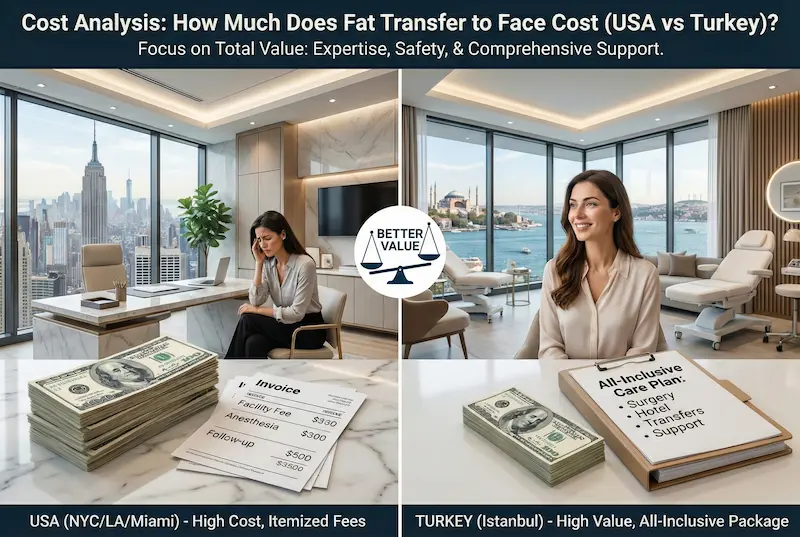
In the United States, pricing is strongly influenced by local overhead, operating facility costs, and market demand—especially in high-cost metros like New York City, Los Angeles, and Miami. In Istanbul, the cost structure can be different while still allowing a high standard of medical care. The smart comparison is “what is included, how is safety managed, and what does follow-up look like?”
What drives facial fat transfer cost in the US (NYC, LA, Miami)
US pricing is shaped by high operating costs and market dynamics. Even when the technique is similar on paper, your total cost may increase significantly based on facility fees, anesthesia fees, and the number of visits needed for planning and follow-up. City-by-city figures, package inclusions and what changes the quote for combined plans are listed on our fat transfer to face cost breakdown.
- Operating room and facility overhead
- Anesthesia fees and monitoring costs
- High-demand markets and premium location pricing
- Separate billing for pre-op testing, follow-up visits, and medications
Why Turkey can be a high-value choice (without compromising standards)
Many patients choose Istanbul because the overall value proposition can be stronger—especially when the care model includes coordinated logistics and structured aftercare. Instead of viewing it as “price,” expert patients often view it as an investment with better cost-to-support ratio.
- Different operational cost structure compared with major US metros
- All-inclusive planning that reduces surprise add-ons
- Coordinated medical travel support to simplify the journey
What’s typically included: USA vs Istanbul (comparison table)
| Category | Typical High-Cost US Markets (NYC / LA / Miami) | AKM Clinic in Istanbul (Typical Care Model) |
|---|---|---|
| Quoted price structure | Often itemized; multiple fees may be separate | Often packaged with clear inclusions and a single plan |
| Pre-op tests & evaluation | May be billed separately depending on provider | Coordinated as part of the surgical journey plan |
| Medications & supplies | Commonly separate pharmacy costs | Organized in advance; guidance provided as part of aftercare |
| Follow-up system | In-person visits may be required; scheduling varies | Structured post-op checks + long-term virtual follow-ups |
| Recovery support options | Varies; often external services | Integrated support options (e.g., HBOT / LLLT when appropriate) |
| Travel logistics | Not applicable | Coordinated hotel + VIP transfers (as included in the package model) |
| Hidden add-on risk | Moderate (facility, anesthesia, tests, aftercare can add up) | Lower when inclusions are clearly defined up front |
Finding The Right Surgeon: What Matters For Natural Facial Fat Grafting Results
If you’re searching for the “best facial fat grafting surgeons,” focus on what expert outcomes actually require: anatomy-driven planning, consistent natural results, and a conservative strategy in delicate areas. A clinic’s marketing claims matter far less than its decision-making discipline.
Credentials matter—but consistency matters more
Training and certification help establish a baseline. But facial fat transfer is technique-sensitive, and real-world consistency is the best proof. Ask to see multiple outcomes similar to your facial structure and your target concern—not only highlight cases.
- Ask for cases in your age range and facial pattern (midface hollowing vs under-eye focus)
- Look for consistent “natural-first” volume, not dramatic over-projection
- Evaluate results in different lighting and angles if available
Questions expert patients should ask in consultation
A strong consultation is not just reassurance—it’s a plan. We encourage patients to ask for specifics. Clear answers reflect clear thinking.
- What zones will you treat, and in which layers?
- How do you prevent lumps, irregularities, and overcorrection?
- What is your approach to under-eyes: conservative single-stage vs staged refinement?
- How do you handle touch-ups, and when would you avoid them?
- What is the follow-up schedule after I return home?
What a safe, natural plan should sound like
If a plan relies on “bigger is better,” it’s a red flag. Natural results come from restraint and structure. A responsible surgeon explains trade-offs clearly, especially in high-risk zones, and sets realistic expectations about the settling timeline.
“The best plan is the one that still looks natural in motion—months later, not just in week one.”
Your Medical Journey In Istanbul: What To Expect Step-By-Step
Medical travel should feel organized, not uncertain. Our system is designed to reduce friction: you receive a clear plan before you fly, coordinated logistics during your stay, and structured follow-ups after you return home. For many patients, this continuity is what turns “international” into “comfortable.”
Step 1: virtual consultation and personalized plan
We start with a photo-based evaluation and a consultation focused on your goals and facial structure. The output is not vague advice—it’s a practical plan: target zones, realism about outcomes, recommended anesthesia approach, and a transparent outline of what is included.
- Photo review and goal mapping
- Zone-by-zone strategy (midface, temples, under-eyes, etc.)
- Clear explanation of recovery phases and support options
Step 2: arrival and coordinated logistics
Once you arrive in Istanbul, logistics should not be your job. Our all-inclusive model typically includes hotel and VIP transfers so you can focus on rest, not navigation. We also coordinate the timing of pre-op evaluation and procedure-day planning.
- Airport welcome and VIP transfer coordination
- Hotel organization aligned with your surgical schedule
- On-site guidance and a structured timeline
Step 3: post-op checks and long-term follow-up after you return home
Your questions won’t end on day one—and they shouldn’t. We schedule check-ins during your stay and continue with virtual follow-ups after you return home. This keeps your recovery guided through the real-world phases: week two, week six, and the settling months.
- Post-op evaluations before you travel back
- Virtual follow-ups as your face settles (timeline-based)
- Clear guidance on what’s normal vs what needs urgent evaluation
Realistic Expectations & Results: Our Natural-First Outcome Philosophy
The best facial fat transfer results usually don’t look “new.” They look rested. That’s why we plan with a Natural-First mindset: restore what time removed, protect facial identity, and avoid the overfilled look that many expert patients fear.
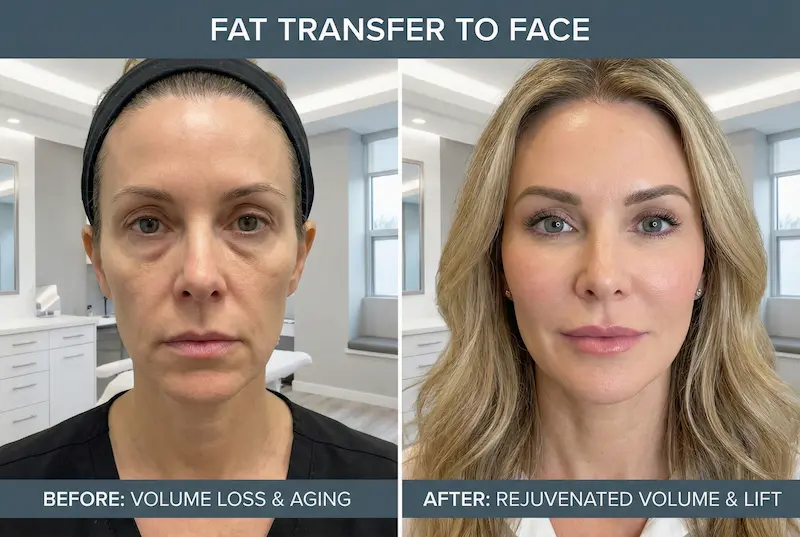
Your final outcome is a combination of anatomy, technique, and biology. The face needs time to settle. Early swelling can disguise the real contour, and small day-to-day fluctuations are normal during healing.
What you can realistically improve (and what changes most)
Fat grafting is strongest when volume loss is the driver. It can soften shadows and restore smoother transitions in areas that look hollow or deflated.
- Midface/cheeks: improved support and softer highlights
- Temples: reduced hollowing for upper-face harmony
- Smile-line region: softening when deflation is the cause
- Under-eyes: selective cases, conservative strategy
What you should not expect (so you don’t set yourself up for disappointment)
Fat transfer is not a photo filter, and it won’t stop aging. It also won’t instantly look “final” in the first two weeks.
- Not instant: swelling and settling are part of the process
- Not a facelift: significant laxity may require lifting for the best result
- Not perfectly symmetrical: faces aren’t symmetrical, and the goal is balance
“A natural result is one that still looks like you—especially in motion.”
How we judge success (the expert-patient checklist)
We evaluate outcomes based on harmony, smooth transitions, and long-term believability—not short-term “wow.” This is also how you should evaluate before-and-after photos.
- Does the face look natural in different angles and lighting?
- Are the under-eye and cheek transitions smooth, not puffy?
- Does the result look stable and balanced, not “overdone”?
Fat Transfer To Face Frequently Asked Questions (FAQ):
What is facial fat grafting?
Facial fat grafting (fat transfer to face) is the process of harvesting your own fat, purifying it, and reinjecting it in precise micro-amounts to restore facial volume and soften hollow areas.
How long does fat transfer to face last?
After the settling phase, the portion of fat that survives can be long-lasting. Your face will still age naturally, and weight changes can influence long-term volume.
Is facial fat grafting permanent?
It’s best described as stable rather than “permanent.” The surviving fat can persist for years, but it behaves like your native fat and changes with your body and time.
Day by day fat transfer to face recovery time: what should I expect?
Most swelling is front-loaded in the first 1–2 weeks. Many patients feel socially presentable sometime between days 7–14, depending on bruising. Refinement continues through weeks 3–12 as the face settles.
How long does swelling after fat transfer to face last?
Swelling is usually most noticeable in the first 72 hours and improves week by week. Mild puffiness can linger longer, especially in delicate areas, but it typically becomes far less noticeable by weeks 2–3.
Lumps after facial fat transfer: is it normal?
Early firmness or unevenness is often part of swelling and healing. True persistent nodules are less common and are usually reduced with conservative dosing, micro-placement technique, and proper aftercare. If a firm area persists beyond the expected timeline, we evaluate it and guide next steps.
What are the risks of fat transfer to face?
Common expected effects include swelling, bruising, temporary asymmetry, and donor-site soreness. Technique-sensitive risks include contour irregularities or overcorrection, which is why conservative planning and precise placement matter.
Facial fat grafting gone wrong: what are the red flags?
Red flags include rapidly worsening pain, sudden vision changes, severe one-sided swelling, fever, or drainage. These require urgent medical evaluation. Most online “gone wrong” cases relate to overfilling, poor planning, or weak follow-up systems.
Fat transfer to face vs fillers: which looks more natural?
Both can look natural when planned well. Fat grafting can feel and integrate like native tissue and may offer longer-term stability, but it has more downtime and isn’t easily reversible. Fillers often have faster recovery and can be reversible (depending on type), but require maintenance.
How much does facial fat transfer cost in Turkey vs the US?
Costs vary widely based on city, facility fees, anesthesia, and what’s included. The most useful comparison is the full care model: inclusions, safety protocols, follow-ups, and recovery support. We provide a transparent plan and quote after reviewing your goals and photos.
Is facial fat grafting worth it for under-eyes?
It can be worth it in the right candidate, but under-eyes require a conservative strategy. We evaluate lid support, skin thickness, and your anatomy to decide whether fat transfer, a staged plan, or a different approach is safer and more predictable.
Do you offer a facial fat grafting consultation?
Yes. We offer a free virtual consultation where we review your photos, identify target zones, explain anesthesia options, and map a realistic recovery timeline—especially helpful if you’re comparing Turkey with high-cost US markets.
How much donor fat do I need for a facial fat transfer?
Far less than most patients expect. Facial grafting works in millilitres, not litres, so even slim patients usually have enough fat in the abdomen, flanks or inner thighs. If donor volume is genuinely limited, we say so at the consultation rather than at the pre-op visit.
Can under-eye fat grafting be combined with lower eyelid surgery?
Yes, and in patients with fat herniation or lax lower-lid skin it is often the more predictable plan. Volume alone can make a heavy lower lid look heavier. We assess lid support and skin thickness before deciding between grafting, eyelid surgery, or both in one session.
What happens to my result if I lose weight after surgery?
Grafted fat behaves like the fat around it. A significant weight loss can reduce facial volume, including the transferred portion, which is why we prefer to operate when your weight has been stable for a few months.
How soon can I fly home after facial fat grafting?
Most patients stay in Istanbul for their post-op checks before travelling back, and the all-inclusive plan is built around that window. Swelling on the flight is normal; hydration, an aisle seat and keeping the head elevated help.
Medical Disclaimer: This information is for educational purposes only and does not replace medical advice. Every patient is different. A consultation and medical evaluation are required to determine candidacy, risks, and the most appropriate treatment plan.