




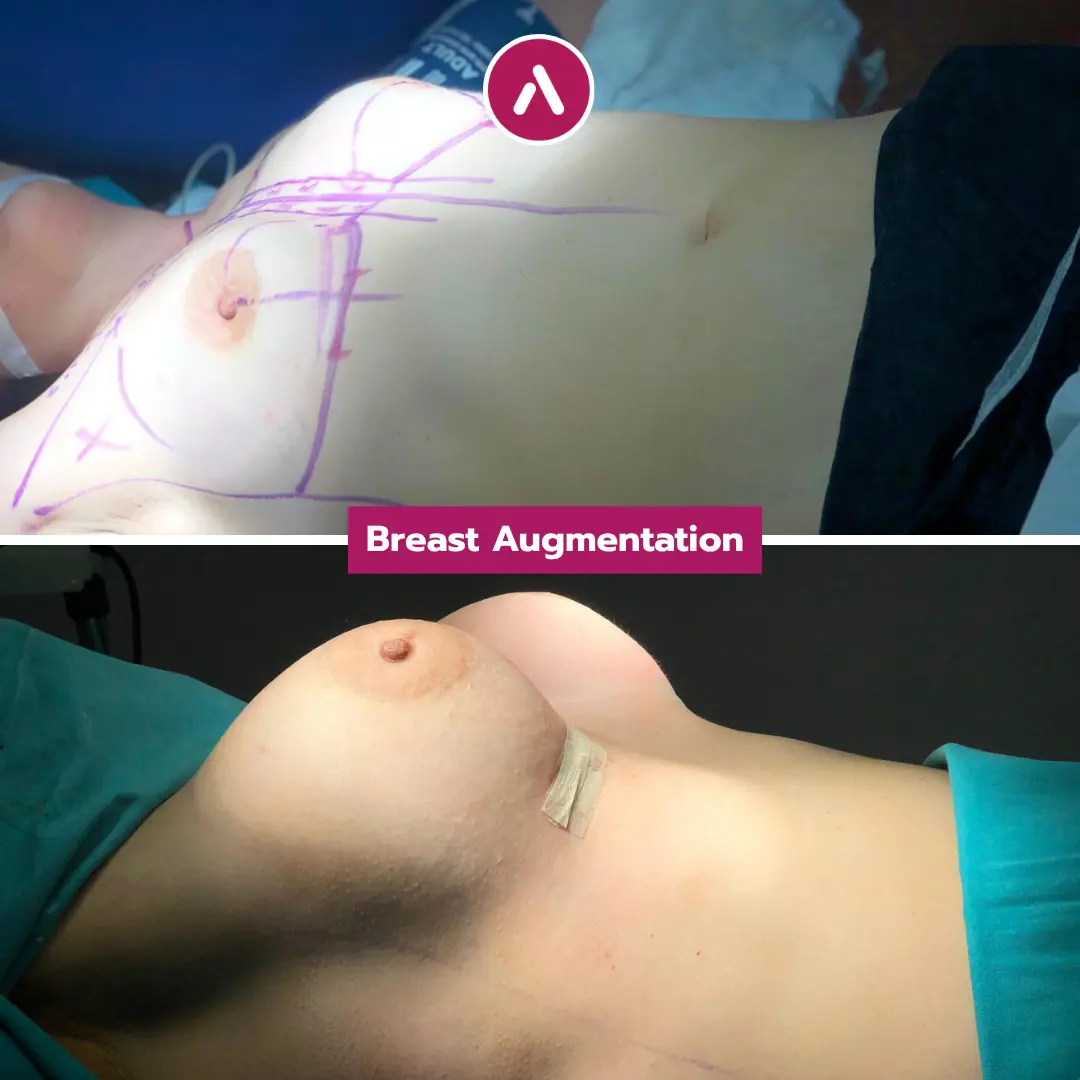
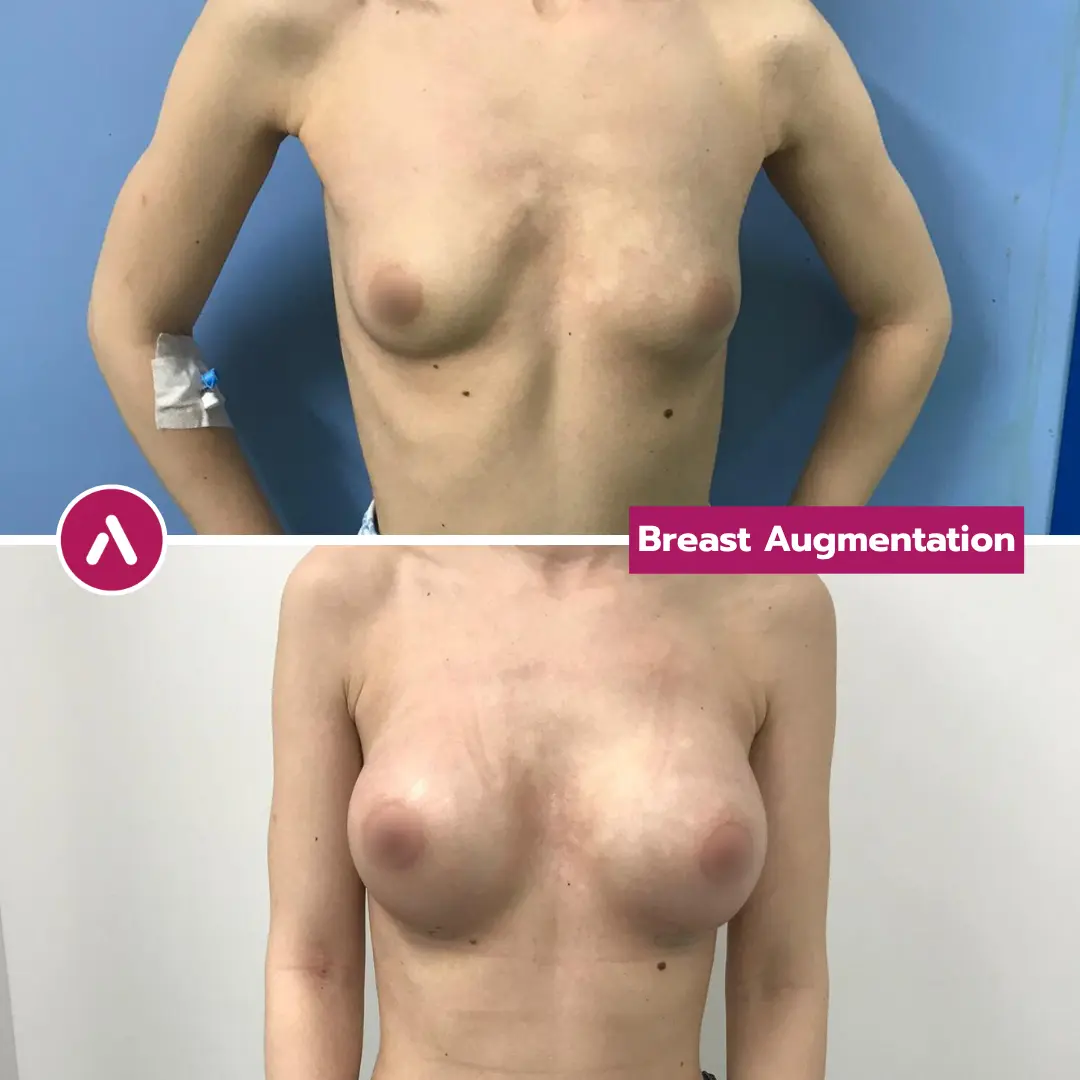
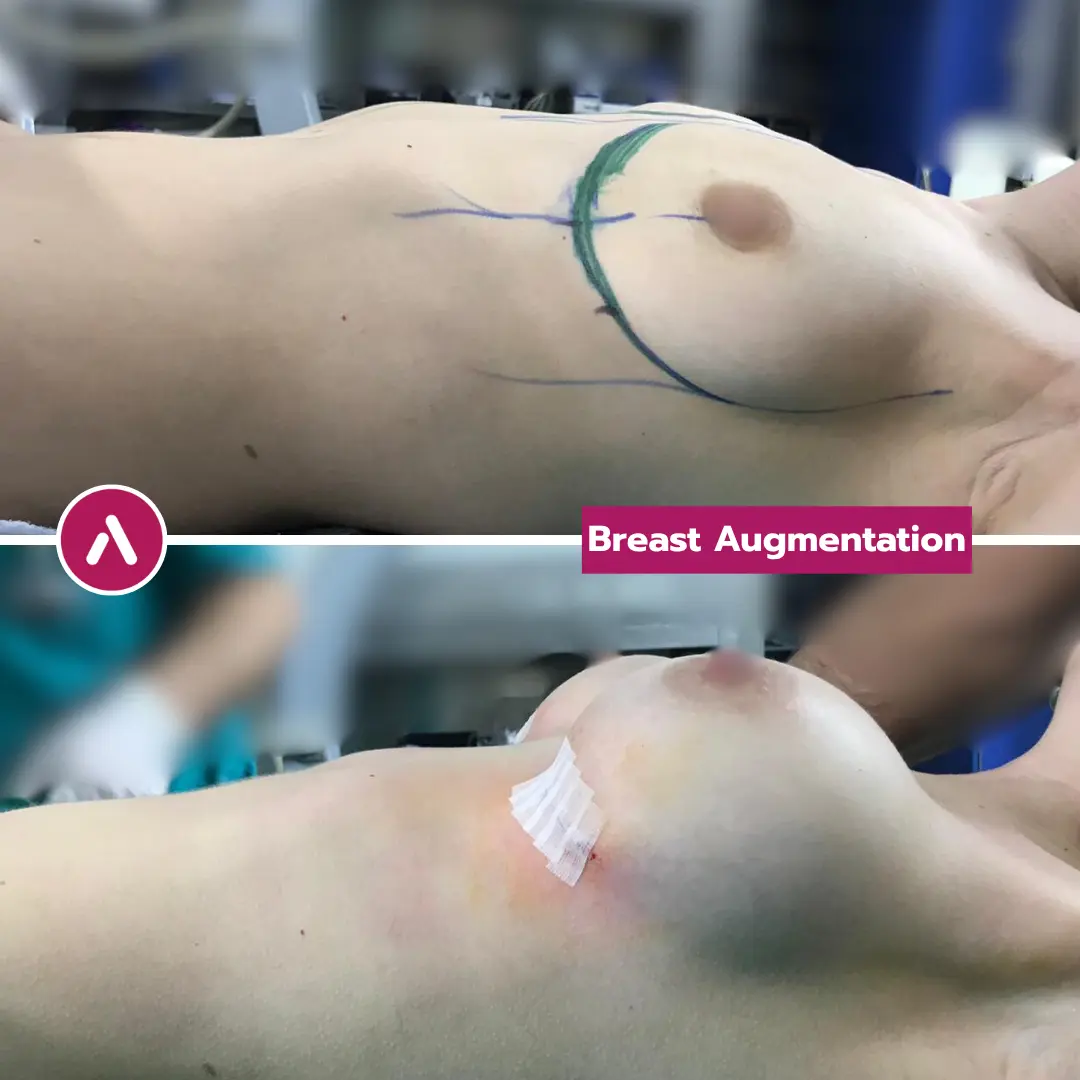
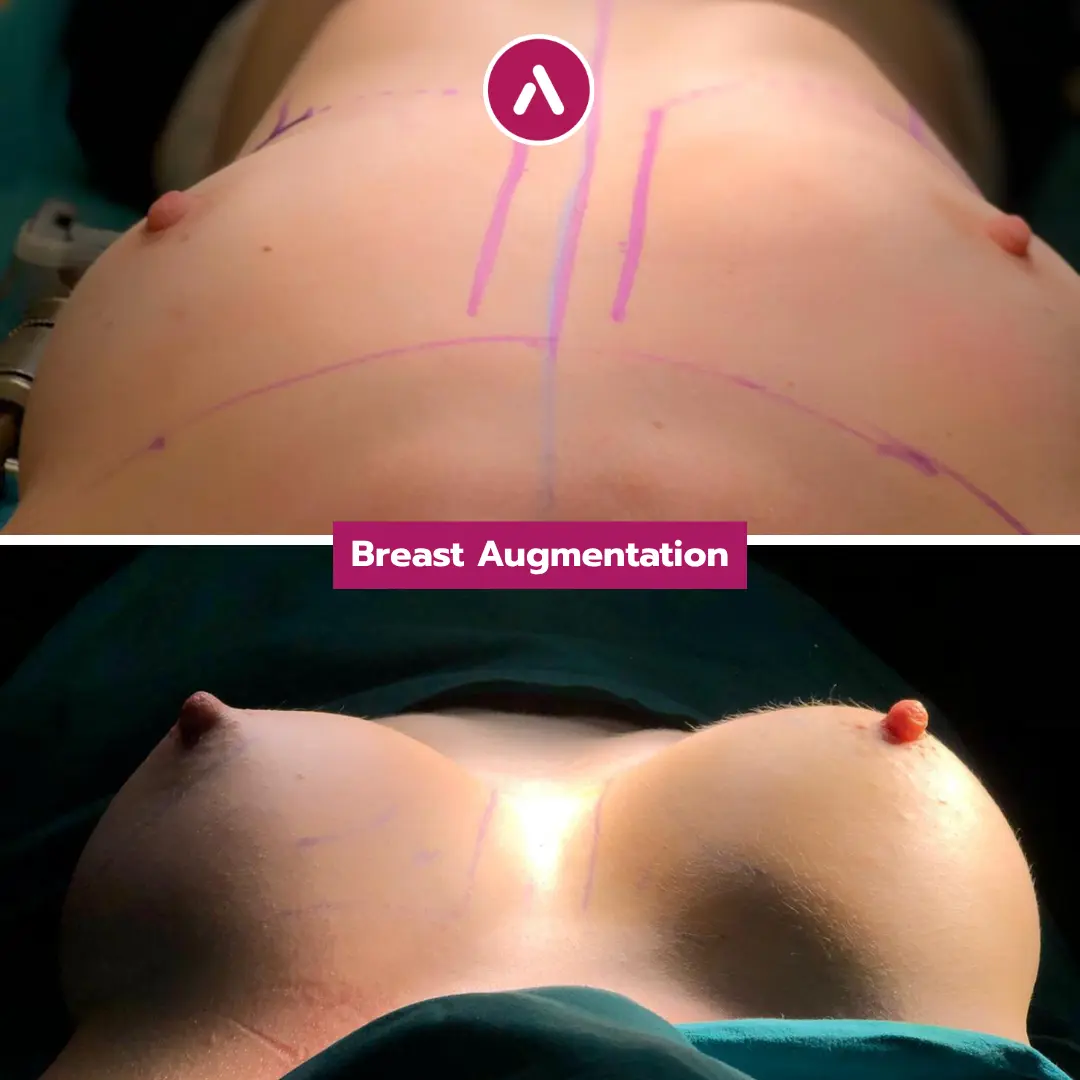
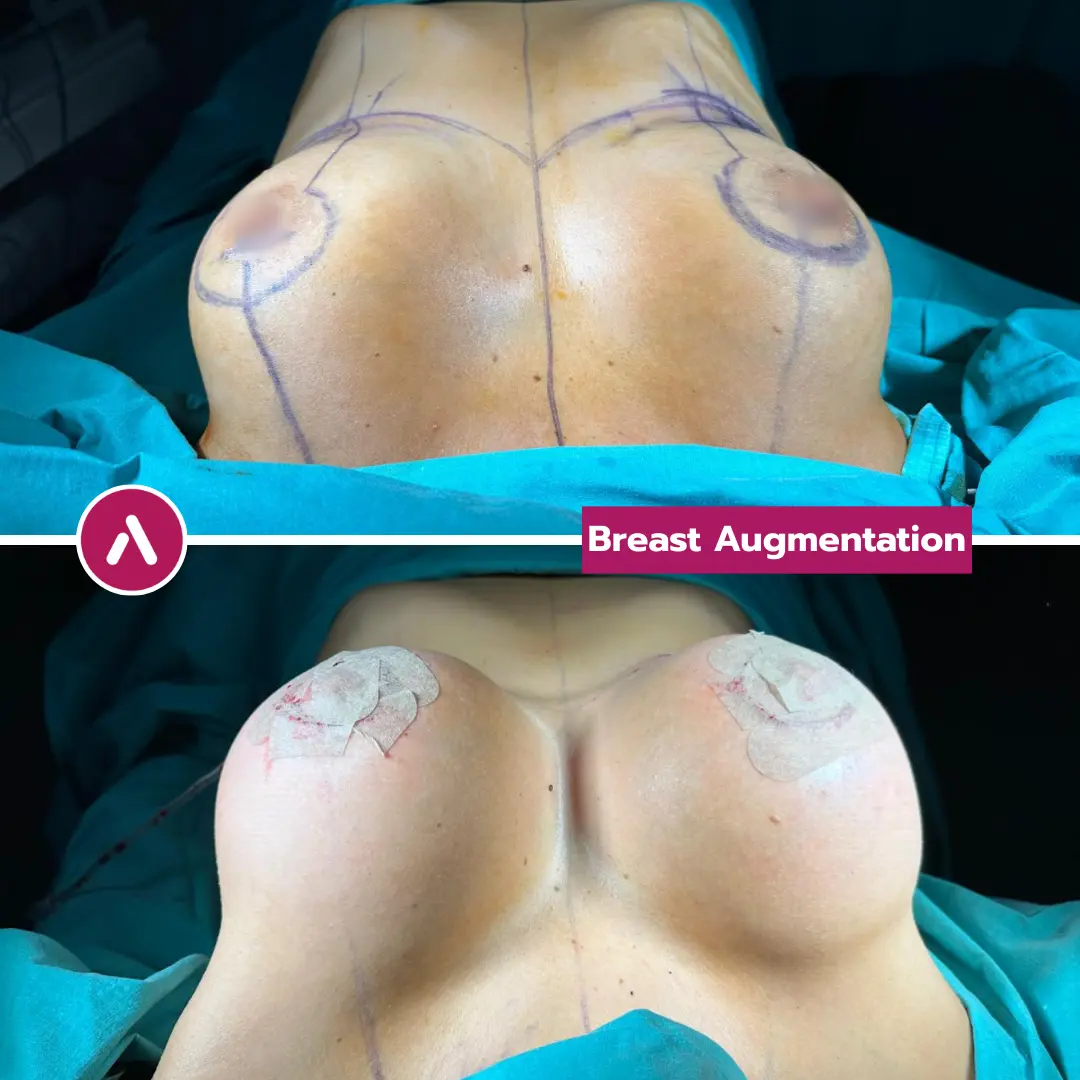
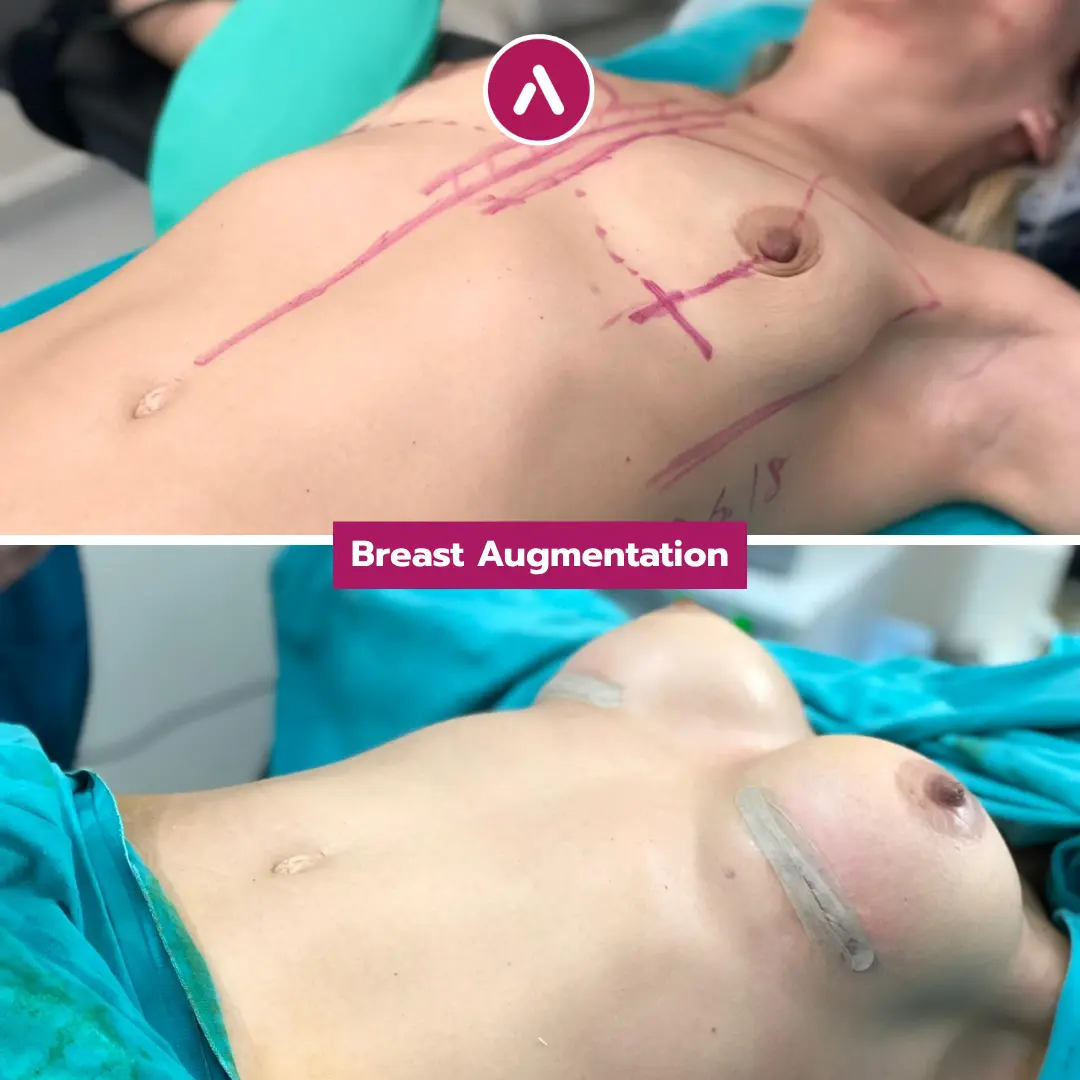
Preservé® breast augmentation is a less invasive* way to enlarge and reshape the breast. Instead of cutting a pocket for the implant, the surgeon uses a small balloon to gently stretch your own breast tissue until there is room for it. Tissue preservation is the whole point: the ligaments that hold your breast in place stay intact, the pectoral muscle is never touched, and the implant settles above the muscle in a space your anatomy already provides. Motiva Preservé® was developed by Establishment Labs and is built around a dedicated set of single-use instruments and the SmoothSilk® Ergonomix2® implant. At AKM Clinic in Istanbul, Turkey, Preservé is performed with the complete Motiva system by Dr. Aylin Yılmaz, a Preservé-accredited plastic surgeon, in a JCI-accredited hospital.
Most of the women who contact us about preserve breast augmentation have already read the headlines: smaller incision, no drains, sedation instead of general anesthesia, back on your feet quickly. Those points are real, and we will get to each of them. But the questions that decide whether Preservé is right for you are more specific. How is the implant pocket actually made? What does “less invasive” include, and what does it leave out? Who is a good candidate, and who should be steered toward a lift or a hybrid procedure instead? What has been published, and how long have those patients been followed?
This page answers those questions in the order you would ask them at a consultation, from the mechanics of tissue preservation to candidacy, anesthesia, the surgery itself, recovery, risks, published evidence, and cost. Our six-night all-inclusive Preservé package in Istanbul is USD 7,500; flights are not included.
*Compared to traditional breast augmentation. Individual results vary.
Table of Contents
What Is Preservé® Breast Augmentation?
Motiva defines Preservé as “a less invasive breast surgery* utilizing tissue preservation, specialized technologies, and techniques to reshape the breast while conserving its intrinsic structure and function.” You will also see it written as Preserve by Motiva, Motiva Preserve, Preserve Motiva, the Preservé technique or the Preservé method for breast augmentation, or simply preserve breast augmentation. All of these names refer to the same thing: a technique, a set of purpose-built surgical instruments, and a specific implant that together let a surgeon place an implant without dividing the structures that support the breast.
Three things separate it from the augmentation most people picture. The pocket is made by elongating tissue rather than cutting it. The implant goes above the pectoral muscle, so the muscle is never lifted or released. And the procedure can be done under local anesthesia with light sedation, although general anesthesia remains available when the surgeon or the patient prefers it.
Preserve, Don’t Cut: How the Implant Pocket Is Made
Your breast is held in position by a ring of connective tissue called the circummammary ligament and by the Cooper’s ligaments that run through the gland. In a conventional augmentation, the surgeon creates the implant pocket by dividing tissue with a scalpel or electrocautery, and some of those attachments are cut along the way. Preservé takes a different route to the same destination.
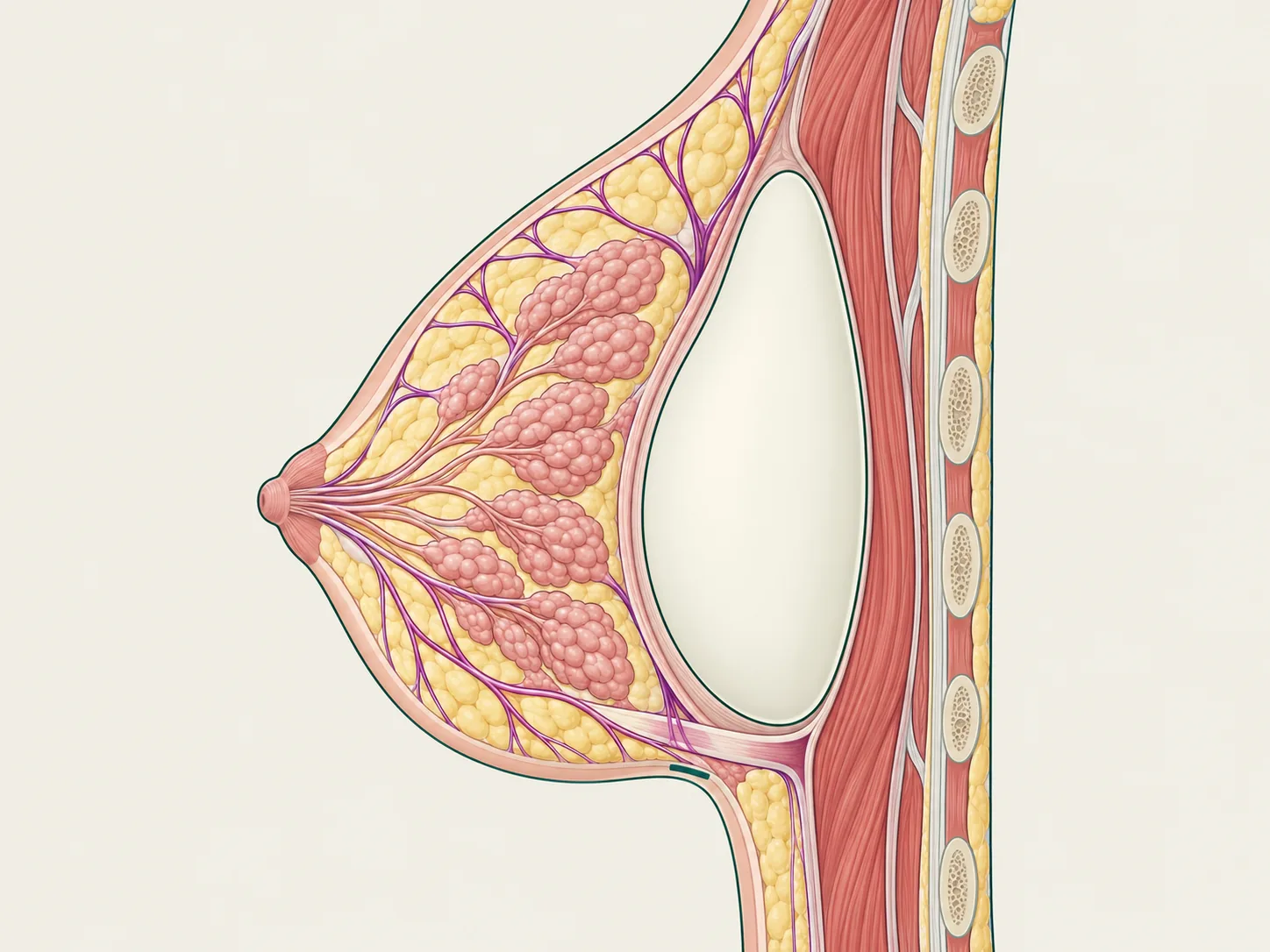
- A short incision in the fold under the breast. Typically 2.5 to 3 cm, placed in the inframammary crease where the scar is hidden by the breast itself.
- A narrow tunnel instead of a wide dissection. A blunt, single-use instrument, the Motiva® Channel Separator, opens a slim channel toward the upper boundary of the planned pocket. No sweeping to the sides, no release of tissue toward the sternum or the armpit.
- Controlled stretching with a balloon. The Motiva® Inflatable Balloon is passed through the tunnel and inflated with air in measured increments until the space matches the volume of the implant. The tissue is elongated in three dimensions; it is not sliced.
- No-touch implant delivery. The implant slides through the Motiva® Insertion Sleeve into what Motiva calls the Breast Tissue Preservation Space, the layer between the breast gland and the deeper fascia, above the muscle.
A cadaver study of this surgical plane found that the Cooper’s ligaments are displaced rather than transected when the pocket is opened this way.[1] Because the surrounding tissue keeps its natural tension, it closes snugly around the implant, an effect Motiva calls “nesting.” That mechanism is behind most of the benefits described further down this page: the implant is held by your own anatomy rather than by a surgically created cavity.
What “Less Invasive” Means Here (and What It Doesn’t)
Less invasive is a comparison, not a promise, and it pays to be precise about it. Preservé is still breast surgery. There is an incision, a scar in the fold that fades but does not vanish, an implant that is a medical device, and a recovery period. What changes is how much tissue has to be disturbed to get the implant in place, and several things follow from that:
- A smaller incision and a narrower dissection. The pocket is stretched open rather than cut open, and no lateral or medial dissection is performed.
- The muscle is left alone. With the implant above the pectoral muscle, there is no animation deformity, the visible shifting of an implant when the muscle flexes that can occur after submuscular placement.
- Lighter anesthesia becomes an option. The tissue is numbed with a tumescent solution before anything else happens, which is why many Preservé procedures are performed under local anesthesia with light sedation. If you want to know what that feels like from the patient’s side, our page on breast augmentation under sedation describes it in detail.
- No drains, and patients typically go home within hours of surgery.
Now for what it is not. Preservé is not scarless, and it is not painless, although post-operative pain is generally reported as reduced compared with a conventional augmentation*. It is not a way to make complications go away, either. In a two-center series of 330 patients, the overall complication rate was 0.9 percent, and the authors state plainly that the technique was not developed to reduce complication rates.[2] The case for Preservé rests on tissue preservation, comfort during recovery, and how the breast looks and feels afterward, not on a claim that complications disappear.
One more distinction, because the two terms are easy to confuse. Motiva makes two tissue-preserving techniques. Mia Femtech® enters through the armpit, is described as minimally invasive, and is designed for a modest increase of one to two cup sizes. Preservé enters through the fold under the breast, is described as less invasive*, and accommodates a much wider range of implants, up to four cup sizes*. They share a philosophy, not a set of results.
A note for readers in the United States: the SmoothSilk® Ergonomix2® implant that belongs to the Preservé system is not FDA-approved, so the version of the procedure offered by US surgeons is performed with a different implant. In Turkey, AKM Clinic performs Preservé with the complete Motiva system, implant included. The FAQ section below explains what that difference means in practice.
Preservé vs. Traditional Augmentation vs. Mia Femtech
The table compares the three approaches on the points patients ask about most. If a conventional procedure is still on your shortlist, our breast augmentation in Turkey page covers implant types, incision options, and pricing. Women with mild sagging may be better served by a breast lift with implants, and those who want a softer, partly natural result can combine Preservé with fat transfer to the breast as a hybrid augmentation.
| Preservé® | Traditional augmentation | Mia Femtech® | |
|---|---|---|---|
| Incision | 2.5–3 cm in the inframammary fold | Typically 4–5 cm; in the fold, around the areola, or in the armpit | In the armpit (transaxillary) |
| How the pocket is made | Narrow tunnel, then balloon elongation of tissue | Surgical dissection with scalpel or electrocautery | Tissue-preserving instruments through the axilla |
| Implant position | Above the muscle (Breast Tissue Preservation Space) | Above the muscle, below it, or dual plane | Above the muscle |
| Size range | Up to 4 cup sizes*; implants from 95 to 330 cc | No fixed ceiling; limited by your tissue and implant choice | 1–2 cup sizes |
| Implant | SmoothSilk® Ergonomix2® (Zen® RFID optional) | Any brand; round or anatomical | SmoothSilk® Ergonomix2® Diamond |
| Anesthesia | Local with light sedation, or general | General anesthesia in most cases | Local with sedation |
| Drains | None | Sometimes | None |
| Return to daily activities | Within about a week in published series[3] | Commonly one to two weeks | 2.8 days on average in a 3-year study[4] |
Two cautions when reading a comparison like this one. The Mia Femtech numbers come from a 100-patient, three-year study of that technique, which uses a related but not identical set of instruments and a smaller implant, so they should not be read as Preservé results.[4] And the long-term data for Preservé itself is still maturing: the largest published series to date has a mean follow-up of 18 months.[2] The Clinical Evidence section below sets out exactly what has been studied, in whom, and for how long.
How the Preservé System Works
Preservé is a technique, but it is also a kit. Motiva built the system around three single-use instruments and one implant, plus a set of sizing templates and a marking stencil that come into play at the planning stage. Motiva’s patient materials sum the procedure up in a handful of moves; in the operating room there are six steps, and the Surgery Step by Step section further down walks through them in order. This section is about the tools themselves: what each one does, why it is shaped the way it is, and what that means for the tissue it passes through. If you have been reading about the Motiva Preserve technique and wondering how a balloon can stand in for a scalpel, the answer is in the next four parts.
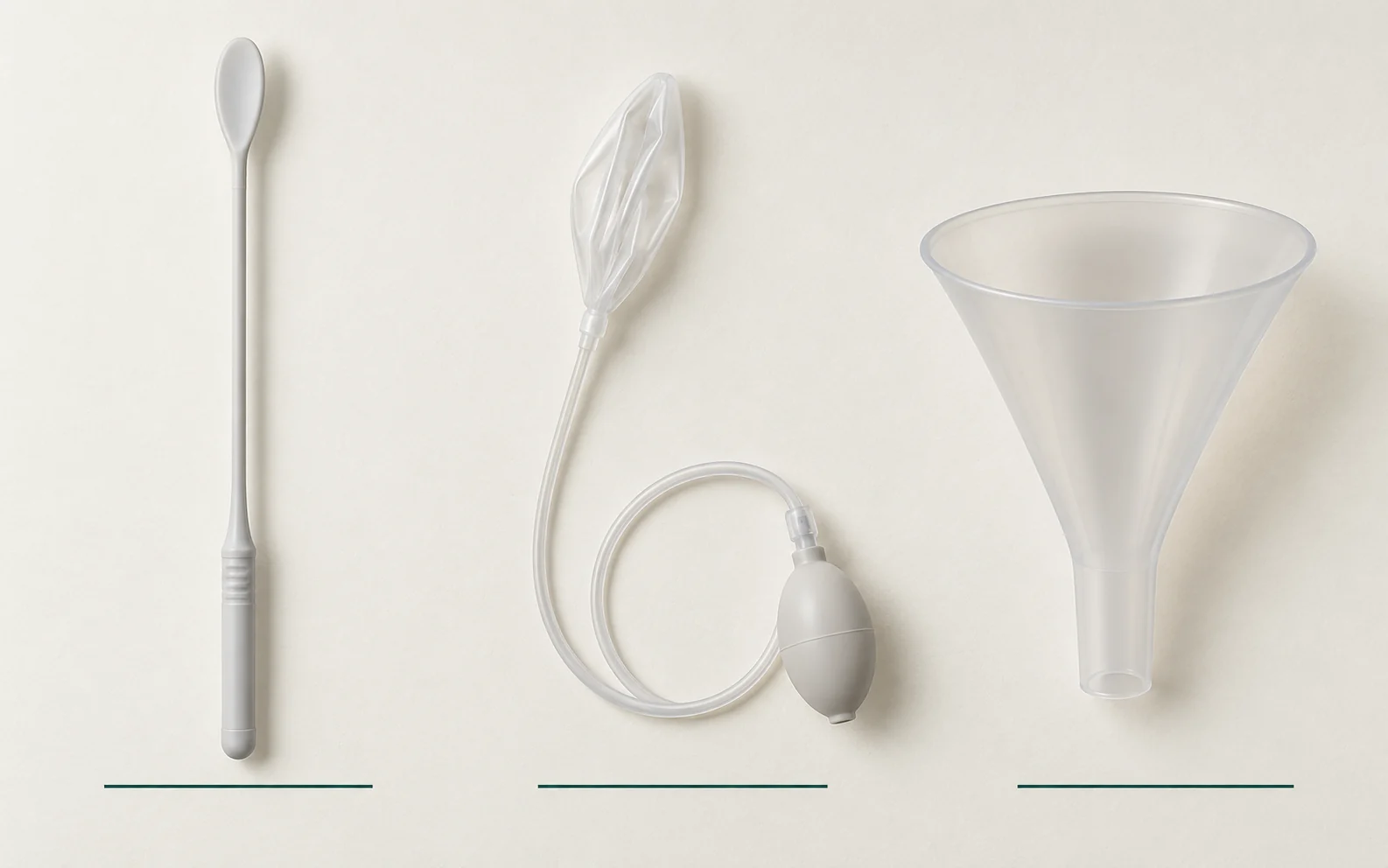
One point applies to everything below. Every instrument in the set is opened for your surgery and discarded afterward. Motiva’s stated reason is patient safety; a practical consequence is cost, and the single-use set is one of the reasons a Preservé package is priced above a standard augmentation. The cost section explains that difference line by line.
Motiva® Channel Separator: Creating the Tunnel
The Motiva® Channel Separator is a slim, single-use instrument 24 cm long and 2 cm wide, with a rounded, blunt tip and no cutting edge. Its only job is to open a narrow passage from the incision in the breast fold to the far edge of the planned pocket, so the balloon that follows can be guided into position along a path that has already been defined.
To picture where that passage runs, it helps to know how the breast is packaged. The gland sits inside an envelope of superficial fascia with a front layer and a back layer, the anterior and posterior lamellae. Where those layers fuse at the perimeter of the breast and anchor to the chest wall, they form the circummammary ligament, a roughly circular band that marks the breast’s footprint.[5] Between the gland and the posterior lamella lies a layered zone of fat and fibrous tissue that Motiva calls the Breast Tissue Preservation Space. That is where the tunnel goes: beneath the gland, parallel to the pectoral fascia, above the muscle — the prepectoral plane — and inside the ring of the ligament. A cadaver study of this plane found that the Cooper’s ligaments running through it are displaced rather than transected when the pocket is opened this way.[1]
The maneuver itself is unhurried. The surgeon introduces the tip through the 2.5 to 3 cm incision, aims it toward the suprasternal notch (the dip at the base of the throat), and advances it with a slight twisting motion while the other hand lifts the breast out of the way. It stops once the tip has passed about 2 cm beyond the planned upper boundary of the pocket. There is no sweeping to the sides and no release of tissue toward the sternum or the armpit; the separator makes a channel, not a cavity.
The direction of that channel is a design decision, not a formality: because the balloon follows the tunnel, the tunnel decides where the pocket forms. Aimed at the center of the nipple, it gives an even, overall enhancement. Angled toward the upper-inner quadrant, it builds upper-pole fullness and cleavage, an option for women who want more volume high on the chest or a modest lifting effect. A short distance between fold and nipple calls for a lower placement to expand the lower pole. Your surgeon settles this during planning, with measurements and 3D imaging, before the first instrument is opened.
Motiva® Inflatable Balloon: Controlled Elongation and the “Nesting Effect”
This is the instrument that replaces the dissection. The Motiva® Inflatable Balloon is a single-use silicone balloon on a slender stem, supplied with a hand pump and a clip that holds the air in. It comes in three base diameters: 8, 9 and 10 cm. The size is chosen from the Preservé matrix to match the implant your surgeon has selected, and it is always a little narrower than the implant’s base, because the balloon’s effective diameter shrinks as it fills.
The sequence is simple to describe. The balloon is unfolded, moistened with sterile saline, and threaded through the tunnel to the center of the planned pocket. Then it is inflated with air in measured squeezes of the pump, each delivering roughly 40 cc, until it holds about the volume of the implant that will follow; a 200 cc implant means about five pumps. The surgeon’s free hand rests on the breast to feel and guide the expanding boundary. With both sides inflated and clipped, the surgeon checks symmetry, letting air out of one side or adding it to the other until the two match. In dense or tight tissue the balloon may be filled and emptied a few times so the tissue gives way gradually. Then it is deflated and withdrawn, leaving behind a pocket made by stretching, not cutting. That controlled elongation is the step that defines the published technique.[3]
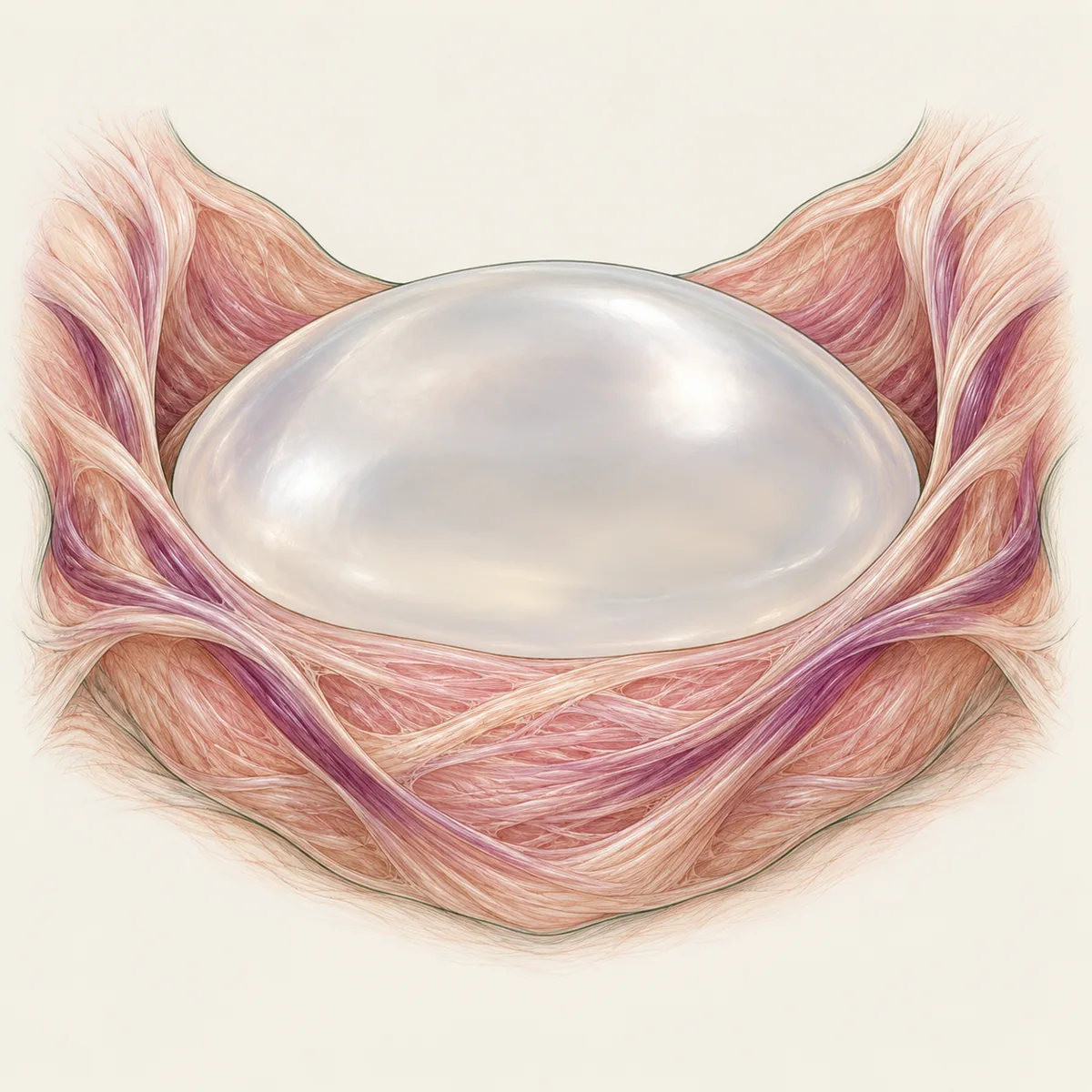
Motiva has a name for what happens to the tissue during that stretch. The nesting effect, in the company’s definition, “refers to the result from elongating the breast tissues radially during controlled expansion of the Motiva® Inflatable Balloon. The redistributed tissues surround the rounder edges of the SmoothSilk® Ergonomix2® implant, providing stability and support.” In plain terms: the tissue the balloon pushes outward is neither removed nor divided. It thickens around the pocket, keeps its elasticity, and when the round-edged implant settles into the space, those thicker walls close around it and hold it. That is the mechanism Motiva credits for implant stability without textured surfaces, mesh, or additional surgical maneuvers, and it is why the balloon is matched so carefully to the implant: the nest has to fit what goes into it.
Two more points about this step. The tunnel-and-balloon method is shared with Mia Femtech, Motiva’s armpit technique, whose 100-patient prospective study has three years of published follow-up, the longest track record these instruments have, although Mia enters by a different route and uses a different implant.[4] And the balloon doubles as a sizer: it can be repositioned, refilled, and compared side to side before anything permanent happens, so small asymmetries are addressed on the table. Larger ones are planned for in advance, sometimes with two implant volumes, sometimes by pairing Preservé with fat grafting to the breast. What the nesting effect has meant for implant position in clinical follow-up is covered in the Benefits section.
Motiva® Insertion Sleeve: No-Touch Implant Delivery
Once the pocket exists, the implant has to get into it through an opening far smaller than itself. The Motiva® Insertion Sleeve is a cone of flexible film with a coating on the inside that turns slippery when wetted with sterile saline. The narrow end is trimmed to the implant: a 2.5 cm opening for implants up to 255 cc, 3 cm for implants up to 400 cc. That trim, together with the implant’s size, is what sets the length of the incision, which is why Preservé incisions are planned at 2.5 to 3 cm. The largest published series reported incisions of 2.5 to 3.5 cm, and the final figure in your case depends on implant volume and your surgeon’s technique.[2]
“No-touch” means exactly that. The sleeve is hydrated to activate its lining, the implant goes from its sterile packaging straight into the wide end without being handled, the tip is placed about a centimeter inside the incision and aimed along the tunnel, and a gentle squeeze propels the implant into the pocket. Gloves never grip the implant, and its surface never brushes the skin. Motiva describes this as supporting a shorter procedure and minimizing the risk of infection, on the reasoning that the fewer surfaces an implant touches on its way in, the less contamination it can carry with it.†
Insertion funnels are not unique to Preservé; they are widely used in modern breast augmentation for the same reason. What is specific here is the pairing: a sleeve that belongs to the single-use set, trimmed to an incision that was sized around it, delivering an implant designed to be compressed through a small opening without damage to its shell. That last point belongs to the implant itself.
†Manufacturer’s description (Establishment Labs, Preservé® healthcare professional materials, 2025). Individual results vary.
SmoothSilk® Ergonomix2® Implants: 4-Micron Surface, 95–330 cc
If you have searched for “preserve breast implants” or “Motiva Preserve implants,” this is the device in question. Preservé is performed with one implant family, the round SmoothSilk® Ergonomix2®, in the sizes Motiva has matched to the balloon and to the anatomy the technique is meant to protect. That means 95 to 330 cc, base widths of 8 to 11 cm, and projections of 2.1 to 4.5 cm, in Mini, Demi and Full profiles. The ceiling is deliberate. Motiva cautions against larger volumes and wider bases in Preservé because they raise the mechanical load on the Cooper’s and circummammary ligaments, the structures the procedure exists to leave intact. And because your own tissue gathers around the implant and does part of the shaping, Motiva’s guidance to its surgeons is that Mini and Demi projections usually give the most natural result. How base width and projection are chosen for you is covered in the Planning and Marking section below.
Several technologies are layered into the implant, and each has a job:
- SmoothSilk® surface. The shell’s outer surface has an average roughness of about 4 microns, a middle ground between conventional smooth shells and heavily textured ones, chosen on purpose. In a 2021 study spanning mice, rabbits and human tissue samples, surfaces in this range provoked less inflammatory foreign-body response than both smoother and rougher ones, with a higher share of regulatory T cells and less macrophage activity around the implant.[6] What that has meant in clinical follow-up is set out in the Benefits section.
- TrueMonobloc+®. The shell, the patch that seals it, and the gel are bonded into a single structure. That unity is what lets the implant be folded tightly and pushed through the insertion sleeve without damaging the shell, and it is one reason a 2.5 to 3 cm incision is realistic for this implant.
- Motiva SuperSilicones®. The shell material, made from ultra-high-purity medical-grade silicone and formulated so the shell moves with the gel rather than against it. Motiva’s aim with this chemistry is to reduce the risk of rippling and palpability, which matters for an implant placed above the muscle.
- ProgressiveGel ULTIMA®. A cohesive gel with low viscosity and high elasticity. It is what gives the implant its ergonomic behavior: designed to sit rounder when you lie down and settle into more of a teardrop when you stand, moving with you instead of holding one shape.
- BluSeal+®. A blue-tinted barrier layer visible through the shell, which lets your surgeon confirm the integrity of that layer by eye.
- Zen®, optional. A passive RFID chip inside the implant that carries its identification data and can be read from outside the body, so the details of your implant never depend on a paper card. You can choose to have Zen® in your implants or opt out; the FAQ below covers what it means for MRI and other imaging.
A reminder for readers in the United States: this is the implant that is not FDA-approved, as noted in the previous section. It is the reason Preservé performed in the US uses a different implant from the one described here. If you are still weighing implant brands and shapes in general, the implant types we offer are compared on our breast augmentation page. Your implants are registered with Motiva within 90 days of surgery; that registration activates the warranties and the Woman’s Choice Program® described later on this page.
Benefits of Preservé: What You Keep
Motiva frames the benefits of Preservé as four things you keep rather than four things you gain: your anatomy, your softness, your stability, and your peace of mind. We use the same four headings and add, under each, where the evidence comes from and how far it reaches. Some of it is Preservé data, some comes from the Mia Femtech study of the same instruments, and some belongs to the implant surface, which has been in use far longer than the technique. Individual results vary; the Risks section further down is the other half of this conversation.
Preserve Your Breast Anatomy
Preservé leaves three structures intact that a conventional augmentation may not. The first is the ligament system. The circummammary ring that defines your breast’s footprint, and the Cooper’s ligaments inside it, are displaced rather than divided when the pocket is made,[1] so the breast keeps the internal scaffolding that holds its shape. The second is the pectoral muscle. The implant sits above it, and the muscle is never lifted or released: no animation deformity, and a muscle that works as before when you push, lift, or train. The third is sensation. The incision sits at the 5 and 7 o’clock positions of the fold, placed to spare the nerve branch that supplies the nipple, and the pocket is made by blunt stretching rather than by cutting or cautery near those nerves. Motiva describes the technique as designed to preserve nipple and breast sensation, and in the three-year Mia Femtech study no patient reported loss of either.[4] A design goal with data behind it, not a promise; altered sensation stays on the list of risks below.
Preserve Softness and Natural Movement
Softness has two sources. The first is your tissue. Tissue that has been stretched keeps its architecture and its blood supply; it heals as a continuous envelope around the implant rather than as a cut surface that has to scar back together. Motiva calls the result a healthy tissue envelope, and the low-inflammatory behavior of the 4-micron surface, described in the previous section, is part of the same picture.[6]
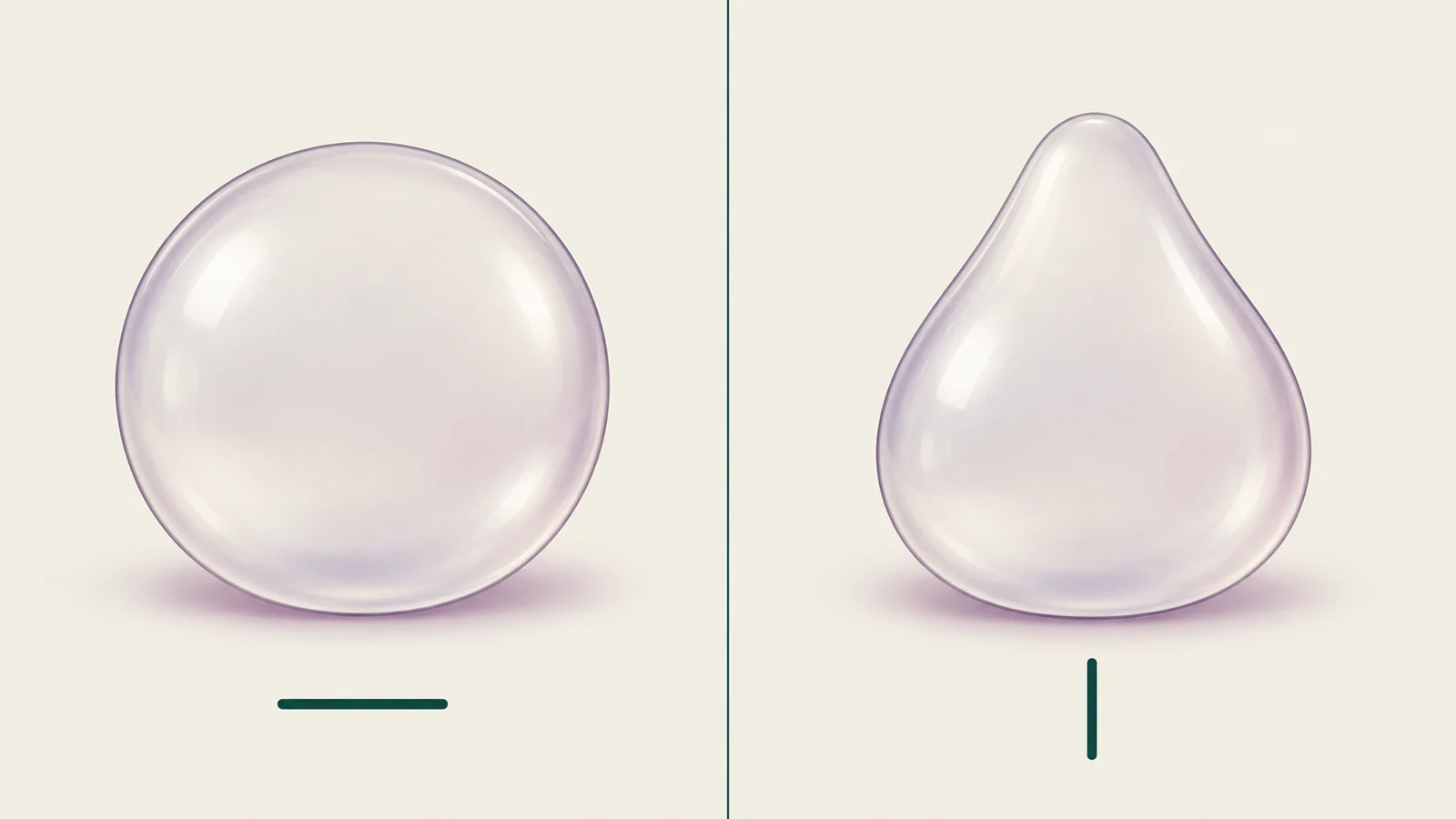
The second source is the implant. The ProgressiveGel ULTIMA® filling and the single-piece TrueMonobloc+® construction let the SmoothSilk® Ergonomix2® change shape with your position: rounder and fuller when you lie on your back, settling into a soft teardrop when you stand. A 2024 clinical evaluation of Ergonomix2 implants described them as closely mimicking the biomechanical behavior of natural breast tissue, with enhanced softness and pliability and a low occurrence of rippling.[7] One honest note on rippling: above the muscle, the thickness of your own tissue over the implant matters, which is why the 2 cm pinch test in the candidacy section is not a formality.
Preserve Breast Stability
An implant that stays where it was placed is the benefit that only shows itself years later. Preservé approaches it from three directions. The nesting effect described earlier leaves the implant held by thicker walls of your own tissue rather than by a textured shell or a surgical mesh. The implant base is chosen to fit inside the circummammary ligament rather than push past it, so the footprint that supports the implant is never enlarged. And the incision is set slightly to the side of the fold, away from the part of the fold that carries the implant’s weight.
What the data say so far. In the three-year Mia Femtech study, which uses the same pocket-creation instruments and a smaller implant of the same family, inferior malposition (the implant sliding below the fold) was 0 percent at three years.[4] In the largest published Preservé series, 330 patients followed for an average of 18 months, no implant dropped below the fold; two settled slightly higher than planned.[2] Both results are encouraging, and both are short by the standards of implant surgery; we will report longer follow-up as it is published, not before.
Preserve Your Peace of Mind
Peace of mind takes two forms here: what the implant surface has shown over time, and what the warranty covers if something does go wrong. The SmoothSilk® surface has been on the market since 2010. In the FDA core study of implants with this 4-micron surface, the estimated rate of capsular contracture, the tightening of scar tissue around an implant, was 0.5 percent at five years among 451 primary augmentation patients.[8] Since that market introduction, no primary case of breast implant-associated anaplastic large cell lymphoma (BIA-ALCL) has been reported in association with this surface, which fits the epidemiology linking most BIA-ALCL cases to heavily textured devices.[8] The authors of that review add a line we would underline ourselves: absence of evidence is not evidence of absence, and surveillance continues.
The warranty is Motiva’s, not ours, and it comes with the implant. The Always Confident Warranty® covers rupture for the lifetime of the device, a replacement policy covers Baker grade III and IV capsular contracture, and implants placed through the Preservé program add Motiva’s five-year extended warranty at no additional cost. The Woman’s Choice Program® is newer: if you later decide to reverse your augmentation, it provides up to USD 1,500 toward that surgery. Everything depends on registering your implants with Motiva within 90 days of surgery, and everything is subject to Motiva’s terms and conditions. AKM’s own written revision policy sits alongside these programs (see the Why AKM section), and our verified patient reviews are the best place to hear from women who came before you.
Am I a Good Candidate for Preservé?
Candidacy for Preservé starts where candidacy for any breast augmentation starts. It then adds three questions that belong to this technique alone: how much of your own tissue will cover an implant placed above the muscle, whether the ligaments the technique relies on can be trusted to hold, and how much lift your breast needs. All three are answered at consultation with measurements and 3D imaging, not with impressions from photographs.
Ideal Candidates
Motiva lists three indications for Preservé. The first is primary breast augmentation, including correction of a size difference between the two sides. The second is mastopexy augmentation, a lift with implants in one operation for mild to moderate sagging. The third is hybrid augmentation, an implant combined with your own fat. Within those, the breast shapes that respond well are small breasts, mild tuberous shapes, mild to moderate sagging (Regnault grade I–II), deflation after pregnancy, chest wall variations, and asymmetry.
The woman who does best with it looks like this. Her breast development is complete; Motiva’s US patient information puts the minimum age at 22. Her weight is stable, she is not pregnant or breastfeeding, and she is not planning a pregnancy in the near term, because all three change breast tissue and can undo a careful result. She does not smoke, or is willing to stop for a period before and after surgery. Any chronic condition is well controlled. She wants a natural, proportional result rather than the largest implant her frame can carry, and she understands that skin quality, breast density, and tissue elasticity set the limits of what any technique can do. And she has enough tissue of her own: at the upper inner breast, a pinch of skin and gland measuring about 2 cm or more. The largest Preservé series found its rippling cases in patients with about 1 cm of pinch and now recommends 2 cm as the working minimum.[2]
Who May Need a Different Approach
None of the situations below is an automatic no. Each is a reason the plan may change, sometimes to a modified Preservé, sometimes to another procedure we offer.
- Less than 2 cm of tissue at the pinch test. Above the muscle, thin cover means a higher chance of visible rippling. One option is a hybrid procedure, where fat grafting thickens the cover; a 2026 review of the 4-micron surface reports this working even at a pinch under 2 cm and a BMI under 20.[8] The other is a conventional dual-plane augmentation, where the muscle provides the cover instead.
- Thin or weakened ligaments, often after major weight loss, or tissue that has already been stretched: severe stretch marks, sagging without a pregnancy behind it, or a connective-tissue condition such as Ehlers-Danlos syndrome. The nest the technique relies on may not hold, so the plan shifts toward a smaller implant, added support, or a different plane.[2]
- Grade III sagging, with the nipple well below the fold. An implant alone will not lift it; a breast lift (mastopexy), alone or combined with implants, is the honest answer.
- A previous implant above the muscle or a dual-plane history. The planes and ligaments Preservé depends on have already been altered, so revision surgery is planned on its own terms; Preservé is first of all a technique for a first augmentation.[3]
- A wish for very large implants. The Preservé matrix stops at 330 cc and at an 11 cm base for a reason: larger volumes and wider bases load the very ligaments the technique is meant to protect.[8] If your goal is beyond that range, a conventional augmentation is the better fit, and we will say so.
- Unstable weight or uncontrolled medical conditions,[3] and, as with any surgery, an active infection or a bleeding disorder that cannot be managed around the operation. These postpone any augmentation, Preservé included, until they are resolved.
How Many Cup Sizes Can Preservé Add?
Motiva’s answer is up to four cup sizes*, which is the main practical difference from Mia Femtech, its armpit technique designed for a one- to two-size change. The more useful answer is that cup size is not a unit of volume. The same 250 cc implant reads as a larger change on a narrow frame than on a broad one, and bra brands do not agree on what a cup is. What your surgeon can control is the implant’s base width and projection: for Preservé that means 95 to 330 cc, in Mini, Demi, and Full projections. Mini projection implants at the lower end of the range, which some clinics describe as a Preservé mini breast augmentation, suit women who want a subtle, low-profile change; Full projection sits at the other end. Because the balloon recruits your own tissue around the implant, the final projection tends to exceed what the implant alone would give, which is why Mini and Demi profiles cover most requests. The volume is settled at consultation from your measurements, and confirmed on the table with the balloon, as described above.
*Results vary between patients. The change you can expect depends on your frame, your tissue, and the implant chosen with your surgeon.
Anesthesia: Light Sedation or General?
Six in ten women consider breast enhancement at some point; about one in ten goes ahead.[9] Among the reasons the other nine hold back, fear of general anesthesia sits near the top, alongside fear of a painful recovery.[4] Preservé answers that fear with a choice rather than a promise. It can be performed under local anesthesia with light sedation, which is how most published cases have been done, or under general anesthesia, which remains available and is sometimes the better option. What makes breast augmentation without general anesthesia possible here is not willpower; it is the tumescent technique.
Why the Tumescent Technique Makes Sedation Possible
Before any instrument is picked up, the surgeon infiltrates the Breast Tissue Preservation Space with a large volume of dilute anesthetic solution. It is a modified version of the Klein solution used in tumescent liposuction: a liter of saline carrying lidocaine to numb, epinephrine to constrict blood vessels, and sodium bicarbonate to soften the sting of the injection. About 150 cc goes into each breast in six fan-shaped passes with a long infiltration cannula, or as a single 250 cc bolus beneath the nipple, and then the surgeon waits ten minutes for it to work.
That fluid does three jobs at once, and each one lowers the anesthetic load the rest of the operation needs. First, it anesthetizes the tissue itself, deeply and locally, which is also why post-operative pain relief needs tend to be lower. Second, the epinephrine, spread through a large volume, closes down small vessels, so the pocket is made with very little bleeding; that is one of the reasons Preservé is done without drains. Third, the fluid physically separates the dense, layered tissue of the space, a process called hydrodissection, which pre-opens the plane that the channel separator and balloon will follow and shortens the procedure. Motiva’s own materials put it plainly: tumescent infiltration is there to allow controlled balloon pocket creation and to allow the option of light sedation without general anesthesia.
Put the pieces together and the logic is clear. The tissue is numb before it is touched, the pocket is stretched rather than cut, and nothing is done to the muscle. What remains for the anesthesia team is to keep you calm and comfortable, not to keep you unconscious with a breathing tube in place. One practical footnote to the technique: the infiltrated fluid makes the breasts look larger for the first days after surgery. It is reabsorbed over one to ten days, and ordinary swelling settles over the following weeks, so the size you see on day one is not the size you keep.
How We Decide Together
Both routes are standard, and neither is a compromise. In the largest Preservé series, most patients had local anesthesia with or without light sedation, and general anesthesia was reserved mainly for combined lift-and-augmentation cases.[2] In a 159-patient series from five US centers, 58 percent had local anesthesia with sedation, 6 percent local anesthesia alone, and 36 percent general anesthesia.[9] The technique’s own description lists local with sedation or general as equal options, decided by the surgical team.[3]
At AKM, the default for Preservé is the same twilight approach we use for awake breast augmentation: local anesthesia to numb the surgical area, with sedation to keep you calm, sleepy, and comfortable. Most patients describe the experience as deeply relaxed, unbothered by time passing, aware of very little; some notice pressure, movement, or gentle pulling, none of it sharp. Your vital signs are monitored continuously throughout, in a JCI-accredited hospital operating room where general anesthesia is available in the same room should the plan need to change. If you want to know what that feels like from the patient’s side, our page on what twilight sedation feels like was written for exactly that question.
General anesthesia is the better choice, and we will say so, in three situations: when the plan combines Preservé with a lift or another procedure, when a medical factor calls for full airway control, or when you know that any awareness during surgery would make you anxious. The decision is made with you at consultation and confirmed at your pre-operative assessment in Istanbul. It draws on your medical history, any earlier experiences with anesthesia, medication sensitivities, a tendency to nausea, and your sleep and airway profile. We will not push sedation on anyone whose comfort or safety is better served by general anesthesia. The point of Preservé is a lighter operation, not a lighter standard of care.
Preservé Surgery Step by Step
If you have read the sections above, you already know the instruments and the anesthesia. This section puts them in order: what is decided and drawn on the skin before surgery, what happens in the operating room, and how long it takes. The published technique follows the same sequence at every accredited center; what varies is the planning, which is where your anatomy comes in.[3]
Planning and Marking
Preservé is planned from measurements, not from a wished-for cup size. At consultation the surgeon records each breast’s base width, the pinch of tissue at the upper inner breast, the distance between the breasts and from nipple to fold, and your existing volume and projection from a 3D scan; we use the Vectra 3D imaging system for this. Some of it can begin online from photographs and your history. The measurements themselves are taken in person in Istanbul before surgery; our page on how the days before surgery are scheduled explains when.
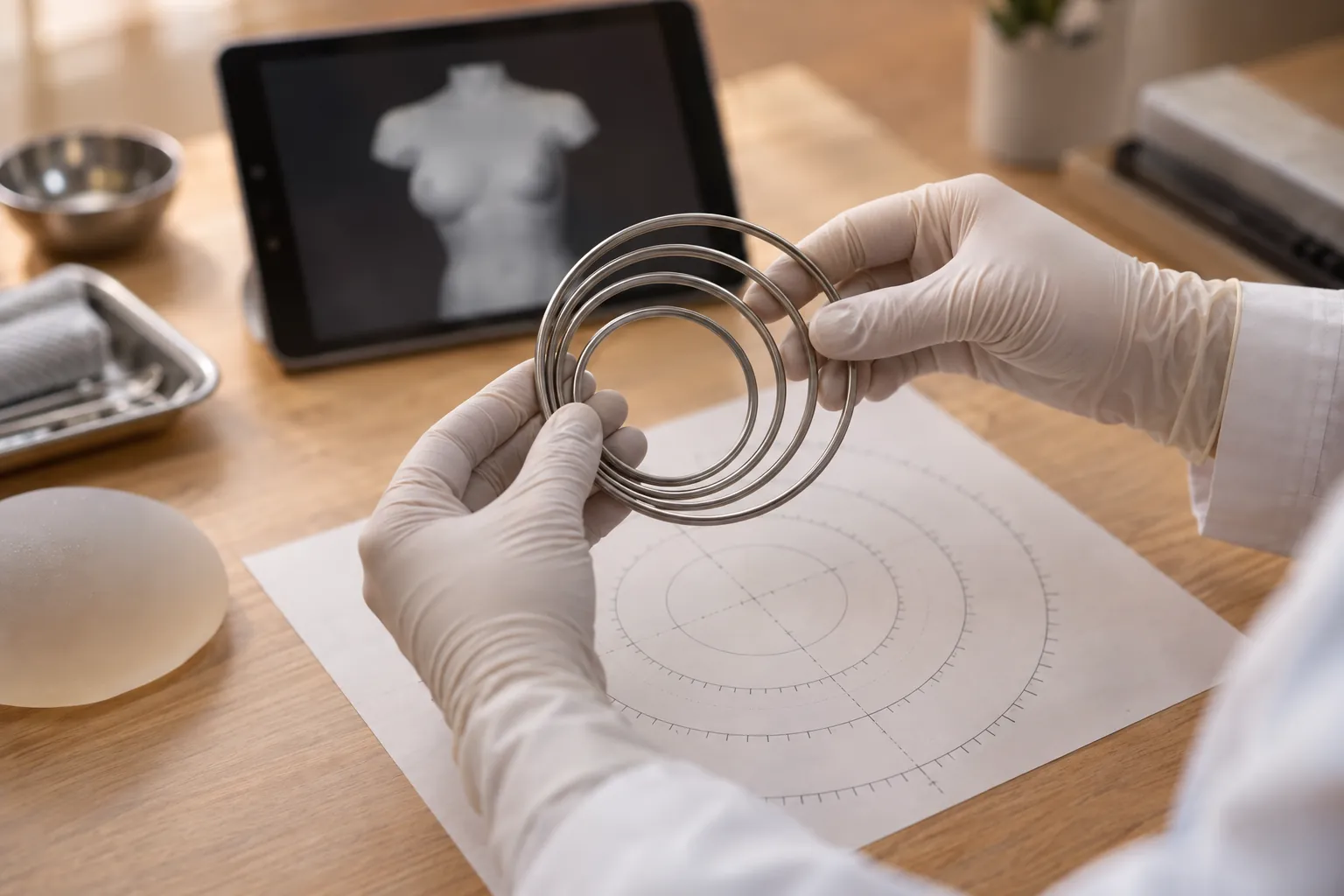
The measurement that makes Preservé different is the circummammary ligament. The surgeon moves the breast up, down, inward and outward to feel where the ligament anchors it to the chest wall, marks that outer border, and marks the inner edge roughly a centimeter inside it. That inner edge is the boundary the implant must respect. The Preservé® Implant Selection Set, nested sizing rings from 8 to 11 cm, is laid over the breast, smallest first; the largest ring that fits inside the inner edge sets the implant’s base width. Because a tape measurement of the breast includes about a centimeter of ligament on each side, the Preservé implant ends up roughly 2 cm narrower than that figure, and the balloon recruits your own tissue to make up the difference. Projection, Mini, Demi or Full, is then chosen against the projection you already have and the result you want, and the Preservé matrix pairs the implant with its balloon.
Two more decisions follow. Where the pocket should sit: centered under the nipple for an even enhancement, angled toward the upper inner quadrant for fullness and cleavage, or lower when the fold-to-nipple distance is short, as the system section explains. And how any difference between the two sides will be handled: two implant volumes, or fat grafting, planned rather than improvised. Everything is then drawn on the skin while you stand, using Motiva’s marking stencil: the implant footprint inside the ligament, the incision at the fold, the direction of the tunnel. The marks go on before the tumescent fluid, because the swelling it causes would blur them.
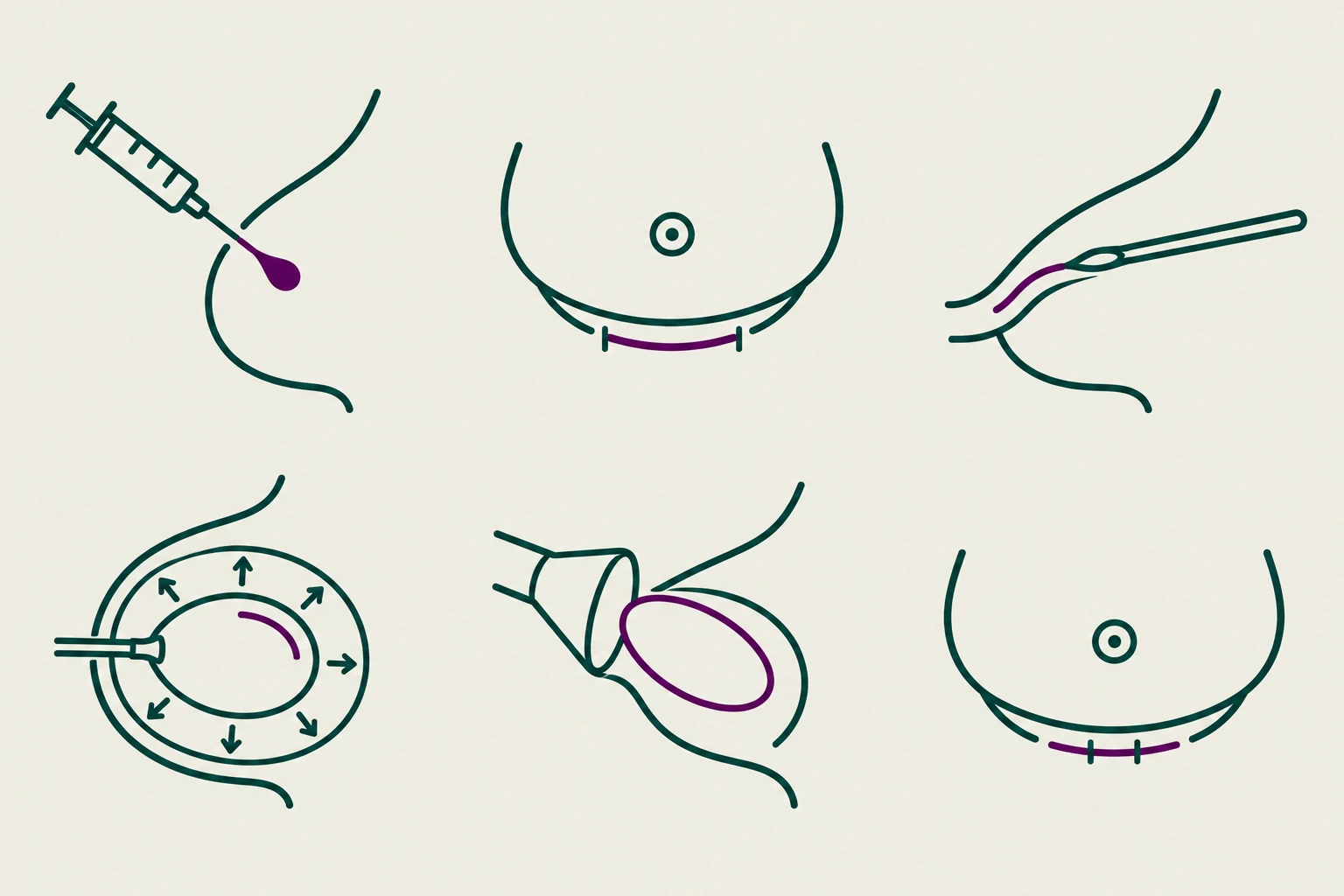
The Six Steps in the Operating Room
- Infiltration. The tumescent solution goes into the Breast Tissue Preservation Space on both sides, about 150 cc per breast, and the surgeon waits ten minutes for it to numb, constrict, and separate the tissue.
- Incision. A 2.5 to 3 cm incision in the inframammary fold beneath each breast, at the 5 and 7 o’clock positions, slightly to the outer side of the fold’s lowest point, after a small additional dose of local anesthetic. The incision is carried down to the fascia of the pectoral muscle and no further.
- Tunneling. The channel separator opens a narrow passage toward the base of the throat, stopping about 2 cm beyond the planned upper edge of the pocket. Before going further, the surgeon confirms with a fingertip that the muscle fascia lies below the tunnel, untouched.
- Controlled elongation. The balloon is threaded through the tunnel and inflated with air to the volume of the planned implant, then clipped. The second breast is done the same way, symmetry is checked with both balloons in place, and each is deflated and withdrawn.
- Implant deployment. The implant is loaded into the saline-activated sleeve straight from its packaging and delivered into the pocket without being touched, patch facing backward. Position and symmetry are checked once more.
- Closure. Absorbable stitches (PDS 3-0) rejoin the deep layer of the fascia, and the skin is closed with fine absorbable sutures (Monocryl 4-0), tissue glue, or both. No drains are placed.[2] A supportive dressing and garment go on in the operating room.
How Long Does It Take?
Motiva describes the technique as shorter than a conventional augmentation with a full surgical dissection, and that matches the logic of stretching rather than cutting. We will still not put a number on this page that we cannot stand behind. The published Preservé series do not report an operating time that transfers to an individual patient. The very short minute counts that circulate online belong to Mia Femtech, a different procedure through the armpit with a different implant, and do not apply here. What sets the time is the technique itself: two breasts done in sequence, a ten-minute wait after infiltration on each side, a symmetry check with both balloons inflated, and the fat harvest beforehand if you are having a hybrid procedure. General anesthesia adds its own preparation and wake-up time. Your surgeon will give you the hour range that applies to your plan at consultation, and it will not be a surprise on the day. Under our package you spend one night in the hospital regardless, so the clock in the operating room is not one you need to watch.
Recovery Timeline After Preservé
Quicker recovery* is one of the benefits Motiva lists for Preservé, and the reasons are concrete: no muscle has been cut, no wide pocket has been dissected, no drains are in place, and the tissue was numbed before it was touched. What that adds up to is a recovery measured in days for daily life and in weeks for sport, with the usual caveat that your body sets the pace. The timeline below combines what the largest published Preservé series report with how we run the six nights you spend with us in Istanbul.
*Compared to conventional breast augmentation. Results, recovery experience, and healing times vary from person to person.
The First 72 Hours
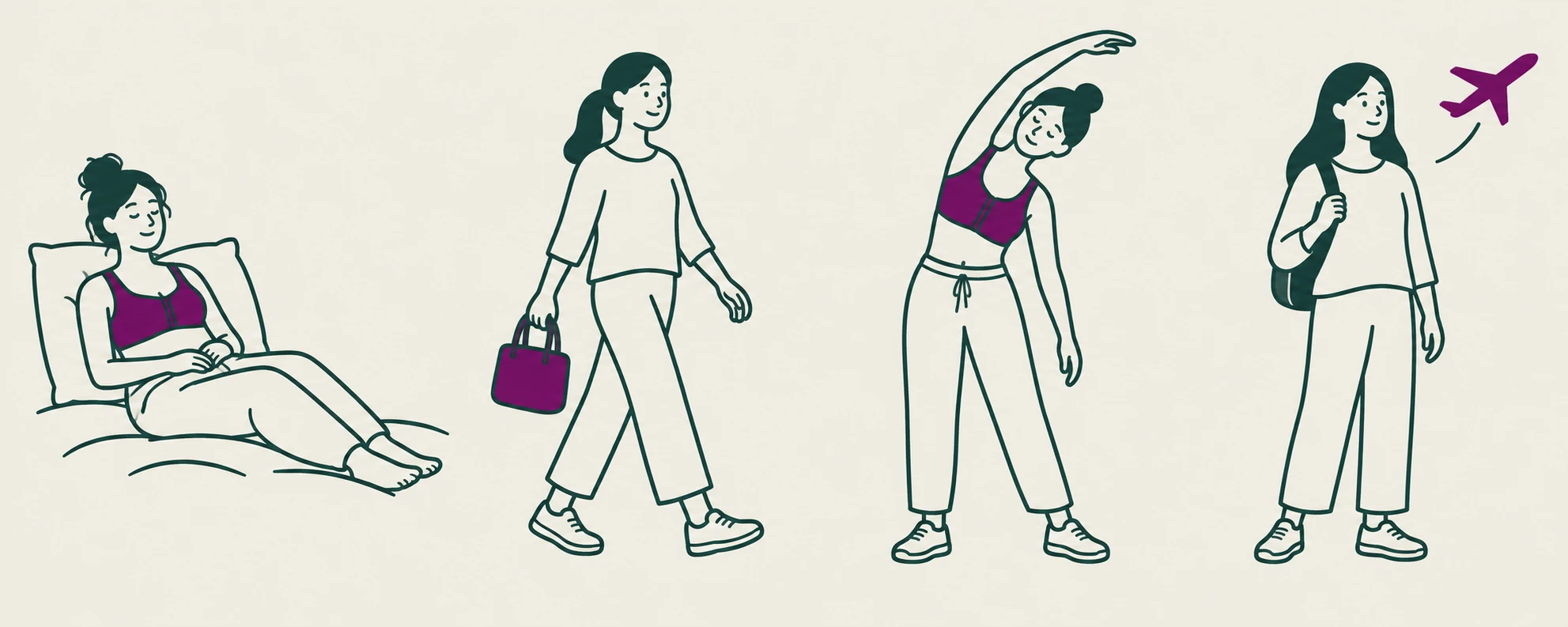
You spend the night after surgery in the hospital under our package. The published series show how light the first hours usually are: in the largest Preservé series, patients were discharged within 90 minutes of surgery and resumed ordinary daily activities the same day.[2] In a five-center US series, about half of the patients were back to normal daily activity within one day, and one in six within one to three hours.[9] Expect tightness, a feeling of pressure, and swelling rather than sharp pain; the tumescent fluid also makes the breasts look larger than they will be, and it is reabsorbed over the first one to ten days. The rules for these three days are simple. Sleep on your back with your upper body slightly elevated. Walk around the room and the hotel corridor several times a day. Keep the supportive garment on, and lift nothing heavier than a cup of coffee; the US series kept its patients to a 72-hour activity restriction for good reason.[9] Your Patient Host is reachable on WhatsApp around the clock.
“I could raise my hands by day 2 or 3.”
Alejandra, 220 cc · Motiva Preservé® patient
Week 1 to 2
This is the week most patients describe as the turning point. The published expectation is a return to daily activities within about one week,[3] and many are there sooner; desk work is realistic within a few days, while a week is the conservative plan we suggest for anyone who can take it. The incisions are closed with absorbable sutures and tissue glue, so there are no stitches to remove; they are checked in person before you fly, and showering resumes once your surgeon has confirmed the incisions are sealed. Walking is encouraged, driving waits until you are off any prescription pain medication and can turn the wheel without discomfort, and anything that works the chest, from carrying groceries to a vacuum cleaner, stays off the list. A supportive garment stays on through this period; feeling better early does not shorten the tissue’s own healing timeline, and the garment is there for the tissue, not for you.
Weeks 3 to 6 and Beyond
Light exercise was reintroduced after 10 days in the US series, and by three weeks all of its patients had returned to their normal routine.[9] The European series allowed light sports from three weeks and asked patients to wear a compression bra for at least three weeks.[2] Our guidance follows the same sequence: light cardio, meaning walking, an incline treadmill or a stationary bike without arm work, from week three; upper-body training and anything that bounces from week six; your surgeon’s go-ahead at each step. Scar care starts once the incisions are fully closed, with silicone tape or gel from about week six, and continues for several months. This is also the period of what surgeons call drop and fluff: the upper pole softens, the implants settle into the lower half of the breast, and the silhouette that looked high and firm at two weeks becomes the natural one you planned for. The final shape is a matter of months, not weeks, and photographs for comparison are best taken after the sixth month.
When Can I Fly Home?
On the day our package ends, and not before your final check. The six-night stay in Istanbul is timed so that you have one night in the hospital, the first days of recovery in your hotel with your Patient Host on call, and an in-person review with your surgeon before departure. At that visit the incisions are examined, any swelling or fluid collection is ruled out, and you are cleared to travel; only then do you fly. For the flight itself, wear your supportive garment, ask for help with your bag rather than lifting it into the overhead bin, walk the aisle every hour or so, and drink water rather than alcohol. Flights are not included in the package; we recommend a changeable return ticket, so that the date follows your surgeon’s clearance rather than the other way around. What the stay itself covers is set out on our all-inclusive package page. After you land, follow-up continues by video at one, three, six, and twelve months, and your Patient Host stays reachable on WhatsApp between those calls.
Risks, Limitations and Honest Expectations
Preservé is surgery, and it places a medical device in your body. The risks come in three layers: the ones that belong to any breast implant, the ones that belong to a technique this new, and the one that candidacy controls, which is tissue thickness. We would rather you read all three here than discover one of them in a consent form the night before surgery.
General Implant Risks
Every breast augmentation, by any technique, carries the same list, and Preservé does not remove any item from it. Capsular contracture: the scar capsule that forms around any implant can tighten, making the breast firm, distorted, or painful, and in its higher grades it is treated with further surgery. Rupture: silicone gel implants can fail silently, which is why imaging is recommended at intervals; a ruptured implant is replaced, and the Motiva warranty described above covers the device. Malposition: an implant can settle too high, too low, or to the side, or the two can drift toward the midline. Rippling: folds in the implant can show through thin tissue. Infection, bleeding, and fluid collection are uncommon but real, and an infected implant sometimes has to be removed before it can be replaced. Nipple or breast sensation can change, temporarily or permanently. Scars in the fold fade but do not vanish. Asymmetry can persist or appear. Implants can interfere with mammography, which needs extra views, and some women report systemic symptoms after augmentation with any implant, sometimes called breast implant illness; the cause is not established, and US labeling for breast implants now mentions it. Above all, implants are not lifetime devices: the longer you have them, the more likely you are to need another operation at some point, whether for a complication, a size change, or simply age. Anesthesia carries its own risks, discussed with you separately. The lymphoma associated with textured implants, BIA-ALCL, is covered in the peace-of-mind section: no primary case has been reported with the SmoothSilk® surface, and surveillance continues.
What the Studies Show — and What They Don’t
The largest published Preservé series followed 330 procedures for an average of 18 months (range 3 to 33). It recorded no capsular contracture of grade III or IV, no rupture, no implant sliding sideways or below the fold, no seroma, no infection, and no wound breakdown. Two implants settled higher than planned (0.6 percent), one patient bled from a lift incision (0.3 percent), and three reported rippling (0.9 percent).[2] Those are good numbers. The authors nonetheless write that their complication rates were already low before they adopted the technique, that it was not developed to reduce complication rates, and that its introduction did not produce a statistically meaningful reduction in complications. They present it as an additional option with advantages in tissue preservation, comfort, and functional recovery.[2] We quote that because it is the honest frame, and because it means the case for Preservé rests on what it preserves, not on a claim of fewer complications.
The other data points are consistent with that picture and just as limited in time. The three-year Mia Femtech study of 100 patients, a related technique with the same pocket-creation instruments, recorded a 3.2 percent rate of any complication and one reoperation.[4] The five-center US series recorded one rippling case, one infection, and one high-riding implant, with no hematomas and no sensory disturbances, over three to six months.[9] An editorial that accompanies the US papers sets out what is missing. Follow-up is short, and capsular contracture, malposition, and size changes do not fully declare themselves on that timeline. Every published paper so far comes from within the technique’s own development ecosystem, and independent, randomized replication from unaffiliated centers is the next necessary step. And the technique has a real learning curve, which is why the authors treat Motiva’s mandatory certification as a patient-safety standard rather than a credential.[10] The same editorial concludes that the technique will not suit every patient and is a valid option for carefully selected ones; we agree with both halves. The lead authors of the largest series are consultants to the manufacturer, and the journal supplement was sponsored by it. That does not make the data wrong, but you should know it when you weigh them. Our own Preservé outcomes will be added to this page as they accumulate.
Thin Tissue and Rippling: The 2 cm Rule
The one limitation that is entirely within your surgeon’s control is patient selection, and the clearest example is tissue thickness. The two-center series started with a 2 cm pinch of tissue at the upper inner breast as its minimum, then relaxed it to 1 cm on the assumption that rippling would not occur even in very thin skin. Three cases of rippling followed, and the 2 cm minimum was reinstated as the guideline for minimizing long-term risks such as rippling and implant visibility.[2] The reason is simple: with the implant above the muscle, your own tissue is the only cover it has, and an implant designed to ripple less still ripples when there is nothing over it. The same authors list the situations where connective tissue itself is compromised (the candidacy section covers them) and advise fat grafting alongside the implant in those cases, or a conventional submuscular or dual-plane approach instead.[2] A 2026 review reports the hybrid route working even at a pinch under 2 cm and a BMI under 20.[8] We measure this at your consultation and tell you which side of the line you are on; the candidacy section above explains what each side means for your plan.
This content is intended for informational purposes only and does not replace professional medical advice. Breast implants are medical devices regulated under applicable medical device regulations. Please consult a qualified healthcare professional to determine whether this procedure and this device are suitable for you, and to discuss potential risks and benefits.
The Clinical Evidence Behind Preservé
Every number on this page traces back to one of the studies below, and the full citations with links are in the References section at the end. We have added two columns that patient pages usually leave out: the level of evidence, on the scale surgeons use, where level 1 means a randomized controlled trial and level 5 means expert opinion or a narrative review, and who funded or was affiliated with the work. Preservé is a young technique, launched commercially in 2025, and its evidence base looks exactly like that: strong on mechanism and anatomy, encouraging on early outcomes, and short on time.
| Study | Type and evidence level | Patients and follow-up | What it found | Funding or affiliation |
|---|---|---|---|---|
| Chacón-Quirós et al., 2025, Mia Femtech 3-year study[4] | Prospective, single center, single surgeon; level 4 | 100 patients, 3 years | Related armpit technique with the same pocket-creation instruments and a smaller implant: 0% capsular contracture, 0% rupture, 0% inferior malposition, 0% loss of nipple or breast sensation, 3.2% any complication, 1% reoperation; daily activities at 2.8 days on average. The longest follow-up for these instruments; not Preservé data. | Funded by Establishment Labs |
| Randquist et al., 2026, tissue-preserving IMF augmentation[2] | Retrospective, two centers (Stockholm, Bangkok), four surgeons; level 4 | 330 procedures; mean 18 months (3 to 33) | The largest Preservé-technique series: 0.9% overall complications; no grade III/IV contracture, rupture, lateral or inferior malposition, seroma, infection, or wound breakdown; two high-riding implants, one bleed from a lift incision, three rippling cases; 2 cm pinch rule; most cases under local anesthesia with or without light sedation. Authors state the technique was not developed to reduce complication rates. | Lead authors are consultants to Establishment Labs |
| Pittman et al., 2026, US multicenter series[9] | Prospective case series, five US centers; level 4 | 159 patients; 3 to 6 months | Early US experience during the surgeons’ learning curve: one rippling case, one infection, one high-riding implant; no hematomas, no sensory disturbances; 64% under local anesthesia with or without sedation; half of patients back to normal activity within a day. Includes a surgeon roundtable on technique. | Published in a journal supplement sponsored by Establishment Labs |
| Chacón-Quirós et al., 2026, retrospective validation[11] | Retrospective, two cohorts, 3D imaging and ultrasound; level 4 | 111 patients; 12 months | As summarized in the supplement’s editorial: upper-pole fullness improved in over 97% of patients, nipple projection alignment held in over 95%, and lateral displacement did not increase at 12 months despite the added implant weight.[10] | Same supplement; authors from the technique’s development group |
| Chacón-Quirós, 2025, “Breast Tissue Preservation: A Paradigm Shift”[3] | Technique description and rationale; level 5 | Not an outcome study | Defines the inframammary tissue-preservation technique, its steps, anesthesia options, candidacy cautions, and the expectation of a return to daily activities within about a week. | Written by the surgeon who led the Mia Femtech program |
| Lhuaire et al., 2026, anatomical basis of the posterior intralamellar plane[1] | Cadaveric dissection with histology, two academic anatomy centers | 16 breasts | The plane Preservé uses is a consistent compartment between the gland and the pectoral fascia, free of glandular tissue and major vessels; Cooper’s ligaments are displaced rather than transected by balloon expansion. | Same supplement; co-authored with the technique’s developers |
| Rehnke et al., 2018, superficial fascia system of the breast[5] | Anatomical study | Not applicable | Describes the anterior and posterior lamellae and the circummammary ligament, the anatomy the technique is built around. Predates Preservé. | Predates the technique |
| Doloff et al., 2021, surface topography and the foreign body response[6] | Preclinical (mice, rabbits) plus human capsule samples | Not applicable | Implant surfaces in the 4-micron range produced the mildest inflammatory response of those tested, with more regulatory T cells and less macrophage activity. | Co-authored with the manufacturer’s scientists |
| Calobrace et al., 2026, the 4-micron surface from bench to bedside[8] | Narrative review; level 5 | Reviews studies including the FDA core study (451 primary augmentation patients, 5 years) | Capsular contracture estimated at 0.5% at five years with the SmoothSilk® surface; no primary BIA-ALCL reported with the surface since 2010; hybrid fat grafting reported to work even at a pinch under 2 cm. Notes that absence of evidence is not evidence of absence. | Same supplement, sponsored by the manufacturer |
| Graf and LeBlanc, 2026, editorial[10] | Editorial; level 5 | Not applicable | Endorses the anatomy and mechanism, calls the early outcomes consistent, and lists the gaps: short follow-up, no independent randomized replication yet, a real learning curve, and certification as a safety standard. | Same supplement; authors declare consulting and travel support from the manufacturer and state that editorial independence was retained |
Read as a whole, the evidence supports three statements and stops short of a fourth. The anatomy is confirmed: the plane exists, and the ligaments survive the technique. The mechanism is credible: a 4-micron surface behaves differently from textured ones at the cellular level, and stretching bleeds less than cutting. The early outcomes are consistent across several countries and more than 600 patients, with low complication rates and, so far, no inferior malposition. What the evidence cannot yet say is what happens at five and ten years, because no Preservé patient has been followed that long, and whether the same results hold in the hands of surgeons unconnected to the technique’s developers, because every study so far has come from within that circle. Those are the two questions we would want answered too, and we will update this section as the answers are published. Until then, the honest summary is the one the editorial gives: a valid option for carefully selected patients, on a credible scientific foundation, with long-term reporting still owed.
Preservé Breast Augmentation Cost 2026: Turkey vs USA
Our all-inclusive Preservé® package is USD 7,500 for a 6-night stay in Istanbul (flights excluded). That is one figure for the whole episode of care, from your pre-operative tests to your final check before you fly, and it is the figure you should compare with the sum of the separate quotes you would collect at home. It is also the whole answer to a question we are asked every week — how much is Preservé breast augmentation — with one number instead of a range. This section lists what the price covers, explains why it sits above our standard breast augmentation package, and sets out how to read a US quote against it.
What’s Included in the All-Inclusive Package (USD 7,500 · 6 Nights)
- The surgery, performed by a Preservé-accredited plastic surgeon in a JCI-accredited hospital, with the complete single-use Motiva Preservé set opened for you: channel separator, inflatable balloon, and insertion sleeve.
- SmoothSilk® Ergonomix2® implants, the implant family the technique is built around, with Zen® RFID as an option you choose or decline.
- Anesthesia, whether light sedation or general, and the anesthesia team’s fees.
- One night in the hospital, plus pre-operative tests and post-operative checks, including your in-person review before departure.
- Six nights in a 5-star hotel with breakfast, timed so that you fly home only after that review.
- VIP transfers between the airport, the hotel, the hospital, and the clinic.
- Post-operative medications and the supportive garment you wear for the first weeks.
- A dedicated Patient Host, reachable around the clock on WhatsApp, and translation whenever you need it.
- Follow-up after you land: video check-ins at one, three, six, and twelve months.
Not included: international flights, which we help you plan but do not book, and personal spending outside the hotel. There is no separate implant fee, facility fee, or anesthesia fee waiting behind the headline number. The same structure applies to every AKM package; the Preservé version adds two nights and the Preservé-specific items below.
Why Preservé Costs More Than a Standard Augmentation
Our standard breast augmentation package is USD 5,400 for four nights. Preservé is USD 2,100 more and two nights longer, and the difference is made of four specific things rather than a premium for a new name.
| Standard augmentation | Preservé | |
|---|---|---|
| Package price | USD 5,400 | USD 7,500 |
| Nights in Istanbul | 4 | 6 |
| Instruments | Reusable surgical instruments | Single-use Motiva Preservé set, opened for one patient and discarded |
| Implant | Chosen with you from the brands we offer | SmoothSilk® Ergonomix2® only, the implant the technique requires |
| Surgeon | Board-certified plastic surgeon | Board-certified plastic surgeon with Preservé accreditation from Establishment Labs |
| Pocket creation | Surgical dissection | Tunnel and balloon elongation, no drains |
The single-use set is the largest of the four. Every Preservé procedure consumes a channel separator, a balloon with its pump, and an insertion sleeve that cannot be resterilized, a cost the developers of the related Mia Femtech technique acknowledge in their own three-year paper as the additional cost of single-use devices.[4] The implant is the second: the technique is validated only with SmoothSilk® Ergonomix2®, so there is no lower-priced implant to substitute. The third is accreditation, which Motiva requires before a surgeon can obtain the instruments at all. The fourth is time: two extra nights so that your final check happens in Istanbul rather than by video. What you get for the difference is the subject of the rest of this page; whether it is worth it to you depends on how much weight you give to tissue preservation, sedation instead of general anesthesia, and the recovery profile described above.
Istanbul vs New York, Miami, Los Angeles
Comparing a US quote with ours takes one rule: compare the all-in figure, not the headline fee. A Motiva Preservé cost quoted at a US consultation, and the Motiva Preservé price you see online, usually cover the surgeon and anesthesia only. In the United States a breast augmentation quote typically covers the surgeon and anesthesia, with the operating facility, the implants, garments, and follow-up visits billed separately, and a Preservé procedure adds the single-use set on top. Where US practices publish an all-in Preservé price, it sits around USD 18,000. One Northern California practice lists approximately USD 18,000 for surgeon, operating room, anesthesia, and the single-use devices; a New York State practice lists USD 16,500 with implants and follow-up included; and practices describe the national range as USD 11,000 to 30,000 depending on surgeon, region, and what the quote covers. Most clinics quote only at consultation, so the figures below are typical all-in ranges by city, drawn from published quotes and regional cost differences, not a price list.
Three things explain the gap without any difference in what goes into your body. US facility and anesthesia fees are billed at US rates. The single-use set and the implant cost the same everywhere, but in Istanbul they sit inside a package rather than on top of one. And six nights in Istanbul, transfers, and a Patient Host are included here, where in the US they are not part of the quote at all. Even at the bottom of the Miami range, the difference covers a round trip from the US several times over. If a clinic you are considering quotes below these ranges, ask what is left out; if it quotes above them, ask what is added. Then add your own flights to the Istanbul figure, and the comparison is honest. For a conventional augmentation, our breast augmentation cost comparison gives the same city-by-city view.
Two more differences belong in the calculation. The first is the implant: as noted in the implants section, Preservé in the United States uses a different implant, while in Turkey you receive the complete system the technique was validated with. The second is what the price buys in follow-up: a year of scheduled video reviews and a Patient Host on call are part of the package here, not an extra. If you are also weighing Preservé against our other breast procedures, the next section compares them side by side.
Why Have Preservé at AKM Clinic in Istanbul?
Preservé is offered by a growing number of surgeons in the United States, the United Kingdom, and Europe, so the question is not access. It is what you get for the trip. Our answer has three parts: the complete system the technique was validated with, a JCI-accredited hospital and a surgeon accredited by the manufacturer, and aftercare that is built for a patient who lives on another continent.
The Complete Motiva Preservé System
Every Preservé procedure at AKM uses the full set described earlier on this page: the Motiva® Channel Separator, the Motiva® Inflatable Balloon, and the Motiva® Insertion Sleeve, opened new for you, together with the SmoothSilk® Ergonomix2® implant, with or without Zen®, in the sizes the Preservé matrix pairs with the balloon. The implant matters more than it may seem. Every outcome study in the evidence section above was performed with this implant family, so “Preservé” performed with a different implant is a related procedure, not the one that was studied. In the United States, as noted earlier, the Ergonomix2® implant is not FDA-approved and the technique is performed with a substitute; in Turkey it is the standard product, supplied through Motiva’s official distributor, and each implant is registered to you with the manufacturer so that the warranty and the Woman’s Choice Program® apply.
JCI-Accredited Hospital and a Preservé-Accredited Plastic Surgeon
Preservé surgery at AKM takes place in a JCI-accredited hospital in Istanbul, Turkey. Joint Commission International is the international arm of The Joint Commission, the organization that accredits most US hospitals; its standards cover patient safety, infection control, anesthesia, and emergency readiness, and they are audited on site. The consultation, planning, and post-operative care happen at our clinic in Levent, where the Vectra 3D imaging used for your planning is located, and the two are connected by our own transfers.
The technique is performed by Dr. Aylin Yılmaz, MD, a board-certified plastic, reconstructive, and aesthetic surgeon with a breast and body focus and training in reconstructive microsurgery. She completed her residency at the University of Health Sciences, Ankara Training and Research Hospital, holds the Turkish Ministry of Health specialist certificate in plastic, reconstructive, and aesthetic surgery, and is a member of the Turkish Society of Plastic, Reconstructive and Aesthetic Surgeons, the Turkish Aesthetic Plastic Surgery Society, and the Istanbul Medical Chamber. For Preservé specifically, she completed Establishment Labs’ educational modules and live surgeries and is recognized by the manufacturer as an accredited surgeon for Preservé, certificate number P-202603123, issued on March 30, 2026. That accreditation is the condition Motiva sets for access to the instruments at all, and the editorial quoted in the risks section calls it a patient-safety standard rather than an optional credential. The certificate and her full credentials are on her profile page. Her own summary of how she consults is one we would put on the door: “I would rather tell you honestly that a procedure will not give you the result you are picturing than promise it and manage your disappointment afterwards.”
Aftercare That Follows You Home
An international patient’s real question is what happens after the flight. Three things do. Your Patient Host, your coordinator from the first message onward, stays your single point of contact on WhatsApp, around the clock, for as long as you need. Your surgeon reviews you by video at one, three, six, and twelve months, and sooner if anything concerns either of you; questions between appointments go to your Patient Host, not to a call center. And our revision policy is in writing: in the rare event of a medical complication or a significant deviation from your surgical plan, we stand by our work and address it. Ask for the full text with your quote, so that it is read before you commit rather than afterward. Alongside these sits the Motiva warranty described in the benefits section, which is why we remind every patient to register their implants within the 90-day window that activates it.
None of this is a substitute for hearing from patients who have already made the trip. Our reviews on Trustpilot, rated 4.7 out of 5, and on Google are published unedited and can be verified on the platforms themselves; read them in their own words before you decide.
Preservé vs Other Breast Options at AKM
Preservé breast augmentation is one of several breast procedures we perform in Turkey, and it is the right one for a specific patient: a first augmentation, an implant between 95 and 330 cc, about 2 cm of tissue or more at the pinch test, and no more than mild to moderate sagging. Outside that profile, another option usually serves you better, and we would rather say so here than at the end of a consultation. The five below are the ones we most often weigh against Preservé; the table puts them side by side.
Standard breast augmentation. The conventional operation: a pocket made by surgical dissection, and an implant above the muscle, below it, or in a dual plane. The choice of implant is open: round or anatomical, any volume your frame can carry, from the brands we offer. It is the better fit when you want more than 330 cc, when thin tissue calls for muscle cover, or when a previous augmentation has already altered the planes Preservé depends on. It is performed under general anesthesia or awake, with one night in the hospital; our standard breast augmentation page covers implant types, incisions, and placement.
Awake breast augmentation. The same operation under local anesthesia with twilight sedation instead of general: sleepy, but not fully asleep. As our awake page puts it, “awake surgery does not change the fundamentals of the operation—it changes how comfort is managed.” It suits an uncomplicated augmentation in a woman who wants to avoid general anesthesia but falls outside the Preservé profile, because she needs dual-plane cover, say, or a larger implant. If you are a Preservé candidate and want sedation, Preservé already gives you both. Our awake breast augmentation page describes the experience in detail, and who it is not offered to.
Fat transfer, alone or as a hybrid. Your own fat, taken from the abdomen, flanks, or thighs and moved into the breast. Alone, it gives a subtle to moderate increase with no implant, provided you have enough donor fat; part of the transferred fat does not survive, so some patients need a second session. As a hybrid, the implant provides the core volume and the fat softens the transitions, which is how Preservé handles a pinch test under 2 cm; Motiva lists hybrid Preservé augmentation among its indications. Our fat transfer breast augmentation page explains donor areas, fat survival, and staging.
Breast lift with implants. When the nipple sits at or below the fold and the upper breast has emptied, an implant alone will not lift it. A lift removes the excess skin and repositions the nipple, through a lollipop, anchor, or periareolar pattern, while the implant restores the volume. For mild to moderate sagging, Preservé can be combined with a lift — a Preservé breast lift, or mastopexy augmentation, one of its three indications; published series perform those cases under general anesthesia.[2] More advanced sagging calls for the conventional version, described on our page about a lift combined with implants.
Mommy makeover. When pregnancy has changed the abdomen as well as the breasts, a mommy makeover combines the breast procedure of your choice, augmentation, lift, reduction, or fat transfer, with a tummy tuck and liposuction: one operation, one recovery. It is planned once your family is complete and your weight is stable, takes four to five hours under general anesthesia, and includes one night in the hospital. Whether Preservé can be the breast component depends on the candidacy checks above; ask at consultation. Our mommy makeover page sets out the combinations, and when staging them is wiser than one operation.
| Option | Best suited to | Anesthesia | How it differs from Preservé |
|---|---|---|---|
| Preservé® | First augmentation, 95–330 cc, about 2 cm of pinch or more, at most mild to moderate sagging | Local with light sedation, or general | The reference point: pocket stretched with a balloon, implant above the muscle, SmoothSilk® Ergonomix2® only, no drains |
| Standard breast augmentation | Larger implants, muscle cover for thin tissue, revision cases, widest implant choice | General, or awake under twilight sedation | Pocket made by dissection; any plane; any implant brand or shape |
| Awake breast augmentation | Uncomplicated augmentation without general anesthesia, outside the Preservé profile | Local with twilight sedation | Same anesthesia approach; conventional pocket and implant |
| Fat transfer / hybrid | Subtle to moderate increase without an implant; thin cover or a softer contour with one | Twilight sedation or general | No implant when used alone; as a hybrid, fat is added to an implant technique, Preservé included |
| Breast lift with implants | Nipple at or below the fold with lost upper fullness | Twilight sedation or general | Skin removed and nipple repositioned; for mild to moderate sagging Preservé can supply the implant, under general anesthesia |
| Mommy makeover | Breasts and abdomen both changed by pregnancy | General | A breast procedure plus tummy tuck and liposuction, in one operation and one recovery |
Some women who ask us about Preservé are better served by one of the options above, and some by a combination. The candidacy checks earlier on this page decide which, and the consultation applies them to you, with measurements rather than impressions. Prices are not repeated here: the cost section above covers Preservé, and our plastic surgery price list compares every package in one place. The next section describes how the consultation, and the rest of your stay in Istanbul, is organized.
Your Preservé Journey as an International Patient
Your trip for Preservé breast augmentation in Turkey is built around one rule from the recovery section: you fly home after your surgeon has seen you, not before. Our package covers six nights in Istanbul — five in a 5-star hotel and the night after surgery in the hospital; international flights, travel insurance, visa fees, extra hotel nights, and personal spending are not included. Here is the sequence, from your first message to your one-year follow-up.
- Online consultation, before you book. You send photographs, your goals, and your medical history, then have a video call with your Patient Host and the medical team. Your surgeon screens the photographs against the candidacy checks on this page, the 2 cm pinch, the degree of sagging, any previous breast surgery, and you receive a written plan with an all-inclusive quote in USD. If Preservé is not the right fit, the plan says so and names the alternative.
- Your date and your travel plan. Once you confirm, your Patient Host fixes the surgery date, books the hotel and the VIP transfers, and schedules your clinic appointments; you book your own flights. Choose a changeable return ticket and plan for seven days in Istanbul. Visas, the booking and payment structure, and traveling alone are covered in our patient FAQs.
- Day 1: arrival. A driver meets you at the arrivals gate of Istanbul Airport or Sabiha Gökçen with a name sign and takes you to your hotel. Nothing medical happens on arrival day; rest and eat, and let your Patient Host know you have landed.
- Day 2: assessment and tests. At our clinic in Levent you meet your surgeon in person, and the plan becomes final. The measurements described in the surgery section are taken, including the pinch test and the ligament assessment, along with the Vectra 3D scan. The implant’s volume and projection are settled, and so is the choice between light sedation and general anesthesia. Blood work and the other pre-operative tests are done the same day, you sign the consent forms, and you are told when to stop eating and drinking. If the examination changes the plan, toward a hybrid procedure, say, or a smaller implant, it changes here, with you, and not in the operating room.
- Day 3: surgery and the hospital night. Your transfer takes you to the hospital in the morning. The skin is marked while you stand, the procedure follows the six steps described above, and you spend the night in the hospital with the nursing team, your supportive garment already on. There are no drains to manage.
- Days 4 to 7: recovery at the hotel, then your final review. You return to the hotel on the morning of day 4 with your medications, your garment, and written instructions. The first 72-hour rules from the recovery section apply: sleep on your back, take short walks, lift nothing heavier than a cup of coffee. Your Patient Host is one WhatsApp message away around the clock, and you are seen at the clinic for a post-operative check during these days. On day 7 your surgeon examines the incisions, rules out swelling or fluid collection, gives you your implant card, and clears you to fly.
- Back home: follow-up by video. Your surgeon reviews you by video at one, three, six, and twelve months; between calls, your Patient Host remains your contact. Register your implants with Motiva within 90 days of surgery to activate the Woman’s Choice Program®, subject to Motiva’s terms. We remind you, but the registration is yours to complete.
“They look and feel completely natural.”
Fernanda, 185 cc · Motiva Preservé® patient
The sequence mirrors the one every AKM patient follows, and the general version is on our patient journey guide. The Preservé version gives the in-person assessment its own day, because this technique is planned from measurements, and it keeps you in Istanbul until your surgeon has seen the result rather than a photograph of it.
Frequently Asked Questions
These are the questions we are asked most often about Preservé, answered briefly. Each one has a fuller treatment in the section of this page it belongs to.
What Is Preservé Breast Augmentation?
Preservé® breast augmentation is Motiva's tissue-preserving technique for placing a breast implant: instead of cutting a pocket, the surgeon stretches your own tissue with a small balloon until there is room for the implant. The ligaments that hold the breast in place stay intact, the pectoral muscle is never touched, and the implant sits above it. The technique uses three single-use Motiva instruments and the SmoothSilk® Ergonomix2® implant, and it was launched commercially in 2025.
Is "Preserve by Motiva" the Same as Preservé?
Yes. Preserve by Motiva, Motiva Preserve, Preservé™, and Preservé® all name the same technique from Establishment Labs, the company behind Motiva implants; the accent is part of the brand name and is usually dropped in searches. It is not the same as Mia Femtech®, Motiva's other tissue-preserving procedure, which enters through the armpit with a smaller implant and is designed for a one- to two-cup change.
How Is Preservé Different From Traditional Breast Augmentation?
The pocket is made differently. A traditional augmentation cuts the pocket open, often under the muscle; Preservé opens a narrow tunnel and stretches the tissue with a balloon, above the muscle, so the ligaments are displaced rather than divided. The incision is 2.5 to 3 cm, there are no drains, and local anesthesia with light sedation is an option. Complication rates in the largest series were low, but not shown to be lower than conventional surgery.[2]
Preservé vs Mia Femtech: Which One Is for Me?
Choose by how much change you want and where you accept a scar. Mia Femtech® enters through the armpit, is described by Motiva as minimally invasive, uses a smaller implant, and is designed for a one- to two-cup increase; it is not combined with a lift. Preservé enters through the fold under the breast, accommodates implants from 95 to 330 cc, and can be combined with a lift or with fat grafting. Your measurements and your goal decide at consultation.
Where Is the Scar and How Big Is the Incision?
The incision is 2.5 to 3 cm long and sits in the inframammary fold, the crease beneath each breast at the 5 and 7 o'clock positions, where the breast itself hides it. It is closed with absorbable sutures and tissue glue, so nothing has to be removed later. The scar fades over months but does not vanish; Preservé is not scarless. Silicone tape or gel from about week six, as used in the largest published series, helps it mature.[2]
Can Preservé Be Done Without General Anesthesia?
Yes. Most published Preservé procedures were performed under local anesthesia with light sedation, which the tumescent technique makes possible: the tissue is numbed and separated with a dilute anesthetic solution before anything else happens.[2][9] General anesthesia remains available, and it is used when a lift is combined with the augmentation or when you prefer it. The choice is made with your surgeon at consultation and confirmed at your pre-operative assessment in Istanbul.
How Long Is the Recovery? When Can I Work, Exercise, and Fly?
Most patients return to daily activities within about a week,[3] and desk work is realistic within a few days. Light cardio without arm work starts around week three, upper-body training and impact sport around week six, each with your surgeon's go-ahead.Under our package you fly home on day seven, after an in-person check; wear the supportive garment on the flight. Swelling settles over the first weeks, and the final shape takes months.
Does Preservé Preserve Nipple Sensation?
It is designed to. The incision at the 5 and 7 o'clock positions of the fold spares the nerve branch that supplies the nipple, and the pocket is stretched open rather than cut or cauterized near it. In the three-year Mia Femtech study, with the same pocket-creation instruments, no patient reported loss of nipple or breast sensation,[4] and the five-center US series recorded no sensory disturbances.[9] Evidence, not a guarantee; altered sensation remains a listed risk.
How Many Cup Sizes Can I Go Up?
Motiva puts the range at up to four cup sizes*, with implants from 95 to 330 cc in Mini, Demi, and Full projections. Cup size is not a unit of volume, though: the same implant reads differently on a narrow frame and a broad one, and bra brands disagree about what a cup is. What sets your limit is your breast's base width and the tissue available to cover the implant, both measured at consultation.
*Results vary between patients.
Which Implants Are Used, and What Is Zen®?
Preservé uses one implant family: SmoothSilk® Ergonomix2®, a round implant with a 4-micron surface whose gel adapts to your position. Zen® is an optional passive RFID chip inside the implant; it stores the implant's identification data, can be read from outside the body, and Motiva describes it as compatible with all breast imaging, including MRI**. You can opt out of it. In the United States this implant is not FDA-approved, so US Preservé procedures use a substitute.
**Under specific conditions set by the manufacturer. Tell every imaging center that your implants carry an RFID chip.
How Much Does Preservé Breast Augmentation Cost in Turkey?
Our all-inclusive Preservé® package is USD 7,500 for six nights in Istanbul, flights excluded. It covers surgery in a JCI-accredited hospital, the complete single-use Motiva Preservé set and SmoothSilk® Ergonomix2® implants, anesthesia, six nights in Istanbul including the hospital night, transfers, medications and garment, a Patient Host, and a year of video follow-ups. It costs more than our standard augmentation package (USD 5,400, four nights) because of the single-use instruments, the implant, the accredited surgeon, and two extra nights.
What Warranty Do I Get? What Is the Woman's Choice Program®?
Motiva's warranties come with the implant, subject to its terms. The Always Confident Warranty® covers rupture for the lifetime of the device, a replacement policy covers grade III and IV capsular contracture, and Preservé implants add a five-year extended warranty at no extra cost. The Woman's Choice Program® provides up to USD 1,500 toward reversal, should you later choose it. All of it depends on registering your implants with Motiva within 90 days; AKM's written revision policy applies alongside.
Can I Breastfeed After Preservé?
Many women breastfeed after breast augmentation, and Preservé is planned to keep that possibility open. The pocket is made behind the gland rather than through it, the incision is in the fold rather than around the areola, and no gland tissue is removed. No technique can promise it, because milk supply depends on your gland and varies between women with or without implants. Tell your surgeon if you plan to breastfeed; a later pregnancy can also change the result.
Is Preservé Available in the USA? Why Do Patients Travel to Turkey for It?
Yes, a growing number of US surgeons offer Preservé, but with a substitute implant, because the SmoothSilk® Ergonomix2® implant the technique was validated with is not FDA-approved. Patients travel to us for the complete Motiva system, implant included, and for a JCI-accredited hospital with a Preservé-accredited surgeon. The all-inclusive price is USD 7,500, against published US quotes of around USD 16,500 to 18,000, and it includes a six-night stay and a Patient Host.
What Are the Disadvantages of Preservé?
Every technique has pros and cons; Preservé's cons come down to four things, and we would rather list them ourselves. Candidacy is narrower than for a conventional augmentation: a 2 cm pinch of tissue, implants up to 330 cc, a first augmentation, at most mild to moderate sagging. The technique is young: the largest series averages 18 months of follow-up, and every study so far comes from the developer's circle.[2][10] Single-use instruments make it cost more than a standard augmentation. And it is still surgery, with an incision, a scar, and every implant risk.
References
Sources are numbered in the order they first appear on this page, and every bracketed number in the text links to its entry below. Each entry links to the publisher’s record through its DOI. Several of the 2026 papers were published in an Aesthetic Surgery Journal supplement sponsored by the manufacturer; the evidence section above notes the funding and affiliation of each study.
- Lhuaire M, Chacón-Quirós M, Rehnke RD, et al. Anatomical Basis of a Posterior Intralamellar Plane in Breast Tissue-Preservation Surgery. Aesthet Surg J. 2026;46(Suppl 2):S109–S116. doi:10.1093/asj/sjag059
- Randquist C, Gahm J, Wongkietkachorn A, Jaeger M. Tissue-Preserving Inframammary Fold Breast Augmentation: A 3-Year Clinical Experience. Aesthet Surg J. 2026;46(9):1012–1021. Published online February 6, 2026. doi:10.1093/asj/sjag038
- Chacón-Quirós M. Breast Tissue Preservation: A Paradigm Shift in Aesthetic Breast Surgery. Clin Plast Surg. 2026;53(2):255–265. Published online 2025. doi:10.1016/j.cps.2025.11.015
- Chacón-Quirós M, Sforza M, Solís-Chaves P, et al. The 3-Year Results of a 100-Patient Prospective Study of the Safety and Effectiveness of Mia Femtech. Aesthet Surg J. 2026;46(3):250–259. Published online October 7, 2025. doi:10.1093/asj/sjaf196
- Rehnke RD, Groening RM, Van Buskirk ER, Clarke JM. Anatomy of the Superficial Fascia System of the Breast: A Comprehensive Theory of Breast Fascial Anatomy. Plast Reconstr Surg. 2018;142(5):1135–1144. doi:10.1097/PRS.0000000000004948
- Doloff JC, Veiseh O, de Mezerville R, et al. The surface topography of silicone breast implants mediates the foreign body response in mice, rabbits and humans. Nat Biomed Eng. 2021;5(10):1115–1130. doi:10.1038/s41551-021-00739-4
- Szychta P. Advancements in Aesthetic Breast Augmentation: Evaluating the Safety, Efficacy, and Naturalistic Outcomes of Ergonomix2 Implants. Aesthetic Plast Surg. 2024;48:4351–4364. doi:10.1007/s00266-024-03994-3
- Calobrace MB, Kinney BM, Doloff JC, et al. From Bench to Bedside: Clinical Implications of a 4-Micron Surface-Modulated Immune Response in the Era of Breast Tissue Preservation. Aesthet Surg J. 2026;46(Suppl 2):S96–S108. doi:10.1093/asj/sjag115
- Pittman TA, Steve A, Zeidler K, Chidester JR, Calobrace MB. Minimally Invasive, Tissue-Preserving Breast Augmentation: Insights From a Large Case Series, Technique and Surgical Pearls. Aesthet Surg J. 2026;46(Suppl 2):S117–S126. doi:10.1093/asj/sjag113
- Graf R, LeBlanc D. Tissue Preservation in Primary Breast Augmentation: From Founding Concepts to Early Evidence. Aesthet Surg J. 2026;46(Suppl 2):S93–S95. doi:10.1093/asj/sjag114
- Chacón-Quirós M, Burke R, Gordon A, et al. Retrospective Validation of a Tissue-Preserving Breast Augmentation Approach: From Native Tissue Geometry to Surgical Practice. Aesthet Surg J. 2026;46(Suppl 2):S127–S137. doi:10.1093/asj/sjag110
Product descriptions attributed to Motiva on this page are taken from Motiva® Preservé® patient and professional information published by Establishment Labs (2025–2026). Warranty and Woman’s Choice Program® terms are Motiva’s and are subject to its conditions.
The two patient quotations on this page are provided by Motiva (Establishment Labs) from its Preservé® program. Motiva’s testimonial statement: “The testimonials, statements, and opinions presented are applicable to each individual. Results will vary and these results may not be representative of the experience of others. Testimonials are representative of patient experiences, but the exact results and experience will be unique and individual to each patient. Motiva® testimonials are freely provided, but in some cases, may receive some benefits in exchange for their participation. Please, consult a healthcare professional to find out which solution is right for you.”